Literature Review on Business Models and Innovation for Businesses
VerifiedAdded on 2023/05/28
|18
|3619
|123
Literature Review
AI Summary
This literature review delves into the concepts of business models and business model innovation, drawing from a wide range of academic and business literature. It begins by defining business models, exploring their frameworks, and introducing the Business Model Canvas as a tool for design and strategic discussion. The review then transitions to business model innovation, examining its definition, necessity, frameworks, and various types. The review highlights the importance of value creation and capture in achieving a competitive advantage through innovation. The paper also briefly mentions a recommended business model for Hikari Data Solutions Limited. Desklib provides access to similar past papers and solved assignments for students.
Business Research Methodology

Paraphrase This Document
Need a fresh take? Get an instant paraphrase of this document with our AI Paraphraser
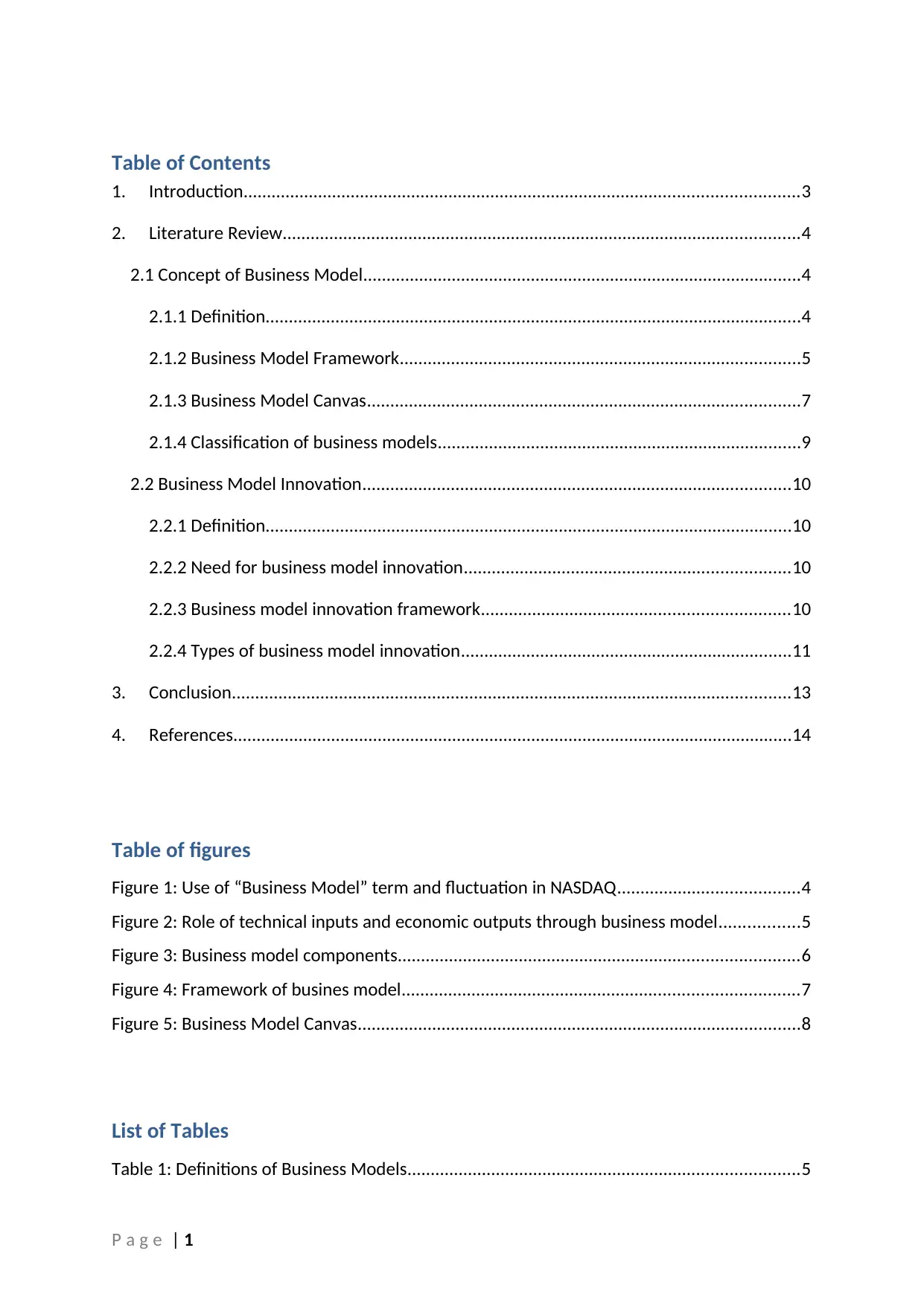
Table of Contents
1. Introduction.......................................................................................................................3
2. Literature Review...............................................................................................................4
2.1 Concept of Business Model..............................................................................................4
2.1.1 Definition...................................................................................................................4
2.1.2 Business Model Framework......................................................................................5
2.1.3 Business Model Canvas.............................................................................................7
2.1.4 Classification of business models..............................................................................9
2.2 Business Model Innovation............................................................................................10
2.2.1 Definition.................................................................................................................10
2.2.2 Need for business model innovation......................................................................10
2.2.3 Business model innovation framework..................................................................10
2.2.4 Types of business model innovation.......................................................................11
3. Conclusion........................................................................................................................13
4. References........................................................................................................................14
Table of figures
Figure 1: Use of “Business Model” term and fluctuation in NASDAQ.......................................4
Figure 2: Role of technical inputs and economic outputs through business model.................5
Figure 3: Business model components......................................................................................6
Figure 4: Framework of busines model.....................................................................................7
Figure 5: Business Model Canvas...............................................................................................8
List of Tables
Table 1: Definitions of Business Models....................................................................................5
P a g e | 1
1. Introduction.......................................................................................................................3
2. Literature Review...............................................................................................................4
2.1 Concept of Business Model..............................................................................................4
2.1.1 Definition...................................................................................................................4
2.1.2 Business Model Framework......................................................................................5
2.1.3 Business Model Canvas.............................................................................................7
2.1.4 Classification of business models..............................................................................9
2.2 Business Model Innovation............................................................................................10
2.2.1 Definition.................................................................................................................10
2.2.2 Need for business model innovation......................................................................10
2.2.3 Business model innovation framework..................................................................10
2.2.4 Types of business model innovation.......................................................................11
3. Conclusion........................................................................................................................13
4. References........................................................................................................................14
Table of figures
Figure 1: Use of “Business Model” term and fluctuation in NASDAQ.......................................4
Figure 2: Role of technical inputs and economic outputs through business model.................5
Figure 3: Business model components......................................................................................6
Figure 4: Framework of busines model.....................................................................................7
Figure 5: Business Model Canvas...............................................................................................8
List of Tables
Table 1: Definitions of Business Models....................................................................................5
P a g e | 1
Table 2: Business model classification.......................................................................................9
Table 3: E-business model classification....................................................................................9
Table 4: Innovation in business model types...........................................................................11
P a g e | 2
Table 3: E-business model classification....................................................................................9
Table 4: Innovation in business model types...........................................................................11
P a g e | 2
⊘ This is a preview!⊘
Do you want full access?
Subscribe today to unlock all pages.

Trusted by 1+ million students worldwide
1. Introduction
A company’s plan or strategy which defines processes through which the corporation
focuses on generating revenues and makes a profit is referred as a business plan. It shapes
the nature, culture and ethos of a corporation along with its financial strategies
(Schaltegger, Ludeke-Freund & Hansen, 2012). This concept is studied by many experts in
order to understand, design and implement business models which are targeted on
fostering innovation and achieving effectiveness in the market. In this report, the concept of
business model will be analysed along with business model innovation by evaluating a wider
range of literature on the topic. Furthermore, this report will also provide a business model
for Hikari Data Solutions Limited which will assist the company in sustaining its future
growth.
The section of this report will introduce various concepts of business models and its
origin. Section two of this report will include definitions of business model framework by
evaluating literature. This section will also describe the role of Business Model Canvas. It is
referred to a tool which is used by the management to design and shape their business
model. Different business model types will be included in this section as well. Section three
focuses on exploring various literature in order to understand the definition of business
model innovation and its types. Recommendations will be made in section four of this
report in which a business model will be recommended for Hikari Data Solution Limited.
Lastly, this report will be summarised in section five.
P a g e | 3
A company’s plan or strategy which defines processes through which the corporation
focuses on generating revenues and makes a profit is referred as a business plan. It shapes
the nature, culture and ethos of a corporation along with its financial strategies
(Schaltegger, Ludeke-Freund & Hansen, 2012). This concept is studied by many experts in
order to understand, design and implement business models which are targeted on
fostering innovation and achieving effectiveness in the market. In this report, the concept of
business model will be analysed along with business model innovation by evaluating a wider
range of literature on the topic. Furthermore, this report will also provide a business model
for Hikari Data Solutions Limited which will assist the company in sustaining its future
growth.
The section of this report will introduce various concepts of business models and its
origin. Section two of this report will include definitions of business model framework by
evaluating literature. This section will also describe the role of Business Model Canvas. It is
referred to a tool which is used by the management to design and shape their business
model. Different business model types will be included in this section as well. Section three
focuses on exploring various literature in order to understand the definition of business
model innovation and its types. Recommendations will be made in section four of this
report in which a business model will be recommended for Hikari Data Solution Limited.
Lastly, this report will be summarised in section five.
P a g e | 3
Paraphrase This Document
Need a fresh take? Get an instant paraphrase of this document with our AI Paraphraser
2. Literature Review
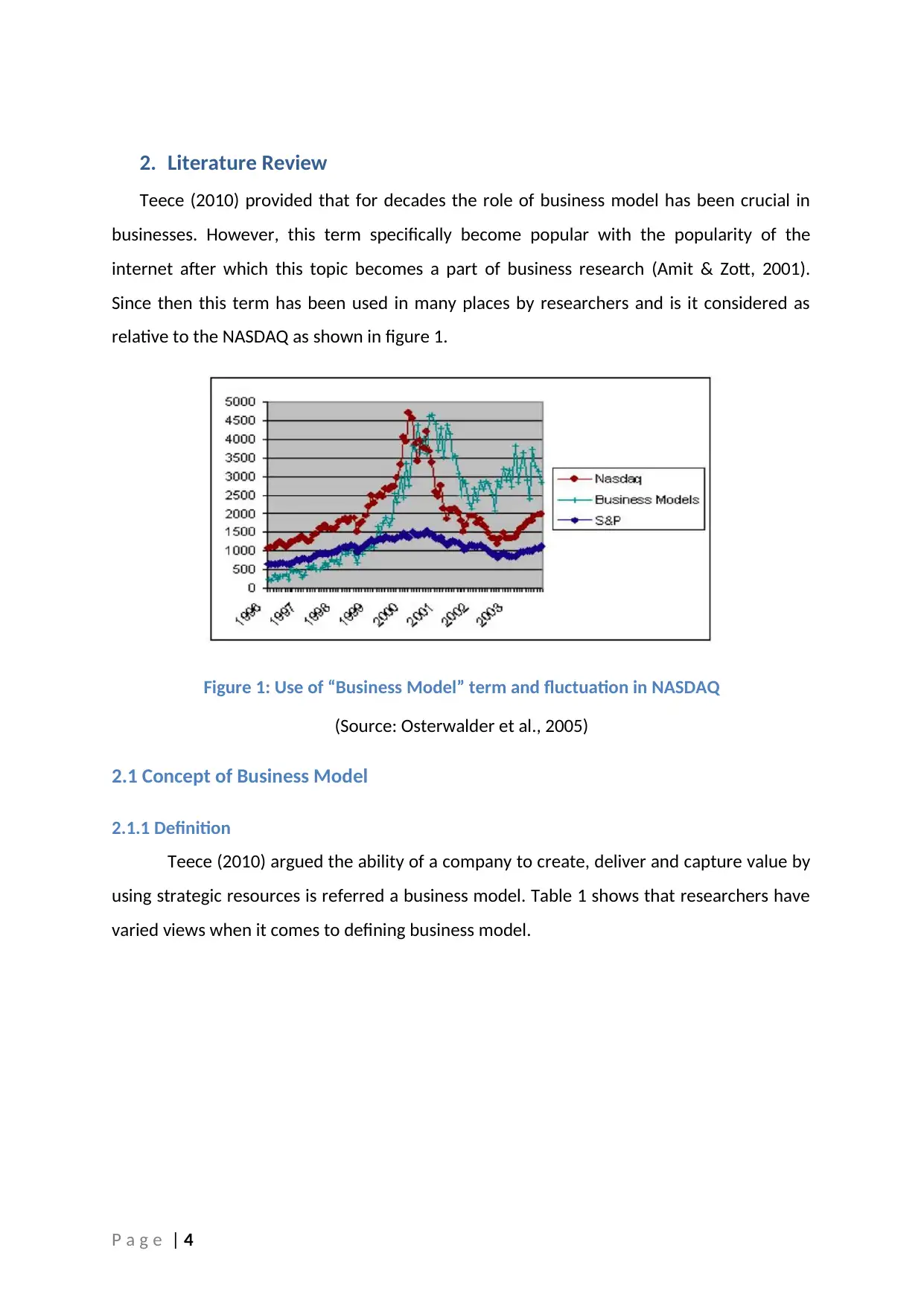
Teece (2010) provided that for decades the role of business model has been crucial in
businesses. However, this term specifically become popular with the popularity of the
internet after which this topic becomes a part of business research (Amit & Zott, 2001).
Since then this term has been used in many places by researchers and is it considered as
relative to the NASDAQ as shown in figure 1.
Figure 1: Use of “Business Model” term and fluctuation in NASDAQ
(Source: Osterwalder et al., 2005)
2.1 Concept of Business Model
2.1.1 Definition
Teece (2010) argued the ability of a company to create, deliver and capture value by
using strategic resources is referred a business model. Table 1 shows that researchers have
varied views when it comes to defining business model.
P a g e | 4
Teece (2010) provided that for decades the role of business model has been crucial in
businesses. However, this term specifically become popular with the popularity of the
internet after which this topic becomes a part of business research (Amit & Zott, 2001).
Since then this term has been used in many places by researchers and is it considered as
relative to the NASDAQ as shown in figure 1.
Figure 1: Use of “Business Model” term and fluctuation in NASDAQ
(Source: Osterwalder et al., 2005)
2.1 Concept of Business Model
2.1.1 Definition
Teece (2010) argued the ability of a company to create, deliver and capture value by
using strategic resources is referred a business model. Table 1 shows that researchers have
varied views when it comes to defining business model.
P a g e | 4
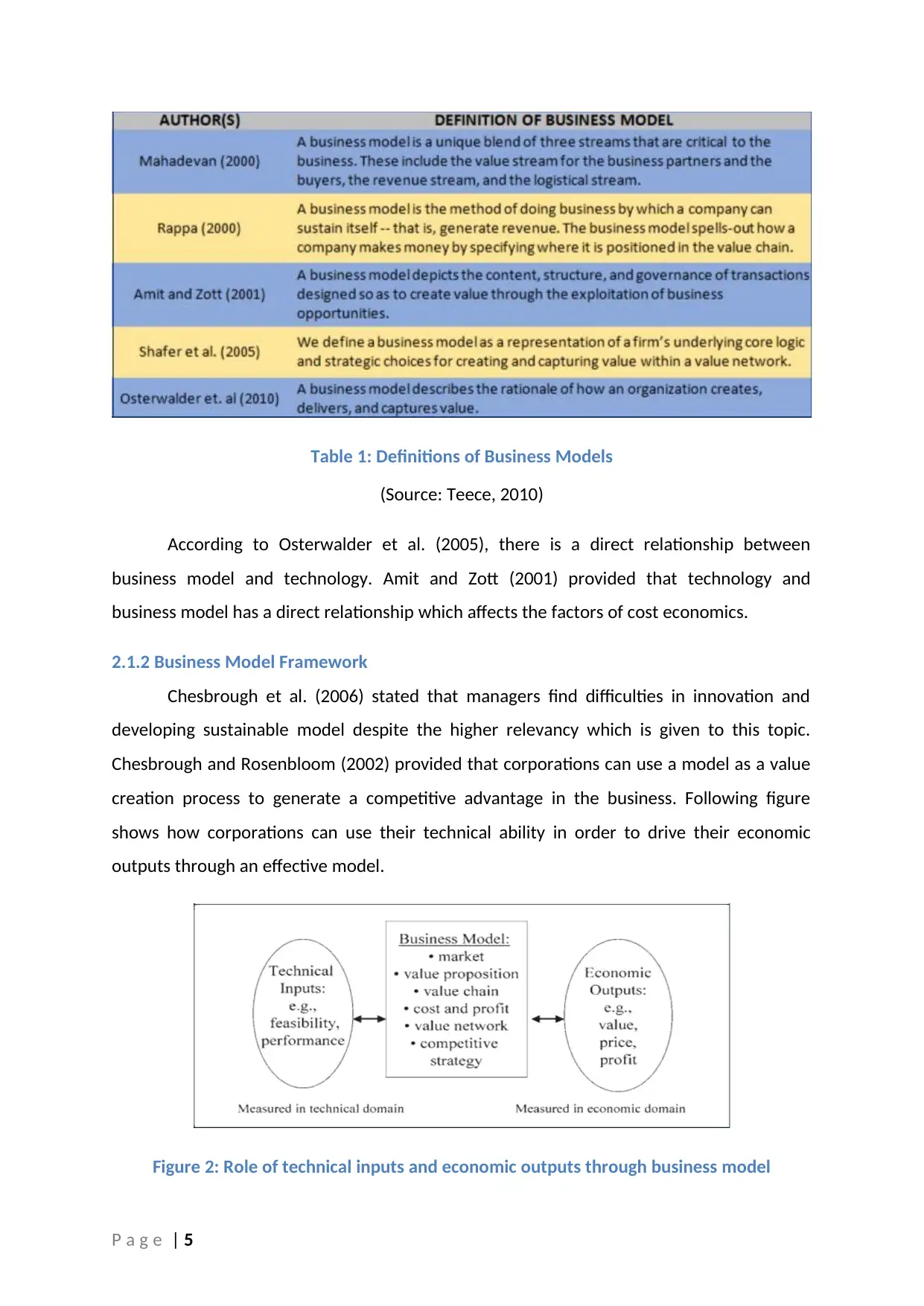
Table 1: Definitions of Business Models
(Source: Teece, 2010)
According to Osterwalder et al. (2005), there is a direct relationship between
business model and technology. Amit and Zott (2001) provided that technology and
business model has a direct relationship which affects the factors of cost economics.
2.1.2 Business Model Framework
Chesbrough et al. (2006) stated that managers find difficulties in innovation and
developing sustainable model despite the higher relevancy which is given to this topic.
Chesbrough and Rosenbloom (2002) provided that corporations can use a model as a value
creation process to generate a competitive advantage in the business. Following figure
shows how corporations can use their technical ability in order to drive their economic
outputs through an effective model.
Figure 2: Role of technical inputs and economic outputs through business model
P a g e | 5
(Source: Teece, 2010)
According to Osterwalder et al. (2005), there is a direct relationship between
business model and technology. Amit and Zott (2001) provided that technology and
business model has a direct relationship which affects the factors of cost economics.
2.1.2 Business Model Framework
Chesbrough et al. (2006) stated that managers find difficulties in innovation and
developing sustainable model despite the higher relevancy which is given to this topic.
Chesbrough and Rosenbloom (2002) provided that corporations can use a model as a value
creation process to generate a competitive advantage in the business. Following figure
shows how corporations can use their technical ability in order to drive their economic
outputs through an effective model.
Figure 2: Role of technical inputs and economic outputs through business model
P a g e | 5
⊘ This is a preview!⊘
Do you want full access?
Subscribe today to unlock all pages.
Trusted by 1+ million students worldwide
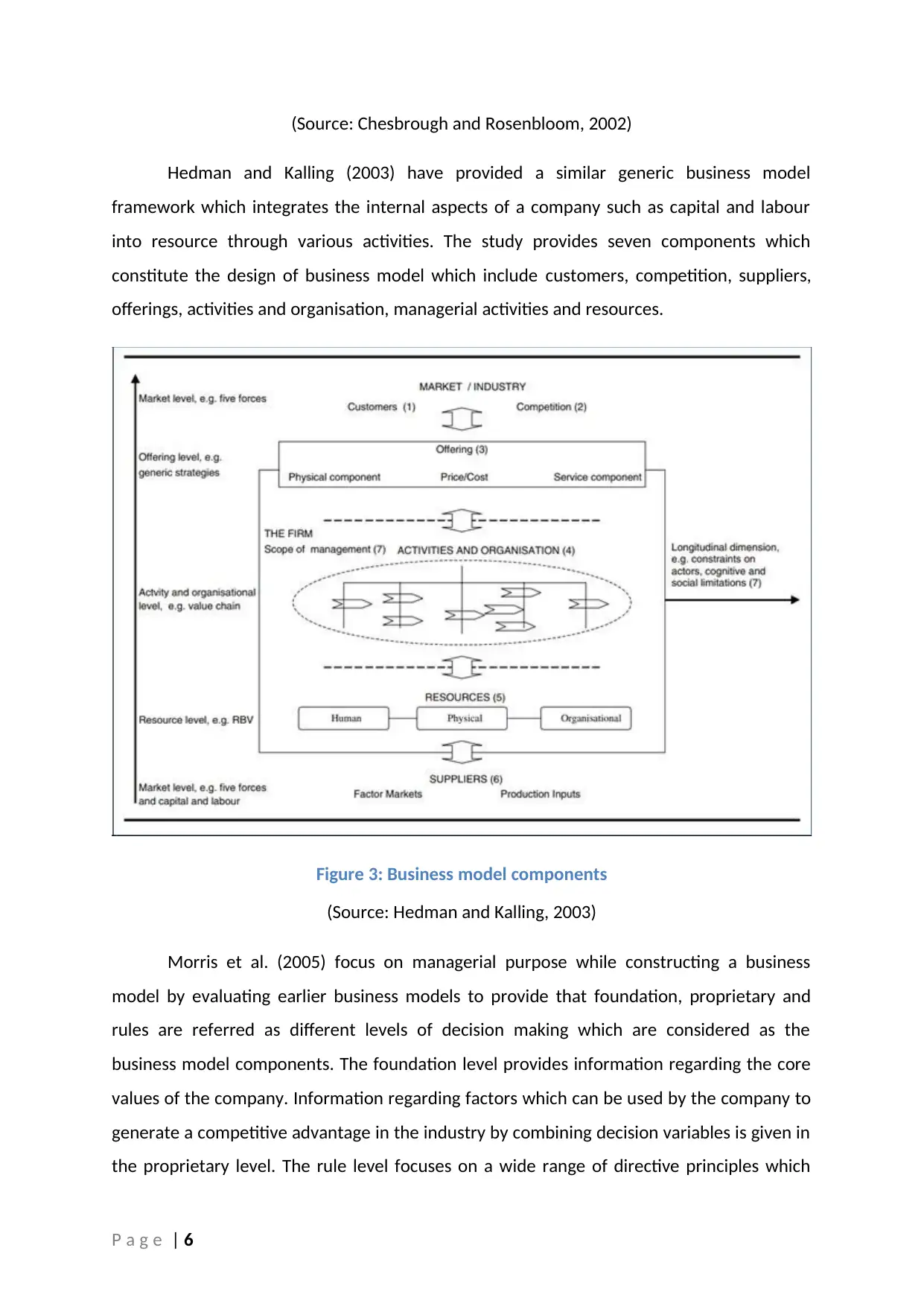
(Source: Chesbrough and Rosenbloom, 2002)
Hedman and Kalling (2003) have provided a similar generic business model
framework which integrates the internal aspects of a company such as capital and labour
into resource through various activities. The study provides seven components which
constitute the design of business model which include customers, competition, suppliers,
offerings, activities and organisation, managerial activities and resources.
Figure 3: Business model components
(Source: Hedman and Kalling, 2003)
Morris et al. (2005) focus on managerial purpose while constructing a business
model by evaluating earlier business models to provide that foundation, proprietary and
rules are referred as different levels of decision making which are considered as the
business model components. The foundation level provides information regarding the core
values of the company. Information regarding factors which can be used by the company to
generate a competitive advantage in the industry by combining decision variables is given in
the proprietary level. The rule level focuses on a wide range of directive principles which
P a g e | 6
Hedman and Kalling (2003) have provided a similar generic business model
framework which integrates the internal aspects of a company such as capital and labour
into resource through various activities. The study provides seven components which
constitute the design of business model which include customers, competition, suppliers,
offerings, activities and organisation, managerial activities and resources.
Figure 3: Business model components
(Source: Hedman and Kalling, 2003)
Morris et al. (2005) focus on managerial purpose while constructing a business
model by evaluating earlier business models to provide that foundation, proprietary and
rules are referred as different levels of decision making which are considered as the
business model components. The foundation level provides information regarding the core
values of the company. Information regarding factors which can be used by the company to
generate a competitive advantage in the industry by combining decision variables is given in
the proprietary level. The rule level focuses on a wide range of directive principles which
P a g e | 6
Paraphrase This Document
Need a fresh take? Get an instant paraphrase of this document with our AI Paraphraser
govern the decision of executive made in the previous levels. It was held that there are six
basic decision areas which are considered at each of these levels which include offerings,
market factors, internal capabilities factors, competitive strategy factors, economic factors
and personal/investor (growth) factors.
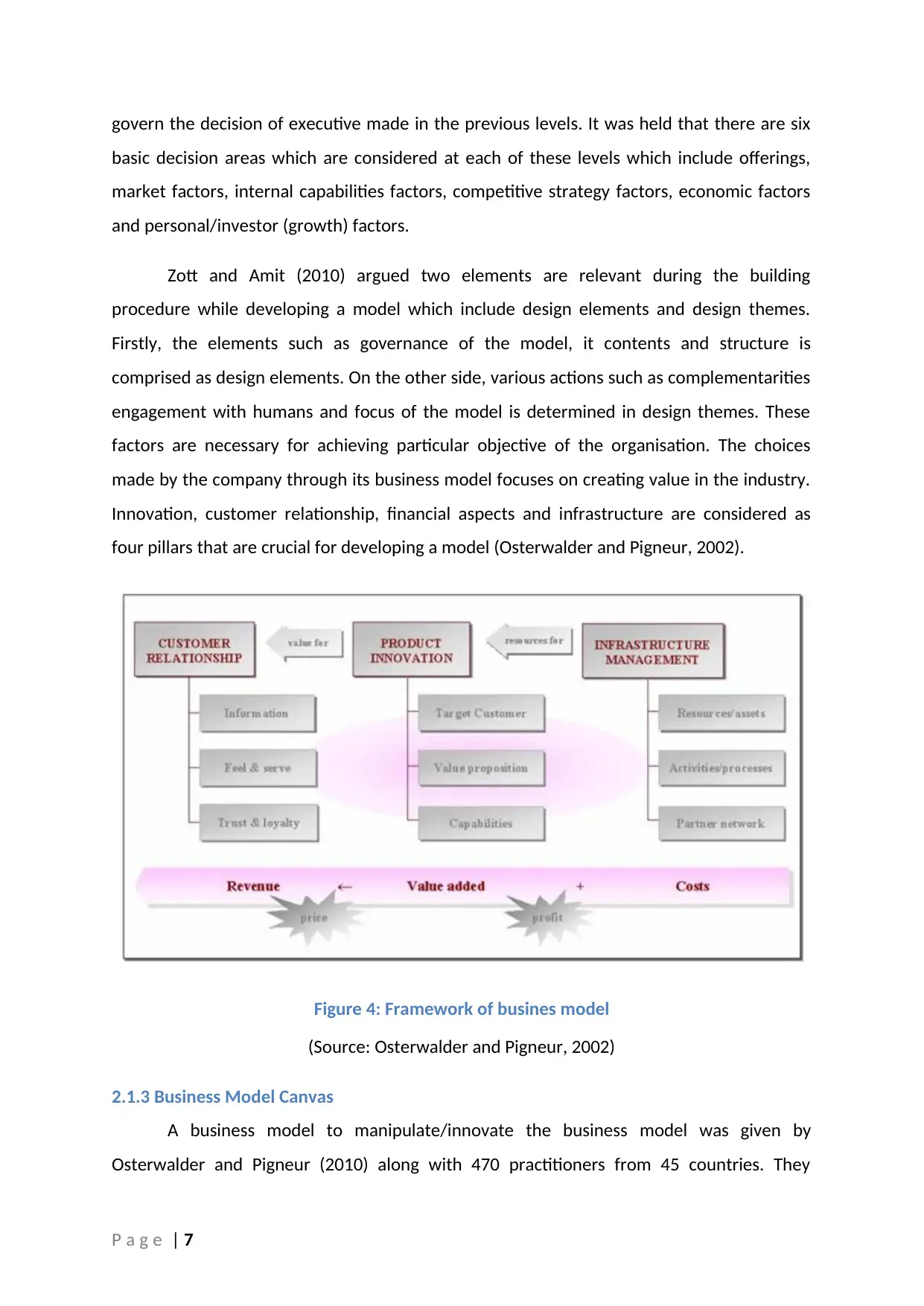
Zott and Amit (2010) argued two elements are relevant during the building
procedure while developing a model which include design elements and design themes.
Firstly, the elements such as governance of the model, it contents and structure is
comprised as design elements. On the other side, various actions such as complementarities
engagement with humans and focus of the model is determined in design themes. These
factors are necessary for achieving particular objective of the organisation. The choices
made by the company through its business model focuses on creating value in the industry.
Innovation, customer relationship, financial aspects and infrastructure are considered as
four pillars that are crucial for developing a model (Osterwalder and Pigneur, 2002).
Figure 4: Framework of busines model
(Source: Osterwalder and Pigneur, 2002)
2.1.3 Business Model Canvas
A business model to manipulate/innovate the business model was given by
Osterwalder and Pigneur (2010) along with 470 practitioners from 45 countries. They
P a g e | 7
basic decision areas which are considered at each of these levels which include offerings,
market factors, internal capabilities factors, competitive strategy factors, economic factors
and personal/investor (growth) factors.
Zott and Amit (2010) argued two elements are relevant during the building
procedure while developing a model which include design elements and design themes.
Firstly, the elements such as governance of the model, it contents and structure is
comprised as design elements. On the other side, various actions such as complementarities
engagement with humans and focus of the model is determined in design themes. These
factors are necessary for achieving particular objective of the organisation. The choices
made by the company through its business model focuses on creating value in the industry.
Innovation, customer relationship, financial aspects and infrastructure are considered as
four pillars that are crucial for developing a model (Osterwalder and Pigneur, 2002).
Figure 4: Framework of busines model
(Source: Osterwalder and Pigneur, 2002)
2.1.3 Business Model Canvas
A business model to manipulate/innovate the business model was given by
Osterwalder and Pigneur (2010) along with 470 practitioners from 45 countries. They
P a g e | 7
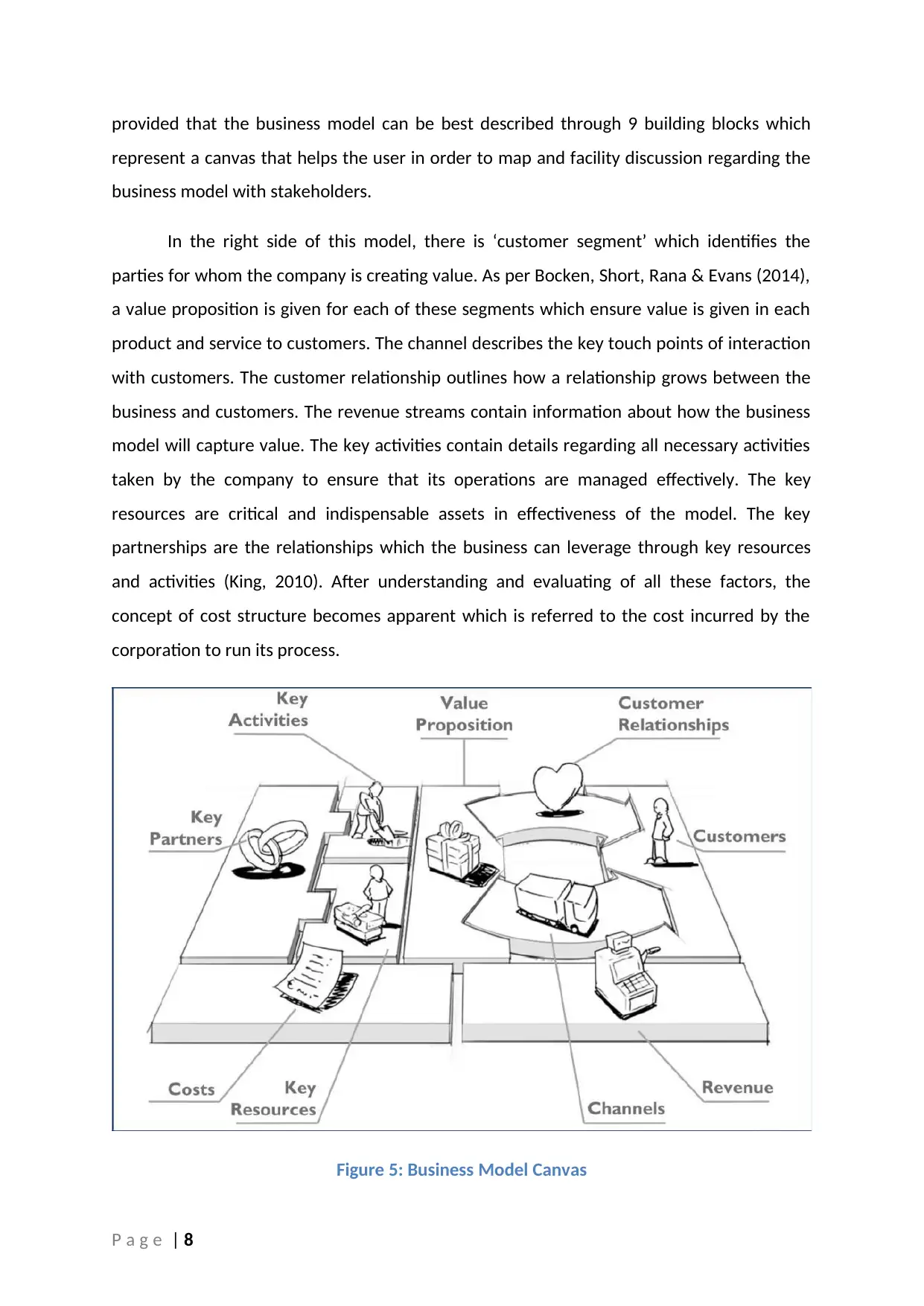
provided that the business model can be best described through 9 building blocks which
represent a canvas that helps the user in order to map and facility discussion regarding the
business model with stakeholders.
In the right side of this model, there is ‘customer segment’ which identifies the
parties for whom the company is creating value. As per Bocken, Short, Rana & Evans (2014),
a value proposition is given for each of these segments which ensure value is given in each
product and service to customers. The channel describes the key touch points of interaction
with customers. The customer relationship outlines how a relationship grows between the
business and customers. The revenue streams contain information about how the business
model will capture value. The key activities contain details regarding all necessary activities
taken by the company to ensure that its operations are managed effectively. The key
resources are critical and indispensable assets in effectiveness of the model. The key
partnerships are the relationships which the business can leverage through key resources
and activities (King, 2010). After understanding and evaluating of all these factors, the
concept of cost structure becomes apparent which is referred to the cost incurred by the
corporation to run its process.
Figure 5: Business Model Canvas
P a g e | 8
represent a canvas that helps the user in order to map and facility discussion regarding the
business model with stakeholders.
In the right side of this model, there is ‘customer segment’ which identifies the
parties for whom the company is creating value. As per Bocken, Short, Rana & Evans (2014),
a value proposition is given for each of these segments which ensure value is given in each
product and service to customers. The channel describes the key touch points of interaction
with customers. The customer relationship outlines how a relationship grows between the
business and customers. The revenue streams contain information about how the business
model will capture value. The key activities contain details regarding all necessary activities
taken by the company to ensure that its operations are managed effectively. The key
resources are critical and indispensable assets in effectiveness of the model. The key
partnerships are the relationships which the business can leverage through key resources
and activities (King, 2010). After understanding and evaluating of all these factors, the
concept of cost structure becomes apparent which is referred to the cost incurred by the
corporation to run its process.
Figure 5: Business Model Canvas
P a g e | 8
⊘ This is a preview!⊘
Do you want full access?
Subscribe today to unlock all pages.
Trusted by 1+ million students worldwide
(Source: Osterwalder et al., 2010)
2.1.4 Classification of business models
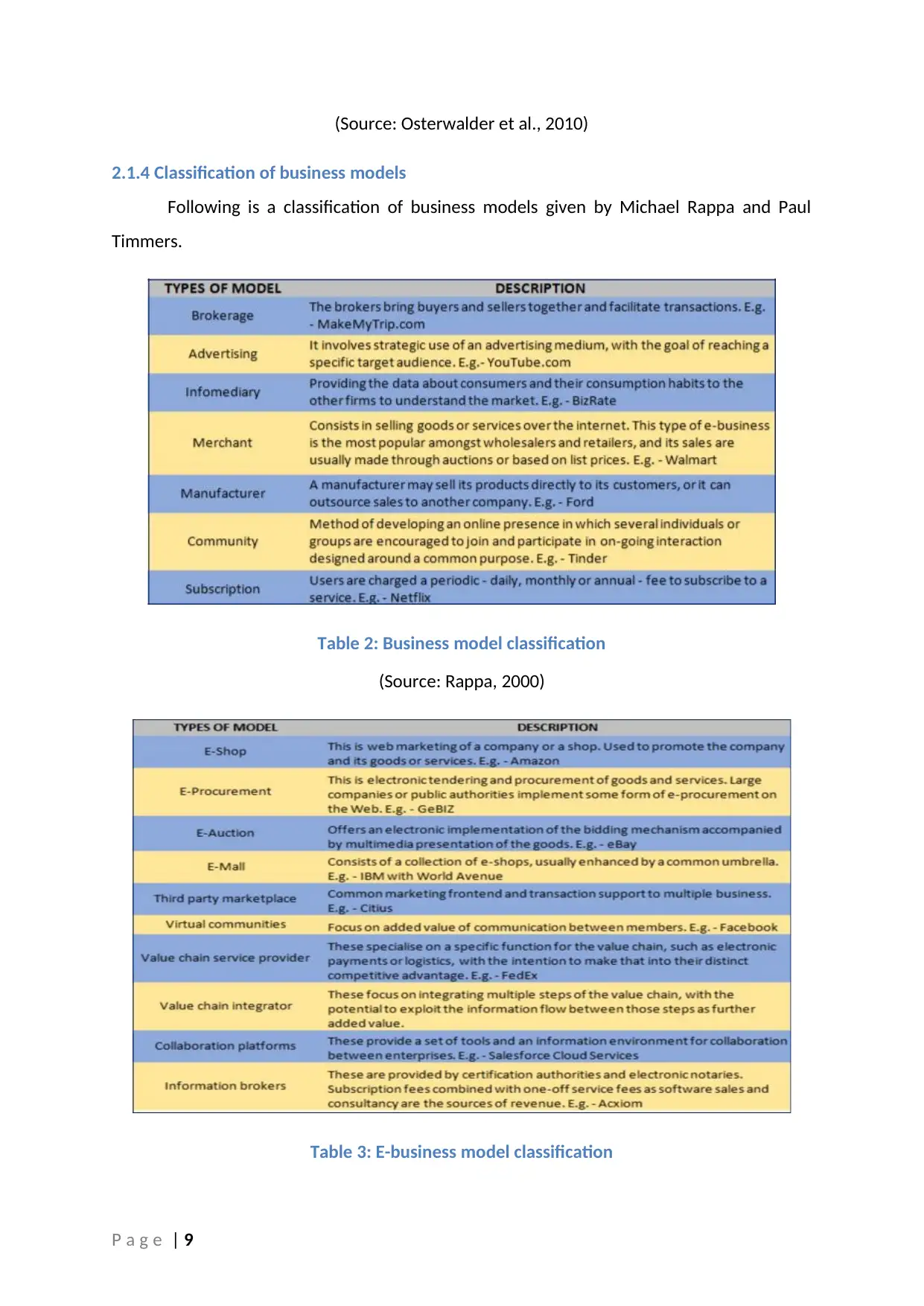
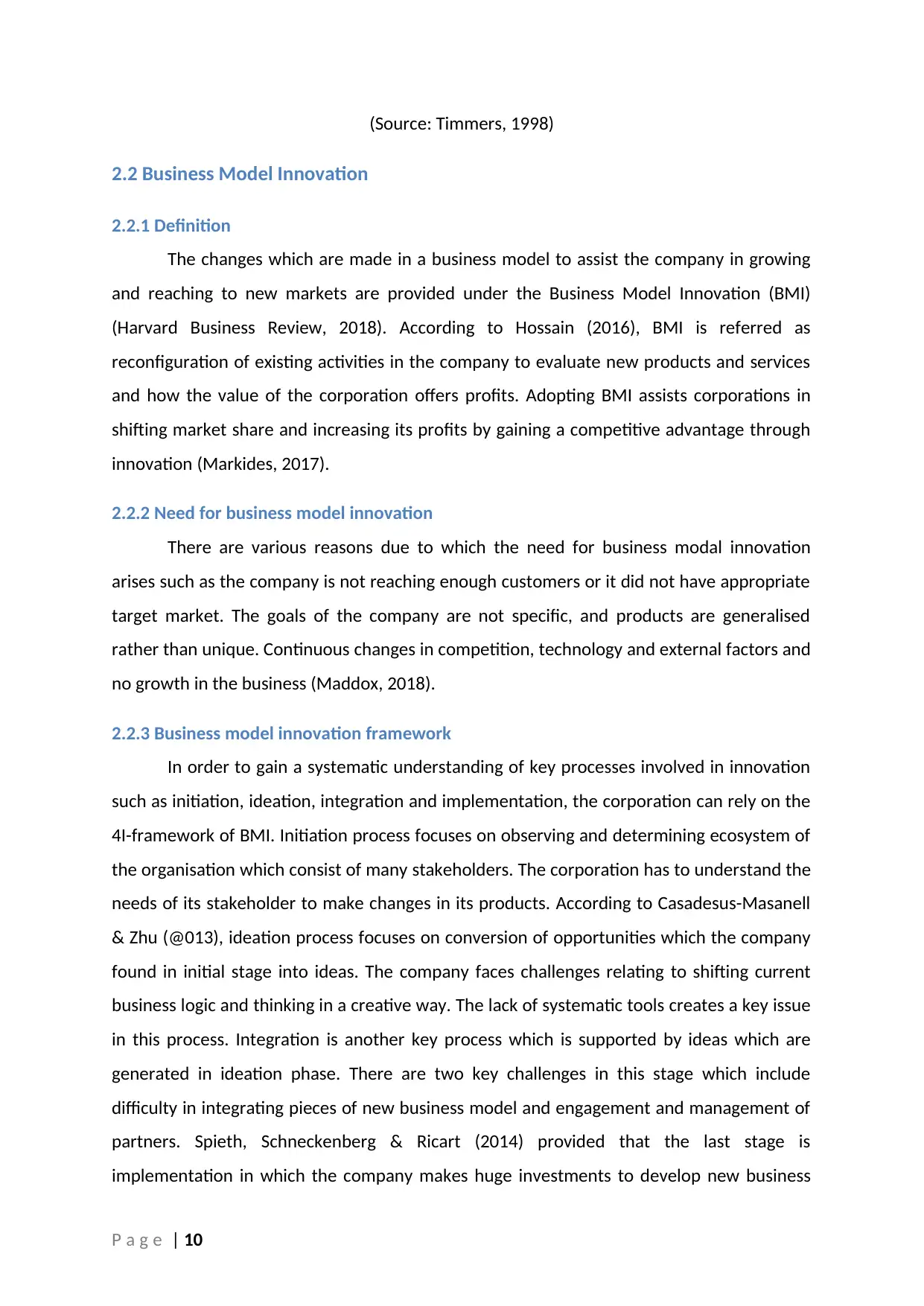
Following is a classification of business models given by Michael Rappa and Paul
Timmers.
Table 2: Business model classification
(Source: Rappa, 2000)
Table 3: E-business model classification
P a g e | 9
2.1.4 Classification of business models
Following is a classification of business models given by Michael Rappa and Paul
Timmers.
Table 2: Business model classification
(Source: Rappa, 2000)
Table 3: E-business model classification
P a g e | 9
Paraphrase This Document
Need a fresh take? Get an instant paraphrase of this document with our AI Paraphraser
(Source: Timmers, 1998)
2.2 Business Model Innovation
2.2.1 Definition
The changes which are made in a business model to assist the company in growing
and reaching to new markets are provided under the Business Model Innovation (BMI)
(Harvard Business Review, 2018). According to Hossain (2016), BMI is referred as
reconfiguration of existing activities in the company to evaluate new products and services
and how the value of the corporation offers profits. Adopting BMI assists corporations in
shifting market share and increasing its profits by gaining a competitive advantage through
innovation (Markides, 2017).
2.2.2 Need for business model innovation
There are various reasons due to which the need for business modal innovation
arises such as the company is not reaching enough customers or it did not have appropriate
target market. The goals of the company are not specific, and products are generalised
rather than unique. Continuous changes in competition, technology and external factors and
no growth in the business (Maddox, 2018).
2.2.3 Business model innovation framework
In order to gain a systematic understanding of key processes involved in innovation
such as initiation, ideation, integration and implementation, the corporation can rely on the
4I-framework of BMI. Initiation process focuses on observing and determining ecosystem of
the organisation which consist of many stakeholders. The corporation has to understand the
needs of its stakeholder to make changes in its products. According to Casadesus-Masanell
& Zhu (@013), ideation process focuses on conversion of opportunities which the company
found in initial stage into ideas. The company faces challenges relating to shifting current
business logic and thinking in a creative way. The lack of systematic tools creates a key issue
in this process. Integration is another key process which is supported by ideas which are
generated in ideation phase. There are two key challenges in this stage which include
difficulty in integrating pieces of new business model and engagement and management of
partners. Spieth, Schneckenberg & Ricart (2014) provided that the last stage is
implementation in which the company makes huge investments to develop new business
P a g e | 10
2.2 Business Model Innovation
2.2.1 Definition
The changes which are made in a business model to assist the company in growing
and reaching to new markets are provided under the Business Model Innovation (BMI)
(Harvard Business Review, 2018). According to Hossain (2016), BMI is referred as
reconfiguration of existing activities in the company to evaluate new products and services
and how the value of the corporation offers profits. Adopting BMI assists corporations in
shifting market share and increasing its profits by gaining a competitive advantage through
innovation (Markides, 2017).
2.2.2 Need for business model innovation
There are various reasons due to which the need for business modal innovation
arises such as the company is not reaching enough customers or it did not have appropriate
target market. The goals of the company are not specific, and products are generalised
rather than unique. Continuous changes in competition, technology and external factors and
no growth in the business (Maddox, 2018).
2.2.3 Business model innovation framework
In order to gain a systematic understanding of key processes involved in innovation
such as initiation, ideation, integration and implementation, the corporation can rely on the
4I-framework of BMI. Initiation process focuses on observing and determining ecosystem of
the organisation which consist of many stakeholders. The corporation has to understand the
needs of its stakeholder to make changes in its products. According to Casadesus-Masanell
& Zhu (@013), ideation process focuses on conversion of opportunities which the company
found in initial stage into ideas. The company faces challenges relating to shifting current
business logic and thinking in a creative way. The lack of systematic tools creates a key issue
in this process. Integration is another key process which is supported by ideas which are
generated in ideation phase. There are two key challenges in this stage which include
difficulty in integrating pieces of new business model and engagement and management of
partners. Spieth, Schneckenberg & Ricart (2014) provided that the last stage is
implementation in which the company makes huge investments to develop new business
P a g e | 10
models by overcoming challenges. The business models are implemented using various
approaches such as trial-and-error, big-bang, pilots and others. The gap in these studies is
that they did not define the term innovation and it is difficult for established brands to focus
on innovation because it is difficult for them to diversify their offerings.
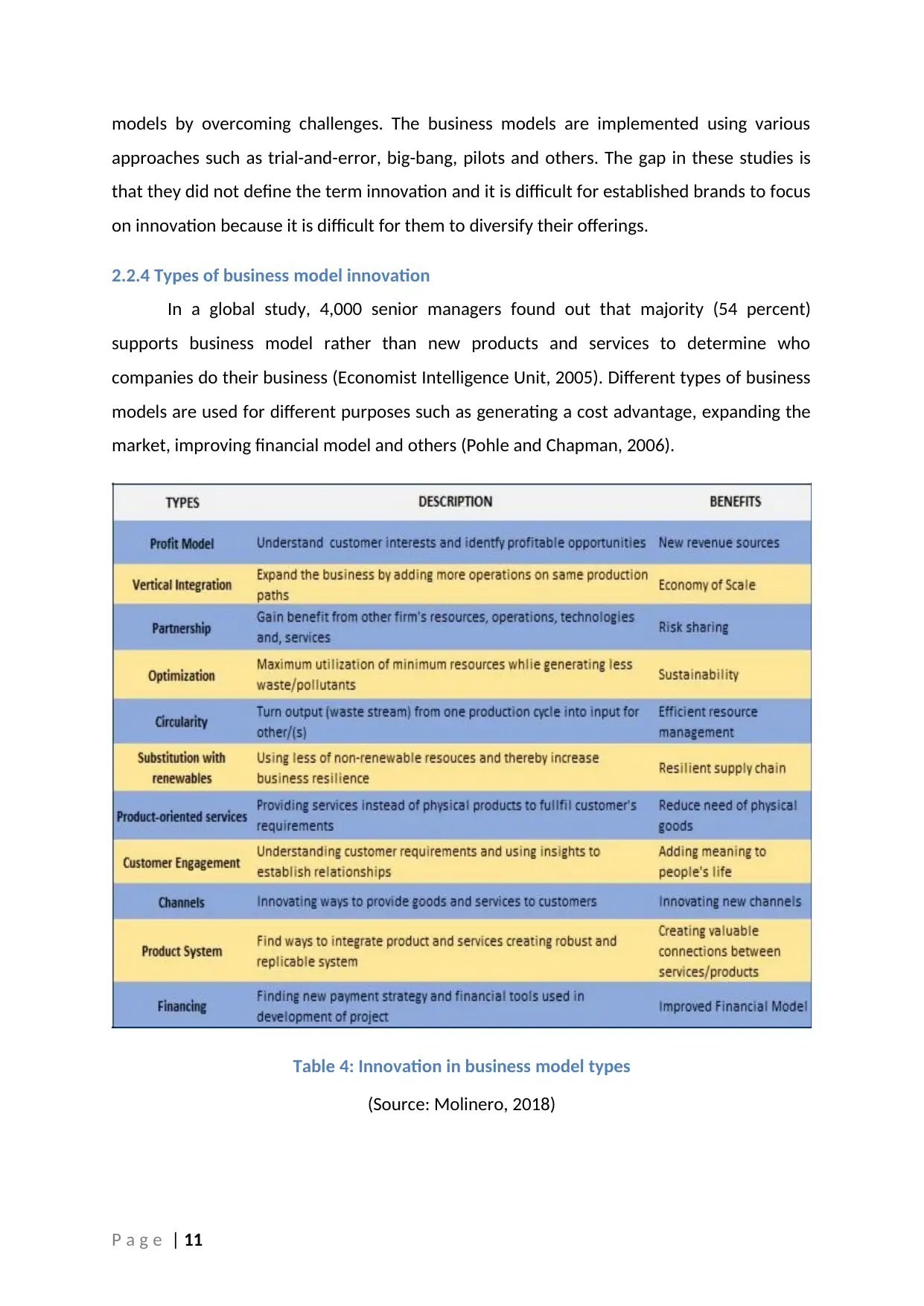
2.2.4 Types of business model innovation
In a global study, 4,000 senior managers found out that majority (54 percent)
supports business model rather than new products and services to determine who
companies do their business (Economist Intelligence Unit, 2005). Different types of business
models are used for different purposes such as generating a cost advantage, expanding the
market, improving financial model and others (Pohle and Chapman, 2006).
Table 4: Innovation in business model types
(Source: Molinero, 2018)
P a g e | 11
approaches such as trial-and-error, big-bang, pilots and others. The gap in these studies is
that they did not define the term innovation and it is difficult for established brands to focus
on innovation because it is difficult for them to diversify their offerings.
2.2.4 Types of business model innovation
In a global study, 4,000 senior managers found out that majority (54 percent)
supports business model rather than new products and services to determine who
companies do their business (Economist Intelligence Unit, 2005). Different types of business
models are used for different purposes such as generating a cost advantage, expanding the
market, improving financial model and others (Pohle and Chapman, 2006).
Table 4: Innovation in business model types
(Source: Molinero, 2018)
P a g e | 11
⊘ This is a preview!⊘
Do you want full access?
Subscribe today to unlock all pages.
Trusted by 1+ million students worldwide

1 out of 18


Related Documents


Your All-in-One AI-Powered Toolkit for Academic Success.
+13062052269
info@desklib.com
Available 24*7 on WhatsApp / Email
![[object Object]](/_next/static/media/star-bottom.7253800d.svg)
Unlock your academic potential
Copyright © 2020–2026 A2Z Services. All Rights Reserved. Developed and managed by ZUCOL.