Impact of Management Styles on Organisational Effectiveness Report
VerifiedAdded on 2020/07/23
|12
|3238
|93
Report
AI Summary
This report delves into the multifaceted roles of managers within a business context, examining the impact of various management styles—autocratic, paternalistic, and democratic—on organisational effectiveness and goal attainment. It highlights the specific responsibilities of finance and human resource managers, including fund allocation, investment decisions, recruitment, and training. The report further explores contextual factors such as company size, public versus private sector dynamics, and governmental policies that influence organisational performance. Additionally, it discusses methods for maintaining control over staff, meeting employee expectations, and the influence of the workforce on overall outcomes. The analysis includes practical recommendations for improving staff performance through delegation, skill matching, effective communication, and employee incentives, emphasizing the importance of feedback and open communication channels. Overall, the report provides a comprehensive overview of management principles and their practical application in the workplace.

BUSINESS

Paraphrase This Document
Need a fresh take? Get an instant paraphrase of this document with our AI Paraphraser
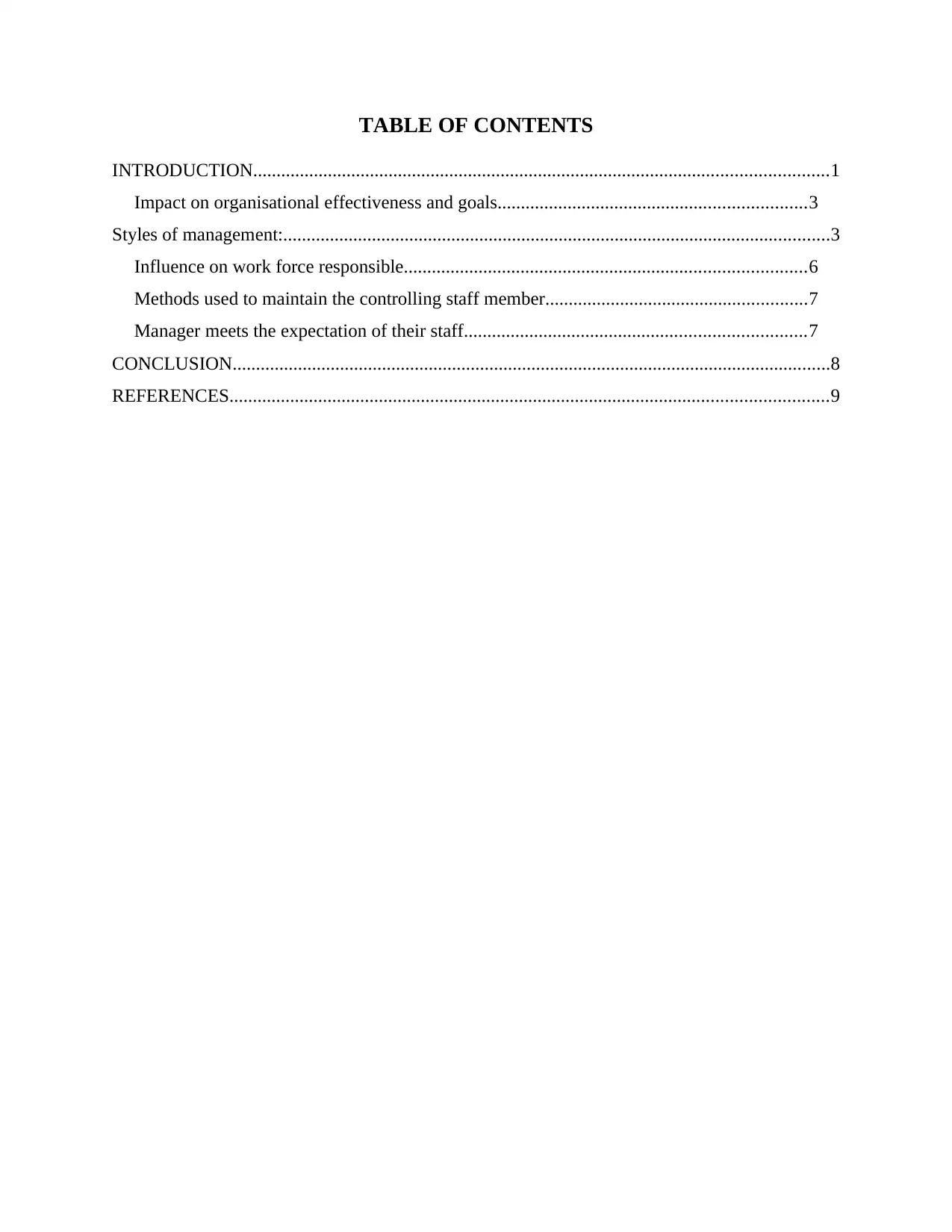
TABLE OF CONTENTS
INTRODUCTION...........................................................................................................................1
Impact on organisational effectiveness and goals..................................................................3
Styles of management:.....................................................................................................................3
Influence on work force responsible......................................................................................6
Methods used to maintain the controlling staff member........................................................7
Manager meets the expectation of their staff.........................................................................7
CONCLUSION................................................................................................................................8
REFERENCES................................................................................................................................9
INTRODUCTION...........................................................................................................................1
Impact on organisational effectiveness and goals..................................................................3
Styles of management:.....................................................................................................................3
Influence on work force responsible......................................................................................6
Methods used to maintain the controlling staff member........................................................7
Manager meets the expectation of their staff.........................................................................7
CONCLUSION................................................................................................................................8
REFERENCES................................................................................................................................9
INTRODUCTION
In the workplace of each and every business entity, different types of the managers
having very important place for taking effective business decisions. Several managers playing
significant role in the enterprise are such as finance, human resource, production, research and
development etc. The present study reflects role and basic tasks of the manager which are
performed in the relevant department of the entity. Along with this, responsibilities which are
taken by the managers at the working environment are described in proper direction. In addition
to this, various contextual elements are explained in the present study. Further, such aspects
affect to the effectiveness as well as objectives and goals of the businesses. At the workplace
different kinds of the employees working which are like full-time, aged, skilled, qualified, part-
time etc. Further, impact of such types of the workforce at the responsibilities of the managers
and organisation is described in the present report.
Role of finance manager:
At the workplace of an organisation, different department are there for which particular
managers are assigned. Further, various managers performing role in the company are like HR,
finance, R&D, marketing, production etc. In the present scenario, role of the finance managers
are explained as below:
Raising fund: In an organisation, when management going to adopt new project or expand
business then capital required (Role of a Financial Manager, 2017). Further, how much amount
of fund is needed to raise from which financing source is decided by the financial manager of the
company.
Allocation of financial resources: Apart from this, to each and every business department fund
is required which is allotted by the finance manager. Moreover, other basic role of this manager
in the company is to allocate fund or financial resources to the organisational functions.
Investment decisions: In order decide that in which alternative money should be invest, financial
manager plays the basic role. Effective investment decisions supportive for the business entity
for enhancing return and profit at the end (Role of Finance Manager, 2017).
Profit planning: This is another major responsibility of the finance manager under which he/she
has to plan for the profit. He/she has responsibility to manage the profit and loss of the company.
1
In the workplace of each and every business entity, different types of the managers
having very important place for taking effective business decisions. Several managers playing
significant role in the enterprise are such as finance, human resource, production, research and
development etc. The present study reflects role and basic tasks of the manager which are
performed in the relevant department of the entity. Along with this, responsibilities which are
taken by the managers at the working environment are described in proper direction. In addition
to this, various contextual elements are explained in the present study. Further, such aspects
affect to the effectiveness as well as objectives and goals of the businesses. At the workplace
different kinds of the employees working which are like full-time, aged, skilled, qualified, part-
time etc. Further, impact of such types of the workforce at the responsibilities of the managers
and organisation is described in the present report.
Role of finance manager:
At the workplace of an organisation, different department are there for which particular
managers are assigned. Further, various managers performing role in the company are like HR,
finance, R&D, marketing, production etc. In the present scenario, role of the finance managers
are explained as below:
Raising fund: In an organisation, when management going to adopt new project or expand
business then capital required (Role of a Financial Manager, 2017). Further, how much amount
of fund is needed to raise from which financing source is decided by the financial manager of the
company.
Allocation of financial resources: Apart from this, to each and every business department fund
is required which is allotted by the finance manager. Moreover, other basic role of this manager
in the company is to allocate fund or financial resources to the organisational functions.
Investment decisions: In order decide that in which alternative money should be invest, financial
manager plays the basic role. Effective investment decisions supportive for the business entity
for enhancing return and profit at the end (Role of Finance Manager, 2017).
Profit planning: This is another major responsibility of the finance manager under which he/she
has to plan for the profit. He/she has responsibility to manage the profit and loss of the company.
1
⊘ This is a preview!⊘
Do you want full access?
Subscribe today to unlock all pages.

Trusted by 1+ million students worldwide
They have to make the report and statement under which all information related to the
profitability and loss included (Kathy and Deborah, 2007). While manager effective design the
profit planning then company may able to know its future expenses.
Role of the human resource manager
Within the organisation, human resource manager plays a very crucial role as they are
responsible to manage the all workforce and their activities. HR manager is responsible to
recruit the employees, train them and manage in such manner so as they can able to attain the
organisation objective. Following are some responsibility of the human resource manger- Training and development- Training and development is one of the most important
responsibility of the human resource manager under which they are responsible to train
the employees. With help of this support, employees can able to improve their skill,
ability, knowledge about the business. (Barrick and et.al., 2013) In order to organise the
training and development program, it is very essential to analyse the performance of
employees. While manger effectively assess and evaluate the performance of employees
then it becomes easy to organise the accurate training session for them within the
company. Recruitment and selection- Recruitment and selection is another major responsibility of
the human resource managers under which they are responsible to recruit the candidate
for required position within the company. In order to recruit the employees, it is very
important for HR manager to analyse the skill, ability, talent of the candidate in the
interview round (Hakanen and van Dierendonck, 2013). Manage the policies and practices- This is another important responsibility of the human
resource manager under which they are responsible to manage the policies, practices and
system of the organisation. HR manager manage and implement the company policies
and practices.
Resolve the issue of personnels- HR manager another responsibility is to resolve the
issue of personnels related to their working. If any issue faced employees then it is great
responsibility of the HR manager to identify and resolve them.
2
profitability and loss included (Kathy and Deborah, 2007). While manager effective design the
profit planning then company may able to know its future expenses.
Role of the human resource manager
Within the organisation, human resource manager plays a very crucial role as they are
responsible to manage the all workforce and their activities. HR manager is responsible to
recruit the employees, train them and manage in such manner so as they can able to attain the
organisation objective. Following are some responsibility of the human resource manger- Training and development- Training and development is one of the most important
responsibility of the human resource manager under which they are responsible to train
the employees. With help of this support, employees can able to improve their skill,
ability, knowledge about the business. (Barrick and et.al., 2013) In order to organise the
training and development program, it is very essential to analyse the performance of
employees. While manger effectively assess and evaluate the performance of employees
then it becomes easy to organise the accurate training session for them within the
company. Recruitment and selection- Recruitment and selection is another major responsibility of
the human resource managers under which they are responsible to recruit the candidate
for required position within the company. In order to recruit the employees, it is very
important for HR manager to analyse the skill, ability, talent of the candidate in the
interview round (Hakanen and van Dierendonck, 2013). Manage the policies and practices- This is another important responsibility of the human
resource manager under which they are responsible to manage the policies, practices and
system of the organisation. HR manager manage and implement the company policies
and practices.
Resolve the issue of personnels- HR manager another responsibility is to resolve the
issue of personnels related to their working. If any issue faced employees then it is great
responsibility of the HR manager to identify and resolve them.
2
Paraphrase This Document
Need a fresh take? Get an instant paraphrase of this document with our AI Paraphraser
Impact on organisational effectiveness and goals
Styles of management:
Autocratic: Under this style of management all the decisions are taken by the top level
management without any involvement from the workers.
Impact on organisational effectiveness and goals:
11 Decision making is swift as only the senior managers make the entire decisions.
11 Its highly effective in companies with low skilled workers.
11 The decisions made by the managers become the company policy, having no advantage
for the workers.
Paternalistic: Managers make decisions keeping in mind the interest of the workers.
Impact on the organisational effectiveness and goals:
2. There is good communication between the management and workers and worker's wants
are satisfied.
3. Workers are motivated which result in increased productiveness which helps the
organisation reach the goals.
4. Slow decision making as the worker's involvement increases the time of decision making.
Democratic: Decision making power is in the hand of workers. Decisions are made on
majority basis. Workers are also allowed to make their own decisions.
Impact on organisational effectiveness and goals:
1. Effective working when decision complexity is fierce and specialisation is required.
2. Workers are motivated due to decision making power which leads to improved
productivity.
3. Large change of mistakes when workers are not skilled may lead to loss of the company.
3
Styles of management:
Autocratic: Under this style of management all the decisions are taken by the top level
management without any involvement from the workers.
Impact on organisational effectiveness and goals:
11 Decision making is swift as only the senior managers make the entire decisions.
11 Its highly effective in companies with low skilled workers.
11 The decisions made by the managers become the company policy, having no advantage
for the workers.
Paternalistic: Managers make decisions keeping in mind the interest of the workers.
Impact on the organisational effectiveness and goals:
2. There is good communication between the management and workers and worker's wants
are satisfied.
3. Workers are motivated which result in increased productiveness which helps the
organisation reach the goals.
4. Slow decision making as the worker's involvement increases the time of decision making.
Democratic: Decision making power is in the hand of workers. Decisions are made on
majority basis. Workers are also allowed to make their own decisions.
Impact on organisational effectiveness and goals:
1. Effective working when decision complexity is fierce and specialisation is required.
2. Workers are motivated due to decision making power which leads to improved
productivity.
3. Large change of mistakes when workers are not skilled may lead to loss of the company.
3
Impact of contextual factors:
Impact due to size of company: The size of organisation differs the level at which the
organisation performs. The strengths and weaknesses of an organisation depend on its size. A
start-ups has properties and priorities which vastly differ from that compared to large
corporations. Size of the company also determines the market the company is operating in. A
large company may operate in the international market, whereas it is not for a small company to
operate in the international market as the competition intense and it needs continuous
innovations and resources to compete.
Impact of public and private sector on organisation:
1. A company's working and goals are widely effected by the sector it works in, a public
sector company is more affected by the change in government than that of an impact on a
private sector company.
2. Policies: policies made by government are different for both the sectors, public sector
companies have an edge over the private sector when new policies are framed.
3. Government intervention: public companies are more prone to government interventions
as they work directly under the government, private companies may be intervened only in
case of doubt or legal litigation.
4. Funding: In case of public sector company funding is made available by the government.
Private sector company get no help from government on funding issue. Private sector
companies find funding through different tools.
5. Competition: public sector companies are monopolistic in nature, there is no competition
at all. Private sector companies face fierce competition according to its choice of market.
6. Resources allocation: there is a large supply of resources, may it be human or physical, to
the public sector company. Whereas private sector companies work on a limited supply
of resources.
4
Impact due to size of company: The size of organisation differs the level at which the
organisation performs. The strengths and weaknesses of an organisation depend on its size. A
start-ups has properties and priorities which vastly differ from that compared to large
corporations. Size of the company also determines the market the company is operating in. A
large company may operate in the international market, whereas it is not for a small company to
operate in the international market as the competition intense and it needs continuous
innovations and resources to compete.
Impact of public and private sector on organisation:
1. A company's working and goals are widely effected by the sector it works in, a public
sector company is more affected by the change in government than that of an impact on a
private sector company.
2. Policies: policies made by government are different for both the sectors, public sector
companies have an edge over the private sector when new policies are framed.
3. Government intervention: public companies are more prone to government interventions
as they work directly under the government, private companies may be intervened only in
case of doubt or legal litigation.
4. Funding: In case of public sector company funding is made available by the government.
Private sector company get no help from government on funding issue. Private sector
companies find funding through different tools.
5. Competition: public sector companies are monopolistic in nature, there is no competition
at all. Private sector companies face fierce competition according to its choice of market.
6. Resources allocation: there is a large supply of resources, may it be human or physical, to
the public sector company. Whereas private sector companies work on a limited supply
of resources.
4
⊘ This is a preview!⊘
Do you want full access?
Subscribe today to unlock all pages.
Trusted by 1+ million students worldwide
Management styles are characteristics ways of making decision and relating to subordinate.
Management follows two type of style 1.autocratic and permissive and 2.democratic.
But this company is following democratic style, because this style allows the employee to take
part in decision making. And company discuss on decision which are given by employee
and agreed upon by the majority (Collinson and Cook, 2013). The communication is
exchange in both direction upward or downward that means ideas and problems are
transfer from employees to leader and orders and suggestions are transfer from higher
authority to lower authority. This style is only use when complex decision need to require
specialist skill. For example if the manger of company need information about the market
rate of product but the marketing executive have no any knowledge of market then this
style will not work. With the help of this style job satisfaction and quality of work
improved and employee work in this company with dedication and motivation is also
increased.
This company can improve the performance of their staff by:-
* Delegate responsibilities:- Don't be afraid to delegate the responsibilities to those employees
who are not qualified because if you trust on them they will perform their task well. This
will ultimately give benefit to your company.
* Match task to skills:-Knowing your employee skills and their behaviour toward company is
essential for maximizing efficiency (Hakanen and van Dierendonck, 2013). Before giving
any assignment, ask yourself: is this person best suited to perform the task?, find someone
else whose skill and style match your needs.
*communicate effectively:-Instead of using email, try social networking tools, designed for even
quicker team communication. This company can also encourage their employee by voice
to voice communication or face to face communication.
* Incentivize employee:- recognizing your worker for a job well done will make them feel
appreciated and encourage them to continue increase their productivity. Instead of giving
bonus, company can offer additional paid time off (PTO) without having to use their
vacation and sick time, take them out for a meal, send hand written note, allow lazy
Monday coupons, tell your boss for the good performance of particular employee.
5
Management follows two type of style 1.autocratic and permissive and 2.democratic.
But this company is following democratic style, because this style allows the employee to take
part in decision making. And company discuss on decision which are given by employee
and agreed upon by the majority (Collinson and Cook, 2013). The communication is
exchange in both direction upward or downward that means ideas and problems are
transfer from employees to leader and orders and suggestions are transfer from higher
authority to lower authority. This style is only use when complex decision need to require
specialist skill. For example if the manger of company need information about the market
rate of product but the marketing executive have no any knowledge of market then this
style will not work. With the help of this style job satisfaction and quality of work
improved and employee work in this company with dedication and motivation is also
increased.
This company can improve the performance of their staff by:-
* Delegate responsibilities:- Don't be afraid to delegate the responsibilities to those employees
who are not qualified because if you trust on them they will perform their task well. This
will ultimately give benefit to your company.
* Match task to skills:-Knowing your employee skills and their behaviour toward company is
essential for maximizing efficiency (Hakanen and van Dierendonck, 2013). Before giving
any assignment, ask yourself: is this person best suited to perform the task?, find someone
else whose skill and style match your needs.
*communicate effectively:-Instead of using email, try social networking tools, designed for even
quicker team communication. This company can also encourage their employee by voice
to voice communication or face to face communication.
* Incentivize employee:- recognizing your worker for a job well done will make them feel
appreciated and encourage them to continue increase their productivity. Instead of giving
bonus, company can offer additional paid time off (PTO) without having to use their
vacation and sick time, take them out for a meal, send hand written note, allow lazy
Monday coupons, tell your boss for the good performance of particular employee.
5
Paraphrase This Document
Need a fresh take? Get an instant paraphrase of this document with our AI Paraphraser
Give each other feedback:- Measure your employee's performance then hold individual meetings
to let them know where they are excelling, and what areas they need to work on. Asking
for feedback not only gives you clear, immediate way to help your employees improve but
also encourage a culture of open thoughts that will allow for continued development over
time (Fullan, 2011).
Methods used to maintain the controlling staff member
In the Marks and Spencer organisation, manager controls the employee's performance by various
methods which are as follows-
Establishing performance standards- In the Marks and Spencer company, manger manage
and control the performance of employees by use of the performance standards. These
performances standard are often just more clearly defined objective.
Adopting various leadership style- In order to mange the performance of employees in
the Marks and Spencer, manager can adopt the various management style according to
the situation (Collinson and Cook, 2013). There are various management styles like
autocratic, democratic etc. According to the different situation and need, manager adopt
an impressive style of leadership and lead the employees for attainment of the
organisation objective,
Manager meets the expectation of their staff
In the Marks and Spencer company, manager meet the staff requirement by
understanding their need related to the working. Manager adopts the different leadership
style according to the situation so as employees can easily understand the target of
company (Avolio and Mhatre, 2012).
In the marks and Spencer company, manager conduct regular meeting with each
employee's so as they can identify the issue which faced by them. Manager also allow
employees for open communication so as they can easily discus each issue with the
manger (Akers, 2013). While employees discuss the issue related to working with
employees then it can resolve in an effective manner.
6
to let them know where they are excelling, and what areas they need to work on. Asking
for feedback not only gives you clear, immediate way to help your employees improve but
also encourage a culture of open thoughts that will allow for continued development over
time (Fullan, 2011).
Methods used to maintain the controlling staff member
In the Marks and Spencer organisation, manager controls the employee's performance by various
methods which are as follows-
Establishing performance standards- In the Marks and Spencer company, manger manage
and control the performance of employees by use of the performance standards. These
performances standard are often just more clearly defined objective.
Adopting various leadership style- In order to mange the performance of employees in
the Marks and Spencer, manager can adopt the various management style according to
the situation (Collinson and Cook, 2013). There are various management styles like
autocratic, democratic etc. According to the different situation and need, manager adopt
an impressive style of leadership and lead the employees for attainment of the
organisation objective,
Manager meets the expectation of their staff
In the Marks and Spencer company, manager meet the staff requirement by
understanding their need related to the working. Manager adopts the different leadership
style according to the situation so as employees can easily understand the target of
company (Avolio and Mhatre, 2012).
In the marks and Spencer company, manager conduct regular meeting with each
employee's so as they can identify the issue which faced by them. Manager also allow
employees for open communication so as they can easily discus each issue with the
manger (Akers, 2013). While employees discuss the issue related to working with
employees then it can resolve in an effective manner.
6
With help of effective training and development program, manager can also lead
employees in an effective manner. With help of this program, employees can able to
improve their existing skill, ability, knowledge about the working at workplace.
◦ Influence on work force responsible
The work force can be influenced by the flexibility at the work place, shifts of the
employees, pay-offs, knowledge and talent acquired by them. This can influence the
employee's work performance in the organisation and there will be unfavourable
outcomes from their work. Marks and Spencer deals in various products in the UK
market including cloths, home products, grocery products and the luxury food articles
(Lupu and Force, 2010). There are around 83,000 employees dealing with the consumers.
Organisation has to make planning to give adequate satisfaction to the employees and
manage their queries. The work performance can be influenced by the following reasons:
Flexibility: Switching employees from one department to another department, the
employee cannot be easily get comfortable with the changes in the duties. It can affect the
promptness of his work. It can be affect the quality of his work performance. Other
employees with the department will not easily coordinate with the new employee
(Podsiadlowski and et.al. 2013). On the other side, the switch of departments can be
helpful in making an employee to gain more knowledge about the other departments and
the operations of the organisation. It can be helpful in building the satisfaction in
employee towards his duties. Marks and Spencer should allow the flexibility in the
organisation as it is helpful in lower down the work load on the particular department.
Shifts of employees: Work of an organisation can be affected by the changing
shifts of the employees, there should be fix time schedule for the employees
(Podsiadlowski and et.al. 2013). The hours of shift can be discussed with all the
employees and they should know all the conditions of Marks and Spencer. The overtime
which is out of the satisfactory of an employee can make him unsatisfied with the work.
Pay-rolls: Inappropriate salary given to the employees can be very influencing to
the employee. The employee will not be able to meet his daily expenses and cannot save
any amount of money for future purpose (Pitts and Recascino Wise, 2010). It can be
frustrating and make employee distraught toward his work. Mark and Spencer has the
7
employees in an effective manner. With help of this program, employees can able to
improve their existing skill, ability, knowledge about the working at workplace.
◦ Influence on work force responsible
The work force can be influenced by the flexibility at the work place, shifts of the
employees, pay-offs, knowledge and talent acquired by them. This can influence the
employee's work performance in the organisation and there will be unfavourable
outcomes from their work. Marks and Spencer deals in various products in the UK
market including cloths, home products, grocery products and the luxury food articles
(Lupu and Force, 2010). There are around 83,000 employees dealing with the consumers.
Organisation has to make planning to give adequate satisfaction to the employees and
manage their queries. The work performance can be influenced by the following reasons:
Flexibility: Switching employees from one department to another department, the
employee cannot be easily get comfortable with the changes in the duties. It can affect the
promptness of his work. It can be affect the quality of his work performance. Other
employees with the department will not easily coordinate with the new employee
(Podsiadlowski and et.al. 2013). On the other side, the switch of departments can be
helpful in making an employee to gain more knowledge about the other departments and
the operations of the organisation. It can be helpful in building the satisfaction in
employee towards his duties. Marks and Spencer should allow the flexibility in the
organisation as it is helpful in lower down the work load on the particular department.
Shifts of employees: Work of an organisation can be affected by the changing
shifts of the employees, there should be fix time schedule for the employees
(Podsiadlowski and et.al. 2013). The hours of shift can be discussed with all the
employees and they should know all the conditions of Marks and Spencer. The overtime
which is out of the satisfactory of an employee can make him unsatisfied with the work.
Pay-rolls: Inappropriate salary given to the employees can be very influencing to
the employee. The employee will not be able to meet his daily expenses and cannot save
any amount of money for future purpose (Pitts and Recascino Wise, 2010). It can be
frustrating and make employee distraught toward his work. Mark and Spencer has the
7
⊘ This is a preview!⊘
Do you want full access?
Subscribe today to unlock all pages.
Trusted by 1+ million students worldwide
good strength of the employees who are serving for it, to manage the worker's economic
condition they should awarded them with the best suitable salary package.
Skills: Work can be allotted to the employees as per the skills or talent owned by them.
The work performance of the employees can show their talent and they should be timely
awarded with the increment in their post in which they are serving or increase in their pay-offs
(Pitts and Recascino wise, 2010). Marks and Spencer has various departments like cloths and
grocery articles, they need to recruit employees as per the talent ans skills they have.
CONCLUSION
From this report it has been concluded that manager plays a very crucial role within the
company. With help of various management style, manager can easily manage the
employees and their activities according to the situation. It has been also concluded that by
use of effective measure like establishing monitor standard, regular meeting etc manager
can manage the staff at workplace.
8
condition they should awarded them with the best suitable salary package.
Skills: Work can be allotted to the employees as per the skills or talent owned by them.
The work performance of the employees can show their talent and they should be timely
awarded with the increment in their post in which they are serving or increase in their pay-offs
(Pitts and Recascino wise, 2010). Marks and Spencer has various departments like cloths and
grocery articles, they need to recruit employees as per the talent ans skills they have.
CONCLUSION
From this report it has been concluded that manager plays a very crucial role within the
company. With help of various management style, manager can easily manage the
employees and their activities according to the situation. It has been also concluded that by
use of effective measure like establishing monitor standard, regular meeting etc manager
can manage the staff at workplace.
8
Paraphrase This Document
Need a fresh take? Get an instant paraphrase of this document with our AI Paraphraser
REFERENCES
Books and Journals
Akers, R.L., 2013. Criminological theories: Introduction and evaluation. Routledge.
AlMazrouei, H. and Zacca, R., 2015. Expatriate leadership competencies and performance: a
qualitative study. International Journal of Organizational Analysis. 23(3). pp.404-424.
Avolio, B.J. and Mhatre, K.H., 2012. Advances in theory and research on authentic
leadership. The Oxford handbook of positive organizational scholarship. pp.773-783.
Barrick, M.R. and et.al., 2013. The theory of purposeful work behavior: The role of personality,
higher-order goals, and job characteristics. Academy of Management Review. 38(1).
pp.132-153.
Collinson, V. and Cook, T.F., 2013. Organizational Learning: Leading Innovations. International
Journal of Educational Leadership and Management. 1(1). pp.69-98.
Daft, R., 2014. The leadership experience. Cengage Learning.
Daicoff, S.S., 2012. Expanding the Lawyer's Toolkit of Skills and Competencies: Synthesizing
Leadership, Professionalism, Emotional Intelligence, Conflict Resolution, and
Comprehensive Law. Santa Clara L. Rev. 52. p.795.
Frick, P.J. and et.al., 2014. Annual Research Review: A developmental psychopathology
approach to understanding callous‐unemotional traits in children and adolescents with
serious conduct problems. Journal of Child Psychology and Psychiatry. 55(6). pp.532-
548.
Fullan, M., 2011. The six secrets of change: What the best leaders do to help their organizations
survive and thrive. John Wiley & Sons.
Hakanen, J. and van Dierendonck, D., 2013. Servant-Leadership and Life Satisfaction: The
Mediating Role of Justice, Job Control, and Burnout.International Journal of Servant-
Leadership. 7(1). pp.253-261.
9
Books and Journals
Akers, R.L., 2013. Criminological theories: Introduction and evaluation. Routledge.
AlMazrouei, H. and Zacca, R., 2015. Expatriate leadership competencies and performance: a
qualitative study. International Journal of Organizational Analysis. 23(3). pp.404-424.
Avolio, B.J. and Mhatre, K.H., 2012. Advances in theory and research on authentic
leadership. The Oxford handbook of positive organizational scholarship. pp.773-783.
Barrick, M.R. and et.al., 2013. The theory of purposeful work behavior: The role of personality,
higher-order goals, and job characteristics. Academy of Management Review. 38(1).
pp.132-153.
Collinson, V. and Cook, T.F., 2013. Organizational Learning: Leading Innovations. International
Journal of Educational Leadership and Management. 1(1). pp.69-98.
Daft, R., 2014. The leadership experience. Cengage Learning.
Daicoff, S.S., 2012. Expanding the Lawyer's Toolkit of Skills and Competencies: Synthesizing
Leadership, Professionalism, Emotional Intelligence, Conflict Resolution, and
Comprehensive Law. Santa Clara L. Rev. 52. p.795.
Frick, P.J. and et.al., 2014. Annual Research Review: A developmental psychopathology
approach to understanding callous‐unemotional traits in children and adolescents with
serious conduct problems. Journal of Child Psychology and Psychiatry. 55(6). pp.532-
548.
Fullan, M., 2011. The six secrets of change: What the best leaders do to help their organizations
survive and thrive. John Wiley & Sons.
Hakanen, J. and van Dierendonck, D., 2013. Servant-Leadership and Life Satisfaction: The
Mediating Role of Justice, Job Control, and Burnout.International Journal of Servant-
Leadership. 7(1). pp.253-261.
9
Lupu, D. and Force, P. M. W. T., 2010. Estimate of current hospice and palliative medicine
physician workforce shortage. Journal of pain and symptom management. 40(6). pp.899-
911.
Pitts, D. W. and Recascino Wise, L., 2010. Workforce diversity in the new millennium:
Prospects for research. Review of public personnel administration. 30(1). pp.44-69.
Podsiadlowski, A., and et.al. 2013. Managing a culturally diverse workforce: Diversity
perspectives in organizations. International Journal of Intercultural Relations. 37(2).
pp.159-175.
Online
Role of a Financial Manager, 2017. [Online]. Available through:
<http://www.managementstudyguide.com/financial-innovation-can-be-both-a-force-for-
good-and-bad.htm> [Accessed on 3rd August 2017].
Role of Finance Manager, 2017. [Online]. Available through:
<http://education.svtuition.org/2011/08/role-of-finance-manager.html> [Accessed on 3rd
August 2017].
10
physician workforce shortage. Journal of pain and symptom management. 40(6). pp.899-
911.
Pitts, D. W. and Recascino Wise, L., 2010. Workforce diversity in the new millennium:
Prospects for research. Review of public personnel administration. 30(1). pp.44-69.
Podsiadlowski, A., and et.al. 2013. Managing a culturally diverse workforce: Diversity
perspectives in organizations. International Journal of Intercultural Relations. 37(2).
pp.159-175.
Online
Role of a Financial Manager, 2017. [Online]. Available through:
<http://www.managementstudyguide.com/financial-innovation-can-be-both-a-force-for-
good-and-bad.htm> [Accessed on 3rd August 2017].
Role of Finance Manager, 2017. [Online]. Available through:
<http://education.svtuition.org/2011/08/role-of-finance-manager.html> [Accessed on 3rd
August 2017].
10
⊘ This is a preview!⊘
Do you want full access?
Subscribe today to unlock all pages.
Trusted by 1+ million students worldwide

1 out of 12


Related Documents


Your All-in-One AI-Powered Toolkit for Academic Success.
+13062052269
info@desklib.com
Available 24*7 on WhatsApp / Email
![[object Object]](/_next/static/media/star-bottom.7253800d.svg)
Unlock your academic potential
Copyright © 2020–2026 A2Z Services. All Rights Reserved. Developed and managed by ZUCOL.