Managing People: Power, Control, Groups, and Teams at Byfield College
VerifiedAdded on 2021/07/20
|12
|2538
|52
Essay
AI Summary
This essay analyzes the case of Byfield Business College, focusing on the challenges of managing change through the lens of power and control, and group dynamics. The essay explores how the director's attempts to implement a more structured environment, aiming to address a perceived lack of productivity and image issues, resulted in employee resistance due to poor communication and a lack of consideration for employee perspectives. The analysis highlights the importance of employee input and the need for a gradual approach to change. The essay recommends establishing a department to collect employee suggestions, holding meetings to explain the benefits of changes, and utilizing key personnel like Jane Hacking as a communication bridge. The essay concludes by emphasizing the significance of communication, considering employee opinions, and allowing sufficient time for acceptance during organizational change, advocating for a balanced approach to power and control within teams.

STUDENT EXAMINATION NUMBER Y_3862017__
MODULE NO: __MAN00025M_______________
MODULE TITLE: _Managing people
Module Tutor: Carolyn Hunter
Essay Title: Analysis power and control, group and teams
through Managing change at Byfield Business College
Word Count: _____1836______
Introduction
MODULE NO: __MAN00025M_______________
MODULE TITLE: _Managing people
Module Tutor: Carolyn Hunter
Essay Title: Analysis power and control, group and teams
through Managing change at Byfield Business College
Word Count: _____1836______
Introduction

Paraphrase This Document
Need a fresh take? Get an instant paraphrase of this document with our AI Paraphraser
In today's rapid development, many enterprises are seeking a positive
management model to effectively control and influence the organization and
teams. In the Byfield college case study, the main problems are based on
challenges faces by the organization and the unpredictable outcomes of
change, at the same time control and power are considered to be a key
component of any organization’s development. Not every member of the work
team is ready for particular changes, and to comprehend the problems
associated with managing change or accept the unknown consequences of
the change. According to Corbett (1994), employee turnover is low due to
employee satisfaction with the relaxed work environment of the old system.
Importantly, power and control are directly related to the stability of the
organizational system, which can help the value consensus of the team staff
of the group become more and more rational and systematic(Clegg,2006(.
Based on the chaotic and laid-back work environment, managers have made
appropriate reforms in the group and teams, but not obtain satisfaction. In the
case study, the director manager tries to change the lazy work environment
more rigorous that causes unnecessary workloads and reduces productivity
which increases student complains. This essay will argue that the main
problem with the change was lack of communication with employees and
difficult to predict an outcome of change management that led to a resistance
of change by the employees, as analyzed through power and control, groups
management model to effectively control and influence the organization and
teams. In the Byfield college case study, the main problems are based on
challenges faces by the organization and the unpredictable outcomes of
change, at the same time control and power are considered to be a key
component of any organization’s development. Not every member of the work
team is ready for particular changes, and to comprehend the problems
associated with managing change or accept the unknown consequences of
the change. According to Corbett (1994), employee turnover is low due to
employee satisfaction with the relaxed work environment of the old system.
Importantly, power and control are directly related to the stability of the
organizational system, which can help the value consensus of the team staff
of the group become more and more rational and systematic(Clegg,2006(.
Based on the chaotic and laid-back work environment, managers have made
appropriate reforms in the group and teams, but not obtain satisfaction. In the
case study, the director manager tries to change the lazy work environment
more rigorous that causes unnecessary workloads and reduces productivity
which increases student complains. This essay will argue that the main
problem with the change was lack of communication with employees and
difficult to predict an outcome of change management that led to a resistance
of change by the employees, as analyzed through power and control, groups
and teams. As a result, it will make the following recommendation to the
director of the college: First of all, set up a special department to collect the
employee's suggestions. Secondly, holding a meeting to introduce the
benefits of changing and give them a long time to accept the politics. Finally,
using Jane hacking as a bridge between employees and managers. This
paper will explain Managers using power and control in Byfield Business
School, reducing productivity and people's satisfaction. Secondly, the lack of
effective communication and lack of listening to employees during the Byfield
college change process directly affects employees' enthusiasm for work and
reduces team cohesion. Finally, Byfield administrators should pay more
attention to the opinions of their employers or gradually make employees and
students slowly accept changes rather than mandatory ones based on reality.
Power and control
Power and control in an organization can help managers make effective
decisions and promote the faster implementation of change programs, thus
increasing efficiency and productivity, it still has some disadvantages, such as
low moral motivation. Controls are designed to check whether capacity,
scheduling, and inventory planning work. Without control change and planning
are meaningless because there is no mechanism to monitor the effectiveness
of change (Boddy, 2017). Power can be defined as the ability to influence
someone to do something they otherwise would not do, and it involves
individuals and groups from different resources (Barrett,1986). Byfield's
director of the college: First of all, set up a special department to collect the
employee's suggestions. Secondly, holding a meeting to introduce the
benefits of changing and give them a long time to accept the politics. Finally,
using Jane hacking as a bridge between employees and managers. This
paper will explain Managers using power and control in Byfield Business
School, reducing productivity and people's satisfaction. Secondly, the lack of
effective communication and lack of listening to employees during the Byfield
college change process directly affects employees' enthusiasm for work and
reduces team cohesion. Finally, Byfield administrators should pay more
attention to the opinions of their employers or gradually make employees and
students slowly accept changes rather than mandatory ones based on reality.
Power and control
Power and control in an organization can help managers make effective
decisions and promote the faster implementation of change programs, thus
increasing efficiency and productivity, it still has some disadvantages, such as
low moral motivation. Controls are designed to check whether capacity,
scheduling, and inventory planning work. Without control change and planning
are meaningless because there is no mechanism to monitor the effectiveness
of change (Boddy, 2017). Power can be defined as the ability to influence
someone to do something they otherwise would not do, and it involves
individuals and groups from different resources (Barrett,1986). Byfield's
⊘ This is a preview!⊘
Do you want full access?
Subscribe today to unlock all pages.

Trusted by 1+ million students worldwide
employees are happy with the relaxed work environment and flexible working
hours because they believe it will give them a passion for work and they will
be able to get their jobs done quickly to get off work early. It does increase
productivity. But George boon argues that an undisciplined work environment
can damage the business school's image or damage some confidential
documents (Corbett,1994). The new system in Byfield college has many
advantages(firstly, the new system gives a special role to everyone and the
office staff have a sense of loyalty and ownership; secondly, queuing system
help employees take it in turns to deal with inquiries which makes work more
orderly; the last one is that the new system is more conducive to managers'
control over employees, and the old atmosphere of playfulness had
completely disappeared.
However, there are some issues in the new system. The most serious
problem is that the new policy has been met with great dissatisfaction from
students and staff, such as an overly cumbersome queuing system or a tough
management system limits employee’s creativity. Bouwens et al (2010)
argued that Leaders communicate in different ways, monitor and control
choices, empower employees to different degrees, and implement visions in
different ways. This means that the style of the leader affects the use of
planning and control systems.
In implementing the new system, Byfield business school overemphasized the
uniformity of norms and used position oppression, instead of accepting the
hours because they believe it will give them a passion for work and they will
be able to get their jobs done quickly to get off work early. It does increase
productivity. But George boon argues that an undisciplined work environment
can damage the business school's image or damage some confidential
documents (Corbett,1994). The new system in Byfield college has many
advantages(firstly, the new system gives a special role to everyone and the
office staff have a sense of loyalty and ownership; secondly, queuing system
help employees take it in turns to deal with inquiries which makes work more
orderly; the last one is that the new system is more conducive to managers'
control over employees, and the old atmosphere of playfulness had
completely disappeared.
However, there are some issues in the new system. The most serious
problem is that the new policy has been met with great dissatisfaction from
students and staff, such as an overly cumbersome queuing system or a tough
management system limits employee’s creativity. Bouwens et al (2010)
argued that Leaders communicate in different ways, monitor and control
choices, empower employees to different degrees, and implement visions in
different ways. This means that the style of the leader affects the use of
planning and control systems.
In implementing the new system, Byfield business school overemphasized the
uniformity of norms and used position oppression, instead of accepting the
Paraphrase This Document
Need a fresh take? Get an instant paraphrase of this document with our AI Paraphraser
opinions of employees. As mentioned in the case, the manager insisted on
implementing the new management system even though he was aware of
employees' complaints about the new system. This will lead to an increase in
the negative emotions of employees and negative waiting for work. The
concept of normative control has a long conceptual pedigree in organizational
research and can strengthen internal operations by establishing common
attitudes, beliefs, and values among employees (Lukes,2003). But many
critics point to its limitations, from the rigidity of a homogeneous culture to the
mockery of employees who will hide their "real" selves -- far from the
collective norm(Fleming and Sturdy,2009(. This shows that excessive use of
Power and control and neglect of communication with employees will lead to
internal disorders.
Groups and teams
Teamwork is the preferred way to motivate employees, it ensures cohesion
and productivity within an organization, but group thinking and social loafing
can also exist(Boddy,2017). A team is defined as two or more people who
have signed a psychological contract, shared organizational goals, and
Shared responsibility for results (Sims et al,1981). The group, however, refers
to two or more people who share a common goal but not everyone is involved
and not everyone is responsible for the results (Clegg,2010).
Byfield's old system of management was more likely management, they tend
to share out work between each other, but no one is responsible for the
implementing the new management system even though he was aware of
employees' complaints about the new system. This will lead to an increase in
the negative emotions of employees and negative waiting for work. The
concept of normative control has a long conceptual pedigree in organizational
research and can strengthen internal operations by establishing common
attitudes, beliefs, and values among employees (Lukes,2003). But many
critics point to its limitations, from the rigidity of a homogeneous culture to the
mockery of employees who will hide their "real" selves -- far from the
collective norm(Fleming and Sturdy,2009(. This shows that excessive use of
Power and control and neglect of communication with employees will lead to
internal disorders.
Groups and teams
Teamwork is the preferred way to motivate employees, it ensures cohesion
and productivity within an organization, but group thinking and social loafing
can also exist(Boddy,2017). A team is defined as two or more people who
have signed a psychological contract, shared organizational goals, and
Shared responsibility for results (Sims et al,1981). The group, however, refers
to two or more people who share a common goal but not everyone is involved
and not everyone is responsible for the results (Clegg,2010).
Byfield's old system of management was more likely management, they tend
to share out work between each other, but no one is responsible for the
results which cause social loafing. According to Harkins and Szymanski
(1989), Social loafing is colloquially called slacking, and in some cases,
people make less effort and are less accountable for their actions when they
know someone else will clean up the mess. Thus, under the old business
school system, Jane often stayed up too late to do someone else’s work,
which not only reduced productivity but also unevenly division of labor,
eventually leading to dissatisfaction among employees. Being appointed as a
new director of the college, George Boon is not satisfied with the methods
used by Jane Hacking. Therefore, two other people were invited to work out
the details of the new system, based on which control and ownership were the
main concepts. Unfortunately, the results of the change have not proved as
successful as expected.
According to Baker (1993), In an organization where oppressive bureaucracy
is known as an iron cage, managers' desire for the order will constantly
rationalize bureaucratic relationships, negotiations between managers and
employees will be reduced, and workers will seek approval from supervisors
to make decisions because that's what workers are supposed to do. In the
reform of the Byfield business school system, the management did not inform
all the members about the need to change the old system or make some
corresponding explanations. When employees complain about the new
system, managers still force employees to accept it. As Schippers (2015),
Managers often believe that only in demanding environments and challenging
(1989), Social loafing is colloquially called slacking, and in some cases,
people make less effort and are less accountable for their actions when they
know someone else will clean up the mess. Thus, under the old business
school system, Jane often stayed up too late to do someone else’s work,
which not only reduced productivity but also unevenly division of labor,
eventually leading to dissatisfaction among employees. Being appointed as a
new director of the college, George Boon is not satisfied with the methods
used by Jane Hacking. Therefore, two other people were invited to work out
the details of the new system, based on which control and ownership were the
main concepts. Unfortunately, the results of the change have not proved as
successful as expected.
According to Baker (1993), In an organization where oppressive bureaucracy
is known as an iron cage, managers' desire for the order will constantly
rationalize bureaucratic relationships, negotiations between managers and
employees will be reduced, and workers will seek approval from supervisors
to make decisions because that's what workers are supposed to do. In the
reform of the Byfield business school system, the management did not inform
all the members about the need to change the old system or make some
corresponding explanations. When employees complain about the new
system, managers still force employees to accept it. As Schippers (2015),
Managers often believe that only in demanding environments and challenging
⊘ This is a preview!⊘
Do you want full access?
Subscribe today to unlock all pages.
Trusted by 1+ million students worldwide
times can teams and organizations maintain innovation or improve
productivity. Therefore, in the process of change, managers should coordinate
the consistency of the team, timely communicate and adopt the opinions of
employees, and make employees accept the change slowly, instead of
requiring each employee to accept all the changes in a short time.
Solutions
Here are some Suggestions for business school reform failures (
In the first, a professional department should be built. The post-bureaucratic is
a horizontal structure with decentralism power which enables empowerment
(Clegg et al, 2012). Byfield business college has a relaxed management
environment that is more likely postmodern bureaucracy, while George Bone
believes that there should be some control and centralization within the
organization. Boon should focus on workers' perceptions and
recommendations on work quality and conditions. Therefore, the manager
should communicate with employees in a timely and set up a dedicated group
of departments to collect their pieces of advice.
Secondly, the manager should hold a meeting to tell the staff involved about
the benefits of the change and give them a longer period to accept it.
According to Bridges (1986), there is a certain transition stage in
organizational change that people must first give up the old identity and have
a conflict between the new identity and the old identity, then accept the new
identity. Therefore, the change at Byfield should change the time frame and
productivity. Therefore, in the process of change, managers should coordinate
the consistency of the team, timely communicate and adopt the opinions of
employees, and make employees accept the change slowly, instead of
requiring each employee to accept all the changes in a short time.
Solutions
Here are some Suggestions for business school reform failures (
In the first, a professional department should be built. The post-bureaucratic is
a horizontal structure with decentralism power which enables empowerment
(Clegg et al, 2012). Byfield business college has a relaxed management
environment that is more likely postmodern bureaucracy, while George Bone
believes that there should be some control and centralization within the
organization. Boon should focus on workers' perceptions and
recommendations on work quality and conditions. Therefore, the manager
should communicate with employees in a timely and set up a dedicated group
of departments to collect their pieces of advice.
Secondly, the manager should hold a meeting to tell the staff involved about
the benefits of the change and give them a longer period to accept it.
According to Bridges (1986), there is a certain transition stage in
organizational change that people must first give up the old identity and have
a conflict between the new identity and the old identity, then accept the new
identity. Therefore, the change at Byfield should change the time frame and
Paraphrase This Document
Need a fresh take? Get an instant paraphrase of this document with our AI Paraphraser
improve the time to implement the change to one month instead of
immediately. Gupta and Singhal (1993) argued that people are the main
assets of the company, establish an appropriate performance evaluation
system for them and implement a reward system to recognize and enhance
the creativity of employees. The new system can improve work efficiency and
enhance the image of the business school, to attract more students to the
business school which will undoubtedly increase the income. Therefore,
managers can set up a reward system to reward the whole department when
they have completed a certain number of recorded cases.
Finally, using Jane hacking as a bridge between employees and managers.
Getting the ideas from your employees is always a challenge, especially
When leaders take on new roles or join new organizations, it's hard for them
to hear from the people in the group (Detert and Burries, 2016). Boone had
just been appointed the new director of the institute, and it was hard to find
out what the staff thought. When he asked them what they thought about the
new system, everyone said they were satisfied with it except Jack Hacking.
The most important thing was that she had a good relationship of trust with all
the staff in the office. Therefore, communicating with her and letting her
explain the intentions and expectations of the new system to employees is
more effective than forcing them to accept the change.
Conclusion
immediately. Gupta and Singhal (1993) argued that people are the main
assets of the company, establish an appropriate performance evaluation
system for them and implement a reward system to recognize and enhance
the creativity of employees. The new system can improve work efficiency and
enhance the image of the business school, to attract more students to the
business school which will undoubtedly increase the income. Therefore,
managers can set up a reward system to reward the whole department when
they have completed a certain number of recorded cases.
Finally, using Jane hacking as a bridge between employees and managers.
Getting the ideas from your employees is always a challenge, especially
When leaders take on new roles or join new organizations, it's hard for them
to hear from the people in the group (Detert and Burries, 2016). Boone had
just been appointed the new director of the institute, and it was hard to find
out what the staff thought. When he asked them what they thought about the
new system, everyone said they were satisfied with it except Jack Hacking.
The most important thing was that she had a good relationship of trust with all
the staff in the office. Therefore, communicating with her and letting her
explain the intentions and expectations of the new system to employees is
more effective than forcing them to accept the change.
Conclusion
This essay has demonstrated that the problems facing the college can be
understood through power control and group teams, by showing that force
employees to accept the change compulsively which leads to employees'
antipathy. As the lazy atmosphere of the old system tarnished the reputation
of business schools and reduced productivity, Boom made a failed attempt at
change through power and control. This paper analyzes the reasons for the
failure of Boom reform through different theoretical thinking. The key reason is
not to consider the importance of communication in the team and group. This
paper puts forward some measures to ease the conflict between employees
and managers. Employees' ideas and suggestions should be considered
instead of forcing them to accept changes. Besides, managers should give
employees a period to accept rather than immediately implement. The most
important thing is to explain the benefits of the change to employees so that
they are willing to accept and implement it. Change in the organization is an
extremely difficult plan, how to use the right and control in the team is still
worth thinking about in the future.
understood through power control and group teams, by showing that force
employees to accept the change compulsively which leads to employees'
antipathy. As the lazy atmosphere of the old system tarnished the reputation
of business schools and reduced productivity, Boom made a failed attempt at
change through power and control. This paper analyzes the reasons for the
failure of Boom reform through different theoretical thinking. The key reason is
not to consider the importance of communication in the team and group. This
paper puts forward some measures to ease the conflict between employees
and managers. Employees' ideas and suggestions should be considered
instead of forcing them to accept changes. Besides, managers should give
employees a period to accept rather than immediately implement. The most
important thing is to explain the benefits of the change to employees so that
they are willing to accept and implement it. Change in the organization is an
extremely difficult plan, how to use the right and control in the team is still
worth thinking about in the future.
⊘ This is a preview!⊘
Do you want full access?
Subscribe today to unlock all pages.
Trusted by 1+ million students worldwide
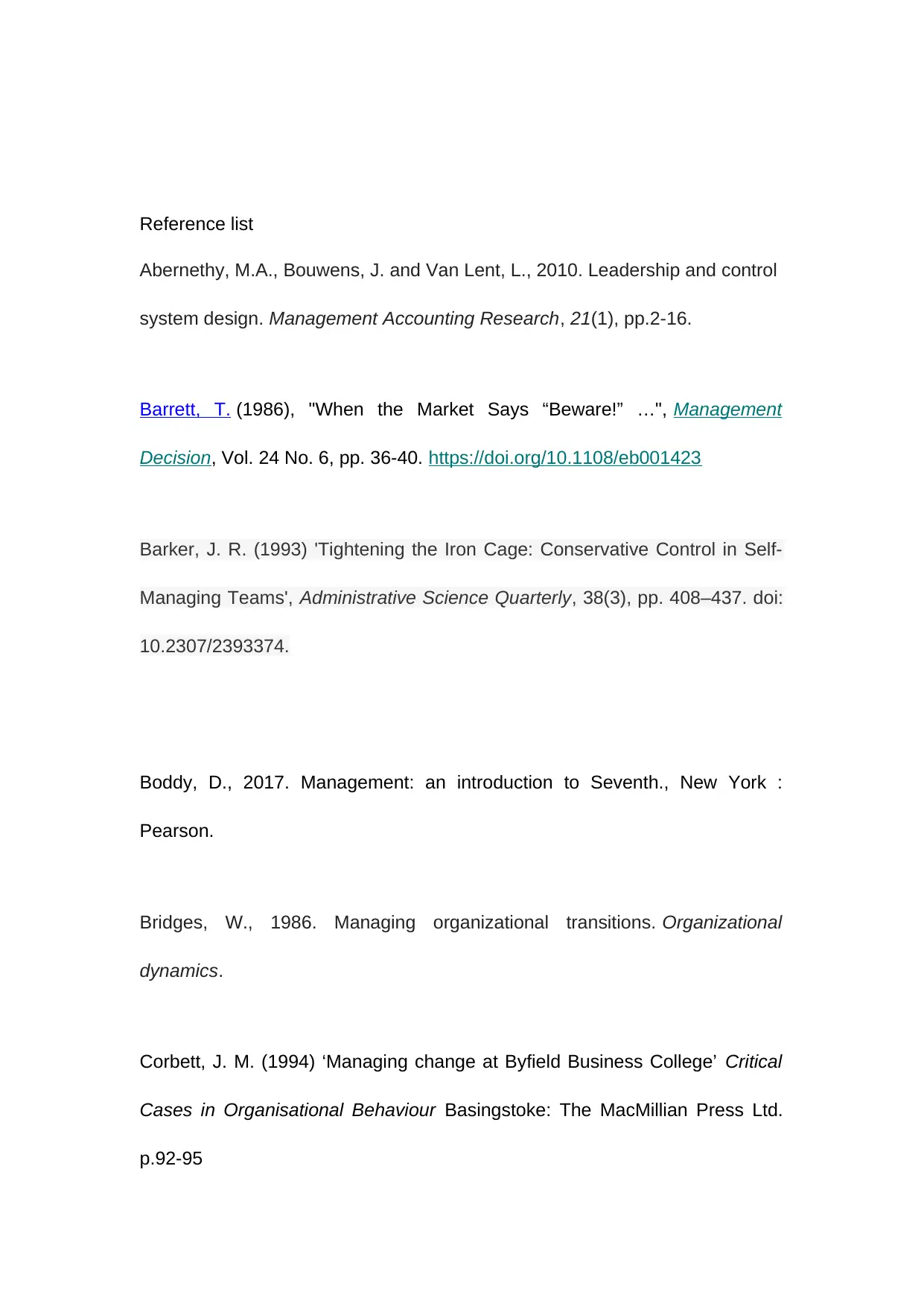
Reference list
Abernethy, M.A., Bouwens, J. and Van Lent, L., 2010. Leadership and control
system design. Management Accounting Research, 21(1), pp.2-16.
Barrett, T. (1986), "When the Market Says “Beware!” …", Management
Decision, Vol. 24 No. 6, pp. 36-40. https://doi.org/10.1108/eb001423
Barker, J. R. (1993) 'Tightening the Iron Cage: Conservative Control in Self-
Managing Teams', Administrative Science Quarterly, 38(3), pp. 408–437. doi:
10.2307/2393374.
Boddy, D., 2017. Management: an introduction to Seventh., New York :
Pearson.
Bridges, W., 1986. Managing organizational transitions. Organizational
dynamics.
Corbett, J. M. (1994) ‘Managing change at Byfield Business College’ Critical
Cases in Organisational Behaviour Basingstoke: The MacMillian Press Ltd.
p.92-95
Abernethy, M.A., Bouwens, J. and Van Lent, L., 2010. Leadership and control
system design. Management Accounting Research, 21(1), pp.2-16.
Barrett, T. (1986), "When the Market Says “Beware!” …", Management
Decision, Vol. 24 No. 6, pp. 36-40. https://doi.org/10.1108/eb001423
Barker, J. R. (1993) 'Tightening the Iron Cage: Conservative Control in Self-
Managing Teams', Administrative Science Quarterly, 38(3), pp. 408–437. doi:
10.2307/2393374.
Boddy, D., 2017. Management: an introduction to Seventh., New York :
Pearson.
Bridges, W., 1986. Managing organizational transitions. Organizational
dynamics.
Corbett, J. M. (1994) ‘Managing change at Byfield Business College’ Critical
Cases in Organisational Behaviour Basingstoke: The MacMillian Press Ltd.
p.92-95
Paraphrase This Document
Need a fresh take? Get an instant paraphrase of this document with our AI Paraphraser
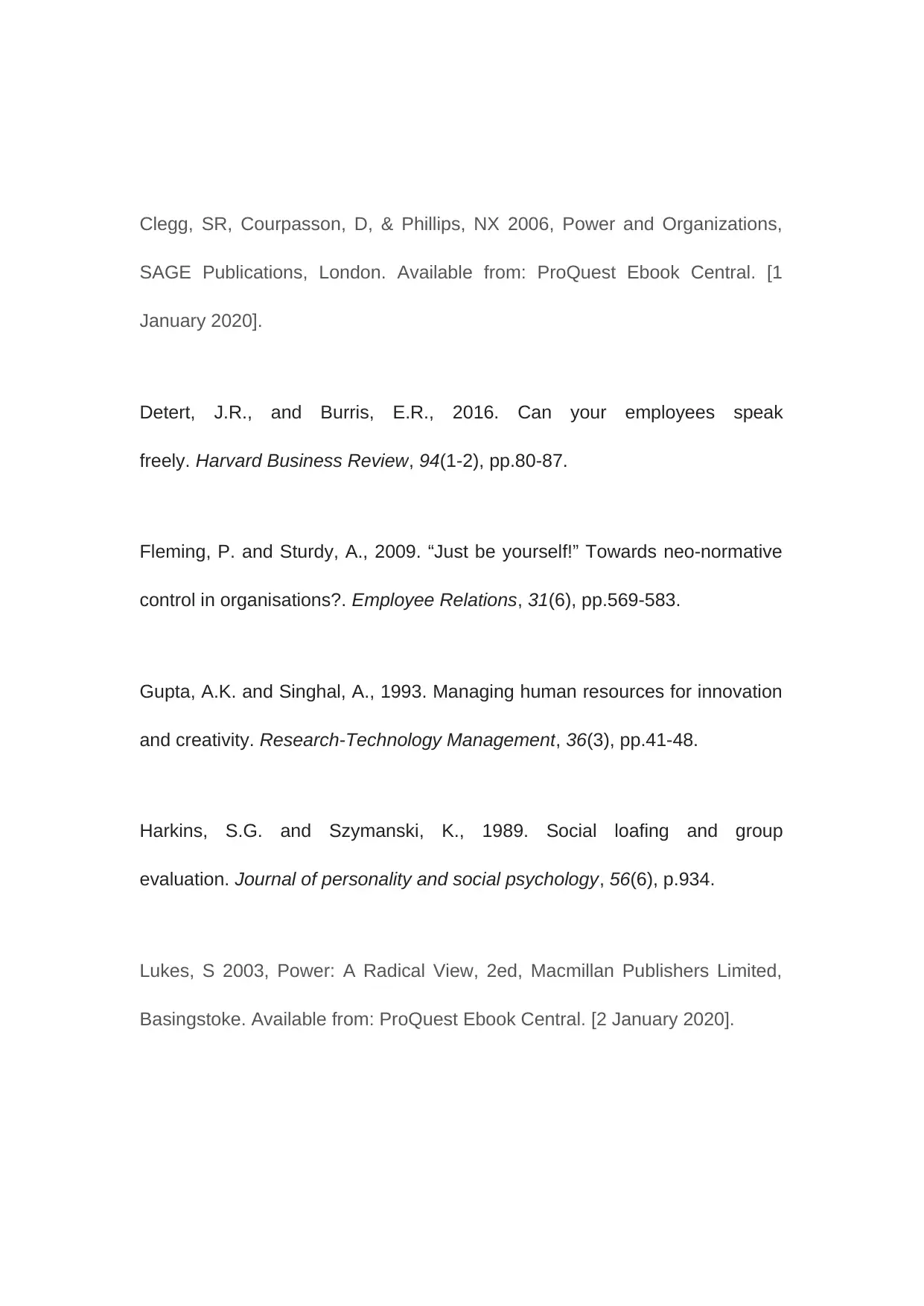
Clegg, SR, Courpasson, D, & Phillips, NX 2006, Power and Organizations,
SAGE Publications, London. Available from: ProQuest Ebook Central. [1
January 2020].
Detert, J.R., and Burris, E.R., 2016. Can your employees speak
freely. Harvard Business Review, 94(1-2), pp.80-87.
Fleming, P. and Sturdy, A., 2009. “Just be yourself!” Towards neo-normative
control in organisations?. Employee Relations, 31(6), pp.569-583.
Gupta, A.K. and Singhal, A., 1993. Managing human resources for innovation
and creativity. Research-Technology Management, 36(3), pp.41-48.
Harkins, S.G. and Szymanski, K., 1989. Social loafing and group
evaluation. Journal of personality and social psychology, 56(6), p.934.
Lukes, S 2003, Power: A Radical View, 2ed, Macmillan Publishers Limited,
Basingstoke. Available from: ProQuest Ebook Central. [2 January 2020].
SAGE Publications, London. Available from: ProQuest Ebook Central. [1
January 2020].
Detert, J.R., and Burris, E.R., 2016. Can your employees speak
freely. Harvard Business Review, 94(1-2), pp.80-87.
Fleming, P. and Sturdy, A., 2009. “Just be yourself!” Towards neo-normative
control in organisations?. Employee Relations, 31(6), pp.569-583.
Gupta, A.K. and Singhal, A., 1993. Managing human resources for innovation
and creativity. Research-Technology Management, 36(3), pp.41-48.
Harkins, S.G. and Szymanski, K., 1989. Social loafing and group
evaluation. Journal of personality and social psychology, 56(6), p.934.
Lukes, S 2003, Power: A Radical View, 2ed, Macmillan Publishers Limited,
Basingstoke. Available from: ProQuest Ebook Central. [2 January 2020].

Schippers, M.C., West, M.A. and Dawson, J.F., 2015. Team reflexivity and
innovation: The moderating role of team context. Journal of
Management, 41(3), pp.769-788.
Sims, D., Eden, C. and Jones, S., 1981. Facilitating problem definition in
teams. European Journal of Operational Research, 6(4), pp.360-366.
innovation: The moderating role of team context. Journal of
Management, 41(3), pp.769-788.
Sims, D., Eden, C. and Jones, S., 1981. Facilitating problem definition in
teams. European Journal of Operational Research, 6(4), pp.360-366.
⊘ This is a preview!⊘
Do you want full access?
Subscribe today to unlock all pages.
Trusted by 1+ million students worldwide

1 out of 12


Related Documents


Your All-in-One AI-Powered Toolkit for Academic Success.
+13062052269
info@desklib.com
Available 24*7 on WhatsApp / Email
![[object Object]](/_next/static/media/star-bottom.7253800d.svg)
Unlock your academic potential
Copyright © 2020–2026 A2Z Services. All Rights Reserved. Developed and managed by ZUCOL.