Comprehensive Analysis of Care Coordination in Healthcare Settings
VerifiedAdded on 2022/10/11
|12
|1342
|6
Report
AI Summary
This report provides a comprehensive overview of the care coordination process in healthcare, emphasizing the crucial role of nurses and healthcare coordinators. It begins by highlighting the importance of data collection and analysis to understand patient needs and risks. The report then details the sequential stages of care coordination, including selection, assessment, planning, interventions, and evaluation. Key principles such as person-centered care, resource utilization, equitability, stakeholder involvement, and safety are discussed. The report also outlines strategies for effective collaboration with patients and their families, emphasizing shared decision-making, building trust, and cultural sensitivity. The report references key publications and guidelines from organizations like the American Academy of Pediatrics and the Agency for Healthcare Research and Quality, providing a solid foundation for understanding and implementing effective care coordination practices.

Care Coordination
NAME OF STUDENT
INSTITUTION AFFILIATION
NAME OF STUDENT
INSTITUTION AFFILIATION
Paraphrase This Document
Need a fresh take? Get an instant paraphrase of this document with our AI Paraphraser

Care Coordination Process: Data
and Analysis
• The first consideration for nurses should be on
data collection and analysis.
• The data relating to the assigned individual case
or population provides multidimensional insights
such as healthcare metrics.
• The analysis of the available or collected data
ensures that the practitioners are in a position to
determine the specific needs of the population
and the related risks and impact (Rushton,
2015).
and Analysis
• The first consideration for nurses should be on
data collection and analysis.
• The data relating to the assigned individual case
or population provides multidimensional insights
such as healthcare metrics.
• The analysis of the available or collected data
ensures that the practitioners are in a position to
determine the specific needs of the population
and the related risks and impact (Rushton,
2015).

Care Coordination Process:
Selection
• The selection of the healthcare needs of the people
should be entirely based on priority in line with the
presented risks and implications.
• High-risk populations and needs should be given more
attention and priority (American Academy of Pediatrics,
2014).
• During the selection, collaboration is required where all
primary and secondary stakeholders should be included
to guarantee and inclusive decision when prioritizing
the needs and problems of the affected group,
individual, or community (Rushton, 2015).
Selection
• The selection of the healthcare needs of the people
should be entirely based on priority in line with the
presented risks and implications.
• High-risk populations and needs should be given more
attention and priority (American Academy of Pediatrics,
2014).
• During the selection, collaboration is required where all
primary and secondary stakeholders should be included
to guarantee and inclusive decision when prioritizing
the needs and problems of the affected group,
individual, or community (Rushton, 2015).
⊘ This is a preview!⊘
Do you want full access?
Subscribe today to unlock all pages.

Trusted by 1+ million students worldwide

Care Coordination Process:
Assessment
• After identifying the high-risk group as well as
the specific subpopulations that create this
group or community, healthcare practitioners
and coordinators should focus on assessment,
which entails a comprehensive examination of
past, present, and anticipated health status
(Fani-Marvasti & Stafford, 2012).
• The objective of assessment is to define the
problem or needs that are specific and
individual-centered, with the focus of
Assessment
• After identifying the high-risk group as well as
the specific subpopulations that create this
group or community, healthcare practitioners
and coordinators should focus on assessment,
which entails a comprehensive examination of
past, present, and anticipated health status
(Fani-Marvasti & Stafford, 2012).
• The objective of assessment is to define the
problem or needs that are specific and
individual-centered, with the focus of
Paraphrase This Document
Need a fresh take? Get an instant paraphrase of this document with our AI Paraphraser

Care Coordination Process:
Planning
• When the required information is available and
the needs of the targeted population, group, or
an individual have been identified, the care
coordination team should now outline the
healthcare goals to be attained.
• Working with specific milestones to be attained
makes it possible to measure progress and
achievement (Rushton, 2015).
• At this level, other factors to consider include
documentation, communication, and assigning of
Planning
• When the required information is available and
the needs of the targeted population, group, or
an individual have been identified, the care
coordination team should now outline the
healthcare goals to be attained.
• Working with specific milestones to be attained
makes it possible to measure progress and
achievement (Rushton, 2015).
• At this level, other factors to consider include
documentation, communication, and assigning of

Care Coordination Process:
Interventions
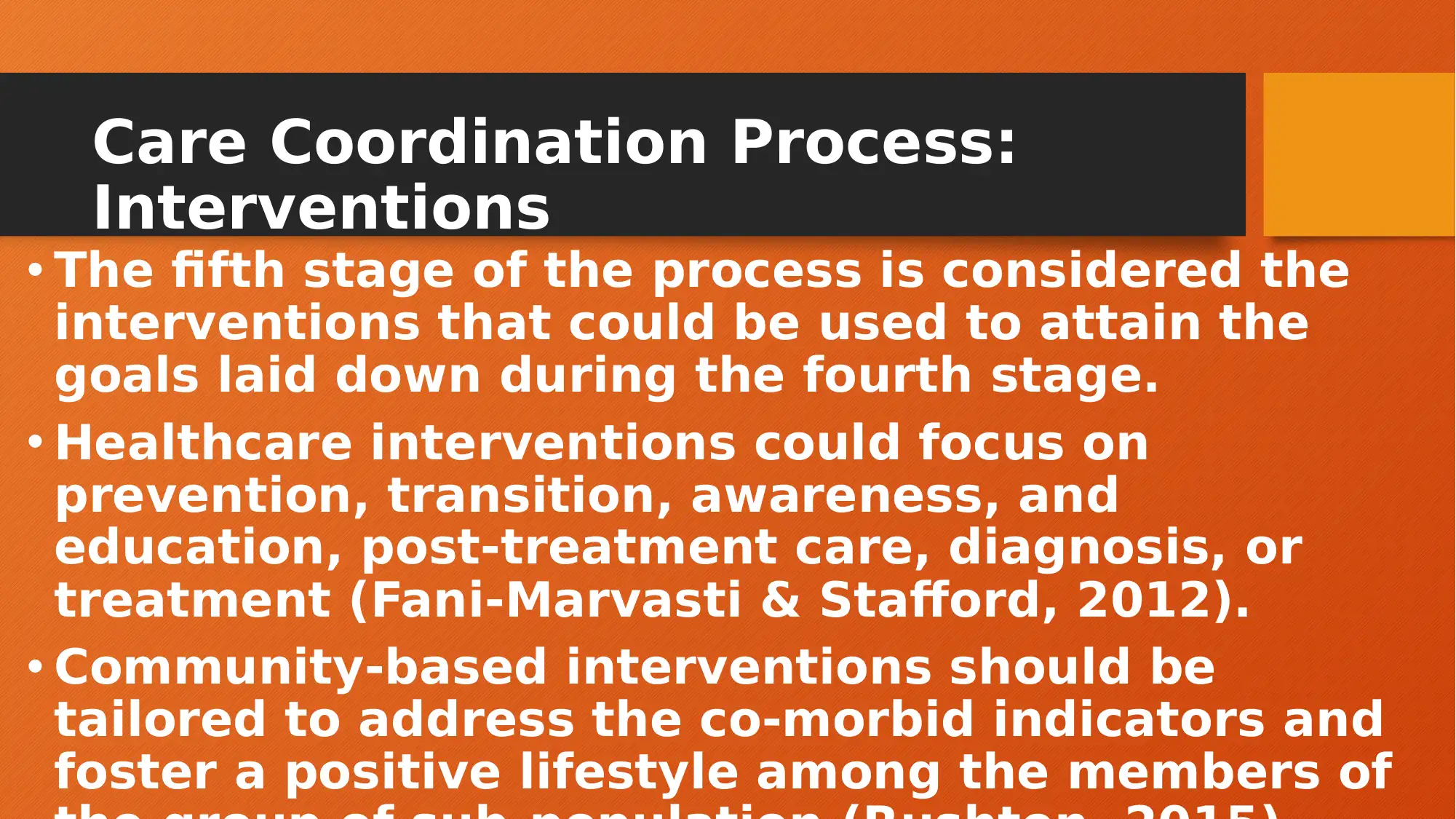
• The fifth stage of the process is considered the
interventions that could be used to attain the
goals laid down during the fourth stage.
• Healthcare interventions could focus on
prevention, transition, awareness, and
education, post-treatment care, diagnosis, or
treatment (Fani-Marvasti & Stafford, 2012).
• Community-based interventions should be
tailored to address the co-morbid indicators and
foster a positive lifestyle among the members of
Interventions
• The fifth stage of the process is considered the
interventions that could be used to attain the
goals laid down during the fourth stage.
• Healthcare interventions could focus on
prevention, transition, awareness, and
education, post-treatment care, diagnosis, or
treatment (Fani-Marvasti & Stafford, 2012).
• Community-based interventions should be
tailored to address the co-morbid indicators and
foster a positive lifestyle among the members of
⊘ This is a preview!⊘
Do you want full access?
Subscribe today to unlock all pages.

Trusted by 1+ million students worldwide

Care Coordination Process:
Evaluation
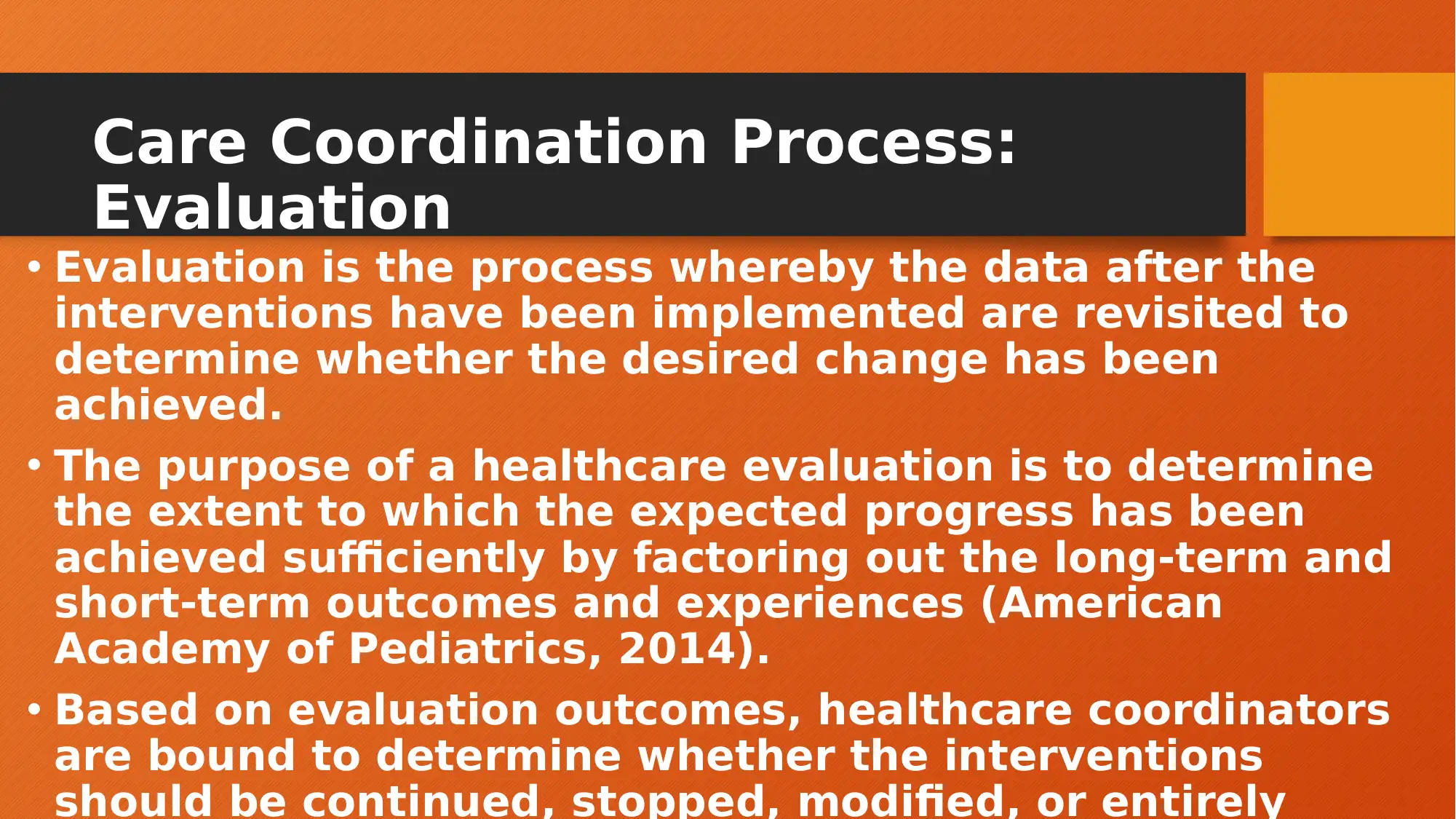
• Evaluation is the process whereby the data after the
interventions have been implemented are revisited to
determine whether the desired change has been
achieved.
• The purpose of a healthcare evaluation is to determine
the extent to which the expected progress has been
achieved sufficiently by factoring out the long-term and
short-term outcomes and experiences (American
Academy of Pediatrics, 2014).
• Based on evaluation outcomes, healthcare coordinators
are bound to determine whether the interventions
should be continued, stopped, modified, or entirely
Evaluation
• Evaluation is the process whereby the data after the
interventions have been implemented are revisited to
determine whether the desired change has been
achieved.
• The purpose of a healthcare evaluation is to determine
the extent to which the expected progress has been
achieved sufficiently by factoring out the long-term and
short-term outcomes and experiences (American
Academy of Pediatrics, 2014).
• Based on evaluation outcomes, healthcare coordinators
are bound to determine whether the interventions
should be continued, stopped, modified, or entirely
Paraphrase This Document
Need a fresh take? Get an instant paraphrase of this document with our AI Paraphraser

Care Coordination Principles
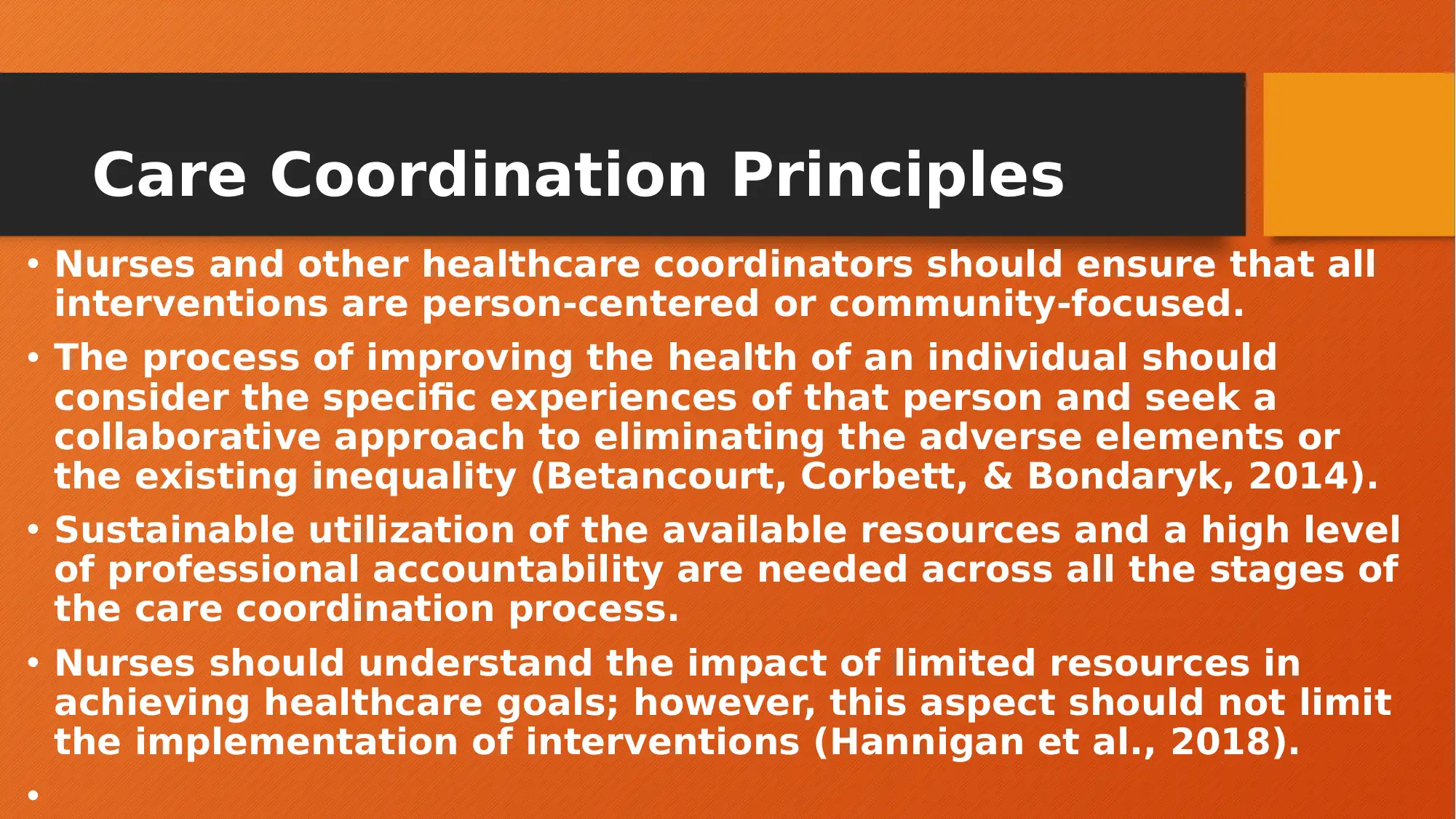
• Nurses and other healthcare coordinators should ensure that all
interventions are person-centered or community-focused.
• The process of improving the health of an individual should
consider the specific experiences of that person and seek a
collaborative approach to eliminating the adverse elements or
the existing inequality (Betancourt, Corbett, & Bondaryk, 2014).
• Sustainable utilization of the available resources and a high level
of professional accountability are needed across all the stages of
the care coordination process.
• Nurses should understand the impact of limited resources in
achieving healthcare goals; however, this aspect should not limit
the implementation of interventions (Hannigan et al., 2018).
•
• Nurses and other healthcare coordinators should ensure that all
interventions are person-centered or community-focused.
• The process of improving the health of an individual should
consider the specific experiences of that person and seek a
collaborative approach to eliminating the adverse elements or
the existing inequality (Betancourt, Corbett, & Bondaryk, 2014).
• Sustainable utilization of the available resources and a high level
of professional accountability are needed across all the stages of
the care coordination process.
• Nurses should understand the impact of limited resources in
achieving healthcare goals; however, this aspect should not limit
the implementation of interventions (Hannigan et al., 2018).
•

Care Coordination Principles
Cont.
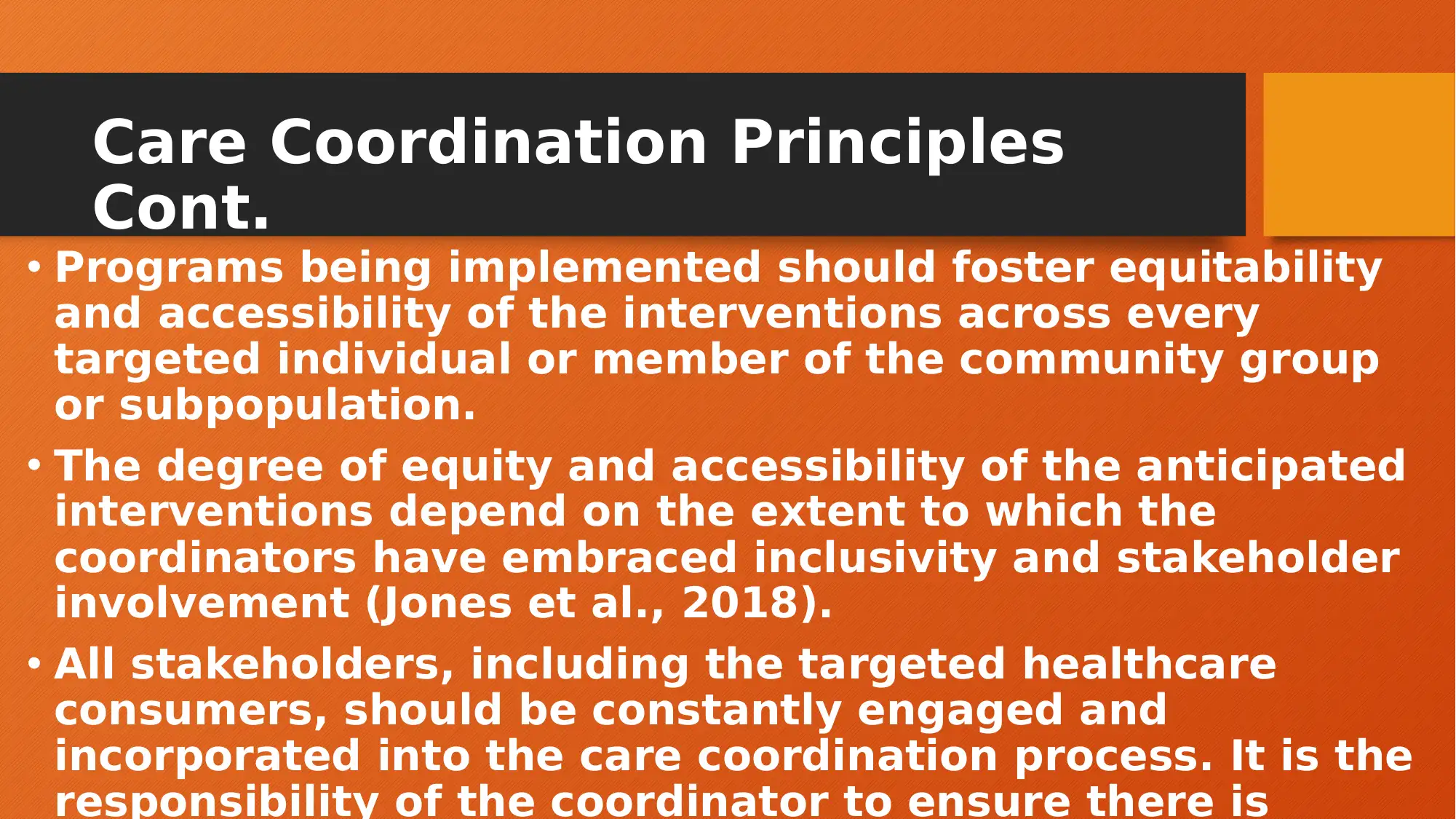
• Programs being implemented should foster equitability
and accessibility of the interventions across every
targeted individual or member of the community group
or subpopulation.
• The degree of equity and accessibility of the anticipated
interventions depend on the extent to which the
coordinators have embraced inclusivity and stakeholder
involvement (Jones et al., 2018).
• All stakeholders, including the targeted healthcare
consumers, should be constantly engaged and
incorporated into the care coordination process. It is the
responsibility of the coordinator to ensure there is
Cont.
• Programs being implemented should foster equitability
and accessibility of the interventions across every
targeted individual or member of the community group
or subpopulation.
• The degree of equity and accessibility of the anticipated
interventions depend on the extent to which the
coordinators have embraced inclusivity and stakeholder
involvement (Jones et al., 2018).
• All stakeholders, including the targeted healthcare
consumers, should be constantly engaged and
incorporated into the care coordination process. It is the
responsibility of the coordinator to ensure there is
⊘ This is a preview!⊘
Do you want full access?
Subscribe today to unlock all pages.

Trusted by 1+ million students worldwide

Care Coordination Principles
Cont.
• Additionally, care coordinators should foster safety and quality
services within the context of professional practice in healthcare.
• At the same time, there should be a high level of confidentiality
when handling patients’ data considered private.
• The practitioners are required to adhere to ethical practices while
planning, implementing, and evaluating the proposed
interventions.
• Finally the care coordination programs should be focused on
wellness. Coordinators should encourage wellness as a
component of effective healthcare services.
• In order for nurses to achieve effective wellness by encouraging
personalized interventions, they are expected to adhere to and
promoted culturally safe practices in healthcare (Li, Young, &
Cont.
• Additionally, care coordinators should foster safety and quality
services within the context of professional practice in healthcare.
• At the same time, there should be a high level of confidentiality
when handling patients’ data considered private.
• The practitioners are required to adhere to ethical practices while
planning, implementing, and evaluating the proposed
interventions.
• Finally the care coordination programs should be focused on
wellness. Coordinators should encourage wellness as a
component of effective healthcare services.
• In order for nurses to achieve effective wellness by encouraging
personalized interventions, they are expected to adhere to and
promoted culturally safe practices in healthcare (Li, Young, &
Paraphrase This Document
Need a fresh take? Get an instant paraphrase of this document with our AI Paraphraser

Strategies for Collaborating with
Patients and their Families
• The first strategy is involving the patient and the family in
decision making starting from the diagnostic state to prognosis
(Johnson & Abraham, 2012).
• The outcomes should be equally shared with the patient and the
family to ensure a proper communication framework exists
between the parties.
• It is important for the nurse to build a positive, professional, and
therapeutic relationship with the patient and the family by
focusing of trust and culture sensitivity.
• Leadership rotation and regular updates meeting among
practitioners could also be used to improve collaboration
between patients and practitioners (Johnson & Abraham, 2012).
Patients and their Families
• The first strategy is involving the patient and the family in
decision making starting from the diagnostic state to prognosis
(Johnson & Abraham, 2012).
• The outcomes should be equally shared with the patient and the
family to ensure a proper communication framework exists
between the parties.
• It is important for the nurse to build a positive, professional, and
therapeutic relationship with the patient and the family by
focusing of trust and culture sensitivity.
• Leadership rotation and regular updates meeting among
practitioners could also be used to improve collaboration
between patients and practitioners (Johnson & Abraham, 2012).

REFERENCES
• Agency for Healthcare Research and Quality. (2014, October). Care coordination. Available at:
http://www.ahrq.gov/professionals/prevention-chronic-care/improve/coordination/
• American Academy of Pediatrics. (2014). Patient- and family-centered care coordination: A framework for integrating care for
children and youth across multiple systems. Pediatrics, 133(5), e1451 – e1460.
• Betancourt, J. R., Corbett, J., & Bondaryk, M. R. (2014). Addressing disparities and achieving equity: Cultural competence,
ethics, and health-care transformation. Chest, 145(1), 143 – 148.
• Fani-Marvasti, F., & Stafford, R. S. (2012). From sick care to health care-reengineering prevention into the U.S. system. The New
England Journal of Medicine, 367(10), 889 – 891.
• Hannigan, B., Simpson, A., Coffey, M, Barlow, S., & Jones, A. (2018). Care Coordination as Imagined, Care Coordination as Done:
Findings from a Cross-national Mental Health Systems Study. International Journal of Integrated Care, 18(3): 12, 1–14.
• Johnson, B. H. & Abraham, M. A. (2012). Partnering with patients, residents, and families: a resource for leaders of hospitals,
ambulatory care settings, and long-term care communities Bethesda. MD: Institute for Patient- and Family-Centered Care.
• Jones, A., Hannigan, B., Coffey, M., & Simpson, A. (2018). Traditions of research into community mental health care planning
and care coordination: A meta-narrative review. PloS One, 13(6): e0198427.
• Li, J., Young, R., & Williams, M. V. (2014). Optimizing transitions of care to reduce rehospitalizations. Cleveland Clinic Journal of
Medicine, 81(5), 312 – 320.
• Rushton, S. (2015). The Population Care Coordination Process. Professional Case Management, 20(5), 230 – 238.
• Agency for Healthcare Research and Quality. (2014, October). Care coordination. Available at:
http://www.ahrq.gov/professionals/prevention-chronic-care/improve/coordination/
• American Academy of Pediatrics. (2014). Patient- and family-centered care coordination: A framework for integrating care for
children and youth across multiple systems. Pediatrics, 133(5), e1451 – e1460.
• Betancourt, J. R., Corbett, J., & Bondaryk, M. R. (2014). Addressing disparities and achieving equity: Cultural competence,
ethics, and health-care transformation. Chest, 145(1), 143 – 148.
• Fani-Marvasti, F., & Stafford, R. S. (2012). From sick care to health care-reengineering prevention into the U.S. system. The New
England Journal of Medicine, 367(10), 889 – 891.
• Hannigan, B., Simpson, A., Coffey, M, Barlow, S., & Jones, A. (2018). Care Coordination as Imagined, Care Coordination as Done:
Findings from a Cross-national Mental Health Systems Study. International Journal of Integrated Care, 18(3): 12, 1–14.
• Johnson, B. H. & Abraham, M. A. (2012). Partnering with patients, residents, and families: a resource for leaders of hospitals,
ambulatory care settings, and long-term care communities Bethesda. MD: Institute for Patient- and Family-Centered Care.
• Jones, A., Hannigan, B., Coffey, M., & Simpson, A. (2018). Traditions of research into community mental health care planning
and care coordination: A meta-narrative review. PloS One, 13(6): e0198427.
• Li, J., Young, R., & Williams, M. V. (2014). Optimizing transitions of care to reduce rehospitalizations. Cleveland Clinic Journal of
Medicine, 81(5), 312 – 320.
• Rushton, S. (2015). The Population Care Coordination Process. Professional Case Management, 20(5), 230 – 238.
⊘ This is a preview!⊘
Do you want full access?
Subscribe today to unlock all pages.

Trusted by 1+ million students worldwide
1 out of 12
Related Documents
Your All-in-One AI-Powered Toolkit for Academic Success.
+13062052269
info@desklib.com
Available 24*7 on WhatsApp / Email
Unlock your academic potential
Copyright © 2020–2025 A2Z Services. All Rights Reserved. Developed and managed by ZUCOL.