Palliative Care Standards: A Case Study on Dignity of Dying Patient
VerifiedAdded on 2023/01/06
|13
|4258
|89
Case Study
AI Summary
This case study explores the critical aspects of palliative care for a dying patient, emphasizing the importance of maintaining dignity and adhering to healthcare standards such as NSQHSS and NMBA. It delves into the physical, emotional, and spiritual needs of patients, highlighting the role of nurses and other healthcare professionals in providing comprehensive support. The case of Frank Rosie, a 60-year-old male with a complex medical history, illustrates the challenges and considerations in end-of-life care, including pain management, communication, and respecting patient autonomy. The study underscores the necessity of treating patients with respect and compassion, ensuring their comfort and well-being during their final stages of life, while also addressing the needs of their families.
Care of the Dying
Patient
Patient

Paraphrase This Document
Need a fresh take? Get an instant paraphrase of this document with our AI Paraphraser
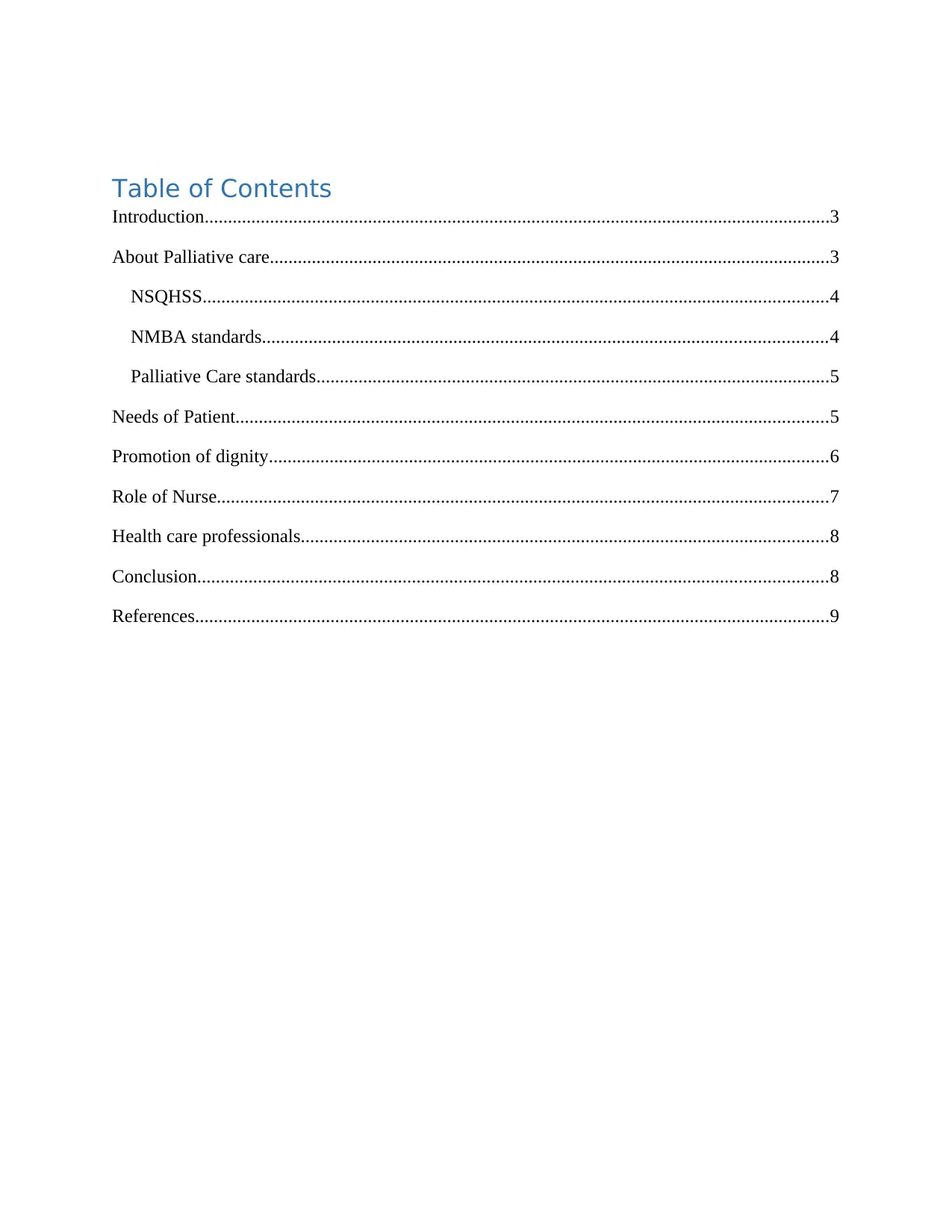
Table of Contents
Introduction......................................................................................................................................3
About Palliative care........................................................................................................................3
NSQHSS......................................................................................................................................4
NMBA standards.........................................................................................................................4
Palliative Care standards..............................................................................................................5
Needs of Patient...............................................................................................................................5
Promotion of dignity........................................................................................................................6
Role of Nurse...................................................................................................................................7
Health care professionals.................................................................................................................8
Conclusion.......................................................................................................................................8
References........................................................................................................................................9
Introduction......................................................................................................................................3
About Palliative care........................................................................................................................3
NSQHSS......................................................................................................................................4
NMBA standards.........................................................................................................................4
Palliative Care standards..............................................................................................................5
Needs of Patient...............................................................................................................................5
Promotion of dignity........................................................................................................................6
Role of Nurse...................................................................................................................................7
Health care professionals.................................................................................................................8
Conclusion.......................................................................................................................................8
References........................................................................................................................................9
Introduction
When the words "patient dignity" are heard, it will generally be considered to show the patient
that they are, probably, worthy of respect and esteem. While it doesn't seem to argue that tolerant
poaching is an important idea, it is much more difficult to incorporate this theoretical view into
the clinical context. Maintaining ongoing compliance is something we often hear mentioned as
we talk about mitigation consideration levels; at least it is conceivable that this almost turns into
a futile repetition of little significance to the nature of the care the patient is actually receiving.
The purpose of this paper is to consider why respect is important in considering the discount and
how the idea of pride can affect a person's daily practice.
About Palliative care
Palliative care can be used to help counteract most of the time (e.g. malignant tumors, COPD,
and HIV) and allow the patient to die in agreed conditions. For example: patients with end-stage
chronic COPD aspirator disease (1). He certainly experiences breathing problems, fatigue,
frustration and pain, and the pile largely affects the state of mind, for example, sadness,
discomfort, fear. Therefore, we can consider a discount:
The most important part of palliative care is physical support for the inclusion of individual
cleansing, pain control and reduction of breathing problems, hard nutrition and getting rid of it.
The patient suffers from depression, anxiety, fear and mental disorders due to his condition
which requires mental help.
Promote other help through conversation about faith, trust and belief. Likewise, empower and
support the patient to spend their daily lives serenely and allow them to plan with hope. Also,
fully support the activity of the rituals and its deep affirmations.
The family supported the expression of sympathy and empathy and gave them advice and asked
them to build the patient’s affirmation through his near and near presence, as well as persuading
them to intervene in the patient's situation. In addition, family support has a greater impact on the
patient's mind.
When the words "patient dignity" are heard, it will generally be considered to show the patient
that they are, probably, worthy of respect and esteem. While it doesn't seem to argue that tolerant
poaching is an important idea, it is much more difficult to incorporate this theoretical view into
the clinical context. Maintaining ongoing compliance is something we often hear mentioned as
we talk about mitigation consideration levels; at least it is conceivable that this almost turns into
a futile repetition of little significance to the nature of the care the patient is actually receiving.
The purpose of this paper is to consider why respect is important in considering the discount and
how the idea of pride can affect a person's daily practice.
About Palliative care
Palliative care can be used to help counteract most of the time (e.g. malignant tumors, COPD,
and HIV) and allow the patient to die in agreed conditions. For example: patients with end-stage
chronic COPD aspirator disease (1). He certainly experiences breathing problems, fatigue,
frustration and pain, and the pile largely affects the state of mind, for example, sadness,
discomfort, fear. Therefore, we can consider a discount:
The most important part of palliative care is physical support for the inclusion of individual
cleansing, pain control and reduction of breathing problems, hard nutrition and getting rid of it.
The patient suffers from depression, anxiety, fear and mental disorders due to his condition
which requires mental help.
Promote other help through conversation about faith, trust and belief. Likewise, empower and
support the patient to spend their daily lives serenely and allow them to plan with hope. Also,
fully support the activity of the rituals and its deep affirmations.
The family supported the expression of sympathy and empathy and gave them advice and asked
them to build the patient’s affirmation through his near and near presence, as well as persuading
them to intervene in the patient's situation. In addition, family support has a greater impact on the
patient's mind.
⊘ This is a preview!⊘
Do you want full access?
Subscribe today to unlock all pages.

Trusted by 1+ million students worldwide
The notions of respect, autonomy, reinforcement and letters are recognized within writing as key
characteristics of a character of balance. As such, each of these features is multifaceted, further
adding to the invisible and curious nature of the idea. For example, attention may include
respect, respect for others and respect for the safety of individuals; self-reliance can include
determination, determination, determination, skill and self-knowledge; strengthening can include
confidence, self-esteem, stillness and pride; and letters can include clarification and
understanding of data using verbal and non-verbal methods (2).
Like these lines, the idea of discounting is a successful business and it is important that this
situation provides the best possible personal satisfaction. To measure the personal satisfaction of
COPD patients, the St. George's Respiratory Questionnaire (SGRQ) must be completed.
However, when the inability to assess the patient's mental disorder can occasionally result in real
results, such as sadness and depression with impaired intellectual capacity. Further as identified
by "Chest physicians and masters of respiratory medical care have a vital role to play in ensuring
that patients who kick the bucket of COPD are considered 'optimizing'.
Frank Rosie is a 60 year old male and he was born in Italy. Frank has experienced some
confusion at work and he used to get seizur Off unknown origin which was witnessed by
grandchildren and wife. Frank was then transported under the care of paramedics in the
emergency Department of Metropolitan hospital. He used to spend his time in General Medical
world. Who was shifted to palliative care unit in an outer City Hospital. It was in his records that
he used to smoke a packet of cigarettes daily before he was 25 years old. It is also seen that
Frank is having vital signs upon admission in medical world Witcher abnormal flexion from
pain. Frank was having confusion and inability to recognize his wife. Pupil size of both his eyes
were unequal and light reflects was also sluggish. There was a MRI conducted for Frank which
showed that there are some abnormalities in temporal and frontal region. Frank has to experience
an increase of intra cranial pressure. It was discussed among the health practitioners that
metastatistics celebral tumorsWere there and there is rapid tumor growth within frontal lobe of
France. It was decided by his wife that surgical tumor resection as a palliative measure will be
allowed. Family of Frank advised to discuss and complete an advanced care directive. Frank was
offered palliative radiotherapy which included inpatient palliative care units closer to the family
members. Frank provided an information to medical and nursing staff that his father had died
characteristics of a character of balance. As such, each of these features is multifaceted, further
adding to the invisible and curious nature of the idea. For example, attention may include
respect, respect for others and respect for the safety of individuals; self-reliance can include
determination, determination, determination, skill and self-knowledge; strengthening can include
confidence, self-esteem, stillness and pride; and letters can include clarification and
understanding of data using verbal and non-verbal methods (2).
Like these lines, the idea of discounting is a successful business and it is important that this
situation provides the best possible personal satisfaction. To measure the personal satisfaction of
COPD patients, the St. George's Respiratory Questionnaire (SGRQ) must be completed.
However, when the inability to assess the patient's mental disorder can occasionally result in real
results, such as sadness and depression with impaired intellectual capacity. Further as identified
by "Chest physicians and masters of respiratory medical care have a vital role to play in ensuring
that patients who kick the bucket of COPD are considered 'optimizing'.
Frank Rosie is a 60 year old male and he was born in Italy. Frank has experienced some
confusion at work and he used to get seizur Off unknown origin which was witnessed by
grandchildren and wife. Frank was then transported under the care of paramedics in the
emergency Department of Metropolitan hospital. He used to spend his time in General Medical
world. Who was shifted to palliative care unit in an outer City Hospital. It was in his records that
he used to smoke a packet of cigarettes daily before he was 25 years old. It is also seen that
Frank is having vital signs upon admission in medical world Witcher abnormal flexion from
pain. Frank was having confusion and inability to recognize his wife. Pupil size of both his eyes
were unequal and light reflects was also sluggish. There was a MRI conducted for Frank which
showed that there are some abnormalities in temporal and frontal region. Frank has to experience
an increase of intra cranial pressure. It was discussed among the health practitioners that
metastatistics celebral tumorsWere there and there is rapid tumor growth within frontal lobe of
France. It was decided by his wife that surgical tumor resection as a palliative measure will be
allowed. Family of Frank advised to discuss and complete an advanced care directive. Frank was
offered palliative radiotherapy which included inpatient palliative care units closer to the family
members. Frank provided an information to medical and nursing staff that his father had died
Paraphrase This Document
Need a fresh take? Get an instant paraphrase of this document with our AI Paraphraser
from GB M. He told that Sofia was medical power of attorney ah Frank and he presented a
paperwork in order to support the admitting palliative care team. When there was a rival in
admission to palliative care then physiotherapist revu worst controlled in order to increase
Paristhesia and weakening in legs of Frank. The care provided to Frank within palliative care
unit was Offered as he was welcomed by a registered nurse who was assigned to undertook all
the assessments and discussions between wife, daughter and Frank. This registered nurse has all
the detailed information about condition of Frank and he is allowed to manage the condition of
Frank and stop him from deteriorating Phase. Frank was admitted in palliative care unit where he
was in bad condition. He had a fall overnight when he was trying to get to toilet. In the morning,
nurse saw that he was Not in his bed. He stated that his feet felt numb. Then he was reviewed by
night General Medical registrar who inserted an IDC into Frank. For conducting a bladder scan,
this nurse did the wrong thing. While the procedure of medical and nursing staffwas going on,
Frank had a breakthrough off morphine and it created discomfort for him. There was
neurological assessment with lower limb weakness and he used to experience skin tears, breaks
in head and body , helplessness. Next day, there was shift nurse who walked and introduce
herself and found that his wife left Frank an hour ago and his breathing is shallow and short. The
palliative care team reviewed that Frank has recognized symptoms of terminal restlessness. Sofia
agrees for sub cutaneous medication which will be given to Frank. According to the present
scenario, Frank is fully bedbound and he is controlled in terminal palliative care. The treatment
given to Frank was not adequate as he was treated in a really bad manner. People Then and also
they are treating him as he is a burden. According to these standards for registered nurses, this is
not fair as they have to treat all patients equally without judging them on the basis of their
disease or living span time.
Role of Nurse
The connection between nurse and patient will be the restorative relationship in order to be
fertile the relationship must be present which the association, commonality and commonality
meet in the rehabilitative experience between the treating physician and the patient (15). The role
of a nurse in palliative care plays an important role in working together for the benefit of the
individual and in the patient and family setting. Offer important action in supportive thinking
that allows the patient and family to adjust to their situation and treatment to measure from
paperwork in order to support the admitting palliative care team. When there was a rival in
admission to palliative care then physiotherapist revu worst controlled in order to increase
Paristhesia and weakening in legs of Frank. The care provided to Frank within palliative care
unit was Offered as he was welcomed by a registered nurse who was assigned to undertook all
the assessments and discussions between wife, daughter and Frank. This registered nurse has all
the detailed information about condition of Frank and he is allowed to manage the condition of
Frank and stop him from deteriorating Phase. Frank was admitted in palliative care unit where he
was in bad condition. He had a fall overnight when he was trying to get to toilet. In the morning,
nurse saw that he was Not in his bed. He stated that his feet felt numb. Then he was reviewed by
night General Medical registrar who inserted an IDC into Frank. For conducting a bladder scan,
this nurse did the wrong thing. While the procedure of medical and nursing staffwas going on,
Frank had a breakthrough off morphine and it created discomfort for him. There was
neurological assessment with lower limb weakness and he used to experience skin tears, breaks
in head and body , helplessness. Next day, there was shift nurse who walked and introduce
herself and found that his wife left Frank an hour ago and his breathing is shallow and short. The
palliative care team reviewed that Frank has recognized symptoms of terminal restlessness. Sofia
agrees for sub cutaneous medication which will be given to Frank. According to the present
scenario, Frank is fully bedbound and he is controlled in terminal palliative care. The treatment
given to Frank was not adequate as he was treated in a really bad manner. People Then and also
they are treating him as he is a burden. According to these standards for registered nurses, this is
not fair as they have to treat all patients equally without judging them on the basis of their
disease or living span time.
Role of Nurse
The connection between nurse and patient will be the restorative relationship in order to be
fertile the relationship must be present which the association, commonality and commonality
meet in the rehabilitative experience between the treating physician and the patient (15). The role
of a nurse in palliative care plays an important role in working together for the benefit of the
individual and in the patient and family setting. Offer important action in supportive thinking
that allows the patient and family to adjust to their situation and treatment to measure from
anticipation, going through analysis and treatment, to correction, going forward with their
disease and transition. This encourages the patient to reap the maximum benefits from treatment
and to survive the effects of the disease (NCPC, 2009). Nursing work includes the reduction of
physical and mental distress, the treatment of torment and the treatment of associated symptoms,
aiding mental recovery and social isolation and recovery to achieve and provide appropriate
personal satisfaction in pleasurable settings (14).
NSQHSS
NSQHS Standards were delivered in November 2017. These are prepared for wellbeing
administration associations for analyzing the change plans for accreditation well ahead of time of
execution. There is involvement of Australian Government, state and region accomplices,
wellbeing administration associations, purchasers, top bodies and intrigue gatherings. The
second version of the NSQHS Standards tends to holes recognized in the primary release,
including psychological wellness and intellectual impedance, wellbeing education, end-of-life
care, and Aboriginal and Torres Strait Islander wellbeing. These standards are followed by each
and every healthcare organisation for providing services to patients.
NMBA standards
In context of Frank’s services, it has been analyzed that healthcare nurse must use these
standards in his working abilities so that patients are taken care in well manner. The Registered
medical caretaker principles for training comprise of the accompanying seven norms: Thinks
basically and examinations nursing practice, participates in restorative and expert connections,
Keeps up the ability for training, Extensively directs appraisals, Builds up an arrangement for
nursing practice., Gives protected, proper and responsive quality nursing practice, Assesses
results to advise nursing practice. These all are used for managing the services provided to Frank
by the nurse.
Palliative Care standards
Palliative consideration ought to be emphatically receptive to the requirements,
inclinations and estimations of individuals, their families and carers. An individual and family-
focused way to deal with palliative consideration depends on successful correspondence, mutual
disease and transition. This encourages the patient to reap the maximum benefits from treatment
and to survive the effects of the disease (NCPC, 2009). Nursing work includes the reduction of
physical and mental distress, the treatment of torment and the treatment of associated symptoms,
aiding mental recovery and social isolation and recovery to achieve and provide appropriate
personal satisfaction in pleasurable settings (14).
NSQHSS
NSQHS Standards were delivered in November 2017. These are prepared for wellbeing
administration associations for analyzing the change plans for accreditation well ahead of time of
execution. There is involvement of Australian Government, state and region accomplices,
wellbeing administration associations, purchasers, top bodies and intrigue gatherings. The
second version of the NSQHS Standards tends to holes recognized in the primary release,
including psychological wellness and intellectual impedance, wellbeing education, end-of-life
care, and Aboriginal and Torres Strait Islander wellbeing. These standards are followed by each
and every healthcare organisation for providing services to patients.
NMBA standards
In context of Frank’s services, it has been analyzed that healthcare nurse must use these
standards in his working abilities so that patients are taken care in well manner. The Registered
medical caretaker principles for training comprise of the accompanying seven norms: Thinks
basically and examinations nursing practice, participates in restorative and expert connections,
Keeps up the ability for training, Extensively directs appraisals, Builds up an arrangement for
nursing practice., Gives protected, proper and responsive quality nursing practice, Assesses
results to advise nursing practice. These all are used for managing the services provided to Frank
by the nurse.
Palliative Care standards
Palliative consideration ought to be emphatically receptive to the requirements,
inclinations and estimations of individuals, their families and carers. An individual and family-
focused way to deal with palliative consideration depends on successful correspondence, mutual
⊘ This is a preview!⊘
Do you want full access?
Subscribe today to unlock all pages.
Trusted by 1+ million students worldwide
dynamic and individual self-rule. Palliative consideration ought to be accessible to all individuals
living with a functioning, reformist, progressed illness, paying little mind to the finding. In
context of Frank’s treatment, it is considered that he is provided proper services that are going to
help him to get well soon.
Needs of Patient
“What concrete recommendations will this theoretical and multifaceted idea have for patients
who need end-of-life care?” There are two main components that influence the preservation of
pride towards end of life promote respect and the approach to the delayed patient (3); however,
how are the latter defined in a mitigation consideration? Most end-of-life media focus on
controlling publication rather than full consideration (4). In this way, it may be helpful to
consider the physical, passion and island needs of patients in the contexts of mitigating
consideration.
In terms of needs, when trying to develop and save pride, a close examination found that
controlling the event and being placed in the right weather is important in providing end-of-life
care decorative (5). Good management of physical issues, for example, pain, dyspnea, block,
nausea, and respiratory disturbances can consider the possibilities of working on other
passionate, mental, and imperfect issues and improve mood of near-end-of-life determination (6).
However, violent and inappropriate testing should be conducted at a strategic distance from (7).
In terms of needs, a study found that important functions for medical care specialists providing
end-of-life care include referral, attraction, sympathetic transmission, and inclusion of patients in
dynamics (8). In addition, extensive communication should take place between the patient and
the supporter about their feelings (9).
Other needs in the world should also be affected (7). An observational study evaluated the other
needs of patients with late malignant growth. The two most relevant needs that should be seen as
an individual to the end are to live without losing one's character and the need to know the truth
about the disease. Less important were concerns about the past and the future and about tensions
(10). Of course, since deep consideration goes beyond the religious standard, it implies more
than just encouraging admission to competent ministers. Any medical service can be considered
living with a functioning, reformist, progressed illness, paying little mind to the finding. In
context of Frank’s treatment, it is considered that he is provided proper services that are going to
help him to get well soon.
Needs of Patient
“What concrete recommendations will this theoretical and multifaceted idea have for patients
who need end-of-life care?” There are two main components that influence the preservation of
pride towards end of life promote respect and the approach to the delayed patient (3); however,
how are the latter defined in a mitigation consideration? Most end-of-life media focus on
controlling publication rather than full consideration (4). In this way, it may be helpful to
consider the physical, passion and island needs of patients in the contexts of mitigating
consideration.
In terms of needs, when trying to develop and save pride, a close examination found that
controlling the event and being placed in the right weather is important in providing end-of-life
care decorative (5). Good management of physical issues, for example, pain, dyspnea, block,
nausea, and respiratory disturbances can consider the possibilities of working on other
passionate, mental, and imperfect issues and improve mood of near-end-of-life determination (6).
However, violent and inappropriate testing should be conducted at a strategic distance from (7).
In terms of needs, a study found that important functions for medical care specialists providing
end-of-life care include referral, attraction, sympathetic transmission, and inclusion of patients in
dynamics (8). In addition, extensive communication should take place between the patient and
the supporter about their feelings (9).
Other needs in the world should also be affected (7). An observational study evaluated the other
needs of patients with late malignant growth. The two most relevant needs that should be seen as
an individual to the end are to live without losing one's character and the need to know the truth
about the disease. Less important were concerns about the past and the future and about tensions
(10). Of course, since deep consideration goes beyond the religious standard, it implies more
than just encouraging admission to competent ministers. Any medical service can be considered
Paraphrase This Document
Need a fresh take? Get an instant paraphrase of this document with our AI Paraphraser
in depth by being available, understanding the patient's point of view, and making a
comprehensive patient-to-patient consideration plan that takes compliance issues into account
(11).
Various hypotheses found to promote respect include enhancing account management,
encouraging exercises, for example, spying or watching TV, allowing patients to invest energy
with their family, make decisions about the whereabouts of death, remember the nobles of the
family after the individual has died and offer passionate help (7). Additionally, life reports have
been shown to help people with dementia maintain a sense of personality. This can be useful in
further end-of-life care and can help caregivers understand the patient's needs (12).
A patient's age can influence how a person evaluates compliance in end of life care. For example,
in a study examining the characteristics of "severe depression" for children with malignant
growth, the importance of caring for "lumpiness" was long overdue. Therefore, the child should
be given ample opportunities to play without hindrance, get into their normal routines and
connections, feel recognized and respected by others the patient's youth and indicative
observation. There should also be less emphasis on passing skill.
A unique association of the mitigation group supports a sense of pride as the emphasis is less on
chance and more on the individual (16). Measures, for example, experimenting with new housing
structures or being introduced by different staff and residents seem to encourage a sense of
respect among the heads of the household - nursing - measures that can be transferred to discount
rates (17).
Feelings of depersonalization reduce the patient's perception of balance (10); therefore knowing
the patient as an individual can help promote respect. Patient Dignity Question (PDQ) "What do
I need to think about as an individual to give you the best possible attention?" was born for
patients with palliative care needs by Chochinov to combat this remodeling associated with
modern medicine (20).
The PDQ was satisfactory for patients with a need for palliative care (21). This research was
found to improve the climate with individual focus and levels of empathy seen by patients, and
also confirmed the disclosure of existing data to medical services specialists (medical services
specialists) (22).
comprehensive patient-to-patient consideration plan that takes compliance issues into account
(11).
Various hypotheses found to promote respect include enhancing account management,
encouraging exercises, for example, spying or watching TV, allowing patients to invest energy
with their family, make decisions about the whereabouts of death, remember the nobles of the
family after the individual has died and offer passionate help (7). Additionally, life reports have
been shown to help people with dementia maintain a sense of personality. This can be useful in
further end-of-life care and can help caregivers understand the patient's needs (12).
A patient's age can influence how a person evaluates compliance in end of life care. For example,
in a study examining the characteristics of "severe depression" for children with malignant
growth, the importance of caring for "lumpiness" was long overdue. Therefore, the child should
be given ample opportunities to play without hindrance, get into their normal routines and
connections, feel recognized and respected by others the patient's youth and indicative
observation. There should also be less emphasis on passing skill.
A unique association of the mitigation group supports a sense of pride as the emphasis is less on
chance and more on the individual (16). Measures, for example, experimenting with new housing
structures or being introduced by different staff and residents seem to encourage a sense of
respect among the heads of the household - nursing - measures that can be transferred to discount
rates (17).
Feelings of depersonalization reduce the patient's perception of balance (10); therefore knowing
the patient as an individual can help promote respect. Patient Dignity Question (PDQ) "What do
I need to think about as an individual to give you the best possible attention?" was born for
patients with palliative care needs by Chochinov to combat this remodeling associated with
modern medicine (20).
The PDQ was satisfactory for patients with a need for palliative care (21). This research was
found to improve the climate with individual focus and levels of empathy seen by patients, and
also confirmed the disclosure of existing data to medical services specialists (medical services
specialists) (22).
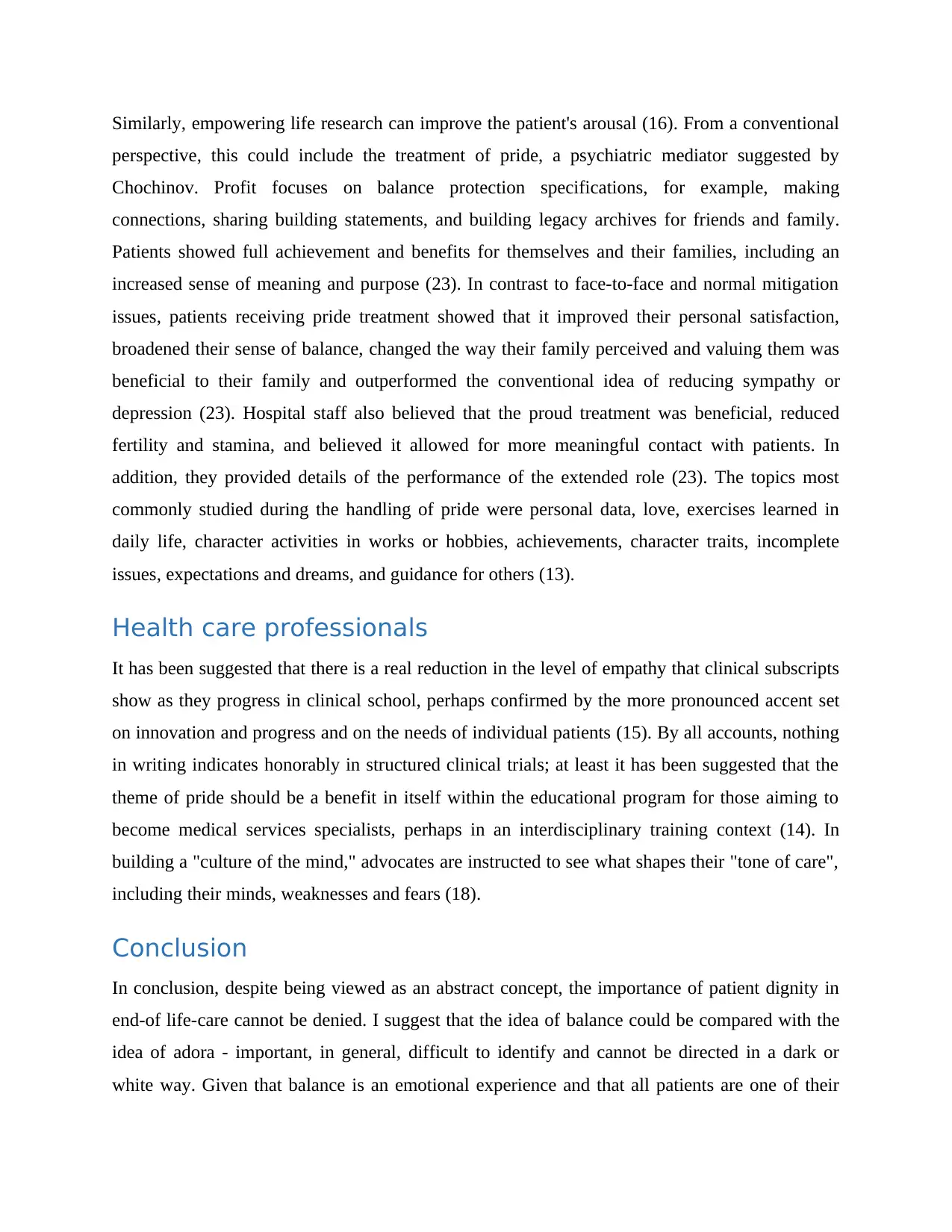
Similarly, empowering life research can improve the patient's arousal (16). From a conventional
perspective, this could include the treatment of pride, a psychiatric mediator suggested by
Chochinov. Profit focuses on balance protection specifications, for example, making
connections, sharing building statements, and building legacy archives for friends and family.
Patients showed full achievement and benefits for themselves and their families, including an
increased sense of meaning and purpose (23). In contrast to face-to-face and normal mitigation
issues, patients receiving pride treatment showed that it improved their personal satisfaction,
broadened their sense of balance, changed the way their family perceived and valuing them was
beneficial to their family and outperformed the conventional idea of reducing sympathy or
depression (23). Hospital staff also believed that the proud treatment was beneficial, reduced
fertility and stamina, and believed it allowed for more meaningful contact with patients. In
addition, they provided details of the performance of the extended role (23). The topics most
commonly studied during the handling of pride were personal data, love, exercises learned in
daily life, character activities in works or hobbies, achievements, character traits, incomplete
issues, expectations and dreams, and guidance for others (13).
Health care professionals
It has been suggested that there is a real reduction in the level of empathy that clinical subscripts
show as they progress in clinical school, perhaps confirmed by the more pronounced accent set
on innovation and progress and on the needs of individual patients (15). By all accounts, nothing
in writing indicates honorably in structured clinical trials; at least it has been suggested that the
theme of pride should be a benefit in itself within the educational program for those aiming to
become medical services specialists, perhaps in an interdisciplinary training context (14). In
building a "culture of the mind," advocates are instructed to see what shapes their "tone of care",
including their minds, weaknesses and fears (18).
Conclusion
In conclusion, despite being viewed as an abstract concept, the importance of patient dignity in
end-of life-care cannot be denied. I suggest that the idea of balance could be compared with the
idea of adora - important, in general, difficult to identify and cannot be directed in a dark or
white way. Given that balance is an emotional experience and that all patients are one of their
perspective, this could include the treatment of pride, a psychiatric mediator suggested by
Chochinov. Profit focuses on balance protection specifications, for example, making
connections, sharing building statements, and building legacy archives for friends and family.
Patients showed full achievement and benefits for themselves and their families, including an
increased sense of meaning and purpose (23). In contrast to face-to-face and normal mitigation
issues, patients receiving pride treatment showed that it improved their personal satisfaction,
broadened their sense of balance, changed the way their family perceived and valuing them was
beneficial to their family and outperformed the conventional idea of reducing sympathy or
depression (23). Hospital staff also believed that the proud treatment was beneficial, reduced
fertility and stamina, and believed it allowed for more meaningful contact with patients. In
addition, they provided details of the performance of the extended role (23). The topics most
commonly studied during the handling of pride were personal data, love, exercises learned in
daily life, character activities in works or hobbies, achievements, character traits, incomplete
issues, expectations and dreams, and guidance for others (13).
Health care professionals
It has been suggested that there is a real reduction in the level of empathy that clinical subscripts
show as they progress in clinical school, perhaps confirmed by the more pronounced accent set
on innovation and progress and on the needs of individual patients (15). By all accounts, nothing
in writing indicates honorably in structured clinical trials; at least it has been suggested that the
theme of pride should be a benefit in itself within the educational program for those aiming to
become medical services specialists, perhaps in an interdisciplinary training context (14). In
building a "culture of the mind," advocates are instructed to see what shapes their "tone of care",
including their minds, weaknesses and fears (18).
Conclusion
In conclusion, despite being viewed as an abstract concept, the importance of patient dignity in
end-of life-care cannot be denied. I suggest that the idea of balance could be compared with the
idea of adora - important, in general, difficult to identify and cannot be directed in a dark or
white way. Given that balance is an emotional experience and that all patients are one of their
⊘ This is a preview!⊘
Do you want full access?
Subscribe today to unlock all pages.
Trusted by 1+ million students worldwide
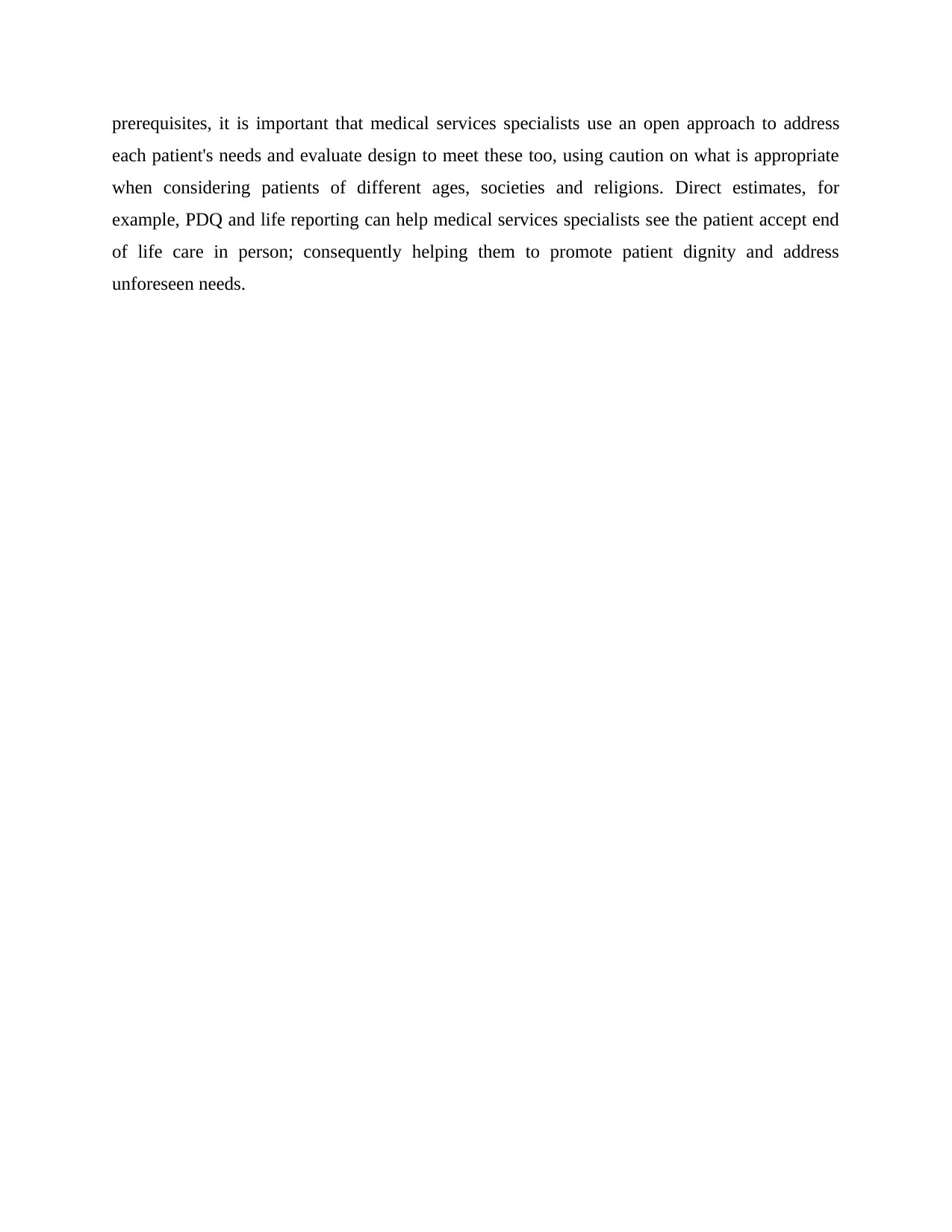
prerequisites, it is important that medical services specialists use an open approach to address
each patient's needs and evaluate design to meet these too, using caution on what is appropriate
when considering patients of different ages, societies and religions. Direct estimates, for
example, PDQ and life reporting can help medical services specialists see the patient accept end
of life care in person; consequently helping them to promote patient dignity and address
unforeseen needs.
each patient's needs and evaluate design to meet these too, using caution on what is appropriate
when considering patients of different ages, societies and religions. Direct estimates, for
example, PDQ and life reporting can help medical services specialists see the patient accept end
of life care in person; consequently helping them to promote patient dignity and address
unforeseen needs.
Paraphrase This Document
Need a fresh take? Get an instant paraphrase of this document with our AI Paraphraser
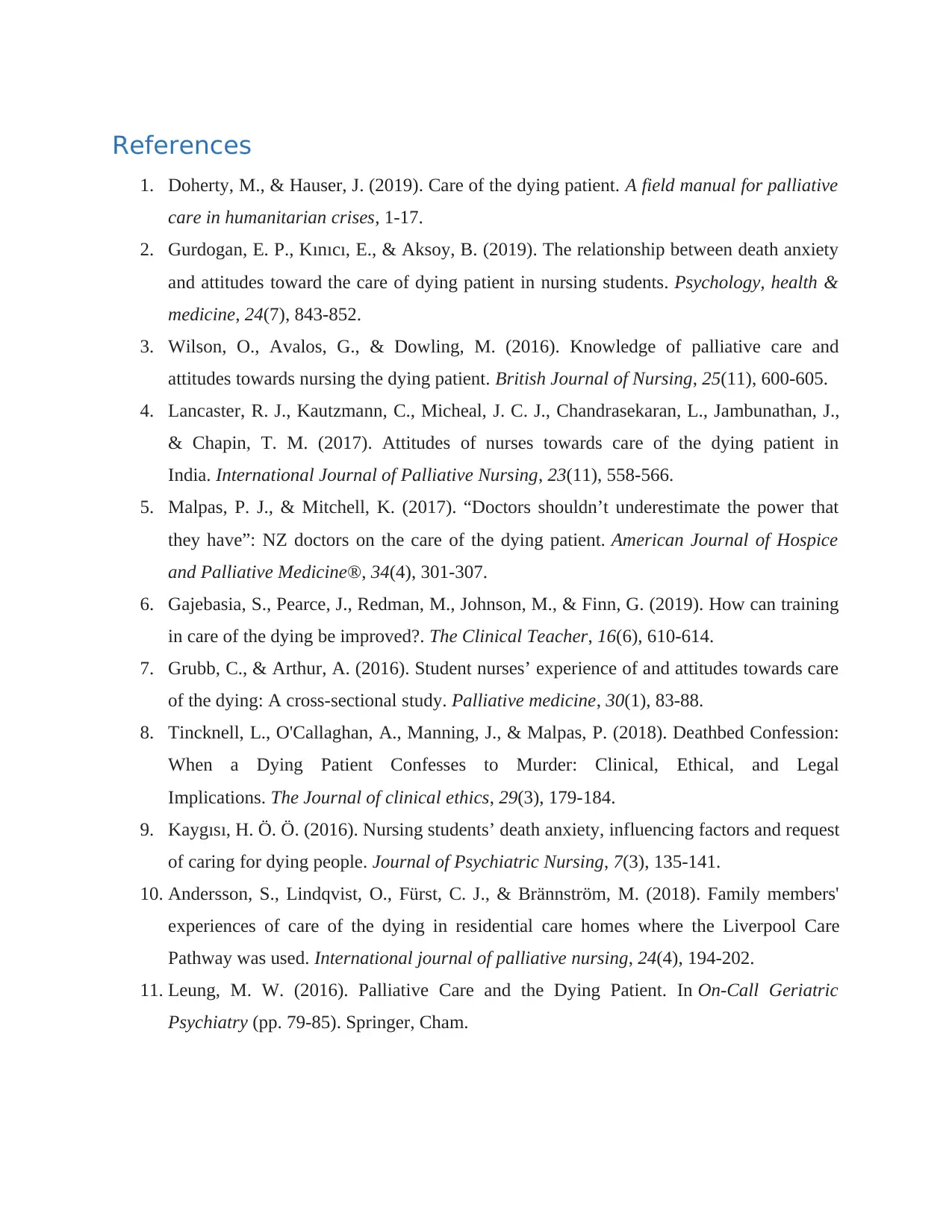
References
1. Doherty, M., & Hauser, J. (2019). Care of the dying patient. A field manual for palliative
care in humanitarian crises, 1-17.
2. Gurdogan, E. P., Kınıcı, E., & Aksoy, B. (2019). The relationship between death anxiety
and attitudes toward the care of dying patient in nursing students. Psychology, health &
medicine, 24(7), 843-852.
3. Wilson, O., Avalos, G., & Dowling, M. (2016). Knowledge of palliative care and
attitudes towards nursing the dying patient. British Journal of Nursing, 25(11), 600-605.
4. Lancaster, R. J., Kautzmann, C., Micheal, J. C. J., Chandrasekaran, L., Jambunathan, J.,
& Chapin, T. M. (2017). Attitudes of nurses towards care of the dying patient in
India. International Journal of Palliative Nursing, 23(11), 558-566.
5. Malpas, P. J., & Mitchell, K. (2017). “Doctors shouldn’t underestimate the power that
they have”: NZ doctors on the care of the dying patient. American Journal of Hospice
and Palliative Medicine®, 34(4), 301-307.
6. Gajebasia, S., Pearce, J., Redman, M., Johnson, M., & Finn, G. (2019). How can training
in care of the dying be improved?. The Clinical Teacher, 16(6), 610-614.
7. Grubb, C., & Arthur, A. (2016). Student nurses’ experience of and attitudes towards care
of the dying: A cross-sectional study. Palliative medicine, 30(1), 83-88.
8. Tincknell, L., O'Callaghan, A., Manning, J., & Malpas, P. (2018). Deathbed Confession:
When a Dying Patient Confesses to Murder: Clinical, Ethical, and Legal
Implications. The Journal of clinical ethics, 29(3), 179-184.
9. Kaygısı, H. Ö. Ö. (2016). Nursing students’ death anxiety, influencing factors and request
of caring for dying people. Journal of Psychiatric Nursing, 7(3), 135-141.
10. Andersson, S., Lindqvist, O., Fürst, C. J., & Brännström, M. (2018). Family members'
experiences of care of the dying in residential care homes where the Liverpool Care
Pathway was used. International journal of palliative nursing, 24(4), 194-202.
11. Leung, M. W. (2016). Palliative Care and the Dying Patient. In On-Call Geriatric
Psychiatry (pp. 79-85). Springer, Cham.
1. Doherty, M., & Hauser, J. (2019). Care of the dying patient. A field manual for palliative
care in humanitarian crises, 1-17.
2. Gurdogan, E. P., Kınıcı, E., & Aksoy, B. (2019). The relationship between death anxiety
and attitudes toward the care of dying patient in nursing students. Psychology, health &
medicine, 24(7), 843-852.
3. Wilson, O., Avalos, G., & Dowling, M. (2016). Knowledge of palliative care and
attitudes towards nursing the dying patient. British Journal of Nursing, 25(11), 600-605.
4. Lancaster, R. J., Kautzmann, C., Micheal, J. C. J., Chandrasekaran, L., Jambunathan, J.,
& Chapin, T. M. (2017). Attitudes of nurses towards care of the dying patient in
India. International Journal of Palliative Nursing, 23(11), 558-566.
5. Malpas, P. J., & Mitchell, K. (2017). “Doctors shouldn’t underestimate the power that
they have”: NZ doctors on the care of the dying patient. American Journal of Hospice
and Palliative Medicine®, 34(4), 301-307.
6. Gajebasia, S., Pearce, J., Redman, M., Johnson, M., & Finn, G. (2019). How can training
in care of the dying be improved?. The Clinical Teacher, 16(6), 610-614.
7. Grubb, C., & Arthur, A. (2016). Student nurses’ experience of and attitudes towards care
of the dying: A cross-sectional study. Palliative medicine, 30(1), 83-88.
8. Tincknell, L., O'Callaghan, A., Manning, J., & Malpas, P. (2018). Deathbed Confession:
When a Dying Patient Confesses to Murder: Clinical, Ethical, and Legal
Implications. The Journal of clinical ethics, 29(3), 179-184.
9. Kaygısı, H. Ö. Ö. (2016). Nursing students’ death anxiety, influencing factors and request
of caring for dying people. Journal of Psychiatric Nursing, 7(3), 135-141.
10. Andersson, S., Lindqvist, O., Fürst, C. J., & Brännström, M. (2018). Family members'
experiences of care of the dying in residential care homes where the Liverpool Care
Pathway was used. International journal of palliative nursing, 24(4), 194-202.
11. Leung, M. W. (2016). Palliative Care and the Dying Patient. In On-Call Geriatric
Psychiatry (pp. 79-85). Springer, Cham.
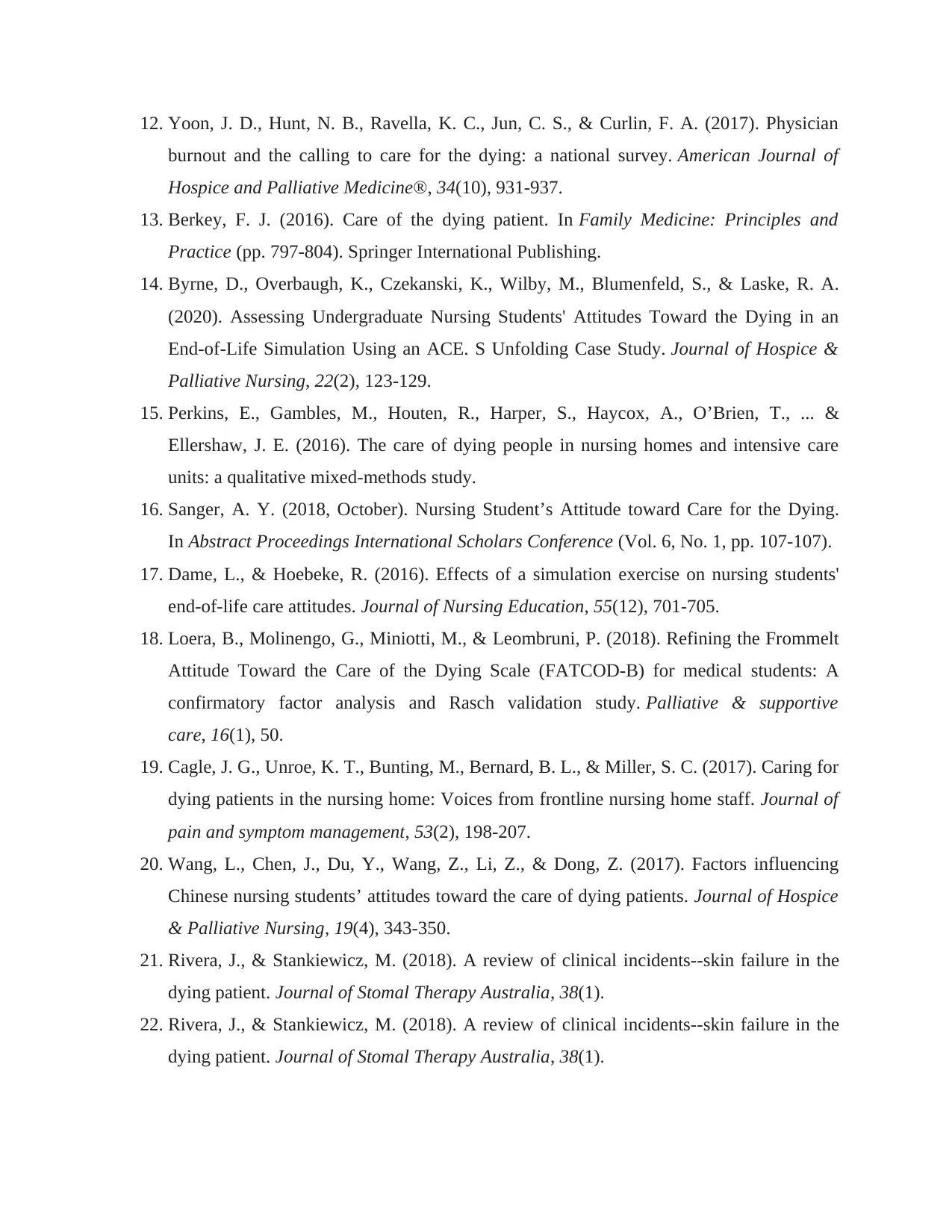
12. Yoon, J. D., Hunt, N. B., Ravella, K. C., Jun, C. S., & Curlin, F. A. (2017). Physician
burnout and the calling to care for the dying: a national survey. American Journal of
Hospice and Palliative Medicine®, 34(10), 931-937.
13. Berkey, F. J. (2016). Care of the dying patient. In Family Medicine: Principles and
Practice (pp. 797-804). Springer International Publishing.
14. Byrne, D., Overbaugh, K., Czekanski, K., Wilby, M., Blumenfeld, S., & Laske, R. A.
(2020). Assessing Undergraduate Nursing Students' Attitudes Toward the Dying in an
End-of-Life Simulation Using an ACE. S Unfolding Case Study. Journal of Hospice &
Palliative Nursing, 22(2), 123-129.
15. Perkins, E., Gambles, M., Houten, R., Harper, S., Haycox, A., O’Brien, T., ... &
Ellershaw, J. E. (2016). The care of dying people in nursing homes and intensive care
units: a qualitative mixed-methods study.
16. Sanger, A. Y. (2018, October). Nursing Student’s Attitude toward Care for the Dying.
In Abstract Proceedings International Scholars Conference (Vol. 6, No. 1, pp. 107-107).
17. Dame, L., & Hoebeke, R. (2016). Effects of a simulation exercise on nursing students'
end-of-life care attitudes. Journal of Nursing Education, 55(12), 701-705.
18. Loera, B., Molinengo, G., Miniotti, M., & Leombruni, P. (2018). Refining the Frommelt
Attitude Toward the Care of the Dying Scale (FATCOD-B) for medical students: A
confirmatory factor analysis and Rasch validation study. Palliative & supportive
care, 16(1), 50.
19. Cagle, J. G., Unroe, K. T., Bunting, M., Bernard, B. L., & Miller, S. C. (2017). Caring for
dying patients in the nursing home: Voices from frontline nursing home staff. Journal of
pain and symptom management, 53(2), 198-207.
20. Wang, L., Chen, J., Du, Y., Wang, Z., Li, Z., & Dong, Z. (2017). Factors influencing
Chinese nursing students’ attitudes toward the care of dying patients. Journal of Hospice
& Palliative Nursing, 19(4), 343-350.
21. Rivera, J., & Stankiewicz, M. (2018). A review of clinical incidents--skin failure in the
dying patient. Journal of Stomal Therapy Australia, 38(1).
22. Rivera, J., & Stankiewicz, M. (2018). A review of clinical incidents--skin failure in the
dying patient. Journal of Stomal Therapy Australia, 38(1).
burnout and the calling to care for the dying: a national survey. American Journal of
Hospice and Palliative Medicine®, 34(10), 931-937.
13. Berkey, F. J. (2016). Care of the dying patient. In Family Medicine: Principles and
Practice (pp. 797-804). Springer International Publishing.
14. Byrne, D., Overbaugh, K., Czekanski, K., Wilby, M., Blumenfeld, S., & Laske, R. A.
(2020). Assessing Undergraduate Nursing Students' Attitudes Toward the Dying in an
End-of-Life Simulation Using an ACE. S Unfolding Case Study. Journal of Hospice &
Palliative Nursing, 22(2), 123-129.
15. Perkins, E., Gambles, M., Houten, R., Harper, S., Haycox, A., O’Brien, T., ... &
Ellershaw, J. E. (2016). The care of dying people in nursing homes and intensive care
units: a qualitative mixed-methods study.
16. Sanger, A. Y. (2018, October). Nursing Student’s Attitude toward Care for the Dying.
In Abstract Proceedings International Scholars Conference (Vol. 6, No. 1, pp. 107-107).
17. Dame, L., & Hoebeke, R. (2016). Effects of a simulation exercise on nursing students'
end-of-life care attitudes. Journal of Nursing Education, 55(12), 701-705.
18. Loera, B., Molinengo, G., Miniotti, M., & Leombruni, P. (2018). Refining the Frommelt
Attitude Toward the Care of the Dying Scale (FATCOD-B) for medical students: A
confirmatory factor analysis and Rasch validation study. Palliative & supportive
care, 16(1), 50.
19. Cagle, J. G., Unroe, K. T., Bunting, M., Bernard, B. L., & Miller, S. C. (2017). Caring for
dying patients in the nursing home: Voices from frontline nursing home staff. Journal of
pain and symptom management, 53(2), 198-207.
20. Wang, L., Chen, J., Du, Y., Wang, Z., Li, Z., & Dong, Z. (2017). Factors influencing
Chinese nursing students’ attitudes toward the care of dying patients. Journal of Hospice
& Palliative Nursing, 19(4), 343-350.
21. Rivera, J., & Stankiewicz, M. (2018). A review of clinical incidents--skin failure in the
dying patient. Journal of Stomal Therapy Australia, 38(1).
22. Rivera, J., & Stankiewicz, M. (2018). A review of clinical incidents--skin failure in the
dying patient. Journal of Stomal Therapy Australia, 38(1).
⊘ This is a preview!⊘
Do you want full access?
Subscribe today to unlock all pages.
Trusted by 1+ million students worldwide

1 out of 13


Related Documents


Your All-in-One AI-Powered Toolkit for Academic Success.
+13062052269
info@desklib.com
Available 24*7 on WhatsApp / Email
![[object Object]](/_next/static/media/star-bottom.7253800d.svg)
Unlock your academic potential
Copyright © 2020–2026 A2Z Services. All Rights Reserved. Developed and managed by ZUCOL.