Case Management in Criminal Justice: Comparing Settings & Ethics
VerifiedAdded on 2023/06/01
|6
|1515
|483
Case Study
AI Summary
This case study provides a comparative analysis of case management in community and correctional settings within the criminal justice system. It highlights the differences in approaches, focusing on how community settings utilize probation and teamwork to manage lawbreakers, while correctional settings aim to reduce reoffending through effective management and collaboration with partners. The study also examines the importance of strength-based case management models and the need for process modifications to ensure fairness for special populations. Furthermore, it identifies potential clients, including juveniles and individuals with mental disorders, and emphasizes the critical role of ethics and confidentiality in maintaining client welfare and professional reputation throughout the case management process. The study concludes that confidentiality is essential for client recovery and the overall effectiveness of case management in both settings.

Running HEAD: CASE MANAGEMENT 1
Comparison of Case Management
Name
Instructor
Course code
Date
Comparison of Case Management
Name
Instructor
Course code
Date
Paraphrase This Document
Need a fresh take? Get an instant paraphrase of this document with our AI Paraphraser

CASE MANAGEMENT 2
Introduction
Different types of cases require a different case management according to the criminal
justice that need to be achieved in a given case (Popil, 2012). Relevant authorities hence chose
the suitable case management appropriately. The case management approaches are used in
different situations such as in reducing reoccurrence of an offence, in serious psychological
problems, lack of employment, cases of incapacities, wrongdoing cases such as abuse of drugs,
domestic violence in adults and those arrested for the wrong doings. In justice to criminal cases,
different case management are used by various curriculums and organizations. All-inclusive
refrain methodology is applied by different authorities to address different criminal justice cases
over the law breakers. This methodology could lead to occurrence of re-occurrence cases,
homelessness, lack of employment, and increase of drug and substance abuse cases (Ravet,
2011).
Differences between Community and Correctional setting case management
Case management for situations of the public is very important in determining the
boosting accountabilities for individuals on supervising the law breakers in a wider perspective.
In order to handle the law breakers effectively and efficiently, communal situation can be used
on probation. This can be accomplished by through teamwork of associates within the external
peripheries by managing the law breakers efficiently and effectively with an aim of protecting
the community in a collective manner (Ploing, 2012). Consequently correctional setting has an
aim of increasing the public safety by reducing the tenancy of reoffending by the convicted
criminals (Andrews & Bonta, 2010). This is achieved by the act of managing effectively the law
breakers in any given society. This will therefore necessitate reaching out of the partners who are
willing to collaborate in the correctional process by the correction agencies. The collaborative
Introduction
Different types of cases require a different case management according to the criminal
justice that need to be achieved in a given case (Popil, 2012). Relevant authorities hence chose
the suitable case management appropriately. The case management approaches are used in
different situations such as in reducing reoccurrence of an offence, in serious psychological
problems, lack of employment, cases of incapacities, wrongdoing cases such as abuse of drugs,
domestic violence in adults and those arrested for the wrong doings. In justice to criminal cases,
different case management are used by various curriculums and organizations. All-inclusive
refrain methodology is applied by different authorities to address different criminal justice cases
over the law breakers. This methodology could lead to occurrence of re-occurrence cases,
homelessness, lack of employment, and increase of drug and substance abuse cases (Ravet,
2011).
Differences between Community and Correctional setting case management
Case management for situations of the public is very important in determining the
boosting accountabilities for individuals on supervising the law breakers in a wider perspective.
In order to handle the law breakers effectively and efficiently, communal situation can be used
on probation. This can be accomplished by through teamwork of associates within the external
peripheries by managing the law breakers efficiently and effectively with an aim of protecting
the community in a collective manner (Ploing, 2012). Consequently correctional setting has an
aim of increasing the public safety by reducing the tenancy of reoffending by the convicted
criminals (Andrews & Bonta, 2010). This is achieved by the act of managing effectively the law
breakers in any given society. This will therefore necessitate reaching out of the partners who are
willing to collaborate in the correctional process by the correction agencies. The collaborative

CASE MANAGEMENT 3
partners play a key role in offering the required assistance and resources required to promote the
success of law breakers.
Comparison of the Case Management
Both the correctional and the community setting case management consists of 2 models
that are usually chosen in terms of assertiveness and strength of the case management. Basing the
case management on strength, the client’s strength and talents and are the basis and foundation
on which the treatment and plan of service are built on. The positive and unconditional opinion
of the case manager towards the client holds weight in this model. It also entails delivering
services to the client aggressively. This model therefore entails the involvement of the case
manager in searching of the job area of the client, their home, community for counseling and also
location of the offices that offer services to the client in the community (Hope, Hope, Savulescu,
& Hendrick, 2008).
Process modification to suit various special populations
In order to ensure fairness to different special populations, there is need to alter the case
management process. It must be ensured that the process of research and analysis of data in the
case management system is done within the system in order to ensure that the issues of common
interest are well understood. This gives the case managers an opportunity to clearly understand
the clients and therefore gives them an upper hand in effectively managing the case at hand.
Professionalism should also be involved in the process in order to promote a sense of
responsibility in the system of case management. This system should therefore be focused as a
system within another. It should also be ensured that the system of case management has
strengthened the ability to provide and analyze the crucial data as well as the ability to share best
partners play a key role in offering the required assistance and resources required to promote the
success of law breakers.
Comparison of the Case Management
Both the correctional and the community setting case management consists of 2 models
that are usually chosen in terms of assertiveness and strength of the case management. Basing the
case management on strength, the client’s strength and talents and are the basis and foundation
on which the treatment and plan of service are built on. The positive and unconditional opinion
of the case manager towards the client holds weight in this model. It also entails delivering
services to the client aggressively. This model therefore entails the involvement of the case
manager in searching of the job area of the client, their home, community for counseling and also
location of the offices that offer services to the client in the community (Hope, Hope, Savulescu,
& Hendrick, 2008).
Process modification to suit various special populations
In order to ensure fairness to different special populations, there is need to alter the case
management process. It must be ensured that the process of research and analysis of data in the
case management system is done within the system in order to ensure that the issues of common
interest are well understood. This gives the case managers an opportunity to clearly understand
the clients and therefore gives them an upper hand in effectively managing the case at hand.
Professionalism should also be involved in the process in order to promote a sense of
responsibility in the system of case management. This system should therefore be focused as a
system within another. It should also be ensured that the system of case management has
strengthened the ability to provide and analyze the crucial data as well as the ability to share best
⊘ This is a preview!⊘
Do you want full access?
Subscribe today to unlock all pages.

Trusted by 1+ million students worldwide

CASE MANAGEMENT 4
practices. In order to ensure effectiveness of the local regulators, preeminent practices should be
fortified.
In an endeavor of ensuring efficient and effective management of cases in different
groups, there is the need to improve the stress point and problems acceptance in the community
by the local case managers. Involvement of combined effort in the system has different merits
such as communication refining, logic right nurturing and also building good relations within the
subdivisions of the system. Changing the case management systems using the combined
employed groups, equality of all special groups is guaranteed (Campbell, 2009).
Potential Clients
In these two case management systems, the correctional and the community setting case
management systems, the potential clients are numerous, These clients ranges from juveniles,
those unable to control their personality and also they that cannot control their impulse
(Peterson-Badali, Skilling & Haqanee, 2015)
There are usually some hopeful programs that are used for law breakers with mental
disorders. This is a type of client case management that has a keen track that is proven in almost
all other settings. This case necessitates involvement of mental disorders specialists. This
projects usually involves and helps five percent of adult and juvenile law breakers. Those
eligible for this program are the probationers found guilty of committing nonviolent crimes,
those with mental disorders, and they suffering from psychological conditions. The management
usually vary in intensity according to individual need of the client. This may entail regular
watching, counselling and medication.
practices. In order to ensure effectiveness of the local regulators, preeminent practices should be
fortified.
In an endeavor of ensuring efficient and effective management of cases in different
groups, there is the need to improve the stress point and problems acceptance in the community
by the local case managers. Involvement of combined effort in the system has different merits
such as communication refining, logic right nurturing and also building good relations within the
subdivisions of the system. Changing the case management systems using the combined
employed groups, equality of all special groups is guaranteed (Campbell, 2009).
Potential Clients
In these two case management systems, the correctional and the community setting case
management systems, the potential clients are numerous, These clients ranges from juveniles,
those unable to control their personality and also they that cannot control their impulse
(Peterson-Badali, Skilling & Haqanee, 2015)
There are usually some hopeful programs that are used for law breakers with mental
disorders. This is a type of client case management that has a keen track that is proven in almost
all other settings. This case necessitates involvement of mental disorders specialists. This
projects usually involves and helps five percent of adult and juvenile law breakers. Those
eligible for this program are the probationers found guilty of committing nonviolent crimes,
those with mental disorders, and they suffering from psychological conditions. The management
usually vary in intensity according to individual need of the client. This may entail regular
watching, counselling and medication.
Paraphrase This Document
Need a fresh take? Get an instant paraphrase of this document with our AI Paraphraser

CASE MANAGEMENT 5
Importance of ethics and confidentiality
Confidentiality and ethics are very crucial during working with the clients. Occasionally,
ethical dilemmas are usually present and regularly occur in any case management regardless of
the case management system used. These dilemmas occur in the line of duty of the practitioners
and also in the whole case management process. Due to the far reaching –effects of any ethical
issue on the welfare of the client and the professionals involved in the case management. It
necessitates confidentiality in the process. Ethical conduct while dealing with all the clients is
also very crucial in ensuring the reputation of the professionals is maintained (Castles, 2008).
The ethical standards that must be maintained in the process are the widely accepted and
prescribed behaviors in service to humanities. This necessitates the identification of the ethical
questions involved in every step of the process. This plays a crucial role in ensuring the
confidentiality of the clients is maintained hence ensure that the client will not in any way be
affected by the case management process in future. In conclusion, confidentiality is very key in
quick recovery of a client without any fear of blackmail and mockery from other people in the
community. This helps to ensure effectiveness and efficiency in the case management process in
the two case management systems, the correctional and the community setting.
Importance of ethics and confidentiality
Confidentiality and ethics are very crucial during working with the clients. Occasionally,
ethical dilemmas are usually present and regularly occur in any case management regardless of
the case management system used. These dilemmas occur in the line of duty of the practitioners
and also in the whole case management process. Due to the far reaching –effects of any ethical
issue on the welfare of the client and the professionals involved in the case management. It
necessitates confidentiality in the process. Ethical conduct while dealing with all the clients is
also very crucial in ensuring the reputation of the professionals is maintained (Castles, 2008).
The ethical standards that must be maintained in the process are the widely accepted and
prescribed behaviors in service to humanities. This necessitates the identification of the ethical
questions involved in every step of the process. This plays a crucial role in ensuring the
confidentiality of the clients is maintained hence ensure that the client will not in any way be
affected by the case management process in future. In conclusion, confidentiality is very key in
quick recovery of a client without any fear of blackmail and mockery from other people in the
community. This helps to ensure effectiveness and efficiency in the case management process in
the two case management systems, the correctional and the community setting.

CASE MANAGEMENT 6
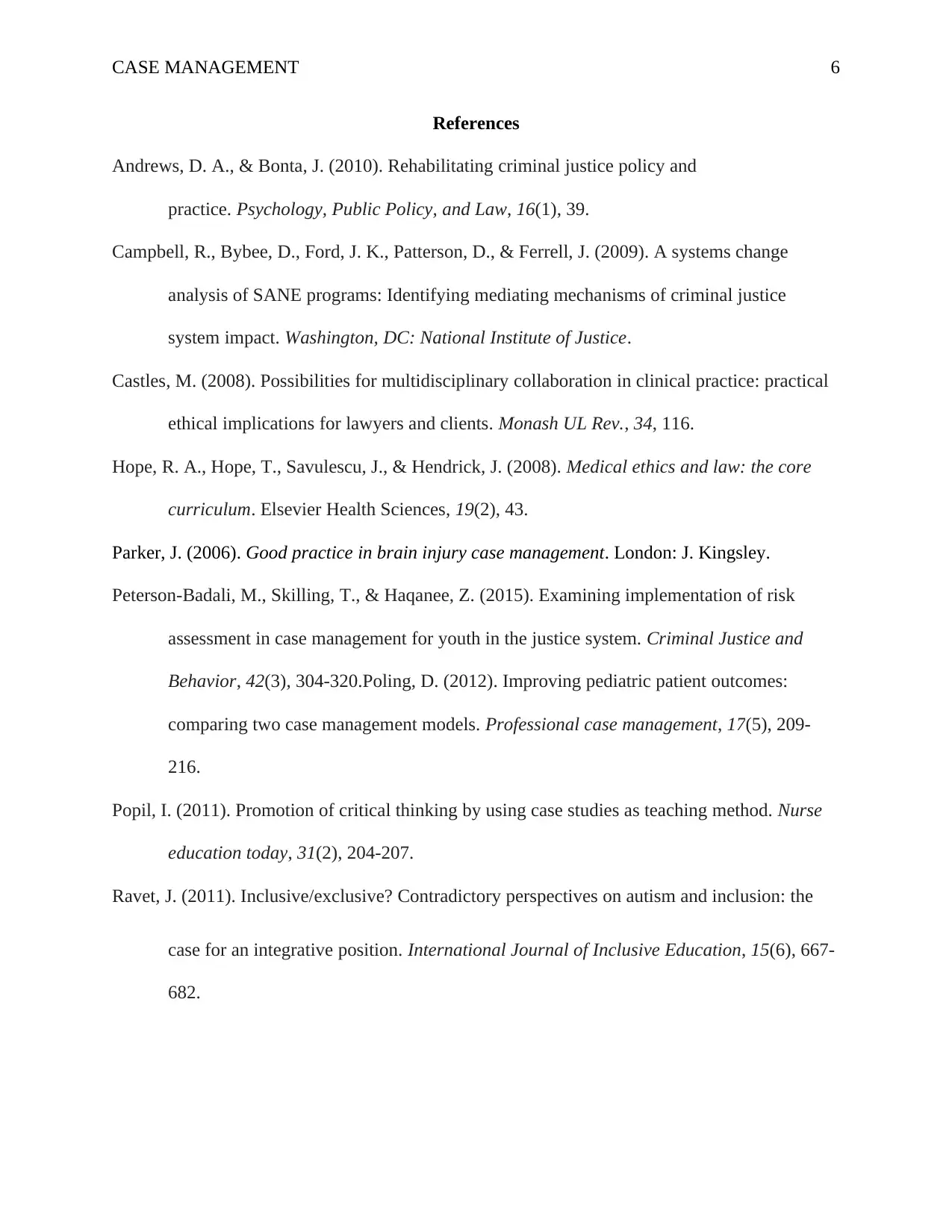
References
Andrews, D. A., & Bonta, J. (2010). Rehabilitating criminal justice policy and
practice. Psychology, Public Policy, and Law, 16(1), 39.
Campbell, R., Bybee, D., Ford, J. K., Patterson, D., & Ferrell, J. (2009). A systems change
analysis of SANE programs: Identifying mediating mechanisms of criminal justice
system impact. Washington, DC: National Institute of Justice.
Castles, M. (2008). Possibilities for multidisciplinary collaboration in clinical practice: practical
ethical implications for lawyers and clients. Monash UL Rev., 34, 116.
Hope, R. A., Hope, T., Savulescu, J., & Hendrick, J. (2008). Medical ethics and law: the core
curriculum. Elsevier Health Sciences, 19(2), 43.
Parker, J. (2006). Good practice in brain injury case management. London: J. Kingsley.
Peterson-Badali, M., Skilling, T., & Haqanee, Z. (2015). Examining implementation of risk
assessment in case management for youth in the justice system. Criminal Justice and
Behavior, 42(3), 304-320.Poling, D. (2012). Improving pediatric patient outcomes:
comparing two case management models. Professional case management, 17(5), 209-
216.
Popil, I. (2011). Promotion of critical thinking by using case studies as teaching method. Nurse
education today, 31(2), 204-207.
Ravet, J. (2011). Inclusive/exclusive? Contradictory perspectives on autism and inclusion: the
case for an integrative position. International Journal of Inclusive Education, 15(6), 667-
682.
References
Andrews, D. A., & Bonta, J. (2010). Rehabilitating criminal justice policy and
practice. Psychology, Public Policy, and Law, 16(1), 39.
Campbell, R., Bybee, D., Ford, J. K., Patterson, D., & Ferrell, J. (2009). A systems change
analysis of SANE programs: Identifying mediating mechanisms of criminal justice
system impact. Washington, DC: National Institute of Justice.
Castles, M. (2008). Possibilities for multidisciplinary collaboration in clinical practice: practical
ethical implications for lawyers and clients. Monash UL Rev., 34, 116.
Hope, R. A., Hope, T., Savulescu, J., & Hendrick, J. (2008). Medical ethics and law: the core
curriculum. Elsevier Health Sciences, 19(2), 43.
Parker, J. (2006). Good practice in brain injury case management. London: J. Kingsley.
Peterson-Badali, M., Skilling, T., & Haqanee, Z. (2015). Examining implementation of risk
assessment in case management for youth in the justice system. Criminal Justice and
Behavior, 42(3), 304-320.Poling, D. (2012). Improving pediatric patient outcomes:
comparing two case management models. Professional case management, 17(5), 209-
216.
Popil, I. (2011). Promotion of critical thinking by using case studies as teaching method. Nurse
education today, 31(2), 204-207.
Ravet, J. (2011). Inclusive/exclusive? Contradictory perspectives on autism and inclusion: the
case for an integrative position. International Journal of Inclusive Education, 15(6), 667-
682.
⊘ This is a preview!⊘
Do you want full access?
Subscribe today to unlock all pages.

Trusted by 1+ million students worldwide
1 out of 6
Your All-in-One AI-Powered Toolkit for Academic Success.
+13062052269
info@desklib.com
Available 24*7 on WhatsApp / Email
Unlock your academic potential
Copyright © 2020–2025 A2Z Services. All Rights Reserved. Developed and managed by ZUCOL.