Analyzing DDI's Accounting Policies: A COMM 201 Case Study
VerifiedAdded on 2022/09/02
|12
|2277
|18
Case Study
AI Summary
This case study examines the accounting practices of Delicious Delivery Inc. (DDI) and assesses their compliance with Canadian Accounting Standards for Private Enterprises (ASPE). The analysis covers several key areas, including revenue recognition, receivables management, inventory valuation, and the treatment of tangible and intangible assets. The study identifies discrepancies between DDI's current practices and ASPE guidelines, particularly in revenue recognition for business versus residential customers, the use of the allowance method for doubtful accounts, and the depreciation of tangible assets. Furthermore, the case highlights the inappropriate capitalization of data insights as an intangible asset. The conclusion emphasizes the need for DDI to adjust its accounting policies to ensure accurate financial reporting and compliance with ASPE, ultimately providing a more reliable view of the company's financial performance to stakeholders. Recommendations include the consistent application of accounting principles and appropriate disclosures in the financial statements. This case study provides a comprehensive overview of financial accounting concepts applied in a real-world business scenario.
Running head: CASE STUDY – ACCOUNTING
CASE STUDY – ACCOUNTING
Name of the Student
Name of the University
Author note
CASE STUDY – ACCOUNTING
Name of the Student
Name of the University
Author note

Paraphrase This Document
Need a fresh take? Get an instant paraphrase of this document with our AI Paraphraser
1
CASE STUDY – ACCOUNTING
Executive Summary
The purpose of this paper is to identify the deviation of accounting policies adopted by DDI in
comparison with accounting policies as prescribed by AcSB. The private entities or small-sized
entities will follow the accounting standard as per ASPE sections.
CASE STUDY – ACCOUNTING
Executive Summary
The purpose of this paper is to identify the deviation of accounting policies adopted by DDI in
comparison with accounting policies as prescribed by AcSB. The private entities or small-sized
entities will follow the accounting standard as per ASPE sections.
2
CASE STUDY – ACCOUNTING
Table of Contents
Introduction......................................................................................................................................3
Discussion........................................................................................................................................3
Accounting treatment for following –.........................................................................................3
Revenue recognition................................................................................................................4
Receivables..............................................................................................................................5
Inventories...............................................................................................................................6
Tangible and Intangible assets.................................................................................................7
Others.......................................................................................................................................8
Conclusion.......................................................................................................................................8
References......................................................................................................................................10
CASE STUDY – ACCOUNTING
Table of Contents
Introduction......................................................................................................................................3
Discussion........................................................................................................................................3
Accounting treatment for following –.........................................................................................3
Revenue recognition................................................................................................................4
Receivables..............................................................................................................................5
Inventories...............................................................................................................................6
Tangible and Intangible assets.................................................................................................7
Others.......................................................................................................................................8
Conclusion.......................................................................................................................................8
References......................................................................................................................................10
⊘ This is a preview!⊘
Do you want full access?
Subscribe today to unlock all pages.

Trusted by 1+ million students worldwide
3
CASE STUDY – ACCOUNTING
Introduction
The main objective of this report is to identify and analyze the adequate accounting
policies for Delicious Delivery and to inform the owners about the issues in compliance with
accounting policies. The discussion part will focus on explaining the financial reporting to
owners and what adjustments the company needs to make in accounts to present it before the
investors. This report focuses on evaluating whether the accounting standards adopted by the
company are in accordance with “Canadian accounting standards for private companies.”
(ASPE)
Discussion
The company Delicious Delivery Inc is a company engaged in delivering their self-made
food to the two groups of targeted consumers. The company never had done any audit for the
financial statements and have no such idea for financial reporting and accounting policies. The
company must follow the accounting standards established by Accounting Standards Boards
(AcSB) (Frascanada.ca 2020). The Board has established Accounting Standards for Private
Enterprises (ASPE). These standards are to be followed by the entity whose debt and shares are
not traded publically. The company can follow either IFRS or ASPE (Annand and Dauderis
2018). DDI chooses to maintain its financial statements as per ASPE as it had just started its
business two years ago, and it’s a small-sized entity.
Accounting treatment for following –
The accounting policies as per the prescribed standard and the treatment made by the
company are explained below –
CASE STUDY – ACCOUNTING
Introduction
The main objective of this report is to identify and analyze the adequate accounting
policies for Delicious Delivery and to inform the owners about the issues in compliance with
accounting policies. The discussion part will focus on explaining the financial reporting to
owners and what adjustments the company needs to make in accounts to present it before the
investors. This report focuses on evaluating whether the accounting standards adopted by the
company are in accordance with “Canadian accounting standards for private companies.”
(ASPE)
Discussion
The company Delicious Delivery Inc is a company engaged in delivering their self-made
food to the two groups of targeted consumers. The company never had done any audit for the
financial statements and have no such idea for financial reporting and accounting policies. The
company must follow the accounting standards established by Accounting Standards Boards
(AcSB) (Frascanada.ca 2020). The Board has established Accounting Standards for Private
Enterprises (ASPE). These standards are to be followed by the entity whose debt and shares are
not traded publically. The company can follow either IFRS or ASPE (Annand and Dauderis
2018). DDI chooses to maintain its financial statements as per ASPE as it had just started its
business two years ago, and it’s a small-sized entity.
Accounting treatment for following –
The accounting policies as per the prescribed standard and the treatment made by the
company are explained below –
Paraphrase This Document
Need a fresh take? Get an instant paraphrase of this document with our AI Paraphraser
4
CASE STUDY – ACCOUNTING
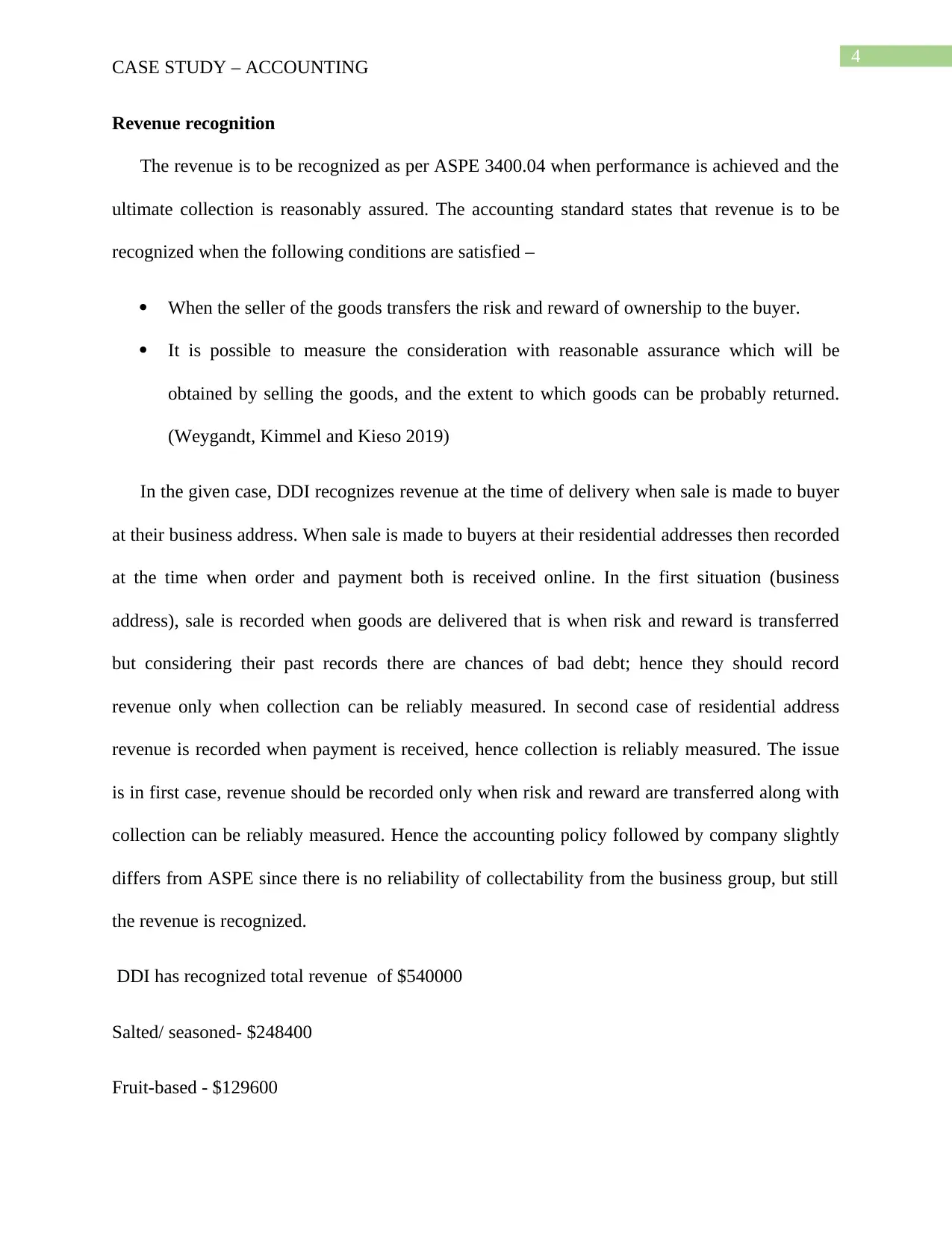
Revenue recognition
The revenue is to be recognized as per ASPE 3400.04 when performance is achieved and the
ultimate collection is reasonably assured. The accounting standard states that revenue is to be
recognized when the following conditions are satisfied –
When the seller of the goods transfers the risk and reward of ownership to the buyer.
It is possible to measure the consideration with reasonable assurance which will be
obtained by selling the goods, and the extent to which goods can be probably returned.
(Weygandt, Kimmel and Kieso 2019)
In the given case, DDI recognizes revenue at the time of delivery when sale is made to buyer
at their business address. When sale is made to buyers at their residential addresses then recorded
at the time when order and payment both is received online. In the first situation (business
address), sale is recorded when goods are delivered that is when risk and reward is transferred
but considering their past records there are chances of bad debt; hence they should record
revenue only when collection can be reliably measured. In second case of residential address
revenue is recorded when payment is received, hence collection is reliably measured. The issue
is in first case, revenue should be recorded only when risk and reward are transferred along with
collection can be reliably measured. Hence the accounting policy followed by company slightly
differs from ASPE since there is no reliability of collectability from the business group, but still
the revenue is recognized.
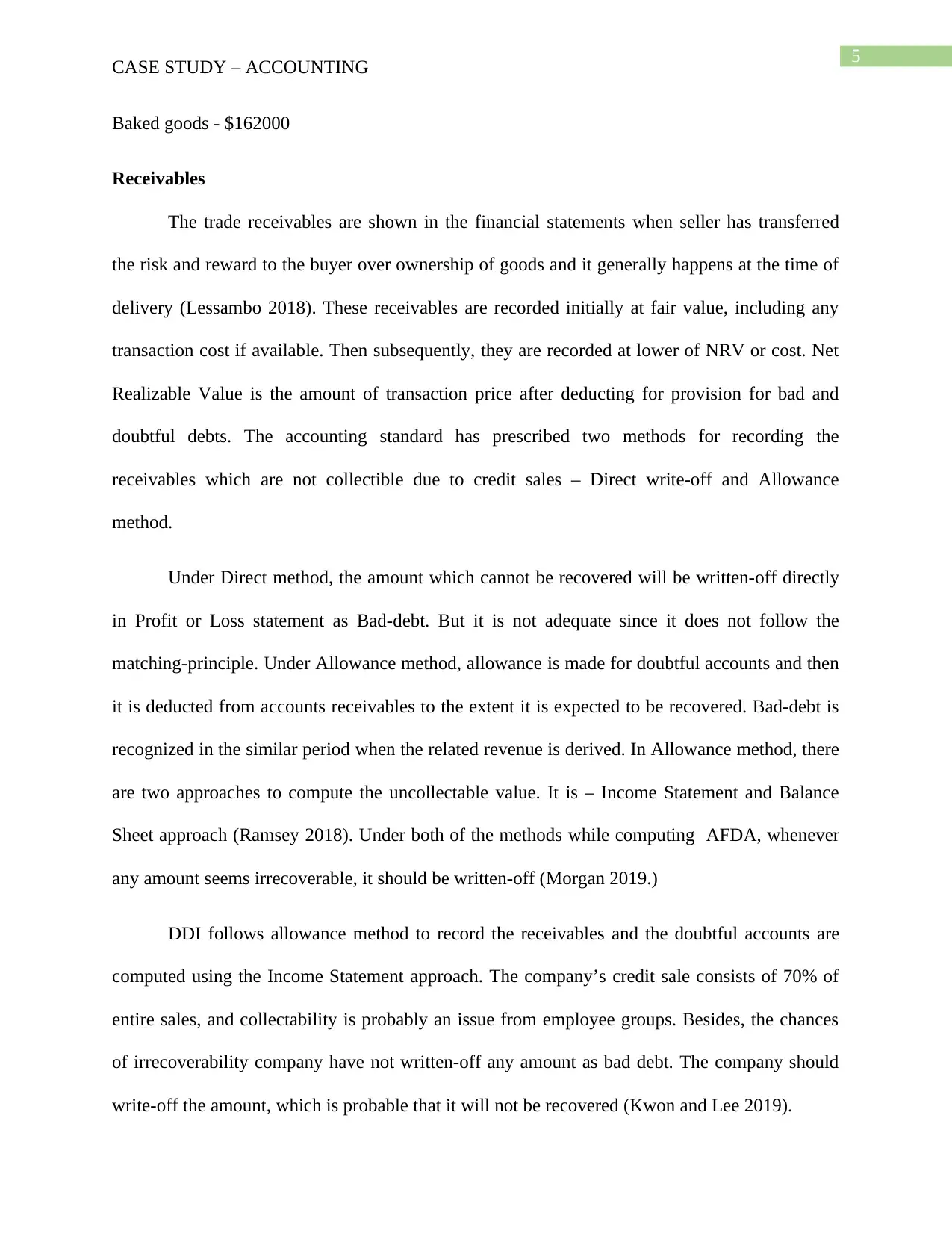
DDI has recognized total revenue of $540000
Salted/ seasoned- $248400
Fruit-based - $129600
CASE STUDY – ACCOUNTING
Revenue recognition
The revenue is to be recognized as per ASPE 3400.04 when performance is achieved and the
ultimate collection is reasonably assured. The accounting standard states that revenue is to be
recognized when the following conditions are satisfied –
When the seller of the goods transfers the risk and reward of ownership to the buyer.
It is possible to measure the consideration with reasonable assurance which will be
obtained by selling the goods, and the extent to which goods can be probably returned.
(Weygandt, Kimmel and Kieso 2019)
In the given case, DDI recognizes revenue at the time of delivery when sale is made to buyer
at their business address. When sale is made to buyers at their residential addresses then recorded
at the time when order and payment both is received online. In the first situation (business
address), sale is recorded when goods are delivered that is when risk and reward is transferred
but considering their past records there are chances of bad debt; hence they should record
revenue only when collection can be reliably measured. In second case of residential address
revenue is recorded when payment is received, hence collection is reliably measured. The issue
is in first case, revenue should be recorded only when risk and reward are transferred along with
collection can be reliably measured. Hence the accounting policy followed by company slightly
differs from ASPE since there is no reliability of collectability from the business group, but still
the revenue is recognized.
DDI has recognized total revenue of $540000
Salted/ seasoned- $248400
Fruit-based - $129600
5
CASE STUDY – ACCOUNTING
Baked goods - $162000
Receivables
The trade receivables are shown in the financial statements when seller has transferred
the risk and reward to the buyer over ownership of goods and it generally happens at the time of
delivery (Lessambo 2018). These receivables are recorded initially at fair value, including any
transaction cost if available. Then subsequently, they are recorded at lower of NRV or cost. Net
Realizable Value is the amount of transaction price after deducting for provision for bad and
doubtful debts. The accounting standard has prescribed two methods for recording the
receivables which are not collectible due to credit sales – Direct write-off and Allowance
method.
Under Direct method, the amount which cannot be recovered will be written-off directly
in Profit or Loss statement as Bad-debt. But it is not adequate since it does not follow the
matching-principle. Under Allowance method, allowance is made for doubtful accounts and then
it is deducted from accounts receivables to the extent it is expected to be recovered. Bad-debt is
recognized in the similar period when the related revenue is derived. In Allowance method, there
are two approaches to compute the uncollectable value. It is – Income Statement and Balance
Sheet approach (Ramsey 2018). Under both of the methods while computing AFDA, whenever
any amount seems irrecoverable, it should be written-off (Morgan 2019.)
DDI follows allowance method to record the receivables and the doubtful accounts are
computed using the Income Statement approach. The company’s credit sale consists of 70% of
entire sales, and collectability is probably an issue from employee groups. Besides, the chances
of irrecoverability company have not written-off any amount as bad debt. The company should
write-off the amount, which is probable that it will not be recovered (Kwon and Lee 2019).
CASE STUDY – ACCOUNTING
Baked goods - $162000
Receivables
The trade receivables are shown in the financial statements when seller has transferred
the risk and reward to the buyer over ownership of goods and it generally happens at the time of
delivery (Lessambo 2018). These receivables are recorded initially at fair value, including any
transaction cost if available. Then subsequently, they are recorded at lower of NRV or cost. Net
Realizable Value is the amount of transaction price after deducting for provision for bad and
doubtful debts. The accounting standard has prescribed two methods for recording the
receivables which are not collectible due to credit sales – Direct write-off and Allowance
method.
Under Direct method, the amount which cannot be recovered will be written-off directly
in Profit or Loss statement as Bad-debt. But it is not adequate since it does not follow the
matching-principle. Under Allowance method, allowance is made for doubtful accounts and then
it is deducted from accounts receivables to the extent it is expected to be recovered. Bad-debt is
recognized in the similar period when the related revenue is derived. In Allowance method, there
are two approaches to compute the uncollectable value. It is – Income Statement and Balance
Sheet approach (Ramsey 2018). Under both of the methods while computing AFDA, whenever
any amount seems irrecoverable, it should be written-off (Morgan 2019.)
DDI follows allowance method to record the receivables and the doubtful accounts are
computed using the Income Statement approach. The company’s credit sale consists of 70% of
entire sales, and collectability is probably an issue from employee groups. Besides, the chances
of irrecoverability company have not written-off any amount as bad debt. The company should
write-off the amount, which is probable that it will not be recovered (Kwon and Lee 2019).
⊘ This is a preview!⊘
Do you want full access?
Subscribe today to unlock all pages.
Trusted by 1+ million students worldwide
6
CASE STUDY – ACCOUNTING
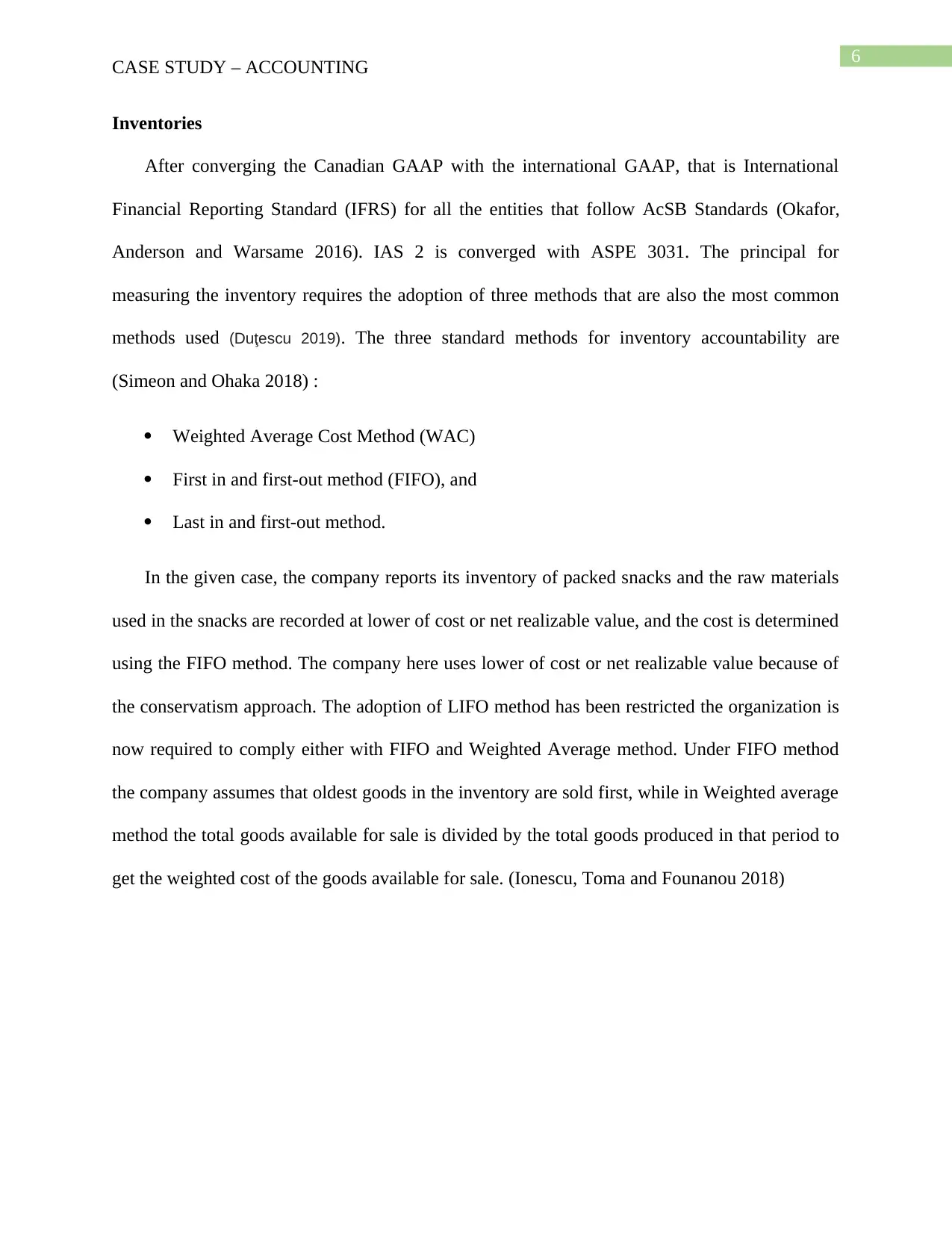
Inventories
After converging the Canadian GAAP with the international GAAP, that is International
Financial Reporting Standard (IFRS) for all the entities that follow AcSB Standards (Okafor,
Anderson and Warsame 2016). IAS 2 is converged with ASPE 3031. The principal for
measuring the inventory requires the adoption of three methods that are also the most common
methods used (Duţescu 2019). The three standard methods for inventory accountability are
(Simeon and Ohaka 2018) :
Weighted Average Cost Method (WAC)
First in and first-out method (FIFO), and
Last in and first-out method.
In the given case, the company reports its inventory of packed snacks and the raw materials
used in the snacks are recorded at lower of cost or net realizable value, and the cost is determined
using the FIFO method. The company here uses lower of cost or net realizable value because of
the conservatism approach. The adoption of LIFO method has been restricted the organization is
now required to comply either with FIFO and Weighted Average method. Under FIFO method
the company assumes that oldest goods in the inventory are sold first, while in Weighted average
method the total goods available for sale is divided by the total goods produced in that period to
get the weighted cost of the goods available for sale. (Ionescu, Toma and Founanou 2018)
CASE STUDY – ACCOUNTING
Inventories
After converging the Canadian GAAP with the international GAAP, that is International
Financial Reporting Standard (IFRS) for all the entities that follow AcSB Standards (Okafor,
Anderson and Warsame 2016). IAS 2 is converged with ASPE 3031. The principal for
measuring the inventory requires the adoption of three methods that are also the most common
methods used (Duţescu 2019). The three standard methods for inventory accountability are
(Simeon and Ohaka 2018) :
Weighted Average Cost Method (WAC)
First in and first-out method (FIFO), and
Last in and first-out method.
In the given case, the company reports its inventory of packed snacks and the raw materials
used in the snacks are recorded at lower of cost or net realizable value, and the cost is determined
using the FIFO method. The company here uses lower of cost or net realizable value because of
the conservatism approach. The adoption of LIFO method has been restricted the organization is
now required to comply either with FIFO and Weighted Average method. Under FIFO method
the company assumes that oldest goods in the inventory are sold first, while in Weighted average
method the total goods available for sale is divided by the total goods produced in that period to
get the weighted cost of the goods available for sale. (Ionescu, Toma and Founanou 2018)
Paraphrase This Document
Need a fresh take? Get an instant paraphrase of this document with our AI Paraphraser
7
CASE STUDY – ACCOUNTING
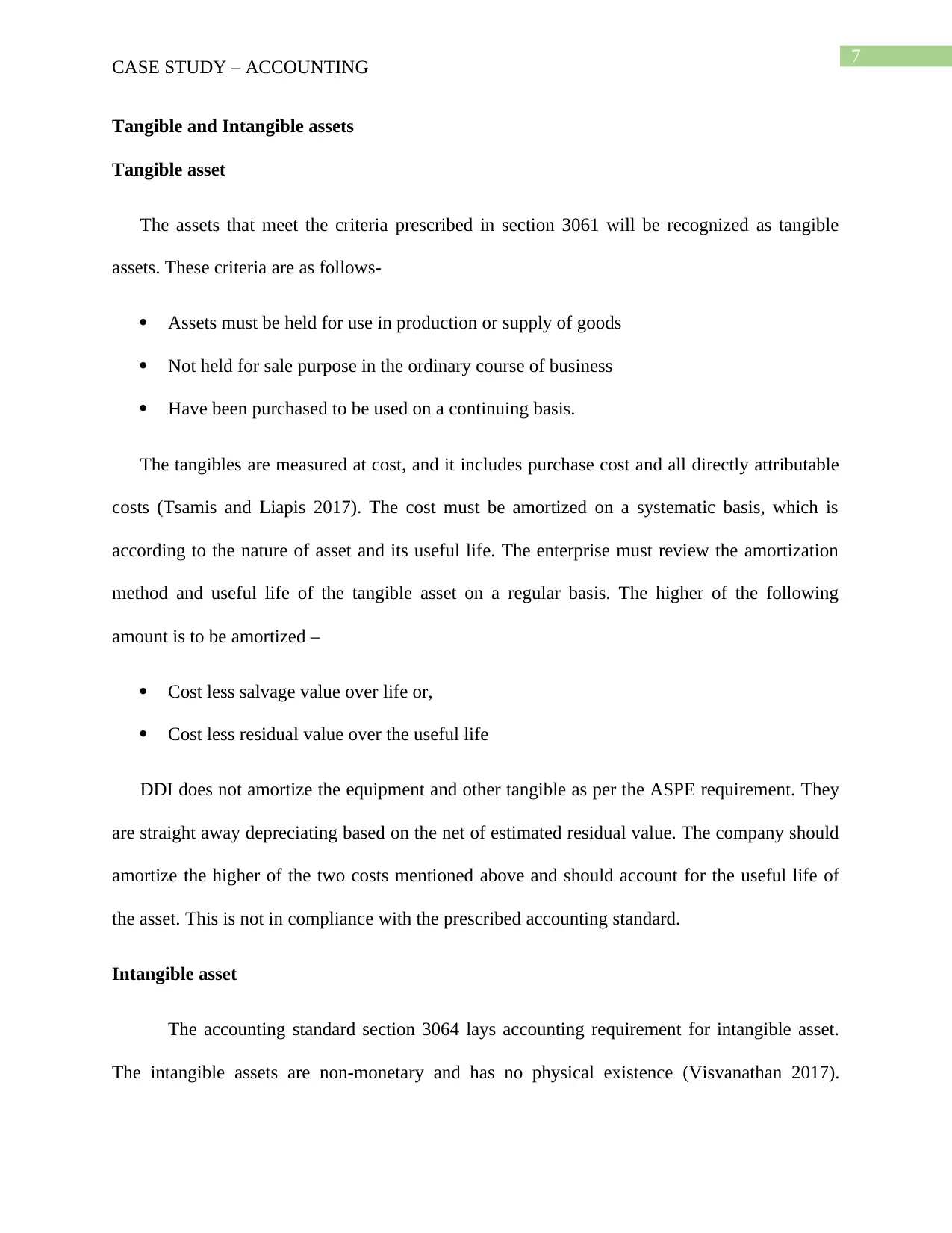
Tangible and Intangible assets
Tangible asset
The assets that meet the criteria prescribed in section 3061 will be recognized as tangible
assets. These criteria are as follows-
Assets must be held for use in production or supply of goods
Not held for sale purpose in the ordinary course of business
Have been purchased to be used on a continuing basis.
The tangibles are measured at cost, and it includes purchase cost and all directly attributable
costs (Tsamis and Liapis 2017). The cost must be amortized on a systematic basis, which is
according to the nature of asset and its useful life. The enterprise must review the amortization
method and useful life of the tangible asset on a regular basis. The higher of the following
amount is to be amortized –
Cost less salvage value over life or,
Cost less residual value over the useful life
DDI does not amortize the equipment and other tangible as per the ASPE requirement. They
are straight away depreciating based on the net of estimated residual value. The company should
amortize the higher of the two costs mentioned above and should account for the useful life of
the asset. This is not in compliance with the prescribed accounting standard.
Intangible asset
The accounting standard section 3064 lays accounting requirement for intangible asset.
The intangible assets are non-monetary and has no physical existence (Visvanathan 2017).
CASE STUDY – ACCOUNTING
Tangible and Intangible assets
Tangible asset
The assets that meet the criteria prescribed in section 3061 will be recognized as tangible
assets. These criteria are as follows-
Assets must be held for use in production or supply of goods
Not held for sale purpose in the ordinary course of business
Have been purchased to be used on a continuing basis.
The tangibles are measured at cost, and it includes purchase cost and all directly attributable
costs (Tsamis and Liapis 2017). The cost must be amortized on a systematic basis, which is
according to the nature of asset and its useful life. The enterprise must review the amortization
method and useful life of the tangible asset on a regular basis. The higher of the following
amount is to be amortized –
Cost less salvage value over life or,
Cost less residual value over the useful life
DDI does not amortize the equipment and other tangible as per the ASPE requirement. They
are straight away depreciating based on the net of estimated residual value. The company should
amortize the higher of the two costs mentioned above and should account for the useful life of
the asset. This is not in compliance with the prescribed accounting standard.
Intangible asset
The accounting standard section 3064 lays accounting requirement for intangible asset.
The intangible assets are non-monetary and has no physical existence (Visvanathan 2017).
8
CASE STUDY – ACCOUNTING
Hence, these assets should be initially recorded at cost and should be amortized on a
systematized basis. In the given case, the company has recorded and amortized each intangible
asset correctly. However, capitalization of the data insight derived from the website development
and treating it as an intangible-assets is an inappropriate treatment. Data insight, rather, should
be a part of operating expense and should be charged in the income statement of the company.
Capitalizing data insight has increased the income of the company which will also affect
profitability ratios and enhance the performance of the company. Thus, the profitability ratio
indicated by the company will also mislead investors and other stakeholders. It is recommended
for the company to charge data insight as an operating expense for that year to reflect true
position and fair view to the stakeholders.
Others
The customers who make an order for home deliveries are required to make payment at
the time of making order itself; the same should be done for the other customer group also. It
will help in reducing the chances of losses. The company should work on selecting its target
consumers, and it will help in avoiding bad debts and also will assist in expanding business
operations. The company must prepare their Income Statement as per Section 1520, and Balance
Sheet as per Section 1521. Accounting policies must be disclosed as per the standard 1505 to
show what methods, rules, and practices are followed by the company (DDI).
Conclusion
Therefore it is to be concluded that since the company has just begun its operations
company is incurring profits and has shown growth. Several areas in accounting require
judgments like the selection of adequate method for measurement, accounting estimates. The
company needs to make adequate disclosures in Notes to Financial Statements. They must
CASE STUDY – ACCOUNTING
Hence, these assets should be initially recorded at cost and should be amortized on a
systematized basis. In the given case, the company has recorded and amortized each intangible
asset correctly. However, capitalization of the data insight derived from the website development
and treating it as an intangible-assets is an inappropriate treatment. Data insight, rather, should
be a part of operating expense and should be charged in the income statement of the company.
Capitalizing data insight has increased the income of the company which will also affect
profitability ratios and enhance the performance of the company. Thus, the profitability ratio
indicated by the company will also mislead investors and other stakeholders. It is recommended
for the company to charge data insight as an operating expense for that year to reflect true
position and fair view to the stakeholders.
Others
The customers who make an order for home deliveries are required to make payment at
the time of making order itself; the same should be done for the other customer group also. It
will help in reducing the chances of losses. The company should work on selecting its target
consumers, and it will help in avoiding bad debts and also will assist in expanding business
operations. The company must prepare their Income Statement as per Section 1520, and Balance
Sheet as per Section 1521. Accounting policies must be disclosed as per the standard 1505 to
show what methods, rules, and practices are followed by the company (DDI).
Conclusion
Therefore it is to be concluded that since the company has just begun its operations
company is incurring profits and has shown growth. Several areas in accounting require
judgments like the selection of adequate method for measurement, accounting estimates. The
company needs to make adequate disclosures in Notes to Financial Statements. They must
⊘ This is a preview!⊘
Do you want full access?
Subscribe today to unlock all pages.
Trusted by 1+ million students worldwide
9
CASE STUDY – ACCOUNTING
maintain the fundamental characteristic of relevance and faithful representation. The company
has applied with accounting policies and has implemented approaches, but there are some issues
in the accounting treatment. There are issues in the accounting treatment of intangible assets of
Data Insight, revenue recognition, and amounts to be written-off. The company must fix the
issues so that financial statements are completely in accordance with ASPE.
CASE STUDY – ACCOUNTING
maintain the fundamental characteristic of relevance and faithful representation. The company
has applied with accounting policies and has implemented approaches, but there are some issues
in the accounting treatment. There are issues in the accounting treatment of intangible assets of
Data Insight, revenue recognition, and amounts to be written-off. The company must fix the
issues so that financial statements are completely in accordance with ASPE.
Paraphrase This Document
Need a fresh take? Get an instant paraphrase of this document with our AI Paraphraser
10
CASE STUDY – ACCOUNTING
References
Annand, D. and Dauderis, H., 2018. Introduction to Financial Accounting: International
Financial Reporting Standards (Lyryx).
Duţescu, A., 2019. Inventories. In Financial Accounting (pp. 93-129). Palgrave Macmillan,
Cham.
Elkins, H. and Entwistle, G., 2018. A commentary on accounting standards and the disclosure
problem: Exploring a way forward. Journal of International Accounting, Auditing and
Taxation, 33, pp.79-89.
Frascanada.ca, 2020. Accounting Standards Board. [online] Frascanada.ca. Available at:
<https://www.frascanada.ca/en/acsb> [Accessed 31 March 2020].
Ionescu, L., Toma, M. and Founanou, M., 2018. Applied Analysis of the Impact of Inventory
Valuation Methods on the Financial Situation and Financial Performance. Valahian Journal of
Economic Studies, 9(1), pp.67-76.
Kwon, K.H. and Lee, N., 2019. Unbilled Receivables, Loss Allowances and Earnings
Management. Academy of Accounting and Financial Studies Journal.
Lessambo, F.I., 2018. Account Receivables. In Financial Statements (pp. 53-67). Palgrave
Macmillan, Cham.
Morgan, P., 2019. Financial Reporting: A Comprehensive Evaluation of Accounting Methods
and Applications (Doctoral dissertation, University of Mississippi).
Okafor, O.N., Anderson, M. and Warsame, H., 2016. IFRS and value relevance: evidence based
on Canadian adoption. International Journal of Managerial Finance, 12(2), pp.136-160.
CASE STUDY – ACCOUNTING
References
Annand, D. and Dauderis, H., 2018. Introduction to Financial Accounting: International
Financial Reporting Standards (Lyryx).
Duţescu, A., 2019. Inventories. In Financial Accounting (pp. 93-129). Palgrave Macmillan,
Cham.
Elkins, H. and Entwistle, G., 2018. A commentary on accounting standards and the disclosure
problem: Exploring a way forward. Journal of International Accounting, Auditing and
Taxation, 33, pp.79-89.
Frascanada.ca, 2020. Accounting Standards Board. [online] Frascanada.ca. Available at:
<https://www.frascanada.ca/en/acsb> [Accessed 31 March 2020].
Ionescu, L., Toma, M. and Founanou, M., 2018. Applied Analysis of the Impact of Inventory
Valuation Methods on the Financial Situation and Financial Performance. Valahian Journal of
Economic Studies, 9(1), pp.67-76.
Kwon, K.H. and Lee, N., 2019. Unbilled Receivables, Loss Allowances and Earnings
Management. Academy of Accounting and Financial Studies Journal.
Lessambo, F.I., 2018. Account Receivables. In Financial Statements (pp. 53-67). Palgrave
Macmillan, Cham.
Morgan, P., 2019. Financial Reporting: A Comprehensive Evaluation of Accounting Methods
and Applications (Doctoral dissertation, University of Mississippi).
Okafor, O.N., Anderson, M. and Warsame, H., 2016. IFRS and value relevance: evidence based
on Canadian adoption. International Journal of Managerial Finance, 12(2), pp.136-160.
11
CASE STUDY – ACCOUNTING
Ramsey, E.D., 2018. A Comprehensive Review of Accounting through Case Studies (Doctoral
dissertation, The University of Mississippi).
Simeon, E.D. and Ohaka, J., 2018. Implication of Choice of Inventory Valuation Methods on
Profit, Tax, and Closing Inventory. Account and Financial Management Journal, 3(7).
Tsamis, A. and Liapis, K., 2017. Fair value and cost accounting, depreciation methods,
recognition and measurement for fixed assets.
Visvanathan, G., 2017. Intangible assets on the balance sheet and audit fees. International
Journal of Disclosure and Governance, 14(3), pp.241-250.
Weygandt, J.J., Kimmel, P.D. and Kieso, D.E., 2019. Financial accounting. Wiley.
CASE STUDY – ACCOUNTING
Ramsey, E.D., 2018. A Comprehensive Review of Accounting through Case Studies (Doctoral
dissertation, The University of Mississippi).
Simeon, E.D. and Ohaka, J., 2018. Implication of Choice of Inventory Valuation Methods on
Profit, Tax, and Closing Inventory. Account and Financial Management Journal, 3(7).
Tsamis, A. and Liapis, K., 2017. Fair value and cost accounting, depreciation methods,
recognition and measurement for fixed assets.
Visvanathan, G., 2017. Intangible assets on the balance sheet and audit fees. International
Journal of Disclosure and Governance, 14(3), pp.241-250.
Weygandt, J.J., Kimmel, P.D. and Kieso, D.E., 2019. Financial accounting. Wiley.
⊘ This is a preview!⊘
Do you want full access?
Subscribe today to unlock all pages.
Trusted by 1+ million students worldwide

1 out of 12


Related Documents


Your All-in-One AI-Powered Toolkit for Academic Success.
+13062052269
info@desklib.com
Available 24*7 on WhatsApp / Email
![[object Object]](/_next/static/media/star-bottom.7253800d.svg)
Unlock your academic potential
Copyright © 2020–2026 A2Z Services. All Rights Reserved. Developed and managed by ZUCOL.