Oldlandia ABC Case Study: Needs, Political Economy, Capacity & Policy
VerifiedAdded on 2019/09/16
|9
|1337
|284
Case Study
AI Summary
This case study analyzes Oldlandia ABC, focusing on a needs and risk assessment, political economy, capacity assessment, and policy linkages. The analysis includes an examination of population distribution, poverty rates, and stakeholder perspectives on a social protection scheme. The document evaluates the capacity of agencies to implement the scheme, suggesting methods and tools for assessment, and proposes ways to reduce administrative burdens. Furthermore, it reviews the evidence related to the credibility and success of graduation models, drawing on examples from the USA and East Asia, and identifies enablers and challenges associated with such models. The overall objective is to provide a comprehensive understanding of the economic and social considerations relevant to the implementation of a social protection program.

Case study of Oldlandia
ABC
[Pick the date]
ABC
[Pick the date]
Paraphrase This Document
Need a fresh take? Get an instant paraphrase of this document with our AI Paraphraser

Part 1: Needs/Risk assessment
1.
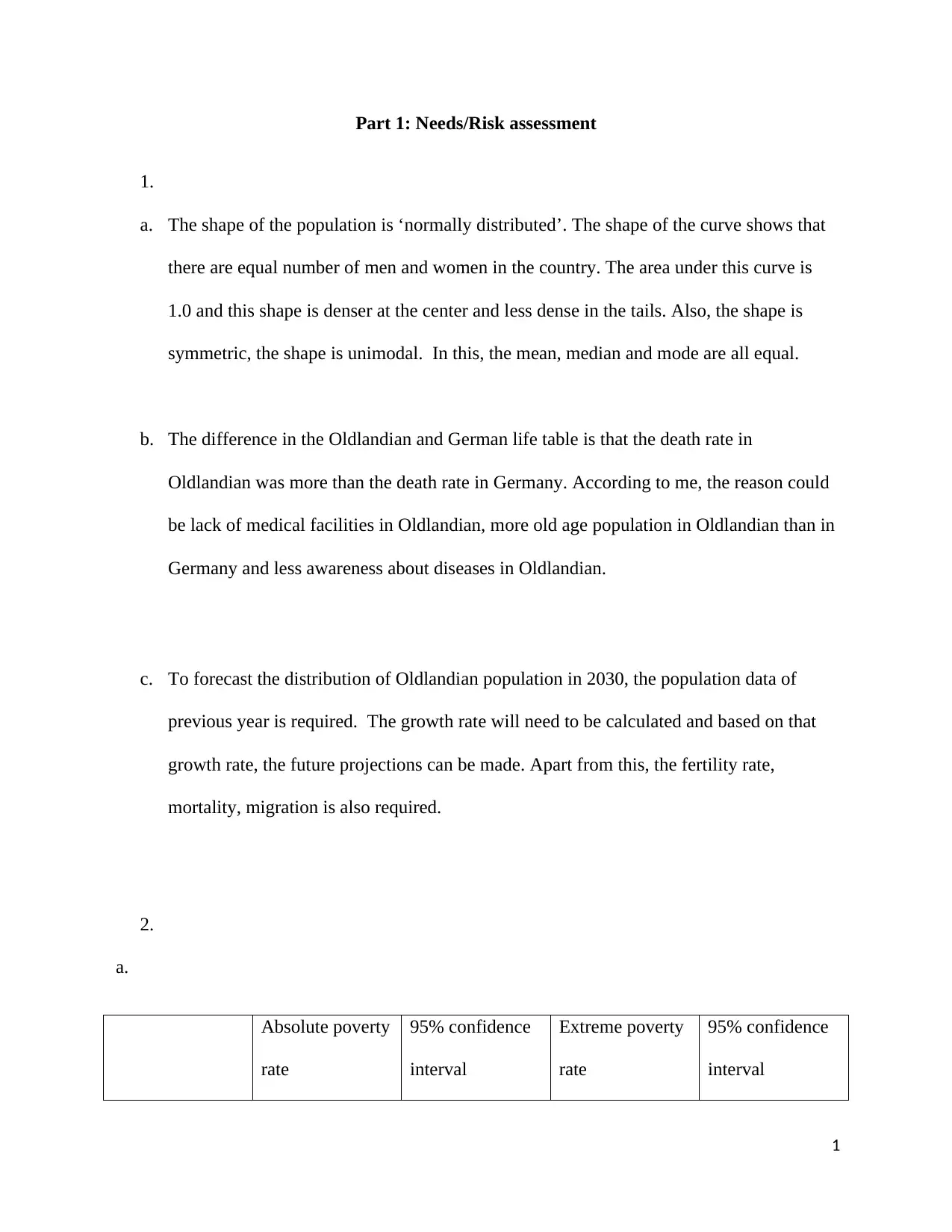
a. The shape of the population is ‘normally distributed’. The shape of the curve shows that
there are equal number of men and women in the country. The area under this curve is
1.0 and this shape is denser at the center and less dense in the tails. Also, the shape is
symmetric, the shape is unimodal. In this, the mean, median and mode are all equal.
b. The difference in the Oldlandian and German life table is that the death rate in
Oldlandian was more than the death rate in Germany. According to me, the reason could
be lack of medical facilities in Oldlandian, more old age population in Oldlandian than in
Germany and less awareness about diseases in Oldlandian.
c. To forecast the distribution of Oldlandian population in 2030, the population data of
previous year is required. The growth rate will need to be calculated and based on that
growth rate, the future projections can be made. Apart from this, the fertility rate,
mortality, migration is also required.
2.
a.
Absolute poverty
rate
95% confidence
interval
Extreme poverty
rate
95% confidence
interval
1
1.
a. The shape of the population is ‘normally distributed’. The shape of the curve shows that
there are equal number of men and women in the country. The area under this curve is
1.0 and this shape is denser at the center and less dense in the tails. Also, the shape is
symmetric, the shape is unimodal. In this, the mean, median and mode are all equal.
b. The difference in the Oldlandian and German life table is that the death rate in
Oldlandian was more than the death rate in Germany. According to me, the reason could
be lack of medical facilities in Oldlandian, more old age population in Oldlandian than in
Germany and less awareness about diseases in Oldlandian.
c. To forecast the distribution of Oldlandian population in 2030, the population data of
previous year is required. The growth rate will need to be calculated and based on that
growth rate, the future projections can be made. Apart from this, the fertility rate,
mortality, migration is also required.
2.
a.
Absolute poverty
rate
95% confidence
interval
Extreme poverty
rate
95% confidence
interval
1

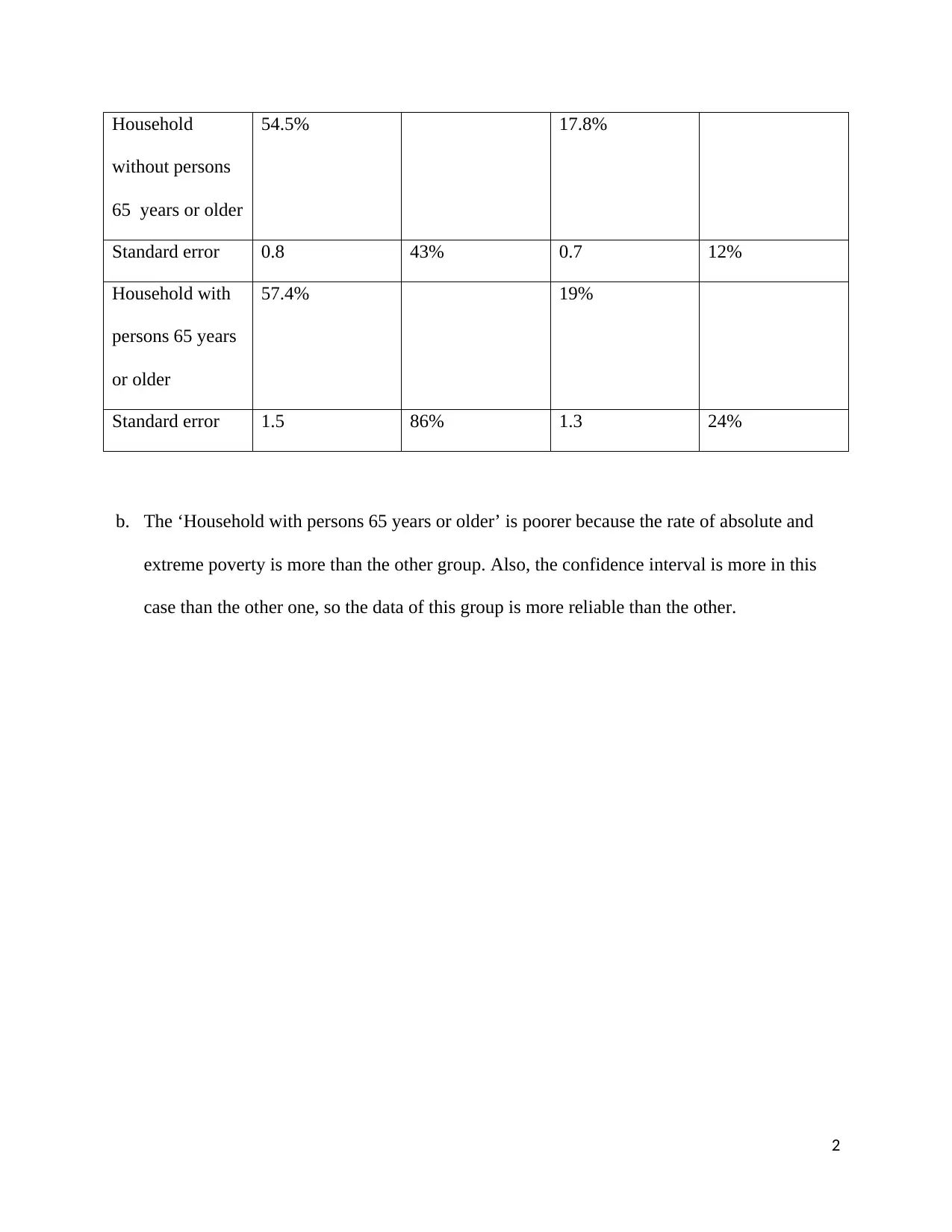
Household
without persons
65 years or older
54.5% 17.8%
Standard error 0.8 43% 0.7 12%
Household with
persons 65 years
or older
57.4% 19%
Standard error 1.5 86% 1.3 24%
b. The ‘Household with persons 65 years or older’ is poorer because the rate of absolute and
extreme poverty is more than the other group. Also, the confidence interval is more in this
case than the other one, so the data of this group is more reliable than the other.
2
without persons
65 years or older
54.5% 17.8%
Standard error 0.8 43% 0.7 12%
Household with
persons 65 years
or older
57.4% 19%
Standard error 1.5 86% 1.3 24%
b. The ‘Household with persons 65 years or older’ is poorer because the rate of absolute and
extreme poverty is more than the other group. Also, the confidence interval is more in this
case than the other one, so the data of this group is more reliable than the other.
2
⊘ This is a preview!⊘
Do you want full access?
Subscribe today to unlock all pages.

Trusted by 1+ million students worldwide

Part 2: Political Economy
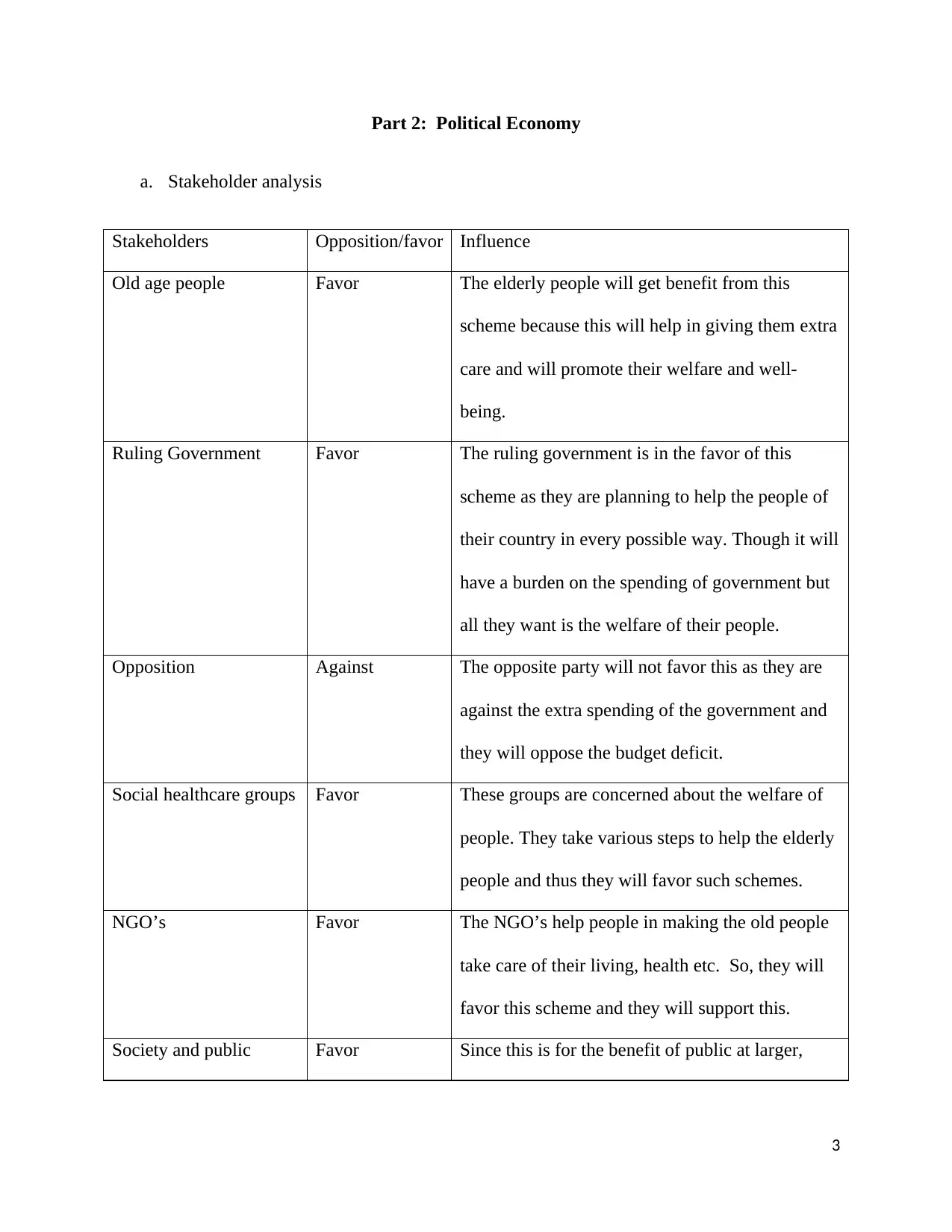
a. Stakeholder analysis
Stakeholders Opposition/favor Influence
Old age people Favor The elderly people will get benefit from this
scheme because this will help in giving them extra
care and will promote their welfare and well-
being.
Ruling Government Favor The ruling government is in the favor of this
scheme as they are planning to help the people of
their country in every possible way. Though it will
have a burden on the spending of government but
all they want is the welfare of their people.
Opposition Against The opposite party will not favor this as they are
against the extra spending of the government and
they will oppose the budget deficit.
Social healthcare groups Favor These groups are concerned about the welfare of
people. They take various steps to help the elderly
people and thus they will favor such schemes.
NGO’s Favor The NGO’s help people in making the old people
take care of their living, health etc. So, they will
favor this scheme and they will support this.
Society and public Favor Since this is for the benefit of public at larger,
3
a. Stakeholder analysis
Stakeholders Opposition/favor Influence
Old age people Favor The elderly people will get benefit from this
scheme because this will help in giving them extra
care and will promote their welfare and well-
being.
Ruling Government Favor The ruling government is in the favor of this
scheme as they are planning to help the people of
their country in every possible way. Though it will
have a burden on the spending of government but
all they want is the welfare of their people.
Opposition Against The opposite party will not favor this as they are
against the extra spending of the government and
they will oppose the budget deficit.
Social healthcare groups Favor These groups are concerned about the welfare of
people. They take various steps to help the elderly
people and thus they will favor such schemes.
NGO’s Favor The NGO’s help people in making the old people
take care of their living, health etc. So, they will
favor this scheme and they will support this.
Society and public Favor Since this is for the benefit of public at larger,
3
Paraphrase This Document
Need a fresh take? Get an instant paraphrase of this document with our AI Paraphraser

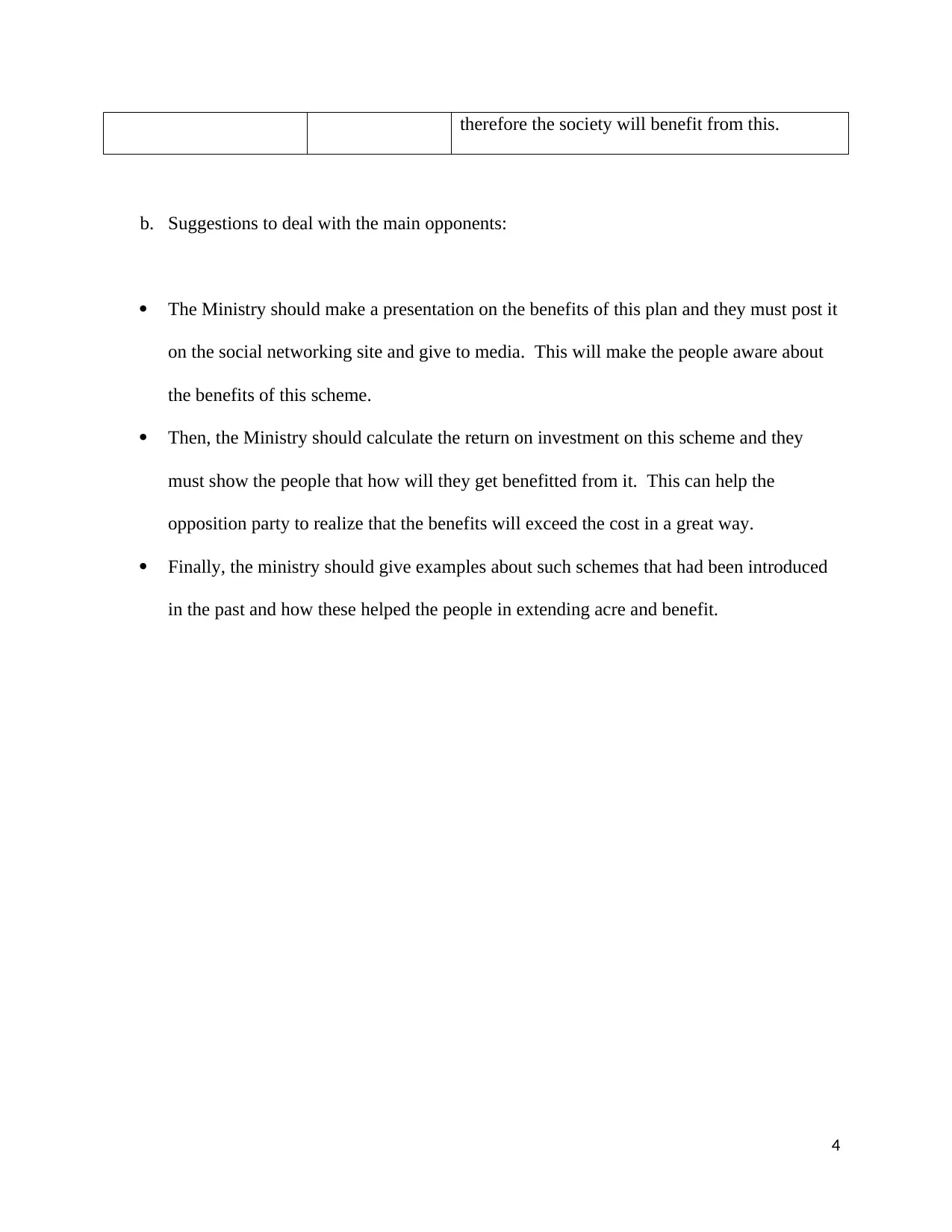
therefore the society will benefit from this.
b. Suggestions to deal with the main opponents:
The Ministry should make a presentation on the benefits of this plan and they must post it
on the social networking site and give to media. This will make the people aware about
the benefits of this scheme.
Then, the Ministry should calculate the return on investment on this scheme and they
must show the people that how will they get benefitted from it. This can help the
opposition party to realize that the benefits will exceed the cost in a great way.
Finally, the ministry should give examples about such schemes that had been introduced
in the past and how these helped the people in extending acre and benefit.
4
b. Suggestions to deal with the main opponents:
The Ministry should make a presentation on the benefits of this plan and they must post it
on the social networking site and give to media. This will make the people aware about
the benefits of this scheme.
Then, the Ministry should calculate the return on investment on this scheme and they
must show the people that how will they get benefitted from it. This can help the
opposition party to realize that the benefits will exceed the cost in a great way.
Finally, the ministry should give examples about such schemes that had been introduced
in the past and how these helped the people in extending acre and benefit.
4

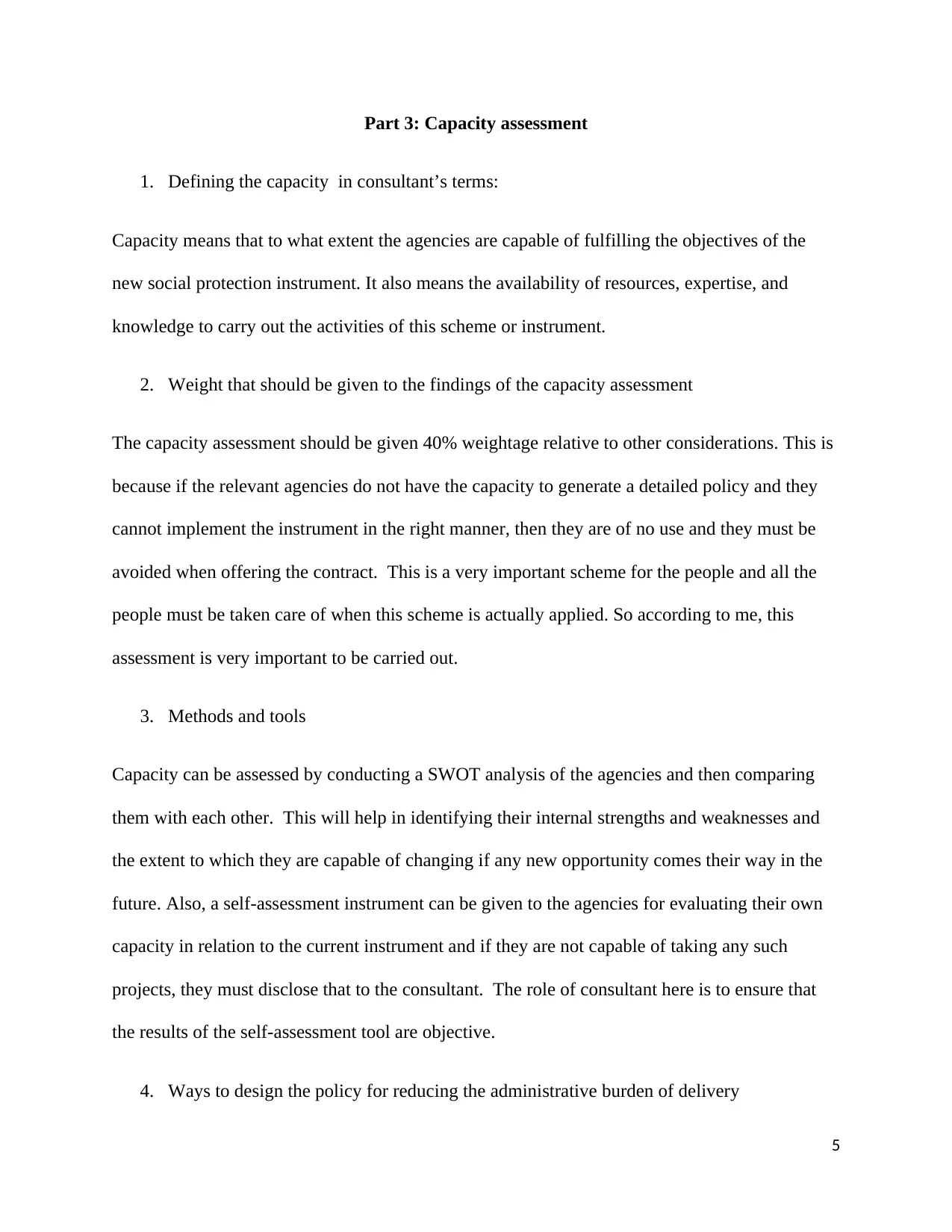
Part 3: Capacity assessment
1. Defining the capacity in consultant’s terms:
Capacity means that to what extent the agencies are capable of fulfilling the objectives of the
new social protection instrument. It also means the availability of resources, expertise, and
knowledge to carry out the activities of this scheme or instrument.
2. Weight that should be given to the findings of the capacity assessment
The capacity assessment should be given 40% weightage relative to other considerations. This is
because if the relevant agencies do not have the capacity to generate a detailed policy and they
cannot implement the instrument in the right manner, then they are of no use and they must be
avoided when offering the contract. This is a very important scheme for the people and all the
people must be taken care of when this scheme is actually applied. So according to me, this
assessment is very important to be carried out.
3. Methods and tools
Capacity can be assessed by conducting a SWOT analysis of the agencies and then comparing
them with each other. This will help in identifying their internal strengths and weaknesses and
the extent to which they are capable of changing if any new opportunity comes their way in the
future. Also, a self-assessment instrument can be given to the agencies for evaluating their own
capacity in relation to the current instrument and if they are not capable of taking any such
projects, they must disclose that to the consultant. The role of consultant here is to ensure that
the results of the self-assessment tool are objective.
4. Ways to design the policy for reducing the administrative burden of delivery
5
1. Defining the capacity in consultant’s terms:
Capacity means that to what extent the agencies are capable of fulfilling the objectives of the
new social protection instrument. It also means the availability of resources, expertise, and
knowledge to carry out the activities of this scheme or instrument.
2. Weight that should be given to the findings of the capacity assessment
The capacity assessment should be given 40% weightage relative to other considerations. This is
because if the relevant agencies do not have the capacity to generate a detailed policy and they
cannot implement the instrument in the right manner, then they are of no use and they must be
avoided when offering the contract. This is a very important scheme for the people and all the
people must be taken care of when this scheme is actually applied. So according to me, this
assessment is very important to be carried out.
3. Methods and tools
Capacity can be assessed by conducting a SWOT analysis of the agencies and then comparing
them with each other. This will help in identifying their internal strengths and weaknesses and
the extent to which they are capable of changing if any new opportunity comes their way in the
future. Also, a self-assessment instrument can be given to the agencies for evaluating their own
capacity in relation to the current instrument and if they are not capable of taking any such
projects, they must disclose that to the consultant. The role of consultant here is to ensure that
the results of the self-assessment tool are objective.
4. Ways to design the policy for reducing the administrative burden of delivery
5
⊘ This is a preview!⊘
Do you want full access?
Subscribe today to unlock all pages.

Trusted by 1+ million students worldwide

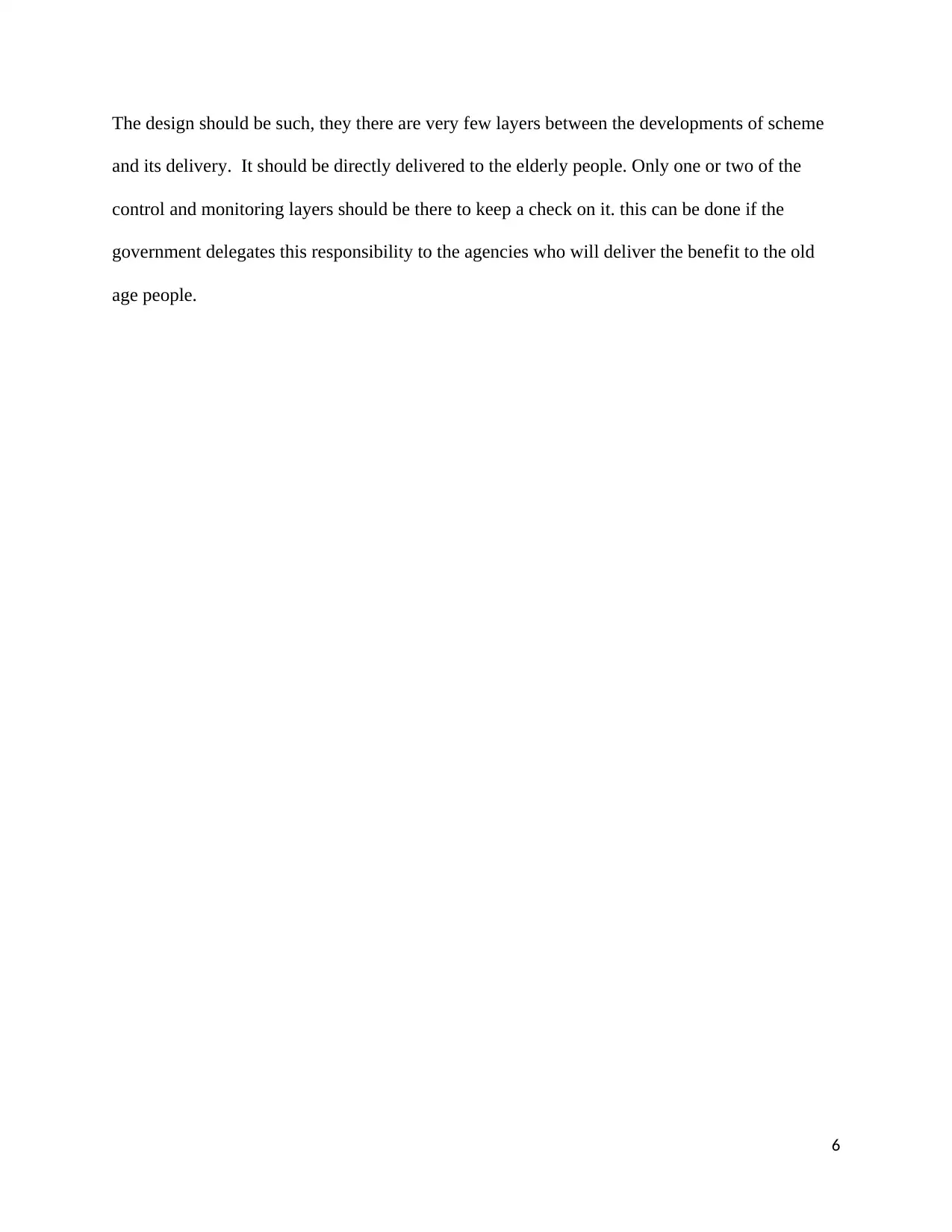
The design should be such, they there are very few layers between the developments of scheme
and its delivery. It should be directly delivered to the elderly people. Only one or two of the
control and monitoring layers should be there to keep a check on it. this can be done if the
government delegates this responsibility to the agencies who will deliver the benefit to the old
age people.
6
and its delivery. It should be directly delivered to the elderly people. Only one or two of the
control and monitoring layers should be there to keep a check on it. this can be done if the
government delegates this responsibility to the agencies who will deliver the benefit to the old
age people.
6
Paraphrase This Document
Need a fresh take? Get an instant paraphrase of this document with our AI Paraphraser

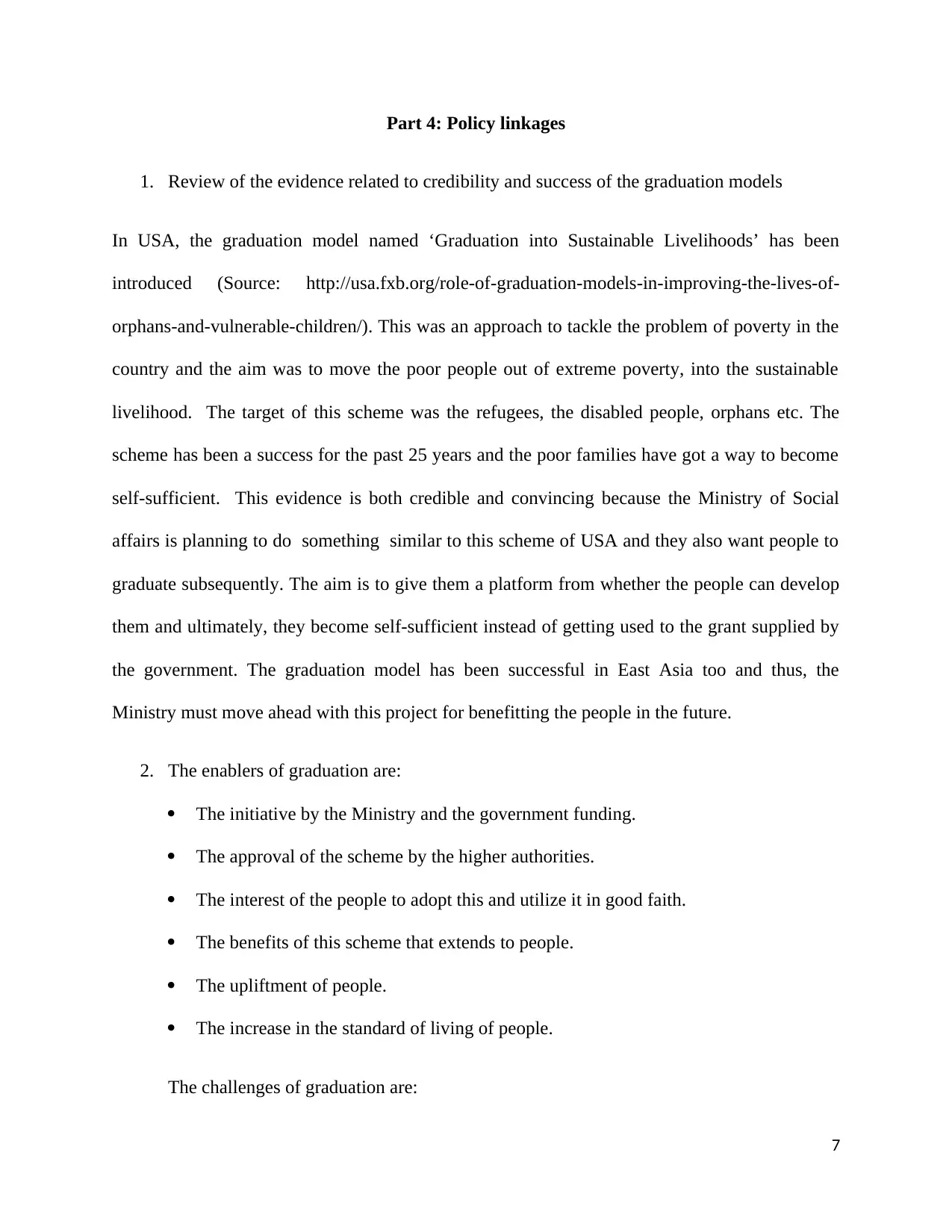
Part 4: Policy linkages
1. Review of the evidence related to credibility and success of the graduation models
In USA, the graduation model named ‘Graduation into Sustainable Livelihoods’ has been
introduced (Source: http://usa.fxb.org/role-of-graduation-models-in-improving-the-lives-of-
orphans-and-vulnerable-children/). This was an approach to tackle the problem of poverty in the
country and the aim was to move the poor people out of extreme poverty, into the sustainable
livelihood. The target of this scheme was the refugees, the disabled people, orphans etc. The
scheme has been a success for the past 25 years and the poor families have got a way to become
self-sufficient. This evidence is both credible and convincing because the Ministry of Social
affairs is planning to do something similar to this scheme of USA and they also want people to
graduate subsequently. The aim is to give them a platform from whether the people can develop
them and ultimately, they become self-sufficient instead of getting used to the grant supplied by
the government. The graduation model has been successful in East Asia too and thus, the
Ministry must move ahead with this project for benefitting the people in the future.
2. The enablers of graduation are:
The initiative by the Ministry and the government funding.
The approval of the scheme by the higher authorities.
The interest of the people to adopt this and utilize it in good faith.
The benefits of this scheme that extends to people.
The upliftment of people.
The increase in the standard of living of people.
The challenges of graduation are:
7
1. Review of the evidence related to credibility and success of the graduation models
In USA, the graduation model named ‘Graduation into Sustainable Livelihoods’ has been
introduced (Source: http://usa.fxb.org/role-of-graduation-models-in-improving-the-lives-of-
orphans-and-vulnerable-children/). This was an approach to tackle the problem of poverty in the
country and the aim was to move the poor people out of extreme poverty, into the sustainable
livelihood. The target of this scheme was the refugees, the disabled people, orphans etc. The
scheme has been a success for the past 25 years and the poor families have got a way to become
self-sufficient. This evidence is both credible and convincing because the Ministry of Social
affairs is planning to do something similar to this scheme of USA and they also want people to
graduate subsequently. The aim is to give them a platform from whether the people can develop
them and ultimately, they become self-sufficient instead of getting used to the grant supplied by
the government. The graduation model has been successful in East Asia too and thus, the
Ministry must move ahead with this project for benefitting the people in the future.
2. The enablers of graduation are:
The initiative by the Ministry and the government funding.
The approval of the scheme by the higher authorities.
The interest of the people to adopt this and utilize it in good faith.
The benefits of this scheme that extends to people.
The upliftment of people.
The increase in the standard of living of people.
The challenges of graduation are:
7

Burden on the spending of government and Ministry.
The possibility that people take the accommodation but do not graduate.
The social protection will not be extended to many other groups of people who
may oppose this scheme.
8
The possibility that people take the accommodation but do not graduate.
The social protection will not be extended to many other groups of people who
may oppose this scheme.
8
⊘ This is a preview!⊘
Do you want full access?
Subscribe today to unlock all pages.

Trusted by 1+ million students worldwide
1 out of 9
Your All-in-One AI-Powered Toolkit for Academic Success.
+13062052269
info@desklib.com
Available 24*7 on WhatsApp / Email
Unlock your academic potential
Copyright © 2020–2025 A2Z Services. All Rights Reserved. Developed and managed by ZUCOL.