Identifying Leadership's Impact on ALDI's Organizational Changes
VerifiedAdded on 2020/12/29
|32
|10018
|360
Report
AI Summary
This report delves into the significant influence of leadership on organizational changes and its subsequent impact on employee performance, using ALDI as a focal case study. The introduction highlights the importance of effective leadership in navigating organizational changes, such as technological advancements and market shifts, to maintain a competitive edge. The literature review explores organizational culture, leadership models, and their relationship with employee performance and change management. The research aims to analyze the issues arising from organizational culture, the impact of ineffective leadership, and strategies to improve leadership roles in managing workplace changes. The methodology section outlines the data collection and analysis methods used to investigate the research questions, focusing on leadership's role in change management and its effects on employee performance. The findings and discussion sections analyze the implications of leadership styles and organizational culture on employee performance and the effectiveness of change initiatives within ALDI. The conclusion summarizes the key findings and offers recommendations for improving leadership practices and managing organizational change. The report emphasizes the importance of proactive leadership in driving successful organizational transformations and enhancing employee outcomes.
“To identify the influence of
leaderships on organization changes
and employee performance”: ALDI
case study
leaderships on organization changes
and employee performance”: ALDI
case study

Paraphrase This Document
Need a fresh take? Get an instant paraphrase of this document with our AI Paraphraser
Table of Contents
INTRODUCTION...........................................................................................................................1
LITERATURE REVIEW................................................................................................................2
To identify the need of leadership in making effective organization change..............................3
To analyse the relationships between organisational changes and employee performance:.......4
METHODOLOGY:.........................................................................................................................7
ACCESS TO DATA RESEARCH ETHICS.................................................................................10
DATA ANALYSIS AND FINDINGS..........................................................................................11
Introduction................................................................................................................................11
DISCUSSION AND FINDINGS ..................................................................................................23
CONCLUSION..............................................................................................................................26
RECOMMENDATION.................................................................................................................26
REFERENCES..............................................................................................................................28
INTRODUCTION...........................................................................................................................1
LITERATURE REVIEW................................................................................................................2
To identify the need of leadership in making effective organization change..............................3
To analyse the relationships between organisational changes and employee performance:.......4
METHODOLOGY:.........................................................................................................................7
ACCESS TO DATA RESEARCH ETHICS.................................................................................10
DATA ANALYSIS AND FINDINGS..........................................................................................11
Introduction................................................................................................................................11
DISCUSSION AND FINDINGS ..................................................................................................23
CONCLUSION..............................................................................................................................26
RECOMMENDATION.................................................................................................................26
REFERENCES..............................................................................................................................28
INTRODUCTION
Business is said to be a group activity of making an individual living or making income
by producing or purchasing and selling goods to another person or company. A business can
earn maximum profit for the products and services with the innovative ideas and thinking power.
All these can be made possible by the proper guidance of workers by the leaders or supervisors.
An effective leader is an individual that is having ability to create inspiring vision of the future
growth for the company. Nowadays, it has been seen that most of the companies such as ALDI is
not been able to manage their team or resources effectively that would lead to huge reduction in
the overall performance as well as growth for them. This would basically arise because of
organisation changes, as this process in which a wide company or organisation changes their
working methods or aims. Like, in order to develop and make coordination with latest situation
or market, sometimes deep changes is essential in accordance to maintain a competitive balance
among the market. Organisation need to develop proper adaptability to change otherwise, it will
either be left behind or be swept always by the forces of modification (Jeston, 2014).
ALDI Company can make changes in various manners. Their technology can be
changes, it structure, people and other component can also be changed. It calls for changes in the
individual behavior of the employees sometimes. It has been found that most of the time certain
changes can misbalanced the equilibrium of behavior of the employees. The primary reason for
choice this title is to analyse the condition of organisation changes and how it will be making
impacts on the leadership. It is an area of management theory that aims on the stages that a
company goes through as they get associated with changes. The principles behind these change
theory can be apply to both short as well long term variations. The common characteristics of the
various phases of organisation variation are based on the certain strategies that can appropriate to
their own circumstances at the stage they are currently navigating. It is essential to plan the
changes in advance or can be forced upon an organization because of a shift in the environment.
Organisation changes are the way things are done within ALDI. In case of any regardless of the
types, changes associated with letting go of the manner in which employees work is done. It is
essential to determine their aims and objectives more effectively so that changes of mistakes can
less in near future time. Importance of organisation culture is associated with the beliefs,
ideologies, concepts and people values of an organisation from their culture. It is crucial for an
1
Business is said to be a group activity of making an individual living or making income
by producing or purchasing and selling goods to another person or company. A business can
earn maximum profit for the products and services with the innovative ideas and thinking power.
All these can be made possible by the proper guidance of workers by the leaders or supervisors.
An effective leader is an individual that is having ability to create inspiring vision of the future
growth for the company. Nowadays, it has been seen that most of the companies such as ALDI is
not been able to manage their team or resources effectively that would lead to huge reduction in
the overall performance as well as growth for them. This would basically arise because of
organisation changes, as this process in which a wide company or organisation changes their
working methods or aims. Like, in order to develop and make coordination with latest situation
or market, sometimes deep changes is essential in accordance to maintain a competitive balance
among the market. Organisation need to develop proper adaptability to change otherwise, it will
either be left behind or be swept always by the forces of modification (Jeston, 2014).
ALDI Company can make changes in various manners. Their technology can be
changes, it structure, people and other component can also be changed. It calls for changes in the
individual behavior of the employees sometimes. It has been found that most of the time certain
changes can misbalanced the equilibrium of behavior of the employees. The primary reason for
choice this title is to analyse the condition of organisation changes and how it will be making
impacts on the leadership. It is an area of management theory that aims on the stages that a
company goes through as they get associated with changes. The principles behind these change
theory can be apply to both short as well long term variations. The common characteristics of the
various phases of organisation variation are based on the certain strategies that can appropriate to
their own circumstances at the stage they are currently navigating. It is essential to plan the
changes in advance or can be forced upon an organization because of a shift in the environment.
Organisation changes are the way things are done within ALDI. In case of any regardless of the
types, changes associated with letting go of the manner in which employees work is done. It is
essential to determine their aims and objectives more effectively so that changes of mistakes can
less in near future time. Importance of organisation culture is associated with the beliefs,
ideologies, concepts and people values of an organisation from their culture. It is crucial for an
1
⊘ This is a preview!⊘
Do you want full access?
Subscribe today to unlock all pages.

Trusted by 1+ million students worldwide
employee is to maintain proper balance among within the department by the help of proper
attitude and behavior that can help them to attain maximum growth and profitability in near
future time (Weske, 2012).
Aim of the research:
To analyse the issues that are arises because of organisation culture. All kind of internal
problems those are associated with the ALDI regarding the ineffective leadership are determined
under this research. Therefore, the aim that can proposed the analysis is to investigate the matters
those are helpful in attaining overall goals of an organisation.
Rational of the research: The main reason for choosing this particular topic, because
leadership is crucial aspects for an organization. As, it provides proper shape to employee
performance and increasing their skills. In case leader is more effective, organisation can easily
be able to utilise their resources in efficient manner. It is directly related with an organisation as
well as employee performance. It is crucial to make deep research on this topic as leader
influences can lead to huge success for an organisation in coming period.
Research Objective:
To identify the need of leadership in making effective organization change.
To analyse the relationships between organisational changes and employee performance.
To determine the role of leaderships in managing necessary change at workplace.
To determine influence of business leadership on organisational change and their principles.
Research Questions
Q1: What are implications that are arises on the leader in case of ineffective organisational
culture?
Q2: Does it impact negatively on the overall performance of employees?
Q3: How to improve the role of leader to manage and control necessary changes in an
organisation?
Q4: How does ALDI business leadership influence organisational change and their Principles?
LITERATURE REVIEW
Organisation culture is one of the effective aspects that can make people attain all their
essential goals by operating together in the same roof. It is concepts of shared assumptions,
beliefs and norms that are govern about how people used to behave within an organisation.
2
attitude and behavior that can help them to attain maximum growth and profitability in near
future time (Weske, 2012).
Aim of the research:
To analyse the issues that are arises because of organisation culture. All kind of internal
problems those are associated with the ALDI regarding the ineffective leadership are determined
under this research. Therefore, the aim that can proposed the analysis is to investigate the matters
those are helpful in attaining overall goals of an organisation.
Rational of the research: The main reason for choosing this particular topic, because
leadership is crucial aspects for an organization. As, it provides proper shape to employee
performance and increasing their skills. In case leader is more effective, organisation can easily
be able to utilise their resources in efficient manner. It is directly related with an organisation as
well as employee performance. It is crucial to make deep research on this topic as leader
influences can lead to huge success for an organisation in coming period.
Research Objective:
To identify the need of leadership in making effective organization change.
To analyse the relationships between organisational changes and employee performance.
To determine the role of leaderships in managing necessary change at workplace.
To determine influence of business leadership on organisational change and their principles.
Research Questions
Q1: What are implications that are arises on the leader in case of ineffective organisational
culture?
Q2: Does it impact negatively on the overall performance of employees?
Q3: How to improve the role of leader to manage and control necessary changes in an
organisation?
Q4: How does ALDI business leadership influence organisational change and their Principles?
LITERATURE REVIEW
Organisation culture is one of the effective aspects that can make people attain all their
essential goals by operating together in the same roof. It is concepts of shared assumptions,
beliefs and norms that are govern about how people used to behave within an organisation.
2
Paraphrase This Document
Need a fresh take? Get an instant paraphrase of this document with our AI Paraphraser
These values would have strong impacts on the people that are working in them with full
dedication. Every organisation such as ALDI would need to develop and maintain a valuable
culture that provided proper guidelines and areas for the attitude of people of an organisation.
The notion that an organisation can have specific culture is seems to be sprinkled in large array
of publication on plan and business strategies.
According to the Saunders and Lewis, 2012, although, the absence of a positive
theoretical grounds for the areas of organisation culture has been changes drastically.
Organisation culture impact the ways people interact with each other that resistance they will
have towards certain all kind changes and ultimately the way they share knowledge. It represents
the collective values, beliefs and concepts of organisational members and is a product of factors
such as products and other important services that are delivering to the people by the company.
Organisational culture would be an essential method from various prospective (6 Steps to
Improve Organization Performance, 2018). Culture of the organisation is something that could
essentially arrive a business actual competitive advantage. Authoritative culture is a complicated
be unsure and is framed in variety of ways, it strength start from the difficulties and hindrance
that association deal with, it could be a planned production of the administration; People
working in the association have hard contribution to determining a culture. Culture directs how
individuals and gatherings impart and carry on in the miniaturised scale and full scale condition.
Wide business utilises Culture as wellspring of Competitive preferred position. Essay way to
manage employees that are working within an organisation as they are more valuable part of the
company. All kind of aims and objectives can be attained in case proper culture would be
followed within an organisation. Unity among each and every worker would lead to attainment
of future achievement and help in proper communication within internal as well as external
department of an organisation. By the help of effective leadership guidance all workers can
move toward right direction which will be majorly suitable for ALDI in upcoming time (Myers,
2013).
To identify the need of leadership in making effective organization change
In the view point of Cameron and Green, 2015, the classic model of the effective
organisational leader is the management of all the essential changes that are affecting the
business growth up to the same level. Leadership is a crucial aspect for making an organisational
successful. The top executive leader operates by following reliable stages and have well organise
3
dedication. Every organisation such as ALDI would need to develop and maintain a valuable
culture that provided proper guidelines and areas for the attitude of people of an organisation.
The notion that an organisation can have specific culture is seems to be sprinkled in large array
of publication on plan and business strategies.
According to the Saunders and Lewis, 2012, although, the absence of a positive
theoretical grounds for the areas of organisation culture has been changes drastically.
Organisation culture impact the ways people interact with each other that resistance they will
have towards certain all kind changes and ultimately the way they share knowledge. It represents
the collective values, beliefs and concepts of organisational members and is a product of factors
such as products and other important services that are delivering to the people by the company.
Organisational culture would be an essential method from various prospective (6 Steps to
Improve Organization Performance, 2018). Culture of the organisation is something that could
essentially arrive a business actual competitive advantage. Authoritative culture is a complicated
be unsure and is framed in variety of ways, it strength start from the difficulties and hindrance
that association deal with, it could be a planned production of the administration; People
working in the association have hard contribution to determining a culture. Culture directs how
individuals and gatherings impart and carry on in the miniaturised scale and full scale condition.
Wide business utilises Culture as wellspring of Competitive preferred position. Essay way to
manage employees that are working within an organisation as they are more valuable part of the
company. All kind of aims and objectives can be attained in case proper culture would be
followed within an organisation. Unity among each and every worker would lead to attainment
of future achievement and help in proper communication within internal as well as external
department of an organisation. By the help of effective leadership guidance all workers can
move toward right direction which will be majorly suitable for ALDI in upcoming time (Myers,
2013).
To identify the need of leadership in making effective organization change
In the view point of Cameron and Green, 2015, the classic model of the effective
organisational leader is the management of all the essential changes that are affecting the
business growth up to the same level. Leadership is a crucial aspect for making an organisational
successful. The top executive leader operates by following reliable stages and have well organise
3
pattern. The organisation of present time does not have the luxury of stability hence, if faces an
ever enhance changing in market in near future time. It required to accepts, adopt and formulate
changes in the business as per the changing trend, technology and future concerns. Leaderships
are essential factors for making an organisation more profitable in nowadays, The importance of
leadership to the alternate management process is underscored by way of the truth that trade, by
using definition, calls for developing a new device after which institutionalising the brand new
approaches (Emaraldinsight, 1999) . It is the art or procedure of impact people to deliver
assigned tasks willingly, efficiently and stability. Changes do not have to be a complex process.
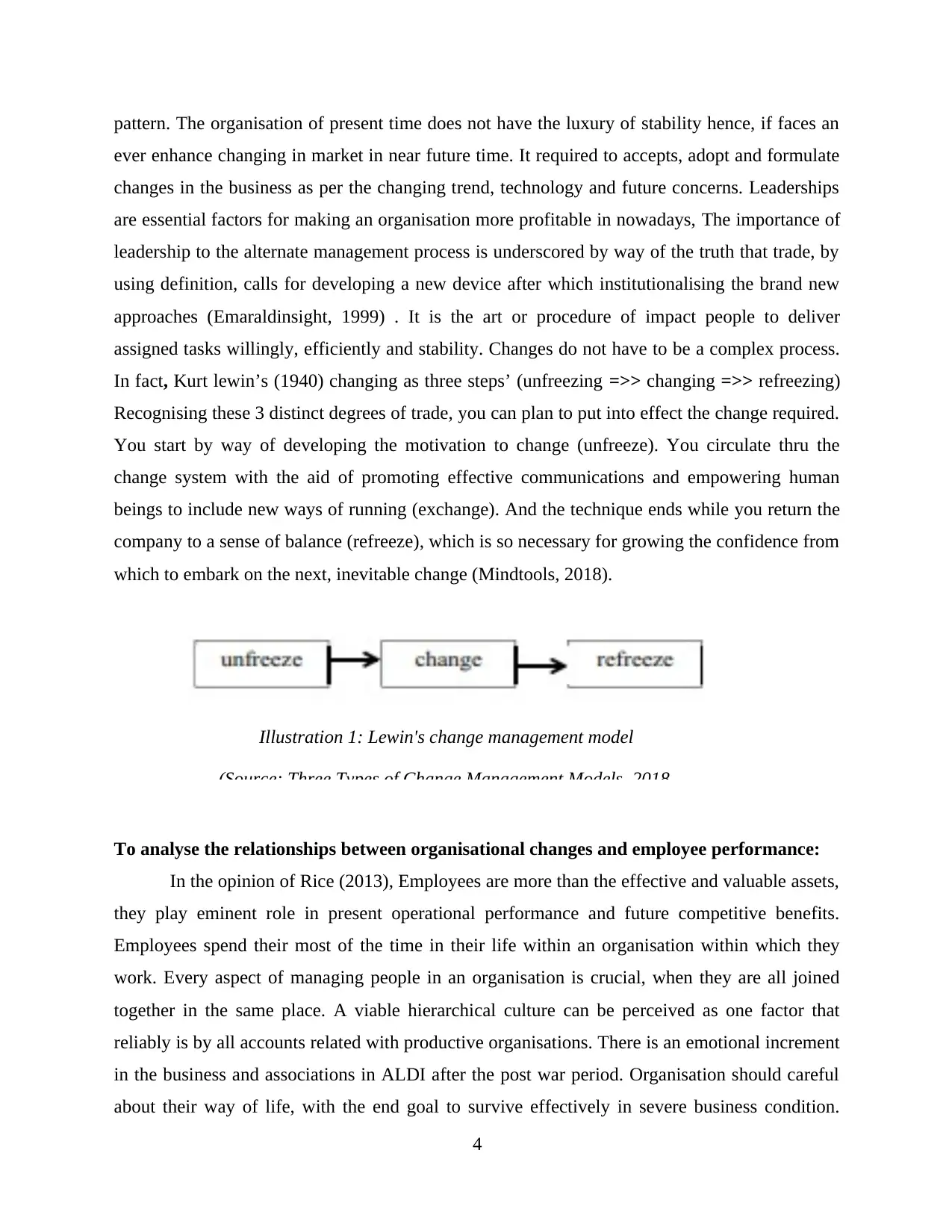
In fact, Kurt lewin’s (1940) changing as three steps’ (unfreezing =>> changing =>> refreezing)
Recognising these 3 distinct degrees of trade, you can plan to put into effect the change required.
You start by way of developing the motivation to change (unfreeze). You circulate thru the
change system with the aid of promoting effective communications and empowering human
beings to include new ways of running (exchange). And the technique ends while you return the
company to a sense of balance (refreeze), which is so necessary for growing the confidence from
which to embark on the next, inevitable change (Mindtools, 2018).
Illustration 1: Lewin's change management model
(Source: Three Types of Change Management Models, 2018.
To analyse the relationships between organisational changes and employee performance:
In the opinion of Rice (2013), Employees are more than the effective and valuable assets,
they play eminent role in present operational performance and future competitive benefits.
Employees spend their most of the time in their life within an organisation within which they
work. Every aspect of managing people in an organisation is crucial, when they are all joined
together in the same place. A viable hierarchical culture can be perceived as one factor that
reliably is by all accounts related with productive organisations. There is an emotional increment
in the business and associations in ALDI after the post war period. Organisation should careful
about their way of life, with the end goal to survive effectively in severe business condition.
4
ever enhance changing in market in near future time. It required to accepts, adopt and formulate
changes in the business as per the changing trend, technology and future concerns. Leaderships
are essential factors for making an organisation more profitable in nowadays, The importance of
leadership to the alternate management process is underscored by way of the truth that trade, by
using definition, calls for developing a new device after which institutionalising the brand new
approaches (Emaraldinsight, 1999) . It is the art or procedure of impact people to deliver
assigned tasks willingly, efficiently and stability. Changes do not have to be a complex process.
In fact, Kurt lewin’s (1940) changing as three steps’ (unfreezing =>> changing =>> refreezing)
Recognising these 3 distinct degrees of trade, you can plan to put into effect the change required.
You start by way of developing the motivation to change (unfreeze). You circulate thru the
change system with the aid of promoting effective communications and empowering human
beings to include new ways of running (exchange). And the technique ends while you return the
company to a sense of balance (refreeze), which is so necessary for growing the confidence from
which to embark on the next, inevitable change (Mindtools, 2018).
Illustration 1: Lewin's change management model
(Source: Three Types of Change Management Models, 2018.
To analyse the relationships between organisational changes and employee performance:
In the opinion of Rice (2013), Employees are more than the effective and valuable assets,
they play eminent role in present operational performance and future competitive benefits.
Employees spend their most of the time in their life within an organisation within which they
work. Every aspect of managing people in an organisation is crucial, when they are all joined
together in the same place. A viable hierarchical culture can be perceived as one factor that
reliably is by all accounts related with productive organisations. There is an emotional increment
in the business and associations in ALDI after the post war period. Organisation should careful
about their way of life, with the end goal to survive effectively in severe business condition.
4
⊘ This is a preview!⊘
Do you want full access?
Subscribe today to unlock all pages.
Trusted by 1+ million students worldwide
Authoritative culture esteems shifted essentially among the organisations. The variety in social
qualities significantly affected employees of an organisation. The main aim of this study is to
examine the relationships of team creatively, job satisfaction and work performance under the
implication of on-going organisational changes. The best ways to analyse the issues by the help
of Kotter, (1995) change model. The fundamental objective of leaderships is to produce useful
changes. According to kotter theory managing organisational trade will be more a success if you
practice these simple concepts. Achieving personal alternate may be more a hit too if you use the
identical method where applicable. Change control entails considerate planning and sensitive
implementation, and certainly, session with, and involvement of, the human beings stricken by
the changes. If you force trade on humans typically problems raise up.
To determine the role of leaderships in managing necessary change at workplace:
According to Goetsch and Davis, (2014), a leader has various kind of ability to determine
the vision of a manager. Manager always fears changes because it would upset their carefully
planned way of their life. But leader embrace all difficult kind of changes that can lead to create
issues in organisation growth and development. A leader can easily manage their team by
selecting appropriate leadership style can assist while implementing any theory within planning.
Leadership theories can be better option for the management to make profitable plan in near
future time. Thus, leader must process the inventive change model as it aids to moderate in
complexity, implementation and cost. As per the view of Goetsch and Davis, (2014) it can be
stated that new technical advancement can works as to moderate the sense of uncertainty,
resistance and unexpected cost. Management of any kind of changes is associated with creating
a vision, communicating a plan and analyses all the outcomes that are determined during the
research time. Behavioural theory of leadership is one of the suitable aspects that can provide
valuable outcomes for an organisation in balancing the culture in the workplace. These are based
upon the belief system that great leaders are made not born. The use of the trait and this theory to
leaderships showed positively depended on various variables such as nature of activities
performed by the employees within an organisation. In an organisation, where there is
confidence in the ability of formal leaders, employee will look towards the staffs for various
things. At the time of drastic change, workers will expect powerful and sensible strategies, sure
and viable basic leadership, and standard, finish correspondence that is on time.
5
qualities significantly affected employees of an organisation. The main aim of this study is to
examine the relationships of team creatively, job satisfaction and work performance under the
implication of on-going organisational changes. The best ways to analyse the issues by the help
of Kotter, (1995) change model. The fundamental objective of leaderships is to produce useful
changes. According to kotter theory managing organisational trade will be more a success if you
practice these simple concepts. Achieving personal alternate may be more a hit too if you use the
identical method where applicable. Change control entails considerate planning and sensitive
implementation, and certainly, session with, and involvement of, the human beings stricken by
the changes. If you force trade on humans typically problems raise up.
To determine the role of leaderships in managing necessary change at workplace:
According to Goetsch and Davis, (2014), a leader has various kind of ability to determine
the vision of a manager. Manager always fears changes because it would upset their carefully
planned way of their life. But leader embrace all difficult kind of changes that can lead to create
issues in organisation growth and development. A leader can easily manage their team by
selecting appropriate leadership style can assist while implementing any theory within planning.
Leadership theories can be better option for the management to make profitable plan in near
future time. Thus, leader must process the inventive change model as it aids to moderate in
complexity, implementation and cost. As per the view of Goetsch and Davis, (2014) it can be
stated that new technical advancement can works as to moderate the sense of uncertainty,
resistance and unexpected cost. Management of any kind of changes is associated with creating
a vision, communicating a plan and analyses all the outcomes that are determined during the
research time. Behavioural theory of leadership is one of the suitable aspects that can provide
valuable outcomes for an organisation in balancing the culture in the workplace. These are based
upon the belief system that great leaders are made not born. The use of the trait and this theory to
leaderships showed positively depended on various variables such as nature of activities
performed by the employees within an organisation. In an organisation, where there is
confidence in the ability of formal leaders, employee will look towards the staffs for various
things. At the time of drastic change, workers will expect powerful and sensible strategies, sure
and viable basic leadership, and standard, finish correspondence that is on time.
5
Paraphrase This Document
Need a fresh take? Get an instant paraphrase of this document with our AI Paraphraser
To determine influence of business leadership on organizational change and their
principles:
According to Mark Wilding (2018) the various unique pricing strategies such as
economy pricing and price skimming, so that large number of customer are attracted toward their
pub and fulfil their needs. Similarly, other organisation as ALDI can apply the same pricing
strategy to improve the sales and increase the profitability of business. He worked with the HR
department of company so that highly skilled and retaining talent could be hired. They fix a
criterion that any employee could not be appointed in company if they are below age 16. Other
companies like ALDI must use this process of making a conversation with their HR department
so that qualified staffs are appointed that help in increasing the productivity of company.
As per the view of Brunsson and Olsen, (2018) stated that Leadership is the term that
relates in terms to lead the working of enterprise in effective and efficient mode. Thus, leaders
within the enterprise must design better communication knowledge that aids to ensure the staff
about to understand vision for entity so that they perform their effectively and efficiently. In this,
stated that the number of the changes can be taken into place and this can be relate with nature of
the enterprise and may be of its environment. Thus, the changes within the enterprise is very
important and it is essential to deal with these changes. There are number of changes that can
affect the strategies, task and all other activities. According to the view of Luhmann, (2018) it
can be stated that leaders within the enterprise have active participation in terms to change
bringing by employees in decision making process. Herein, Hatch, 2018 stated that the
leadership style of management works as to influence productivity and it has its direct impact
over morale of employees. Under this, the autocratic leaders within the enterprise works as to set
goals without taking any input from the employees. Hence, Wolf, (2018) stated that if the aims
and objective within the enterprise are not specific, measurable, attainable, realistic and time
constrained then there can be difficulties in order to achieve the enterprise goals. According to
the view of Gray, (2018) it can be stated that if enterprise bring any changes then leader to the
firm should work as to provide training regarding the new skills as needed. This will aid to
leader in terms to review the stricture of organisation in order to align with the changes. In
contrary to Soluk, Tekkeşin and Wright, (2018) stated that leaders within the enterprise must
have huge influence on the culture of enterprise. In addition to it, good leader works as to assert
his influence in order to empower and support people so that they can able to think in one proper
6
principles:
According to Mark Wilding (2018) the various unique pricing strategies such as
economy pricing and price skimming, so that large number of customer are attracted toward their
pub and fulfil their needs. Similarly, other organisation as ALDI can apply the same pricing
strategy to improve the sales and increase the profitability of business. He worked with the HR
department of company so that highly skilled and retaining talent could be hired. They fix a
criterion that any employee could not be appointed in company if they are below age 16. Other
companies like ALDI must use this process of making a conversation with their HR department
so that qualified staffs are appointed that help in increasing the productivity of company.
As per the view of Brunsson and Olsen, (2018) stated that Leadership is the term that
relates in terms to lead the working of enterprise in effective and efficient mode. Thus, leaders
within the enterprise must design better communication knowledge that aids to ensure the staff
about to understand vision for entity so that they perform their effectively and efficiently. In this,
stated that the number of the changes can be taken into place and this can be relate with nature of
the enterprise and may be of its environment. Thus, the changes within the enterprise is very
important and it is essential to deal with these changes. There are number of changes that can
affect the strategies, task and all other activities. According to the view of Luhmann, (2018) it
can be stated that leaders within the enterprise have active participation in terms to change
bringing by employees in decision making process. Herein, Hatch, 2018 stated that the
leadership style of management works as to influence productivity and it has its direct impact
over morale of employees. Under this, the autocratic leaders within the enterprise works as to set
goals without taking any input from the employees. Hence, Wolf, (2018) stated that if the aims
and objective within the enterprise are not specific, measurable, attainable, realistic and time
constrained then there can be difficulties in order to achieve the enterprise goals. According to
the view of Gray, (2018) it can be stated that if enterprise bring any changes then leader to the
firm should work as to provide training regarding the new skills as needed. This will aid to
leader in terms to review the stricture of organisation in order to align with the changes. In
contrary to Soluk, Tekkeşin and Wright, (2018) stated that leaders within the enterprise must
have huge influence on the culture of enterprise. In addition to it, good leader works as to assert
his influence in order to empower and support people so that they can able to think in one proper
6
direction towards achieving the organisational goals. According to the view of Gray, (2018) it
can be stated that the leaders within the enterprise takes initiatives in terms to changes and adapt
the policies so that it can be possible to maintain peace and harmony. In contrary to Johnson and
Szamosi, (2018) stated that the leader must process the changes within the enterprise as it is one
of crucial component that aids to streamline the process of change and also supports in order to
have reduction of negative impact on workers. As per the view of Goetsch and Davis, (2014)
stated that the leader must process better communication between workers so that the member
can understand the reason behind implementation of changes. So, it can be said that leaders have
both positive and negative effect changes and it also depends method of changes that used and
effectiveness within the organisation. Thus, it can be termed out as strong and clear leadership is
one of the crucial concept that works as to inspire and leads the people effectively. The quality of
leaders plays the dynamic role as they are the person who has to handle the resistance,
exploration, confusion and commitment of management. In addition to it, Fjeldstad and Snow,
(2018) stated that change is very crucial process that aids to enterprise towards the path of
success. Thus, there are number of factors that influence the change within the enterprise and
this forces may be are as to create expectation relates with having improvement in efficiency,
better services and various external forces that leads to change in the working of enterprise.
METHODOLOGY:
Research is a type of systematic examination of different facts, figures and materials that
may be or are used while studying a particular topic. It helps to identify appropriateness of facts
and reach to the conclusions of a whole research program. It is conducted by a person to enhance
the knowledge level. There are two different types of research methods that may be used by a
researcher while identifying the way in which leadership influences organisational change. Both
the methods are explained below:
Research philosophies- It is term that termed out as belief with help of which data can be
gathered, analysed and used. There are many types of research philosophies as doxology,
epistemology, interpretive and positivism (Burnes, Hughes and By, 2018). In order to determine
the implication of change within the enterprise on behaviour of leaders the researcher has used
interpretative technique so that there can be better analyse of the issues that are arises because of
organisation culture. Thus, it is helpful to integrates the human interest into the study. With help
7
can be stated that the leaders within the enterprise takes initiatives in terms to changes and adapt
the policies so that it can be possible to maintain peace and harmony. In contrary to Johnson and
Szamosi, (2018) stated that the leader must process the changes within the enterprise as it is one
of crucial component that aids to streamline the process of change and also supports in order to
have reduction of negative impact on workers. As per the view of Goetsch and Davis, (2014)
stated that the leader must process better communication between workers so that the member
can understand the reason behind implementation of changes. So, it can be said that leaders have
both positive and negative effect changes and it also depends method of changes that used and
effectiveness within the organisation. Thus, it can be termed out as strong and clear leadership is
one of the crucial concept that works as to inspire and leads the people effectively. The quality of
leaders plays the dynamic role as they are the person who has to handle the resistance,
exploration, confusion and commitment of management. In addition to it, Fjeldstad and Snow,
(2018) stated that change is very crucial process that aids to enterprise towards the path of
success. Thus, there are number of factors that influence the change within the enterprise and
this forces may be are as to create expectation relates with having improvement in efficiency,
better services and various external forces that leads to change in the working of enterprise.
METHODOLOGY:
Research is a type of systematic examination of different facts, figures and materials that
may be or are used while studying a particular topic. It helps to identify appropriateness of facts
and reach to the conclusions of a whole research program. It is conducted by a person to enhance
the knowledge level. There are two different types of research methods that may be used by a
researcher while identifying the way in which leadership influences organisational change. Both
the methods are explained below:
Research philosophies- It is term that termed out as belief with help of which data can be
gathered, analysed and used. There are many types of research philosophies as doxology,
epistemology, interpretive and positivism (Burnes, Hughes and By, 2018). In order to determine
the implication of change within the enterprise on behaviour of leaders the researcher has used
interpretative technique so that there can be better analyse of the issues that are arises because of
organisation culture. Thus, it is helpful to integrates the human interest into the study. With help
7
⊘ This is a preview!⊘
Do you want full access?
Subscribe today to unlock all pages.
Trusted by 1+ million students worldwide
of it, it can be possible to define elements of study in better manner. Thus, research would not
have the use of positivism philosophy as it define the approach to study that based on scientific,
evidence, experience and statistical data. Therefore, it is time consuming and costly process.
Research approach- This term is defined as plan and procedure that consists of steps and broad
assumptions. There are number of approaches as deductive and inductive. In order to determine
the implication of present research the researcher will have the use of inductive technique. On
the other hand, inductive approach can be termed out as to have detailed method of data
collection analysis and interpretation (Hosking and Anderson, 2018). It is also known as
inductive reasoning which starts with the observation and theories that are proposed by the
researcher while conducting the research. It is the process of observation and development of
explanations that may help to find solutions for organisational problems. It is concerned with the
generation of new theory emerging from the data which has been collected by the person who is
studying a particular topic for the purpose of research. In this, researcher has used inductive
approach to get analyse the issues that are arises because of organisation culture.
This approach helps the researcher to collect appropriate data from different sources such
as articles and journals. There are no specific rules for this research as it is based on secondary
data which have been already collected. This method has resulted effectively while finding
answer for the research question which is “how leadership influences organizational change”. It
has helped to get the right answer for the question with the help of different online sources. Any
other alternative is not considered by the researcher because the data is collected from secondary
sources which were available online (Hutt and Speh, 2012). Thus, Deductive approach is based
on developing hypothesis that must related with existing theory and design research strategy in
order to test the hypothesis. This can be called as top down approach. Hence, it can not be used
as it run the enterprise process as more general to more specific. According to the journal of
management, leadership can help in organisational change that may help to attain long term
sustainability for the organisation. It is possible with the help of effective processes and content
that may be collected through good research of the company in which the change is going to be
implemented. As the research is based on secondary data no sample size and population are
selected by the researcher for this purpose all the data has been collected with the help of
questionnaires survey. Inductive approach is used by the researcher to find answer for the
research question. It has also helped to achieve all the research objectives that need to be attained
8
have the use of positivism philosophy as it define the approach to study that based on scientific,
evidence, experience and statistical data. Therefore, it is time consuming and costly process.
Research approach- This term is defined as plan and procedure that consists of steps and broad
assumptions. There are number of approaches as deductive and inductive. In order to determine
the implication of present research the researcher will have the use of inductive technique. On
the other hand, inductive approach can be termed out as to have detailed method of data
collection analysis and interpretation (Hosking and Anderson, 2018). It is also known as
inductive reasoning which starts with the observation and theories that are proposed by the
researcher while conducting the research. It is the process of observation and development of
explanations that may help to find solutions for organisational problems. It is concerned with the
generation of new theory emerging from the data which has been collected by the person who is
studying a particular topic for the purpose of research. In this, researcher has used inductive
approach to get analyse the issues that are arises because of organisation culture.
This approach helps the researcher to collect appropriate data from different sources such
as articles and journals. There are no specific rules for this research as it is based on secondary
data which have been already collected. This method has resulted effectively while finding
answer for the research question which is “how leadership influences organizational change”. It
has helped to get the right answer for the question with the help of different online sources. Any
other alternative is not considered by the researcher because the data is collected from secondary
sources which were available online (Hutt and Speh, 2012). Thus, Deductive approach is based
on developing hypothesis that must related with existing theory and design research strategy in
order to test the hypothesis. This can be called as top down approach. Hence, it can not be used
as it run the enterprise process as more general to more specific. According to the journal of
management, leadership can help in organisational change that may help to attain long term
sustainability for the organisation. It is possible with the help of effective processes and content
that may be collected through good research of the company in which the change is going to be
implemented. As the research is based on secondary data no sample size and population are
selected by the researcher for this purpose all the data has been collected with the help of
questionnaires survey. Inductive approach is used by the researcher to find answer for the
research question. It has also helped to achieve all the research objectives that need to be attained
8
Paraphrase This Document
Need a fresh take? Get an instant paraphrase of this document with our AI Paraphraser
by the researcher in order to complete the research effectively. It has been also analysed while
researching the topicthat inductive approach guides to the right way to find solutions for the
business problems of the organisations that are faced while running and operating business
activities (Maylor, Blackmon and Huemann, 2016).
Data collection- This is process that termed out as gathering, measuring of all the information
that based on targetted variables in the established mode. Thus, collection of the data is one of
the statistical requirement. The data can be collected with help of both primary and secondary
method. In order to determine the impact of change the researcher will have the use of with
techniques as primary and secondary. The primary method aids to gather the first hand
information. Thus, primary method can be used to have the use of method as individual
interviews, focus groups and observations. On the other hand secondary method will be useful in
order to get the depth information with the use of books, online articles, journals etc. in order to
make this research effective, the researcher has used primary technique so that depth information
can be conducted and better issues can be analysed that arises due to organisation culture
conflicts.
Sampling- This term is defined as a group of sample that aids to collect the information with
help of selecting respondents. Thus, sampling is inclusive of various methods as cluster,
probabilistic, non probabilistic and sample random technique. In order to determine the
implication of organisational change the researcher will have the use of sample random
techniques with the sample size of 30 respondents as leaders.
Data analysis- It can be termed out as process of inspecting, analysing, cleansing, transforming
and modelling the data in order to gain the depth information. Thus, data can be analysed with
help of two techniques as qualitative and quantitative. It can be defined as the primarily
exploratory research which can be chosen by the researcher in order to gain an understanding of
the fundamental reasons, opinions and motivations. It helps to get detailed information of the
problems that are faced by the organisation and also guide to form effective solutions for the
same. This method can be used by the research to identify the effect of leadership upon the
organisational change. Data collected in this method is unstructured or semi structured which
can be gathered with the help of interviewing the individuals. Data analysis in this approach is
non-statistical. Small sample size is used for the purpose of study and respondents are selected to
fulfil a provided quota of research. In order to determine the implication of change on leadership
9
researching the topicthat inductive approach guides to the right way to find solutions for the
business problems of the organisations that are faced while running and operating business
activities (Maylor, Blackmon and Huemann, 2016).
Data collection- This is process that termed out as gathering, measuring of all the information
that based on targetted variables in the established mode. Thus, collection of the data is one of
the statistical requirement. The data can be collected with help of both primary and secondary
method. In order to determine the impact of change the researcher will have the use of with
techniques as primary and secondary. The primary method aids to gather the first hand
information. Thus, primary method can be used to have the use of method as individual
interviews, focus groups and observations. On the other hand secondary method will be useful in
order to get the depth information with the use of books, online articles, journals etc. in order to
make this research effective, the researcher has used primary technique so that depth information
can be conducted and better issues can be analysed that arises due to organisation culture
conflicts.
Sampling- This term is defined as a group of sample that aids to collect the information with
help of selecting respondents. Thus, sampling is inclusive of various methods as cluster,
probabilistic, non probabilistic and sample random technique. In order to determine the
implication of organisational change the researcher will have the use of sample random
techniques with the sample size of 30 respondents as leaders.
Data analysis- It can be termed out as process of inspecting, analysing, cleansing, transforming
and modelling the data in order to gain the depth information. Thus, data can be analysed with
help of two techniques as qualitative and quantitative. It can be defined as the primarily
exploratory research which can be chosen by the researcher in order to gain an understanding of
the fundamental reasons, opinions and motivations. It helps to get detailed information of the
problems that are faced by the organisation and also guide to form effective solutions for the
same. This method can be used by the research to identify the effect of leadership upon the
organisational change. Data collected in this method is unstructured or semi structured which
can be gathered with the help of interviewing the individuals. Data analysis in this approach is
non-statistical. Small sample size is used for the purpose of study and respondents are selected to
fulfil a provided quota of research. In order to determine the implication of change on leadership
9
behaviour the leader will have the use of qualitative techniques. In this, the questionnaire will be
farmed with the sample size of 30 respondent as leaders of Aldi. This method is used to collect
data from different sources and it includes the use of computational, statistical and mathematical
tools to get result. It is a systematic empirical investigation of facts that are used to prove a
particular thing with the help of different techniques. The main objective of this method of
research is to develop and deliver mathematical theories and hypothesis relating to spectacles. It
is also used in social sciences in psychology, demography, economics and marketing to gather
information of community health, gender, human developments etc. It can be used to produce
information on particular cases that are studied by a researcher. It also guides to reach an
effective conclusion of whole study so that the case can be understood effectively. Respondents
in this method are selected randomly to collect the data. Structured method is used to collect the
data that includes telephonic interview and online questionnaires. In this type of research, a
particular population is selected by the researcher in which a sample is being chosen in order to
gather data (Chang, 2016). Thus, quantitative data will be not be taken as it is too time and cost
involving process. This needs to have practical implication of tools and techniques.
In order to determine the implication of present research the researcher has used
qualitative technique. In this, questionnaire will be framed and depth interpretation can be taken
with help of it. Qualitative method is used by the researcher to identify the effects of leadership
upon organisational change. Secondary data collection technique is used to collect the data from
different sources. Majorly the data is collected from articles and online journals that may help to
gather information. In secondary approach inductive method is used by the researcher for this
particular report.
ACCESS TO DATA RESEARCH ETHICS
The data has been collected from the effective and appropriate sources that are available
online and guided the researcher while finding answer for the research question. The access for
the research field has been gained with the help of online sources that have helped to fulfil all the
research objectives that are required to be achieved to complete the research program. The
information which is required for the particular research has been collected by researching
deeply about the topic which has been chosen by the researcher. Inductive research approach has
guided while the research to get right and appropriate results for the research question.
LIMITATIONS
10
farmed with the sample size of 30 respondent as leaders of Aldi. This method is used to collect
data from different sources and it includes the use of computational, statistical and mathematical
tools to get result. It is a systematic empirical investigation of facts that are used to prove a
particular thing with the help of different techniques. The main objective of this method of
research is to develop and deliver mathematical theories and hypothesis relating to spectacles. It
is also used in social sciences in psychology, demography, economics and marketing to gather
information of community health, gender, human developments etc. It can be used to produce
information on particular cases that are studied by a researcher. It also guides to reach an
effective conclusion of whole study so that the case can be understood effectively. Respondents
in this method are selected randomly to collect the data. Structured method is used to collect the
data that includes telephonic interview and online questionnaires. In this type of research, a
particular population is selected by the researcher in which a sample is being chosen in order to
gather data (Chang, 2016). Thus, quantitative data will be not be taken as it is too time and cost
involving process. This needs to have practical implication of tools and techniques.
In order to determine the implication of present research the researcher has used
qualitative technique. In this, questionnaire will be framed and depth interpretation can be taken
with help of it. Qualitative method is used by the researcher to identify the effects of leadership
upon organisational change. Secondary data collection technique is used to collect the data from
different sources. Majorly the data is collected from articles and online journals that may help to
gather information. In secondary approach inductive method is used by the researcher for this
particular report.
ACCESS TO DATA RESEARCH ETHICS
The data has been collected from the effective and appropriate sources that are available
online and guided the researcher while finding answer for the research question. The access for
the research field has been gained with the help of online sources that have helped to fulfil all the
research objectives that are required to be achieved to complete the research program. The
information which is required for the particular research has been collected by researching
deeply about the topic which has been chosen by the researcher. Inductive research approach has
guided while the research to get right and appropriate results for the research question.
LIMITATIONS
10
⊘ This is a preview!⊘
Do you want full access?
Subscribe today to unlock all pages.
Trusted by 1+ million students worldwide

1 out of 32


Related Documents


Your All-in-One AI-Powered Toolkit for Academic Success.
+13062052269
info@desklib.com
Available 24*7 on WhatsApp / Email
![[object Object]](/_next/static/media/star-bottom.7253800d.svg)
Unlock your academic potential
Copyright © 2020–2026 A2Z Services. All Rights Reserved. Developed and managed by ZUCOL.