Barker Company: Marketing Strategies for Women's Handbags in Australia
VerifiedAdded on 2019/12/28
|14
|3880
|130
Report
AI Summary
This report provides a marketing analysis for Barker Company's introduction of women's handbags into the Australian market. It begins with an executive summary and an introduction highlighting the importance of marketing. The report then utilizes a PESTLE analysis to evaluate the political, economic, social, technological, legal, and ethical factors influencing Barker's operations in Australia. It identifies opportunities and threats, suggesting strategies to mitigate risks and leverage advantages. Marketing strategies, including direct exporting, are explored. The report also covers market segmentation, including geographic, demographic, psychographic, and behavioral approaches, and concludes with a discussion of Porter's Generic Strategies. The report emphasizes the significance of market research and strategic planning for successful product launches.

Marketing

Paraphrase This Document
Need a fresh take? Get an instant paraphrase of this document with our AI Paraphraser
EXECUTIVE SUMMARY
Marketing of new product development is very helpful to enhance market share of
business. Present report covers case study to promote women hand bags in Australia market. For
this organization use PESTLE analysis in which they find factors which affect to business in
other nation. Further, organization has some opportunities through they can expand their
business in Australian market. Along with this, firm can also use strategies to promote product in
other market. Direct exporting is beneficial to Barker because they have no knowledge of
regulations and policies of chosen market. As resultant, they can establish their product through
sales agents of Australian market. This report covered Porter's Generic Strategies which is
helpful to determine the best strategy for promote to product of chosen firm. In this context,
organization can use differentiation strategy through which they can make unique their product
from competitors.
Marketing of new product development is very helpful to enhance market share of
business. Present report covers case study to promote women hand bags in Australia market. For
this organization use PESTLE analysis in which they find factors which affect to business in
other nation. Further, organization has some opportunities through they can expand their
business in Australian market. Along with this, firm can also use strategies to promote product in
other market. Direct exporting is beneficial to Barker because they have no knowledge of
regulations and policies of chosen market. As resultant, they can establish their product through
sales agents of Australian market. This report covered Porter's Generic Strategies which is
helpful to determine the best strategy for promote to product of chosen firm. In this context,
organization can use differentiation strategy through which they can make unique their product
from competitors.
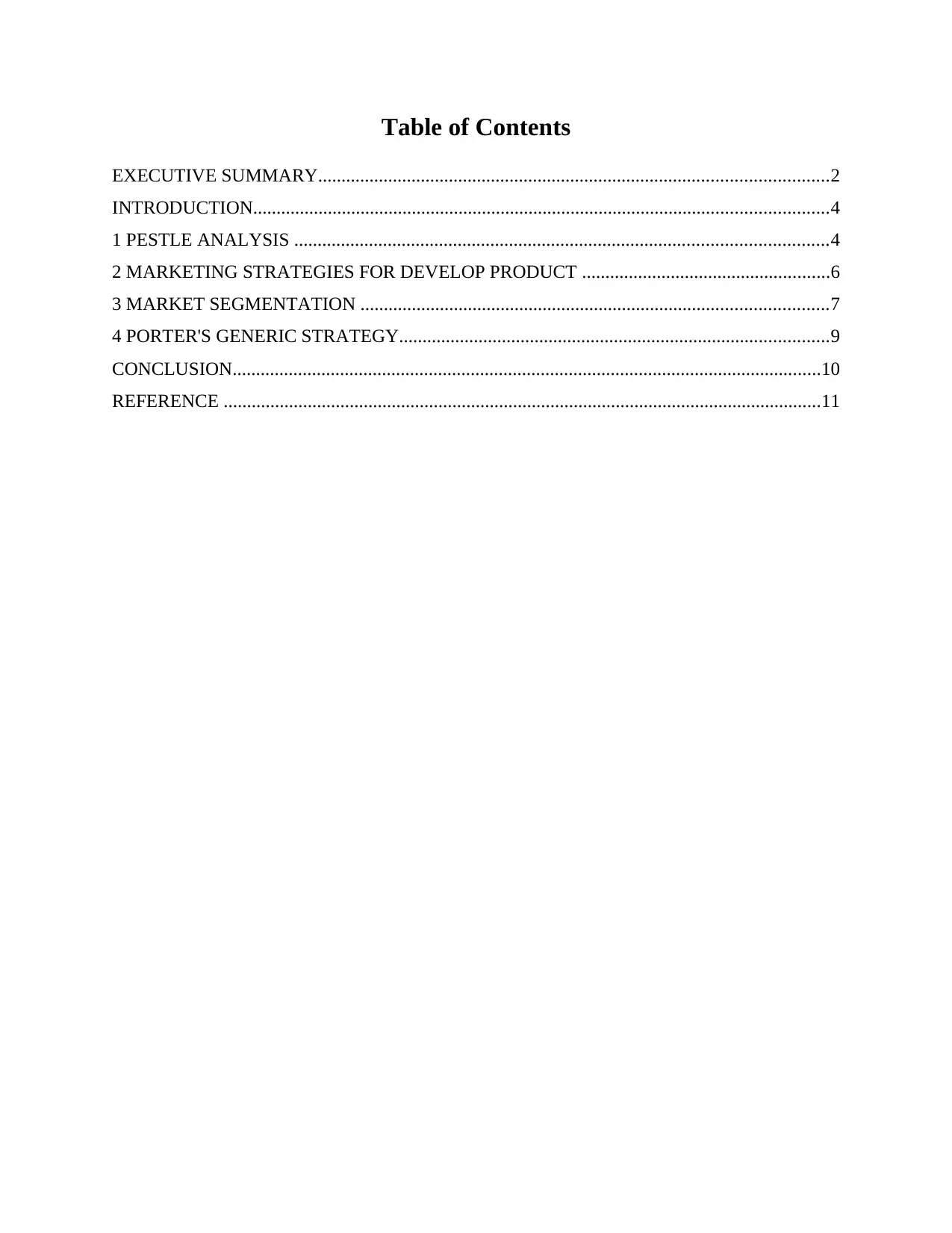
Table of Contents
EXECUTIVE SUMMARY.............................................................................................................2
INTRODUCTION...........................................................................................................................4
1 PESTLE ANALYSIS ..................................................................................................................4
2 MARKETING STRATEGIES FOR DEVELOP PRODUCT .....................................................6
3 MARKET SEGMENTATION ....................................................................................................7
4 PORTER'S GENERIC STRATEGY............................................................................................9
CONCLUSION..............................................................................................................................10
REFERENCE ................................................................................................................................11
EXECUTIVE SUMMARY.............................................................................................................2
INTRODUCTION...........................................................................................................................4
1 PESTLE ANALYSIS ..................................................................................................................4
2 MARKETING STRATEGIES FOR DEVELOP PRODUCT .....................................................6
3 MARKET SEGMENTATION ....................................................................................................7
4 PORTER'S GENERIC STRATEGY............................................................................................9
CONCLUSION..............................................................................................................................10
REFERENCE ................................................................................................................................11
⊘ This is a preview!⊘
Do you want full access?
Subscribe today to unlock all pages.

Trusted by 1+ million students worldwide
INTRODUCTION
Marketing plays a major role in success of every business. It is a process through which
business promote their products and services (Hair, Sarstedt and Mena, 2012). Present report is
based on a case in which new product will be introduced in a new market. This report covers,
PESTLE analysis for the country in which organization want to introduce their new product.
Furthermore, it covers threats that organization can face in the new market. Moreover, it includes
different types of marketing strategies through company can enter into the market. At last, it
covers the market segment so that strategies can be developed to promote the product.
1 PESTLE ANALYSIS
Barker company provides products such as shoe care, belts, socks and leather goods.
Along with this, they have various collection for gents and ladies for special occasions. Now
they are planning to expand their market in Australia with new product which is women hand
bags (Spiller, Fitzsimons and McClelland, 2013). This is because, Australia is a developed
country and this will help to attract more customers. Ion this context, there are various tools
through which efficiency of Australia market can be determined. With the respect, PESTLE
analysis will be used for establishing women hand bags in Australia. Following are the factors
which can be influence to the operations of Barker company when they introduce product in
chosen market:
Political factors: This factors includes stability of political environment and attitude of
variations in these parties (De Vries, Gensler and Leeflang, 2012). In Australian market, there
are different rules that are given by government to protect national economy. In this context, they
have regulation such as tariffs, currency control and administrative policies. It is beneficial to
Barker for establishing their women hand bags in Australia market. This is because, in this
market government make favourable tax systems and effective world class infrastructure is very
high. Further, in Australia market there is stable political environment which is beneficial for
cited firm as they can flow their operations easily. Thus, it creates positive impact on the
business (Katsikeas, Morgan and Hult, 2016).
Economic factors: This define as economic conditions, system and policies related with
the nation. This factors affect to Barker in term of employment, interest rates and inflation. In
Marketing plays a major role in success of every business. It is a process through which
business promote their products and services (Hair, Sarstedt and Mena, 2012). Present report is
based on a case in which new product will be introduced in a new market. This report covers,
PESTLE analysis for the country in which organization want to introduce their new product.
Furthermore, it covers threats that organization can face in the new market. Moreover, it includes
different types of marketing strategies through company can enter into the market. At last, it
covers the market segment so that strategies can be developed to promote the product.
1 PESTLE ANALYSIS
Barker company provides products such as shoe care, belts, socks and leather goods.
Along with this, they have various collection for gents and ladies for special occasions. Now
they are planning to expand their market in Australia with new product which is women hand
bags (Spiller, Fitzsimons and McClelland, 2013). This is because, Australia is a developed
country and this will help to attract more customers. Ion this context, there are various tools
through which efficiency of Australia market can be determined. With the respect, PESTLE
analysis will be used for establishing women hand bags in Australia. Following are the factors
which can be influence to the operations of Barker company when they introduce product in
chosen market:
Political factors: This factors includes stability of political environment and attitude of
variations in these parties (De Vries, Gensler and Leeflang, 2012). In Australian market, there
are different rules that are given by government to protect national economy. In this context, they
have regulation such as tariffs, currency control and administrative policies. It is beneficial to
Barker for establishing their women hand bags in Australia market. This is because, in this
market government make favourable tax systems and effective world class infrastructure is very
high. Further, in Australia market there is stable political environment which is beneficial for
cited firm as they can flow their operations easily. Thus, it creates positive impact on the
business (Katsikeas, Morgan and Hult, 2016).
Economic factors: This define as economic conditions, system and policies related with
the nation. This factors affect to Barker in term of employment, interest rates and inflation. In
Paraphrase This Document
Need a fresh take? Get an instant paraphrase of this document with our AI Paraphraser
this context inflation rates are those forces on which price of product can be increase. This is
only cause on which expenses goes high such as utilities, rent and cost of material which is used
in production. Along with this, it can be stated that if population and income grow high, demand
of products is also enhanced (Spiller, Fitzsimons and McClelland, 2013). As resultant, it helps to
increase profits of the business.
Social factors: Social factors includes set of beliefs, customs, practices and behaviour
which exist in country market. It is greatly influence to the Barker when it introduces product in
Australia market. This is because culture of that market is very positive due to educated people
so that cited business can easily take place in Australia (Kaplan, 2012). Beside this, upper-class
people may be concentrate on quality products so that cited business can easily attract to
customers when they produce expensive products.
Technological factors: This factors includes technological forces which influence
activities of business. In Australia country use advance technology so that it create positive
impact on Barker that they can easily attract to women towards the bags. Australia market is
developed so that mainly concentrate on research and development process of country (Hays,
Page and Buhalis, 2013). Thus, cited business can be negative impact on their operations because
they need to effective communication for develop their product.
Legal factors: These factors related with legal environment in which cited business
introduced product in chosen marketplace. Australian regulation is essential for doing business in
this market. These regulations designed to fair competition, sufficient protection for Barker when
they operate their operations. Thus, they feel safe to introduce product in Australia. Along with
this, they need to follow legal regulations of the nation which can affect to business
(Chintagunta, Hanssens and Staelin, 2013). In this context, includes avoiding age discrimination
and disability, etc.
Ethical factors: Ethical factors refers with all living and non-living things surrounded by
the business. Along with this, it is related to ethics of environment in which company perform
their functions. This factors effect to Barker when their operations influence to market. Thus,
organization have to follow regulations related with environment protection. In this context,
includes wastage and pollutions which greatly affect to business (Berthon, Pitt and Shapiro,
2012). Business can re-use the wastage products to protect the environment.
Opportunities and threats for Barker
only cause on which expenses goes high such as utilities, rent and cost of material which is used
in production. Along with this, it can be stated that if population and income grow high, demand
of products is also enhanced (Spiller, Fitzsimons and McClelland, 2013). As resultant, it helps to
increase profits of the business.
Social factors: Social factors includes set of beliefs, customs, practices and behaviour
which exist in country market. It is greatly influence to the Barker when it introduces product in
Australia market. This is because culture of that market is very positive due to educated people
so that cited business can easily take place in Australia (Kaplan, 2012). Beside this, upper-class
people may be concentrate on quality products so that cited business can easily attract to
customers when they produce expensive products.
Technological factors: This factors includes technological forces which influence
activities of business. In Australia country use advance technology so that it create positive
impact on Barker that they can easily attract to women towards the bags. Australia market is
developed so that mainly concentrate on research and development process of country (Hays,
Page and Buhalis, 2013). Thus, cited business can be negative impact on their operations because
they need to effective communication for develop their product.
Legal factors: These factors related with legal environment in which cited business
introduced product in chosen marketplace. Australian regulation is essential for doing business in
this market. These regulations designed to fair competition, sufficient protection for Barker when
they operate their operations. Thus, they feel safe to introduce product in Australia. Along with
this, they need to follow legal regulations of the nation which can affect to business
(Chintagunta, Hanssens and Staelin, 2013). In this context, includes avoiding age discrimination
and disability, etc.
Ethical factors: Ethical factors refers with all living and non-living things surrounded by
the business. Along with this, it is related to ethics of environment in which company perform
their functions. This factors effect to Barker when their operations influence to market. Thus,
organization have to follow regulations related with environment protection. In this context,
includes wastage and pollutions which greatly affect to business (Berthon, Pitt and Shapiro,
2012). Business can re-use the wastage products to protect the environment.
Opportunities and threats for Barker
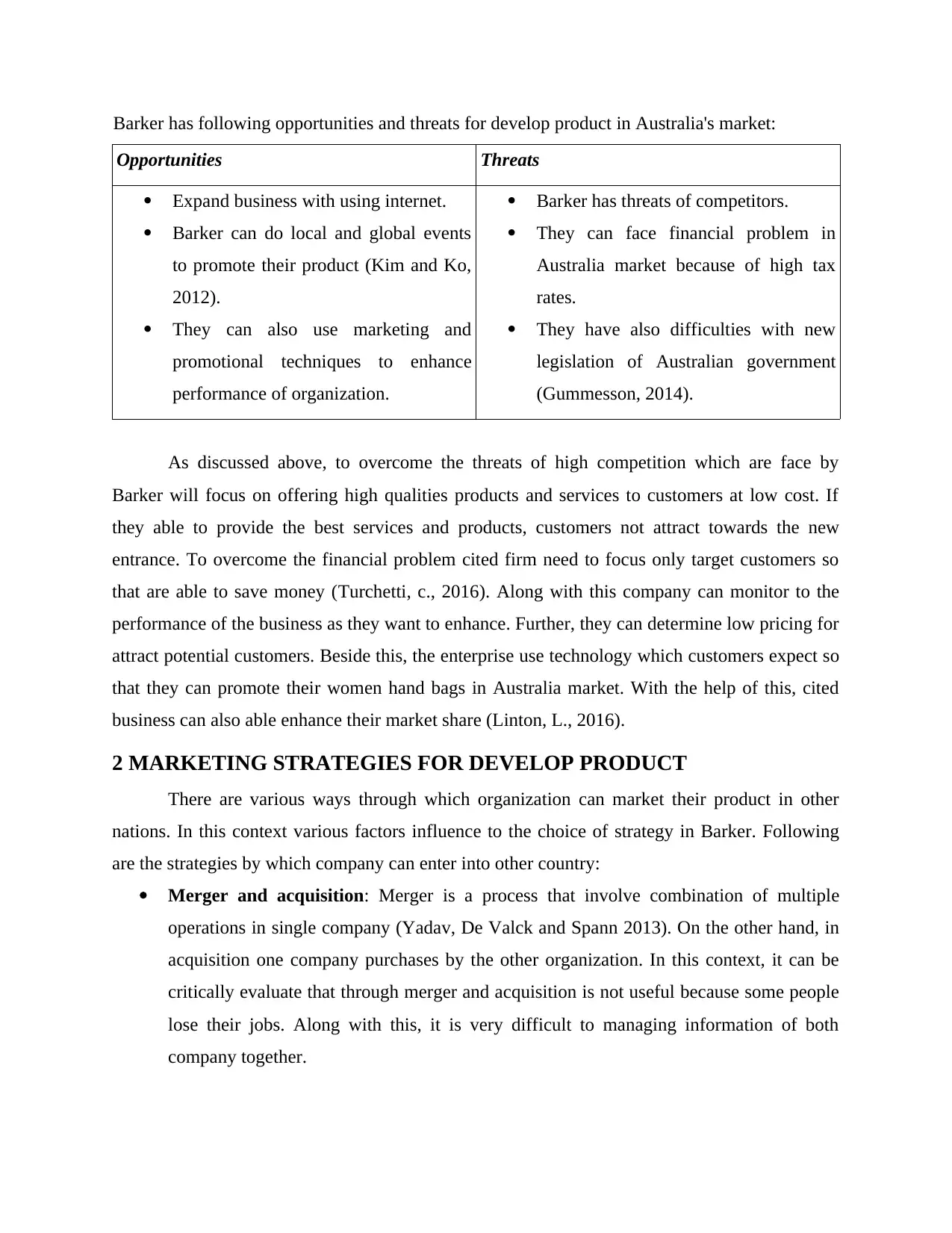
Barker has following opportunities and threats for develop product in Australia's market:
Opportunities Threats
Expand business with using internet.
Barker can do local and global events
to promote their product (Kim and Ko,
2012).
They can also use marketing and
promotional techniques to enhance
performance of organization.
Barker has threats of competitors.
They can face financial problem in
Australia market because of high tax
rates.
They have also difficulties with new
legislation of Australian government
(Gummesson, 2014).
As discussed above, to overcome the threats of high competition which are face by
Barker will focus on offering high qualities products and services to customers at low cost. If
they able to provide the best services and products, customers not attract towards the new
entrance. To overcome the financial problem cited firm need to focus only target customers so
that are able to save money (Turchetti, c., 2016). Along with this company can monitor to the
performance of the business as they want to enhance. Further, they can determine low pricing for
attract potential customers. Beside this, the enterprise use technology which customers expect so
that they can promote their women hand bags in Australia market. With the help of this, cited
business can also able enhance their market share (Linton, L., 2016).
2 MARKETING STRATEGIES FOR DEVELOP PRODUCT
There are various ways through which organization can market their product in other
nations. In this context various factors influence to the choice of strategy in Barker. Following
are the strategies by which company can enter into other country:
Merger and acquisition: Merger is a process that involve combination of multiple
operations in single company (Yadav, De Valck and Spann 2013). On the other hand, in
acquisition one company purchases by the other organization. In this context, it can be
critically evaluate that through merger and acquisition is not useful because some people
lose their jobs. Along with this, it is very difficult to managing information of both
company together.
Opportunities Threats
Expand business with using internet.
Barker can do local and global events
to promote their product (Kim and Ko,
2012).
They can also use marketing and
promotional techniques to enhance
performance of organization.
Barker has threats of competitors.
They can face financial problem in
Australia market because of high tax
rates.
They have also difficulties with new
legislation of Australian government
(Gummesson, 2014).
As discussed above, to overcome the threats of high competition which are face by
Barker will focus on offering high qualities products and services to customers at low cost. If
they able to provide the best services and products, customers not attract towards the new
entrance. To overcome the financial problem cited firm need to focus only target customers so
that are able to save money (Turchetti, c., 2016). Along with this company can monitor to the
performance of the business as they want to enhance. Further, they can determine low pricing for
attract potential customers. Beside this, the enterprise use technology which customers expect so
that they can promote their women hand bags in Australia market. With the help of this, cited
business can also able enhance their market share (Linton, L., 2016).
2 MARKETING STRATEGIES FOR DEVELOP PRODUCT
There are various ways through which organization can market their product in other
nations. In this context various factors influence to the choice of strategy in Barker. Following
are the strategies by which company can enter into other country:
Merger and acquisition: Merger is a process that involve combination of multiple
operations in single company (Yadav, De Valck and Spann 2013). On the other hand, in
acquisition one company purchases by the other organization. In this context, it can be
critically evaluate that through merger and acquisition is not useful because some people
lose their jobs. Along with this, it is very difficult to managing information of both
company together.
⊘ This is a preview!⊘
Do you want full access?
Subscribe today to unlock all pages.
Trusted by 1+ million students worldwide
Direct Exporting: Organization can also sell their products into the markets through
agents. Many companies use this strategy with developing sales program in other nations
(Krishna, 2012). It can be difficult towards the organization that they are unable to make
direct communication with the market. Organization face problem to export business in
other market because they have no knowledge structure and rules of new nation. Thus,
business can make their distributors in different nation so that they can easily promote
their products.
Licensing: Licensing is very helpful strategy where organization transfer their rights to
sell the products or services by other company. It is useful where market is very wide and
organization can not reach each place. Through this organization can easily market and
promote their product. It can be critically evaluate that other firm can miss use the rights
which organization given to them (Hair Jr and Lukas, 2014).
From the above discussion it can be stated that direct exporting may be appropriate
strategy for Barker's women bag. This, is because they have no knowledge regarding Australia
market. Thus, they can appoint agents from Australia who sell their product in their market. With
the help of this strategy, cited business can eliminate intermediaries and they easily understand
who are their right customers (Wilson, Zeithaml and Gremler, 2012). With the helps of direct
exporting, cited business gain knowledge of different country through their agents. It is helpful to
understand rules and regulations of different market at minimum cost. Along with this they also
enter together at a time in different marketplace.
3 MARKET SEGMENTATION
Market segmentation refers as process of dividing large unit into small groups which has
similar characteristics. In other words, segmentation define as dividing of smaller part of market
according to different types of customers such as taste preferences, demand and many more
things (Jobber and Ellis-Chadwick, 2012). In this context, following are the basis of market
segmentation: Geographic segmentation: It is the first variable segmentation which can be used by the
organization. In this context, they can break their market in section of size, population
density and climate. Thus, company can target according to these aspects in term of
weather pattern, classification of urban and rural area or so on. This can be critically
agents. Many companies use this strategy with developing sales program in other nations
(Krishna, 2012). It can be difficult towards the organization that they are unable to make
direct communication with the market. Organization face problem to export business in
other market because they have no knowledge structure and rules of new nation. Thus,
business can make their distributors in different nation so that they can easily promote
their products.
Licensing: Licensing is very helpful strategy where organization transfer their rights to
sell the products or services by other company. It is useful where market is very wide and
organization can not reach each place. Through this organization can easily market and
promote their product. It can be critically evaluate that other firm can miss use the rights
which organization given to them (Hair Jr and Lukas, 2014).
From the above discussion it can be stated that direct exporting may be appropriate
strategy for Barker's women bag. This, is because they have no knowledge regarding Australia
market. Thus, they can appoint agents from Australia who sell their product in their market. With
the help of this strategy, cited business can eliminate intermediaries and they easily understand
who are their right customers (Wilson, Zeithaml and Gremler, 2012). With the helps of direct
exporting, cited business gain knowledge of different country through their agents. It is helpful to
understand rules and regulations of different market at minimum cost. Along with this they also
enter together at a time in different marketplace.
3 MARKET SEGMENTATION
Market segmentation refers as process of dividing large unit into small groups which has
similar characteristics. In other words, segmentation define as dividing of smaller part of market
according to different types of customers such as taste preferences, demand and many more
things (Jobber and Ellis-Chadwick, 2012). In this context, following are the basis of market
segmentation: Geographic segmentation: It is the first variable segmentation which can be used by the
organization. In this context, they can break their market in section of size, population
density and climate. Thus, company can target according to these aspects in term of
weather pattern, classification of urban and rural area or so on. This can be critically
Paraphrase This Document
Need a fresh take? Get an instant paraphrase of this document with our AI Paraphraser
evaluate as organization unable to segment their market according to population size
because different people have different perception (Paliwoda and Thomas, 2013). Demographic segmentation: In terms of demographic segmentation organization can
segment their market on the basis of age, gender, family size, religion and income, etc.
This is because these categories has their different values. For instance company can not
target to old people with launching product as noodles. Thus, they need to decide age
group for targeting to people to promote their product. In term of critical evaluation,
according to this strategy company will not able to segment market when they provide
health care services (Hollensen, 2015). It can be critically evaluate that, it creates
negative impact on business when to only female. For example, beauty products is
mainly targeted to the women. Psycho graphic segmentation: It is the segmentation which is based on lifestyle of the
individuals. Individual aspects such as attitude, interest and value help to marketers for
classifying market into smaller group. It is used to target certain group from within whole
population. This segmentation take place in consumer buying behaviour because every
individual possess different social class, personality and attitude. Thus, firm need to
segment their market according to buyer behaviour (Hair, Sarstedt and Mena, 2012).
Behavioural segmentation: Behavioural segmentation is based on actual behaviour of
customers. In this context includes, organization divide their products on the basis of
variable such as benefits sought, brand loyalty and occasions. It is helpful for business
when products are closely related with behaviour of persons. For instance, sweets shops
majorly increase their sell on wedding seasons and festivals (Spiller, Fitzsimons, and
McClelland, 2013).
Target marketing
Target marketing is a process through organization can attract to the customers. In order
to identify, target market effectively company need to find who are customers and how to reach
them. In this context they should try to doing research and planning for target customers. Target
market also involve breaking market into segment to attract different group of people towards
the products (De Vries, Gensler and Leeflang, 2012).
From the above discussion it can be stated that Barker can target their customers
demographic segmentation. Before marketing of product, organization need to identify their
because different people have different perception (Paliwoda and Thomas, 2013). Demographic segmentation: In terms of demographic segmentation organization can
segment their market on the basis of age, gender, family size, religion and income, etc.
This is because these categories has their different values. For instance company can not
target to old people with launching product as noodles. Thus, they need to decide age
group for targeting to people to promote their product. In term of critical evaluation,
according to this strategy company will not able to segment market when they provide
health care services (Hollensen, 2015). It can be critically evaluate that, it creates
negative impact on business when to only female. For example, beauty products is
mainly targeted to the women. Psycho graphic segmentation: It is the segmentation which is based on lifestyle of the
individuals. Individual aspects such as attitude, interest and value help to marketers for
classifying market into smaller group. It is used to target certain group from within whole
population. This segmentation take place in consumer buying behaviour because every
individual possess different social class, personality and attitude. Thus, firm need to
segment their market according to buyer behaviour (Hair, Sarstedt and Mena, 2012).
Behavioural segmentation: Behavioural segmentation is based on actual behaviour of
customers. In this context includes, organization divide their products on the basis of
variable such as benefits sought, brand loyalty and occasions. It is helpful for business
when products are closely related with behaviour of persons. For instance, sweets shops
majorly increase their sell on wedding seasons and festivals (Spiller, Fitzsimons, and
McClelland, 2013).
Target marketing
Target marketing is a process through organization can attract to the customers. In order
to identify, target market effectively company need to find who are customers and how to reach
them. In this context they should try to doing research and planning for target customers. Target
market also involve breaking market into segment to attract different group of people towards
the products (De Vries, Gensler and Leeflang, 2012).
From the above discussion it can be stated that Barker can target their customers
demographic segmentation. Before marketing of product, organization need to identify their
customers towards the product which they introduced. From the helps of research they identified
their customers in Australia market. In that they mainly include age group of women from 15 to
50. In this context, business attract to potential female who are using hand bags. Along with this,
chosen organization can make different types of bags according to age group. In this, they can
make small bags for girls students and large size of bags for married women (Katsikeas, Morgan
and Hult, 2016). Thus, company will able to attract potential customers through there
segmentation criteria. This is also helpful to gain competitive advantage through market.
Through this, Barker can easily achieve their goals and objectives. Beside this, cited business
can also expand there business into new market which is effective for them. In this context, they
need to assess internal capabilities and give priority to the selected market (Spiller, Fitzsimons
and McClelland, 2013).
4 PORTER'S GENERIC STRATEGY
Every business has primary objective to make high profits of business through they can
able to attract customers. In this context, firm position can make their strength for achieving their
goals (Kaplan, 2012). In order to evaluate performance of Barker, organization can use porter's
generic strategies which is best for promote their product in Australia market. Below are the
critical evaluation of Porter's Generic strategies: Cost leadership strategy: According to this strategy, organization can sell their product at
average or lowest price to earn profits higher than competitors. Beside this, Barker can
gain market share from the below average price. In this context, business can produce
cheaper products to attract potential customers. It is useful to target in wide marketplace.
Along with this organization face difficulties when they are adopting this strategy they
need to improve effective communication channel and skills person to design their
products (Hays, Page and Buhalis, 2013). Differentiation strategy: This strategy adopt for make product differ from other
companies. In this context, Barker can provide products and services with unique
characteristics such as attractive packaging style and shapes. They can also add some
different value in products that make it unique in market. Along with this, organization
can success with access market research for developing product in Australia market.
Further, cited business can make differ product when customers change in their tastes
(Chintagunta, Hanssens and Staelin, 2013).
their customers in Australia market. In that they mainly include age group of women from 15 to
50. In this context, business attract to potential female who are using hand bags. Along with this,
chosen organization can make different types of bags according to age group. In this, they can
make small bags for girls students and large size of bags for married women (Katsikeas, Morgan
and Hult, 2016). Thus, company will able to attract potential customers through there
segmentation criteria. This is also helpful to gain competitive advantage through market.
Through this, Barker can easily achieve their goals and objectives. Beside this, cited business
can also expand there business into new market which is effective for them. In this context, they
need to assess internal capabilities and give priority to the selected market (Spiller, Fitzsimons
and McClelland, 2013).
4 PORTER'S GENERIC STRATEGY
Every business has primary objective to make high profits of business through they can
able to attract customers. In this context, firm position can make their strength for achieving their
goals (Kaplan, 2012). In order to evaluate performance of Barker, organization can use porter's
generic strategies which is best for promote their product in Australia market. Below are the
critical evaluation of Porter's Generic strategies: Cost leadership strategy: According to this strategy, organization can sell their product at
average or lowest price to earn profits higher than competitors. Beside this, Barker can
gain market share from the below average price. In this context, business can produce
cheaper products to attract potential customers. It is useful to target in wide marketplace.
Along with this organization face difficulties when they are adopting this strategy they
need to improve effective communication channel and skills person to design their
products (Hays, Page and Buhalis, 2013). Differentiation strategy: This strategy adopt for make product differ from other
companies. In this context, Barker can provide products and services with unique
characteristics such as attractive packaging style and shapes. They can also add some
different value in products that make it unique in market. Along with this, organization
can success with access market research for developing product in Australia market.
Further, cited business can make differ product when customers change in their tastes
(Chintagunta, Hanssens and Staelin, 2013).
⊘ This is a preview!⊘
Do you want full access?
Subscribe today to unlock all pages.
Trusted by 1+ million students worldwide
Focus strategy: This strategy concentrate on segment to achieve cost advantage or
differentiation. According to this strategy, Barker need to give better services by focusing
on entire marketplace. In this, organization can achieve high customers' loyalty towards
their products. Focus strategy helps to focus on development on strength of products
which is introduced in market (Berthon, Pitt and Shapiro, 2012).
From the above discussion, it can be stated that cost leadership strategy is not useful for
Barker. This is because, it ignores customers tastes and preferences and concentrate only
reducing price of the products. In other words, organization not focus on quality of the products
they only provides cheaper products through company can attract potential customers. This
strategy also create negative perception in customers mind towards the product. This is because,
generally some people understand lower price products has not quality (Burgess and Steenkamp,
2013). According to this strategy organization require efficient scale facilities through which
they can promote their products. Cited business may face problem when they are compromising
with the quality of product. Apart from it, when enterprise not willingly accept lower price
customers move towards its competitors.
CONCLUSION
From the above report it can be concluded that PESTLE analysis of country market
influence to the business. In this context, organization can expand their business in new market
with attract potential customers. Furthermore, it included that threats which face by the cited firm
when they are operates their functions in new place such as competition and financial problems.
In order to overcome these issues, company can offer high qualities services to customers so that
they cannot move towards the competitors. Moreover, it summarized market segmentation and
target to attract at new marketplace. In this context, chosen organization target to females on the
basis of age group. At last, it covered Porter's Generic Strategies in which cost leadership
strategy is not useful for enterprise for promote new product.
differentiation. According to this strategy, Barker need to give better services by focusing
on entire marketplace. In this, organization can achieve high customers' loyalty towards
their products. Focus strategy helps to focus on development on strength of products
which is introduced in market (Berthon, Pitt and Shapiro, 2012).
From the above discussion, it can be stated that cost leadership strategy is not useful for
Barker. This is because, it ignores customers tastes and preferences and concentrate only
reducing price of the products. In other words, organization not focus on quality of the products
they only provides cheaper products through company can attract potential customers. This
strategy also create negative perception in customers mind towards the product. This is because,
generally some people understand lower price products has not quality (Burgess and Steenkamp,
2013). According to this strategy organization require efficient scale facilities through which
they can promote their products. Cited business may face problem when they are compromising
with the quality of product. Apart from it, when enterprise not willingly accept lower price
customers move towards its competitors.
CONCLUSION
From the above report it can be concluded that PESTLE analysis of country market
influence to the business. In this context, organization can expand their business in new market
with attract potential customers. Furthermore, it included that threats which face by the cited firm
when they are operates their functions in new place such as competition and financial problems.
In order to overcome these issues, company can offer high qualities services to customers so that
they cannot move towards the competitors. Moreover, it summarized market segmentation and
target to attract at new marketplace. In this context, chosen organization target to females on the
basis of age group. At last, it covered Porter's Generic Strategies in which cost leadership
strategy is not useful for enterprise for promote new product.
Paraphrase This Document
Need a fresh take? Get an instant paraphrase of this document with our AI Paraphraser
REFERENCE
Journals
Berthon, P. R., Pitt, L. F. and Shapiro, D., 2012. Marketing meets Web 2.0, social media, and
creative consumers: Implications for international marketing strategy. Business horizons.
55(3). pp.261-271.
Burgess, S. M. and Steenkamp, J. B. E., 2013. Editorial: introduction to the special issue on
marketing in emerging markets. International journal of research in marketing. 30(1).
pp.1-3.
Chintagunta, P., Hanssens, D. and Staelin, R., 2013. Editorial-marketing science: A strategic
review. Marketing Science. 32(1). pp.4-7.
De Vries, L., Gensler, S. and Leeflang, P. S., 2012. Popularity of brand posts on brand fan pages:
An investigation of the effects of social media marketing. Journal of Interactive
Marketing. 26(2). pp.83-91.
Gummesson, E., 2014. Productivity, quality and relationship marketing in service operations: A
revisit in a new service paradigm. International Journal of Contemporary Hospitality
Management. 26(5). pp.656-662.
Hair, J. F., Sarstedt, M. and Mena, J. A., 2012. An assessment of the use of partial least squares
structural equation modeling in marketing research. Journal of the academy of marketing
science. 40(3). pp.414-433.
Hays, S., Page, S. J. and Buhalis, D., 2013. Social media as a destination marketing tool: its use
by national tourism organisations. Current issues in Tourism. 16(3). pp.211-239.
Kaplan, A. M., 2012. If you love something, let it go mobile: Mobile marketing and mobile
social media 4x4. Business horizons. 55(2). pp.129-139.
Katsikeas, C. S., Morgan, N. A. and Hult, G. T. M., 2016. Assessing performance outcomes in
marketing. Journal of Marketing. 80(2). pp.1-20.
Kim, A. J. and Ko, E., 2012. Do social media marketing activities enhance customer equity? An
empirical study of luxury fashion brand. Journal of Business Research. 65(10). pp.1480-
1486.
Journals
Berthon, P. R., Pitt, L. F. and Shapiro, D., 2012. Marketing meets Web 2.0, social media, and
creative consumers: Implications for international marketing strategy. Business horizons.
55(3). pp.261-271.
Burgess, S. M. and Steenkamp, J. B. E., 2013. Editorial: introduction to the special issue on
marketing in emerging markets. International journal of research in marketing. 30(1).
pp.1-3.
Chintagunta, P., Hanssens, D. and Staelin, R., 2013. Editorial-marketing science: A strategic
review. Marketing Science. 32(1). pp.4-7.
De Vries, L., Gensler, S. and Leeflang, P. S., 2012. Popularity of brand posts on brand fan pages:
An investigation of the effects of social media marketing. Journal of Interactive
Marketing. 26(2). pp.83-91.
Gummesson, E., 2014. Productivity, quality and relationship marketing in service operations: A
revisit in a new service paradigm. International Journal of Contemporary Hospitality
Management. 26(5). pp.656-662.
Hair, J. F., Sarstedt, M. and Mena, J. A., 2012. An assessment of the use of partial least squares
structural equation modeling in marketing research. Journal of the academy of marketing
science. 40(3). pp.414-433.
Hays, S., Page, S. J. and Buhalis, D., 2013. Social media as a destination marketing tool: its use
by national tourism organisations. Current issues in Tourism. 16(3). pp.211-239.
Kaplan, A. M., 2012. If you love something, let it go mobile: Mobile marketing and mobile
social media 4x4. Business horizons. 55(2). pp.129-139.
Katsikeas, C. S., Morgan, N. A. and Hult, G. T. M., 2016. Assessing performance outcomes in
marketing. Journal of Marketing. 80(2). pp.1-20.
Kim, A. J. and Ko, E., 2012. Do social media marketing activities enhance customer equity? An
empirical study of luxury fashion brand. Journal of Business Research. 65(10). pp.1480-
1486.
Krishna, A., 2012. An integrative review of sensory marketing: Engaging the senses to affect
perception, judgment and behavior. Journal of Consumer Psychology. 22(3). pp.332-351.
Spiller, S. A., Fitzsimons, G. J. and McClelland, G. H., 2013. Spotlights, floodlights, and the
magic number zero: Simple effects tests in moderated regression. Journal of Marketing
Research. 50(2). pp.277-288.
Spiller, S. A., Fitzsimons, G. J. and McClelland, G. H., 2013. Spotlights, floodlights, and the
magic number zero: Simple effects tests in moderated regression. Journal of Marketing
Research. 50(2). pp.277-288.
Yadav, M. S., De Valck, K. and Spann, M., 2013. Social commerce: a contingency framework
for assessing marketing potential. Journal of Interactive Marketing. 27(4). pp.311-323.
Books
Hair Jr, J. F. and Lukas, B., 2014. Marketing research. McGraw-Hill Education Australia.
Hollensen, S., 2015. Marketing management: A relationship approach. Pearson Education.
Jobber, D. and Ellis-Chadwick, F., 2012. Principles and practice of marketing(No. 7th).
McGraw-Hill Higher Education.
Paliwoda, S. and Thomas, M., 2013. International marketing. Routledge.
Wilson, A., Zeithaml, V. A. and Gremler, D. D., 2012. Services marketing: Integrating customer
focus across the firm. McGraw Hill.
Online
Linton, L., 2016. Strategies to Overcome Marketing Threats. Available through:
<http://smallbusiness.chron.com/strategies-overcome-marketing-threats-38186.html>
[Accessed on 14 October 2016].
Turchetti, c., 2016. 5 Ways to Overcome Today's Challenges in the Financial Industry. Available
through: <https://www.americanexpress.com/us/small-business/openforum/articles/5-
ways-to-overcome-todays-challenges-in-the-financial-industry/>. [Accessed on 14
October 2016]
perception, judgment and behavior. Journal of Consumer Psychology. 22(3). pp.332-351.
Spiller, S. A., Fitzsimons, G. J. and McClelland, G. H., 2013. Spotlights, floodlights, and the
magic number zero: Simple effects tests in moderated regression. Journal of Marketing
Research. 50(2). pp.277-288.
Spiller, S. A., Fitzsimons, G. J. and McClelland, G. H., 2013. Spotlights, floodlights, and the
magic number zero: Simple effects tests in moderated regression. Journal of Marketing
Research. 50(2). pp.277-288.
Yadav, M. S., De Valck, K. and Spann, M., 2013. Social commerce: a contingency framework
for assessing marketing potential. Journal of Interactive Marketing. 27(4). pp.311-323.
Books
Hair Jr, J. F. and Lukas, B., 2014. Marketing research. McGraw-Hill Education Australia.
Hollensen, S., 2015. Marketing management: A relationship approach. Pearson Education.
Jobber, D. and Ellis-Chadwick, F., 2012. Principles and practice of marketing(No. 7th).
McGraw-Hill Higher Education.
Paliwoda, S. and Thomas, M., 2013. International marketing. Routledge.
Wilson, A., Zeithaml, V. A. and Gremler, D. D., 2012. Services marketing: Integrating customer
focus across the firm. McGraw Hill.
Online
Linton, L., 2016. Strategies to Overcome Marketing Threats. Available through:
<http://smallbusiness.chron.com/strategies-overcome-marketing-threats-38186.html>
[Accessed on 14 October 2016].
Turchetti, c., 2016. 5 Ways to Overcome Today's Challenges in the Financial Industry. Available
through: <https://www.americanexpress.com/us/small-business/openforum/articles/5-
ways-to-overcome-todays-challenges-in-the-financial-industry/>. [Accessed on 14
October 2016]
⊘ This is a preview!⊘
Do you want full access?
Subscribe today to unlock all pages.
Trusted by 1+ million students worldwide

1 out of 14


Related Documents


Your All-in-One AI-Powered Toolkit for Academic Success.
+13062052269
info@desklib.com
Available 24*7 on WhatsApp / Email
![[object Object]](/_next/static/media/star-bottom.7253800d.svg)
Unlock your academic potential
Copyright © 2020–2026 A2Z Services. All Rights Reserved. Developed and managed by ZUCOL.