Analyzing Decision Making Processes: AT&D Case Study Report
VerifiedAdded on 2019/09/30
|3
|1328
|57
Report
AI Summary
This report analyzes a business case study involving American Tool & Die (AT&D), focusing on the decision-making processes of the CEO, Vince Brofft, and his daughter, Kelly Mueller, in response to economic challenges and opportunities with Toyota. The report examines the application of the decision process to create a decision statement, analyzes factors influencing their choices, compares the pros and cons of group and individual decision-making, and identifies biases and other factors affecting decision-making for a team. Furthermore, the report discusses the appropriate authority and composition of a group decision-making team, offering insights into strategic business development and leadership management within a challenging economic environment. The case study highlights the complexities of balancing tradition, family, and business survival in a rapidly changing market, emphasizing the importance of adaptability and strategic planning.
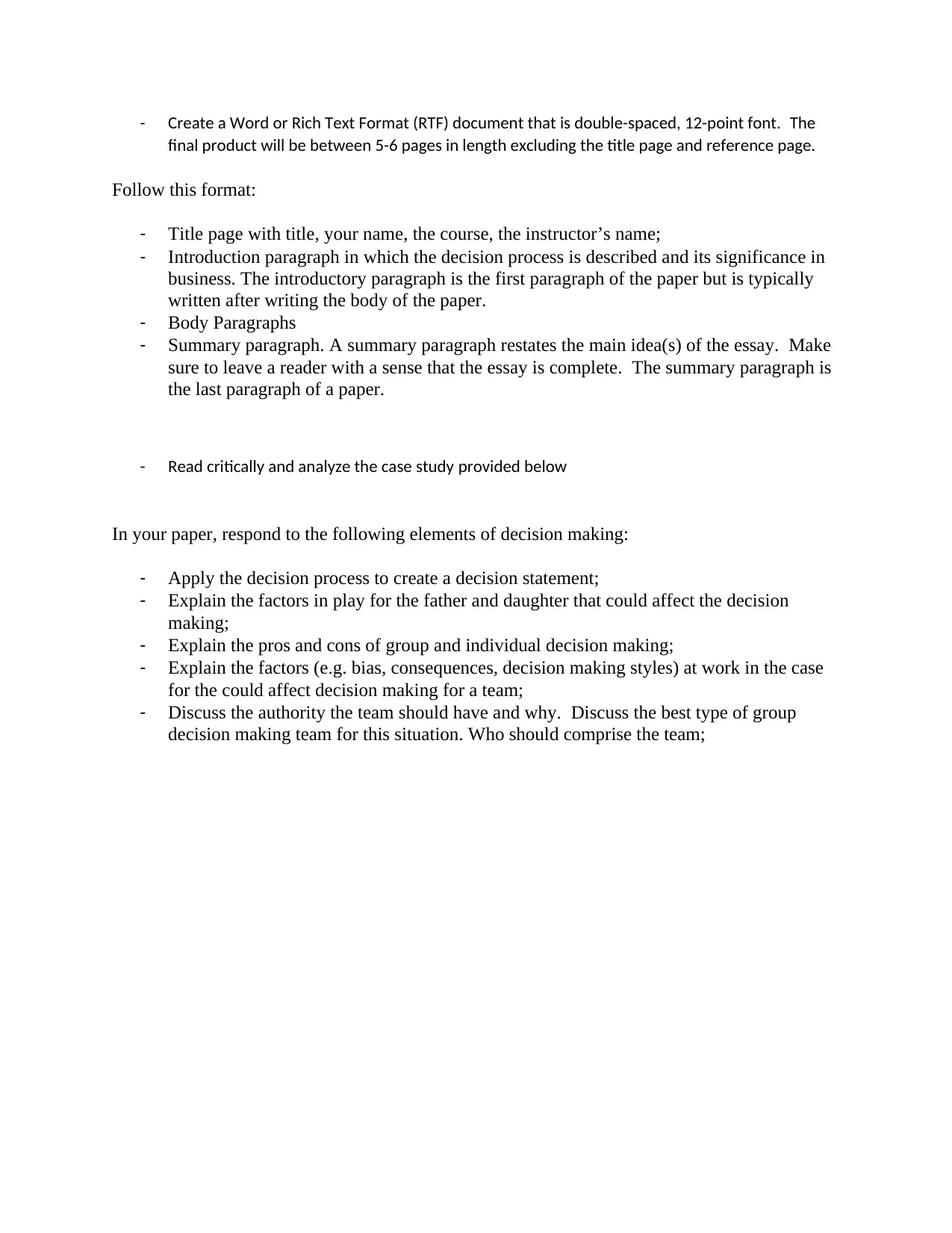
- Create a Word or Rich Text Format (RTF) document that is double-spaced, 12-point font. The
final product will be between 5-6 pages in length excluding the title page and reference page.
Follow this format:
- Title page with title, your name, the course, the instructor’s name;
- Introduction paragraph in which the decision process is described and its significance in
business. The introductory paragraph is the first paragraph of the paper but is typically
written after writing the body of the paper.
- Body Paragraphs
- Summary paragraph. A summary paragraph restates the main idea(s) of the essay. Make
sure to leave a reader with a sense that the essay is complete. The summary paragraph is
the last paragraph of a paper.
- Read critically and analyze the case study provided below
In your paper, respond to the following elements of decision making:
- Apply the decision process to create a decision statement;
- Explain the factors in play for the father and daughter that could affect the decision
making;
- Explain the pros and cons of group and individual decision making;
- Explain the factors (e.g. bias, consequences, decision making styles) at work in the case
for the could affect decision making for a team;
- Discuss the authority the team should have and why. Discuss the best type of group
decision making team for this situation. Who should comprise the team;
final product will be between 5-6 pages in length excluding the title page and reference page.
Follow this format:
- Title page with title, your name, the course, the instructor’s name;
- Introduction paragraph in which the decision process is described and its significance in
business. The introductory paragraph is the first paragraph of the paper but is typically
written after writing the body of the paper.
- Body Paragraphs
- Summary paragraph. A summary paragraph restates the main idea(s) of the essay. Make
sure to leave a reader with a sense that the essay is complete. The summary paragraph is
the last paragraph of a paper.
- Read critically and analyze the case study provided below
In your paper, respond to the following elements of decision making:
- Apply the decision process to create a decision statement;
- Explain the factors in play for the father and daughter that could affect the decision
making;
- Explain the pros and cons of group and individual decision making;
- Explain the factors (e.g. bias, consequences, decision making styles) at work in the case
for the could affect decision making for a team;
- Discuss the authority the team should have and why. Discuss the best type of group
decision making team for this situation. Who should comprise the team;
Paraphrase This Document
Need a fresh take? Get an instant paraphrase of this document with our AI Paraphraser

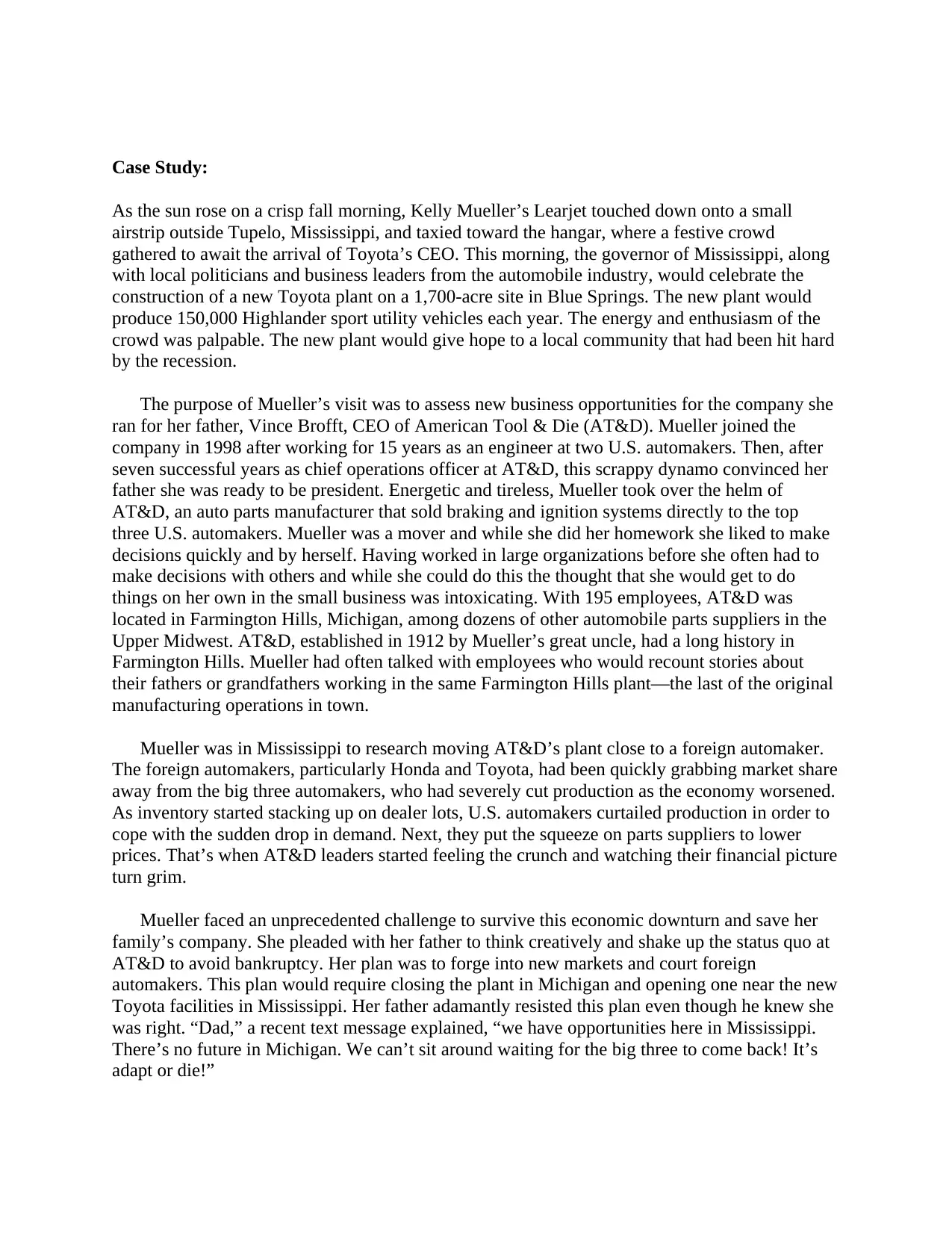
Case Study:
As the sun rose on a crisp fall morning, Kelly Mueller’s Learjet touched down onto a small
airstrip outside Tupelo, Mississippi, and taxied toward the hangar, where a festive crowd
gathered to await the arrival of Toyota’s CEO. This morning, the governor of Mississippi, along
with local politicians and business leaders from the automobile industry, would celebrate the
construction of a new Toyota plant on a 1,700-acre site in Blue Springs. The new plant would
produce 150,000 Highlander sport utility vehicles each year. The energy and enthusiasm of the
crowd was palpable. The new plant would give hope to a local community that had been hit hard
by the recession.
The purpose of Mueller’s visit was to assess new business opportunities for the company she
ran for her father, Vince Brofft, CEO of American Tool & Die (AT&D). Mueller joined the
company in 1998 after working for 15 years as an engineer at two U.S. automakers. Then, after
seven successful years as chief operations officer at AT&D, this scrappy dynamo convinced her
father she was ready to be president. Energetic and tireless, Mueller took over the helm of
AT&D, an auto parts manufacturer that sold braking and ignition systems directly to the top
three U.S. automakers. Mueller was a mover and while she did her homework she liked to make
decisions quickly and by herself. Having worked in large organizations before she often had to
make decisions with others and while she could do this the thought that she would get to do
things on her own in the small business was intoxicating. With 195 employees, AT&D was
located in Farmington Hills, Michigan, among dozens of other automobile parts suppliers in the
Upper Midwest. AT&D, established in 1912 by Mueller’s great uncle, had a long history in
Farmington Hills. Mueller had often talked with employees who would recount stories about
their fathers or grandfathers working in the same Farmington Hills plant—the last of the original
manufacturing operations in town.
Mueller was in Mississippi to research moving AT&D’s plant close to a foreign automaker.
The foreign automakers, particularly Honda and Toyota, had been quickly grabbing market share
away from the big three automakers, who had severely cut production as the economy worsened.
As inventory started stacking up on dealer lots, U.S. automakers curtailed production in order to
cope with the sudden drop in demand. Next, they put the squeeze on parts suppliers to lower
prices. That’s when AT&D leaders started feeling the crunch and watching their financial picture
turn grim.
Mueller faced an unprecedented challenge to survive this economic downturn and save her
family’s company. She pleaded with her father to think creatively and shake up the status quo at
AT&D to avoid bankruptcy. Her plan was to forge into new markets and court foreign
automakers. This plan would require closing the plant in Michigan and opening one near the new
Toyota facilities in Mississippi. Her father adamantly resisted this plan even though he knew she
was right. “Dad,” a recent text message explained, “we have opportunities here in Mississippi.
There’s no future in Michigan. We can’t sit around waiting for the big three to come back! It’s
adapt or die!”
As the sun rose on a crisp fall morning, Kelly Mueller’s Learjet touched down onto a small
airstrip outside Tupelo, Mississippi, and taxied toward the hangar, where a festive crowd
gathered to await the arrival of Toyota’s CEO. This morning, the governor of Mississippi, along
with local politicians and business leaders from the automobile industry, would celebrate the
construction of a new Toyota plant on a 1,700-acre site in Blue Springs. The new plant would
produce 150,000 Highlander sport utility vehicles each year. The energy and enthusiasm of the
crowd was palpable. The new plant would give hope to a local community that had been hit hard
by the recession.
The purpose of Mueller’s visit was to assess new business opportunities for the company she
ran for her father, Vince Brofft, CEO of American Tool & Die (AT&D). Mueller joined the
company in 1998 after working for 15 years as an engineer at two U.S. automakers. Then, after
seven successful years as chief operations officer at AT&D, this scrappy dynamo convinced her
father she was ready to be president. Energetic and tireless, Mueller took over the helm of
AT&D, an auto parts manufacturer that sold braking and ignition systems directly to the top
three U.S. automakers. Mueller was a mover and while she did her homework she liked to make
decisions quickly and by herself. Having worked in large organizations before she often had to
make decisions with others and while she could do this the thought that she would get to do
things on her own in the small business was intoxicating. With 195 employees, AT&D was
located in Farmington Hills, Michigan, among dozens of other automobile parts suppliers in the
Upper Midwest. AT&D, established in 1912 by Mueller’s great uncle, had a long history in
Farmington Hills. Mueller had often talked with employees who would recount stories about
their fathers or grandfathers working in the same Farmington Hills plant—the last of the original
manufacturing operations in town.
Mueller was in Mississippi to research moving AT&D’s plant close to a foreign automaker.
The foreign automakers, particularly Honda and Toyota, had been quickly grabbing market share
away from the big three automakers, who had severely cut production as the economy worsened.
As inventory started stacking up on dealer lots, U.S. automakers curtailed production in order to
cope with the sudden drop in demand. Next, they put the squeeze on parts suppliers to lower
prices. That’s when AT&D leaders started feeling the crunch and watching their financial picture
turn grim.
Mueller faced an unprecedented challenge to survive this economic downturn and save her
family’s company. She pleaded with her father to think creatively and shake up the status quo at
AT&D to avoid bankruptcy. Her plan was to forge into new markets and court foreign
automakers. This plan would require closing the plant in Michigan and opening one near the new
Toyota facilities in Mississippi. Her father adamantly resisted this plan even though he knew she
was right. “Dad,” a recent text message explained, “we have opportunities here in Mississippi.
There’s no future in Michigan. We can’t sit around waiting for the big three to come back! It’s
adapt or die!”

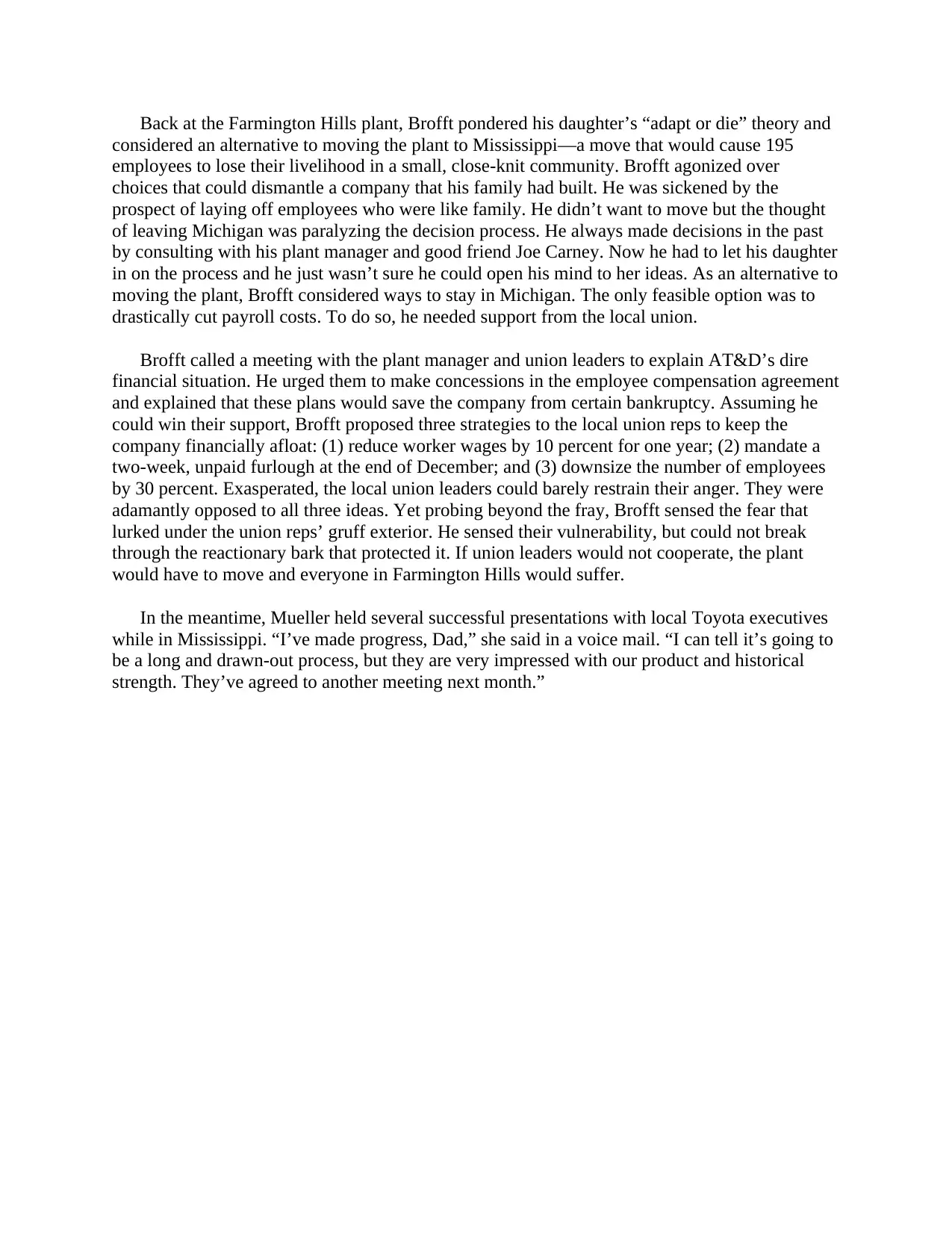
Back at the Farmington Hills plant, Brofft pondered his daughter’s “adapt or die” theory and
considered an alternative to moving the plant to Mississippi—a move that would cause 195
employees to lose their livelihood in a small, close-knit community. Brofft agonized over
choices that could dismantle a company that his family had built. He was sickened by the
prospect of laying off employees who were like family. He didn’t want to move but the thought
of leaving Michigan was paralyzing the decision process. He always made decisions in the past
by consulting with his plant manager and good friend Joe Carney. Now he had to let his daughter
in on the process and he just wasn’t sure he could open his mind to her ideas. As an alternative to
moving the plant, Brofft considered ways to stay in Michigan. The only feasible option was to
drastically cut payroll costs. To do so, he needed support from the local union.
Brofft called a meeting with the plant manager and union leaders to explain AT&D’s dire
financial situation. He urged them to make concessions in the employee compensation agreement
and explained that these plans would save the company from certain bankruptcy. Assuming he
could win their support, Brofft proposed three strategies to the local union reps to keep the
company financially afloat: (1) reduce worker wages by 10 percent for one year; (2) mandate a
two-week, unpaid furlough at the end of December; and (3) downsize the number of employees
by 30 percent. Exasperated, the local union leaders could barely restrain their anger. They were
adamantly opposed to all three ideas. Yet probing beyond the fray, Brofft sensed the fear that
lurked under the union reps’ gruff exterior. He sensed their vulnerability, but could not break
through the reactionary bark that protected it. If union leaders would not cooperate, the plant
would have to move and everyone in Farmington Hills would suffer.
In the meantime, Mueller held several successful presentations with local Toyota executives
while in Mississippi. “I’ve made progress, Dad,” she said in a voice mail. “I can tell it’s going to
be a long and drawn-out process, but they are very impressed with our product and historical
strength. They’ve agreed to another meeting next month.”
considered an alternative to moving the plant to Mississippi—a move that would cause 195
employees to lose their livelihood in a small, close-knit community. Brofft agonized over
choices that could dismantle a company that his family had built. He was sickened by the
prospect of laying off employees who were like family. He didn’t want to move but the thought
of leaving Michigan was paralyzing the decision process. He always made decisions in the past
by consulting with his plant manager and good friend Joe Carney. Now he had to let his daughter
in on the process and he just wasn’t sure he could open his mind to her ideas. As an alternative to
moving the plant, Brofft considered ways to stay in Michigan. The only feasible option was to
drastically cut payroll costs. To do so, he needed support from the local union.
Brofft called a meeting with the plant manager and union leaders to explain AT&D’s dire
financial situation. He urged them to make concessions in the employee compensation agreement
and explained that these plans would save the company from certain bankruptcy. Assuming he
could win their support, Brofft proposed three strategies to the local union reps to keep the
company financially afloat: (1) reduce worker wages by 10 percent for one year; (2) mandate a
two-week, unpaid furlough at the end of December; and (3) downsize the number of employees
by 30 percent. Exasperated, the local union leaders could barely restrain their anger. They were
adamantly opposed to all three ideas. Yet probing beyond the fray, Brofft sensed the fear that
lurked under the union reps’ gruff exterior. He sensed their vulnerability, but could not break
through the reactionary bark that protected it. If union leaders would not cooperate, the plant
would have to move and everyone in Farmington Hills would suffer.
In the meantime, Mueller held several successful presentations with local Toyota executives
while in Mississippi. “I’ve made progress, Dad,” she said in a voice mail. “I can tell it’s going to
be a long and drawn-out process, but they are very impressed with our product and historical
strength. They’ve agreed to another meeting next month.”
⊘ This is a preview!⊘
Do you want full access?
Subscribe today to unlock all pages.

Trusted by 1+ million students worldwide
1 out of 3
Your All-in-One AI-Powered Toolkit for Academic Success.
+13062052269
info@desklib.com
Available 24*7 on WhatsApp / Email
Unlock your academic potential
Copyright © 2020–2026 A2Z Services. All Rights Reserved. Developed and managed by ZUCOL.