Menu Planning, Financial Risk, and Operation Plan Case Study
VerifiedAdded on 2022/12/19
|11
|3738
|70
Case Study
AI Summary
This case study examines the multifaceted aspects of menu planning and the establishment of food and beverage concepts within the hospitality sector. It addresses critical issues in menu setting, including seasonal influences, pandemic-related challenges, and the complexities of catering to large events. The study delves into operational plans, emphasizing product development, menu styles (La carte, Du Jour, Cycle, Static, and Fixed), and the importance of costing and staffing. Furthermore, it analyzes potential financial risks, such as liquidity and funding risks, and proposes strategies for risk minimization, including reviewing and renegotiating with suppliers. The case study also explores opportunities to adapt the business concept and optimize overhead costs, providing a comprehensive overview of the challenges and strategies involved in managing a food and beverage business.
CASE STUDY

Paraphrase This Document
Need a fresh take? Get an instant paraphrase of this document with our AI Paraphraser
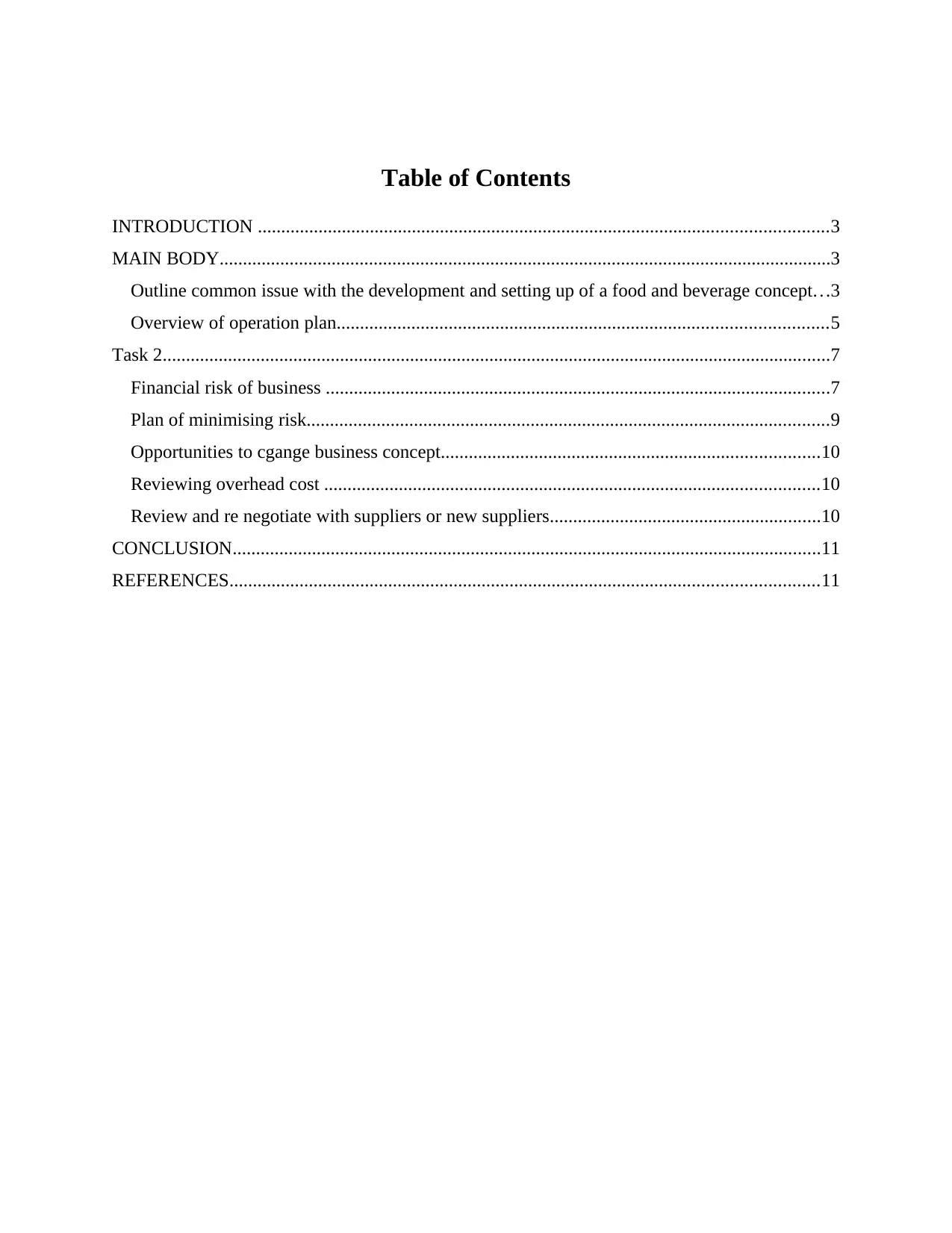
Table of Contents
INTRODUCTION ..........................................................................................................................3
MAIN BODY...................................................................................................................................3
Outline common issue with the development and setting up of a food and beverage concept.. .3
Overview of operation plan.........................................................................................................5
Task 2...............................................................................................................................................7
Financial risk of business ............................................................................................................7
Plan of minimising risk................................................................................................................9
Opportunities to cgange business concept.................................................................................10
Reviewing overhead cost ..........................................................................................................10
Review and re negotiate with suppliers or new suppliers..........................................................10
CONCLUSION..............................................................................................................................11
REFERENCES..............................................................................................................................11
INTRODUCTION ..........................................................................................................................3
MAIN BODY...................................................................................................................................3
Outline common issue with the development and setting up of a food and beverage concept.. .3
Overview of operation plan.........................................................................................................5
Task 2...............................................................................................................................................7
Financial risk of business ............................................................................................................7
Plan of minimising risk................................................................................................................9
Opportunities to cgange business concept.................................................................................10
Reviewing overhead cost ..........................................................................................................10
Review and re negotiate with suppliers or new suppliers..........................................................10
CONCLUSION..............................................................................................................................11
REFERENCES..............................................................................................................................11
INTRODUCTION
Menu planning is about to plan different features associated with the menu. This involves
plan different elements in menu and also to set the prices in menu related to different food items.
This report will talk about different issues associated with the menu planning and also related to
the setting up food and beverage concept in hospitality industry. Overview operation plan will
also demonstrate related to the product development, menu style costing and staffing.
Furthermore, report will discuss the potential financial risk of the business. Plan related to
minimising risk in business. Opportunity relate to changing the concept of business will also
analyse in this project. Overhead cost and amend or strip back will also evaluate in this project.
Review and re negotiate with suppliers or the new suppliers associated with the business entity.
MAIN BODY
Outline common issue with the development and setting up of a food and beverage concept
Menu setting is an important and crucial functiional area that needed to undertake by the
organisation. There are plenty of issues has been undertaken by the organisation while setting
manu. Following are the different aspects related to the menu setting in context to restaurant and
hospitality organisations.
Scenario 1
In this scenario the common issue is that food sector Imense depend upon the season.
Menu planning is immensely influenced with the seasonal aspect. This is a major challenge to
include a product that can provide a unique test. In hospitality sector or the restaurant sector
companies always prefer to include seasonal dishes so that more customer engagement could
have been achieved. This strategy empowers the business entities to gain success under the
hospitality sector (Bigio and d'Avernas, 2019). Seasonal menus in many cases are common and
similar of all restaurant chain. This is a huge issue to include a special dish in the menu that can
offer the best level of growth and development possibility of the business entity. Further the
prices is also a key issue company face when it comes to setting up menu in season. As the
seasonal menu is all about offering products that can only be cater in the specific season to
customers in market. Pricing is a major issue which business entities face as it directly influence
Menu planning is about to plan different features associated with the menu. This involves
plan different elements in menu and also to set the prices in menu related to different food items.
This report will talk about different issues associated with the menu planning and also related to
the setting up food and beverage concept in hospitality industry. Overview operation plan will
also demonstrate related to the product development, menu style costing and staffing.
Furthermore, report will discuss the potential financial risk of the business. Plan related to
minimising risk in business. Opportunity relate to changing the concept of business will also
analyse in this project. Overhead cost and amend or strip back will also evaluate in this project.
Review and re negotiate with suppliers or the new suppliers associated with the business entity.
MAIN BODY
Outline common issue with the development and setting up of a food and beverage concept
Menu setting is an important and crucial functiional area that needed to undertake by the
organisation. There are plenty of issues has been undertaken by the organisation while setting
manu. Following are the different aspects related to the menu setting in context to restaurant and
hospitality organisations.
Scenario 1
In this scenario the common issue is that food sector Imense depend upon the season.
Menu planning is immensely influenced with the seasonal aspect. This is a major challenge to
include a product that can provide a unique test. In hospitality sector or the restaurant sector
companies always prefer to include seasonal dishes so that more customer engagement could
have been achieved. This strategy empowers the business entities to gain success under the
hospitality sector (Bigio and d'Avernas, 2019). Seasonal menus in many cases are common and
similar of all restaurant chain. This is a huge issue to include a special dish in the menu that can
offer the best level of growth and development possibility of the business entity. Further the
prices is also a key issue company face when it comes to setting up menu in season. As the
seasonal menu is all about offering products that can only be cater in the specific season to
customers in market. Pricing is a major issue which business entities face as it directly influence
⊘ This is a preview!⊘
Do you want full access?
Subscribe today to unlock all pages.

Trusted by 1+ million students worldwide
the potential customers in the respective market. Decision making is majorly depend upon the
pricing of the company offer to its potential customer in the respective market.
Scienario 2
In this scenario there are plenty of issues which the organisation will face. This event is
conducting at the tome of pandemic that causes to plenty of challenges related to social
distancing, hygiene, health safety and many such issues. Also the limit is set in the people
collecting or gathered at a specific location which also Increase the issue of the entity.
Community outbreak has also spread under this that also cause to many challenges or issues
under this. Maintaining health and safety protocols is also the key challenge organisation will
face in the time of COVID situation (Bozzolan and Miihkinen, 2019). This pandemic is easy to
spread and also cause the challenge of community outbreak that can suffer the people or society
in form of death and many such issues. All these are the key issue related to the situation that can
suffer to the organisation in the respective market. The one of the major challenge or issue
business entity will face is that in the time of covid enduring the health safety is a major
challenge businesses are facing. To ensure the protocols to be meet at the time of event and with
the coverage of social distancing this is a huge challenges for the organisation to conduct
respective event.
Scienario 3
This event involve almost 500 people as a guest. To ensure the proper facilities of the 500
people is a huge challenge that organisation face. This incident involves gathering of
approximately 500 people due to some annual event. The issue under this is probably related to
ensuring the health and safety standards so that proper facilities could have been provided to the
people. Also the issue must be related to prices under the menu. IN case of any event the menu is
also set which depend upon the organisers. What are the preference event organisers have and
based on the preference and overall budget of event the menu is set under this. Communication is
also become an issue in many cases as gathering of 500 people is a huge challenge in relation to
work burden. Challenge can also be seen while menu planning is that to take care of the choices
and preferences of the people in the sector (Bustos, Watts and Ayala, 2017). TO include the
preference of al the guest attending the event is a huge challenge for the organisers to included in
the event. To set the best menu that can offer the taste of all the expected people attending the
event is a massive challenge which the business entity face in this.
pricing of the company offer to its potential customer in the respective market.
Scienario 2
In this scenario there are plenty of issues which the organisation will face. This event is
conducting at the tome of pandemic that causes to plenty of challenges related to social
distancing, hygiene, health safety and many such issues. Also the limit is set in the people
collecting or gathered at a specific location which also Increase the issue of the entity.
Community outbreak has also spread under this that also cause to many challenges or issues
under this. Maintaining health and safety protocols is also the key challenge organisation will
face in the time of COVID situation (Bozzolan and Miihkinen, 2019). This pandemic is easy to
spread and also cause the challenge of community outbreak that can suffer the people or society
in form of death and many such issues. All these are the key issue related to the situation that can
suffer to the organisation in the respective market. The one of the major challenge or issue
business entity will face is that in the time of covid enduring the health safety is a major
challenge businesses are facing. To ensure the protocols to be meet at the time of event and with
the coverage of social distancing this is a huge challenges for the organisation to conduct
respective event.
Scienario 3
This event involve almost 500 people as a guest. To ensure the proper facilities of the 500
people is a huge challenge that organisation face. This incident involves gathering of
approximately 500 people due to some annual event. The issue under this is probably related to
ensuring the health and safety standards so that proper facilities could have been provided to the
people. Also the issue must be related to prices under the menu. IN case of any event the menu is
also set which depend upon the organisers. What are the preference event organisers have and
based on the preference and overall budget of event the menu is set under this. Communication is
also become an issue in many cases as gathering of 500 people is a huge challenge in relation to
work burden. Challenge can also be seen while menu planning is that to take care of the choices
and preferences of the people in the sector (Bustos, Watts and Ayala, 2017). TO include the
preference of al the guest attending the event is a huge challenge for the organisers to included in
the event. To set the best menu that can offer the taste of all the expected people attending the
event is a massive challenge which the business entity face in this.
Paraphrase This Document
Need a fresh take? Get an instant paraphrase of this document with our AI Paraphraser
The above mentioned points demonstrate that different issues associated with different
situation. Event management is a very hectic schedule and in such a situation to set the best level
of menu that can prefer the taste of all the individuals attending the event is also a massive
challenge organisation face.
Overview of operation plan
Product development
Product development is among the most significant part of menu designing and
planning. In case of restaurant it becomes crucial to innovate and develop the most effective
product which can offer the best level of customer experience to the potential number of the
organisation. It becomes significant to continuously develop and construct the product in the
respective market. Product development include innovate on the dishes offer to the customers
under the menu and design new products and food items (Chicaiza-Becerra and Garcia-Molina,
2017). This is a continuous process in case of food sector organisation where it required to
continuously develop the food item. Product development function support the organisation to
achieve the best level of growth in the respective market. It can only be attract customers over a
continuous basis if it is catered enough to develop the food product and offer new items to
customers to gain consumer experience. Product development comprises with research over
market, customer choice and p[reference, buying power, taste and many such areas. IT becomes
crucial before initiation any development in product to generate a proper market study over
product and potential customers towards which the respective product is about to develop by
the organisation. Also company required to hire the best chef to design new dishes and products
that can match up with the choices and preferences of potential customers in market.
Menu style
Menu are of different types and style. There are five different styles of menu restaurant
and hotels offer to its customer that can demonstrate in the following ways.
La carte menu: This is the menu involve list of price associated with each food item
separately. This menu is precise and specific and offer the customers the best prices presented
in the systematic manner. This menu mention process in front of each food item so that
customers get to decide what item they want to order based on the taste and costing. Phrases
like from the menu and individually priced are also terms that is used instead of this menu by
many food and hospitality organisations (Coates and Gurnell, 2017). This menu favours the
situation. Event management is a very hectic schedule and in such a situation to set the best level
of menu that can prefer the taste of all the individuals attending the event is also a massive
challenge organisation face.
Overview of operation plan
Product development
Product development is among the most significant part of menu designing and
planning. In case of restaurant it becomes crucial to innovate and develop the most effective
product which can offer the best level of customer experience to the potential number of the
organisation. It becomes significant to continuously develop and construct the product in the
respective market. Product development include innovate on the dishes offer to the customers
under the menu and design new products and food items (Chicaiza-Becerra and Garcia-Molina,
2017). This is a continuous process in case of food sector organisation where it required to
continuously develop the food item. Product development function support the organisation to
achieve the best level of growth in the respective market. It can only be attract customers over a
continuous basis if it is catered enough to develop the food product and offer new items to
customers to gain consumer experience. Product development comprises with research over
market, customer choice and p[reference, buying power, taste and many such areas. IT becomes
crucial before initiation any development in product to generate a proper market study over
product and potential customers towards which the respective product is about to develop by
the organisation. Also company required to hire the best chef to design new dishes and products
that can match up with the choices and preferences of potential customers in market.
Menu style
Menu are of different types and style. There are five different styles of menu restaurant
and hotels offer to its customer that can demonstrate in the following ways.
La carte menu: This is the menu involve list of price associated with each food item
separately. This menu is precise and specific and offer the customers the best prices presented
in the systematic manner. This menu mention process in front of each food item so that
customers get to decide what item they want to order based on the taste and costing. Phrases
like from the menu and individually priced are also terms that is used instead of this menu by
many food and hospitality organisations (Coates and Gurnell, 2017). This menu favours the
organisation to offer all food items in the most systematic manner that can offer bets level; of
presentation to the potential customers in market.
Du Jour Menu
Du Jour Menu is denoted as the of the day type of menu. This menu keep on changing
all the time as the items are only presented in this menu based on the product chef could
prepare. Product depends in this menu is over the fact that what items could prepare by the chef
at that moment. This further involve different terms denoted as “chicken du jour” denoted
chicken that is available today (Dickason and Ferreira, 2018). Likewise “soup du jour”
indicated as soup that is available today in the restaurant. It can reflect that dishes and items
keep on changing in this type of menu. Every day new dishes are included in the menu which
also motivate diversity ion the products offer by the organisation.
Cycle menu
Cycle menu is another menu type that contain repeated product option in the menu card.
This menu is very diversified in nature as products are offer differently in different days. This
menu is about to keep diversification in the product as for example company offer different type
of sandwich on one day and the other day it offers different type of sandwich to its customer
(Gao and et.al., 2018). This menu is different from other types. The item offer initially also
repeat again and the cycle keep on moving under this.
Static menu
Static the term itself denote consistency. This menu contains the item that never changes
and always contain in the menu. Restaurant always offer products mentioned in this menu.
Every time customer visit at the restaurant it will always look and offer this menu. Static menu
also contain similar prices all the time.
Fixed menu
Fixed menu contain selected products and al;so the prices in this are fixed. This menu is
limited edition that contain only the fixed selected products contain fixed prices to be offer to
the customers in respective market.
The above mentioned menu are off different types. These menu contain various
characteristics and traits that allow the entity to keep on certain differentiation in each menu
offer to the potential customers in the respective market.
Costing and staffing
presentation to the potential customers in market.
Du Jour Menu
Du Jour Menu is denoted as the of the day type of menu. This menu keep on changing
all the time as the items are only presented in this menu based on the product chef could
prepare. Product depends in this menu is over the fact that what items could prepare by the chef
at that moment. This further involve different terms denoted as “chicken du jour” denoted
chicken that is available today (Dickason and Ferreira, 2018). Likewise “soup du jour”
indicated as soup that is available today in the restaurant. It can reflect that dishes and items
keep on changing in this type of menu. Every day new dishes are included in the menu which
also motivate diversity ion the products offer by the organisation.
Cycle menu
Cycle menu is another menu type that contain repeated product option in the menu card.
This menu is very diversified in nature as products are offer differently in different days. This
menu is about to keep diversification in the product as for example company offer different type
of sandwich on one day and the other day it offers different type of sandwich to its customer
(Gao and et.al., 2018). This menu is different from other types. The item offer initially also
repeat again and the cycle keep on moving under this.
Static menu
Static the term itself denote consistency. This menu contains the item that never changes
and always contain in the menu. Restaurant always offer products mentioned in this menu.
Every time customer visit at the restaurant it will always look and offer this menu. Static menu
also contain similar prices all the time.
Fixed menu
Fixed menu contain selected products and al;so the prices in this are fixed. This menu is
limited edition that contain only the fixed selected products contain fixed prices to be offer to
the customers in respective market.
The above mentioned menu are off different types. These menu contain various
characteristics and traits that allow the entity to keep on certain differentiation in each menu
offer to the potential customers in the respective market.
Costing and staffing
⊘ This is a preview!⊘
Do you want full access?
Subscribe today to unlock all pages.
Trusted by 1+ million students worldwide
Costing and staffing is about to set the prices of the different products and items offer to
the potential customer in the respective market. Every organisation try to keep the prices
competitive in nature that can favour the best level of strategic advantage to the organisation in
the respective market. Staffing involve recruiting potential employee over different designated
position role in the organisation and based on the need and requirements of the organisation it
also involves training and development campaign to cherish the strategic growth of the
organisation.
Task 2
Financial risk of business
Company own different financial risk elements. These are the factors impact and
influence the overall growth and success of the business entity. These are the risk element
potentially influence the operations of the organisations.
Liquidity risk: Liquidity risk is among the major risk driven factor influence the business
operations undertaken by the organisation. This risk is about to pay the debt and creditor
associated with the business operations. This is also a risk associated with the bank credit.
Liquidity allows the organisation to channelises the daily operation and functional activities
effectively so that business entity can achieve the best flow of operations at the organisation
level.
Funding risk: Funding risk is about taking large borrowing. This borrower relies over liquidity
on securities to maintain prices, smooth out price volatility and also The facilities further issues
(Gerrard and et.al., 2019). This risk is that for some reason investors may judge the security to be
insufficiently attractive, with result that prices may fall and access to the market may become
more difficult.
Interest rate risk: Interest rate risk is another risk factor associated with the organisation. This
involve increasing interest expense and reducing interest income. Change in the market rate of
interest may also affect fixed rate security where they are marked to market. This will further
influence the capital value of security. This involves practices like sensitivity analysis to evaluate
impacts over the profit and loss of the business entity.
Foreign exchange risk: This risk involve the impact due top the variation in the foreign
exchange of security. Foreign exchange exposure are of three different types such as transaction
the potential customer in the respective market. Every organisation try to keep the prices
competitive in nature that can favour the best level of strategic advantage to the organisation in
the respective market. Staffing involve recruiting potential employee over different designated
position role in the organisation and based on the need and requirements of the organisation it
also involves training and development campaign to cherish the strategic growth of the
organisation.
Task 2
Financial risk of business
Company own different financial risk elements. These are the factors impact and
influence the overall growth and success of the business entity. These are the risk element
potentially influence the operations of the organisations.
Liquidity risk: Liquidity risk is among the major risk driven factor influence the business
operations undertaken by the organisation. This risk is about to pay the debt and creditor
associated with the business operations. This is also a risk associated with the bank credit.
Liquidity allows the organisation to channelises the daily operation and functional activities
effectively so that business entity can achieve the best flow of operations at the organisation
level.
Funding risk: Funding risk is about taking large borrowing. This borrower relies over liquidity
on securities to maintain prices, smooth out price volatility and also The facilities further issues
(Gerrard and et.al., 2019). This risk is that for some reason investors may judge the security to be
insufficiently attractive, with result that prices may fall and access to the market may become
more difficult.
Interest rate risk: Interest rate risk is another risk factor associated with the organisation. This
involve increasing interest expense and reducing interest income. Change in the market rate of
interest may also affect fixed rate security where they are marked to market. This will further
influence the capital value of security. This involves practices like sensitivity analysis to evaluate
impacts over the profit and loss of the business entity.
Foreign exchange risk: This risk involve the impact due top the variation in the foreign
exchange of security. Foreign exchange exposure are of three different types such as transaction
Paraphrase This Document
Need a fresh take? Get an instant paraphrase of this document with our AI Paraphraser
exposure, translation exposures and competitive exposures. Transaction exposures related to the
normal operational business activities. Translation exposure is resulted as converting of long
term currency assets and liabilities into the local currency. Competitive exposures is about to
attract different approaches to manage foreign exchange. Foreign exchange risk is among the
major risk element attract the business operations of the organisation.
Commodity price risk: Commodity price risk is the risk related to the stock company offer at
the stock exchange and commodity exchange. This involves credit risk. This risk is arises out of
the changes in the currency exchange rate in the respective market (Li and Arreola-Risa, 2017).
IN the international market commodity prices keep on changing due to many reason like
international activities, GDP growth of the country and many other elements allow the country to
set the value of the currency.
Bushiness or operating risk: Business and operating risk is about the risk associated with the
operations of the organisation. This involve internal and external systems related to monitoring,
negotiation and delivery of financial transactions of the organisation (Lu, 2018). This risk
contain wide range involve natural disaster, break down of financial system or failure of
electronic system.
The above mentioned risk elements are associated with the organisation. All these are the
different risk factors influence the overall performance of the organisation in respective market.
Plan of minimising risk
Aim
To reduce the financial risk by 35%.
SMART Objectives
Company will use SMART objective framework to minimise the financial risk
associated with the organisation.
Specific: It is specific to minimise the business or operating risk of the organisation.
Measurable: The risk will be minimised with support of the operation management approach
of the organisation and also performance based evaluation will be done.
Achievable: This aim is achievable in nature with support of proper strategies and practices.
Realistic: Minimising the financial risk by 35% is realistic in nature.
Time based: This will be achieve at the end of this financial year.
normal operational business activities. Translation exposure is resulted as converting of long
term currency assets and liabilities into the local currency. Competitive exposures is about to
attract different approaches to manage foreign exchange. Foreign exchange risk is among the
major risk element attract the business operations of the organisation.
Commodity price risk: Commodity price risk is the risk related to the stock company offer at
the stock exchange and commodity exchange. This involves credit risk. This risk is arises out of
the changes in the currency exchange rate in the respective market (Li and Arreola-Risa, 2017).
IN the international market commodity prices keep on changing due to many reason like
international activities, GDP growth of the country and many other elements allow the country to
set the value of the currency.
Bushiness or operating risk: Business and operating risk is about the risk associated with the
operations of the organisation. This involve internal and external systems related to monitoring,
negotiation and delivery of financial transactions of the organisation (Lu, 2018). This risk
contain wide range involve natural disaster, break down of financial system or failure of
electronic system.
The above mentioned risk elements are associated with the organisation. All these are the
different risk factors influence the overall performance of the organisation in respective market.
Plan of minimising risk
Aim
To reduce the financial risk by 35%.
SMART Objectives
Company will use SMART objective framework to minimise the financial risk
associated with the organisation.
Specific: It is specific to minimise the business or operating risk of the organisation.
Measurable: The risk will be minimised with support of the operation management approach
of the organisation and also performance based evaluation will be done.
Achievable: This aim is achievable in nature with support of proper strategies and practices.
Realistic: Minimising the financial risk by 35% is realistic in nature.
Time based: This will be achieve at the end of this financial year.
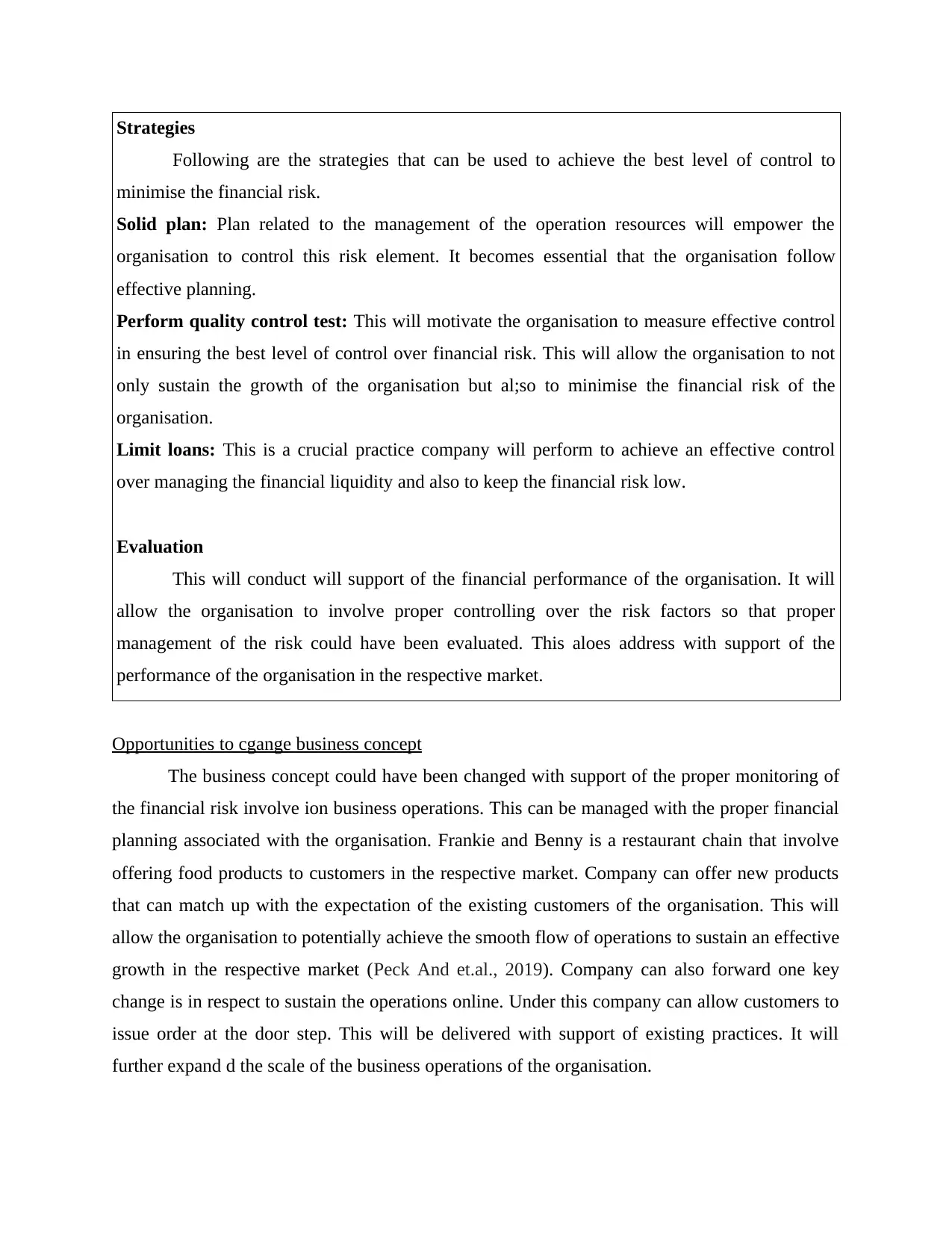
Strategies
Following are the strategies that can be used to achieve the best level of control to
minimise the financial risk.
Solid plan: Plan related to the management of the operation resources will empower the
organisation to control this risk element. It becomes essential that the organisation follow
effective planning.
Perform quality control test: This will motivate the organisation to measure effective control
in ensuring the best level of control over financial risk. This will allow the organisation to not
only sustain the growth of the organisation but al;so to minimise the financial risk of the
organisation.
Limit loans: This is a crucial practice company will perform to achieve an effective control
over managing the financial liquidity and also to keep the financial risk low.
Evaluation
This will conduct will support of the financial performance of the organisation. It will
allow the organisation to involve proper controlling over the risk factors so that proper
management of the risk could have been evaluated. This aloes address with support of the
performance of the organisation in the respective market.
Opportunities to cgange business concept
The business concept could have been changed with support of the proper monitoring of
the financial risk involve ion business operations. This can be managed with the proper financial
planning associated with the organisation. Frankie and Benny is a restaurant chain that involve
offering food products to customers in the respective market. Company can offer new products
that can match up with the expectation of the existing customers of the organisation. This will
allow the organisation to potentially achieve the smooth flow of operations to sustain an effective
growth in the respective market (Peck And et.al., 2019). Company can also forward one key
change is in respect to sustain the operations online. Under this company can allow customers to
issue order at the door step. This will be delivered with support of existing practices. It will
further expand d the scale of the business operations of the organisation.
Following are the strategies that can be used to achieve the best level of control to
minimise the financial risk.
Solid plan: Plan related to the management of the operation resources will empower the
organisation to control this risk element. It becomes essential that the organisation follow
effective planning.
Perform quality control test: This will motivate the organisation to measure effective control
in ensuring the best level of control over financial risk. This will allow the organisation to not
only sustain the growth of the organisation but al;so to minimise the financial risk of the
organisation.
Limit loans: This is a crucial practice company will perform to achieve an effective control
over managing the financial liquidity and also to keep the financial risk low.
Evaluation
This will conduct will support of the financial performance of the organisation. It will
allow the organisation to involve proper controlling over the risk factors so that proper
management of the risk could have been evaluated. This aloes address with support of the
performance of the organisation in the respective market.
Opportunities to cgange business concept
The business concept could have been changed with support of the proper monitoring of
the financial risk involve ion business operations. This can be managed with the proper financial
planning associated with the organisation. Frankie and Benny is a restaurant chain that involve
offering food products to customers in the respective market. Company can offer new products
that can match up with the expectation of the existing customers of the organisation. This will
allow the organisation to potentially achieve the smooth flow of operations to sustain an effective
growth in the respective market (Peck And et.al., 2019). Company can also forward one key
change is in respect to sustain the operations online. Under this company can allow customers to
issue order at the door step. This will be delivered with support of existing practices. It will
further expand d the scale of the business operations of the organisation.
⊘ This is a preview!⊘
Do you want full access?
Subscribe today to unlock all pages.
Trusted by 1+ million students worldwide
Reviewing overhead cost
Overhead cost of the Frankie and Benny can be controlled. This is the cost that always
incurred due to the avoidable or unavoidable reason but it can be control with some strong
policies. The total overhead cost is $7800000 (Vu and et.al., 2018). This cost is controllable but
it is not so much. Company has set an effective framework that offer a smooth control over ma
ageing overhead cost of production. AS compare to other competitors this cost is well managed
and affordable in nature as it do not put major impact over the pricing of the company.
Review and re negotiate with suppliers or new suppliers
Frankie and Benny is among tyeh merging restaurant chain offer quality food to its
customers. Company sustained a huge flow of suppliers that favour the organisation to avail
products to the customers on time. This also empower the organisation achieve an effective flow
of operations for the organisation. Company can re negotiate with its suppliers as now it becomes
better brand so that company can maximise its profit share (Shusha, 2017). In such a process it
can also make strategic alliances with other suppliers so that more options could have been
available by the organisation. All this is an important strategic choice available in front of the
Frankie and Benny to control and make better flow of operations. This will favour the
organisation to improve the profit share and also to sustain better control over operations.
CONCLUSION
Financial risk is the risk associated with the financial risk of the organisation. This
involve many factors such as foreign exchange rate, inflation, interest rate and many such factors
that can influence the financial stability of the organisation. Menu setting is a crucial task
associated with the restaurant and hotel organisations. Based on the need and individual
preference of customers menu are set by the organisation. Financial risk involve liquidity risk,
exchange risk and many such areas.
Overhead cost of the Frankie and Benny can be controlled. This is the cost that always
incurred due to the avoidable or unavoidable reason but it can be control with some strong
policies. The total overhead cost is $7800000 (Vu and et.al., 2018). This cost is controllable but
it is not so much. Company has set an effective framework that offer a smooth control over ma
ageing overhead cost of production. AS compare to other competitors this cost is well managed
and affordable in nature as it do not put major impact over the pricing of the company.
Review and re negotiate with suppliers or new suppliers
Frankie and Benny is among tyeh merging restaurant chain offer quality food to its
customers. Company sustained a huge flow of suppliers that favour the organisation to avail
products to the customers on time. This also empower the organisation achieve an effective flow
of operations for the organisation. Company can re negotiate with its suppliers as now it becomes
better brand so that company can maximise its profit share (Shusha, 2017). In such a process it
can also make strategic alliances with other suppliers so that more options could have been
available by the organisation. All this is an important strategic choice available in front of the
Frankie and Benny to control and make better flow of operations. This will favour the
organisation to improve the profit share and also to sustain better control over operations.
CONCLUSION
Financial risk is the risk associated with the financial risk of the organisation. This
involve many factors such as foreign exchange rate, inflation, interest rate and many such factors
that can influence the financial stability of the organisation. Menu setting is a crucial task
associated with the restaurant and hotel organisations. Based on the need and individual
preference of customers menu are set by the organisation. Financial risk involve liquidity risk,
exchange risk and many such areas.
Paraphrase This Document
Need a fresh take? Get an instant paraphrase of this document with our AI Paraphraser
REFERENCES
Books and Journals
Bigio, S. and d'Avernas, A., 2019. Financial risk capacity (No. w26561). National Bureau of
Economic Research.
Bozzolan, S. and Miihkinen, A., 2019. The quality of mandatory non-financial (risk) disclosures:
The moderating role of audit firm and partner characteristics. Forthcoming, The
International Journal of Accounting.
Bustos, C., Watts, D. and Ayala, M., 2017. Financial risk reduction in photovoltaic projects
through ocean-atmospheric oscillations modeling. Renewable and Sustainable Energy
Reviews. 74. pp.548-568.
Chicaiza-Becerra, L. A. and Garcia-Molina, M., 2017. Prenatal testosterone predicts financial
risk taking: Evidence from Latin America. Personality and Individual Differences. 116.
pp.32-37.
Coates, J. and Gurnell, M., 2017. Combining field work and laboratory work in the study of
financial risk-taking. Hormones and behavior. 92. pp.13-19.
Dickason, Z. and Ferreira, S. J., 2018. The effect of age and gender on financial risk tolerance of
South African investors. Investment Management and Financial Innovations. 15(2).
pp.1-8.
Gao, W. and et.al., 2018. Ultimate bound estimation set and chaos synchronization for a
financial risk system. Mathematics and Computers in Simulation. 154. pp.19-33.
Gerrard, R. and et.al., 2019. Communication and personal selection of pension saver’s financial
risk. European Journal of Operational Research. 274(3). pp.1102-1111.
Li, B. and Arreola-Risa, A., 2017. Financial risk, inventory decision and process improvement
for a firm with random capacity. European Journal of Operational Research. 260(1).
pp.183-194.
Lu, L., 2018. Bitcoin: speculative bubble, financial risk and regulatory response. Butterworths
Journal of International Banking and Financial Law. pp.178-182.
Peck, K. A. And et.al., 2019. ACO contracts with downside financial risk growing, but still in
the minority. Health Affairs. 38(7). pp.1201-1206.
Shusha, A. A., 2017. Does financial literacy moderate the relationship among demographic
characteristics and financial risk tolerance? Evidence from Egypt. Australasian
Accounting, Business and Finance Journal. 11(3). pp.67-86.
Vu, D. H. and et.al., 2018. Customer reward-based demand response program to improve
demand elasticity and minimise financial risk during price spikes. IET Generation,
Transmission & Distribution. 12(15). pp.3764-3771.
Books and Journals
Bigio, S. and d'Avernas, A., 2019. Financial risk capacity (No. w26561). National Bureau of
Economic Research.
Bozzolan, S. and Miihkinen, A., 2019. The quality of mandatory non-financial (risk) disclosures:
The moderating role of audit firm and partner characteristics. Forthcoming, The
International Journal of Accounting.
Bustos, C., Watts, D. and Ayala, M., 2017. Financial risk reduction in photovoltaic projects
through ocean-atmospheric oscillations modeling. Renewable and Sustainable Energy
Reviews. 74. pp.548-568.
Chicaiza-Becerra, L. A. and Garcia-Molina, M., 2017. Prenatal testosterone predicts financial
risk taking: Evidence from Latin America. Personality and Individual Differences. 116.
pp.32-37.
Coates, J. and Gurnell, M., 2017. Combining field work and laboratory work in the study of
financial risk-taking. Hormones and behavior. 92. pp.13-19.
Dickason, Z. and Ferreira, S. J., 2018. The effect of age and gender on financial risk tolerance of
South African investors. Investment Management and Financial Innovations. 15(2).
pp.1-8.
Gao, W. and et.al., 2018. Ultimate bound estimation set and chaos synchronization for a
financial risk system. Mathematics and Computers in Simulation. 154. pp.19-33.
Gerrard, R. and et.al., 2019. Communication and personal selection of pension saver’s financial
risk. European Journal of Operational Research. 274(3). pp.1102-1111.
Li, B. and Arreola-Risa, A., 2017. Financial risk, inventory decision and process improvement
for a firm with random capacity. European Journal of Operational Research. 260(1).
pp.183-194.
Lu, L., 2018. Bitcoin: speculative bubble, financial risk and regulatory response. Butterworths
Journal of International Banking and Financial Law. pp.178-182.
Peck, K. A. And et.al., 2019. ACO contracts with downside financial risk growing, but still in
the minority. Health Affairs. 38(7). pp.1201-1206.
Shusha, A. A., 2017. Does financial literacy moderate the relationship among demographic
characteristics and financial risk tolerance? Evidence from Egypt. Australasian
Accounting, Business and Finance Journal. 11(3). pp.67-86.
Vu, D. H. and et.al., 2018. Customer reward-based demand response program to improve
demand elasticity and minimise financial risk during price spikes. IET Generation,
Transmission & Distribution. 12(15). pp.3764-3771.

1 out of 11


Related Documents


Your All-in-One AI-Powered Toolkit for Academic Success.
+13062052269
info@desklib.com
Available 24*7 on WhatsApp / Email
![[object Object]](/_next/static/media/star-bottom.7253800d.svg)
Unlock your academic potential
Copyright © 2020–2026 A2Z Services. All Rights Reserved. Developed and managed by ZUCOL.