CIVMB_AS_v3A3: Detailed Case Study on Finance and Mortgage Broking
VerifiedAdded on 2024/05/20
|55
|13159
|250
Report
AI Summary
This assignment presents a comprehensive solution to a case study focused on finance and mortgage broking, specifically addressing the requirements of Certificate IV in Finance and Mortgage Broking (CIVMB_AS_v3A3). It includes two case studies, the first involving Clinton and Jennifer Andrews seeking to purchase an investment property, and the second focusing on Tony and Lorraine Denton. The solution covers various tasks such as initial disclosures, client information gathering, assessing financial situations, exploring equity usage, conducting reasonable inquiries, providing recommendations, understanding interest rates, and navigating settlement processes. Furthermore, it delves into responsible lending obligations, special considerations for self-employed individuals, advising on financial strategies, assessing the impact of credit history, and understanding external dispute resolution. The document also incorporates practical tools like a client information collection tool and a serviceability calculator, providing a thorough analysis and guidance on the key aspects of finance and mortgage broking. This assignment, contributed by a student, is available on Desklib, a platform offering AI-powered study tools and resources for students.
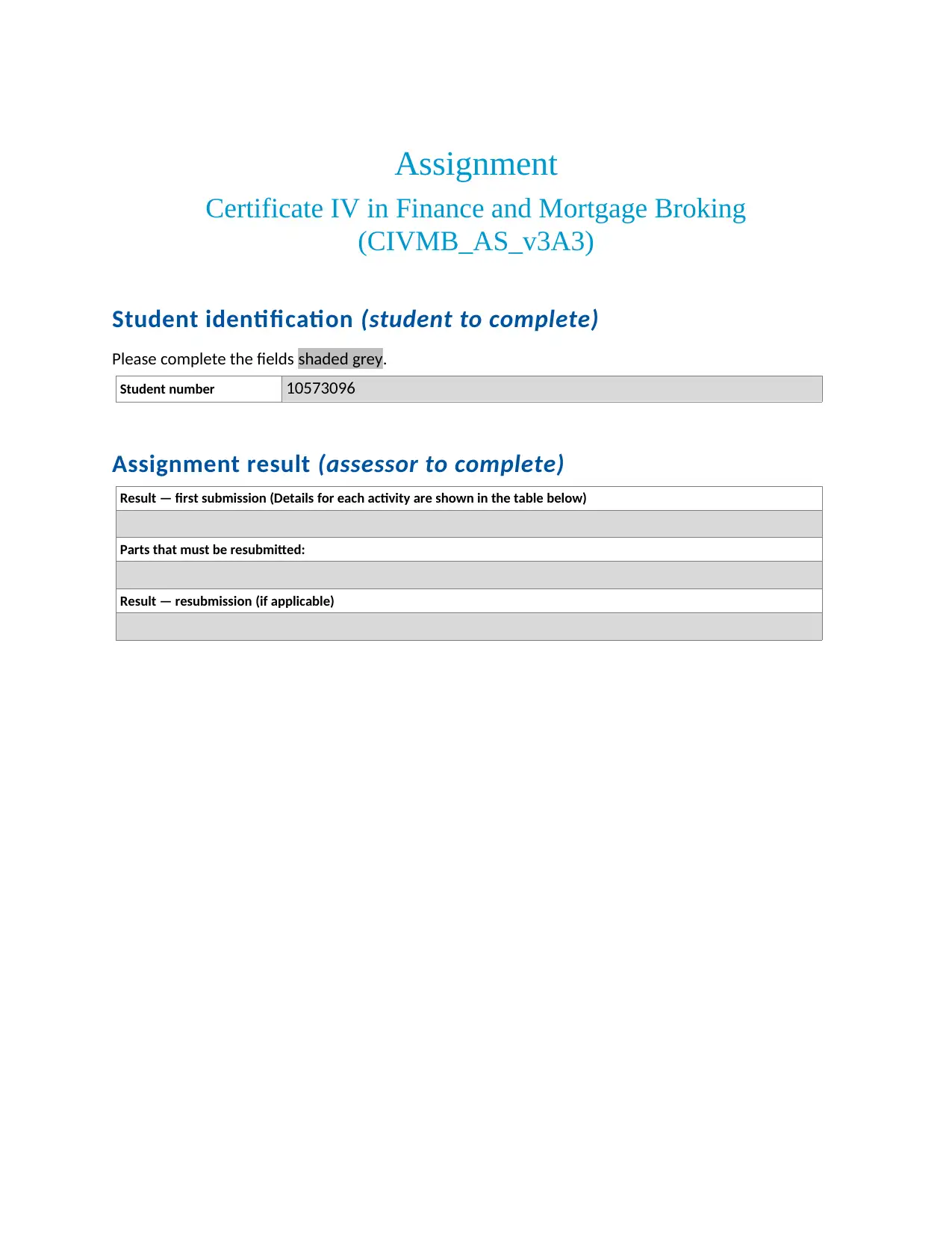
Assignment
Certificate IV in Finance and Mortgage Broking
(CIVMB_AS_v3A3)
Student identification (student to complete)
Please complete the fields shaded grey.
Student number 10573096
Assignment result (assessor to complete)
Result — first submission (Details for each activity are shown in the table below)
Parts that must be resubmitted:
Result — resubmission (if applicable)
Certificate IV in Finance and Mortgage Broking
(CIVMB_AS_v3A3)
Student identification (student to complete)
Please complete the fields shaded grey.
Student number 10573096
Assignment result (assessor to complete)
Result — first submission (Details for each activity are shown in the table below)
Parts that must be resubmitted:
Result — resubmission (if applicable)

Paraphrase This Document
Need a fresh take? Get an instant paraphrase of this document with our AI Paraphraser
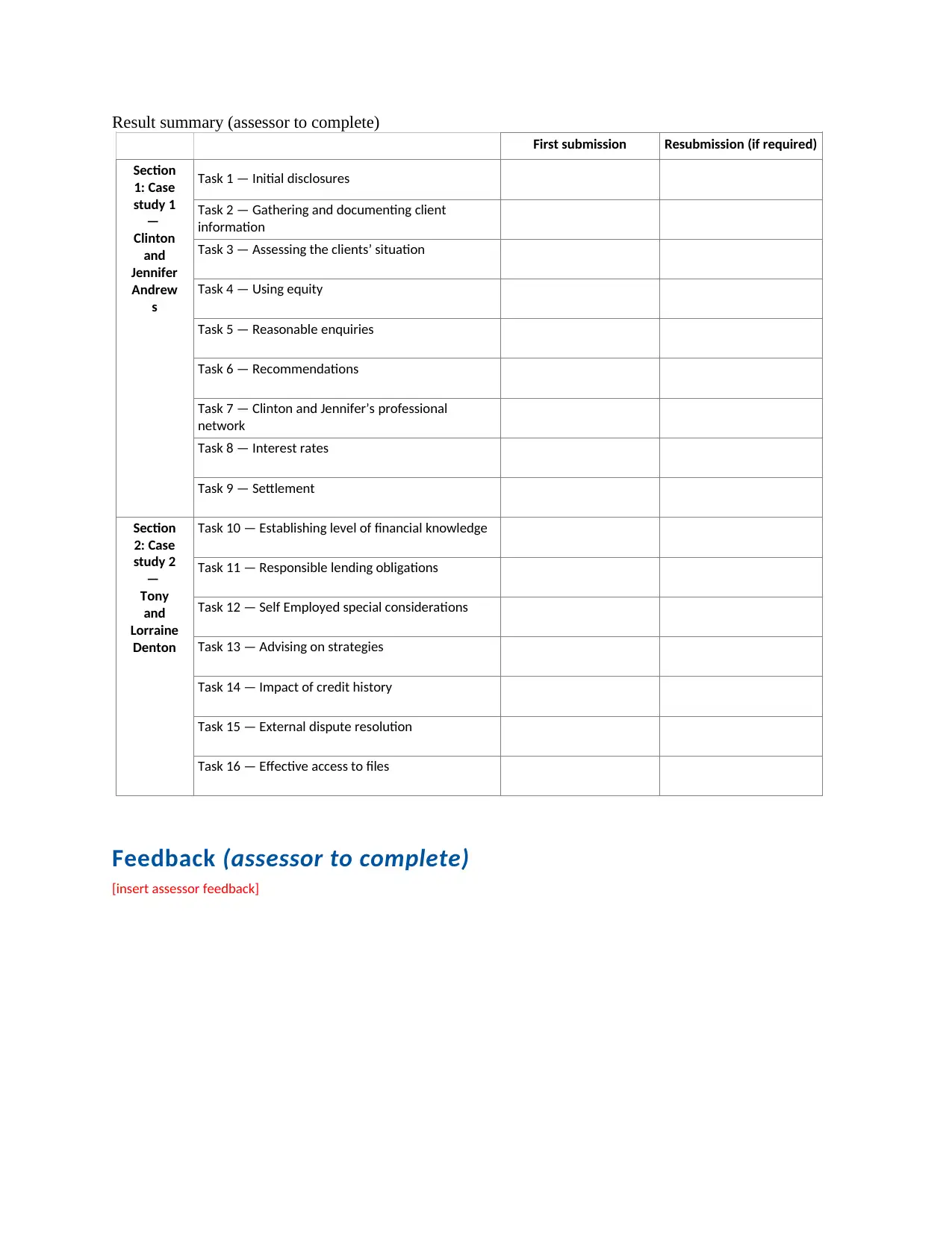
Result summary (assessor to complete)
First submission Resubmission (if required)
Section
1: Case
study 1
—
Clinton
and
Jennifer
Andrew
s
Task 1 — Initial disclosures
Task 2 — Gathering and documenting client
information
Task 3 — Assessing the clients’ situation
Task 4 — Using equity
Task 5 — Reasonable enquiries
Task 6 — Recommendations
Task 7 — Clinton and Jennifer’s professional
network
Task 8 — Interest rates
Task 9 — Settlement
Section
2: Case
study 2
—
Tony
and
Lorraine
Denton
Task 10 — Establishing level of financial knowledge
Task 11 — Responsible lending obligations
Task 12 — Self Employed special considerations
Task 13 — Advising on strategies
Task 14 — Impact of credit history
Task 15 — External dispute resolution
Task 16 — Effective access to files
Feedback (assessor to complete)
[insert assessor feedback]
First submission Resubmission (if required)
Section
1: Case
study 1
—
Clinton
and
Jennifer
Andrew
s
Task 1 — Initial disclosures
Task 2 — Gathering and documenting client
information
Task 3 — Assessing the clients’ situation
Task 4 — Using equity
Task 5 — Reasonable enquiries
Task 6 — Recommendations
Task 7 — Clinton and Jennifer’s professional
network
Task 8 — Interest rates
Task 9 — Settlement
Section
2: Case
study 2
—
Tony
and
Lorraine
Denton
Task 10 — Establishing level of financial knowledge
Task 11 — Responsible lending obligations
Task 12 — Self Employed special considerations
Task 13 — Advising on strategies
Task 14 — Impact of credit history
Task 15 — External dispute resolution
Task 16 — Effective access to files
Feedback (assessor to complete)
[insert assessor feedback]
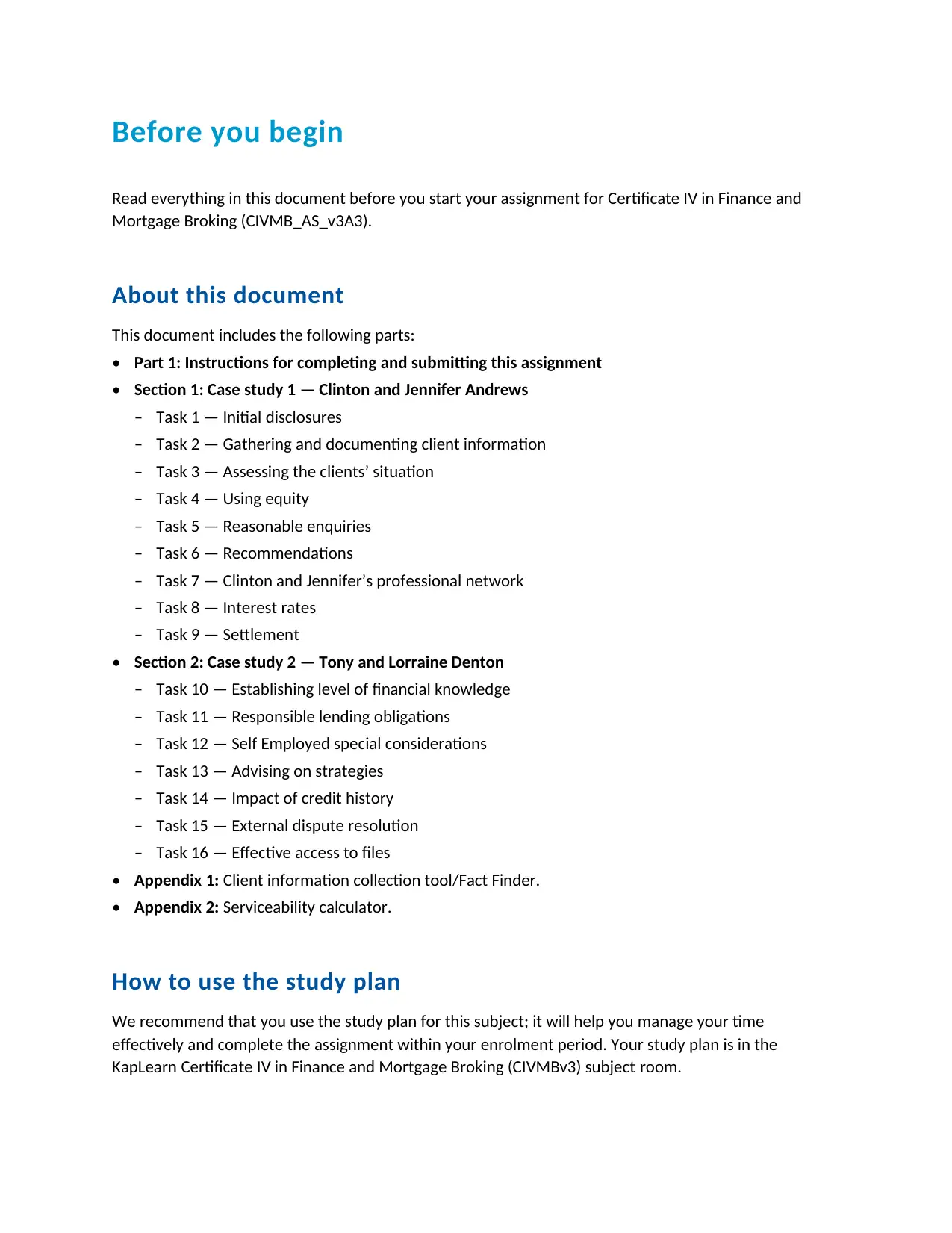
Before you begin
Read everything in this document before you start your assignment for Certificate IV in Finance and
Mortgage Broking (CIVMB_AS_v3A3).
About this document
This document includes the following parts:
• Part 1: Instructions for completing and submitting this assignment
• Section 1: Case study 1 — Clinton and Jennifer Andrews
– Task 1 — Initial disclosures
– Task 2 — Gathering and documenting client information
– Task 3 — Assessing the clients’ situation
– Task 4 — Using equity
– Task 5 — Reasonable enquiries
– Task 6 — Recommendations
– Task 7 — Clinton and Jennifer’s professional network
– Task 8 — Interest rates
– Task 9 — Settlement
• Section 2: Case study 2 — Tony and Lorraine Denton
– Task 10 — Establishing level of financial knowledge
– Task 11 — Responsible lending obligations
– Task 12 — Self Employed special considerations
– Task 13 — Advising on strategies
– Task 14 — Impact of credit history
– Task 15 — External dispute resolution
– Task 16 — Effective access to files
• Appendix 1: Client information collection tool/Fact Finder.
• Appendix 2: Serviceability calculator.
How to use the study plan
We recommend that you use the study plan for this subject; it will help you manage your time
effectively and complete the assignment within your enrolment period. Your study plan is in the
KapLearn Certificate IV in Finance and Mortgage Broking (CIVMBv3) subject room.
Read everything in this document before you start your assignment for Certificate IV in Finance and
Mortgage Broking (CIVMB_AS_v3A3).
About this document
This document includes the following parts:
• Part 1: Instructions for completing and submitting this assignment
• Section 1: Case study 1 — Clinton and Jennifer Andrews
– Task 1 — Initial disclosures
– Task 2 — Gathering and documenting client information
– Task 3 — Assessing the clients’ situation
– Task 4 — Using equity
– Task 5 — Reasonable enquiries
– Task 6 — Recommendations
– Task 7 — Clinton and Jennifer’s professional network
– Task 8 — Interest rates
– Task 9 — Settlement
• Section 2: Case study 2 — Tony and Lorraine Denton
– Task 10 — Establishing level of financial knowledge
– Task 11 — Responsible lending obligations
– Task 12 — Self Employed special considerations
– Task 13 — Advising on strategies
– Task 14 — Impact of credit history
– Task 15 — External dispute resolution
– Task 16 — Effective access to files
• Appendix 1: Client information collection tool/Fact Finder.
• Appendix 2: Serviceability calculator.
How to use the study plan
We recommend that you use the study plan for this subject; it will help you manage your time
effectively and complete the assignment within your enrolment period. Your study plan is in the
KapLearn Certificate IV in Finance and Mortgage Broking (CIVMBv3) subject room.
⊘ This is a preview!⊘
Do you want full access?
Subscribe today to unlock all pages.

Trusted by 1+ million students worldwide
Part 1: Instructions for completing and submitting
this assignment
Completing the assignment
Saving your work
Download this document to your desktop, type your answers in the spaces provided and save your work
regularly.
• Use the template provided, as other formats will not be accepted for these assignments.
• Name your file as follows: Studentnumber_SubjectCode_Submissionnumber
(e.g. 12345678_CIVMBv3A3_Submission1).
• Include your student ID on the first page of the assignment.
Before you submit your work, please do a spell check and proofread your work to ensure that everything
is clear and unambiguous.
The assignment
This assignment is split into 16 Tasks, over 3 Sections. To finish this assignment, you must complete
all 16 tasks.
The information and data needed to complete Sections 1 and 2 is presented in case studies at the
beginning of those sections.
Word count
The word count shown with each question is indicative only. You will not be penalised for exceeding the
suggested word count. Please do not include additional information which is outside the scope of the
question.
Additional research
When completing the Client Information Collection Tool in Appendix 1, assumptions are permitted,
although they must not be in conflict with the information provided in the Case Study.
this assignment
Completing the assignment
Saving your work
Download this document to your desktop, type your answers in the spaces provided and save your work
regularly.
• Use the template provided, as other formats will not be accepted for these assignments.
• Name your file as follows: Studentnumber_SubjectCode_Submissionnumber
(e.g. 12345678_CIVMBv3A3_Submission1).
• Include your student ID on the first page of the assignment.
Before you submit your work, please do a spell check and proofread your work to ensure that everything
is clear and unambiguous.
The assignment
This assignment is split into 16 Tasks, over 3 Sections. To finish this assignment, you must complete
all 16 tasks.
The information and data needed to complete Sections 1 and 2 is presented in case studies at the
beginning of those sections.
Word count
The word count shown with each question is indicative only. You will not be penalised for exceeding the
suggested word count. Please do not include additional information which is outside the scope of the
question.
Additional research
When completing the Client Information Collection Tool in Appendix 1, assumptions are permitted,
although they must not be in conflict with the information provided in the Case Study.
Paraphrase This Document
Need a fresh take? Get an instant paraphrase of this document with our AI Paraphraser

You may also be required to source additional information from other organisations in the finance
industry to find the right products or services to meet your client’s requirements or to calculate any
service fees that may be applicable.
industry to find the right products or services to meet your client’s requirements or to calculate any
service fees that may be applicable.
Submitting the assignment
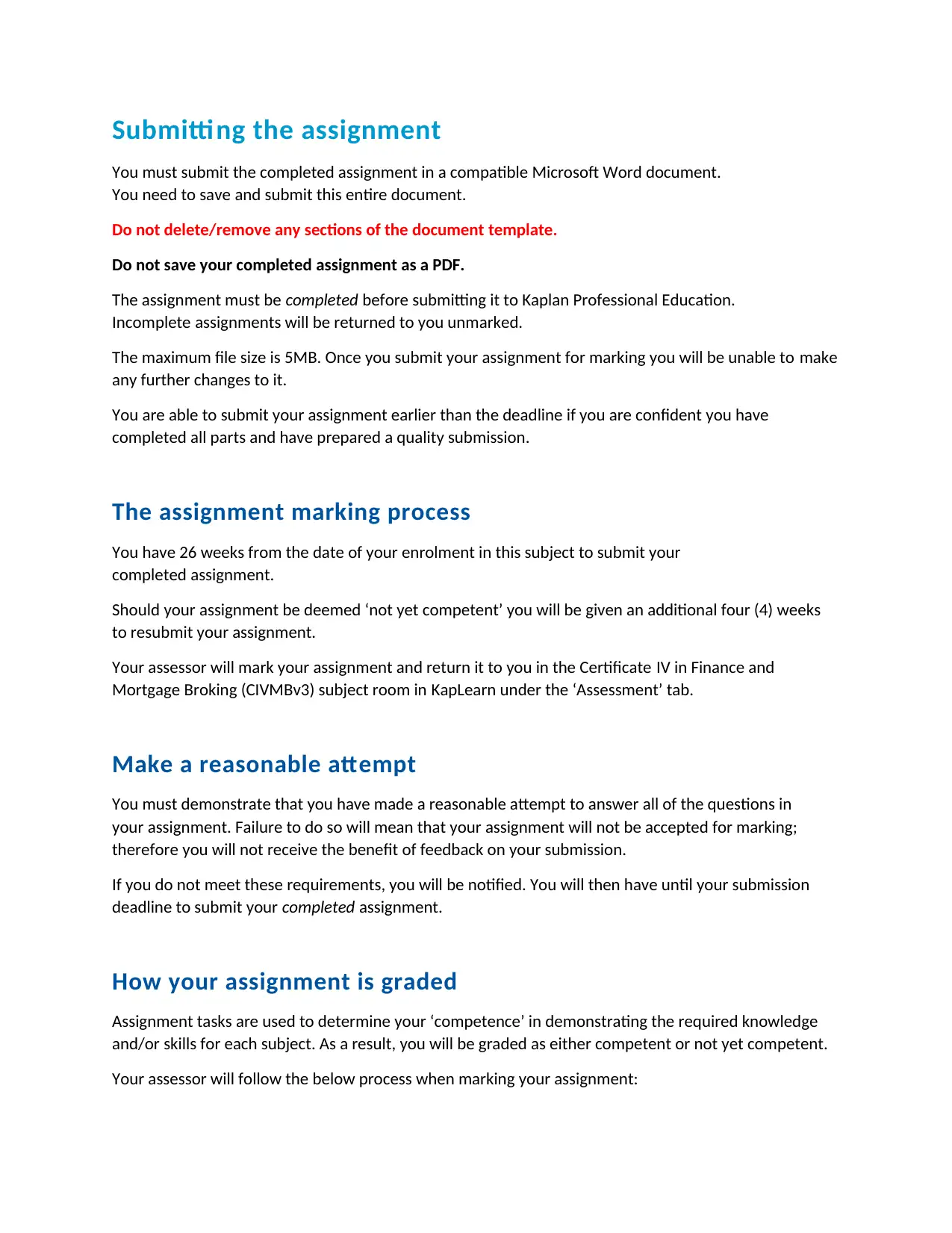
You must submit the completed assignment in a compatible Microsoft Word document.
You need to save and submit this entire document.
Do not delete/remove any sections of the document template.
Do not save your completed assignment as a PDF.
The assignment must be completed before submitting it to Kaplan Professional Education.
Incomplete assignments will be returned to you unmarked.
The maximum file size is 5MB. Once you submit your assignment for marking you will be unable to make
any further changes to it.
You are able to submit your assignment earlier than the deadline if you are confident you have
completed all parts and have prepared a quality submission.
The assignment marking process
You have 26 weeks from the date of your enrolment in this subject to submit your
completed assignment.
Should your assignment be deemed ‘not yet competent’ you will be given an additional four (4) weeks
to resubmit your assignment.
Your assessor will mark your assignment and return it to you in the Certificate IV in Finance and
Mortgage Broking (CIVMBv3) subject room in KapLearn under the ‘Assessment’ tab.
Make a reasonable attempt
You must demonstrate that you have made a reasonable attempt to answer all of the questions in
your assignment. Failure to do so will mean that your assignment will not be accepted for marking;
therefore you will not receive the benefit of feedback on your submission.
If you do not meet these requirements, you will be notified. You will then have until your submission
deadline to submit your completed assignment.
How your assignment is graded
Assignment tasks are used to determine your ‘competence’ in demonstrating the required knowledge
and/or skills for each subject. As a result, you will be graded as either competent or not yet competent.
Your assessor will follow the below process when marking your assignment:
You must submit the completed assignment in a compatible Microsoft Word document.
You need to save and submit this entire document.
Do not delete/remove any sections of the document template.
Do not save your completed assignment as a PDF.
The assignment must be completed before submitting it to Kaplan Professional Education.
Incomplete assignments will be returned to you unmarked.
The maximum file size is 5MB. Once you submit your assignment for marking you will be unable to make
any further changes to it.
You are able to submit your assignment earlier than the deadline if you are confident you have
completed all parts and have prepared a quality submission.
The assignment marking process
You have 26 weeks from the date of your enrolment in this subject to submit your
completed assignment.
Should your assignment be deemed ‘not yet competent’ you will be given an additional four (4) weeks
to resubmit your assignment.
Your assessor will mark your assignment and return it to you in the Certificate IV in Finance and
Mortgage Broking (CIVMBv3) subject room in KapLearn under the ‘Assessment’ tab.
Make a reasonable attempt
You must demonstrate that you have made a reasonable attempt to answer all of the questions in
your assignment. Failure to do so will mean that your assignment will not be accepted for marking;
therefore you will not receive the benefit of feedback on your submission.
If you do not meet these requirements, you will be notified. You will then have until your submission
deadline to submit your completed assignment.
How your assignment is graded
Assignment tasks are used to determine your ‘competence’ in demonstrating the required knowledge
and/or skills for each subject. As a result, you will be graded as either competent or not yet competent.
Your assessor will follow the below process when marking your assignment:
⊘ This is a preview!⊘
Do you want full access?
Subscribe today to unlock all pages.
Trusted by 1+ million students worldwide

• Assessing your responses to each question (and sub-parts if applicable) then determining whether
you have demonstrated competence in each question.
• Determining if, on a holistic basis, your responses to the questions have demonstrated overall
competence.
you have demonstrated competence in each question.
• Determining if, on a holistic basis, your responses to the questions have demonstrated overall
competence.
Paraphrase This Document
Need a fresh take? Get an instant paraphrase of this document with our AI Paraphraser
‘Not yet competent’ and resubmissions
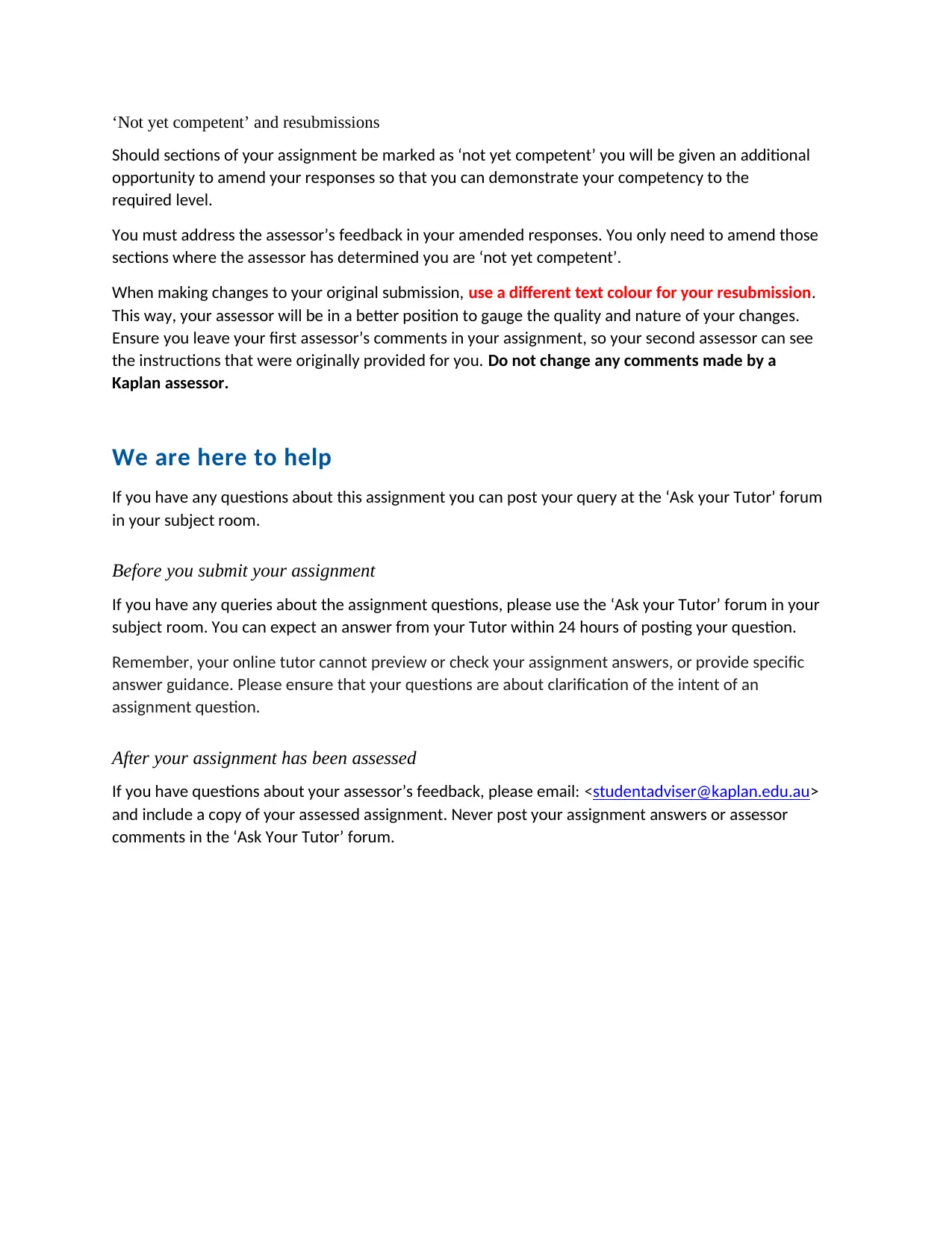
Should sections of your assignment be marked as ‘not yet competent’ you will be given an additional
opportunity to amend your responses so that you can demonstrate your competency to the
required level.
You must address the assessor’s feedback in your amended responses. You only need to amend those
sections where the assessor has determined you are ‘not yet competent’.
When making changes to your original submission, use a different text colour for your resubmission.
This way, your assessor will be in a better position to gauge the quality and nature of your changes.
Ensure you leave your first assessor’s comments in your assignment, so your second assessor can see
the instructions that were originally provided for you. Do not change any comments made by a
Kaplan assessor.
We are here to help
If you have any questions about this assignment you can post your query at the ‘Ask your Tutor’ forum
in your subject room.
Before you submit your assignment
If you have any queries about the assignment questions, please use the ‘Ask your Tutor’ forum in your
subject room. You can expect an answer from your Tutor within 24 hours of posting your question.
Remember, your online tutor cannot preview or check your assignment answers, or provide specific
answer guidance. Please ensure that your questions are about clarification of the intent of an
assignment question.
After your assignment has been assessed
If you have questions about your assessor’s feedback, please email: <studentadviser@kaplan.edu.au>
and include a copy of your assessed assignment. Never post your assignment answers or assessor
comments in the ‘Ask Your Tutor’ forum.
Should sections of your assignment be marked as ‘not yet competent’ you will be given an additional
opportunity to amend your responses so that you can demonstrate your competency to the
required level.
You must address the assessor’s feedback in your amended responses. You only need to amend those
sections where the assessor has determined you are ‘not yet competent’.
When making changes to your original submission, use a different text colour for your resubmission.
This way, your assessor will be in a better position to gauge the quality and nature of your changes.
Ensure you leave your first assessor’s comments in your assignment, so your second assessor can see
the instructions that were originally provided for you. Do not change any comments made by a
Kaplan assessor.
We are here to help
If you have any questions about this assignment you can post your query at the ‘Ask your Tutor’ forum
in your subject room.
Before you submit your assignment
If you have any queries about the assignment questions, please use the ‘Ask your Tutor’ forum in your
subject room. You can expect an answer from your Tutor within 24 hours of posting your question.
Remember, your online tutor cannot preview or check your assignment answers, or provide specific
answer guidance. Please ensure that your questions are about clarification of the intent of an
assignment question.
After your assignment has been assessed
If you have questions about your assessor’s feedback, please email: <studentadviser@kaplan.edu.au>
and include a copy of your assessed assignment. Never post your assignment answers or assessor
comments in the ‘Ask Your Tutor’ forum.
Section 1: Case study 1 — Clinton and Jennifer
Andrews
Background
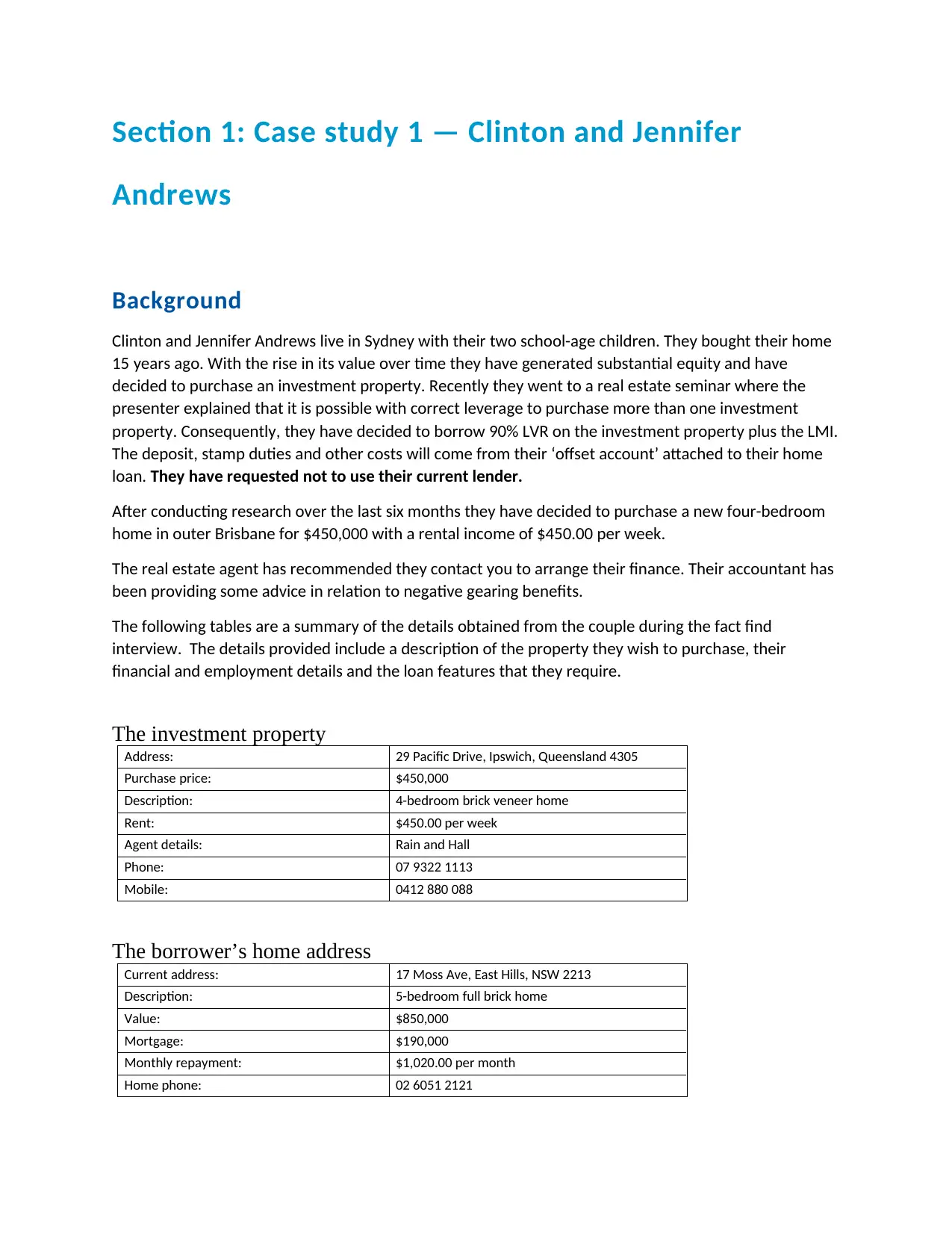
Clinton and Jennifer Andrews live in Sydney with their two school-age children. They bought their home
15 years ago. With the rise in its value over time they have generated substantial equity and have
decided to purchase an investment property. Recently they went to a real estate seminar where the
presenter explained that it is possible with correct leverage to purchase more than one investment
property. Consequently, they have decided to borrow 90% LVR on the investment property plus the LMI.
The deposit, stamp duties and other costs will come from their ‘offset account’ attached to their home
loan. They have requested not to use their current lender.
After conducting research over the last six months they have decided to purchase a new four-bedroom
home in outer Brisbane for $450,000 with a rental income of $450.00 per week.
The real estate agent has recommended they contact you to arrange their finance. Their accountant has
been providing some advice in relation to negative gearing benefits.
The following tables are a summary of the details obtained from the couple during the fact find
interview. The details provided include a description of the property they wish to purchase, their
financial and employment details and the loan features that they require.
The investment property
Address: 29 Pacific Drive, Ipswich, Queensland 4305
Purchase price: $450,000
Description: 4-bedroom brick veneer home
Rent: $450.00 per week
Agent details: Rain and Hall
Phone: 07 9322 1113
Mobile: 0412 880 088
The borrower’s home address
Current address: 17 Moss Ave, East Hills, NSW 2213
Description: 5-bedroom full brick home
Value: $850,000
Mortgage: $190,000
Monthly repayment: $1,020.00 per month
Home phone: 02 6051 2121
Andrews
Background
Clinton and Jennifer Andrews live in Sydney with their two school-age children. They bought their home
15 years ago. With the rise in its value over time they have generated substantial equity and have
decided to purchase an investment property. Recently they went to a real estate seminar where the
presenter explained that it is possible with correct leverage to purchase more than one investment
property. Consequently, they have decided to borrow 90% LVR on the investment property plus the LMI.
The deposit, stamp duties and other costs will come from their ‘offset account’ attached to their home
loan. They have requested not to use their current lender.
After conducting research over the last six months they have decided to purchase a new four-bedroom
home in outer Brisbane for $450,000 with a rental income of $450.00 per week.
The real estate agent has recommended they contact you to arrange their finance. Their accountant has
been providing some advice in relation to negative gearing benefits.
The following tables are a summary of the details obtained from the couple during the fact find
interview. The details provided include a description of the property they wish to purchase, their
financial and employment details and the loan features that they require.
The investment property
Address: 29 Pacific Drive, Ipswich, Queensland 4305
Purchase price: $450,000
Description: 4-bedroom brick veneer home
Rent: $450.00 per week
Agent details: Rain and Hall
Phone: 07 9322 1113
Mobile: 0412 880 088
The borrower’s home address
Current address: 17 Moss Ave, East Hills, NSW 2213
Description: 5-bedroom full brick home
Value: $850,000
Mortgage: $190,000
Monthly repayment: $1,020.00 per month
Home phone: 02 6051 2121
⊘ This is a preview!⊘
Do you want full access?
Subscribe today to unlock all pages.
Trusted by 1+ million students worldwide
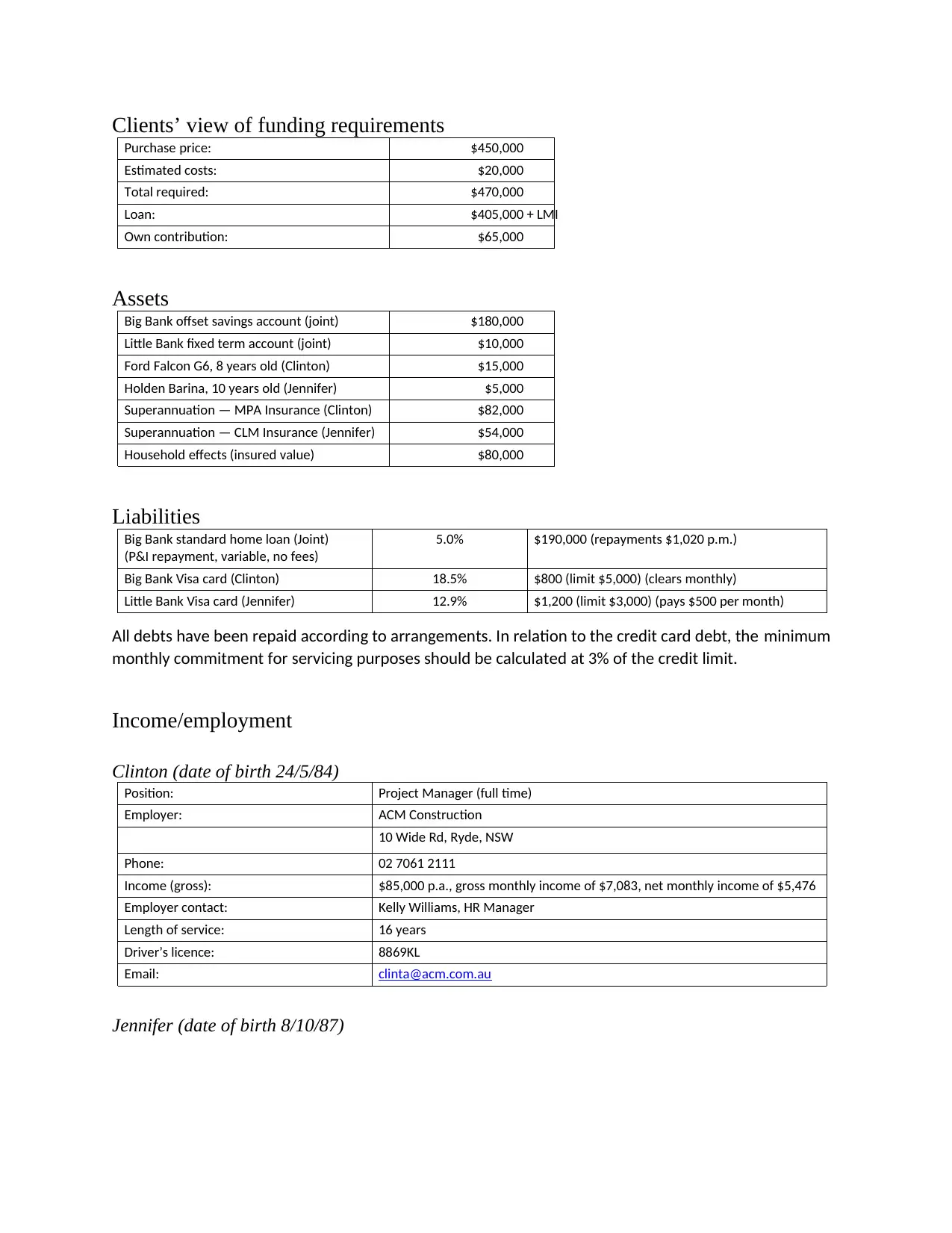
Clients’ view of funding requirements
Purchase price: $450,000
Estimated costs: $20,000
Total required: $470,000
Loan: $405,000 + LMI
Own contribution: $65,000
Assets
Big Bank offset savings account (joint) $180,000
Little Bank fixed term account (joint) $10,000
Ford Falcon G6, 8 years old (Clinton) $15,000
Holden Barina, 10 years old (Jennifer) $5,000
Superannuation — MPA Insurance (Clinton) $82,000
Superannuation — CLM Insurance (Jennifer) $54,000
Household effects (insured value) $80,000
Liabilities
Big Bank standard home loan (Joint)
(P&I repayment, variable, no fees)
5.0% $190,000 (repayments $1,020 p.m.)
Big Bank Visa card (Clinton) 18.5% $800 (limit $5,000) (clears monthly)
Little Bank Visa card (Jennifer) 12.9% $1,200 (limit $3,000) (pays $500 per month)
All debts have been repaid according to arrangements. In relation to the credit card debt, the minimum
monthly commitment for servicing purposes should be calculated at 3% of the credit limit.
Income/employment
Clinton (date of birth 24/5/84)
Position: Project Manager (full time)
Employer: ACM Construction
10 Wide Rd, Ryde, NSW
Phone: 02 7061 2111
Income (gross): $85,000 p.a., gross monthly income of $7,083, net monthly income of $5,476
Employer contact: Kelly Williams, HR Manager
Length of service: 16 years
Driver’s licence: 8869KL
Email: clinta@acm.com.au
Jennifer (date of birth 8/10/87)
Purchase price: $450,000
Estimated costs: $20,000
Total required: $470,000
Loan: $405,000 + LMI
Own contribution: $65,000
Assets
Big Bank offset savings account (joint) $180,000
Little Bank fixed term account (joint) $10,000
Ford Falcon G6, 8 years old (Clinton) $15,000
Holden Barina, 10 years old (Jennifer) $5,000
Superannuation — MPA Insurance (Clinton) $82,000
Superannuation — CLM Insurance (Jennifer) $54,000
Household effects (insured value) $80,000
Liabilities
Big Bank standard home loan (Joint)
(P&I repayment, variable, no fees)
5.0% $190,000 (repayments $1,020 p.m.)
Big Bank Visa card (Clinton) 18.5% $800 (limit $5,000) (clears monthly)
Little Bank Visa card (Jennifer) 12.9% $1,200 (limit $3,000) (pays $500 per month)
All debts have been repaid according to arrangements. In relation to the credit card debt, the minimum
monthly commitment for servicing purposes should be calculated at 3% of the credit limit.
Income/employment
Clinton (date of birth 24/5/84)
Position: Project Manager (full time)
Employer: ACM Construction
10 Wide Rd, Ryde, NSW
Phone: 02 7061 2111
Income (gross): $85,000 p.a., gross monthly income of $7,083, net monthly income of $5,476
Employer contact: Kelly Williams, HR Manager
Length of service: 16 years
Driver’s licence: 8869KL
Email: clinta@acm.com.au
Jennifer (date of birth 8/10/87)
Paraphrase This Document
Need a fresh take? Get an instant paraphrase of this document with our AI Paraphraser
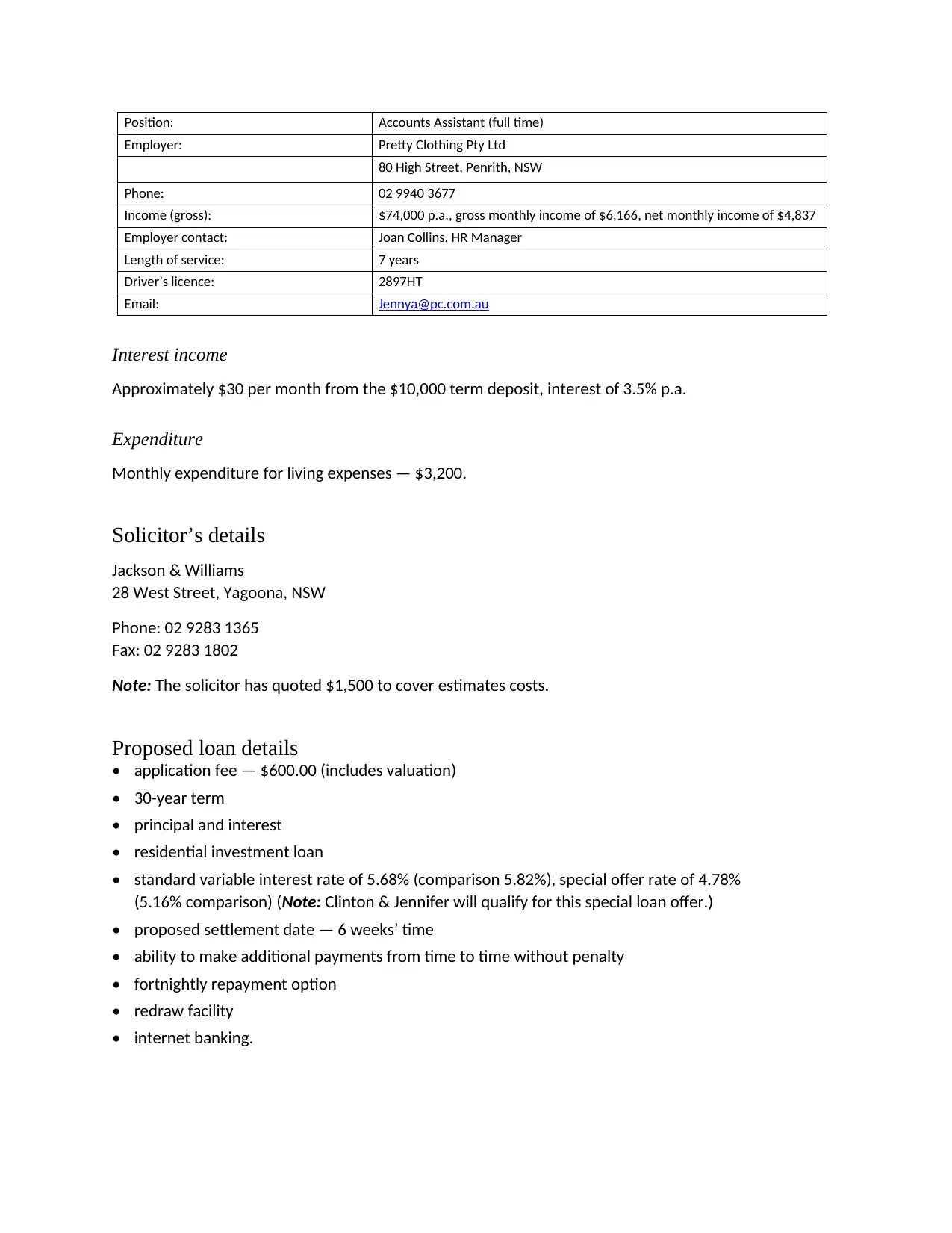
Position: Accounts Assistant (full time)
Employer: Pretty Clothing Pty Ltd
80 High Street, Penrith, NSW
Phone: 02 9940 3677
Income (gross): $74,000 p.a., gross monthly income of $6,166, net monthly income of $4,837
Employer contact: Joan Collins, HR Manager
Length of service: 7 years
Driver’s licence: 2897HT
Email: Jennya@pc.com.au
Interest income
Approximately $30 per month from the $10,000 term deposit, interest of 3.5% p.a.
Expenditure
Monthly expenditure for living expenses — $3,200.
Solicitor’s details
Jackson & Williams
28 West Street, Yagoona, NSW
Phone: 02 9283 1365
Fax: 02 9283 1802
Note: The solicitor has quoted $1,500 to cover estimates costs.
Proposed loan details
• application fee — $600.00 (includes valuation)
• 30-year term
• principal and interest
• residential investment loan
• standard variable interest rate of 5.68% (comparison 5.82%), special offer rate of 4.78%
(5.16% comparison) (Note: Clinton & Jennifer will qualify for this special loan offer.)
• proposed settlement date — 6 weeks’ time
• ability to make additional payments from time to time without penalty
• fortnightly repayment option
• redraw facility
• internet banking.
Employer: Pretty Clothing Pty Ltd
80 High Street, Penrith, NSW
Phone: 02 9940 3677
Income (gross): $74,000 p.a., gross monthly income of $6,166, net monthly income of $4,837
Employer contact: Joan Collins, HR Manager
Length of service: 7 years
Driver’s licence: 2897HT
Email: Jennya@pc.com.au
Interest income
Approximately $30 per month from the $10,000 term deposit, interest of 3.5% p.a.
Expenditure
Monthly expenditure for living expenses — $3,200.
Solicitor’s details
Jackson & Williams
28 West Street, Yagoona, NSW
Phone: 02 9283 1365
Fax: 02 9283 1802
Note: The solicitor has quoted $1,500 to cover estimates costs.
Proposed loan details
• application fee — $600.00 (includes valuation)
• 30-year term
• principal and interest
• residential investment loan
• standard variable interest rate of 5.68% (comparison 5.82%), special offer rate of 4.78%
(5.16% comparison) (Note: Clinton & Jennifer will qualify for this special loan offer.)
• proposed settlement date — 6 weeks’ time
• ability to make additional payments from time to time without penalty
• fortnightly repayment option
• redraw facility
• internet banking.
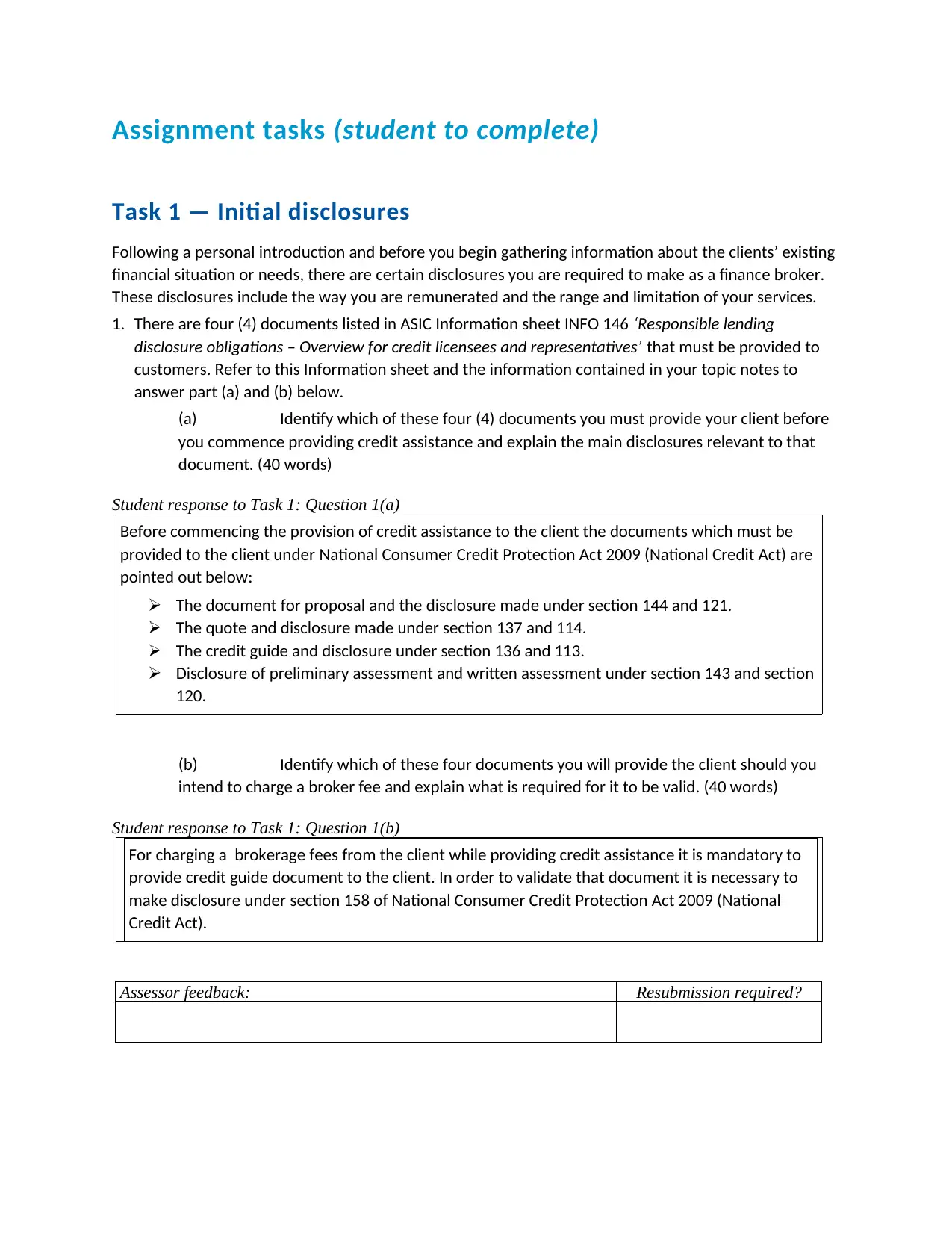
Assignment tasks (student to complete)
Task 1 — Initial disclosures
Following a personal introduction and before you begin gathering information about the clients’ existing
financial situation or needs, there are certain disclosures you are required to make as a finance broker.
These disclosures include the way you are remunerated and the range and limitation of your services.
1. There are four (4) documents listed in ASIC Information sheet INFO 146 ‘Responsible lending
disclosure obligations – Overview for credit licensees and representatives’ that must be provided to
customers. Refer to this Information sheet and the information contained in your topic notes to
answer part (a) and (b) below.
(a) Identify which of these four (4) documents you must provide your client before
you commence providing credit assistance and explain the main disclosures relevant to that
document. (40 words)
Student response to Task 1: Question 1(a)
Before commencing the provision of credit assistance to the client the documents which must be
provided to the client under National Consumer Credit Protection Act 2009 (National Credit Act) are
pointed out below:
The document for proposal and the disclosure made under section 144 and 121.
The quote and disclosure made under section 137 and 114.
The credit guide and disclosure under section 136 and 113.
Disclosure of preliminary assessment and written assessment under section 143 and section
120.
(b) Identify which of these four documents you will provide the client should you
intend to charge a broker fee and explain what is required for it to be valid. (40 words)
Student response to Task 1: Question 1(b)
For charging a brokerage fees from the client while providing credit assistance it is mandatory to
provide credit guide document to the client. In order to validate that document it is necessary to
make disclosure under section 158 of National Consumer Credit Protection Act 2009 (National
Credit Act).
Assessor feedback: Resubmission required?
Task 1 — Initial disclosures
Following a personal introduction and before you begin gathering information about the clients’ existing
financial situation or needs, there are certain disclosures you are required to make as a finance broker.
These disclosures include the way you are remunerated and the range and limitation of your services.
1. There are four (4) documents listed in ASIC Information sheet INFO 146 ‘Responsible lending
disclosure obligations – Overview for credit licensees and representatives’ that must be provided to
customers. Refer to this Information sheet and the information contained in your topic notes to
answer part (a) and (b) below.
(a) Identify which of these four (4) documents you must provide your client before
you commence providing credit assistance and explain the main disclosures relevant to that
document. (40 words)
Student response to Task 1: Question 1(a)
Before commencing the provision of credit assistance to the client the documents which must be
provided to the client under National Consumer Credit Protection Act 2009 (National Credit Act) are
pointed out below:
The document for proposal and the disclosure made under section 144 and 121.
The quote and disclosure made under section 137 and 114.
The credit guide and disclosure under section 136 and 113.
Disclosure of preliminary assessment and written assessment under section 143 and section
120.
(b) Identify which of these four documents you will provide the client should you
intend to charge a broker fee and explain what is required for it to be valid. (40 words)
Student response to Task 1: Question 1(b)
For charging a brokerage fees from the client while providing credit assistance it is mandatory to
provide credit guide document to the client. In order to validate that document it is necessary to
make disclosure under section 158 of National Consumer Credit Protection Act 2009 (National
Credit Act).
Assessor feedback: Resubmission required?
⊘ This is a preview!⊘
Do you want full access?
Subscribe today to unlock all pages.
Trusted by 1+ million students worldwide

1 out of 55


Related Documents


Your All-in-One AI-Powered Toolkit for Academic Success.
+13062052269
info@desklib.com
Available 24*7 on WhatsApp / Email
![[object Object]](/_next/static/media/star-bottom.7253800d.svg)
Unlock your academic potential
Copyright © 2020–2026 A2Z Services. All Rights Reserved. Developed and managed by ZUCOL.