Analyzing the Challenges in Healthcare Knowledge Engineering: A Report
VerifiedAdded on 2020/07/23
|11
|3142
|255
Report
AI Summary
This report provides a comprehensive analysis of the challenges in knowledge engineering (KE) within the healthcare sector. It explores the increasing use of information technology and its impact on healthcare delivery, highlighting both the benefits and limitations. The report delves into the crucial role of knowledge management (KM) in healthcare, discussing various methods and techniques, including the integration of people and technology, and addresses the primary challenge of motivating people to use KM systems. The report outlines the search strategy used and the findings, including the impact of disruptive innovation, data interpretation difficulties, and the need for effective communication. It identifies key challenges such as legal and ethical considerations, data management, and the integration of various IT systems. The report also discusses the need for multidisciplinary investigation, professional evolution, and institutional redesign to overcome these obstacles and improve the quality and efficiency of healthcare services. The conclusion emphasizes the importance of KM in enhancing healthcare quality and efficiency, advocating for increased innovation in KE applications and the collaboration of different organizational units and medical disciplines. The report also emphasizes on the importance of clinical decision support systems and the need for a system-minded approach in healthcare.
Challenges in Knowledge
Engineering for health care
Engineering for health care

Paraphrase This Document
Need a fresh take? Get an instant paraphrase of this document with our AI Paraphraser
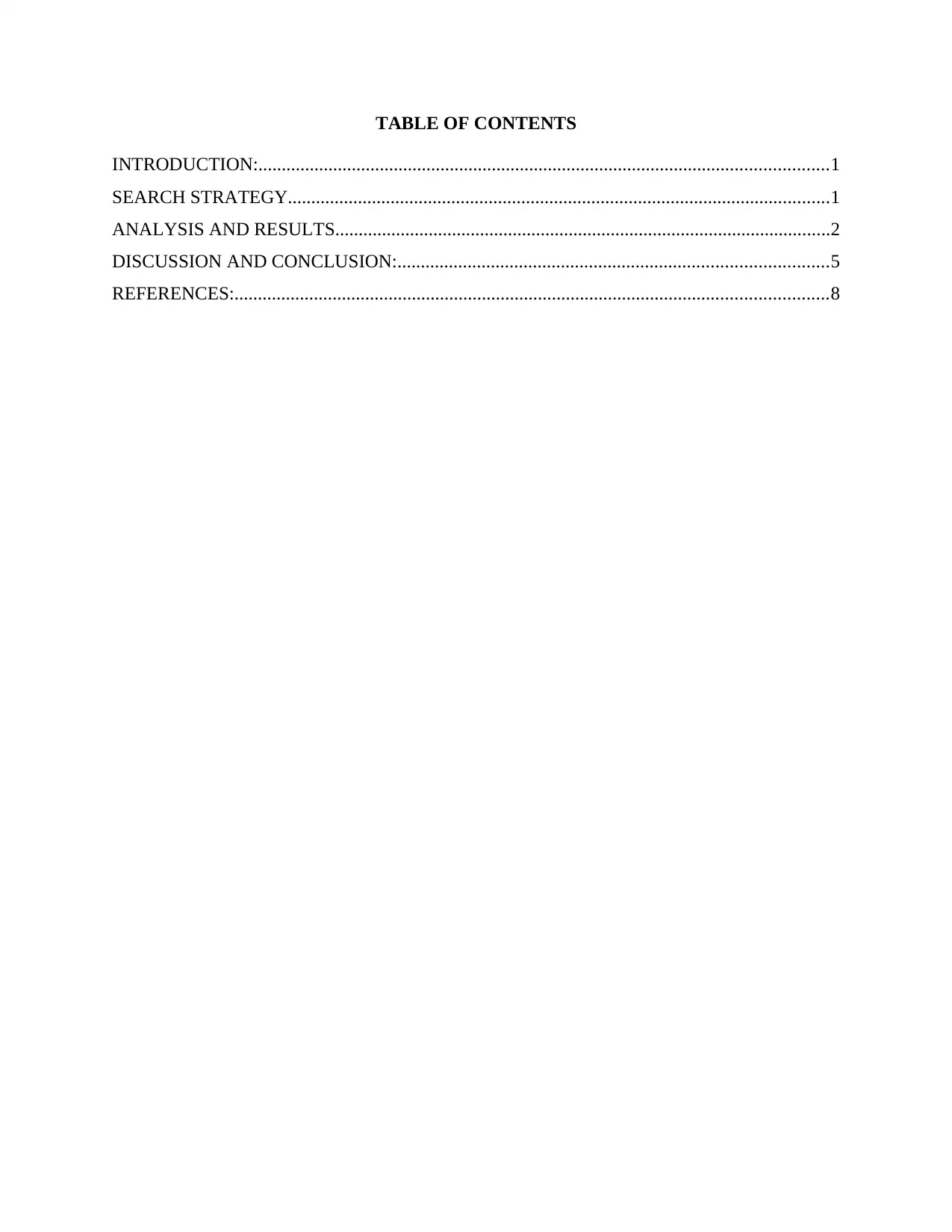
TABLE OF CONTENTS
INTRODUCTION:..........................................................................................................................1
SEARCH STRATEGY....................................................................................................................1
ANALYSIS AND RESULTS..........................................................................................................2
DISCUSSION AND CONCLUSION:............................................................................................5
REFERENCES:...............................................................................................................................8
INTRODUCTION:..........................................................................................................................1
SEARCH STRATEGY....................................................................................................................1
ANALYSIS AND RESULTS..........................................................................................................2
DISCUSSION AND CONCLUSION:............................................................................................5
REFERENCES:...............................................................................................................................8
INTRODUCTION:
Information technology is been widely used in different business sectors. It is providing
ease and flexibility to both business and people. There has been a frequent change in workflow
of technology (Feigenbaum and McCorduck 1983). The health care environment has been
highly benefited by it. But the use of IT has been significantly implemented in health care. Due
to this it has become easy for people to know about their health status. But on the other hand IT
has put certain limitations in health care support. For this knowledge management playing a
crucial role in IT application, its implementation is a very challenging. This is because health
care relies on knowledge. Therefore, research and development done in IT has decreases its
effectiveness. Despite its limitations IT can help in improving the efficiency of health care. KM
follows various methods and techniques ( Choudhry, Fletcher, and Soumerai, 2005). It
included people and technology, human and technical perspective, etc. Its main problem
motivating people to use KM systems.
SEARCH STRATEGY
There is high use of knowledge management techniques in medical and health care
sector. It is because of KM supports the structure of organisation where frameworks are applied.
It follows various methods and techniques. According to reports of _(Nature. 2011) , many
organisations are struggling in providing health care services to people. This is because of
increase in health expenditures. Thus, in order to amend superior of welfare information and
communication technologies are been used. By this the overall health care system can be
accelerated. It helps in design, analysis, etc. engineering plays a vital role in supporting
disruptive dynamic and realising its promise. In a research conducted by (Poste 2011), more
than 90000 people died due to failure of health care systems. Besides this, gap between medical
knowledge and application of that is increasing. Moreover, 75% of patients considered health
care system as weak due to poor communication. According to (Ansell, 2007), estimates that
30 -40 % of every dollar is spent on improving system failures, poor communication and
inefficiency. ICT requires mathematical tools for controlling, designing, analysing system.
Without this, most of health care providers lack the capacity to provide high quality services to
people. However, many institutions are making progress in delivering effective health care
1
Information technology is been widely used in different business sectors. It is providing
ease and flexibility to both business and people. There has been a frequent change in workflow
of technology (Feigenbaum and McCorduck 1983). The health care environment has been
highly benefited by it. But the use of IT has been significantly implemented in health care. Due
to this it has become easy for people to know about their health status. But on the other hand IT
has put certain limitations in health care support. For this knowledge management playing a
crucial role in IT application, its implementation is a very challenging. This is because health
care relies on knowledge. Therefore, research and development done in IT has decreases its
effectiveness. Despite its limitations IT can help in improving the efficiency of health care. KM
follows various methods and techniques ( Choudhry, Fletcher, and Soumerai, 2005). It
included people and technology, human and technical perspective, etc. Its main problem
motivating people to use KM systems.
SEARCH STRATEGY
There is high use of knowledge management techniques in medical and health care
sector. It is because of KM supports the structure of organisation where frameworks are applied.
It follows various methods and techniques. According to reports of _(Nature. 2011) , many
organisations are struggling in providing health care services to people. This is because of
increase in health expenditures. Thus, in order to amend superior of welfare information and
communication technologies are been used. By this the overall health care system can be
accelerated. It helps in design, analysis, etc. engineering plays a vital role in supporting
disruptive dynamic and realising its promise. In a research conducted by (Poste 2011), more
than 90000 people died due to failure of health care systems. Besides this, gap between medical
knowledge and application of that is increasing. Moreover, 75% of patients considered health
care system as weak due to poor communication. According to (Ansell, 2007), estimates that
30 -40 % of every dollar is spent on improving system failures, poor communication and
inefficiency. ICT requires mathematical tools for controlling, designing, analysing system.
Without this, most of health care providers lack the capacity to provide high quality services to
people. However, many institutions are making progress in delivering effective health care
1
⊘ This is a preview!⊘
Do you want full access?
Subscribe today to unlock all pages.

Trusted by 1+ million students worldwide
services. It is observed that only 25% of care providers are using some form of electronic health
record and less than 10% doctors use operational system.
Technological Enablers for Disruptive Innovation in Health Care
It is because of reasons such as increase in medical knowledge and therapies and advance ICT
systems including applications. In recent times medical knowledge have increased accuracy in
treatment of disease (Bali, and Dwivedi, 2007) If treatment is not available then intuitive
medicine is used. But if treatment is available then precision medicine is used. The use of
diagnostic techniques have modified the treatment of infectious disease from intuitive to
precision. The most disruptive IT in health care is recording personal data. Efforts are been done
to manage and control this. Companies have developed PHR. Along with this, the increase of
third party in delivering services is a major issue. This has increased the cost of health care
facilities and reduces its quality.
Knowledge management in health care
KM uses IT systems to manage, store, share and use information or data. It faces a lot of issues
in health care due to its complexity, impact on medical errors, etc. The challenges faced by KM
in health care are due to nature of this sector (Buchan, and Hanka, 1997) There is still a tough
task to create awareness of KE in health care. Once KE is developed, change management can be
implemented. Another challenge is usability. The doctors, nurses, etc. have to work in
stressful atmosphere. Therefore, establishing security measures in KM is very challenging.
Besides this, due to shortage of care workers it is difficult to implement KM in health sector.
Until and unless effective IT tools are not developed, KM can not be implemented. Other than
this there is lack of integration between different IT based system that is DSS, electronic health
record, etc. due to this communication is not very effective thus leading to poor delivery of
health facilities to people. At last in order to measure the performance of health care KM
methods, tools and indicators are required (McGlynn 2007). Hence, it is not possible to
measure intangible assets in both public and private areas.
Keywords :- knowledge management, health care services, Disruptive Innovation , etc.
2
record and less than 10% doctors use operational system.
Technological Enablers for Disruptive Innovation in Health Care
It is because of reasons such as increase in medical knowledge and therapies and advance ICT
systems including applications. In recent times medical knowledge have increased accuracy in
treatment of disease (Bali, and Dwivedi, 2007) If treatment is not available then intuitive
medicine is used. But if treatment is available then precision medicine is used. The use of
diagnostic techniques have modified the treatment of infectious disease from intuitive to
precision. The most disruptive IT in health care is recording personal data. Efforts are been done
to manage and control this. Companies have developed PHR. Along with this, the increase of
third party in delivering services is a major issue. This has increased the cost of health care
facilities and reduces its quality.
Knowledge management in health care
KM uses IT systems to manage, store, share and use information or data. It faces a lot of issues
in health care due to its complexity, impact on medical errors, etc. The challenges faced by KM
in health care are due to nature of this sector (Buchan, and Hanka, 1997) There is still a tough
task to create awareness of KE in health care. Once KE is developed, change management can be
implemented. Another challenge is usability. The doctors, nurses, etc. have to work in
stressful atmosphere. Therefore, establishing security measures in KM is very challenging.
Besides this, due to shortage of care workers it is difficult to implement KM in health sector.
Until and unless effective IT tools are not developed, KM can not be implemented. Other than
this there is lack of integration between different IT based system that is DSS, electronic health
record, etc. due to this communication is not very effective thus leading to poor delivery of
health facilities to people. At last in order to measure the performance of health care KM
methods, tools and indicators are required (McGlynn 2007). Hence, it is not possible to
measure intangible assets in both public and private areas.
Keywords :- knowledge management, health care services, Disruptive Innovation , etc.
2
Paraphrase This Document
Need a fresh take? Get an instant paraphrase of this document with our AI Paraphraser
ANALYSIS AND RESULTS
The basic aspect of health care is research needs to be effectively conducted so that data
and knowledge can flow and used in improving clinical medicine. Engineers works in
partnership with doctors and managers to improve quality (Bradley, and et..al 2011).
Communication is a barrier to success. Engineering needs to be
Legal challenges- The most important challenges faced to implement wellness program is a
variety of laws and regulations to be followed. There are various acts that have to be followed. It
is as follows :-
Data interpretation – It is difficult to make progress with biomedical researcher. Besides this, a
particular domain is needed to develop knowledge engineering. It is because of
Data consideration- There is a vast amount of data and information available in health care
sector. Also, research data consists of information related to complex disease (McKie and
Richardson 2003 ) Thus, it is difficult to access and condense health facility useful
knowledge and utility from these data. The results of clinical situations are based on real time.
With this the degree of trust is decreased. For this an approved mechanism is required for
certifying health information. So implementing a system could be similar to cross mark
initiative. Clinical data will come from EHR
Modelling approaches- Creating a modelling structure that can be used globally for processing
clinical activities by targetting all sorts of single and multiple classes of data with varying degree
of integration is complex task. It is because of there are various degrees of personal and
stratified. Problem of applying KE in biomedical research is the nature of information that is
being engineered (McGinnis Williams-Russo and Knickman 2002) Scientific knowledge
consists of statement based on evidence. But what is considered in this is knowledge on
particular subject, but this can be changed anytime due to continuous re evaluation. The world
consists of vast data and information. In a meeting held at Barcelona, it focused on six topics that
was dealing with expansion of biomedical knowledge for better health care, identify proper
knowledge action that is taken at point of care, exploiting patient information to improve basic
biomedical research, regulation for combining clinical-omics, changes in information technology
(IT) is helping in managing biomedical data management, medicine making systems biology
translational, and effective KM for improving research and development in drugs (Butte 2008).
3
The basic aspect of health care is research needs to be effectively conducted so that data
and knowledge can flow and used in improving clinical medicine. Engineers works in
partnership with doctors and managers to improve quality (Bradley, and et..al 2011).
Communication is a barrier to success. Engineering needs to be
Legal challenges- The most important challenges faced to implement wellness program is a
variety of laws and regulations to be followed. There are various acts that have to be followed. It
is as follows :-
Data interpretation – It is difficult to make progress with biomedical researcher. Besides this, a
particular domain is needed to develop knowledge engineering. It is because of
Data consideration- There is a vast amount of data and information available in health care
sector. Also, research data consists of information related to complex disease (McKie and
Richardson 2003 ) Thus, it is difficult to access and condense health facility useful
knowledge and utility from these data. The results of clinical situations are based on real time.
With this the degree of trust is decreased. For this an approved mechanism is required for
certifying health information. So implementing a system could be similar to cross mark
initiative. Clinical data will come from EHR
Modelling approaches- Creating a modelling structure that can be used globally for processing
clinical activities by targetting all sorts of single and multiple classes of data with varying degree
of integration is complex task. It is because of there are various degrees of personal and
stratified. Problem of applying KE in biomedical research is the nature of information that is
being engineered (McGinnis Williams-Russo and Knickman 2002) Scientific knowledge
consists of statement based on evidence. But what is considered in this is knowledge on
particular subject, but this can be changed anytime due to continuous re evaluation. The world
consists of vast data and information. In a meeting held at Barcelona, it focused on six topics that
was dealing with expansion of biomedical knowledge for better health care, identify proper
knowledge action that is taken at point of care, exploiting patient information to improve basic
biomedical research, regulation for combining clinical-omics, changes in information technology
(IT) is helping in managing biomedical data management, medicine making systems biology
translational, and effective KM for improving research and development in drugs (Butte 2008).
3
There are various social, ethical, legal issues that puts restriction on future IT systems. Social
dimension involves how public will be educated about that system or how they will react to
increasing role of computationally managed knowledge in health care. For example- individual
patients are less bothered about permission of ethical dimensions.
KE in health care system lies with status quo that in method, society and education. It is not
possible to identify benefits without overcoming the challenges (Sansone, Rocca-Serra and
Field 2012) System must be redesigned according to change in environment. There are seven
challenges identified in this. The first is getting people to emphasise interdependence in their
thinking. For example in hospitals there are different specific spaces such as doctor , nurses, staff
rooms, etc. thus, each discipline has its own ethics. Fragmentation means lack of financial
resources for coordination.
The second is need to improve visibility of care processes. It means process through which
health services are delivered. It is difficult to see work flow because of space and time divided.
But when it is seen it is always by supply side (Cavico and Mujtaba 2013).
Third challenge is need to recognise value of dynamic learning as knowledge base learning .
The non linear nature of system dynamics in health care weakens power of formal and classical
method of inquiry. Formal includes mechanisms, contacts, etc. Health care lacks norms of
inquiry. There is a gap between pragmatic engineering sciences and local learning. The RCT
continues to be a method for providing information when needed.
Fourth challenge is knowledge and waste in health care. The benefit of system is knowledge
waste, its level and forms. Waste is often materialisation of method failure and illiteracy
(Feigenbaum and McCorduck 1983) It is very risky to use fragmented system as it can lead to
using another research findings instead of continuing them, destroying products that frame
against poor flowing, modify processes and using capital. Health care waste is very vast as
compared to other industries.
Fifth challenge is platform required for multidisciplinary investigation and evolution in the
point of health care. There is a distance between fields that engineers are unfamiliar with in
health care. Professionals are not aware of disciplines that engineers have. Therefore, creating a
connection in this will take time and is an expensive process.
4
dimension involves how public will be educated about that system or how they will react to
increasing role of computationally managed knowledge in health care. For example- individual
patients are less bothered about permission of ethical dimensions.
KE in health care system lies with status quo that in method, society and education. It is not
possible to identify benefits without overcoming the challenges (Sansone, Rocca-Serra and
Field 2012) System must be redesigned according to change in environment. There are seven
challenges identified in this. The first is getting people to emphasise interdependence in their
thinking. For example in hospitals there are different specific spaces such as doctor , nurses, staff
rooms, etc. thus, each discipline has its own ethics. Fragmentation means lack of financial
resources for coordination.
The second is need to improve visibility of care processes. It means process through which
health services are delivered. It is difficult to see work flow because of space and time divided.
But when it is seen it is always by supply side (Cavico and Mujtaba 2013).
Third challenge is need to recognise value of dynamic learning as knowledge base learning .
The non linear nature of system dynamics in health care weakens power of formal and classical
method of inquiry. Formal includes mechanisms, contacts, etc. Health care lacks norms of
inquiry. There is a gap between pragmatic engineering sciences and local learning. The RCT
continues to be a method for providing information when needed.
Fourth challenge is knowledge and waste in health care. The benefit of system is knowledge
waste, its level and forms. Waste is often materialisation of method failure and illiteracy
(Feigenbaum and McCorduck 1983) It is very risky to use fragmented system as it can lead to
using another research findings instead of continuing them, destroying products that frame
against poor flowing, modify processes and using capital. Health care waste is very vast as
compared to other industries.
Fifth challenge is platform required for multidisciplinary investigation and evolution in the
point of health care. There is a distance between fields that engineers are unfamiliar with in
health care. Professionals are not aware of disciplines that engineers have. Therefore, creating a
connection in this will take time and is an expensive process.
4
⊘ This is a preview!⊘
Do you want full access?
Subscribe today to unlock all pages.
Trusted by 1+ million students worldwide
Sixth challenge is implications of method reasoning for professional evolution. Nurses are
not given training in safety science and practices (Choudhry, Fletcher, and Soumerai, 2005)
Also, professional are dismissing some practices by not following them. Moreover, professional
preparation itself de-emphasizes the role of interdependency.
Seventh challenge is institutional redesign will be needed if method sciences are exploited. If
investment in process design is increased then institutes may have to create fragments to
inadequate spaces between them will get large. From this waste will be incurred. It will lead to
need of integrated system design. Moreover, professionals, hospitals and nurses will be needed
for this.
Hence, issues faced from in health care will be financing, coverage, costs, etc.
Furthermore, hospitals will look empty as there will be system minded approach followed.
Systems thinking and knowledge are manifest already in many areas of human endeavour other
than health care (Ansell, 2007).
DISCUSSION AND CONCLUSION:
This article discussed the challenges in knowledge engineering for health care. It shows
that how implementing KM will lead to different challenges. Why health care applications are
facing problems in delivering services to people. Also, what problems are there in reducing cost
of services. The data interpretation is very complex task as research is done in different
disciplines.
The challenges faced in KE in health care can be improved by implementing KM. Its use
will help in improving the quality of health care services. It will allow health care workers to
work together and provide best services (Poste 2011). More innovations in KE will be a
challenge but applications such as health applications, and evidence based medicine will
help in increasing the overall quality of care as well as efficiency of KE.
The cooperation of different organizational unit's and medical disciplines are required in
the process of health care. The optimal process support becomes crucial in such an environment.
Among the health care organization there is an increase awareness for building and using health
information system. With the clinical decision support system HIS is linked and it also helps in
taking decision at all levels of health service providers such as doctors, staff etc. In the health
5
not given training in safety science and practices (Choudhry, Fletcher, and Soumerai, 2005)
Also, professional are dismissing some practices by not following them. Moreover, professional
preparation itself de-emphasizes the role of interdependency.
Seventh challenge is institutional redesign will be needed if method sciences are exploited. If
investment in process design is increased then institutes may have to create fragments to
inadequate spaces between them will get large. From this waste will be incurred. It will lead to
need of integrated system design. Moreover, professionals, hospitals and nurses will be needed
for this.
Hence, issues faced from in health care will be financing, coverage, costs, etc.
Furthermore, hospitals will look empty as there will be system minded approach followed.
Systems thinking and knowledge are manifest already in many areas of human endeavour other
than health care (Ansell, 2007).
DISCUSSION AND CONCLUSION:
This article discussed the challenges in knowledge engineering for health care. It shows
that how implementing KM will lead to different challenges. Why health care applications are
facing problems in delivering services to people. Also, what problems are there in reducing cost
of services. The data interpretation is very complex task as research is done in different
disciplines.
The challenges faced in KE in health care can be improved by implementing KM. Its use
will help in improving the quality of health care services. It will allow health care workers to
work together and provide best services (Poste 2011). More innovations in KE will be a
challenge but applications such as health applications, and evidence based medicine will
help in increasing the overall quality of care as well as efficiency of KE.
The cooperation of different organizational unit's and medical disciplines are required in
the process of health care. The optimal process support becomes crucial in such an environment.
Among the health care organization there is an increase awareness for building and using health
information system. With the clinical decision support system HIS is linked and it also helps in
taking decision at all levels of health service providers such as doctors, staff etc. In the health
5
Paraphrase This Document
Need a fresh take? Get an instant paraphrase of this document with our AI Paraphraser
care organization this will be useful in order to take quick and appropriate decisions. From being,
lab testing, diagnosis etc. (Nature 2011) these decisions may range. In order to improve the
health care service quality and reduce cost all participants of this sector crate share and use
knowledge. The patients, doctors, staff, administrative staff etc. are bing included in this
community from different health care organization.
The success of a medical care depends on how effectively and efficient information is
used to alter the health care services. In order to manage the flow of information as KM
organization should try to make use of KM. By making use of health information technology the
paperwork can be minimized by making use of electronic health records for patients. Also, there
can be reduction in the cost of services by elimination the repetition of tests by various
professionals.
By modifying of health errors due to incorrect and inaccurate information the
improvement in the quality of care can be there (Bali, and Dwivedi, 2007). Based on history of
patient the better decision will be made by heath care organization and also the overall efficiency
will also be increased in the remote areas. The health care sector is based on knowledge and is
interconnected with hospitals, physicians, patients, etc. for sharing knowledge. The quality
of care and services that is given to the patient can be improved with the help of knowledge-
based health care industry. It is important to bridge gap between research and health care. This
will help in creating effective health services (Buchan, and Hanka, 1997).
There is need to promote knowledge between experts of different disciplines to overcome
mistakes. This will useful in setting up integrated knowledge for managing health problems.
Also, research funding must be consider for data storing and analysing. It will generate data on
human subjects. Those data can be handled with EHR. Besides this, methods and techniques
needs to be improved to integrate analysis of complex information. This will clarify and deliver
only that information that supports in treatment of disease. It is observed that barriers in data
sharing is social but not technical (McKie and Richardson 2003). Scientific reporting and web
sources must be connected by removing the barriers. EHR systems, database must be
implemented for using information effectively. Disease are classified on basis of signs and
symptoms, thus it should be classified on basis of molecular biology. Health care professionals
needs to understand about data access. All clinical and research information related to an
6
lab testing, diagnosis etc. (Nature 2011) these decisions may range. In order to improve the
health care service quality and reduce cost all participants of this sector crate share and use
knowledge. The patients, doctors, staff, administrative staff etc. are bing included in this
community from different health care organization.
The success of a medical care depends on how effectively and efficient information is
used to alter the health care services. In order to manage the flow of information as KM
organization should try to make use of KM. By making use of health information technology the
paperwork can be minimized by making use of electronic health records for patients. Also, there
can be reduction in the cost of services by elimination the repetition of tests by various
professionals.
By modifying of health errors due to incorrect and inaccurate information the
improvement in the quality of care can be there (Bali, and Dwivedi, 2007). Based on history of
patient the better decision will be made by heath care organization and also the overall efficiency
will also be increased in the remote areas. The health care sector is based on knowledge and is
interconnected with hospitals, physicians, patients, etc. for sharing knowledge. The quality
of care and services that is given to the patient can be improved with the help of knowledge-
based health care industry. It is important to bridge gap between research and health care. This
will help in creating effective health services (Buchan, and Hanka, 1997).
There is need to promote knowledge between experts of different disciplines to overcome
mistakes. This will useful in setting up integrated knowledge for managing health problems.
Also, research funding must be consider for data storing and analysing. It will generate data on
human subjects. Those data can be handled with EHR. Besides this, methods and techniques
needs to be improved to integrate analysis of complex information. This will clarify and deliver
only that information that supports in treatment of disease. It is observed that barriers in data
sharing is social but not technical (McKie and Richardson 2003). Scientific reporting and web
sources must be connected by removing the barriers. EHR systems, database must be
implemented for using information effectively. Disease are classified on basis of signs and
symptoms, thus it should be classified on basis of molecular biology. Health care professionals
needs to understand about data access. All clinical and research information related to an
6
individual’s health should be stored in EHR, which would overcome current organisation
bound. (McGinnis Williams-Russo and Knickman 2002).
Creating and implementing a wellness program will be beneficial to both employer and
employee. It will help in maintaining good health and reducing costs. There has been a rapidly
changing research knowledge for better diagnostic of diseases. Moreover, biomedical research
have increased to gain integrative analysis of clinical information. Barriers can be overcome in
different disciplines like biology, medicine, etc. by applying KE. There should be a wellness
culture at work place. It will help company in long run and will benefit society as a whole
(Sansone , Rocca-Serra and Field 2012). It will save money, improve service quality and life
style of people as well as society.
7
bound. (McGinnis Williams-Russo and Knickman 2002).
Creating and implementing a wellness program will be beneficial to both employer and
employee. It will help in maintaining good health and reducing costs. There has been a rapidly
changing research knowledge for better diagnostic of diseases. Moreover, biomedical research
have increased to gain integrative analysis of clinical information. Barriers can be overcome in
different disciplines like biology, medicine, etc. by applying KE. There should be a wellness
culture at work place. It will help company in long run and will benefit society as a whole
(Sansone , Rocca-Serra and Field 2012). It will save money, improve service quality and life
style of people as well as society.
7
⊘ This is a preview!⊘
Do you want full access?
Subscribe today to unlock all pages.
Trusted by 1+ million students worldwide
REFERENCES:
Books and journals:
Bali, R. K., and Dwivedi, A. N. Eds.. 2007. health care Knowledge Management: Springer
Ansell, C. 2007. Fostering Innovation and Collaboration. Medical Device Technology, 18(1),
52.
Bradley, B., Bowden, M., Furnival, J. and Walton, C. 2011 A change is in the air. Health
Service Journal.
Buchan, I. E., and Hanka, R. 1997. Exchanging clinical knowledge via Internet. International
Journal of Medical Informatics. 47(1-2), 39–41. doi:10.1016/S1386-5056(97)00084-1
Butte AJ. 2008 .Translational Bioinformatics: coming of age. J Am Med Inform
Assoc. ;15:709–714
Cavico FJ, Mujtaba BG. 2013 Health and Wellness Policy Ethics. International Journal of
Health Policy and Management.;1:111–13
Choudhry, N. K., Fletcher, R. H., and Soumerai, S. B. (2005). Systematic review: the
relationship between clinical experience and quality of health care. Annals of Internal
Medicine, 142(4), 260–273.
E. McGlynn. 2007. The quality of ambulatory care delivered to children in the United States.
New England Journal of Medicine 357(15): 1549–1551.
Feigenbaum EA and, McCorduck P. 1983. The fifth generation : artificial intelligence and
Japan’s computer challenge to the world. Reading, MA.: Addison-Wesley
McGinnis JM, Williams-Russo P, Knickman JR. The case for more active policy attention to
health promotion. Health Affairs.2002;21(2):78–93
McKie J, Richardson J. The rule of rescue. Social Science & Medicine.2003;56(12):2407–2419.
Nature. 2011. Seven days: 2–8 December 2011. Nature 480:156–157
Poste G. 2011. Bring on the biomarkers. Nature 469:156–157.
Sansone SA, Rocca-Serra P, Field D, et al. 2012 Toward interoperable bioscience data. Nat
Genet. ;44:121–126.
8
Books and journals:
Bali, R. K., and Dwivedi, A. N. Eds.. 2007. health care Knowledge Management: Springer
Ansell, C. 2007. Fostering Innovation and Collaboration. Medical Device Technology, 18(1),
52.
Bradley, B., Bowden, M., Furnival, J. and Walton, C. 2011 A change is in the air. Health
Service Journal.
Buchan, I. E., and Hanka, R. 1997. Exchanging clinical knowledge via Internet. International
Journal of Medical Informatics. 47(1-2), 39–41. doi:10.1016/S1386-5056(97)00084-1
Butte AJ. 2008 .Translational Bioinformatics: coming of age. J Am Med Inform
Assoc. ;15:709–714
Cavico FJ, Mujtaba BG. 2013 Health and Wellness Policy Ethics. International Journal of
Health Policy and Management.;1:111–13
Choudhry, N. K., Fletcher, R. H., and Soumerai, S. B. (2005). Systematic review: the
relationship between clinical experience and quality of health care. Annals of Internal
Medicine, 142(4), 260–273.
E. McGlynn. 2007. The quality of ambulatory care delivered to children in the United States.
New England Journal of Medicine 357(15): 1549–1551.
Feigenbaum EA and, McCorduck P. 1983. The fifth generation : artificial intelligence and
Japan’s computer challenge to the world. Reading, MA.: Addison-Wesley
McGinnis JM, Williams-Russo P, Knickman JR. The case for more active policy attention to
health promotion. Health Affairs.2002;21(2):78–93
McKie J, Richardson J. The rule of rescue. Social Science & Medicine.2003;56(12):2407–2419.
Nature. 2011. Seven days: 2–8 December 2011. Nature 480:156–157
Poste G. 2011. Bring on the biomarkers. Nature 469:156–157.
Sansone SA, Rocca-Serra P, Field D, et al. 2012 Toward interoperable bioscience data. Nat
Genet. ;44:121–126.
8
Paraphrase This Document
Need a fresh take? Get an instant paraphrase of this document with our AI Paraphraser

9

1 out of 11


Related Documents


Your All-in-One AI-Powered Toolkit for Academic Success.
+13062052269
info@desklib.com
Available 24*7 on WhatsApp / Email
![[object Object]](/_next/static/media/star-bottom.7253800d.svg)
Unlock your academic potential
Copyright © 2020–2025 A2Z Services. All Rights Reserved. Developed and managed by ZUCOL.