Challenges Faced by People with Spina Bifida and Spinal Cord Injuries
VerifiedAdded on 2020/03/16
|12
|2905
|138
Report
AI Summary
This report delves into the significant workplace challenges faced by individuals with spina bifida and spinal cord injuries. It highlights limitations in the job market, accessibility issues, and social integration difficulties. The report explores various types of spina bifida and spinal cord injuries, emphasizing the need for accommodations and assistive technology to facilitate employment. It discusses specific challenges such as mobility issues, memory problems, and psychological impacts. Solutions proposed include modified workspaces, flexible working hours, and counseling services. Furthermore, the report stresses the importance of social integration through immersive technology and the need for improved health sector responses and social protection schemes. Recommendations emphasize the need for assistive technology, empowerment of individuals, and flexible working arrangements. The conclusion underscores the importance of addressing these challenges to improve the livelihood and inclusion of people with disabilities in the workplace.

Running head: CHALLENGES OF PEOPLE WITH SPINA BIFIDA AND SPINAL CORD INJURIES 1
Challenges of People with Spina Bifida and Spinal Cord Injuries
Name
Institutional Affiliation
Challenges of People with Spina Bifida and Spinal Cord Injuries
Name
Institutional Affiliation

Paraphrase This Document
Need a fresh take? Get an instant paraphrase of this document with our AI Paraphraser
CHALLENGES OF PEOPLE WITH SPINA BIFIDA AND SPINAL CORD INJURIES 2
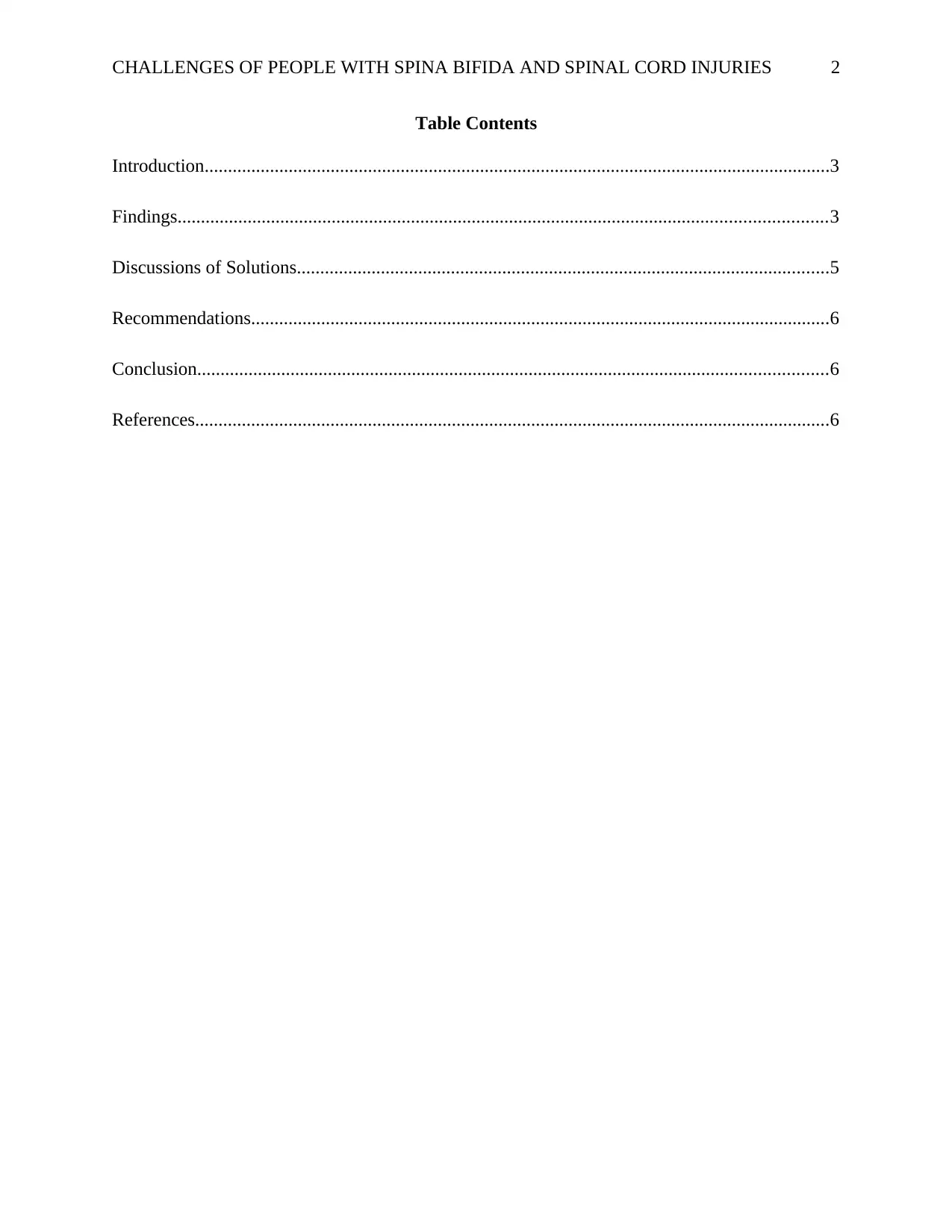
Table Contents
Introduction......................................................................................................................................3
Findings...........................................................................................................................................3
Discussions of Solutions..................................................................................................................5
Recommendations............................................................................................................................6
Conclusion.......................................................................................................................................6
References........................................................................................................................................6
Table Contents
Introduction......................................................................................................................................3
Findings...........................................................................................................................................3
Discussions of Solutions..................................................................................................................5
Recommendations............................................................................................................................6
Conclusion.......................................................................................................................................6
References........................................................................................................................................6
CHALLENGES OF PEOPLE WITH SPINA BIFIDA AND SPINAL CORD INJURIES 3
Introduction
People with disability (PWD) face challenges as far as the job market and economy is
concerned. Currently, they have a very limited prospects of getting employed compared to other
people who are non-disabled (Derose, 2014). Most organizations employ disabled people just to
satisfy the part of the law that requires them to do so due to the fear of being branded negatively.
This study will help to highlight the challenges that people who suffer from spina bifida and
brain or spinal cord injury face in the job market.
Spina bifida is a permanent birth defect where the spinal cord juts out of the spine. It is a
type of the neural tube defect in which a part of the neural tube does not develop fully hence
leading to complications in the spinal cord as well as the spinal bones that are also known as the
vertebrae. Spina bifida exposes the spinal cord and other nerves hence making them vulnerable
to adverse damages and other possible infections. These infections are the main reason for
medical problems that are associated with individuals that suffer this defect (FoN, 2017).
There are several types of spina bifida that comprise of myelomeningocele, meningocele,
and spina bifida occulta (CareersPortal, 2017). Myelomeningocele is where the infant’s spinal
cord remains open although along the back vertebrae. The opening allows the spinal cord and its
surrounding protective membrane to protrude and forms a sac on the infant’s back.
Myelomeningocele is the most severe type of spina bifida. Meningocele is a type of spina bifida
where the protective membrane of the spinal cord pushes out through the spine. The spinal cord
develops normally hence a surgery can be used to eliminate the protruding membranes without
affecting the nerves. Finally, spina bifida occulta is one of the most common and minor types
compare to the above. It is where one or more vertebrae of the baby do not develop properly
Introduction
People with disability (PWD) face challenges as far as the job market and economy is
concerned. Currently, they have a very limited prospects of getting employed compared to other
people who are non-disabled (Derose, 2014). Most organizations employ disabled people just to
satisfy the part of the law that requires them to do so due to the fear of being branded negatively.
This study will help to highlight the challenges that people who suffer from spina bifida and
brain or spinal cord injury face in the job market.
Spina bifida is a permanent birth defect where the spinal cord juts out of the spine. It is a
type of the neural tube defect in which a part of the neural tube does not develop fully hence
leading to complications in the spinal cord as well as the spinal bones that are also known as the
vertebrae. Spina bifida exposes the spinal cord and other nerves hence making them vulnerable
to adverse damages and other possible infections. These infections are the main reason for
medical problems that are associated with individuals that suffer this defect (FoN, 2017).
There are several types of spina bifida that comprise of myelomeningocele, meningocele,
and spina bifida occulta (CareersPortal, 2017). Myelomeningocele is where the infant’s spinal
cord remains open although along the back vertebrae. The opening allows the spinal cord and its
surrounding protective membrane to protrude and forms a sac on the infant’s back.
Myelomeningocele is the most severe type of spina bifida. Meningocele is a type of spina bifida
where the protective membrane of the spinal cord pushes out through the spine. The spinal cord
develops normally hence a surgery can be used to eliminate the protruding membranes without
affecting the nerves. Finally, spina bifida occulta is one of the most common and minor types
compare to the above. It is where one or more vertebrae of the baby do not develop properly
⊘ This is a preview!⊘
Do you want full access?
Subscribe today to unlock all pages.

Trusted by 1+ million students worldwide
CHALLENGES OF PEOPLE WITH SPINA BIFIDA AND SPINAL CORD INJURIES 4
leaving a very small gap in the spine. This type of birth defect does not cause any problems
hence most people may not even realize that they have it (CareersPortal, 2017).
Injuries to the central nervous system normally lead to brain injuries or injuries on the
spinal cord. People who suffer from a traumatic brain injury can also sustain spinal cord injuries.
In the United States, about 12,000 spinal cord injuries are reported each year (Burns &
O’Connell, 2013). These injuries are categorized into four types namely; incomplete tetraplegia,
complete tetraplegia, incomplete paraplegia and complete paraplegia. People with tetraplegia are
considered to have suffered injuries to one of the existing eight cervical spinal cord segments.
Those with paraplegia have wounds or injuries in the lumbar, sacral or thoracic regions of their
spinal cord (Stone, 2015).
Spinal cord injuries are as a result of a sudden traumatic blow on the spine that causes a
fracture, dislocation, crushing or compression of one or more vertebrae on the back. It can also
be caused by a wound that penetrates into the spinal cord. Other complications that cause spinal
cord injury include swelling, inflammation, bleeding and fluid accumulation around the spinal
cord (Burns et al, 2013).
Findings
People with spina bifida face a lot of challenges and limitations in their workplace.
However, since each individual finds the urge to fend for themselves and their families, these
individuals ought to be encouraged to follow their vision and dreams to become who they aspire
to be. The best job duties for people who suffer from this birth defect include clerical positions,
administrative office assistants, secretaries, and receptionists. These duties do not demand a lot
of movements and an individual can execute his or her duties at the comfort of their seats (Best,
2012).
leaving a very small gap in the spine. This type of birth defect does not cause any problems
hence most people may not even realize that they have it (CareersPortal, 2017).
Injuries to the central nervous system normally lead to brain injuries or injuries on the
spinal cord. People who suffer from a traumatic brain injury can also sustain spinal cord injuries.
In the United States, about 12,000 spinal cord injuries are reported each year (Burns &
O’Connell, 2013). These injuries are categorized into four types namely; incomplete tetraplegia,
complete tetraplegia, incomplete paraplegia and complete paraplegia. People with tetraplegia are
considered to have suffered injuries to one of the existing eight cervical spinal cord segments.
Those with paraplegia have wounds or injuries in the lumbar, sacral or thoracic regions of their
spinal cord (Stone, 2015).
Spinal cord injuries are as a result of a sudden traumatic blow on the spine that causes a
fracture, dislocation, crushing or compression of one or more vertebrae on the back. It can also
be caused by a wound that penetrates into the spinal cord. Other complications that cause spinal
cord injury include swelling, inflammation, bleeding and fluid accumulation around the spinal
cord (Burns et al, 2013).
Findings
People with spina bifida face a lot of challenges and limitations in their workplace.
However, since each individual finds the urge to fend for themselves and their families, these
individuals ought to be encouraged to follow their vision and dreams to become who they aspire
to be. The best job duties for people who suffer from this birth defect include clerical positions,
administrative office assistants, secretaries, and receptionists. These duties do not demand a lot
of movements and an individual can execute his or her duties at the comfort of their seats (Best,
2012).
Paraphrase This Document
Need a fresh take? Get an instant paraphrase of this document with our AI Paraphraser
CHALLENGES OF PEOPLE WITH SPINA BIFIDA AND SPINAL CORD INJURIES 5
According to Dufton (2017), people with spina bifida tend to forget easily compared to
non-disabled individuals. This problem often contributes to poor performance in their fields
hence leading to stress and even can contribute to job quitting. Fortunately, this problem can be
easily avoided by the affected individuals since they can note down their instructions so as to
work on them in a certain specific order. Employers can also assist these individuals by giving
them instructions on a written format so as limit the instances of forgetfulness (Dufton, 2017).
Additionally, people who have these defects often look down upon themselves due to
adverse mistakes they make in their workplace. These mistakes may be as a result of fatigue,
stress or any other mobility limitation (NHS, 2017). If this stress is unchecked, the affected
individual may end up losing interest in their duty due to demoralization. To avoid this,
employers should give some lighter duties to the disabled individuals as well as giving room for
a certain free time specifically meant for rest. Moreover, allowing the people with disability time
to visit a counselor once or twice a month helps to build their self-esteem hence giving them the
ability to forgive themselves when they make mistakes instead of beating up their inner beings.
Most people with spina bifida have mobility challenges on their lower limbs. Since the
brain uses nerves that run through the spinal cord to control body muscles, any harm of these
nerves causes major problems as far as muscle movements are concerned (WHO, 2013). Due to
a defect in their spinal cord, individuals with spina bifida find it hard to move their legs or other
parts of their abdomen. Therefore, they live with a certain degree of paralysis that demand ankle
supports to enable them to move around. This can be achieved b use of crutches or wheelchairs
in case of severe paralysis (CDC, 2017).
At the workplace, people with spina bifida ought to be free space for movement and their
workstations should be near to a washroom. This will help to minimize the time used for
According to Dufton (2017), people with spina bifida tend to forget easily compared to
non-disabled individuals. This problem often contributes to poor performance in their fields
hence leading to stress and even can contribute to job quitting. Fortunately, this problem can be
easily avoided by the affected individuals since they can note down their instructions so as to
work on them in a certain specific order. Employers can also assist these individuals by giving
them instructions on a written format so as limit the instances of forgetfulness (Dufton, 2017).
Additionally, people who have these defects often look down upon themselves due to
adverse mistakes they make in their workplace. These mistakes may be as a result of fatigue,
stress or any other mobility limitation (NHS, 2017). If this stress is unchecked, the affected
individual may end up losing interest in their duty due to demoralization. To avoid this,
employers should give some lighter duties to the disabled individuals as well as giving room for
a certain free time specifically meant for rest. Moreover, allowing the people with disability time
to visit a counselor once or twice a month helps to build their self-esteem hence giving them the
ability to forgive themselves when they make mistakes instead of beating up their inner beings.
Most people with spina bifida have mobility challenges on their lower limbs. Since the
brain uses nerves that run through the spinal cord to control body muscles, any harm of these
nerves causes major problems as far as muscle movements are concerned (WHO, 2013). Due to
a defect in their spinal cord, individuals with spina bifida find it hard to move their legs or other
parts of their abdomen. Therefore, they live with a certain degree of paralysis that demand ankle
supports to enable them to move around. This can be achieved b use of crutches or wheelchairs
in case of severe paralysis (CDC, 2017).
At the workplace, people with spina bifida ought to be free space for movement and their
workstations should be near to a washroom. This will help to minimize the time used for
CHALLENGES OF PEOPLE WITH SPINA BIFIDA AND SPINAL CORD INJURIES 6
movements. Additionally, their work desks should be modified to conform to their wheelchairs
since most them find it straining to use other desks and chairs similar to people without a
disability.
Organizations and employers also must restructure and rearrange the offices meant for
people with spina bifida so as to address some of the mobility challenges that the face. For
instance, people with this physical disability may not be able to stretch to pick equipment from
higher shelves. Therefore, the shelves should be lowered and arranged in a manner that is easier
for these people to pick items at ease. Designing shelves in a cylindrical manner that is adjacent
to the desk is highly recommended since reaching items will be just as a result of torching their
wheelchairs around instead of moving (SBH, 2017).
People who suffer from spinal cord injury face almost similar challenges with those who
suffer from spina bifida. Most people with spinal cord injury face a lot of psychological
challenges in relation to their return to work after rehabilitation. Their major concerns range
from being able to retain their job with the pressure that comes from it to be able to sustain
themselves financially. These sorts of aspirations, existing needs and anxieties plunge these
individuals to severe stress due to uncertainties. Most of them may be forced to change their
social lifestyle at their workplace since they can socialize and have fun with other workmates as
before (Noe, Bjerrum & Angel, 2014).
Moreover, most of the people who suffer from spinal cord injuries take time to accept
that the cannot do things that they used to do before. Therefore, readjusting to their way life is a
challenge (TBI, 2016). To address this socialization and low self-esteem problem, employers and
organizations should seek consultancy and counseling services to enable their employee to cope
with their duties easily. People with this disability ought to be taught how to perform their duties
movements. Additionally, their work desks should be modified to conform to their wheelchairs
since most them find it straining to use other desks and chairs similar to people without a
disability.
Organizations and employers also must restructure and rearrange the offices meant for
people with spina bifida so as to address some of the mobility challenges that the face. For
instance, people with this physical disability may not be able to stretch to pick equipment from
higher shelves. Therefore, the shelves should be lowered and arranged in a manner that is easier
for these people to pick items at ease. Designing shelves in a cylindrical manner that is adjacent
to the desk is highly recommended since reaching items will be just as a result of torching their
wheelchairs around instead of moving (SBH, 2017).
People who suffer from spinal cord injury face almost similar challenges with those who
suffer from spina bifida. Most people with spinal cord injury face a lot of psychological
challenges in relation to their return to work after rehabilitation. Their major concerns range
from being able to retain their job with the pressure that comes from it to be able to sustain
themselves financially. These sorts of aspirations, existing needs and anxieties plunge these
individuals to severe stress due to uncertainties. Most of them may be forced to change their
social lifestyle at their workplace since they can socialize and have fun with other workmates as
before (Noe, Bjerrum & Angel, 2014).
Moreover, most of the people who suffer from spinal cord injuries take time to accept
that the cannot do things that they used to do before. Therefore, readjusting to their way life is a
challenge (TBI, 2016). To address this socialization and low self-esteem problem, employers and
organizations should seek consultancy and counseling services to enable their employee to cope
with their duties easily. People with this disability ought to be taught how to perform their duties
⊘ This is a preview!⊘
Do you want full access?
Subscribe today to unlock all pages.
Trusted by 1+ million students worldwide
CHALLENGES OF PEOPLE WITH SPINA BIFIDA AND SPINAL CORD INJURIES 7
as far as they could irrespective of their disability. Additionally, they should be involved in the
process of rearranging their workplace to improve their adaptability since the may be forced to
stick to the use of wheelchairs due to the injury (Noe et al, 2014).
Discussions of Solutions
For many reasons, relationships and socialization with friends, colleagues and other
people may be affected be affected by physical impairments and cognitive disabilities. People
with spina bifida and spinal cord injuries depend on a mobility assistive technology like
wheelchairs or crutches. This, therefore, restricts these disabled individuals from accessing other
places due to restricted mobility compares to people without a disability. These challenges are
directly linked to poor social integration that people with a disability suffer from (Chan &
Dicianno, 2012).
There are other communication disorders that are as a result of low intelligence quotient
(IQ), slow learning and ineffective brain executive function and memory. They affect how an
individual communicates when articulating their conversation as well as the contents of their
phrases. Therefore, these communication disorders mainly seen in people with spina bifida can
lead to peer rejection hence risking psychological and social adjustment (Lee, 2017).
With this in mind, it is evident that social integration is reduced in people with spina
bifida and those who suffer from spinal cord injuries as compared their able-bodied bodied
colleagues. To address this challenge, employers ought to identify the job duties that do not
demand man interactions. This will help protect the disabled individuals from discouragements
that can lower their self-esteem (Chan & Dicianno, 2012).
Additionally, these individuals may be encouraged and also provided with an immersive
technology that offers virtual socialization opportunities that are targeted at improving the
as far as they could irrespective of their disability. Additionally, they should be involved in the
process of rearranging their workplace to improve their adaptability since the may be forced to
stick to the use of wheelchairs due to the injury (Noe et al, 2014).
Discussions of Solutions
For many reasons, relationships and socialization with friends, colleagues and other
people may be affected be affected by physical impairments and cognitive disabilities. People
with spina bifida and spinal cord injuries depend on a mobility assistive technology like
wheelchairs or crutches. This, therefore, restricts these disabled individuals from accessing other
places due to restricted mobility compares to people without a disability. These challenges are
directly linked to poor social integration that people with a disability suffer from (Chan &
Dicianno, 2012).
There are other communication disorders that are as a result of low intelligence quotient
(IQ), slow learning and ineffective brain executive function and memory. They affect how an
individual communicates when articulating their conversation as well as the contents of their
phrases. Therefore, these communication disorders mainly seen in people with spina bifida can
lead to peer rejection hence risking psychological and social adjustment (Lee, 2017).
With this in mind, it is evident that social integration is reduced in people with spina
bifida and those who suffer from spinal cord injuries as compared their able-bodied bodied
colleagues. To address this challenge, employers ought to identify the job duties that do not
demand man interactions. This will help protect the disabled individuals from discouragements
that can lower their self-esteem (Chan & Dicianno, 2012).
Additionally, these individuals may be encouraged and also provided with an immersive
technology that offers virtual socialization opportunities that are targeted at improving the
Paraphrase This Document
Need a fresh take? Get an instant paraphrase of this document with our AI Paraphraser
CHALLENGES OF PEOPLE WITH SPINA BIFIDA AND SPINAL CORD INJURIES 8
quality of life of people and improve social integration of disabled people. The use of text and
voice chatting programs will allow the users to interact with their peers in real time. This will
help to eliminate certain delays and pauses in the speeches of people with spina bifida.
Main barriers of employment in people with spinal cord injuries are more of
environmental rather than biomedical, demographic or psychological. In their report, WHO
(2013) ranks inaccessibility to workplace and discrimination as the most negative factors that
people with spinal cord injuries face (Chan et al, 2012). They point out that these people have a
functioning inability to execute their duties due to lack of endurance or lack of stamina.
Therefore, the best way to address this is to modify the place of work to enable them to perform
their preferred job successfully (WHO, 2013).
Moreover, people with disability are normally prevented from working due to their
inability to access effective transportation to and from work. This problem is experienced
worldwide especially in the rural areas (O’Mahony, 2017).
Recommendations
An improvement of the health sector response is a prerequisite as far as the livelihood of
people with spina bifida and those with spinal cord injuries are concerned. The health sector
should be equipped in a manner that it will be able to strengthen prevention and early responses
to spina bifida and spinal cord injuries respectively. They should also be able to provide effective
rehabilitation services so as to improve the livelihood of the disabled in their workplace and
homes. Assistive technology should also be made available in time and also be redesigned to
help the patients execute their duties easier.
Additionally, people with spina bifida and spinal cord injuries should be empowered so
that they can take responsibility for their own health. This will help a great deal in enabling them
quality of life of people and improve social integration of disabled people. The use of text and
voice chatting programs will allow the users to interact with their peers in real time. This will
help to eliminate certain delays and pauses in the speeches of people with spina bifida.
Main barriers of employment in people with spinal cord injuries are more of
environmental rather than biomedical, demographic or psychological. In their report, WHO
(2013) ranks inaccessibility to workplace and discrimination as the most negative factors that
people with spinal cord injuries face (Chan et al, 2012). They point out that these people have a
functioning inability to execute their duties due to lack of endurance or lack of stamina.
Therefore, the best way to address this is to modify the place of work to enable them to perform
their preferred job successfully (WHO, 2013).
Moreover, people with disability are normally prevented from working due to their
inability to access effective transportation to and from work. This problem is experienced
worldwide especially in the rural areas (O’Mahony, 2017).
Recommendations
An improvement of the health sector response is a prerequisite as far as the livelihood of
people with spina bifida and those with spinal cord injuries are concerned. The health sector
should be equipped in a manner that it will be able to strengthen prevention and early responses
to spina bifida and spinal cord injuries respectively. They should also be able to provide effective
rehabilitation services so as to improve the livelihood of the disabled in their workplace and
homes. Assistive technology should also be made available in time and also be redesigned to
help the patients execute their duties easier.
Additionally, people with spina bifida and spinal cord injuries should be empowered so
that they can take responsibility for their own health. This will help a great deal in enabling them
CHALLENGES OF PEOPLE WITH SPINA BIFIDA AND SPINAL CORD INJURIES 9
to be independent. By doing this, their self-esteem will be improved dramatically hence
improving their socialization.
Finally, organizations and employers must give these people flexible working hours that
will enable them to relax if need be. Social protection schemes also must be made available to
these individuals especially on their economic status and their return to work formula.
Conclusion
In conclusion, incidences of traumatic spinal cord injuries and cases spina bifida in
newborns should be reduced at all costs. However, this aspiration and need may not be effective
as thought, therefore, the effects of these disabilities should be addressed professionally so as not
to impact negatively on the lives of these individuals. Improved health care services,
socialization management, rehabilitation and protection against discrimination will help steer the
disabled individuals to achieve whatever they aspire. Accessible environments, care, and other
supportive services should be provided to these individuals with the aim of minimizing
disruptions in their way of life. Governments also should join hands with other stakeholders to
guarantee social inclusion and good health to the disabled.
to be independent. By doing this, their self-esteem will be improved dramatically hence
improving their socialization.
Finally, organizations and employers must give these people flexible working hours that
will enable them to relax if need be. Social protection schemes also must be made available to
these individuals especially on their economic status and their return to work formula.
Conclusion
In conclusion, incidences of traumatic spinal cord injuries and cases spina bifida in
newborns should be reduced at all costs. However, this aspiration and need may not be effective
as thought, therefore, the effects of these disabilities should be addressed professionally so as not
to impact negatively on the lives of these individuals. Improved health care services,
socialization management, rehabilitation and protection against discrimination will help steer the
disabled individuals to achieve whatever they aspire. Accessible environments, care, and other
supportive services should be provided to these individuals with the aim of minimizing
disruptions in their way of life. Governments also should join hands with other stakeholders to
guarantee social inclusion and good health to the disabled.
⊘ This is a preview!⊘
Do you want full access?
Subscribe today to unlock all pages.
Trusted by 1+ million students worldwide
CHALLENGES OF PEOPLE WITH SPINA BIFIDA AND SPINAL CORD INJURIES 10
References
Best, A. (2012). Individuals with Spina Bifida Need Adequate Home Care Support. Retrieved
October 6, 2017, from
http://besthomecaremn.com/blog/adolescent-home-care/individuals-with-spina-bifida-
need-adequate-home-care-support.
Burns, A. S. & O’Connell, C. (2013). The challenge of spinal cord injury care in the developing
world. The Journal of Spinal Cord Medicine, 35. Retrieved October 6, 2017, from
http://dx.doi.org/10.1179/2045772311Y.0000000043.
CareersPortal. (2017). Spina Bifida Hydrocephalus. Retrieved October 6, 2017, from
https://careersportal.ie/disability/az.php?CAO_Courses__
%3Ca_href=&ed_sub_cat_id=92&parent=20.
Center for Decease Control and Prevention (CDC). (2017). Living With Spina Bifida: Young
Adults. CDC. Retrieved October 6, 2017, from
https://www.cdc.gov/ncbddd/spinabifida/adult.html.
Chan, W. M. & Dicianno, B. E (2012). Virtual Socialization in Adults With Spina Bifida.
American Academy of Physical Medicine and Rehabilitation, 3, 219-223. Retrieved
October 6, 2017, from DOI: 10.1016/j.pmrj.2010.12.002.
Derose, R. (2014). People with disabilities still find job market a challenge. The Hill. Retrieved
October 6, 2017, from http://thehill.com/blogs/congress-blog/labor/212986-people-with-
disabilities-still-find-job-market-a-challenge.
Dufton, M. (2017). Challenges in the Workplace. Retrieved October 6, 2017, from
http://www.sbhao.on.ca/stories/personal-stories/challenges-workplace-mary-dufton.
References
Best, A. (2012). Individuals with Spina Bifida Need Adequate Home Care Support. Retrieved
October 6, 2017, from
http://besthomecaremn.com/blog/adolescent-home-care/individuals-with-spina-bifida-
need-adequate-home-care-support.
Burns, A. S. & O’Connell, C. (2013). The challenge of spinal cord injury care in the developing
world. The Journal of Spinal Cord Medicine, 35. Retrieved October 6, 2017, from
http://dx.doi.org/10.1179/2045772311Y.0000000043.
CareersPortal. (2017). Spina Bifida Hydrocephalus. Retrieved October 6, 2017, from
https://careersportal.ie/disability/az.php?CAO_Courses__
%3Ca_href=&ed_sub_cat_id=92&parent=20.
Center for Decease Control and Prevention (CDC). (2017). Living With Spina Bifida: Young
Adults. CDC. Retrieved October 6, 2017, from
https://www.cdc.gov/ncbddd/spinabifida/adult.html.
Chan, W. M. & Dicianno, B. E (2012). Virtual Socialization in Adults With Spina Bifida.
American Academy of Physical Medicine and Rehabilitation, 3, 219-223. Retrieved
October 6, 2017, from DOI: 10.1016/j.pmrj.2010.12.002.
Derose, R. (2014). People with disabilities still find job market a challenge. The Hill. Retrieved
October 6, 2017, from http://thehill.com/blogs/congress-blog/labor/212986-people-with-
disabilities-still-find-job-market-a-challenge.
Dufton, M. (2017). Challenges in the Workplace. Retrieved October 6, 2017, from
http://www.sbhao.on.ca/stories/personal-stories/challenges-workplace-mary-dufton.
Paraphrase This Document
Need a fresh take? Get an instant paraphrase of this document with our AI Paraphraser
CHALLENGES OF PEOPLE WITH SPINA BIFIDA AND SPINAL CORD INJURIES 11
Focus on Disability (FoN). (2017). Spina Bifida - A Guide. Retrieved October 6, 2017, from
http://www.focusondisability.org.uk/spina-bifida-information.html.
Lee, D. (2017). Tight job market is good for felons, people with disabilities and others who are
hard to employ. But can it last? Los Angeles Times. Retrieved October 6, 2017, from
http://www.latimes.com/business/la-fi-hardcore-jobless-20170626-story.html.
NHS Choices (NHS). (2017). Spina bifida. Retrieved October 6, 2017, from
http://www.nhs.uk/conditions/Spina-bifida/Pages/Introduction.aspx.
Noe, B. B., Bjerrum, M. & Angel, S. (2014). Expectations, Worries and Wishes: The Challenges
of Returning to Home after Initial Hospital Rehabilitation for Traumatic Spinal Cord
Injury. International Journal of Physical Medicine & Rehabilitation, 2:225. Retrieved
October 6, 2017, from doi: 10.4172/2329-9096.1000225.
O’Mahony, M. (2017). Disabilities in the workplace: are we failing our disabled workforce? The
Guardian. Retrieved October 6, 2017, from
https://jobs.theguardian.com/article/disabilities-in-the-workplace-are-we-failing-our-
disabled-workforce-/.
SBH Queensland Inc (SBH). (2017). About Spina Bifida and Hydrocephalus. Retrieved October
6, 2017, from https://www.spinabifida.org/spina-bifida-and-hydrocephalus/.
Stone, J. H. (2015). Spinal cord injuries in the developing world. Center for International
Rehabilitation Research Information & Exchange (CIRRIE). Retrieved October 6, 2017,
from http://sphhp.buffalo.edu/rehabilitation-science/research-and-facilities/funded-
research-archive/center-for-international-rehab-research-info-exchange.html.
TBI Philadelphia. (2016). Spinal Cord Injury. Retrieved October 6, 2017, from
http://www.traumaticbraininjury.com/understanding-tbi/spinal-cord-injury/.
Focus on Disability (FoN). (2017). Spina Bifida - A Guide. Retrieved October 6, 2017, from
http://www.focusondisability.org.uk/spina-bifida-information.html.
Lee, D. (2017). Tight job market is good for felons, people with disabilities and others who are
hard to employ. But can it last? Los Angeles Times. Retrieved October 6, 2017, from
http://www.latimes.com/business/la-fi-hardcore-jobless-20170626-story.html.
NHS Choices (NHS). (2017). Spina bifida. Retrieved October 6, 2017, from
http://www.nhs.uk/conditions/Spina-bifida/Pages/Introduction.aspx.
Noe, B. B., Bjerrum, M. & Angel, S. (2014). Expectations, Worries and Wishes: The Challenges
of Returning to Home after Initial Hospital Rehabilitation for Traumatic Spinal Cord
Injury. International Journal of Physical Medicine & Rehabilitation, 2:225. Retrieved
October 6, 2017, from doi: 10.4172/2329-9096.1000225.
O’Mahony, M. (2017). Disabilities in the workplace: are we failing our disabled workforce? The
Guardian. Retrieved October 6, 2017, from
https://jobs.theguardian.com/article/disabilities-in-the-workplace-are-we-failing-our-
disabled-workforce-/.
SBH Queensland Inc (SBH). (2017). About Spina Bifida and Hydrocephalus. Retrieved October
6, 2017, from https://www.spinabifida.org/spina-bifida-and-hydrocephalus/.
Stone, J. H. (2015). Spinal cord injuries in the developing world. Center for International
Rehabilitation Research Information & Exchange (CIRRIE). Retrieved October 6, 2017,
from http://sphhp.buffalo.edu/rehabilitation-science/research-and-facilities/funded-
research-archive/center-for-international-rehab-research-info-exchange.html.
TBI Philadelphia. (2016). Spinal Cord Injury. Retrieved October 6, 2017, from
http://www.traumaticbraininjury.com/understanding-tbi/spinal-cord-injury/.

CHALLENGES OF PEOPLE WITH SPINA BIFIDA AND SPINAL CORD INJURIES 12
World Health Organization (WHO). (2013). International Perspectives on Spinal Cord Injury.
WHO Library. Retrieved October 6, 2017, from
http://apps.who.int/iris/bitstream/10665/94190/1/9789241564663_eng.pdf.
World Health Organization (WHO). (2013). International Perspectives on Spinal Cord Injury.
WHO Library. Retrieved October 6, 2017, from
http://apps.who.int/iris/bitstream/10665/94190/1/9789241564663_eng.pdf.
⊘ This is a preview!⊘
Do you want full access?
Subscribe today to unlock all pages.
Trusted by 1+ million students worldwide

1 out of 12


Related Documents


Your All-in-One AI-Powered Toolkit for Academic Success.
+13062052269
info@desklib.com
Available 24*7 on WhatsApp / Email
![[object Object]](/_next/static/media/star-bottom.7253800d.svg)
Unlock your academic potential
Copyright © 2020–2026 A2Z Services. All Rights Reserved. Developed and managed by ZUCOL.