Change Management Analysis in Organizations: A Detailed Report
VerifiedAdded on 2020/04/21
|26
|7500
|53
Report
AI Summary
This report provides an in-depth analysis of change management within various organizations, including multinational corporations and small and medium enterprises. It begins with a literature review, exploring contingency theory and models like ADKAR and Kubler-Ross, which are crucial for understanding organizational change. The analysis then examines real-world examples of change management in companies such as Apple, Nokia, Hachette, Danone, and Renault. The report discusses leadership styles, strategic shifts, and the impact of change initiatives on employee performance and organizational profitability. It highlights the importance of effective change management for success, while also acknowledging the potential negative consequences of poorly executed strategies. Ultimately, the report emphasizes the essential role change management plays in enhancing overall organizational performance.
Running head: CHANGE MANAGEMENT ANALYSIS IN ORGANIZATIONS
CHANGE MANAGEMENT ANALYSIS IN ORGANIZATIONS
Name of the Student
Name of the University
Author Note
CHANGE MANAGEMENT ANALYSIS IN ORGANIZATIONS
Name of the Student
Name of the University
Author Note

Paraphrase This Document
Need a fresh take? Get an instant paraphrase of this document with our AI Paraphraser
1CHANGE MANAGEMENT ANALYSIS IN ORGANIZATIONS
Executive Summary
This report is based on the analysis of change management in case of multinational
companies as well as small and medium enterprises. This analysis is built on the literature
review provided in it is based on various models. The literature review analysis is based on
the contingency theory and two different models related to change management. The
companies that are taken into consideration are Apple, Nokia, Hatchett, Danone and Renault.
The different processes related to the change management in these organizations are analysed
in detail. The report is concluded with the learning that change management plays an
essential role in the improvement of the performance of the employees and the increasing the
profitability of the organization. The success in change management can prove to be effective
for the organization and in the same manner the wrong decision of change can have negative
impacts on the organization.
Executive Summary
This report is based on the analysis of change management in case of multinational
companies as well as small and medium enterprises. This analysis is built on the literature
review provided in it is based on various models. The literature review analysis is based on
the contingency theory and two different models related to change management. The
companies that are taken into consideration are Apple, Nokia, Hatchett, Danone and Renault.
The different processes related to the change management in these organizations are analysed
in detail. The report is concluded with the learning that change management plays an
essential role in the improvement of the performance of the employees and the increasing the
profitability of the organization. The success in change management can prove to be effective
for the organization and in the same manner the wrong decision of change can have negative
impacts on the organization.
2CHANGE MANAGEMENT ANALYSIS IN ORGANIZATIONS
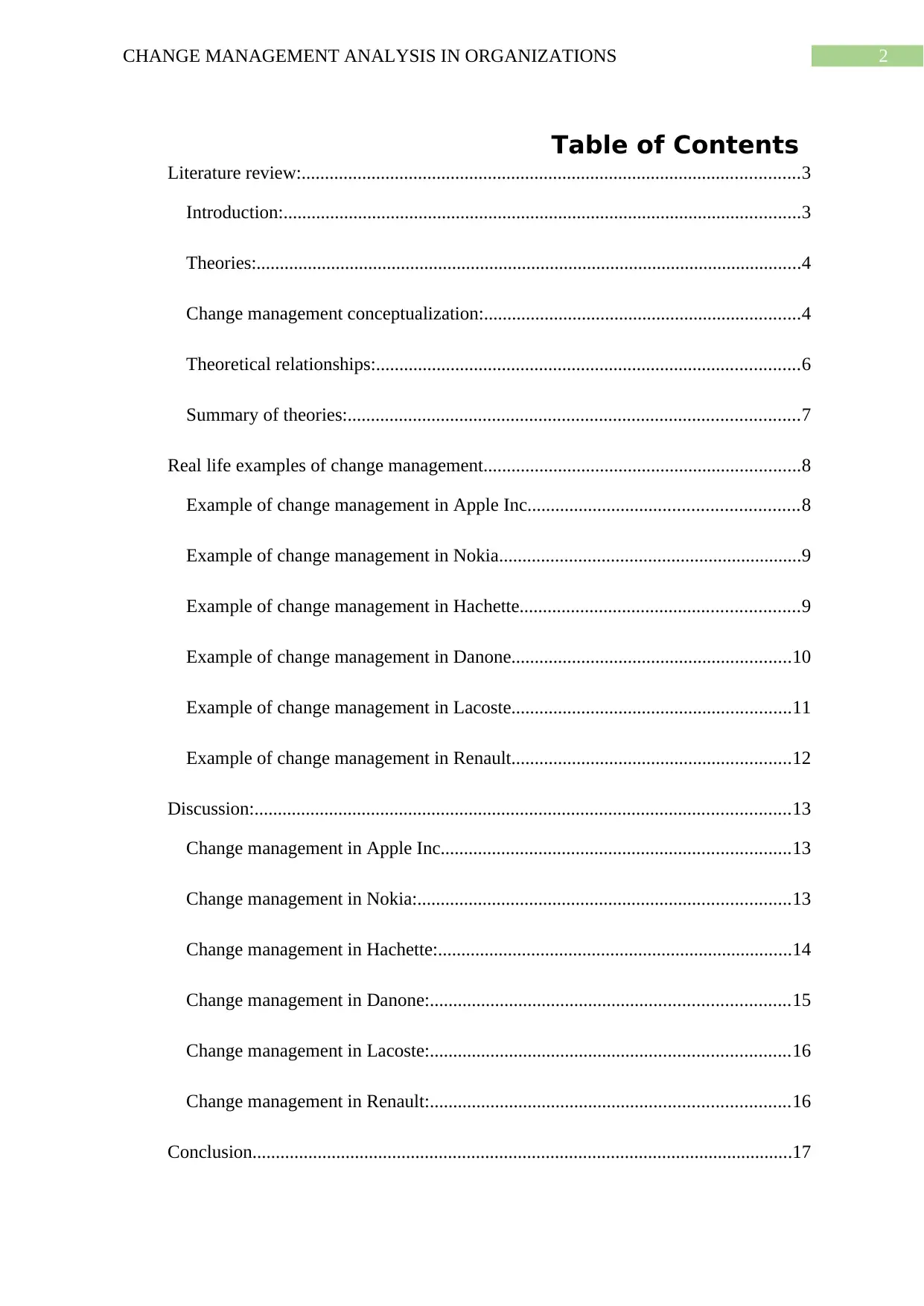
Table of Contents
Literature review:...........................................................................................................3
Introduction:...............................................................................................................3
Theories:.....................................................................................................................4
Change management conceptualization:....................................................................4
Theoretical relationships:...........................................................................................6
Summary of theories:.................................................................................................7
Real life examples of change management....................................................................8
Example of change management in Apple Inc..........................................................8
Example of change management in Nokia.................................................................9
Example of change management in Hachette............................................................9
Example of change management in Danone............................................................10
Example of change management in Lacoste............................................................11
Example of change management in Renault............................................................12
Discussion:...................................................................................................................13
Change management in Apple Inc...........................................................................13
Change management in Nokia:................................................................................13
Change management in Hachette:............................................................................14
Change management in Danone:.............................................................................15
Change management in Lacoste:.............................................................................16
Change management in Renault:.............................................................................16
Conclusion....................................................................................................................17
Table of Contents
Literature review:...........................................................................................................3
Introduction:...............................................................................................................3
Theories:.....................................................................................................................4
Change management conceptualization:....................................................................4
Theoretical relationships:...........................................................................................6
Summary of theories:.................................................................................................7
Real life examples of change management....................................................................8
Example of change management in Apple Inc..........................................................8
Example of change management in Nokia.................................................................9
Example of change management in Hachette............................................................9
Example of change management in Danone............................................................10
Example of change management in Lacoste............................................................11
Example of change management in Renault............................................................12
Discussion:...................................................................................................................13
Change management in Apple Inc...........................................................................13
Change management in Nokia:................................................................................13
Change management in Hachette:............................................................................14
Change management in Danone:.............................................................................15
Change management in Lacoste:.............................................................................16
Change management in Renault:.............................................................................16
Conclusion....................................................................................................................17
⊘ This is a preview!⊘
Do you want full access?
Subscribe today to unlock all pages.

Trusted by 1+ million students worldwide
3CHANGE MANAGEMENT ANALYSIS IN ORGANIZATIONS
References:...................................................................................................................21
Literature review:
Introduction:
Change management describes the adoption of new ideas, procedures, behaviours and
processes to an organization (James Sunday Kehinde 2012). James defines the change
management as a continuous process for aligning a company with the marketplace and
accomplishing the works more effectively and responsively that the competitors. Lichtenstein
proposes that the organizational change is a continuous transformative change that can be
achieved through a complicated model of adaptive system change.
This system change consists of 3 stages. These are: proper organization of the
changes, managing tensions and threshold the new emerging configuration (Wright, Sturdy
and Wylie 2012). It is a procedure in which an enterprise rises its organizational efficiency as
well as effectiveness from its existing plateau and transcends itself to reach the desired
position (Bon and Mustafa 2013). Halme opines that this change is a cross-organizational
process that occurs in multi-level. This process reveals incompetency and disorganization
trend prevailing over a longer period of time. The change management process comprises a
series of some interlocking projects (Halme, Lindeman and Linna 2012). Lindeman and
Linna describe the institutional change management is a continuous process for
experimenting and adapting the changes in an organization. This experimental process is
intended for matching the organization’s capabilities when the volatile environments need to
be attended. Kerzner (2013) defines the change management as an action or a process. He
discusses the organizational changes in the light of managed system. To him, the changed
management process is a behavioural response and process over time to some trigger event.
References:...................................................................................................................21
Literature review:
Introduction:
Change management describes the adoption of new ideas, procedures, behaviours and
processes to an organization (James Sunday Kehinde 2012). James defines the change
management as a continuous process for aligning a company with the marketplace and
accomplishing the works more effectively and responsively that the competitors. Lichtenstein
proposes that the organizational change is a continuous transformative change that can be
achieved through a complicated model of adaptive system change.
This system change consists of 3 stages. These are: proper organization of the
changes, managing tensions and threshold the new emerging configuration (Wright, Sturdy
and Wylie 2012). It is a procedure in which an enterprise rises its organizational efficiency as
well as effectiveness from its existing plateau and transcends itself to reach the desired
position (Bon and Mustafa 2013). Halme opines that this change is a cross-organizational
process that occurs in multi-level. This process reveals incompetency and disorganization
trend prevailing over a longer period of time. The change management process comprises a
series of some interlocking projects (Halme, Lindeman and Linna 2012). Lindeman and
Linna describe the institutional change management is a continuous process for
experimenting and adapting the changes in an organization. This experimental process is
intended for matching the organization’s capabilities when the volatile environments need to
be attended. Kerzner (2013) defines the change management as an action or a process. He
discusses the organizational changes in the light of managed system. To him, the changed
management process is a behavioural response and process over time to some trigger event.
Paraphrase This Document
Need a fresh take? Get an instant paraphrase of this document with our AI Paraphraser
4CHANGE MANAGEMENT ANALYSIS IN ORGANIZATIONS
Theories:
Various research literatures on change management around the world suggest that the
terms change management, organizational change and organizational development are used
interchangeably. the terms like corporate transformation and organizational transformation
also have been used as synonyms of change management. Different researchers have defined
the corporate transformation from individual perspectives. Benn, Dunphy and Griffiths
identified the need of organizational change in an organization to cope up with the changing
environment and its pressure. It assists in achieving the organization’s objectives through
continuous survival and development. Clarke argues that this organizational change is
mandatory to deal with the unexpected shifts of the organizational ambience.
To Dunphy and Griffiths, organisational transformation challenges the traditional
methods that the organizations usually follow. Therefore, the changes challenge the
environment of the company and the employees feel uncertain and pressurized due to the fear
of potential failure to meet the new situation. The management is also seen as a deliberately
generated response for to the environmental shifts. According to Vaiman, Scullion and
Collings, some organizational systems open their workplace environment for natural change.
They believe that it will result in a spontaneous response to the linear sequence of growth
events (Vaiman, Scullion and Collings 2012). This change is a driven process that focuses on
the response of the organization thus adapt to its environment and increase legitimacy as well
as chances of its survival.
Change management conceptualization:
According to Kerzner (2013) the changes in organization seems to be inevitable these
days regardless to extents that the organizations are capable to deal with. Enhanced
competition as well as requirements of strategic adaptability and flexibility have been brought
by globalization (Stahl, Björkman and Morris 2012). It has affected almost every company in
Theories:
Various research literatures on change management around the world suggest that the
terms change management, organizational change and organizational development are used
interchangeably. the terms like corporate transformation and organizational transformation
also have been used as synonyms of change management. Different researchers have defined
the corporate transformation from individual perspectives. Benn, Dunphy and Griffiths
identified the need of organizational change in an organization to cope up with the changing
environment and its pressure. It assists in achieving the organization’s objectives through
continuous survival and development. Clarke argues that this organizational change is
mandatory to deal with the unexpected shifts of the organizational ambience.
To Dunphy and Griffiths, organisational transformation challenges the traditional
methods that the organizations usually follow. Therefore, the changes challenge the
environment of the company and the employees feel uncertain and pressurized due to the fear
of potential failure to meet the new situation. The management is also seen as a deliberately
generated response for to the environmental shifts. According to Vaiman, Scullion and
Collings, some organizational systems open their workplace environment for natural change.
They believe that it will result in a spontaneous response to the linear sequence of growth
events (Vaiman, Scullion and Collings 2012). This change is a driven process that focuses on
the response of the organization thus adapt to its environment and increase legitimacy as well
as chances of its survival.
Change management conceptualization:
According to Kerzner (2013) the changes in organization seems to be inevitable these
days regardless to extents that the organizations are capable to deal with. Enhanced
competition as well as requirements of strategic adaptability and flexibility have been brought
by globalization (Stahl, Björkman and Morris 2012). It has affected almost every company in
5CHANGE MANAGEMENT ANALYSIS IN ORGANIZATIONS
the contemporary world. Had it been an MNC or any SME the effect is regardless of the
organisation’s size, market focus and human resource capabilities (Vaiman, Scullion and
Collings 2012). Therefore, the changes are occurring across spectrum by including the
structural, strategic, processing, operational and the cultural changes. Successfully managing
the organizational transformation from the aspects of the employees’ view therefore is very
important focal point for all extents of management. So also embracing as well as surviving
the change is important from the perspectives of the employees. Change initiatives are not
always accomplished due to various problems in leadership, governance, communication,
motivation and empowerment of the employees in an organisation (Touboulic and Walker
2015). Bolman and Deal (2017) opine that the observers should pay attention to the social
realities including the power dynamics and identify various perspectives on resistance for
change must be revealed.
This power must be analysed from three different perspectives. The power is defined
to be a restraining force through which the manager makes the employees do things that they
would not do themselves. In this perspective the resistance becomes an open reaction to the
overt usage of force or power. Power focusses on the effects of ideologies as well as cultural
socialization on the people to comply with the order (Taipaleenmäki and Ikäheimo 2013).
This method therefore needs no explicit force or overt conflicts. This view resembles the
incorporation of resistance to the change in traditional change management theories (Doz and
Prahalad 2013). This change needs more integration in working process and improvement in
business performance. These considerations result in the structured change projects based on
the speculation that the change management on workers consists of a limited set of
intercession that are regarded to be objective, quantifiable and linearly manageable projects
that which can be understood in a small period of time.
the contemporary world. Had it been an MNC or any SME the effect is regardless of the
organisation’s size, market focus and human resource capabilities (Vaiman, Scullion and
Collings 2012). Therefore, the changes are occurring across spectrum by including the
structural, strategic, processing, operational and the cultural changes. Successfully managing
the organizational transformation from the aspects of the employees’ view therefore is very
important focal point for all extents of management. So also embracing as well as surviving
the change is important from the perspectives of the employees. Change initiatives are not
always accomplished due to various problems in leadership, governance, communication,
motivation and empowerment of the employees in an organisation (Touboulic and Walker
2015). Bolman and Deal (2017) opine that the observers should pay attention to the social
realities including the power dynamics and identify various perspectives on resistance for
change must be revealed.
This power must be analysed from three different perspectives. The power is defined
to be a restraining force through which the manager makes the employees do things that they
would not do themselves. In this perspective the resistance becomes an open reaction to the
overt usage of force or power. Power focusses on the effects of ideologies as well as cultural
socialization on the people to comply with the order (Taipaleenmäki and Ikäheimo 2013).
This method therefore needs no explicit force or overt conflicts. This view resembles the
incorporation of resistance to the change in traditional change management theories (Doz and
Prahalad 2013). This change needs more integration in working process and improvement in
business performance. These considerations result in the structured change projects based on
the speculation that the change management on workers consists of a limited set of
intercession that are regarded to be objective, quantifiable and linearly manageable projects
that which can be understood in a small period of time.
⊘ This is a preview!⊘
Do you want full access?
Subscribe today to unlock all pages.
Trusted by 1+ million students worldwide
6CHANGE MANAGEMENT ANALYSIS IN ORGANIZATIONS
Theoretical relationships:
Contingency theory can be defined as a behavioural theory that demonstrates the best
way to strategies the organizational structure. Joan Woodward was the proponent of this
Contingency theory. He argued that the usage of technology directly determines the
organizational attributes like compass of control, formalizations of regulations as well as
procedures for the employee management and centralization of the authority. The researchers
have found out many variations in the structure of any organization that are associated with
various manufacturing techniques. These bring changes to the employees’ performances. This
theory elaborates different constraints of an organisation. These constraints depend on the
size, adaptability of environment and different resources as well as operations activities. It
also magnifies the managerial assumptions of the employees’ strategies. Contingent variables
focus and anchor on the managerial assumptions of changes of the employee along with the
performances as the variables. The research explains the approaches of the organizational
behaviour and describes the method of contingent factors like technology, culture, external
environment affects the workers and functions of the company for effective changes, displays
that for the performance based outcomes the employees must be fully engaged with the work
(Goksoy, Ozsoy and Vayvay 2012).
This assumption based on the contingency theory reveals that there is no single sort of
company structure that can applied equally to every organization. Organizational
effectiveness depends on the match of the technologies, environmental volatility, the human
capital, size of the company, its structural features as well as the information system of the
company. The Contingency theories were originated from the theories of sociological
functionalism of the structure of an organisation. This theory directly contradicts the classical
organisational theory which assumes that the general principles help an organisation to run
effectively and successfully. In the contrary the Contingency theories propose that the most
Theoretical relationships:
Contingency theory can be defined as a behavioural theory that demonstrates the best
way to strategies the organizational structure. Joan Woodward was the proponent of this
Contingency theory. He argued that the usage of technology directly determines the
organizational attributes like compass of control, formalizations of regulations as well as
procedures for the employee management and centralization of the authority. The researchers
have found out many variations in the structure of any organization that are associated with
various manufacturing techniques. These bring changes to the employees’ performances. This
theory elaborates different constraints of an organisation. These constraints depend on the
size, adaptability of environment and different resources as well as operations activities. It
also magnifies the managerial assumptions of the employees’ strategies. Contingent variables
focus and anchor on the managerial assumptions of changes of the employee along with the
performances as the variables. The research explains the approaches of the organizational
behaviour and describes the method of contingent factors like technology, culture, external
environment affects the workers and functions of the company for effective changes, displays
that for the performance based outcomes the employees must be fully engaged with the work
(Goksoy, Ozsoy and Vayvay 2012).
This assumption based on the contingency theory reveals that there is no single sort of
company structure that can applied equally to every organization. Organizational
effectiveness depends on the match of the technologies, environmental volatility, the human
capital, size of the company, its structural features as well as the information system of the
company. The Contingency theories were originated from the theories of sociological
functionalism of the structure of an organisation. This theory directly contradicts the classical
organisational theory which assumes that the general principles help an organisation to run
effectively and successfully. In the contrary the Contingency theories propose that the most
Paraphrase This Document
Need a fresh take? Get an instant paraphrase of this document with our AI Paraphraser
7CHANGE MANAGEMENT ANALYSIS IN ORGANIZATIONS
effective structure of an organization varies from the aspects of their environments. The
efficiencies of each of the structural aspects vary and depend on the Contingency factors
mentioned previously (Collings 2014). These theories identify the factors of which task
uncertainty is the most important one. It is a central point as it engages the workers for an
effective change that they must realize (Geppert and Dörrenbächer 2014). Nielsen argues that
the structure of a company becomes more decentralised if it is concerned with more uncertain
tasks and needs more enriched and joined structures to communicate as well as generate huge
amount of resources and communications to its employees (Nielsen and Nielsen 2013). On
the contrary if an organisation has gained certainty about their works, they become more
centralized.
Another factor that the theory discusses is the size (Bolman and Deal 2017). Ferner,
Edwards and Tempel (2012) assume that the change can be easily applicable and acceptable
for a small company with few workers as they are more productive. This factors establishes
that the contingency theory successfully describes the changes which can be experienced by
the organizations at the time of restructuring the management and expounds the connection
between the change management and the theory (Symon and Cassell 2012).
Summary of theories:
Every theories and model that concern about the change management have potential
benefits and weaknesses.
Adkar model: it is a goal oriented model for management of change that permits the
teams to attend their activities for a specific business outcome. It determines the impression
of change management on the employees’ presentation and achievement of anticipated
results.
effective structure of an organization varies from the aspects of their environments. The
efficiencies of each of the structural aspects vary and depend on the Contingency factors
mentioned previously (Collings 2014). These theories identify the factors of which task
uncertainty is the most important one. It is a central point as it engages the workers for an
effective change that they must realize (Geppert and Dörrenbächer 2014). Nielsen argues that
the structure of a company becomes more decentralised if it is concerned with more uncertain
tasks and needs more enriched and joined structures to communicate as well as generate huge
amount of resources and communications to its employees (Nielsen and Nielsen 2013). On
the contrary if an organisation has gained certainty about their works, they become more
centralized.
Another factor that the theory discusses is the size (Bolman and Deal 2017). Ferner,
Edwards and Tempel (2012) assume that the change can be easily applicable and acceptable
for a small company with few workers as they are more productive. This factors establishes
that the contingency theory successfully describes the changes which can be experienced by
the organizations at the time of restructuring the management and expounds the connection
between the change management and the theory (Symon and Cassell 2012).
Summary of theories:
Every theories and model that concern about the change management have potential
benefits and weaknesses.
Adkar model: it is a goal oriented model for management of change that permits the
teams to attend their activities for a specific business outcome. It determines the impression
of change management on the employees’ presentation and achievement of anticipated
results.
8CHANGE MANAGEMENT ANALYSIS IN ORGANIZATIONS
Kuble-Ross Model: this model has 5 different stages that explains the change flows
with the feelings of happiness, fear, anxiety, denial, threat, guilt, depression, hostility,
disillusionment, gradual acceptance of the situation and moving forward (van der Heijden,
Cramer and Driessen 2012). In Contingency theory, an ideal situation is presented and
discusses method of achieving the idea of management without providing a distinct level of
designing the best structure for an organization in various constraints (Sidani and Al Ariss
2014). This literature review has discussed the study of change management in order to
encourage the employees for embracing the changes in the organisation for its better
performance.
Real life examples of change management
Example of change management in Apple Inc.
Apple Inc. is a multinational company in the technology with its origin in America.
The headquarters of Apple is located in Cupertino, California. The products of the company
include, iPhone, iPod music and media player, iPad tablet and soft wares like iOS and
macOS. The company was established by Steve Wozniak, Steve Jobs and Ronald Wayne in
the year 1976. The company experienced huge change after the resignation of Steve Jobs in
the year 2011. The company was now in the hands of Tim Cook from the year 2011 and he
had the huge responsibility to take forward the company after Steve Jobs.
The management style of Tim Cook was completely different from that of Steve Jobs.
Steve Jobs was said to be a demanding and passionate leader who expected his employees to
follow his orders to the level of perfection, on the other hand, Tim Cook was transparent style
of management and believes in teamwork in between the employees and the management
(Burke 2017). This change in the style of management brought many changes in the
organization itself with respect to the introduction of new merchandises and the relationship
Kuble-Ross Model: this model has 5 different stages that explains the change flows
with the feelings of happiness, fear, anxiety, denial, threat, guilt, depression, hostility,
disillusionment, gradual acceptance of the situation and moving forward (van der Heijden,
Cramer and Driessen 2012). In Contingency theory, an ideal situation is presented and
discusses method of achieving the idea of management without providing a distinct level of
designing the best structure for an organization in various constraints (Sidani and Al Ariss
2014). This literature review has discussed the study of change management in order to
encourage the employees for embracing the changes in the organisation for its better
performance.
Real life examples of change management
Example of change management in Apple Inc.
Apple Inc. is a multinational company in the technology with its origin in America.
The headquarters of Apple is located in Cupertino, California. The products of the company
include, iPhone, iPod music and media player, iPad tablet and soft wares like iOS and
macOS. The company was established by Steve Wozniak, Steve Jobs and Ronald Wayne in
the year 1976. The company experienced huge change after the resignation of Steve Jobs in
the year 2011. The company was now in the hands of Tim Cook from the year 2011 and he
had the huge responsibility to take forward the company after Steve Jobs.
The management style of Tim Cook was completely different from that of Steve Jobs.
Steve Jobs was said to be a demanding and passionate leader who expected his employees to
follow his orders to the level of perfection, on the other hand, Tim Cook was transparent style
of management and believes in teamwork in between the employees and the management
(Burke 2017). This change in the style of management brought many changes in the
organization itself with respect to the introduction of new merchandises and the relationship
⊘ This is a preview!⊘
Do you want full access?
Subscribe today to unlock all pages.
Trusted by 1+ million students worldwide
9CHANGE MANAGEMENT ANALYSIS IN ORGANIZATIONS
of the company with its investors. The change in the management style has positive effects on
the revenues of Apple and its position in the market. The new CEO was mainly focussed
towards the improvement of the existing products whereas, on the other hand Jobs was more
inclined towards launching new products (By, Burnes and Oswick 2012).
Example of change management in Nokia
Nokia Corporation or NOKIA is a multinational company which has its origins in
Finland and was founded in the year 1965. Nokia has its headquarters in Espoo Uusima.
Currently the company employs around 101,000 employees and has its presence in more than
100 countries. In the year 2012 the value of the shares of Nokia was below $2, which quite
low from their high values in the year 2000 which was $60 and in the year 2007 which was
$40. From the start of the year 2000 Nokia became the highest manufacturer of mobile
phones and this was much before the smartphone era started. Nokia failed to retain its top
position in the market starting from the year 2010 and Apple was successful in beating Nokia
in the smartphone race (Raelin 2012).
This lead to a big change in the management of the company as the decision of
selling the division of phones to Microsoft was taken. This decision was a huge mistake that
was committed by both the companies. The mission of Microsoft to challenge the huge
companies like Google and Apple in the smartphone area failed miserably (Burnes and by
2012). This step also led to huge number of job cuts from the Nokia Corporation. The
Windows supported phones failed to get the share in the market and was an unsuccessful
project. This change brought by the management of both the companies has proved to be
harmful for the organizations as well as the employees (Cummings and Worley 2014).
of the company with its investors. The change in the management style has positive effects on
the revenues of Apple and its position in the market. The new CEO was mainly focussed
towards the improvement of the existing products whereas, on the other hand Jobs was more
inclined towards launching new products (By, Burnes and Oswick 2012).
Example of change management in Nokia
Nokia Corporation or NOKIA is a multinational company which has its origins in
Finland and was founded in the year 1965. Nokia has its headquarters in Espoo Uusima.
Currently the company employs around 101,000 employees and has its presence in more than
100 countries. In the year 2012 the value of the shares of Nokia was below $2, which quite
low from their high values in the year 2000 which was $60 and in the year 2007 which was
$40. From the start of the year 2000 Nokia became the highest manufacturer of mobile
phones and this was much before the smartphone era started. Nokia failed to retain its top
position in the market starting from the year 2010 and Apple was successful in beating Nokia
in the smartphone race (Raelin 2012).
This lead to a big change in the management of the company as the decision of
selling the division of phones to Microsoft was taken. This decision was a huge mistake that
was committed by both the companies. The mission of Microsoft to challenge the huge
companies like Google and Apple in the smartphone area failed miserably (Burnes and by
2012). This step also led to huge number of job cuts from the Nokia Corporation. The
Windows supported phones failed to get the share in the market and was an unsuccessful
project. This change brought by the management of both the companies has proved to be
harmful for the organizations as well as the employees (Cummings and Worley 2014).
Paraphrase This Document
Need a fresh take? Get an instant paraphrase of this document with our AI Paraphraser
10CHANGE MANAGEMENT ANALYSIS IN ORGANIZATIONS
Example of change management in Hachette
Hachette Book Group is a company active in the publishing business. The owner of
this company is Hachette Livre. It is one of the greatest publishing companies in France.
Hachette is also the third highest publisher in the educational sector in the whole world. The
first publisher under the Hachette group was the Little, Brown and Company which was
founded in the year 1837. The company has been acquiring many other publishing groups
since its inception (Janiesch, Matzner and Müller 2012). Hachette associated its operations
with the Time Warner group in the year 1992. Further, in the year 2013, Hachette acquired
Hyperion Books and it was named as Hachette books from there on. In the year 2014 the
collaboration between Hachette and Amazon was ended from the side of Amazon.com.
In the same year Hachette entered in to an agreement with the Black Dog &
Leventhal. In the year 2014 itself the company had signed a three-way deal with Ingram
Content Group and the Perseus Books Group. However, the deal was ended in the month of
August in the year 2014. In the year 2016 Hachette made an agreement to acquire the
division of publishing of The Perseus Book Group. In the year 2016 itself the company
announced a joint venture with the Kadokawa which is a Japanese publisher and the Yen
Press Imprint (Jacobs, van Witteloostuijn and Christe-Zeyse 2013). The discussion about the
operations of the Hachette group over the years shows that the company has gone a lot of
changes in the previous years and this has contributed to its success over the years as well.
Example of change management in Danone
Danone is a multinational company having its origins in France and was established
in Barcelona. The company is present in more than 130 markets and generates sales of around
21.9 billion euros. The company has its operations in greater than half of the emerging
countries in the world. The company was founded in the year 1919 with the name of Isaac
Carasso. After ten years of the inception of the company it moved its headquarters from
Example of change management in Hachette
Hachette Book Group is a company active in the publishing business. The owner of
this company is Hachette Livre. It is one of the greatest publishing companies in France.
Hachette is also the third highest publisher in the educational sector in the whole world. The
first publisher under the Hachette group was the Little, Brown and Company which was
founded in the year 1837. The company has been acquiring many other publishing groups
since its inception (Janiesch, Matzner and Müller 2012). Hachette associated its operations
with the Time Warner group in the year 1992. Further, in the year 2013, Hachette acquired
Hyperion Books and it was named as Hachette books from there on. In the year 2014 the
collaboration between Hachette and Amazon was ended from the side of Amazon.com.
In the same year Hachette entered in to an agreement with the Black Dog &
Leventhal. In the year 2014 itself the company had signed a three-way deal with Ingram
Content Group and the Perseus Books Group. However, the deal was ended in the month of
August in the year 2014. In the year 2016 Hachette made an agreement to acquire the
division of publishing of The Perseus Book Group. In the year 2016 itself the company
announced a joint venture with the Kadokawa which is a Japanese publisher and the Yen
Press Imprint (Jacobs, van Witteloostuijn and Christe-Zeyse 2013). The discussion about the
operations of the Hachette group over the years shows that the company has gone a lot of
changes in the previous years and this has contributed to its success over the years as well.
Example of change management in Danone
Danone is a multinational company having its origins in France and was established
in Barcelona. The company is present in more than 130 markets and generates sales of around
21.9 billion euros. The company has its operations in greater than half of the emerging
countries in the world. The company was founded in the year 1919 with the name of Isaac
Carasso. After ten years of the inception of the company it moved its headquarters from
11CHANGE MANAGEMENT ANALYSIS IN ORGANIZATIONS
Spain to France. The company also started another branch for the purpose of taking over the
glass making field. However, the company was unable to take over the biggest competition in
the market which was Saint-Gobain. Danone went through strategic changes since the year
1973 and it acquired mineral water companies like Evian and Kronenburg (Hornstein 2015).
The company started expanding its international operations from the year 1979. Danone
acquired the famous biscuit manufacturer of Europe that was known as General Biscuit and
this led to the opening of another wing of the company. In the following years from 1999 to
2003 the Danone group had to sell the shares of its business of glass-containers and they also
sold the beer related activities of the group in the year 2000. In the year 2005 the company
sold some of its biscuit manufacturing operations as well. The company decided to make an
agreement with the Kraft Foods Inc. and sold the biscuit divisions of the company. In the year
2010 Danone acquired the Unimilk company and its operations in Russia (Dumas et al.
2013). The company also acquired the nutrition activities of the Wockhardt group in India in
the year 2012. A drastic decision was taken by the company in the year 2013 to fire around
900 employees from its European division. The development of the company in the year
2013 had increased in its African areas. The discussion about the operations of the company
in the previous year show that the strategic changes that were brought in the company has led
to the development in its operations (Georgalis et al. 2015).
Example of change management in Lacoste
Lacoste is a clothing company of French origin. The company was established in the
year 1944 by the tennis players Andre Gillier and Rene Lacoste. The company sells many
different items including footwear, clothing, leather items, eyewear, watches, perfume and
many more. The company was founded by the collaboration between the two tennis players
and they used to manufacture tennis shirts which were revolutionary at that time and they
were worn by the players in the court. The company had formed a partnership with the Izod
Spain to France. The company also started another branch for the purpose of taking over the
glass making field. However, the company was unable to take over the biggest competition in
the market which was Saint-Gobain. Danone went through strategic changes since the year
1973 and it acquired mineral water companies like Evian and Kronenburg (Hornstein 2015).
The company started expanding its international operations from the year 1979. Danone
acquired the famous biscuit manufacturer of Europe that was known as General Biscuit and
this led to the opening of another wing of the company. In the following years from 1999 to
2003 the Danone group had to sell the shares of its business of glass-containers and they also
sold the beer related activities of the group in the year 2000. In the year 2005 the company
sold some of its biscuit manufacturing operations as well. The company decided to make an
agreement with the Kraft Foods Inc. and sold the biscuit divisions of the company. In the year
2010 Danone acquired the Unimilk company and its operations in Russia (Dumas et al.
2013). The company also acquired the nutrition activities of the Wockhardt group in India in
the year 2012. A drastic decision was taken by the company in the year 2013 to fire around
900 employees from its European division. The development of the company in the year
2013 had increased in its African areas. The discussion about the operations of the company
in the previous year show that the strategic changes that were brought in the company has led
to the development in its operations (Georgalis et al. 2015).
Example of change management in Lacoste
Lacoste is a clothing company of French origin. The company was established in the
year 1944 by the tennis players Andre Gillier and Rene Lacoste. The company sells many
different items including footwear, clothing, leather items, eyewear, watches, perfume and
many more. The company was founded by the collaboration between the two tennis players
and they used to manufacture tennis shirts which were revolutionary at that time and they
were worn by the players in the court. The company had formed a partnership with the Izod
⊘ This is a preview!⊘
Do you want full access?
Subscribe today to unlock all pages.
Trusted by 1+ million students worldwide

1 out of 26


Related Documents


Your All-in-One AI-Powered Toolkit for Academic Success.
+13062052269
info@desklib.com
Available 24*7 on WhatsApp / Email
![[object Object]](/_next/static/media/star-bottom.7253800d.svg)
Unlock your academic potential
Copyright © 2020–2026 A2Z Services. All Rights Reserved. Developed and managed by ZUCOL.