Family Tourism: Examining Tourist Characteristics, Needs, Behavior

Verified

Added on  2024/05/30

|8
|1607
|153
Report
AI Summary
This report provides an analysis of the characteristics, needs, and buying behavior of family tourists within the Australian tourism and hospitality industry. It highlights the rapid growth of family tourism and its increasing importance as a family activity. The research identifies issues faced by family travelers, such as financial implications and cultural suitability, and examines factors motivating their travel decisions, including leisure and social attributes of destinations. The methodology involves a hybrid approach using both primary data collected through questionnaires and secondary data from journals and articles. The report concludes that family tourists prioritize travel attributes and the social and cultural aspects of a destination and emphasizes the importance of fulfilling their needs effectively. Access more resources and solved assignments on Desklib to aid your studies.
Document Page
Characteristics, needs and buying behaviour of family tourists
1 | P a g e
tabler-icon-diamond-filled.svg

Paraphrase This Document

Need a fresh take? Get an instant paraphrase of this document with our AI Paraphraser
Document Page
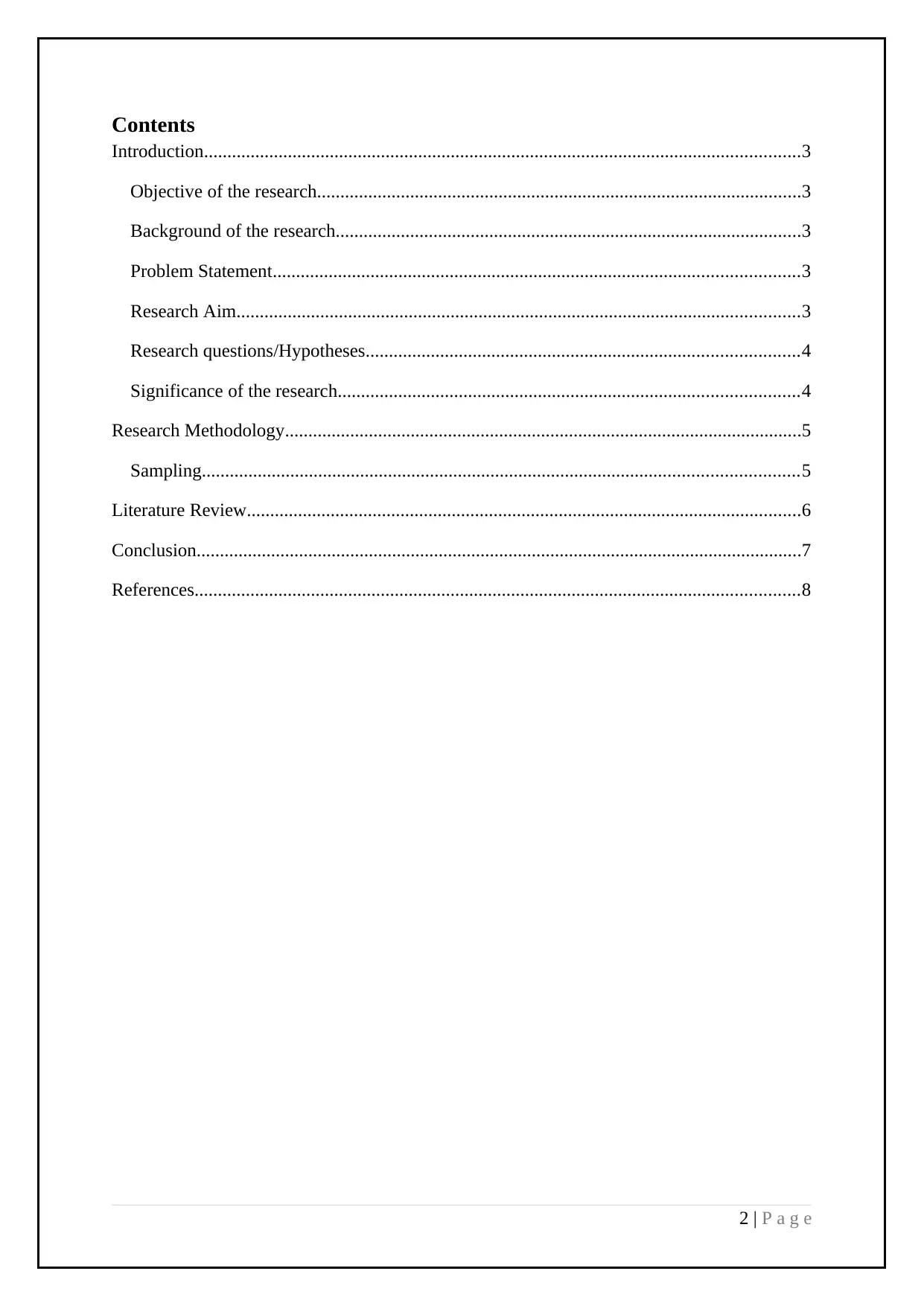
Contents
Introduction................................................................................................................................3
Objective of the research........................................................................................................3
Background of the research....................................................................................................3
Problem Statement.................................................................................................................3
Research Aim.........................................................................................................................3
Research questions/Hypotheses.............................................................................................4
Significance of the research...................................................................................................4
Research Methodology...............................................................................................................5
Sampling................................................................................................................................5
Literature Review.......................................................................................................................6
Conclusion..................................................................................................................................7
References..................................................................................................................................8
2 | P a g e
Document Page
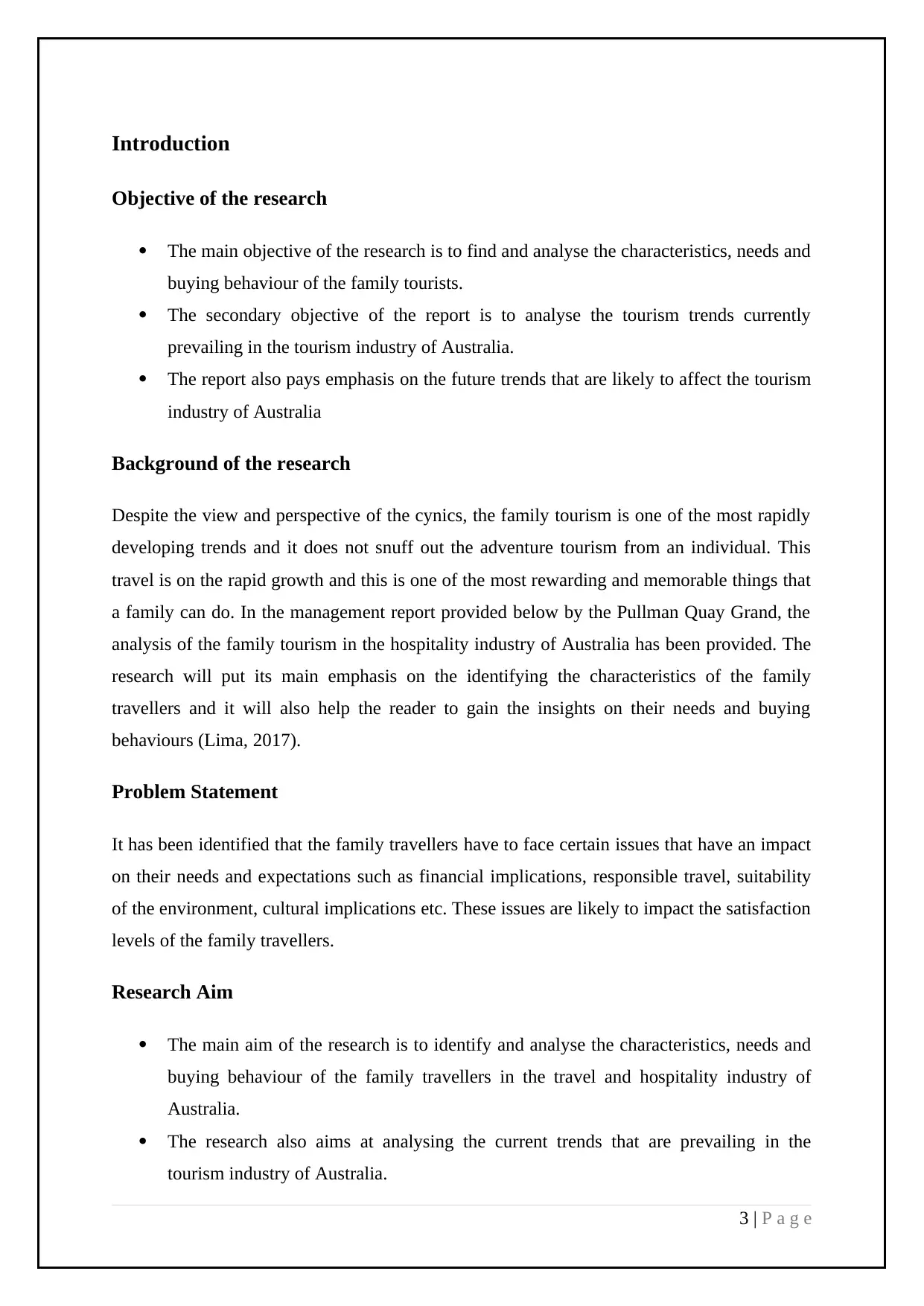
Introduction
Objective of the research
The main objective of the research is to find and analyse the characteristics, needs and
buying behaviour of the family tourists.
The secondary objective of the report is to analyse the tourism trends currently
prevailing in the tourism industry of Australia.
The report also pays emphasis on the future trends that are likely to affect the tourism
industry of Australia
Background of the research
Despite the view and perspective of the cynics, the family tourism is one of the most rapidly
developing trends and it does not snuff out the adventure tourism from an individual. This
travel is on the rapid growth and this is one of the most rewarding and memorable things that
a family can do. In the management report provided below by the Pullman Quay Grand, the
analysis of the family tourism in the hospitality industry of Australia has been provided. The
research will put its main emphasis on the identifying the characteristics of the family
travellers and it will also help the reader to gain the insights on their needs and buying
behaviours (Lima, 2017).
Problem Statement
It has been identified that the family travellers have to face certain issues that have an impact
on their needs and expectations such as financial implications, responsible travel, suitability
of the environment, cultural implications etc. These issues are likely to impact the satisfaction
levels of the family travellers.
Research Aim
The main aim of the research is to identify and analyse the characteristics, needs and
buying behaviour of the family travellers in the travel and hospitality industry of
Australia.
The research also aims at analysing the current trends that are prevailing in the
tourism industry of Australia.
3 | P a g e
Document Page
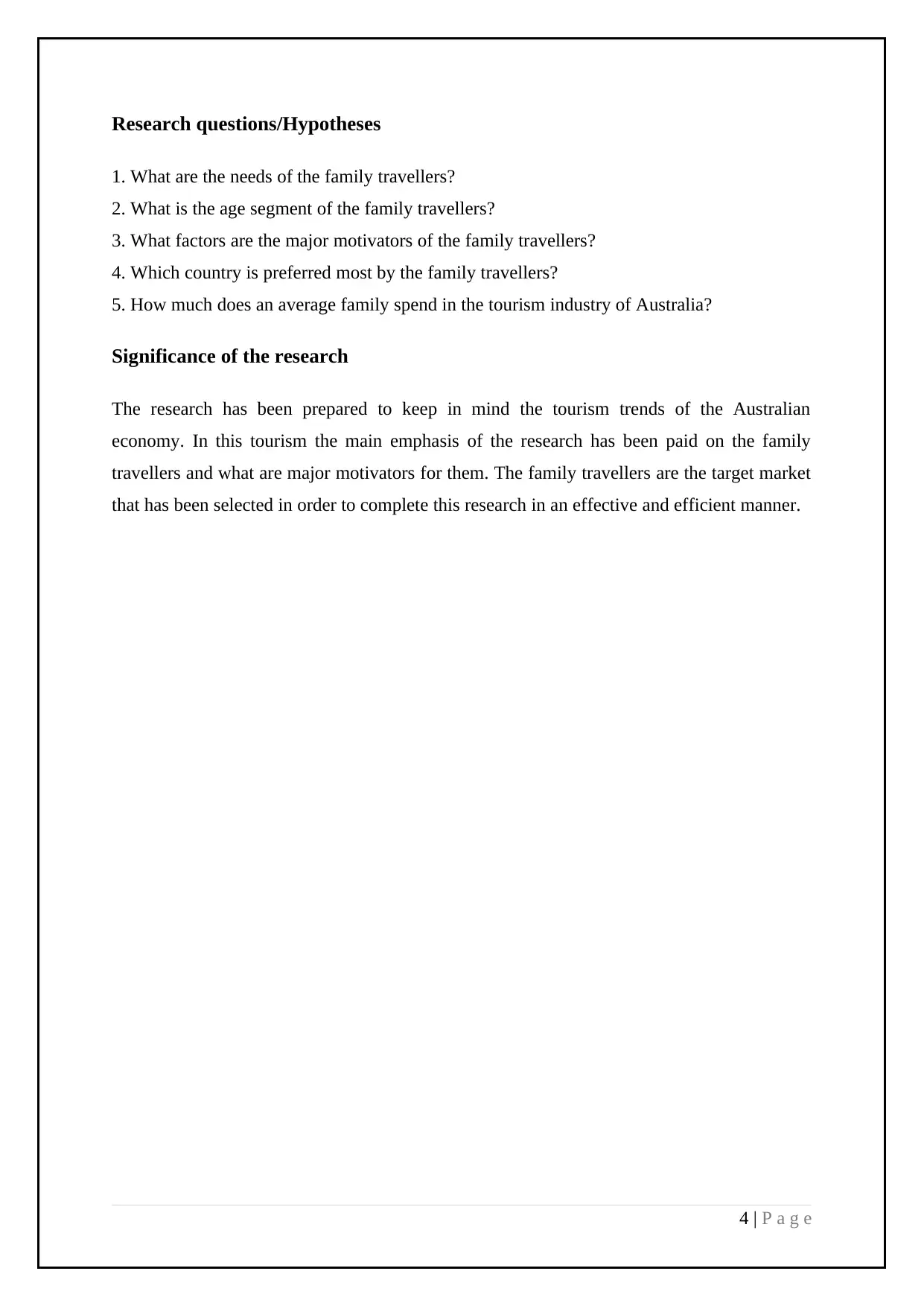
Research questions/Hypotheses
1. What are the needs of the family travellers?
2. What is the age segment of the family travellers?
3. What factors are the major motivators of the family travellers?
4. Which country is preferred most by the family travellers?
5. How much does an average family spend in the tourism industry of Australia?
Significance of the research
The research has been prepared to keep in mind the tourism trends of the Australian
economy. In this tourism the main emphasis of the research has been paid on the family
travellers and what are major motivators for them. The family travellers are the target market
that has been selected in order to complete this research in an effective and efficient manner.
4 | P a g e
tabler-icon-diamond-filled.svg

Paraphrase This Document

Need a fresh take? Get an instant paraphrase of this document with our AI Paraphraser
Document Page
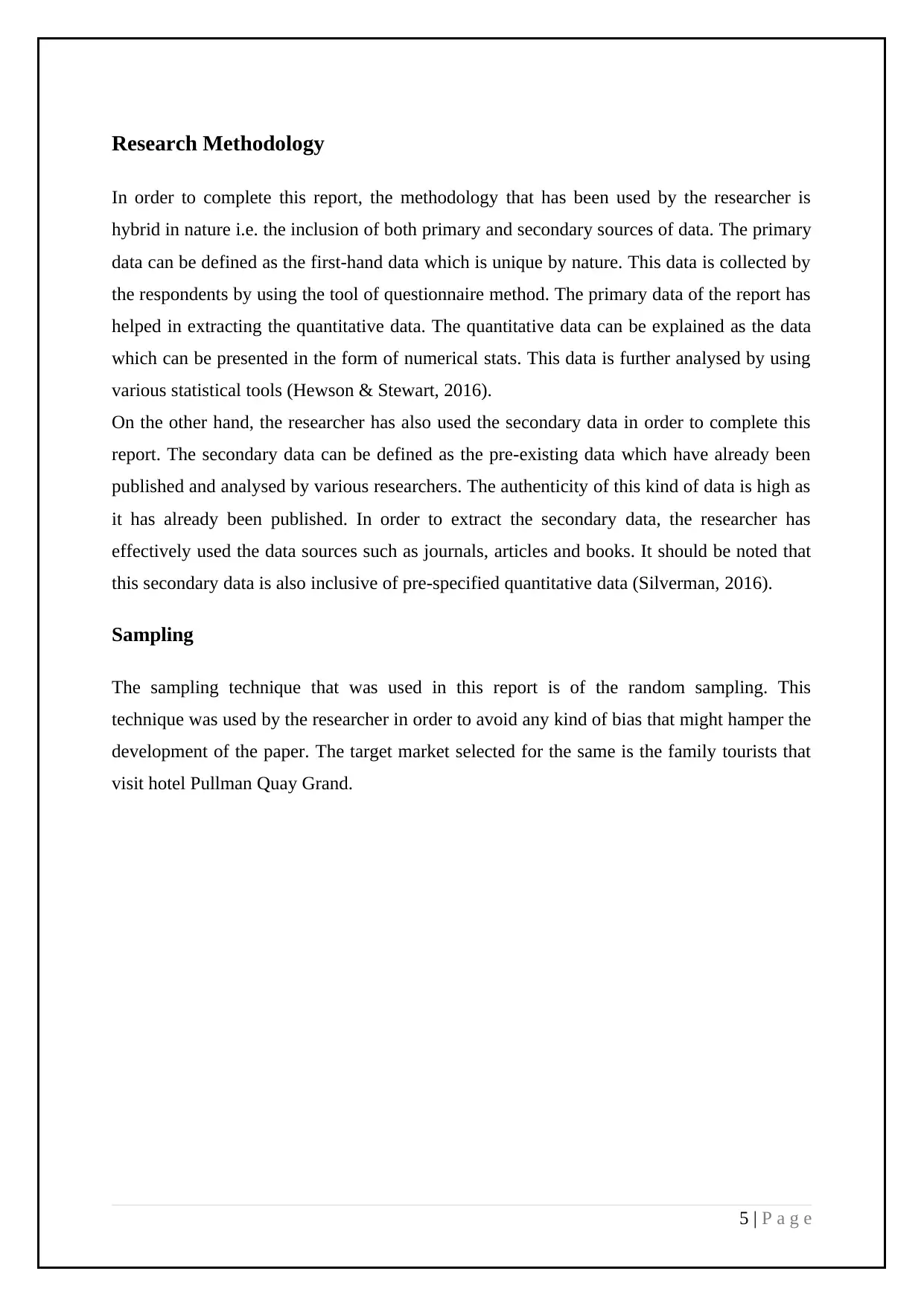
Research Methodology
In order to complete this report, the methodology that has been used by the researcher is
hybrid in nature i.e. the inclusion of both primary and secondary sources of data. The primary
data can be defined as the first-hand data which is unique by nature. This data is collected by
the respondents by using the tool of questionnaire method. The primary data of the report has
helped in extracting the quantitative data. The quantitative data can be explained as the data
which can be presented in the form of numerical stats. This data is further analysed by using
various statistical tools (Hewson & Stewart, 2016).
On the other hand, the researcher has also used the secondary data in order to complete this
report. The secondary data can be defined as the pre-existing data which have already been
published and analysed by various researchers. The authenticity of this kind of data is high as
it has already been published. In order to extract the secondary data, the researcher has
effectively used the data sources such as journals, articles and books. It should be noted that
this secondary data is also inclusive of pre-specified quantitative data (Silverman, 2016).
Sampling
The sampling technique that was used in this report is of the random sampling. This
technique was used by the researcher in order to avoid any kind of bias that might hamper the
development of the paper. The target market selected for the same is the family tourists that
visit hotel Pullman Quay Grand.
5 | P a g e
Document Page
Literature Review
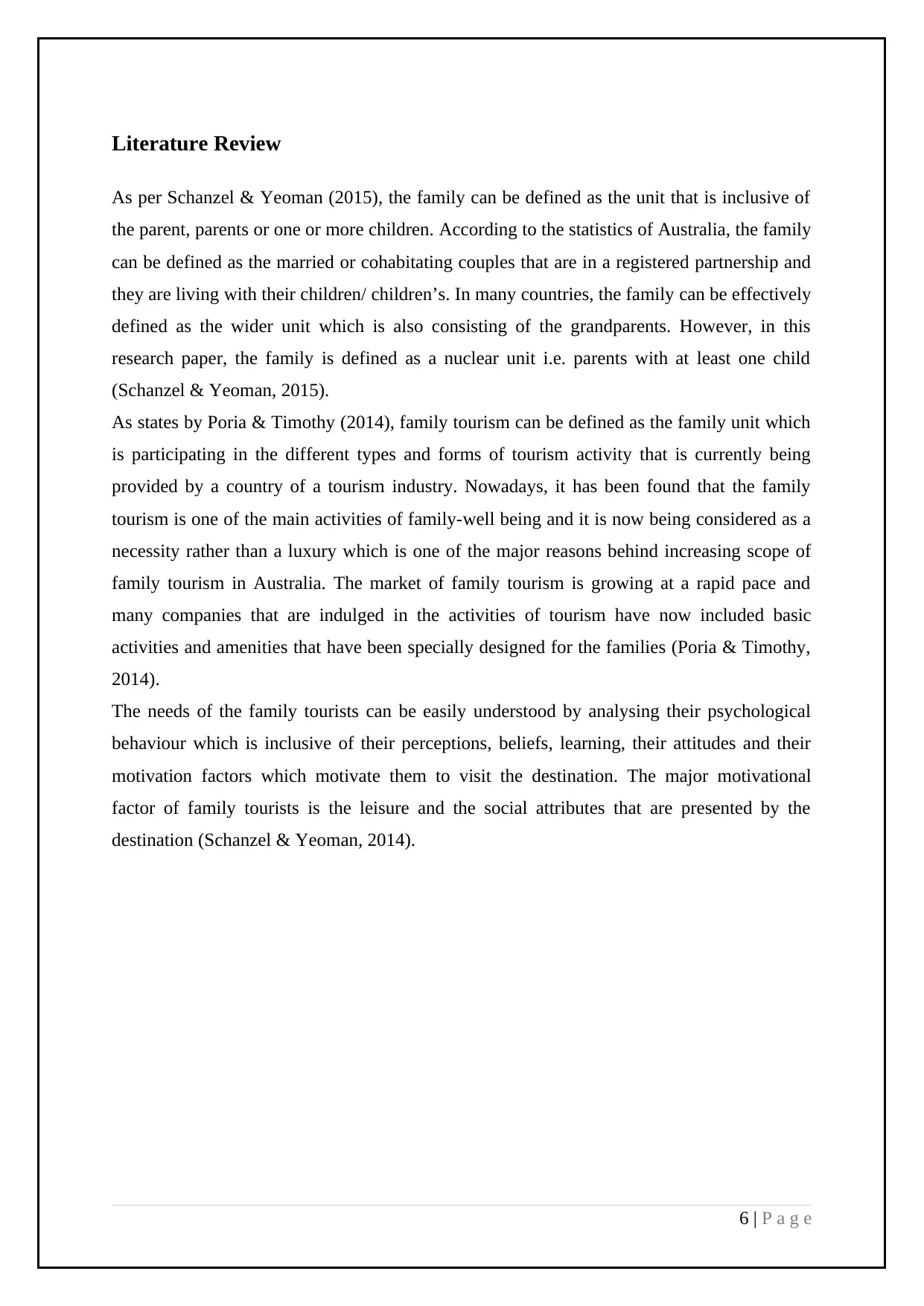
As per Schanzel & Yeoman (2015), the family can be defined as the unit that is inclusive of
the parent, parents or one or more children. According to the statistics of Australia, the family
can be defined as the married or cohabitating couples that are in a registered partnership and
they are living with their children/ children’s. In many countries, the family can be effectively
defined as the wider unit which is also consisting of the grandparents. However, in this
research paper, the family is defined as a nuclear unit i.e. parents with at least one child
(Schanzel & Yeoman, 2015).
As states by Poria & Timothy (2014), family tourism can be defined as the family unit which
is participating in the different types and forms of tourism activity that is currently being
provided by a country of a tourism industry. Nowadays, it has been found that the family
tourism is one of the main activities of family-well being and it is now being considered as a
necessity rather than a luxury which is one of the major reasons behind increasing scope of
family tourism in Australia. The market of family tourism is growing at a rapid pace and
many companies that are indulged in the activities of tourism have now included basic
activities and amenities that have been specially designed for the families (Poria & Timothy,
2014).
The needs of the family tourists can be easily understood by analysing their psychological
behaviour which is inclusive of their perceptions, beliefs, learning, their attitudes and their
motivation factors which motivate them to visit the destination. The major motivational
factor of family tourists is the leisure and the social attributes that are presented by the
destination (Schanzel & Yeoman, 2014).
6 | P a g e
Document Page
Conclusion
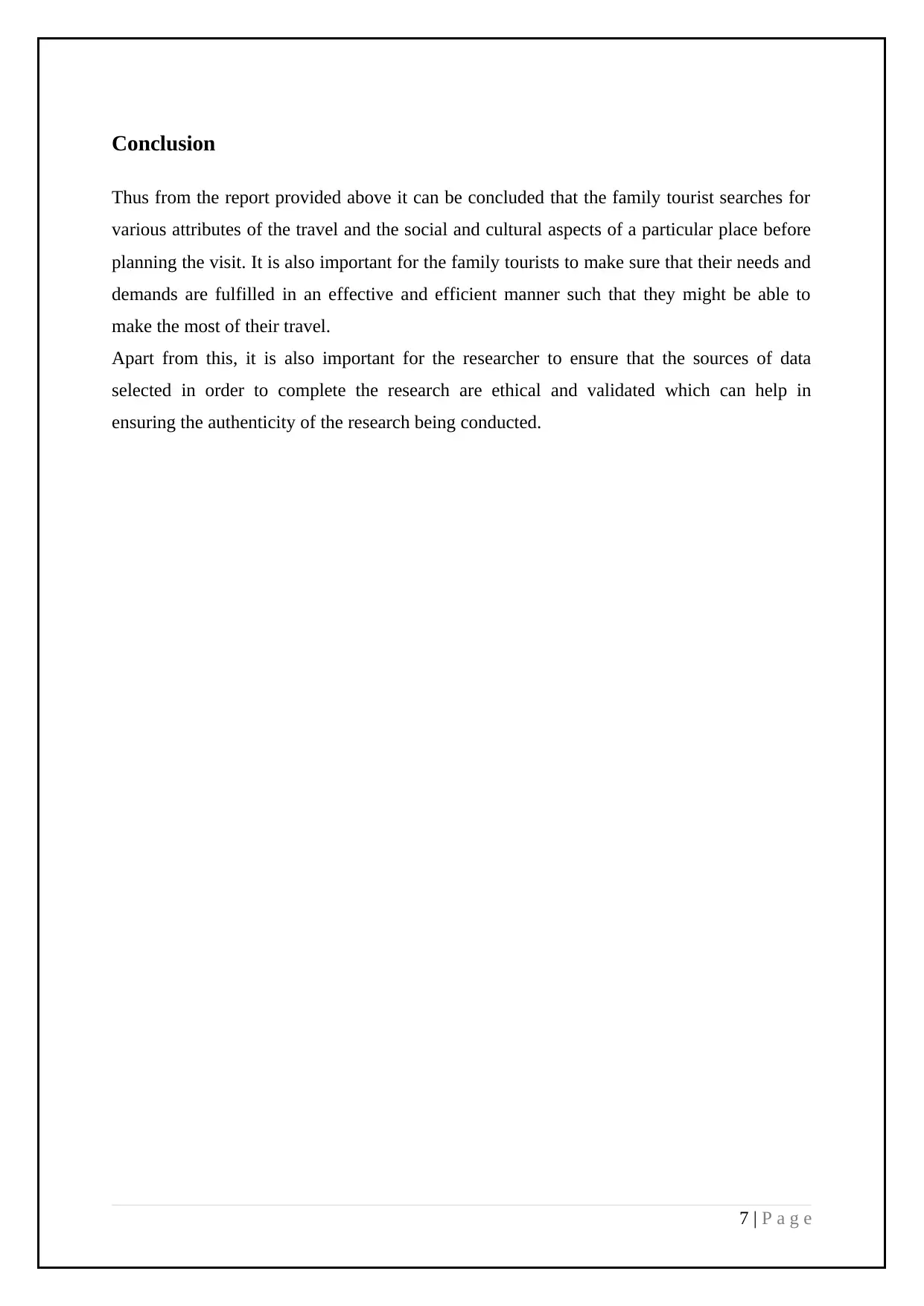
Thus from the report provided above it can be concluded that the family tourist searches for
various attributes of the travel and the social and cultural aspects of a particular place before
planning the visit. It is also important for the family tourists to make sure that their needs and
demands are fulfilled in an effective and efficient manner such that they might be able to
make the most of their travel.
Apart from this, it is also important for the researcher to ensure that the sources of data
selected in order to complete the research are ethical and validated which can help in
ensuring the authenticity of the research being conducted.
7 | P a g e
tabler-icon-diamond-filled.svg

Paraphrase This Document

Need a fresh take? Get an instant paraphrase of this document with our AI Paraphraser
Document Page
References
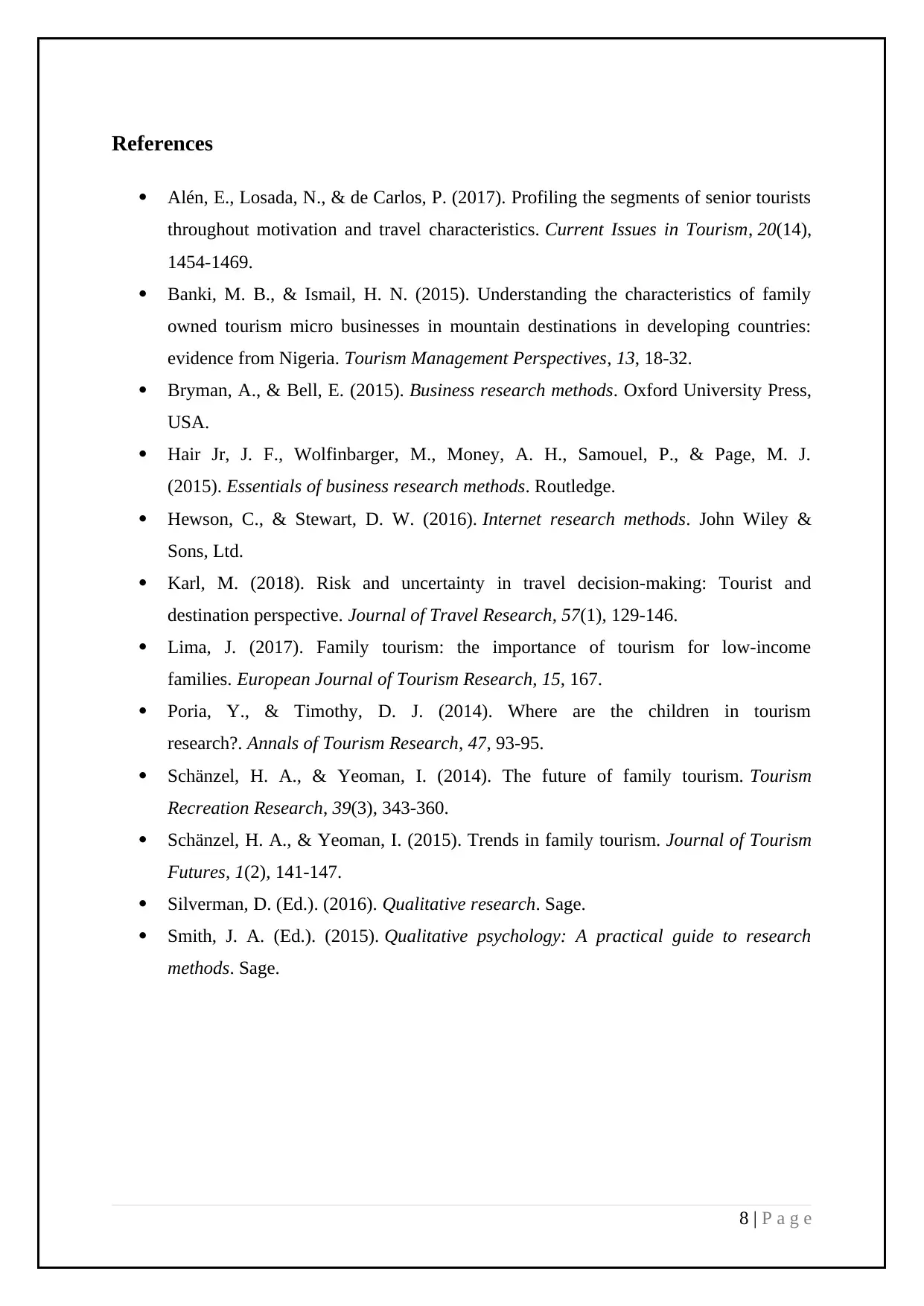
Alén, E., Losada, N., & de Carlos, P. (2017). Profiling the segments of senior tourists
throughout motivation and travel characteristics. Current Issues in Tourism, 20(14),
1454-1469.
Banki, M. B., & Ismail, H. N. (2015). Understanding the characteristics of family
owned tourism micro businesses in mountain destinations in developing countries:
evidence from Nigeria. Tourism Management Perspectives, 13, 18-32.
Bryman, A., & Bell, E. (2015). Business research methods. Oxford University Press,
USA.
Hair Jr, J. F., Wolfinbarger, M., Money, A. H., Samouel, P., & Page, M. J.
(2015). Essentials of business research methods. Routledge.
Hewson, C., & Stewart, D. W. (2016). Internet research methods. John Wiley &
Sons, Ltd.
Karl, M. (2018). Risk and uncertainty in travel decision-making: Tourist and
destination perspective. Journal of Travel Research, 57(1), 129-146.
Lima, J. (2017). Family tourism: the importance of tourism for low-income
families. European Journal of Tourism Research, 15, 167.
Poria, Y., & Timothy, D. J. (2014). Where are the children in tourism
research?. Annals of Tourism Research, 47, 93-95.
Schänzel, H. A., & Yeoman, I. (2014). The future of family tourism. Tourism
Recreation Research, 39(3), 343-360.
Schänzel, H. A., & Yeoman, I. (2015). Trends in family tourism. Journal of Tourism
Futures, 1(2), 141-147.
Silverman, D. (Ed.). (2016). Qualitative research. Sage.
Smith, J. A. (Ed.). (2015). Qualitative psychology: A practical guide to research
methods. Sage.
8 | P a g e
chevron_up_icon
1 out of 8
circle_padding
hide_on_mobile
zoom_out_icon
[object Object]