CHCCSM004: Complex Case Coordination - Assessment Workbook Tasks
VerifiedAdded on 2023/06/18
|20
|4283
|334
Homework Assignment
AI Summary
This document presents a student's assessment workbook for the Diploma of Community Services, focusing on the CHCCSM004 competency: Coordinate complex case requirements. It includes an overview of the unit and assessment, topics covered, and assessment tasks. The workbook provides performance and knowledge evidence requirements, assessment conditions, and instructions for students. Topics covered include case management frameworks and service coordination. The assessment tasks involve questions related to determining service requirements, child abuse allegations, involuntary hospitalization, collaborative working, case management plans, coordination requirements, mandatory reporting, and signs of self-harm or suicide. Desklib offers this document as a resource for students, providing access to solved assignments and study materials.
Student Assessment Workbook
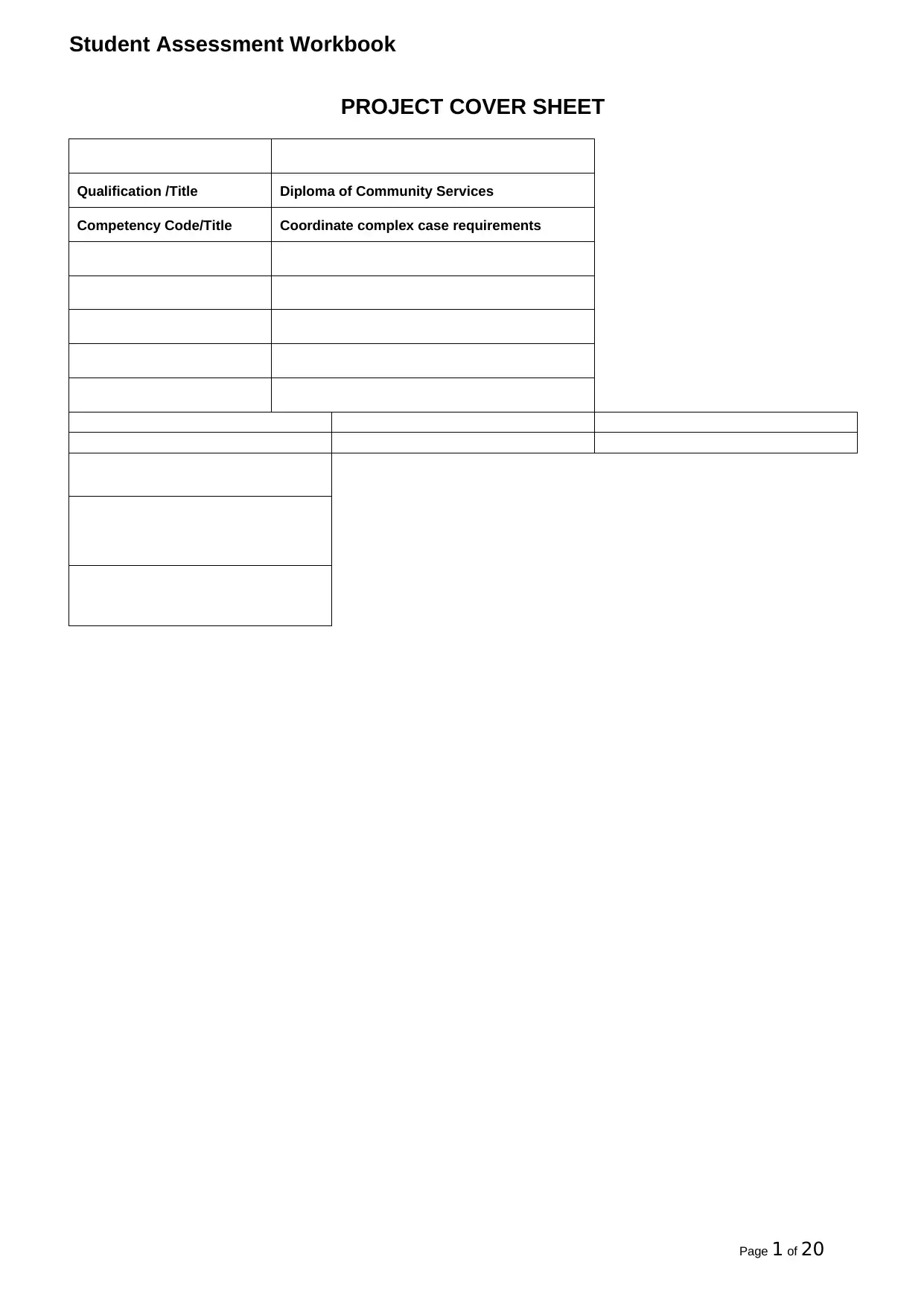
PROJECT COVER SHEET
Qualification /Title Diploma of Community Services
Competency Code/Title Coordinate complex case requirements
Page 1 of 20
PROJECT COVER SHEET
Qualification /Title Diploma of Community Services
Competency Code/Title Coordinate complex case requirements
Page 1 of 20

Paraphrase This Document
Need a fresh take? Get an instant paraphrase of this document with our AI Paraphraser

Student Assessment Workbook
This page has been left blank intentionally
2
This page has been left blank intentionally
2
Student Assessment Workbook
a)
b) CHCCSM004 Coordinate complex case requirements
c) This document comprises of 3 sections:
Section One – Unit and Assessment Overview
Section Two – Topics Covered
Section Three – Assessment Tasks
Section One – Unit and Assessment Overview provides you with an overview of the knowledge
and skills that you need to demonstrate in the assessment tasks. The Unit and Assessment Overview
also provides you with information about the assessment conditions, the Assessor’s role, changes to
the assessment procedure that can be made to accommodate your needs and instructions to
students including how to submit your assessment tasks.
Section Two – Topics Covered provides you with an overview of the key topics covered during your
workshop. These topics are still covered in the workbook by distance based learning students.
Section Three – Assessment Tasks consists of questions, case studies and work-based activities.
These tasks are used to demonstrate that you meet the requirements as detailed in Section One –
Unit and Assessment Overview
Page 3 of 20
a)
b) CHCCSM004 Coordinate complex case requirements
c) This document comprises of 3 sections:
Section One – Unit and Assessment Overview
Section Two – Topics Covered
Section Three – Assessment Tasks
Section One – Unit and Assessment Overview provides you with an overview of the knowledge
and skills that you need to demonstrate in the assessment tasks. The Unit and Assessment Overview
also provides you with information about the assessment conditions, the Assessor’s role, changes to
the assessment procedure that can be made to accommodate your needs and instructions to
students including how to submit your assessment tasks.
Section Two – Topics Covered provides you with an overview of the key topics covered during your
workshop. These topics are still covered in the workbook by distance based learning students.
Section Three – Assessment Tasks consists of questions, case studies and work-based activities.
These tasks are used to demonstrate that you meet the requirements as detailed in Section One –
Unit and Assessment Overview
Page 3 of 20
⊘ This is a preview!⊘
Do you want full access?
Subscribe today to unlock all pages.

Trusted by 1+ million students worldwide
Student Assessment Workbook
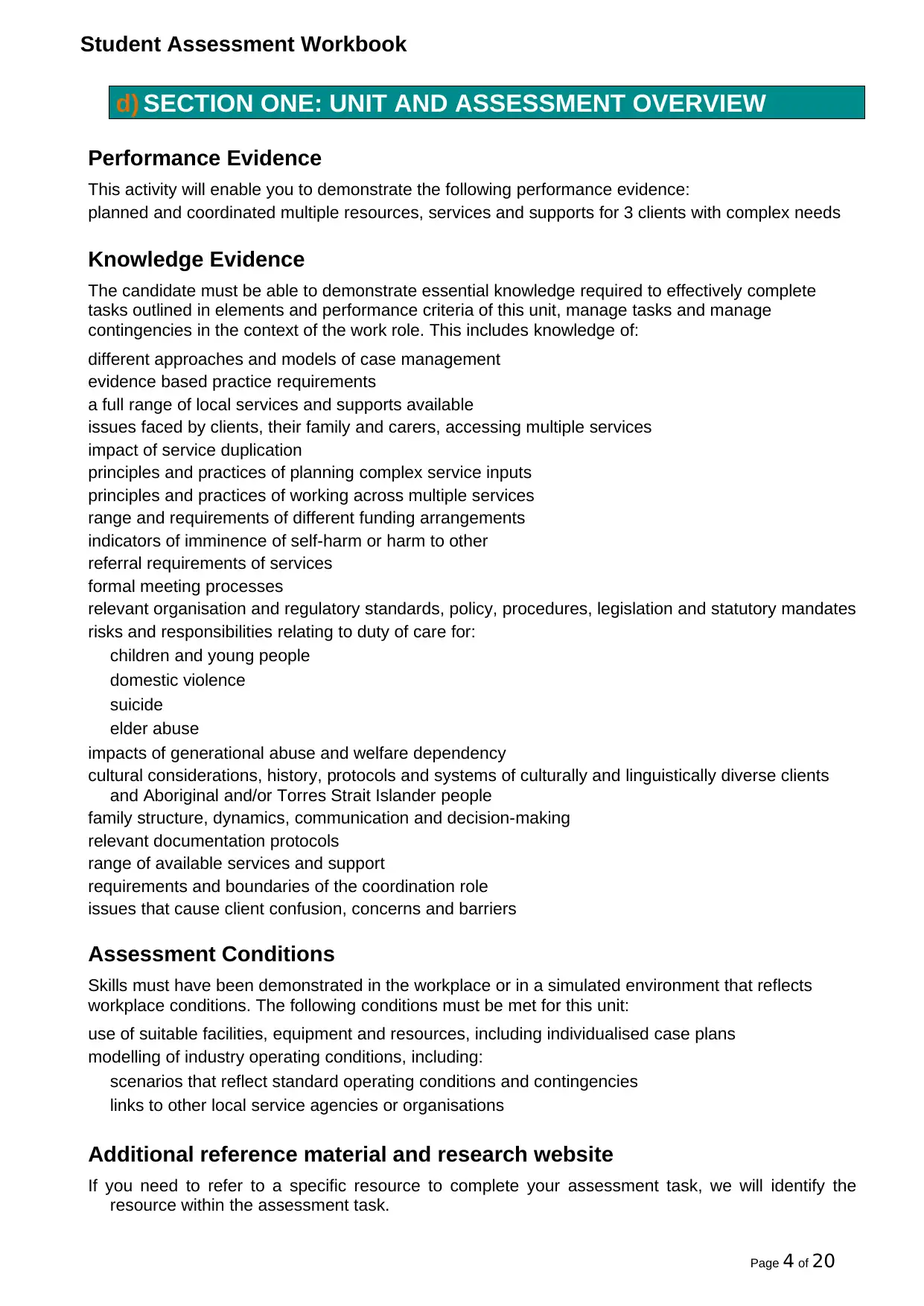
d) SECTION ONE: UNIT AND ASSESSMENT OVERVIEW
Performance Evidence
This activity will enable you to demonstrate the following performance evidence:
planned and coordinated multiple resources, services and supports for 3 clients with complex needs
Knowledge Evidence
The candidate must be able to demonstrate essential knowledge required to effectively complete
tasks outlined in elements and performance criteria of this unit, manage tasks and manage
contingencies in the context of the work role. This includes knowledge of:
different approaches and models of case management
evidence based practice requirements
a full range of local services and supports available
issues faced by clients, their family and carers, accessing multiple services
impact of service duplication
principles and practices of planning complex service inputs
principles and practices of working across multiple services
range and requirements of different funding arrangements
indicators of imminence of self-harm or harm to other
referral requirements of services
formal meeting processes
relevant organisation and regulatory standards, policy, procedures, legislation and statutory mandates
risks and responsibilities relating to duty of care for:
children and young people
domestic violence
suicide
elder abuse
impacts of generational abuse and welfare dependency
cultural considerations, history, protocols and systems of culturally and linguistically diverse clients
and Aboriginal and/or Torres Strait Islander people
family structure, dynamics, communication and decision-making
relevant documentation protocols
range of available services and support
requirements and boundaries of the coordination role
issues that cause client confusion, concerns and barriers
Assessment Conditions
Skills must have been demonstrated in the workplace or in a simulated environment that reflects
workplace conditions. The following conditions must be met for this unit:
use of suitable facilities, equipment and resources, including individualised case plans
modelling of industry operating conditions, including:
scenarios that reflect standard operating conditions and contingencies
links to other local service agencies or organisations
Additional reference material and research website
If you need to refer to a specific resource to complete your assessment task, we will identify the
resource within the assessment task.
Page 4 of 20
d) SECTION ONE: UNIT AND ASSESSMENT OVERVIEW
Performance Evidence
This activity will enable you to demonstrate the following performance evidence:
planned and coordinated multiple resources, services and supports for 3 clients with complex needs
Knowledge Evidence
The candidate must be able to demonstrate essential knowledge required to effectively complete
tasks outlined in elements and performance criteria of this unit, manage tasks and manage
contingencies in the context of the work role. This includes knowledge of:
different approaches and models of case management
evidence based practice requirements
a full range of local services and supports available
issues faced by clients, their family and carers, accessing multiple services
impact of service duplication
principles and practices of planning complex service inputs
principles and practices of working across multiple services
range and requirements of different funding arrangements
indicators of imminence of self-harm or harm to other
referral requirements of services
formal meeting processes
relevant organisation and regulatory standards, policy, procedures, legislation and statutory mandates
risks and responsibilities relating to duty of care for:
children and young people
domestic violence
suicide
elder abuse
impacts of generational abuse and welfare dependency
cultural considerations, history, protocols and systems of culturally and linguistically diverse clients
and Aboriginal and/or Torres Strait Islander people
family structure, dynamics, communication and decision-making
relevant documentation protocols
range of available services and support
requirements and boundaries of the coordination role
issues that cause client confusion, concerns and barriers
Assessment Conditions
Skills must have been demonstrated in the workplace or in a simulated environment that reflects
workplace conditions. The following conditions must be met for this unit:
use of suitable facilities, equipment and resources, including individualised case plans
modelling of industry operating conditions, including:
scenarios that reflect standard operating conditions and contingencies
links to other local service agencies or organisations
Additional reference material and research website
If you need to refer to a specific resource to complete your assessment task, we will identify the
resource within the assessment task.
Page 4 of 20
Paraphrase This Document
Need a fresh take? Get an instant paraphrase of this document with our AI Paraphraser
Student Assessment Workbook
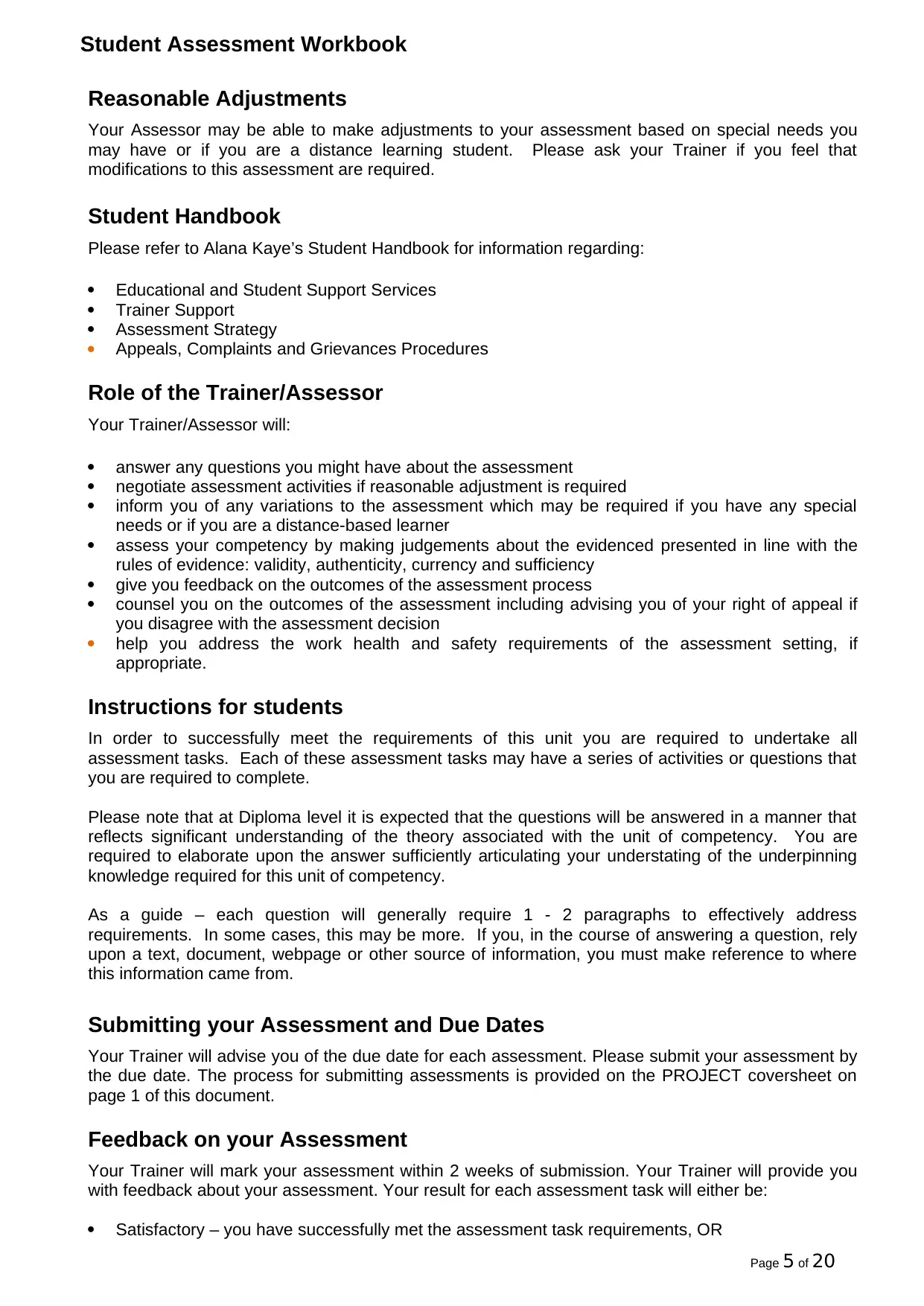
Reasonable Adjustments
Your Assessor may be able to make adjustments to your assessment based on special needs you
may have or if you are a distance learning student. Please ask your Trainer if you feel that
modifications to this assessment are required.
Student Handbook
Please refer to Alana Kaye’s Student Handbook for information regarding:
Educational and Student Support Services
Trainer Support
Assessment Strategy
Appeals, Complaints and Grievances Procedures
Role of the Trainer/Assessor
Your Trainer/Assessor will:
answer any questions you might have about the assessment
negotiate assessment activities if reasonable adjustment is required
inform you of any variations to the assessment which may be required if you have any special
needs or if you are a distance-based learner
assess your competency by making judgements about the evidenced presented in line with the
rules of evidence: validity, authenticity, currency and sufficiency
give you feedback on the outcomes of the assessment process
counsel you on the outcomes of the assessment including advising you of your right of appeal if
you disagree with the assessment decision
help you address the work health and safety requirements of the assessment setting, if
appropriate.
Instructions for students
In order to successfully meet the requirements of this unit you are required to undertake all
assessment tasks. Each of these assessment tasks may have a series of activities or questions that
you are required to complete.
Please note that at Diploma level it is expected that the questions will be answered in a manner that
reflects significant understanding of the theory associated with the unit of competency. You are
required to elaborate upon the answer sufficiently articulating your understating of the underpinning
knowledge required for this unit of competency.
As a guide – each question will generally require 1 - 2 paragraphs to effectively address
requirements. In some cases, this may be more. If you, in the course of answering a question, rely
upon a text, document, webpage or other source of information, you must make reference to where
this information came from.
Submitting your Assessment and Due Dates
Your Trainer will advise you of the due date for each assessment. Please submit your assessment by
the due date. The process for submitting assessments is provided on the PROJECT coversheet on
page 1 of this document.
Feedback on your Assessment
Your Trainer will mark your assessment within 2 weeks of submission. Your Trainer will provide you
with feedback about your assessment. Your result for each assessment task will either be:
Satisfactory – you have successfully met the assessment task requirements, OR
Page 5 of 20
Reasonable Adjustments
Your Assessor may be able to make adjustments to your assessment based on special needs you
may have or if you are a distance learning student. Please ask your Trainer if you feel that
modifications to this assessment are required.
Student Handbook
Please refer to Alana Kaye’s Student Handbook for information regarding:
Educational and Student Support Services
Trainer Support
Assessment Strategy
Appeals, Complaints and Grievances Procedures
Role of the Trainer/Assessor
Your Trainer/Assessor will:
answer any questions you might have about the assessment
negotiate assessment activities if reasonable adjustment is required
inform you of any variations to the assessment which may be required if you have any special
needs or if you are a distance-based learner
assess your competency by making judgements about the evidenced presented in line with the
rules of evidence: validity, authenticity, currency and sufficiency
give you feedback on the outcomes of the assessment process
counsel you on the outcomes of the assessment including advising you of your right of appeal if
you disagree with the assessment decision
help you address the work health and safety requirements of the assessment setting, if
appropriate.
Instructions for students
In order to successfully meet the requirements of this unit you are required to undertake all
assessment tasks. Each of these assessment tasks may have a series of activities or questions that
you are required to complete.
Please note that at Diploma level it is expected that the questions will be answered in a manner that
reflects significant understanding of the theory associated with the unit of competency. You are
required to elaborate upon the answer sufficiently articulating your understating of the underpinning
knowledge required for this unit of competency.
As a guide – each question will generally require 1 - 2 paragraphs to effectively address
requirements. In some cases, this may be more. If you, in the course of answering a question, rely
upon a text, document, webpage or other source of information, you must make reference to where
this information came from.
Submitting your Assessment and Due Dates
Your Trainer will advise you of the due date for each assessment. Please submit your assessment by
the due date. The process for submitting assessments is provided on the PROJECT coversheet on
page 1 of this document.
Feedback on your Assessment
Your Trainer will mark your assessment within 2 weeks of submission. Your Trainer will provide you
with feedback about your assessment. Your result for each assessment task will either be:
Satisfactory – you have successfully met the assessment task requirements, OR
Page 5 of 20
Student Assessment Workbook
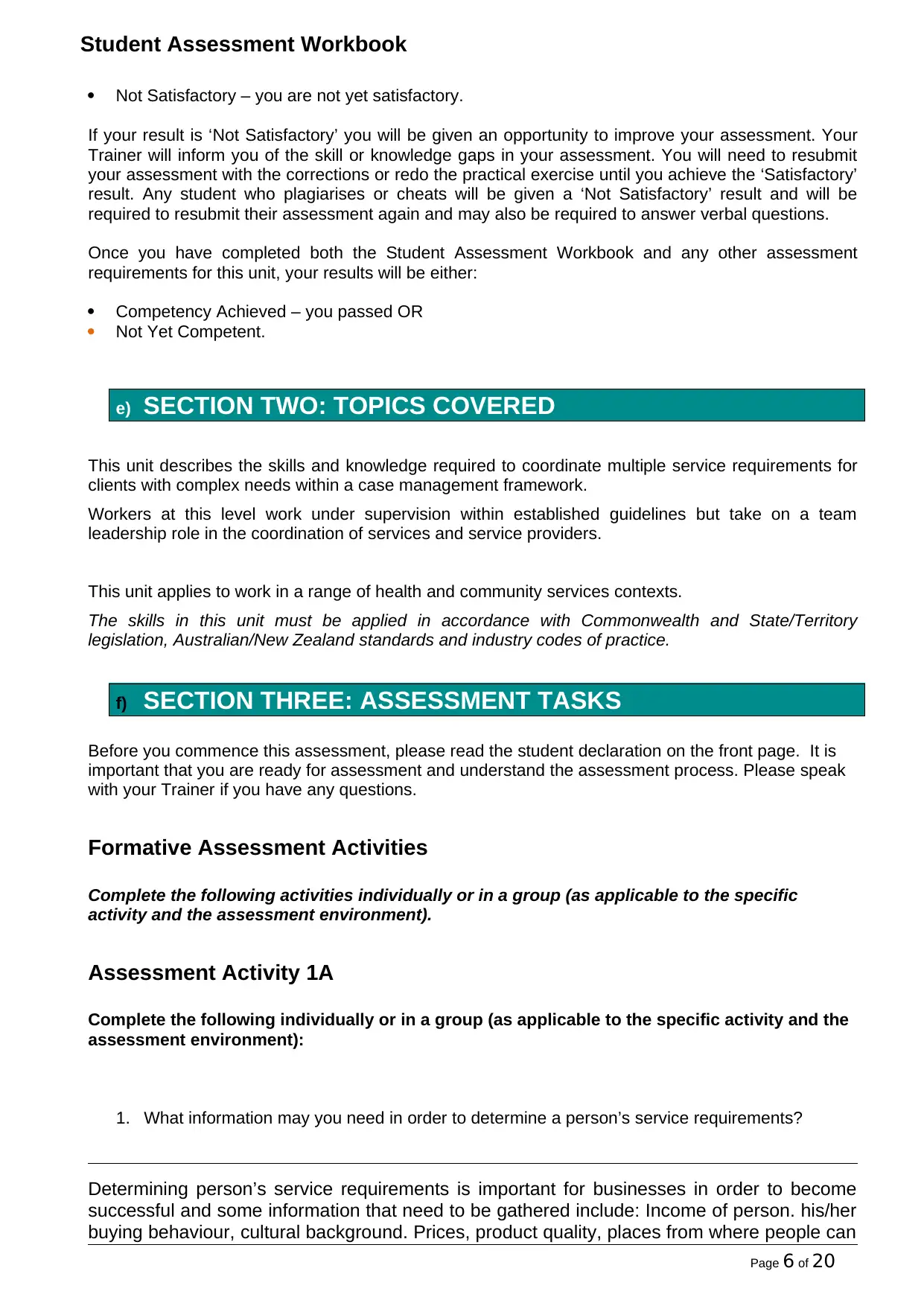
Not Satisfactory – you are not yet satisfactory.
If your result is ‘Not Satisfactory’ you will be given an opportunity to improve your assessment. Your
Trainer will inform you of the skill or knowledge gaps in your assessment. You will need to resubmit
your assessment with the corrections or redo the practical exercise until you achieve the ‘Satisfactory’
result. Any student who plagiarises or cheats will be given a ‘Not Satisfactory’ result and will be
required to resubmit their assessment again and may also be required to answer verbal questions.
Once you have completed both the Student Assessment Workbook and any other assessment
requirements for this unit, your results will be either:
Competency Achieved – you passed OR
Not Yet Competent.
e) SECTION TWO: TOPICS COVERED
This unit describes the skills and knowledge required to coordinate multiple service requirements for
clients with complex needs within a case management framework.
Workers at this level work under supervision within established guidelines but take on a team
leadership role in the coordination of services and service providers.
This unit applies to work in a range of health and community services contexts.
The skills in this unit must be applied in accordance with Commonwealth and State/Territory
legislation, Australian/New Zealand standards and industry codes of practice.
f) SECTION THREE: ASSESSMENT TASKS
Before you commence this assessment, please read the student declaration on the front page. It is
important that you are ready for assessment and understand the assessment process. Please speak
with your Trainer if you have any questions.
Formative Assessment Activities
Complete the following activities individually or in a group (as applicable to the specific
activity and the assessment environment).
Assessment Activity 1A
Complete the following individually or in a group (as applicable to the specific activity and the
assessment environment):
1. What information may you need in order to determine a person’s service requirements?
Determining person’s service requirements is important for businesses in order to become
successful and some information that need to be gathered include: Income of person. his/her
buying behaviour, cultural background. Prices, product quality, places from where people can
Page 6 of 20
Not Satisfactory – you are not yet satisfactory.
If your result is ‘Not Satisfactory’ you will be given an opportunity to improve your assessment. Your
Trainer will inform you of the skill or knowledge gaps in your assessment. You will need to resubmit
your assessment with the corrections or redo the practical exercise until you achieve the ‘Satisfactory’
result. Any student who plagiarises or cheats will be given a ‘Not Satisfactory’ result and will be
required to resubmit their assessment again and may also be required to answer verbal questions.
Once you have completed both the Student Assessment Workbook and any other assessment
requirements for this unit, your results will be either:
Competency Achieved – you passed OR
Not Yet Competent.
e) SECTION TWO: TOPICS COVERED
This unit describes the skills and knowledge required to coordinate multiple service requirements for
clients with complex needs within a case management framework.
Workers at this level work under supervision within established guidelines but take on a team
leadership role in the coordination of services and service providers.
This unit applies to work in a range of health and community services contexts.
The skills in this unit must be applied in accordance with Commonwealth and State/Territory
legislation, Australian/New Zealand standards and industry codes of practice.
f) SECTION THREE: ASSESSMENT TASKS
Before you commence this assessment, please read the student declaration on the front page. It is
important that you are ready for assessment and understand the assessment process. Please speak
with your Trainer if you have any questions.
Formative Assessment Activities
Complete the following activities individually or in a group (as applicable to the specific
activity and the assessment environment).
Assessment Activity 1A
Complete the following individually or in a group (as applicable to the specific activity and the
assessment environment):
1. What information may you need in order to determine a person’s service requirements?
Determining person’s service requirements is important for businesses in order to become
successful and some information that need to be gathered include: Income of person. his/her
buying behaviour, cultural background. Prices, product quality, places from where people can
Page 6 of 20
⊘ This is a preview!⊘
Do you want full access?
Subscribe today to unlock all pages.
Trusted by 1+ million students worldwide
Student Assessment Workbook
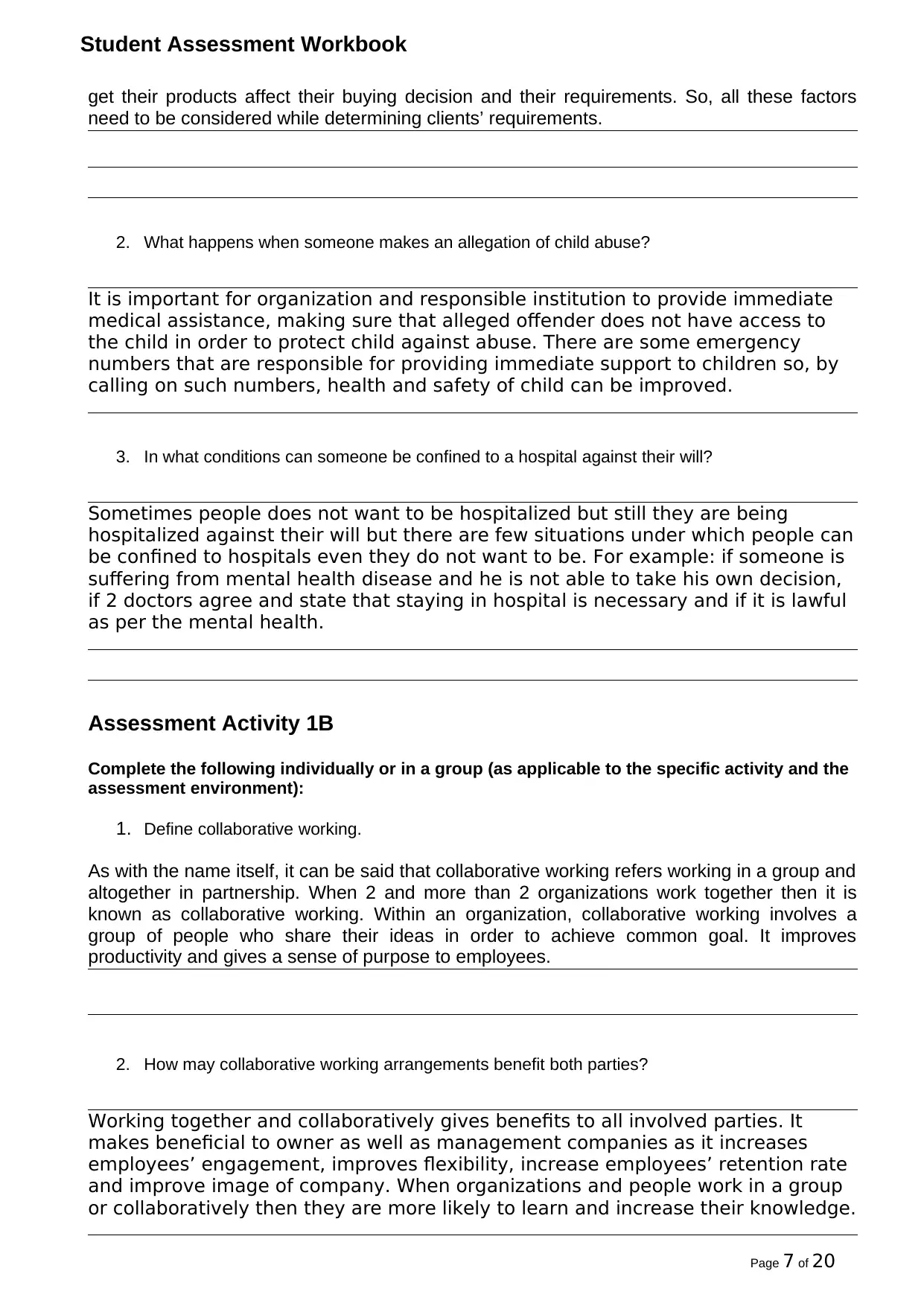
get their products affect their buying decision and their requirements. So, all these factors
need to be considered while determining clients’ requirements.
2. What happens when someone makes an allegation of child abuse?
It is important for organization and responsible institution to provide immediate
medical assistance, making sure that alleged offender does not have access to
the child in order to protect child against abuse. There are some emergency
numbers that are responsible for providing immediate support to children so, by
calling on such numbers, health and safety of child can be improved.
3. In what conditions can someone be confined to a hospital against their will?
Sometimes people does not want to be hospitalized but still they are being
hospitalized against their will but there are few situations under which people can
be confined to hospitals even they do not want to be. For example: if someone is
suffering from mental health disease and he is not able to take his own decision,
if 2 doctors agree and state that staying in hospital is necessary and if it is lawful
as per the mental health.
Assessment Activity 1B
Complete the following individually or in a group (as applicable to the specific activity and the
assessment environment):
1. Define collaborative working.
As with the name itself, it can be said that collaborative working refers working in a group and
altogether in partnership. When 2 and more than 2 organizations work together then it is
known as collaborative working. Within an organization, collaborative working involves a
group of people who share their ideas in order to achieve common goal. It improves
productivity and gives a sense of purpose to employees.
2. How may collaborative working arrangements benefit both parties?
Working together and collaboratively gives benefits to all involved parties. It
makes beneficial to owner as well as management companies as it increases
employees’ engagement, improves flexibility, increase employees’ retention rate
and improve image of company. When organizations and people work in a group
or collaboratively then they are more likely to learn and increase their knowledge.
Page 7 of 20
get their products affect their buying decision and their requirements. So, all these factors
need to be considered while determining clients’ requirements.
2. What happens when someone makes an allegation of child abuse?
It is important for organization and responsible institution to provide immediate
medical assistance, making sure that alleged offender does not have access to
the child in order to protect child against abuse. There are some emergency
numbers that are responsible for providing immediate support to children so, by
calling on such numbers, health and safety of child can be improved.
3. In what conditions can someone be confined to a hospital against their will?
Sometimes people does not want to be hospitalized but still they are being
hospitalized against their will but there are few situations under which people can
be confined to hospitals even they do not want to be. For example: if someone is
suffering from mental health disease and he is not able to take his own decision,
if 2 doctors agree and state that staying in hospital is necessary and if it is lawful
as per the mental health.
Assessment Activity 1B
Complete the following individually or in a group (as applicable to the specific activity and the
assessment environment):
1. Define collaborative working.
As with the name itself, it can be said that collaborative working refers working in a group and
altogether in partnership. When 2 and more than 2 organizations work together then it is
known as collaborative working. Within an organization, collaborative working involves a
group of people who share their ideas in order to achieve common goal. It improves
productivity and gives a sense of purpose to employees.
2. How may collaborative working arrangements benefit both parties?
Working together and collaboratively gives benefits to all involved parties. It
makes beneficial to owner as well as management companies as it increases
employees’ engagement, improves flexibility, increase employees’ retention rate
and improve image of company. When organizations and people work in a group
or collaboratively then they are more likely to learn and increase their knowledge.
Page 7 of 20
Paraphrase This Document
Need a fresh take? Get an instant paraphrase of this document with our AI Paraphraser
Student Assessment Workbook
Assessment Activity 1C
Complete the following individually or in a group (as applicable to the specific activity and the
assessment environment):
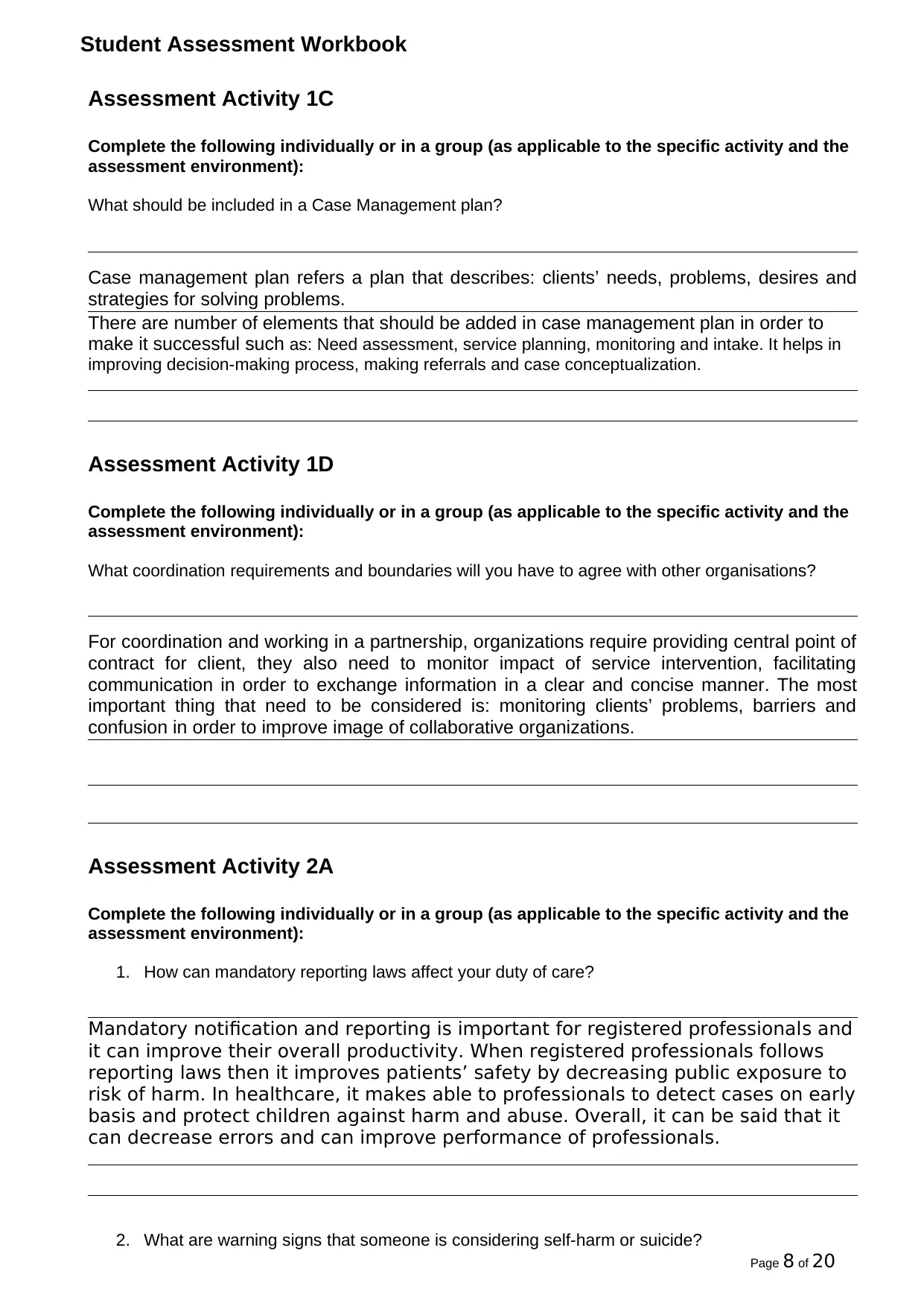
What should be included in a Case Management plan?
Case management plan refers a plan that describes: clients’ needs, problems, desires and
strategies for solving problems.
There are number of elements that should be added in case management plan in order to
make it successful such as: Need assessment, service planning, monitoring and intake. It helps in
improving decision-making process, making referrals and case conceptualization.
Assessment Activity 1D
Complete the following individually or in a group (as applicable to the specific activity and the
assessment environment):
What coordination requirements and boundaries will you have to agree with other organisations?
For coordination and working in a partnership, organizations require providing central point of
contract for client, they also need to monitor impact of service intervention, facilitating
communication in order to exchange information in a clear and concise manner. The most
important thing that need to be considered is: monitoring clients’ problems, barriers and
confusion in order to improve image of collaborative organizations.
Assessment Activity 2A
Complete the following individually or in a group (as applicable to the specific activity and the
assessment environment):
1. How can mandatory reporting laws affect your duty of care?
Mandatory notification and reporting is important for registered professionals and
it can improve their overall productivity. When registered professionals follows
reporting laws then it improves patients’ safety by decreasing public exposure to
risk of harm. In healthcare, it makes able to professionals to detect cases on early
basis and protect children against harm and abuse. Overall, it can be said that it
can decrease errors and can improve performance of professionals.
2. What are warning signs that someone is considering self-harm or suicide?
Page 8 of 20
Assessment Activity 1C
Complete the following individually or in a group (as applicable to the specific activity and the
assessment environment):
What should be included in a Case Management plan?
Case management plan refers a plan that describes: clients’ needs, problems, desires and
strategies for solving problems.
There are number of elements that should be added in case management plan in order to
make it successful such as: Need assessment, service planning, monitoring and intake. It helps in
improving decision-making process, making referrals and case conceptualization.
Assessment Activity 1D
Complete the following individually or in a group (as applicable to the specific activity and the
assessment environment):
What coordination requirements and boundaries will you have to agree with other organisations?
For coordination and working in a partnership, organizations require providing central point of
contract for client, they also need to monitor impact of service intervention, facilitating
communication in order to exchange information in a clear and concise manner. The most
important thing that need to be considered is: monitoring clients’ problems, barriers and
confusion in order to improve image of collaborative organizations.
Assessment Activity 2A
Complete the following individually or in a group (as applicable to the specific activity and the
assessment environment):
1. How can mandatory reporting laws affect your duty of care?
Mandatory notification and reporting is important for registered professionals and
it can improve their overall productivity. When registered professionals follows
reporting laws then it improves patients’ safety by decreasing public exposure to
risk of harm. In healthcare, it makes able to professionals to detect cases on early
basis and protect children against harm and abuse. Overall, it can be said that it
can decrease errors and can improve performance of professionals.
2. What are warning signs that someone is considering self-harm or suicide?
Page 8 of 20
Student Assessment Workbook
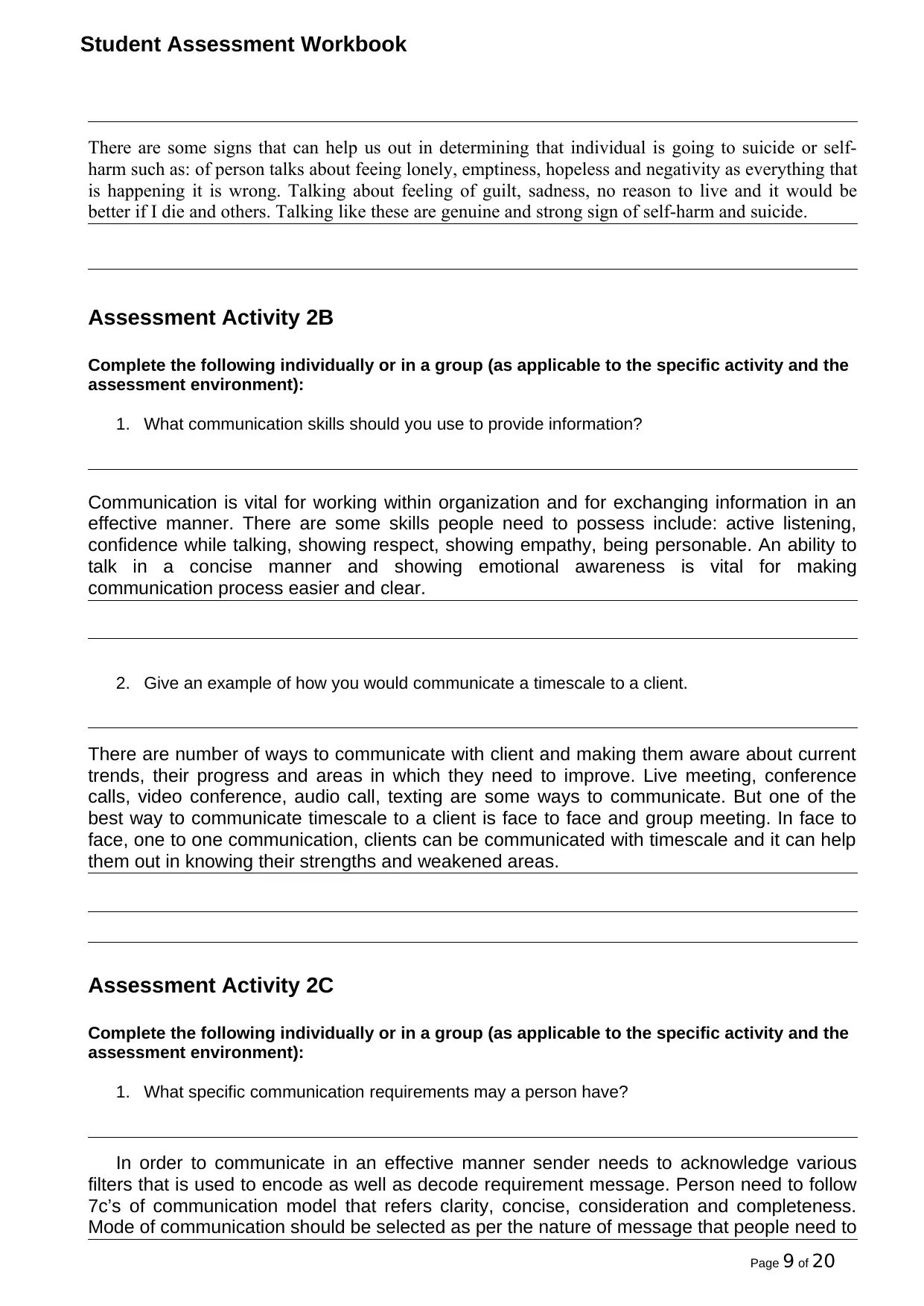
There are some signs that can help us out in determining that individual is going to suicide or self-
harm such as: of person talks about feeing lonely, emptiness, hopeless and negativity as everything that
is happening it is wrong. Talking about feeling of guilt, sadness, no reason to live and it would be
better if I die and others. Talking like these are genuine and strong sign of self-harm and suicide.
Assessment Activity 2B
Complete the following individually or in a group (as applicable to the specific activity and the
assessment environment):
1. What communication skills should you use to provide information?
Communication is vital for working within organization and for exchanging information in an
effective manner. There are some skills people need to possess include: active listening,
confidence while talking, showing respect, showing empathy, being personable. An ability to
talk in a concise manner and showing emotional awareness is vital for making
communication process easier and clear.
2. Give an example of how you would communicate a timescale to a client.
There are number of ways to communicate with client and making them aware about current
trends, their progress and areas in which they need to improve. Live meeting, conference
calls, video conference, audio call, texting are some ways to communicate. But one of the
best way to communicate timescale to a client is face to face and group meeting. In face to
face, one to one communication, clients can be communicated with timescale and it can help
them out in knowing their strengths and weakened areas.
Assessment Activity 2C
Complete the following individually or in a group (as applicable to the specific activity and the
assessment environment):
1. What specific communication requirements may a person have?
In order to communicate in an effective manner sender needs to acknowledge various
filters that is used to encode as well as decode requirement message. Person need to follow
7c’s of communication model that refers clarity, concise, consideration and completeness.
Mode of communication should be selected as per the nature of message that people need to
Page 9 of 20
There are some signs that can help us out in determining that individual is going to suicide or self-
harm such as: of person talks about feeing lonely, emptiness, hopeless and negativity as everything that
is happening it is wrong. Talking about feeling of guilt, sadness, no reason to live and it would be
better if I die and others. Talking like these are genuine and strong sign of self-harm and suicide.
Assessment Activity 2B
Complete the following individually or in a group (as applicable to the specific activity and the
assessment environment):
1. What communication skills should you use to provide information?
Communication is vital for working within organization and for exchanging information in an
effective manner. There are some skills people need to possess include: active listening,
confidence while talking, showing respect, showing empathy, being personable. An ability to
talk in a concise manner and showing emotional awareness is vital for making
communication process easier and clear.
2. Give an example of how you would communicate a timescale to a client.
There are number of ways to communicate with client and making them aware about current
trends, their progress and areas in which they need to improve. Live meeting, conference
calls, video conference, audio call, texting are some ways to communicate. But one of the
best way to communicate timescale to a client is face to face and group meeting. In face to
face, one to one communication, clients can be communicated with timescale and it can help
them out in knowing their strengths and weakened areas.
Assessment Activity 2C
Complete the following individually or in a group (as applicable to the specific activity and the
assessment environment):
1. What specific communication requirements may a person have?
In order to communicate in an effective manner sender needs to acknowledge various
filters that is used to encode as well as decode requirement message. Person need to follow
7c’s of communication model that refers clarity, concise, consideration and completeness.
Mode of communication should be selected as per the nature of message that people need to
Page 9 of 20
⊘ This is a preview!⊘
Do you want full access?
Subscribe today to unlock all pages.
Trusted by 1+ million students worldwide
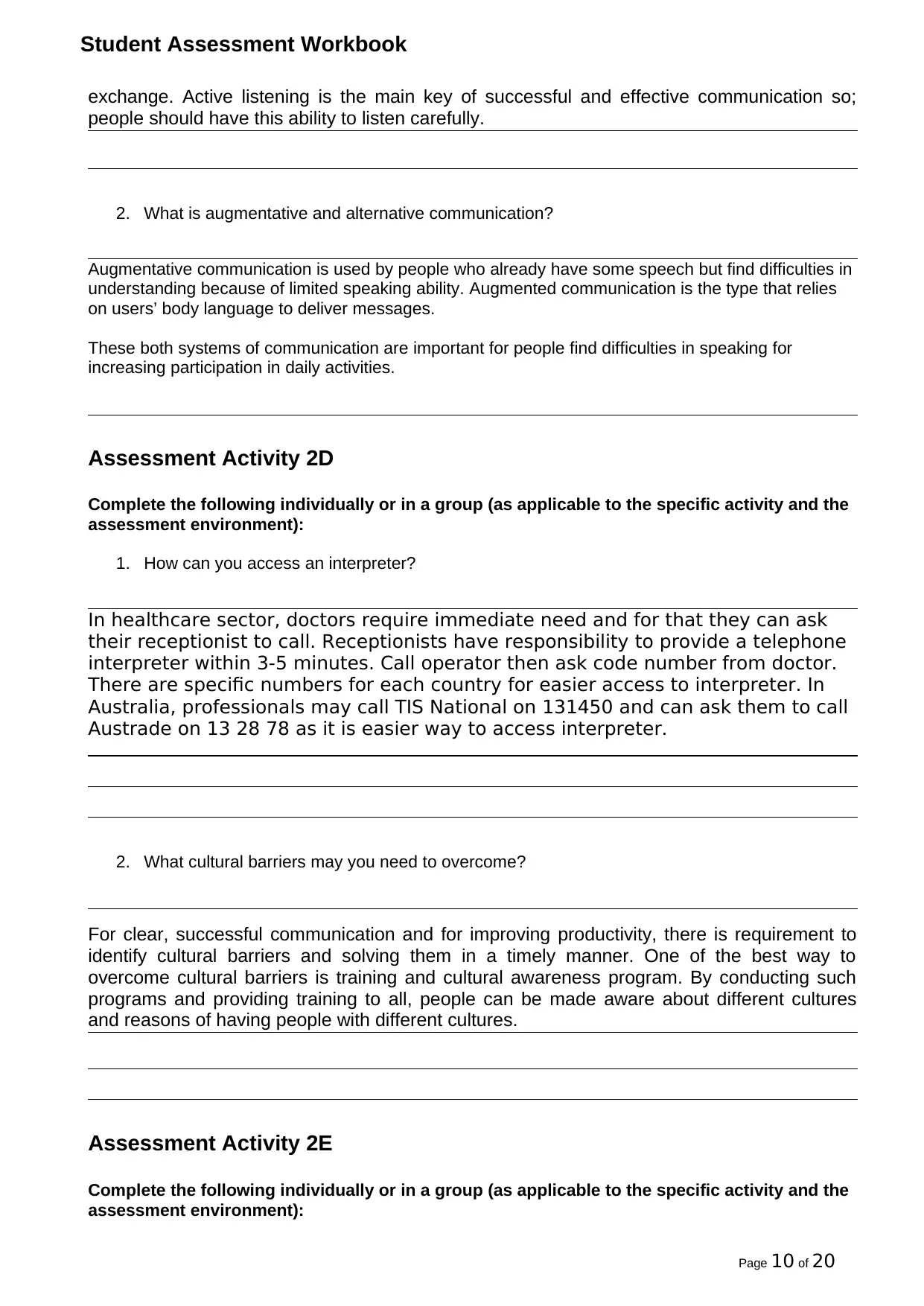
Student Assessment Workbook
exchange. Active listening is the main key of successful and effective communication so;
people should have this ability to listen carefully.
2. What is augmentative and alternative communication?
Augmentative communication is used by people who already have some speech but find difficulties in
understanding because of limited speaking ability. Augmented communication is the type that relies
on users’ body language to deliver messages.
These both systems of communication are important for people find difficulties in speaking for
increasing participation in daily activities.
Assessment Activity 2D
Complete the following individually or in a group (as applicable to the specific activity and the
assessment environment):
1. How can you access an interpreter?
In healthcare sector, doctors require immediate need and for that they can ask
their receptionist to call. Receptionists have responsibility to provide a telephone
interpreter within 3-5 minutes. Call operator then ask code number from doctor.
There are specific numbers for each country for easier access to interpreter. In
Australia, professionals may call TIS National on 131450 and can ask them to call
Austrade on 13 28 78 as it is easier way to access interpreter.
2. What cultural barriers may you need to overcome?
For clear, successful communication and for improving productivity, there is requirement to
identify cultural barriers and solving them in a timely manner. One of the best way to
overcome cultural barriers is training and cultural awareness program. By conducting such
programs and providing training to all, people can be made aware about different cultures
and reasons of having people with different cultures.
Assessment Activity 2E
Complete the following individually or in a group (as applicable to the specific activity and the
assessment environment):
Page 10 of 20
exchange. Active listening is the main key of successful and effective communication so;
people should have this ability to listen carefully.
2. What is augmentative and alternative communication?
Augmentative communication is used by people who already have some speech but find difficulties in
understanding because of limited speaking ability. Augmented communication is the type that relies
on users’ body language to deliver messages.
These both systems of communication are important for people find difficulties in speaking for
increasing participation in daily activities.
Assessment Activity 2D
Complete the following individually or in a group (as applicable to the specific activity and the
assessment environment):
1. How can you access an interpreter?
In healthcare sector, doctors require immediate need and for that they can ask
their receptionist to call. Receptionists have responsibility to provide a telephone
interpreter within 3-5 minutes. Call operator then ask code number from doctor.
There are specific numbers for each country for easier access to interpreter. In
Australia, professionals may call TIS National on 131450 and can ask them to call
Austrade on 13 28 78 as it is easier way to access interpreter.
2. What cultural barriers may you need to overcome?
For clear, successful communication and for improving productivity, there is requirement to
identify cultural barriers and solving them in a timely manner. One of the best way to
overcome cultural barriers is training and cultural awareness program. By conducting such
programs and providing training to all, people can be made aware about different cultures
and reasons of having people with different cultures.
Assessment Activity 2E
Complete the following individually or in a group (as applicable to the specific activity and the
assessment environment):
Page 10 of 20
Paraphrase This Document
Need a fresh take? Get an instant paraphrase of this document with our AI Paraphraser
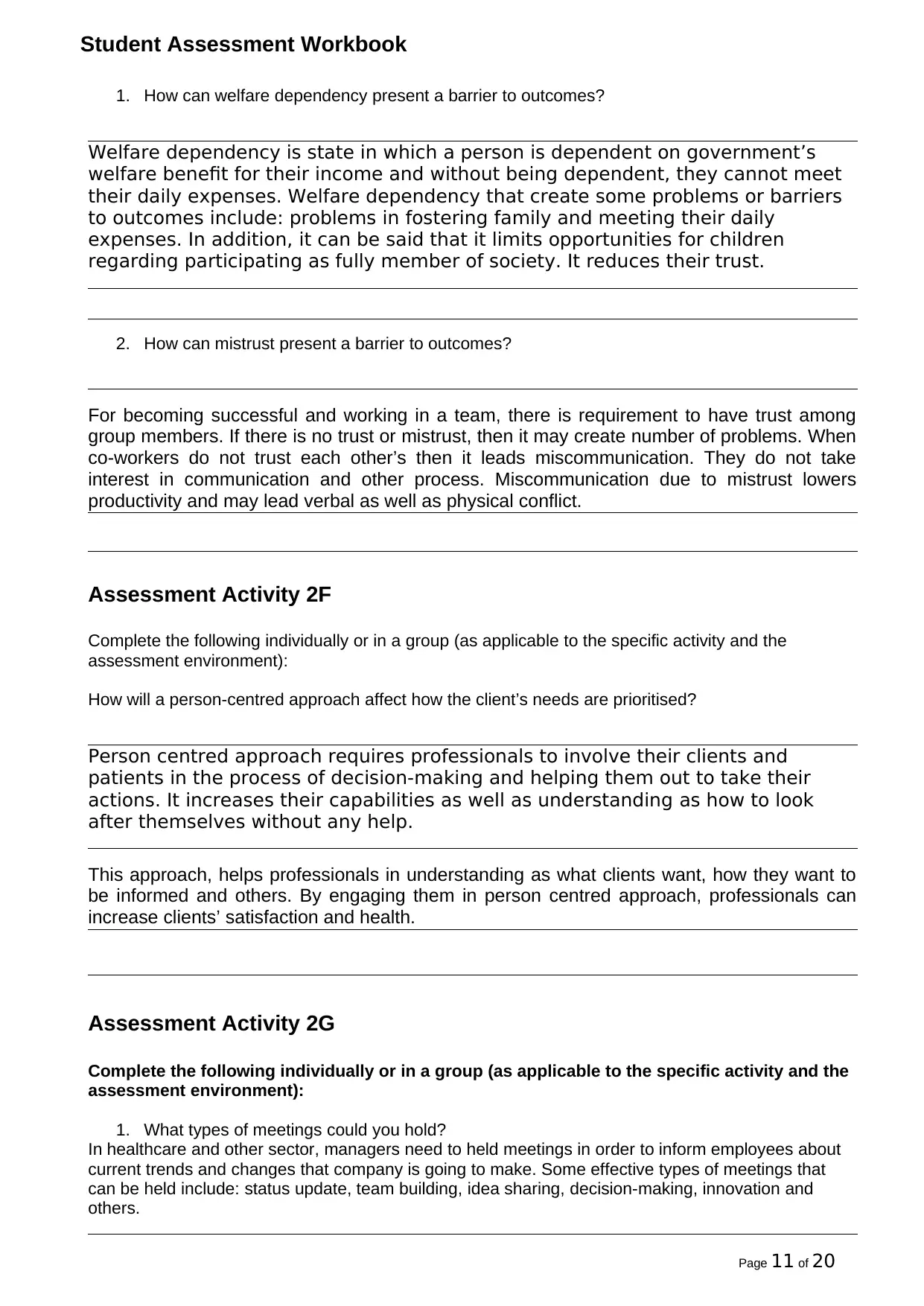
Student Assessment Workbook
1. How can welfare dependency present a barrier to outcomes?
Welfare dependency is state in which a person is dependent on government’s
welfare benefit for their income and without being dependent, they cannot meet
their daily expenses. Welfare dependency that create some problems or barriers
to outcomes include: problems in fostering family and meeting their daily
expenses. In addition, it can be said that it limits opportunities for children
regarding participating as fully member of society. It reduces their trust.
2. How can mistrust present a barrier to outcomes?
For becoming successful and working in a team, there is requirement to have trust among
group members. If there is no trust or mistrust, then it may create number of problems. When
co-workers do not trust each other’s then it leads miscommunication. They do not take
interest in communication and other process. Miscommunication due to mistrust lowers
productivity and may lead verbal as well as physical conflict.
Assessment Activity 2F
Complete the following individually or in a group (as applicable to the specific activity and the
assessment environment):
How will a person-centred approach affect how the client’s needs are prioritised?
Person centred approach requires professionals to involve their clients and
patients in the process of decision-making and helping them out to take their
actions. It increases their capabilities as well as understanding as how to look
after themselves without any help.
This approach, helps professionals in understanding as what clients want, how they want to
be informed and others. By engaging them in person centred approach, professionals can
increase clients’ satisfaction and health.
Assessment Activity 2G
Complete the following individually or in a group (as applicable to the specific activity and the
assessment environment):
1. What types of meetings could you hold?
In healthcare and other sector, managers need to held meetings in order to inform employees about
current trends and changes that company is going to make. Some effective types of meetings that
can be held include: status update, team building, idea sharing, decision-making, innovation and
others.
Page 11 of 20
1. How can welfare dependency present a barrier to outcomes?
Welfare dependency is state in which a person is dependent on government’s
welfare benefit for their income and without being dependent, they cannot meet
their daily expenses. Welfare dependency that create some problems or barriers
to outcomes include: problems in fostering family and meeting their daily
expenses. In addition, it can be said that it limits opportunities for children
regarding participating as fully member of society. It reduces their trust.
2. How can mistrust present a barrier to outcomes?
For becoming successful and working in a team, there is requirement to have trust among
group members. If there is no trust or mistrust, then it may create number of problems. When
co-workers do not trust each other’s then it leads miscommunication. They do not take
interest in communication and other process. Miscommunication due to mistrust lowers
productivity and may lead verbal as well as physical conflict.
Assessment Activity 2F
Complete the following individually or in a group (as applicable to the specific activity and the
assessment environment):
How will a person-centred approach affect how the client’s needs are prioritised?
Person centred approach requires professionals to involve their clients and
patients in the process of decision-making and helping them out to take their
actions. It increases their capabilities as well as understanding as how to look
after themselves without any help.
This approach, helps professionals in understanding as what clients want, how they want to
be informed and others. By engaging them in person centred approach, professionals can
increase clients’ satisfaction and health.
Assessment Activity 2G
Complete the following individually or in a group (as applicable to the specific activity and the
assessment environment):
1. What types of meetings could you hold?
In healthcare and other sector, managers need to held meetings in order to inform employees about
current trends and changes that company is going to make. Some effective types of meetings that
can be held include: status update, team building, idea sharing, decision-making, innovation and
others.
Page 11 of 20
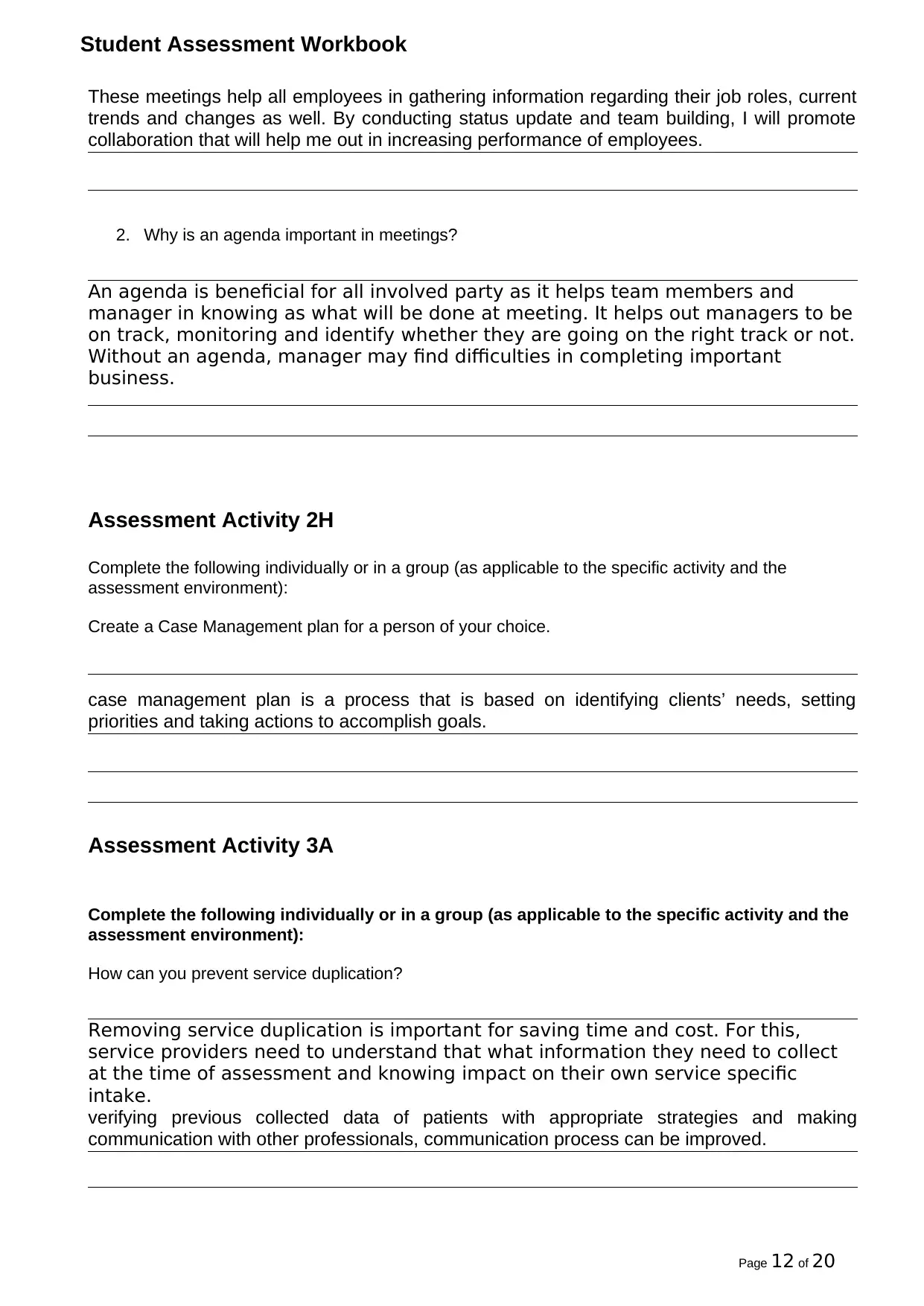
Student Assessment Workbook
These meetings help all employees in gathering information regarding their job roles, current
trends and changes as well. By conducting status update and team building, I will promote
collaboration that will help me out in increasing performance of employees.
2. Why is an agenda important in meetings?
An agenda is beneficial for all involved party as it helps team members and
manager in knowing as what will be done at meeting. It helps out managers to be
on track, monitoring and identify whether they are going on the right track or not.
Without an agenda, manager may find difficulties in completing important
business.
Assessment Activity 2H
Complete the following individually or in a group (as applicable to the specific activity and the
assessment environment):
Create a Case Management plan for a person of your choice.
case management plan is a process that is based on identifying clients’ needs, setting
priorities and taking actions to accomplish goals.
Assessment Activity 3A
Complete the following individually or in a group (as applicable to the specific activity and the
assessment environment):
How can you prevent service duplication?
Removing service duplication is important for saving time and cost. For this,
service providers need to understand that what information they need to collect
at the time of assessment and knowing impact on their own service specific
intake.
verifying previous collected data of patients with appropriate strategies and making
communication with other professionals, communication process can be improved.
Page 12 of 20
These meetings help all employees in gathering information regarding their job roles, current
trends and changes as well. By conducting status update and team building, I will promote
collaboration that will help me out in increasing performance of employees.
2. Why is an agenda important in meetings?
An agenda is beneficial for all involved party as it helps team members and
manager in knowing as what will be done at meeting. It helps out managers to be
on track, monitoring and identify whether they are going on the right track or not.
Without an agenda, manager may find difficulties in completing important
business.
Assessment Activity 2H
Complete the following individually or in a group (as applicable to the specific activity and the
assessment environment):
Create a Case Management plan for a person of your choice.
case management plan is a process that is based on identifying clients’ needs, setting
priorities and taking actions to accomplish goals.
Assessment Activity 3A
Complete the following individually or in a group (as applicable to the specific activity and the
assessment environment):
How can you prevent service duplication?
Removing service duplication is important for saving time and cost. For this,
service providers need to understand that what information they need to collect
at the time of assessment and knowing impact on their own service specific
intake.
verifying previous collected data of patients with appropriate strategies and making
communication with other professionals, communication process can be improved.
Page 12 of 20
⊘ This is a preview!⊘
Do you want full access?
Subscribe today to unlock all pages.
Trusted by 1+ million students worldwide

1 out of 20


Related Documents


Your All-in-One AI-Powered Toolkit for Academic Success.
+13062052269
info@desklib.com
Available 24*7 on WhatsApp / Email
![[object Object]](/_next/static/media/star-bottom.7253800d.svg)
Unlock your academic potential
Copyright © 2020–2025 A2Z Services. All Rights Reserved. Developed and managed by ZUCOL.