Molarity and Dilution: Calculating and Preparing Solutions

Verified

Added on  2023/06/10

|5
|728
|83
Homework Assignment
AI Summary
This assignment provides detailed solutions for various solution preparation problems, including calculating the mass of NaCl required for molar solutions (1M and 0.5M), preparing percentage solutions of sugar and ethanol, and diluting concentrated HCl to desired molarities. It covers calculations for preparing solutions like 500 ml of 70% ethanol, 20 MLD of 80% ethanol, and 20 MLD of 2% acetic acid. The solutions demonstrate step-by-step calculations using the formula C1V1 = C2V2 for dilutions and explain the reasoning behind each step, making it a comprehensive guide for students learning solution chemistry. It references chemical oceanography and aquatic chemistry concepts for context.
Document Page
CHEMISTRY
[Author Name(s), First M. Last, Omit Titles and Degrees]
[Institutional Affiliation(s)]
tabler-icon-diamond-filled.svg

Paraphrase This Document

Need a fresh take? Get an instant paraphrase of this document with our AI Paraphraser
Document Page
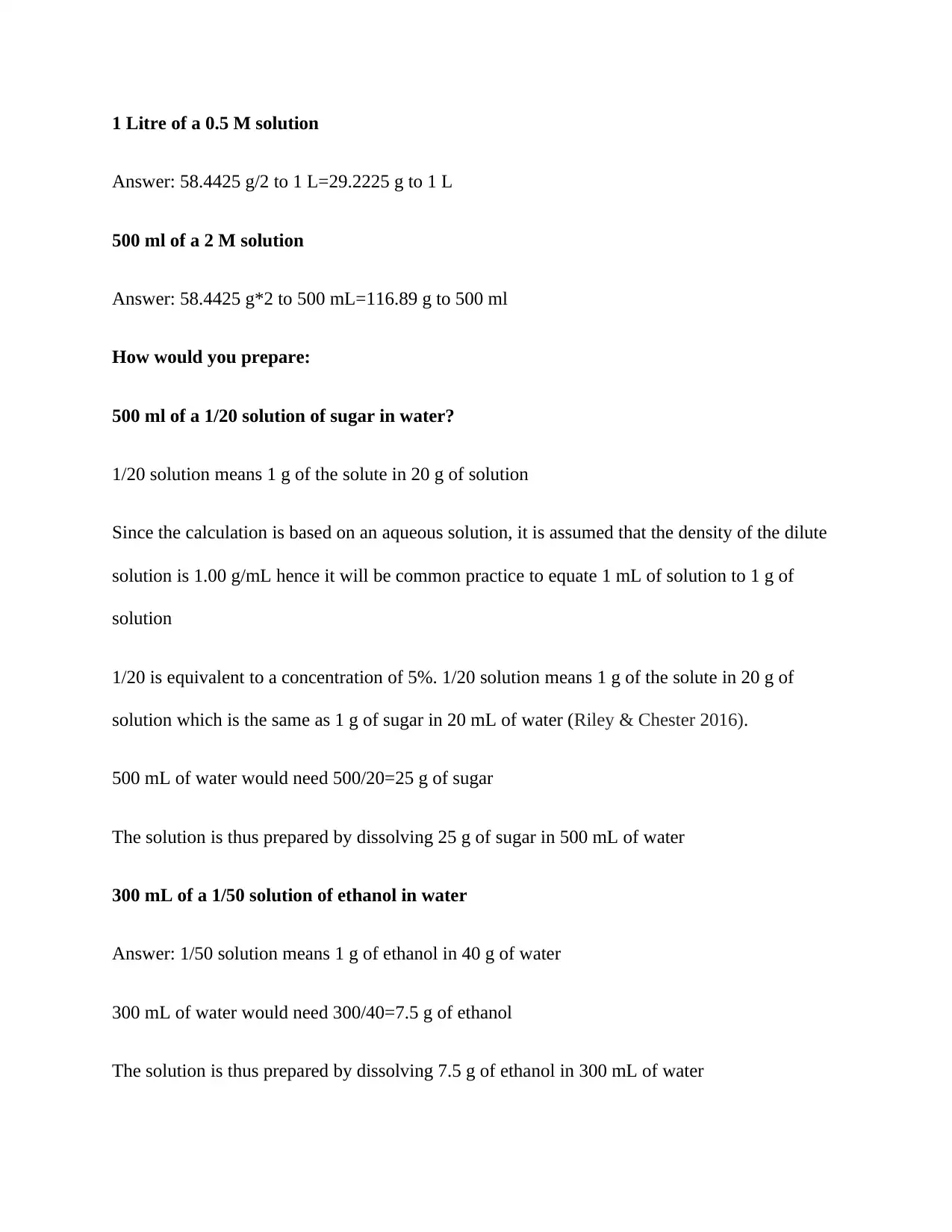
1 Litre of a 0.5 M solution
Answer: 58.4425 g/2 to 1 L=29.2225 g to 1 L
500 ml of a 2 M solution
Answer: 58.4425 g*2 to 500 mL=116.89 g to 500 ml
How would you prepare:
500 ml of a 1/20 solution of sugar in water?
1/20 solution means 1 g of the solute in 20 g of solution
Since the calculation is based on an aqueous solution, it is assumed that the density of the dilute
solution is 1.00 g/mL hence it will be common practice to equate 1 mL of solution to 1 g of
solution
1/20 is equivalent to a concentration of 5%. 1/20 solution means 1 g of the solute in 20 g of
solution which is the same as 1 g of sugar in 20 mL of water (Riley & Chester 2016).
500 mL of water would need 500/20=25 g of sugar
The solution is thus prepared by dissolving 25 g of sugar in 500 mL of water
300 mL of a 1/50 solution of ethanol in water
Answer: 1/50 solution means 1 g of ethanol in 40 g of water
300 mL of water would need 300/40=7.5 g of ethanol
The solution is thus prepared by dissolving 7.5 g of ethanol in 300 mL of water
Document Page
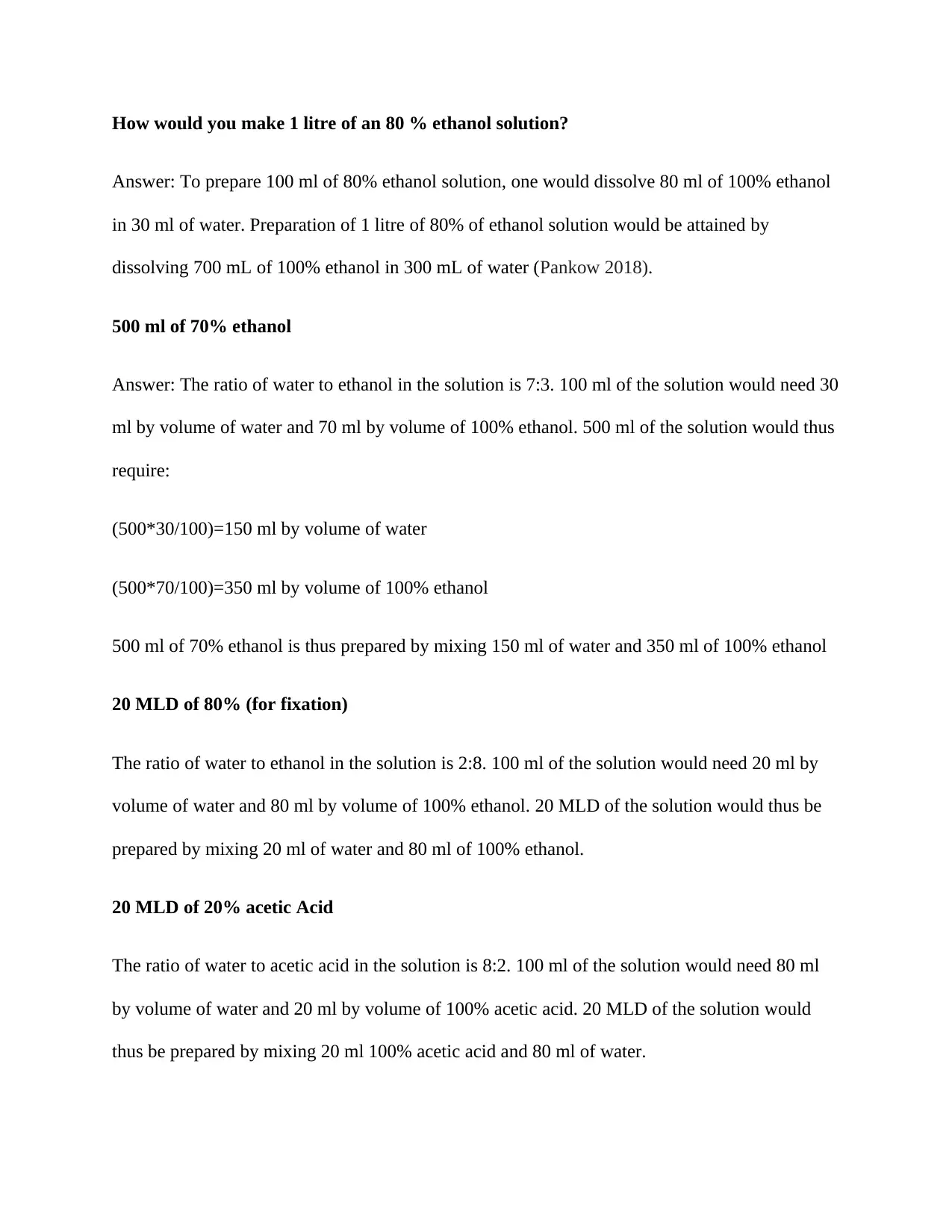
How would you make 1 litre of an 80 % ethanol solution?
Answer: To prepare 100 ml of 80% ethanol solution, one would dissolve 80 ml of 100% ethanol
in 30 ml of water. Preparation of 1 litre of 80% of ethanol solution would be attained by
dissolving 700 mL of 100% ethanol in 300 mL of water (Pankow 2018).
500 ml of 70% ethanol
Answer: The ratio of water to ethanol in the solution is 7:3. 100 ml of the solution would need 30
ml by volume of water and 70 ml by volume of 100% ethanol. 500 ml of the solution would thus
require:
(500*30/100)=150 ml by volume of water
(500*70/100)=350 ml by volume of 100% ethanol
500 ml of 70% ethanol is thus prepared by mixing 150 ml of water and 350 ml of 100% ethanol
20 MLD of 80% (for fixation)
The ratio of water to ethanol in the solution is 2:8. 100 ml of the solution would need 20 ml by
volume of water and 80 ml by volume of 100% ethanol. 20 MLD of the solution would thus be
prepared by mixing 20 ml of water and 80 ml of 100% ethanol.
20 MLD of 20% acetic Acid
The ratio of water to acetic acid in the solution is 8:2. 100 ml of the solution would need 80 ml
by volume of water and 20 ml by volume of 100% acetic acid. 20 MLD of the solution would
thus be prepared by mixing 20 ml 100% acetic acid and 80 ml of water.
Document Page
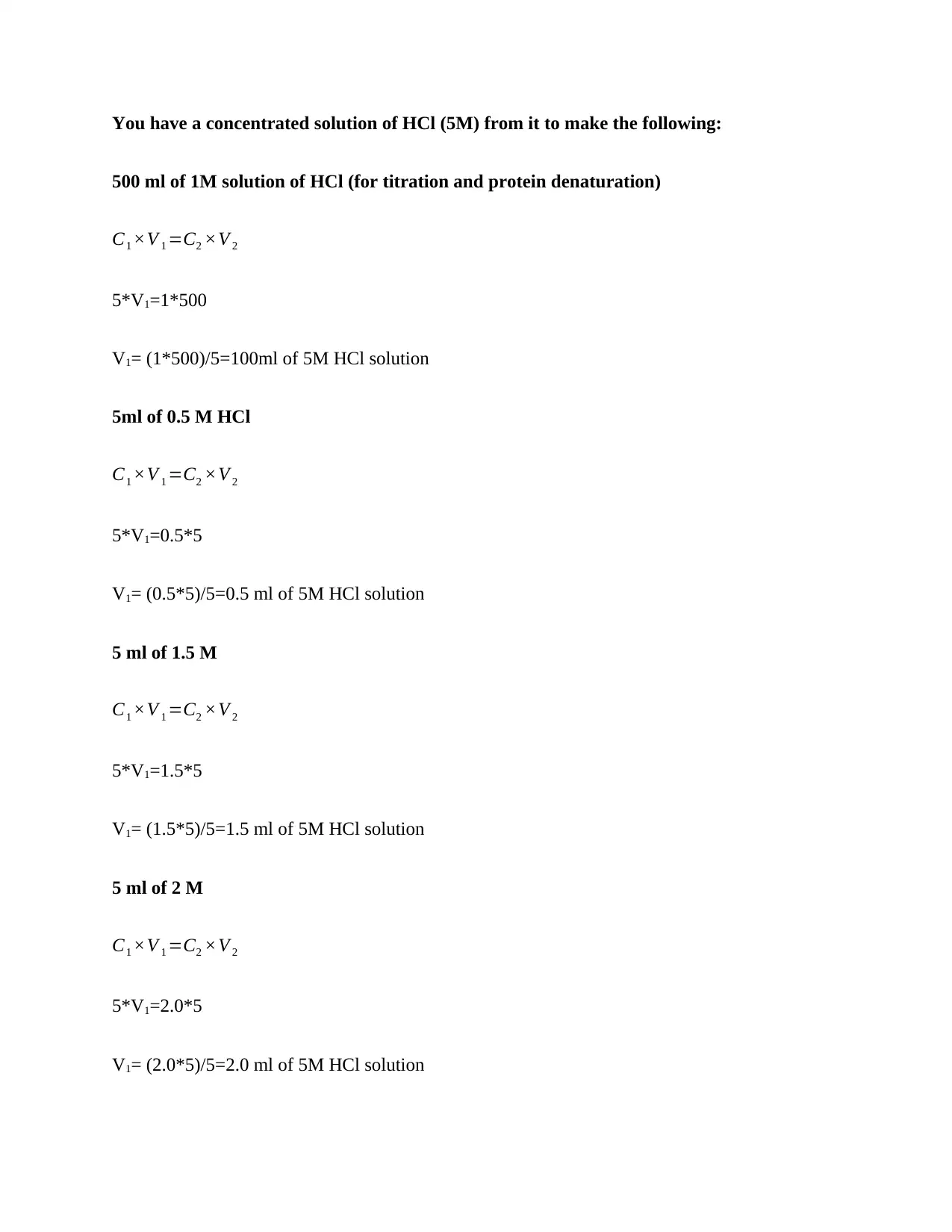
You have a concentrated solution of HCl (5M) from it to make the following:
500 ml of 1M solution of HCl (for titration and protein denaturation)
C1 ×V 1 =C2 ×V 2
5*V1=1*500
V1= (1*500)/5=100ml of 5M HCl solution
5ml of 0.5 M HCl
C1 ×V 1 =C2 ×V 2
5*V1=0.5*5
V1= (0.5*5)/5=0.5 ml of 5M HCl solution
5 ml of 1.5 M
C1 ×V 1 =C2 ×V 2
5*V1=1.5*5
V1= (1.5*5)/5=1.5 ml of 5M HCl solution
5 ml of 2 M
C1 ×V 1 =C2 ×V 2
5*V1=2.0*5
V1= (2.0*5)/5=2.0 ml of 5M HCl solution
tabler-icon-diamond-filled.svg

Paraphrase This Document

Need a fresh take? Get an instant paraphrase of this document with our AI Paraphraser
Document Page
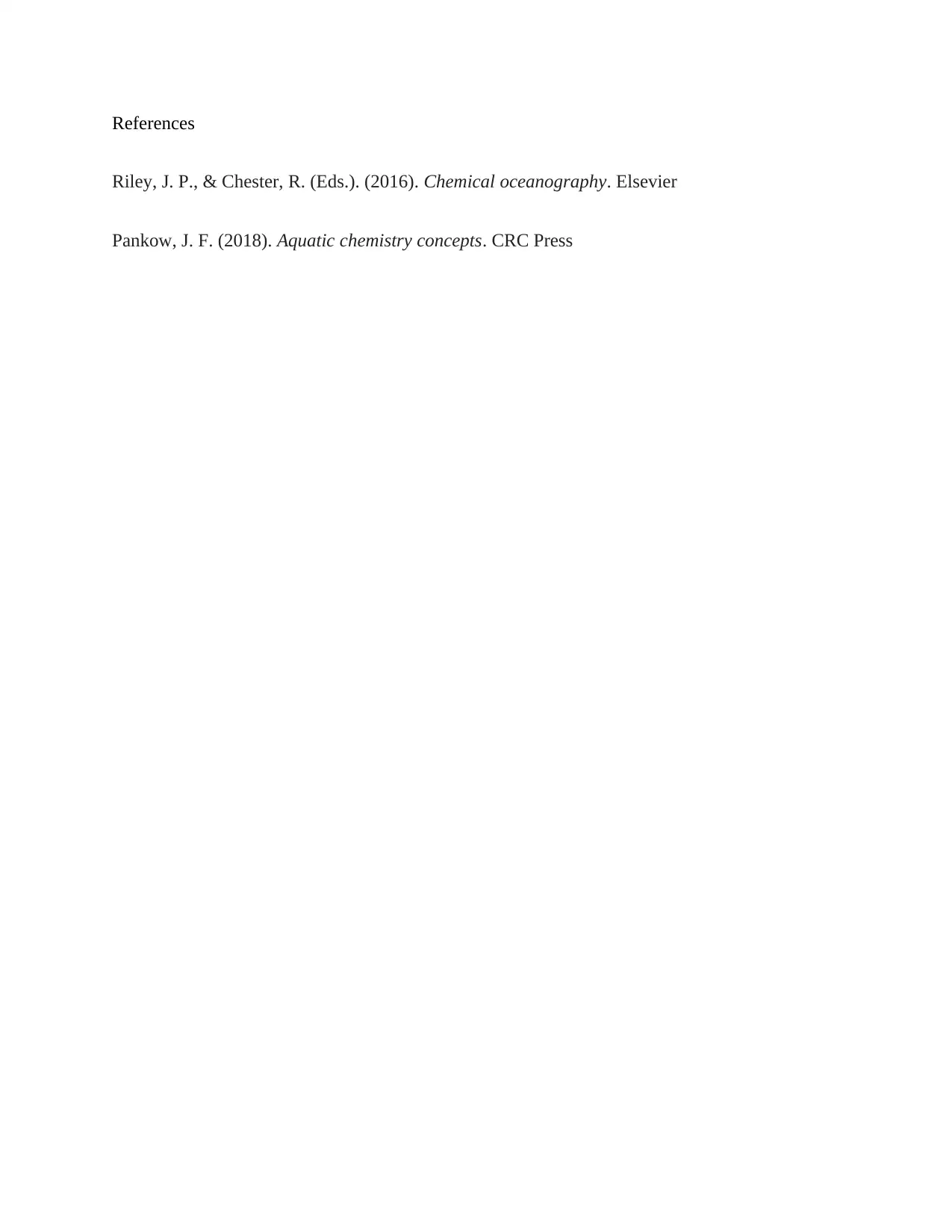
References
Riley, J. P., & Chester, R. (Eds.). (2016). Chemical oceanography. Elsevier
Pankow, J. F. (2018). Aquatic chemistry concepts. CRC Press
chevron_up_icon
1 out of 5
circle_padding
hide_on_mobile
zoom_out_icon
[object Object]