Examining Child Confidentiality and Parental Rights: A Legal Essay

Verified

Added on  2023/06/03

|3
|675
|178
Essay
AI Summary
This essay discusses the complexities of child confidentiality and parental notification, particularly concerning a 17-year-old's sexual activity. It examines the ethical and legal considerations for healthcare providers, contrasting the approach with younger children (11 and 14 years old) where parental notification may be more appropriate. The essay also references Virginia law, emphasizing that 17-year-olds generally have the right to consent to their medical care and maintain confidentiality, whereas younger minors require parental involvement. The conclusion highlights the importance of considering a child's age and maturity level when balancing confidentiality and parental rights, with Desklib providing access to similar solved assignments for students.

Document Page
CHILD CONFIDENTIALITY
Name
Institution affiliation
tabler-icon-diamond-filled.svg

Paraphrase This Document

Need a fresh take? Get an instant paraphrase of this document with our AI Paraphraser
Document Page
CHILD CONFIDENTIALITY
Children Confidentiality and Parent Notification
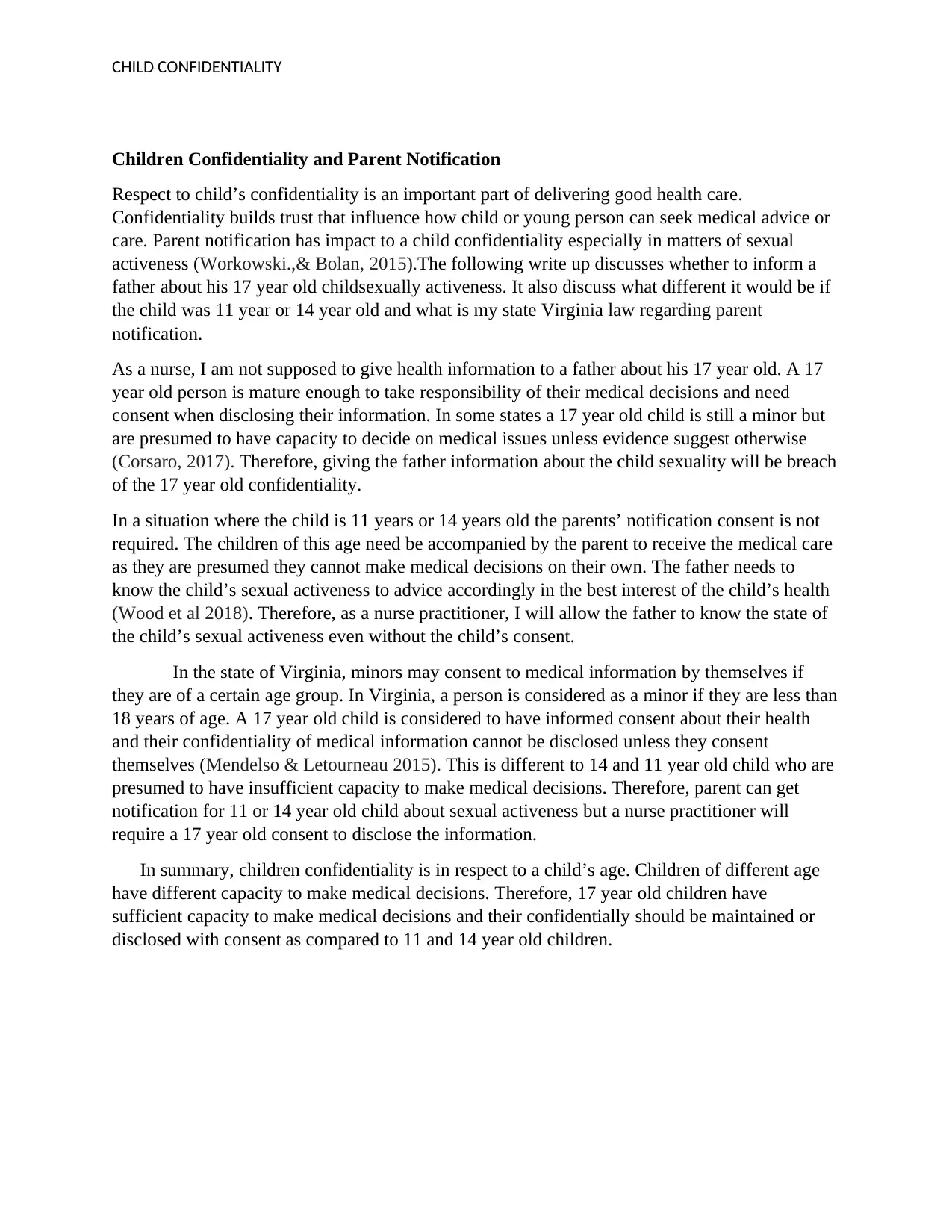
Respect to child’s confidentiality is an important part of delivering good health care.
Confidentiality builds trust that influence how child or young person can seek medical advice or
care. Parent notification has impact to a child confidentiality especially in matters of sexual
activeness (Workowski.,& Bolan, 2015).The following write up discusses whether to inform a
father about his 17 year old childsexually activeness. It also discuss what different it would be if
the child was 11 year or 14 year old and what is my state Virginia law regarding parent
notification.
As a nurse, I am not supposed to give health information to a father about his 17 year old. A 17
year old person is mature enough to take responsibility of their medical decisions and need
consent when disclosing their information. In some states a 17 year old child is still a minor but
are presumed to have capacity to decide on medical issues unless evidence suggest otherwise
(Corsaro, 2017). Therefore, giving the father information about the child sexuality will be breach
of the 17 year old confidentiality.
In a situation where the child is 11 years or 14 years old the parents’ notification consent is not
required. The children of this age need be accompanied by the parent to receive the medical care
as they are presumed they cannot make medical decisions on their own. The father needs to
know the child’s sexual activeness to advice accordingly in the best interest of the child’s health
(Wood et al 2018). Therefore, as a nurse practitioner, I will allow the father to know the state of
the child’s sexual activeness even without the child’s consent.
In the state of Virginia, minors may consent to medical information by themselves if
they are of a certain age group. In Virginia, a person is considered as a minor if they are less than
18 years of age. A 17 year old child is considered to have informed consent about their health
and their confidentiality of medical information cannot be disclosed unless they consent
themselves (Mendelso & Letourneau 2015). This is different to 14 and 11 year old child who are
presumed to have insufficient capacity to make medical decisions. Therefore, parent can get
notification for 11 or 14 year old child about sexual activeness but a nurse practitioner will
require a 17 year old consent to disclose the information.
In summary, children confidentiality is in respect to a child’s age. Children of different age
have different capacity to make medical decisions. Therefore, 17 year old children have
sufficient capacity to make medical decisions and their confidentially should be maintained or
disclosed with consent as compared to 11 and 14 year old children.
Document Page
CHILD CONFIDENTIALITY
References
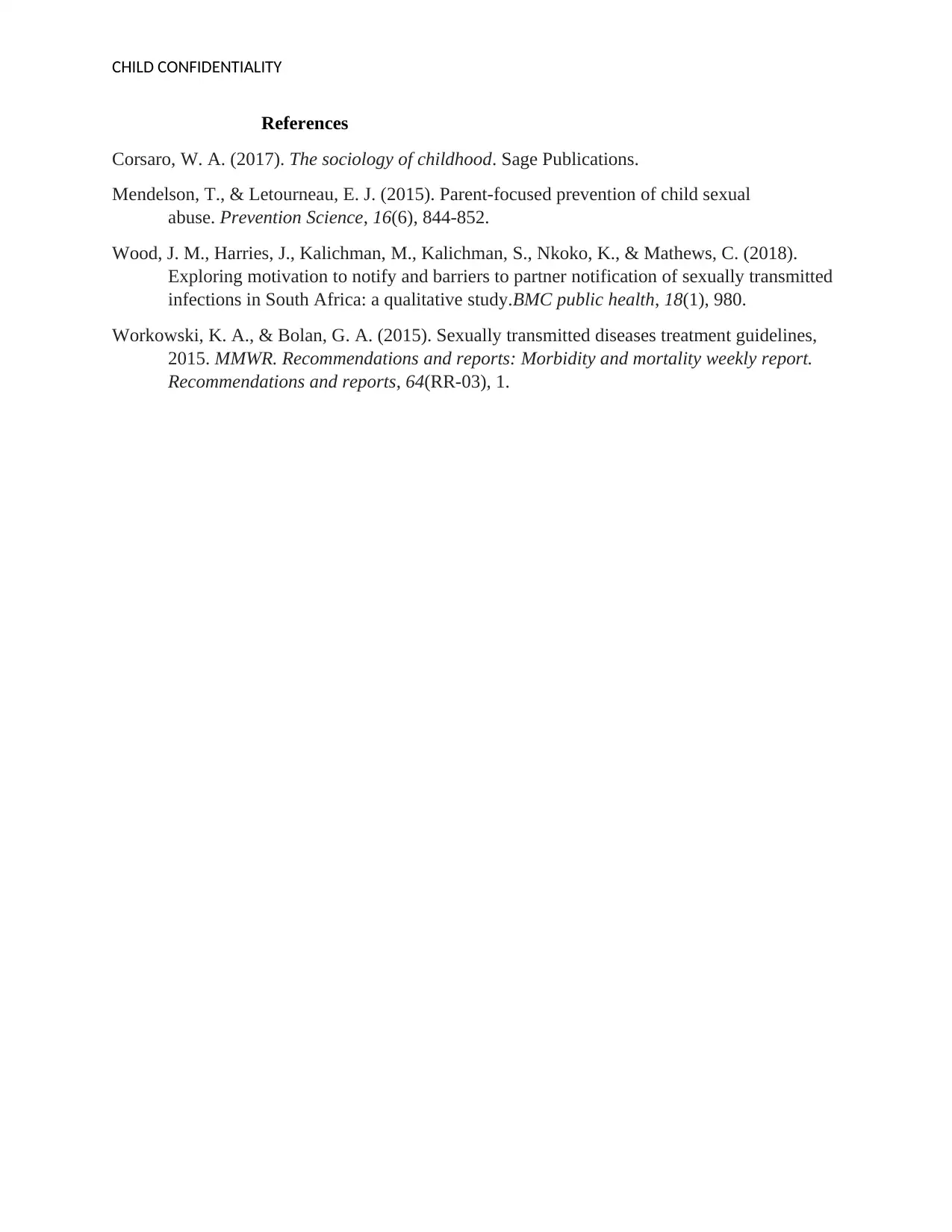
Corsaro, W. A. (2017). The sociology of childhood. Sage Publications.
Mendelson, T., & Letourneau, E. J. (2015). Parent-focused prevention of child sexual
abuse. Prevention Science, 16(6), 844-852.
Wood, J. M., Harries, J., Kalichman, M., Kalichman, S., Nkoko, K., & Mathews, C. (2018).
Exploring motivation to notify and barriers to partner notification of sexually transmitted
infections in South Africa: a qualitative study.BMC public health, 18(1), 980.
Workowski, K. A., & Bolan, G. A. (2015). Sexually transmitted diseases treatment guidelines,
2015. MMWR. Recommendations and reports: Morbidity and mortality weekly report.
Recommendations and reports, 64(RR-03), 1.
chevron_up_icon
1 out of 3
circle_padding
hide_on_mobile
zoom_out_icon
[object Object]