Report on Childhood Obesity: A Public Health Issue in Health Studies
VerifiedAdded on 2023/06/16
|27
|6976
|412
Report
AI Summary
This report examines childhood obesity as a significant public health issue, exploring its causes, health implications, and prevention strategies. Part A provides a review of books, journal articles, websites, electronic databases, and organizations related to obesity. The reviewed materials cover topics such as the risks and effects of obesity, the connection between obesity and lifestyle factors like physical activity and sleep patterns, and the impact of parental behavior on childhood obesity. Part B delves into the causes of childhood obesity, including dietary intake, sedentary lifestyles, and genetic predispositions. It discusses the health implications, such as cardiovascular issues and metabolic disorders, and emphasizes the importance of prevention through healthy eating, physical activity, and family interventions. The report also highlights the need for increased investment in obesity prevention programs and concludes by reiterating the severity of the issue and the necessity for comprehensive strategies to combat it. Desklib offers a range of similar solved assignments and past papers for students.
Running head: HEALTH STUDIES
CHILDHOOD OBESITY- A Public Health Issue
Name of the Student
Name of the University
Author Note
CHILDHOOD OBESITY- A Public Health Issue
Name of the Student
Name of the University
Author Note

Paraphrase This Document
Need a fresh take? Get an instant paraphrase of this document with our AI Paraphraser
1HEALTH STUDIES
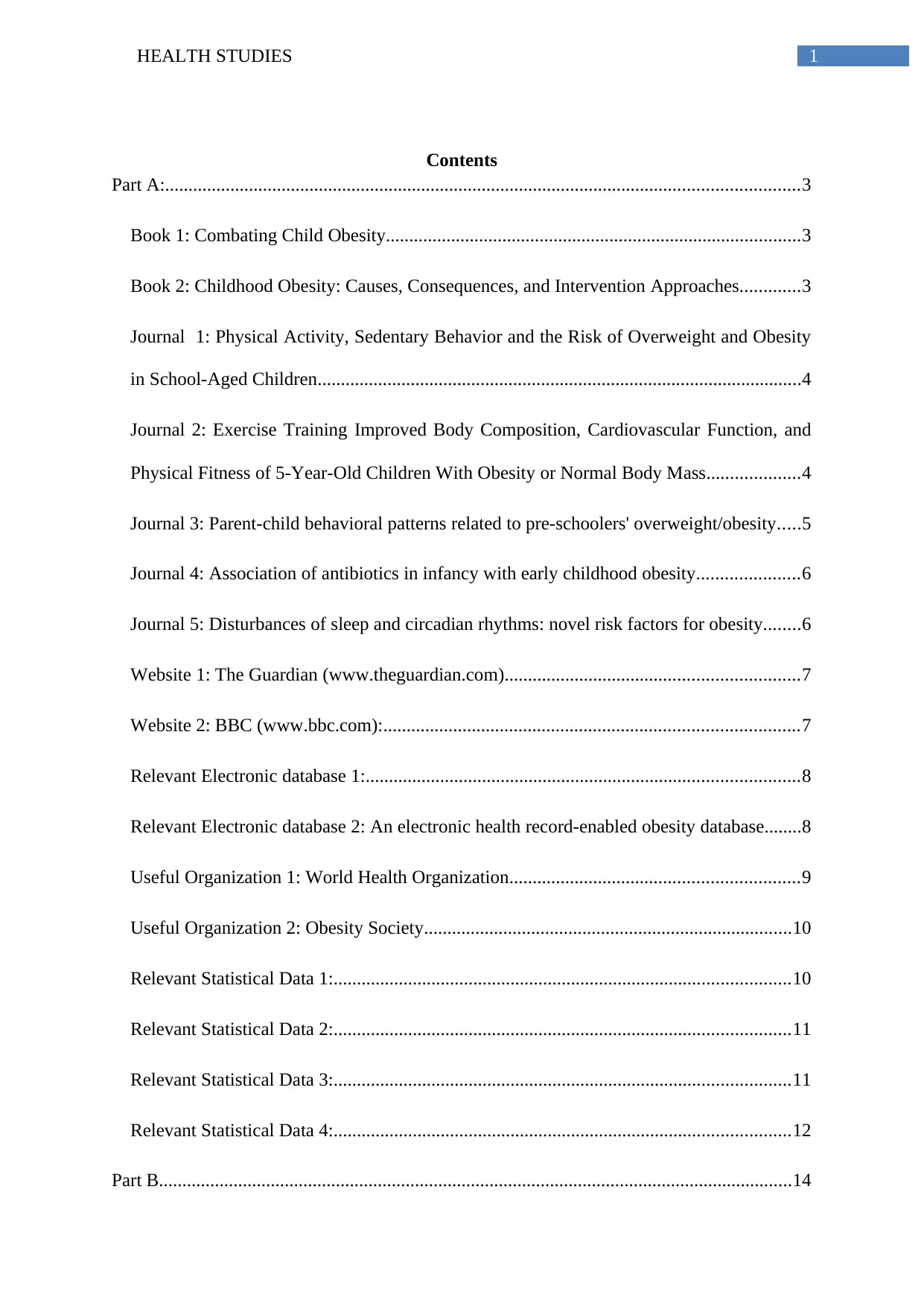
Contents
Part A:........................................................................................................................................3
Book 1: Combating Child Obesity.........................................................................................3
Book 2: Childhood Obesity: Causes, Consequences, and Intervention Approaches.............3
Journal 1: Physical Activity, Sedentary Behavior and the Risk of Overweight and Obesity
in School-Aged Children........................................................................................................4
Journal 2: Exercise Training Improved Body Composition, Cardiovascular Function, and
Physical Fitness of 5-Year-Old Children With Obesity or Normal Body Mass....................4
Journal 3: Parent-child behavioral patterns related to pre-schoolers' overweight/obesity.....5
Journal 4: Association of antibiotics in infancy with early childhood obesity......................6
Journal 5: Disturbances of sleep and circadian rhythms: novel risk factors for obesity........6
Website 1: The Guardian (www.theguardian.com)...............................................................7
Website 2: BBC (www.bbc.com):.........................................................................................7
Relevant Electronic database 1:.............................................................................................8
Relevant Electronic database 2: An electronic health record-enabled obesity database........8
Useful Organization 1: World Health Organization..............................................................9
Useful Organization 2: Obesity Society...............................................................................10
Relevant Statistical Data 1:..................................................................................................10
Relevant Statistical Data 2:..................................................................................................11
Relevant Statistical Data 3:..................................................................................................11
Relevant Statistical Data 4:..................................................................................................12
Part B........................................................................................................................................14
Contents
Part A:........................................................................................................................................3
Book 1: Combating Child Obesity.........................................................................................3
Book 2: Childhood Obesity: Causes, Consequences, and Intervention Approaches.............3
Journal 1: Physical Activity, Sedentary Behavior and the Risk of Overweight and Obesity
in School-Aged Children........................................................................................................4
Journal 2: Exercise Training Improved Body Composition, Cardiovascular Function, and
Physical Fitness of 5-Year-Old Children With Obesity or Normal Body Mass....................4
Journal 3: Parent-child behavioral patterns related to pre-schoolers' overweight/obesity.....5
Journal 4: Association of antibiotics in infancy with early childhood obesity......................6
Journal 5: Disturbances of sleep and circadian rhythms: novel risk factors for obesity........6
Website 1: The Guardian (www.theguardian.com)...............................................................7
Website 2: BBC (www.bbc.com):.........................................................................................7
Relevant Electronic database 1:.............................................................................................8
Relevant Electronic database 2: An electronic health record-enabled obesity database........8
Useful Organization 1: World Health Organization..............................................................9
Useful Organization 2: Obesity Society...............................................................................10
Relevant Statistical Data 1:..................................................................................................10
Relevant Statistical Data 2:..................................................................................................11
Relevant Statistical Data 3:..................................................................................................11
Relevant Statistical Data 4:..................................................................................................12
Part B........................................................................................................................................14
2HEALTH STUDIES
Introduction: Obesity- A significant public health issue:....................................................14
Causes of Childhood Obesity:..............................................................................................14
Health Implications of Childhood Obesity:.........................................................................16
Prevention of Obesity:..........................................................................................................18
Why more investments should be made in the prevention of Obesity:................................21
Conclusion:..........................................................................................................................21
References:...............................................................................................................................22
Introduction: Obesity- A significant public health issue:....................................................14
Causes of Childhood Obesity:..............................................................................................14
Health Implications of Childhood Obesity:.........................................................................16
Prevention of Obesity:..........................................................................................................18
Why more investments should be made in the prevention of Obesity:................................21
Conclusion:..........................................................................................................................21
References:...............................................................................................................................22
⊘ This is a preview!⊘
Do you want full access?
Subscribe today to unlock all pages.

Trusted by 1+ million students worldwide
3HEALTH STUDIES
Part A:
Book 1: Combating Child Obesity
In this book, the author refers to case studies on childhood obesity, and highlights
some key facts about obesity (like the reported risks of obesity, family history and genetic
predisposition of obesity); the effects of obesity (like slipped femoral epiphysis, benign
intercranial hypertension, Obesity Hypoventilation Syndrome, Snoring and Sleep Apnea,
Varicose Veins, Gall Bladder Disease, Polycystic Ovarian Syndrome, High Blood Pressure,
and High Cholesterol.) The book also briefly discusses how childhood obesity can lead to
such conditions and methods to prevent the onset of such complications. The authors also
mention how motivation and self esteem can be affected by obesity, and how the involvement
of children in healthy and enjoyable food programs and physical exercise and activities can
reduce obesity.
Reference: Heaton-Harris, N., 2009. Combating Child Obesity. Straightforward co Ltd.
Book 2: Childhood Obesity: Causes, Consequences, and Intervention Approaches
In the book, the authors point out that childhood obesity as the most prevalent chronic
illness among children and adolescents in the United States, provides a definition and age
differences for obesity. The authors discuss the risk factors associated with Obesity (like
dietary intake, eating disorders, physical activities, environmental effects, sedentary lifestyle,
and sleep disorders). The book also points out a possible connection between obesity with
ethnicities and race (like Hispanic males being more prone to obesity than Asian females).
The author attempts to identify all the factors that can cause obesity so that proper treatment
and interventions can be structured keeping such risk factors in perspective.
Part A:
Book 1: Combating Child Obesity
In this book, the author refers to case studies on childhood obesity, and highlights
some key facts about obesity (like the reported risks of obesity, family history and genetic
predisposition of obesity); the effects of obesity (like slipped femoral epiphysis, benign
intercranial hypertension, Obesity Hypoventilation Syndrome, Snoring and Sleep Apnea,
Varicose Veins, Gall Bladder Disease, Polycystic Ovarian Syndrome, High Blood Pressure,
and High Cholesterol.) The book also briefly discusses how childhood obesity can lead to
such conditions and methods to prevent the onset of such complications. The authors also
mention how motivation and self esteem can be affected by obesity, and how the involvement
of children in healthy and enjoyable food programs and physical exercise and activities can
reduce obesity.
Reference: Heaton-Harris, N., 2009. Combating Child Obesity. Straightforward co Ltd.
Book 2: Childhood Obesity: Causes, Consequences, and Intervention Approaches
In the book, the authors point out that childhood obesity as the most prevalent chronic
illness among children and adolescents in the United States, provides a definition and age
differences for obesity. The authors discuss the risk factors associated with Obesity (like
dietary intake, eating disorders, physical activities, environmental effects, sedentary lifestyle,
and sleep disorders). The book also points out a possible connection between obesity with
ethnicities and race (like Hispanic males being more prone to obesity than Asian females).
The author attempts to identify all the factors that can cause obesity so that proper treatment
and interventions can be structured keeping such risk factors in perspective.
Paraphrase This Document
Need a fresh take? Get an instant paraphrase of this document with our AI Paraphraser
4HEALTH STUDIES
Reference: Goran, M.I. ed., 2016. Childhood Obesity: Causes, Consequences, and
Intervention Approaches. CRC Press.
Journal 1: Physical Activity, Sedentary Behavior and the Risk of Overweight and
Obesity in School-Aged Children
In the journal article, the authors aim to explore the association of childhood obesity
and overweight issues with lifestyle issues like physical activity and sedentary lifestyle. They
concluded that low Moderate to Vigorous Physical Activity (MVPA) is associated with an
increased risk of obesity among children, and is independent of the sedentary time spent by
these children showing that physical inactivity and sedentary lifestyle are risk factors of
obesity. The authors recommended that the 20 minutes per day mean difference between
MVPA values of normal weight and obese children should be targeted in order to reduce
obesity (that is to say an increase in physical activity among obese children can provide
positive results in the control of obesity).
Reference: Keane, E., Li, X., Harrington, J., Fitzgerald, A., Perry, I. and Kearney, P.
(2017). Physical Activity, Sedentary Behavior and the Risk of Overweight and Obesity in
School-Aged Children | Pediatric Exercise Science. [online] Doi.org. Available at:
http://doi.org/10.1123/pes.2016-0234 [Accessed 1 Dec. 2017].
Journal 2: Exercise Training Improved Body Composition, Cardiovascular Function,
and Physical Fitness of 5-Year-Old Children With Obesity or Normal Body Mass
In the journal, the authors aim to explore the effects of exercise training among obese
and lean children, to improve cardiovascular function, physical fitness and body composition.
In the experiment, 42 obese and 62 lean children participated. The results shows that exercise
training helped in the reduction of Body Mass Index (BMI), body fat percentage, waist
circumference and helped to reduce the rate of weight gain among both obese and lean
Reference: Goran, M.I. ed., 2016. Childhood Obesity: Causes, Consequences, and
Intervention Approaches. CRC Press.
Journal 1: Physical Activity, Sedentary Behavior and the Risk of Overweight and
Obesity in School-Aged Children
In the journal article, the authors aim to explore the association of childhood obesity
and overweight issues with lifestyle issues like physical activity and sedentary lifestyle. They
concluded that low Moderate to Vigorous Physical Activity (MVPA) is associated with an
increased risk of obesity among children, and is independent of the sedentary time spent by
these children showing that physical inactivity and sedentary lifestyle are risk factors of
obesity. The authors recommended that the 20 minutes per day mean difference between
MVPA values of normal weight and obese children should be targeted in order to reduce
obesity (that is to say an increase in physical activity among obese children can provide
positive results in the control of obesity).
Reference: Keane, E., Li, X., Harrington, J., Fitzgerald, A., Perry, I. and Kearney, P.
(2017). Physical Activity, Sedentary Behavior and the Risk of Overweight and Obesity in
School-Aged Children | Pediatric Exercise Science. [online] Doi.org. Available at:
http://doi.org/10.1123/pes.2016-0234 [Accessed 1 Dec. 2017].
Journal 2: Exercise Training Improved Body Composition, Cardiovascular Function,
and Physical Fitness of 5-Year-Old Children With Obesity or Normal Body Mass
In the journal, the authors aim to explore the effects of exercise training among obese
and lean children, to improve cardiovascular function, physical fitness and body composition.
In the experiment, 42 obese and 62 lean children participated. The results shows that exercise
training helped in the reduction of Body Mass Index (BMI), body fat percentage, waist
circumference and helped to reduce the rate of weight gain among both obese and lean
5HEALTH STUDIES
children. They also found that training also reduced systolic blood pressure and heart rate
during exercise among obese children. They concluded that 10 weeks of moderate intensity
training for children aged 5 years can be a safe treatment for obesity, and it can also improve
their performance in sports and activities.
Reference: Tan, S., Chen, C., Sui, M., Xue, L. and Wang, J. (2017). Exercise Training
Improved Body Composition, Cardiovascular Function, and Physical Fitness of 5-Year-Old
Children With Obesity or Normal Body Mass. Pediatric Exercise Science, 29(2), pp.245-253.
Journal 3: Parent-child behavioral patterns related to pre-schoolers' overweight/obesity
In this journal article, the authors aim to analyze the relation between parental obesity
and parent child behaviour patterns (like physical activity and screen time) with the chances
of developing obesity among preschool children between 4 to 7 years age. The study included
194 preschool children and their parents. Their results showed a significant relation of
childhood obesity with an excessive screen time (on weekdays and weekends) and obesity of
their mother. They also identified an increased incidence of screen time on weekends by
obese mothers and their male children, which can increase the likelihood of developing
obesity. They recommended that family intervention programs when implemented on
weekends to reduce sedentary screen time, and promote active leisure time, and attractive/
enjoyable physical activity among both the children and their parents can be an effective way
in reducing obesity.
Reference: Sigmundova, D., Sigmund, E., Badura, P., Vokacova, J., Klein, D. and Bucksch,
J. (2017). Parent-child behavioural patterns related to pre-schoolers' overweight/obesity. Acta
Gymnica, 47(2), pp.53-63.
children. They also found that training also reduced systolic blood pressure and heart rate
during exercise among obese children. They concluded that 10 weeks of moderate intensity
training for children aged 5 years can be a safe treatment for obesity, and it can also improve
their performance in sports and activities.
Reference: Tan, S., Chen, C., Sui, M., Xue, L. and Wang, J. (2017). Exercise Training
Improved Body Composition, Cardiovascular Function, and Physical Fitness of 5-Year-Old
Children With Obesity or Normal Body Mass. Pediatric Exercise Science, 29(2), pp.245-253.
Journal 3: Parent-child behavioral patterns related to pre-schoolers' overweight/obesity
In this journal article, the authors aim to analyze the relation between parental obesity
and parent child behaviour patterns (like physical activity and screen time) with the chances
of developing obesity among preschool children between 4 to 7 years age. The study included
194 preschool children and their parents. Their results showed a significant relation of
childhood obesity with an excessive screen time (on weekdays and weekends) and obesity of
their mother. They also identified an increased incidence of screen time on weekends by
obese mothers and their male children, which can increase the likelihood of developing
obesity. They recommended that family intervention programs when implemented on
weekends to reduce sedentary screen time, and promote active leisure time, and attractive/
enjoyable physical activity among both the children and their parents can be an effective way
in reducing obesity.
Reference: Sigmundova, D., Sigmund, E., Badura, P., Vokacova, J., Klein, D. and Bucksch,
J. (2017). Parent-child behavioural patterns related to pre-schoolers' overweight/obesity. Acta
Gymnica, 47(2), pp.53-63.
⊘ This is a preview!⊘
Do you want full access?
Subscribe today to unlock all pages.
Trusted by 1+ million students worldwide
6HEALTH STUDIES
Journal 4: Association of antibiotics in infancy with early childhood obesity
In this journal article, the author’s attempts to assess the effect of antibiotics
prescribed to infants (between ages 0 to 23 months) in the development of childhood obesity
(among 24-59 month infants). The authors performed a cohort study of electronic health data
between 2001 and 2013, comprising the study of 64,580 children. Their results show that
69% of children below 24 months were exposed to antibiotics, and an increased propensity of
developing obesity was associated especially with broad spectrum antibiotics, therefore
concluding that repeated exposure to it can be a risk factor. The authors also pointed out
additional risk factors like ethnicity (Hispanic), steroid use, urban lifestyle, male sex, public
insurance and diagnosis of asthma.
Reference: Bailey, L.C., Forrest, C.B., Zhang, P., Richards, T.M., Livshits, A. and DeRusso,
P.A., 2014. Association of antibiotics in infancy with early childhood obesity. JAMA
pediatrics, 168(11), pp.1063-1069.
Journal 5: Disturbances of sleep and circadian rhythms: novel risk factors for obesity.
In this journal, the authors pointed out four significant findings. 1) disturbances in
circadian rhythm and sleep patterns in adults and children increased the risk of developing
Obesity. 2) a misalignment of the circadian rhythm adversely affects the energy balance of
the body, and elevates the risk of obesity. 3) Endocannabinoid system acting as a link
between feeding behaviour, sleep patterns and circadian rhythm. 4)Circadian misalignment
and sleep dysfunction can be related to the disturbances in circadian variations in gut micro
biome composition. The results show that changes in feeding rhythms in children and adults
can also increase the energy absorbed from food, and suggests avoidance of sleep loss and
circadian misalignment to avoid the risks of obesity
Journal 4: Association of antibiotics in infancy with early childhood obesity
In this journal article, the author’s attempts to assess the effect of antibiotics
prescribed to infants (between ages 0 to 23 months) in the development of childhood obesity
(among 24-59 month infants). The authors performed a cohort study of electronic health data
between 2001 and 2013, comprising the study of 64,580 children. Their results show that
69% of children below 24 months were exposed to antibiotics, and an increased propensity of
developing obesity was associated especially with broad spectrum antibiotics, therefore
concluding that repeated exposure to it can be a risk factor. The authors also pointed out
additional risk factors like ethnicity (Hispanic), steroid use, urban lifestyle, male sex, public
insurance and diagnosis of asthma.
Reference: Bailey, L.C., Forrest, C.B., Zhang, P., Richards, T.M., Livshits, A. and DeRusso,
P.A., 2014. Association of antibiotics in infancy with early childhood obesity. JAMA
pediatrics, 168(11), pp.1063-1069.
Journal 5: Disturbances of sleep and circadian rhythms: novel risk factors for obesity.
In this journal, the authors pointed out four significant findings. 1) disturbances in
circadian rhythm and sleep patterns in adults and children increased the risk of developing
Obesity. 2) a misalignment of the circadian rhythm adversely affects the energy balance of
the body, and elevates the risk of obesity. 3) Endocannabinoid system acting as a link
between feeding behaviour, sleep patterns and circadian rhythm. 4)Circadian misalignment
and sleep dysfunction can be related to the disturbances in circadian variations in gut micro
biome composition. The results show that changes in feeding rhythms in children and adults
can also increase the energy absorbed from food, and suggests avoidance of sleep loss and
circadian misalignment to avoid the risks of obesity
Paraphrase This Document
Need a fresh take? Get an instant paraphrase of this document with our AI Paraphraser
7HEALTH STUDIES
Reference: Broussard, J.L. and Van Cauter, E., 2016. Disturbances of sleep and circadian
rhythms: novel risk factors for obesity. Current Opinion in Endocrinology, Diabetes and
Obesity, 23(5), pp.353-359.
Website 1: The Guardian (www.theguardian.com)
In this news site, the author Dennis Campbell reports that as of November, 2016,
almost 10% of children in England, studying in first year school are obese, with a 0.2 % rise
in the last year, as per NHS studies. The report also shows 19.8% of children between 10-11
years are obese, and points out that the prevalence of obesity to be higher among male
children than among females. The data also points out a class divide as a risk factor, showing
that the prevalence of obesity was higher in the most deprived areas, compared to least
deprived ones. The news article also shows that London has the highest obesity rates among 6
year old children.
Reference: Campbell, D. (2017). Child obesity rising again, NHS report reveals. [online] the
Guardian. Available at: https://www.theguardian.com/society/2016/nov/03/child-obesity-
rising-again-nhs-report-reveals [Accessed 1 Dec. 2017].
Website 2: BBC (www.bbc.com):
The website reports that as of November, 11th, 2017., the obesity rates in the United
Kingdom have doubled in the last two decades, and 63% of the adults living in UK are
overweight and 27% obese, making UK the most overweight country in western Europe as
per Organization for Economic Co-operation and Development (OECD). The news also adds
that UK has been suffering from “historically high” rates of obesity since 1990’s. However
there has been a small decline in the rates of childhood obesity. Relation between alcohol
consumption and obesity has also been drawn, and survival rates of obesity have been
accredited to better health treatment in the UK.
Reference: Broussard, J.L. and Van Cauter, E., 2016. Disturbances of sleep and circadian
rhythms: novel risk factors for obesity. Current Opinion in Endocrinology, Diabetes and
Obesity, 23(5), pp.353-359.
Website 1: The Guardian (www.theguardian.com)
In this news site, the author Dennis Campbell reports that as of November, 2016,
almost 10% of children in England, studying in first year school are obese, with a 0.2 % rise
in the last year, as per NHS studies. The report also shows 19.8% of children between 10-11
years are obese, and points out that the prevalence of obesity to be higher among male
children than among females. The data also points out a class divide as a risk factor, showing
that the prevalence of obesity was higher in the most deprived areas, compared to least
deprived ones. The news article also shows that London has the highest obesity rates among 6
year old children.
Reference: Campbell, D. (2017). Child obesity rising again, NHS report reveals. [online] the
Guardian. Available at: https://www.theguardian.com/society/2016/nov/03/child-obesity-
rising-again-nhs-report-reveals [Accessed 1 Dec. 2017].
Website 2: BBC (www.bbc.com):
The website reports that as of November, 11th, 2017., the obesity rates in the United
Kingdom have doubled in the last two decades, and 63% of the adults living in UK are
overweight and 27% obese, making UK the most overweight country in western Europe as
per Organization for Economic Co-operation and Development (OECD). The news also adds
that UK has been suffering from “historically high” rates of obesity since 1990’s. However
there has been a small decline in the rates of childhood obesity. Relation between alcohol
consumption and obesity has also been drawn, and survival rates of obesity have been
accredited to better health treatment in the UK.
8HEALTH STUDIES
Reference: UK most obese nation in Western Europe. [online] Available at:
http://www.bbc.com/news/uk-41953530 [Accessed 30 Nov. 2017].
Relevant Electronic database 1:
This database covers studies that explore the relation between obesity and sedentary
behaviour. Currently, details of 326 case studies, globally, are incorporated in the database.
The reviews of the studies are assessed and coded to match specific criterion or
characteristics and context for the study, and points out the variables. The database allows
searching using keywords and free text terminologies, provides reports with visual mapping
and analysis, and also includes a help tool for guiding the usage of the database. The results
can also be printed out or incorporated into a word processing application or software.
Reference: Eppi.ioe.ac.uk. (2017). The database on Obesity and Sedentary behaviour
studies. [online] Available at: http://eppi.ioe.ac.uk/webdatabases/ [Accessed 1 Dec. 2017].
Relevant Electronic database 2: An electronic health record-enabled obesity database
This database incorporates information (like clinical data) from Electronic Health
Records (EHR) on patients undergoing Roux-en-Y gastric bypass surgery, and deposited into
a data warehouse. Additionally Kaplan-Meier analysis is done on the data to estimate the
duration of follow-ups post surgery. The survey data contains demographic, laboratory,
medication, and co-morbidity information of 2028 patients since 2004. Post operative weight
data of 75% of the patients are also accessible in the database. The data warehouse also
records data from Billing and information about patient encounter is added with
miscellaneous data, after being validated as consented information.
Reference: Wood, G., Chu, X., Manney, C., Strodel, W., Petrick, A., Gabrielsen, J., Seiler,
J., Carey, D., Argyropoulos, G., Benotti, P., Still, C. and Gerhard, G. (2017). An electronic
health record-enabled obesity database. [online] BMC Medical Informatics and Decision
Reference: UK most obese nation in Western Europe. [online] Available at:
http://www.bbc.com/news/uk-41953530 [Accessed 30 Nov. 2017].
Relevant Electronic database 1:
This database covers studies that explore the relation between obesity and sedentary
behaviour. Currently, details of 326 case studies, globally, are incorporated in the database.
The reviews of the studies are assessed and coded to match specific criterion or
characteristics and context for the study, and points out the variables. The database allows
searching using keywords and free text terminologies, provides reports with visual mapping
and analysis, and also includes a help tool for guiding the usage of the database. The results
can also be printed out or incorporated into a word processing application or software.
Reference: Eppi.ioe.ac.uk. (2017). The database on Obesity and Sedentary behaviour
studies. [online] Available at: http://eppi.ioe.ac.uk/webdatabases/ [Accessed 1 Dec. 2017].
Relevant Electronic database 2: An electronic health record-enabled obesity database
This database incorporates information (like clinical data) from Electronic Health
Records (EHR) on patients undergoing Roux-en-Y gastric bypass surgery, and deposited into
a data warehouse. Additionally Kaplan-Meier analysis is done on the data to estimate the
duration of follow-ups post surgery. The survey data contains demographic, laboratory,
medication, and co-morbidity information of 2028 patients since 2004. Post operative weight
data of 75% of the patients are also accessible in the database. The data warehouse also
records data from Billing and information about patient encounter is added with
miscellaneous data, after being validated as consented information.
Reference: Wood, G., Chu, X., Manney, C., Strodel, W., Petrick, A., Gabrielsen, J., Seiler,
J., Carey, D., Argyropoulos, G., Benotti, P., Still, C. and Gerhard, G. (2017). An electronic
health record-enabled obesity database. [online] BMC Medical Informatics and Decision
⊘ This is a preview!⊘
Do you want full access?
Subscribe today to unlock all pages.
Trusted by 1+ million students worldwide
9HEALTH STUDIES
Making. Available at:
https://bmcmedinformdecismak.biomedcentral.com/articles/10.1186/1472-6947-12-45
[Accessed 1 Dec. 2017].
Useful Organization 1: World Health Organization
Headquarters: Department of Food Safety and Zoonoses (FOS)
World Health Organization, Avenue Appia 20, CH-1211 Geneva 27, Switzerland
Fax: +41 22 791 4807
E-mail: foodsafety@who.int
WHO Regional Office for Europe
UN City, Marmorvej 51, DK-2100 Copenhagen Ø, Denmark.
Phone: +45 45 33 70 00; Fax: +45 45 33 70 01
Website: www.who.int
The World Health Organization plays a significant role in the monitoring, increasing
awareness (educating) and fighting obesity in all age groups. They have performed regular
assessment obesity rates globally, and maintain regularly updated factsheet that shows the
current status of the disease. The work highlight includes the drive to eradicate childhood
obesity. Their site provides valuable information regarding obesity and overweight issues,
recommendation for healthy diet, action plan to fight childhood obesity, and provides links to
other diseases that are liked to obesity. Overall, their site proves to be a valuable resource in
the understanding of obesity and the assess the burden of the disease.
Reference: Who.int. (2017). WHO | Obesity. [online] Available at:
http://www.who.int/topics/obesity/en/ [Accessed 1 Dec. 2017].
Making. Available at:
https://bmcmedinformdecismak.biomedcentral.com/articles/10.1186/1472-6947-12-45
[Accessed 1 Dec. 2017].
Useful Organization 1: World Health Organization
Headquarters: Department of Food Safety and Zoonoses (FOS)
World Health Organization, Avenue Appia 20, CH-1211 Geneva 27, Switzerland
Fax: +41 22 791 4807
E-mail: foodsafety@who.int
WHO Regional Office for Europe
UN City, Marmorvej 51, DK-2100 Copenhagen Ø, Denmark.
Phone: +45 45 33 70 00; Fax: +45 45 33 70 01
Website: www.who.int
The World Health Organization plays a significant role in the monitoring, increasing
awareness (educating) and fighting obesity in all age groups. They have performed regular
assessment obesity rates globally, and maintain regularly updated factsheet that shows the
current status of the disease. The work highlight includes the drive to eradicate childhood
obesity. Their site provides valuable information regarding obesity and overweight issues,
recommendation for healthy diet, action plan to fight childhood obesity, and provides links to
other diseases that are liked to obesity. Overall, their site proves to be a valuable resource in
the understanding of obesity and the assess the burden of the disease.
Reference: Who.int. (2017). WHO | Obesity. [online] Available at:
http://www.who.int/topics/obesity/en/ [Accessed 1 Dec. 2017].
Paraphrase This Document
Need a fresh take? Get an instant paraphrase of this document with our AI Paraphraser
10HEALTH STUDIES
Useful Organization 2: Obesity Society
Postal Address and Contact Details: 1110 Bonifant St #500, Silver Spring, MD 20910,
USA.
Phone: +1 301-563-6526, Fax: (301) 563-6595
Website: www.obesity.org
This organization aims to improve understanding of and provide prevention and
treatment methods to reduce obesity. The organization attempts to reach the goal by
advancing the science based knowledge of the cause, effect, prevention and treatment
associated with obesity. The objective of their actions is to provide compassion to those
living with obesity; taking responsibility towards advocacy, treatment and an investigation
for obese individuals; ensuring respect for afflicted individuals; improving the existing
knowledge on obesity; provide mentorship for helping or teaching professionals who are new
to this field; and ensure that ethical standards are maintained in the treatment process.
Reference:Obesity.org. (2017). Home - The Obesity Society. [online] Available at:
http://www.obesity.org/home [Accessed 1 Dec. 2017].
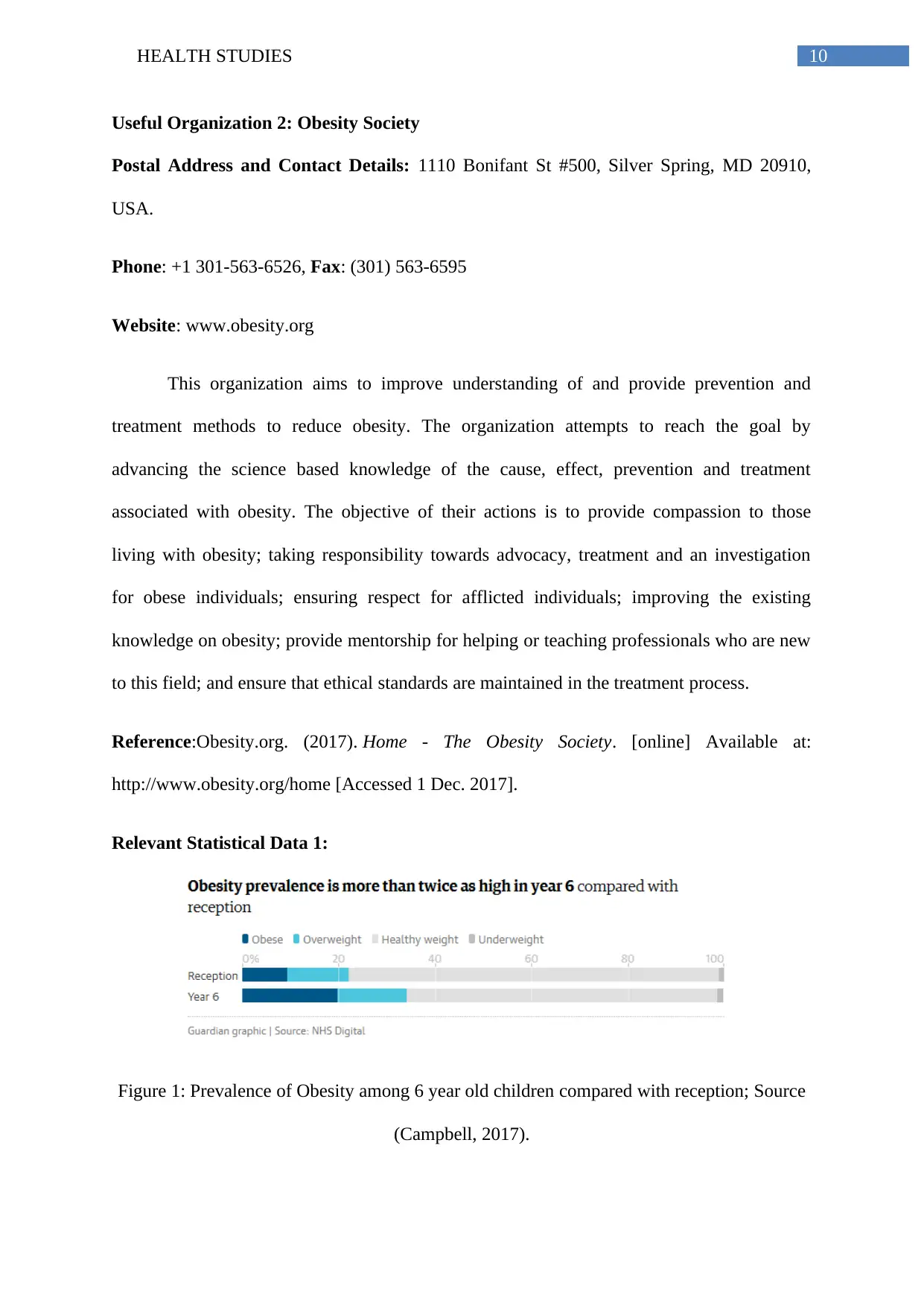
Relevant Statistical Data 1:
Figure 1: Prevalence of Obesity among 6 year old children compared with reception; Source
(Campbell, 2017).
Useful Organization 2: Obesity Society
Postal Address and Contact Details: 1110 Bonifant St #500, Silver Spring, MD 20910,
USA.
Phone: +1 301-563-6526, Fax: (301) 563-6595
Website: www.obesity.org
This organization aims to improve understanding of and provide prevention and
treatment methods to reduce obesity. The organization attempts to reach the goal by
advancing the science based knowledge of the cause, effect, prevention and treatment
associated with obesity. The objective of their actions is to provide compassion to those
living with obesity; taking responsibility towards advocacy, treatment and an investigation
for obese individuals; ensuring respect for afflicted individuals; improving the existing
knowledge on obesity; provide mentorship for helping or teaching professionals who are new
to this field; and ensure that ethical standards are maintained in the treatment process.
Reference:Obesity.org. (2017). Home - The Obesity Society. [online] Available at:
http://www.obesity.org/home [Accessed 1 Dec. 2017].
Relevant Statistical Data 1:
Figure 1: Prevalence of Obesity among 6 year old children compared with reception; Source
(Campbell, 2017).
11HEALTH STUDIES
Figure 1 show that children of years of age are more prone to obesity compared to reception
group. This raises a considerable concern regarding the health concerns of children, and
factors that attributes to such phenomenon.
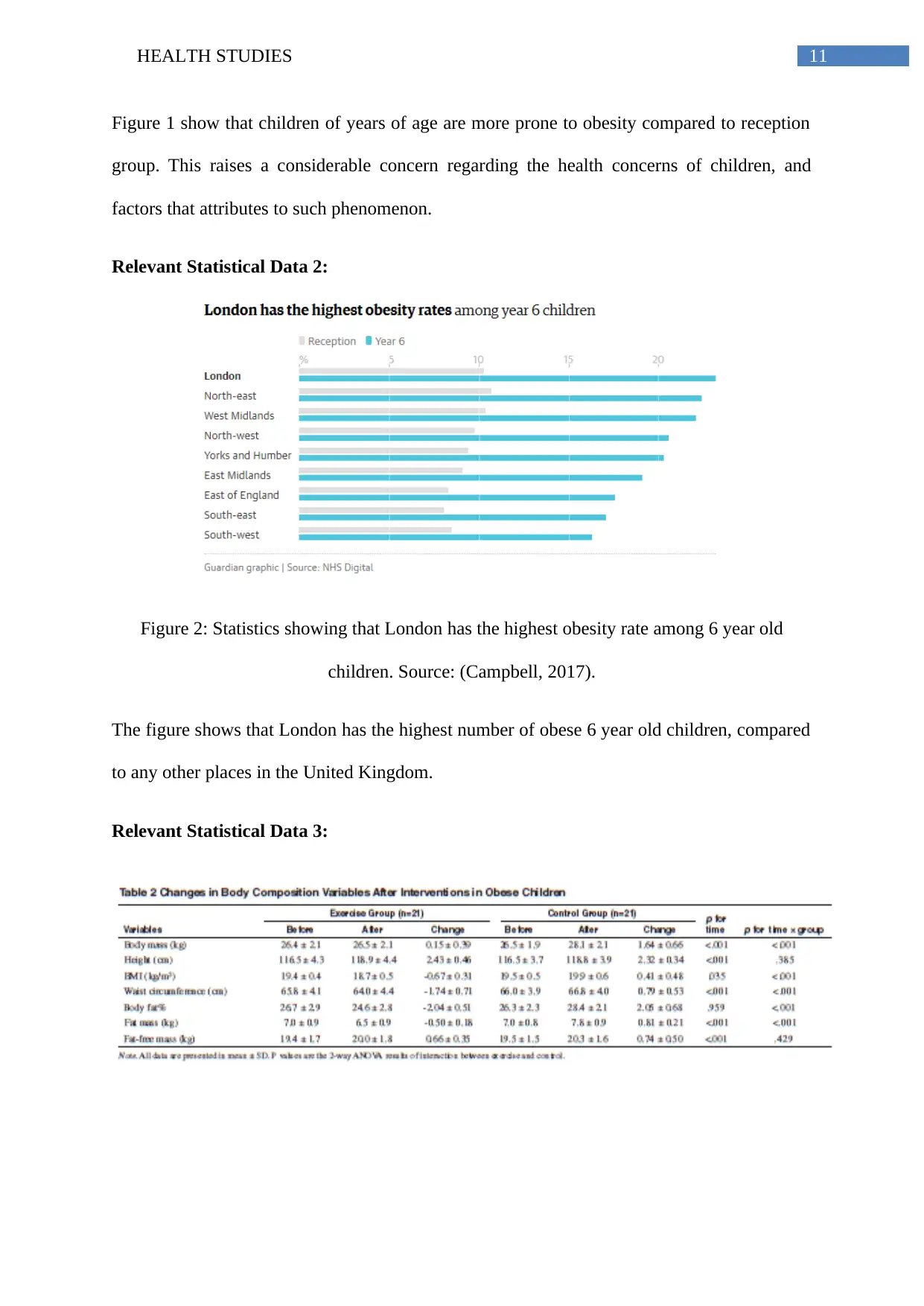
Relevant Statistical Data 2:
Figure 2: Statistics showing that London has the highest obesity rate among 6 year old
children. Source: (Campbell, 2017).
The figure shows that London has the highest number of obese 6 year old children, compared
to any other places in the United Kingdom.
Relevant Statistical Data 3:
Figure 1 show that children of years of age are more prone to obesity compared to reception
group. This raises a considerable concern regarding the health concerns of children, and
factors that attributes to such phenomenon.
Relevant Statistical Data 2:
Figure 2: Statistics showing that London has the highest obesity rate among 6 year old
children. Source: (Campbell, 2017).
The figure shows that London has the highest number of obese 6 year old children, compared
to any other places in the United Kingdom.
Relevant Statistical Data 3:
⊘ This is a preview!⊘
Do you want full access?
Subscribe today to unlock all pages.
Trusted by 1+ million students worldwide

1 out of 27


Related Documents


Your All-in-One AI-Powered Toolkit for Academic Success.
+13062052269
info@desklib.com
Available 24*7 on WhatsApp / Email
![[object Object]](/_next/static/media/star-bottom.7253800d.svg)
Unlock your academic potential
Copyright © 2020–2026 A2Z Services. All Rights Reserved. Developed and managed by ZUCOL.