The Psychological Impact of Terrorism on Children: A Detailed Report

Verified

Added on  2023/06/07

|4
|502
|109
Report
AI Summary
This report examines the significant impact of terrorism on children, highlighting their vulnerability and the psychological trauma they experience. It references studies and data from UNICEF to illustrate how children are often the primary victims of terrorist activities, suffering from death, hunger, and abuse. The report discusses the psychological effects, such as PTSD, and the importance of providing support and intervention to help children recover from traumatic experiences. It emphasizes the need for protective measures to safeguard children from the adverse effects of terrorism and explores the long-term consequences on children's well-being and development. The report also mentions the abduction of children by terrorists and the loss of family ties as a result of terrorism.
Document Page
Running head: CHILDREN AND TERRORISM 1
Children and Terrorism
Student Name
Institutional Affiliation
tabler-icon-diamond-filled.svg

Paraphrase This Document

Need a fresh take? Get an instant paraphrase of this document with our AI Paraphraser
Document Page
CHILDREN AND TERRORISM 2
Children and Terrorism
Terrorism has become rampant in the modern world. Children are the segment of
the population that faces severe impact from terrorist activities. The possibility of
whether a child will suffer effect from a terrorist act depends on the vicinity of the child
from the scene of terrorism (UNICEF, 2013). The response of the trauma that children
accrue from a terrorism incidence also determines whether the young victims will
respond negatively or positively from the impact. In the words of Garbarino, Governale,
Henry, and Nesi (2015), psychological assistance helps kids recuperate successfully from
a traumatizing experience. Another important element that determines whether children
feel affected by terrorism is the degree of impact of the activity. According to Slone and
Mann (2016), children who experience psychical harm record exemplify the profound
effect of the incidence. Therefore, children need to have urgent help once they get
involved in terrorist activity to help them recover from the trauma.
Terrorism has a significant impact on children. Children record the highest
number of people who suffer death, hunger, and persecution from terrorism torn regions.
UNICEF data shows that more than 50 % of casualties of modern wars are children
(2013). Indeed, kids are defenseless, and most terrorists take advantage of them and
subject them to abuse and rape. Therefore, it normal to hear children abduction by
terrorist to make them soldiers something that disassociates them with the family. For
example, more than 20 million children have lost their family ties because of terrorism
from 2000 to present (Slone and Mann, 2016). The most unfortunate effect of terrorism
on children that happens on all occasions is psychological trauma. According to
Garbarino et al. (2015), about 40% of children at the center of the Israel-Palestine war
Document Page
CHILDREN AND TERRORISM 3
recorded a form of PTSD. Therefore, it is important for responsible organs to ensure that
they protect children from adverse effects of terrorism incidences.
Document Page
CHILDREN AND TERRORISM 4
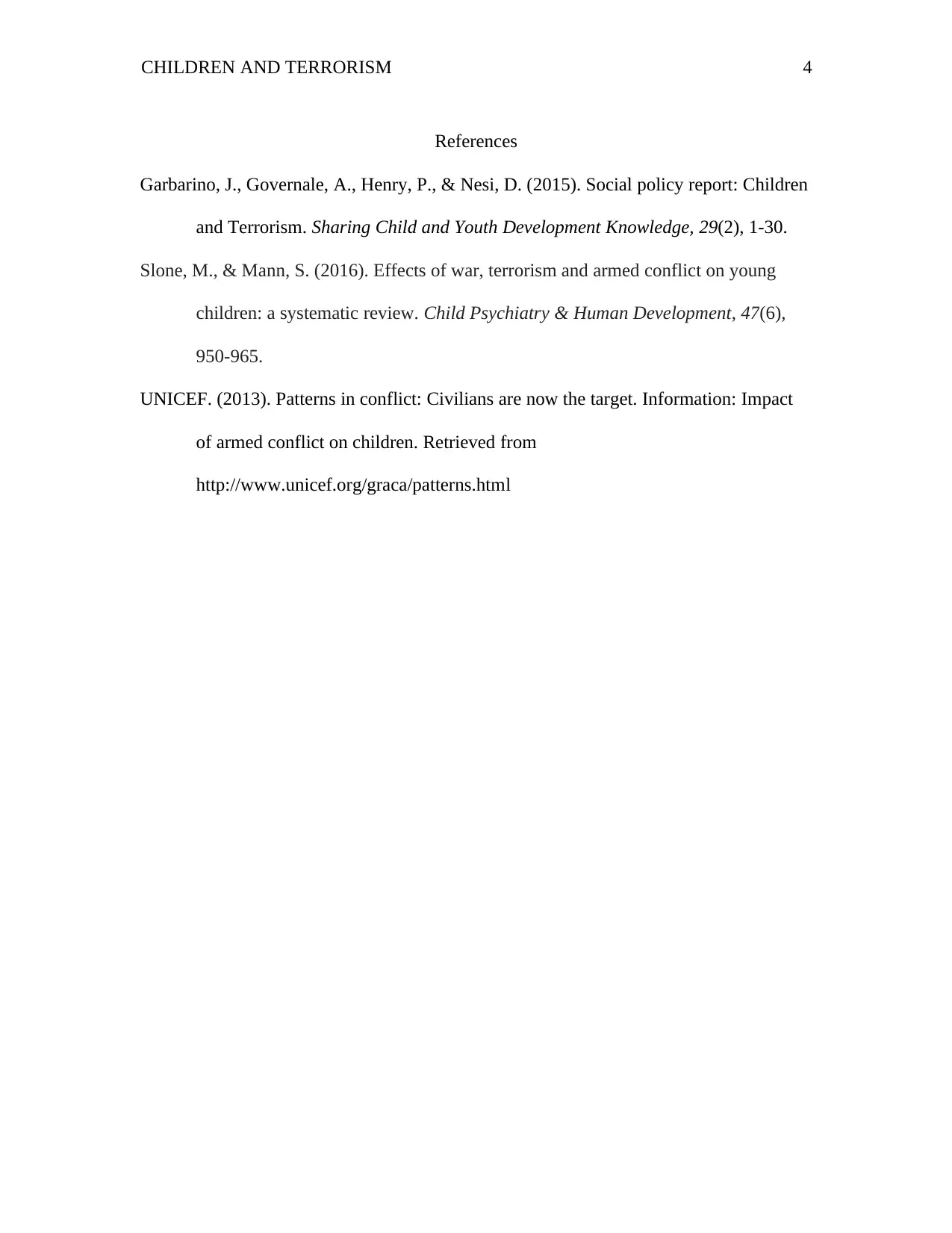
References
Garbarino, J., Governale, A., Henry, P., & Nesi, D. (2015). Social policy report: Children
and Terrorism. Sharing Child and Youth Development Knowledge, 29(2), 1-30.
Slone, M., & Mann, S. (2016). Effects of war, terrorism and armed conflict on young
children: a systematic review. Child Psychiatry & Human Development, 47(6),
950-965.
UNICEF. (2013). Patterns in conflict: Civilians are now the target. Information: Impact
of armed conflict on children. Retrieved from
http://www.unicef.org/graca/patterns.html
chevron_up_icon
1 out of 4
circle_padding
hide_on_mobile
zoom_out_icon
[object Object]