Research Proposal: High Sugar, High Fat Diet and CKD Incidence
VerifiedAdded on 2021/02/19
|14
|3125
|494
Project
AI Summary
This research proposal outlines a study to investigate the correlation between high sugar, high fat diets and the incidence of Chronic Kidney Disease (CKD) in Australia. The study aims to examine patients aged 20-35 admitted to Melbourne hospitals in 2019, utilizing purposive sampling and assessing body fat percentage and blood sugar levels. The research seeks to identify the relationship between poor dietary patterns and CKD, considering ethical considerations such as informed consent and confidentiality. The study design includes a prospective cohort study, employing both parametric and non-parametric statistical methods to analyze the data and calculate relative risk. The research highlights the need for timely identification and management of CKD to mitigate its impact on public health and aims to contribute to the development of effective health policies and regulations.
Research proposal
Question
Question

Paraphrase This Document
Need a fresh take? Get an instant paraphrase of this document with our AI Paraphraser
Table of Contents
Title of the project ...........................................................................................................................3
Study duration .................................................................................................................................3
Project summary..............................................................................................................................3
Rational and background.................................................................................................................4
Study goals and objectives...............................................................................................................5
Study design and methods: ............................................................................................................5
Ethical considerations......................................................................................................................7
Study limitation................................................................................................................................7
Study impact....................................................................................................................................7
Project management.........................................................................................................................8
INTRODUCTION...........................................................................................................................1
Title of the project ...........................................................................................................................3
Study duration .................................................................................................................................3
Project summary..............................................................................................................................3
Rational and background.................................................................................................................4
Study goals and objectives...............................................................................................................5
Study design and methods: ............................................................................................................5
Ethical considerations......................................................................................................................7
Study limitation................................................................................................................................7
Study impact....................................................................................................................................7
Project management.........................................................................................................................8
INTRODUCTION...........................................................................................................................1
Title of the project
Assessment on do high sugar, high fat diet (poor dietary patterns) leads an incidence of Chronic
Kidney Disease (CKD) in Australia.
Study duration
60 months ( 5 years)
Project summary
Australian's high sugar and fat diet leads to epidemic and other chronic disease which
includes the Chronic Kidney Disease (CKD). Due to the consumption of the high sugar and high
fat diet turned to be potential risk factor in development and progression of CKD and other end
stage kidney diseases. Chronic Kidney Disease (CKD) refers to the gradual loss or damaging of
the kidney functions. This is also called as the kidney failure or the last stage renal disease. CKD
have lasting damage to the kidneys which will turn to be worse over time. The individual
consuming high sugar and high fat make kidneys work harder for filtering more blood than a
normal individual as to meet the metabolic demands due to increased weight. The increased
pressure leads to have damaging effects on kidneys which heightens the risk for developing the
CKD in the long term (Webster & et.al., 2017). As per the survey, it has been identified that there
is skyrocketing indicators of CKD in the average population of Australia. There are some studies
which shows the association of high sugar and poor diet patterns which turned out to be
symptoms for Chronic kidney disease (CKD). So, in this study, we have aimed to examine the
relationship between the high sugar, high fat diet (poor dietary patterns) and the incidence of
Chronic Kidney Disease (CKD) studying the patients admitting in the hospitals in Australia. The
proposed plan is to carry out the study in hospitals of Melbourne, Australia taking the individuals
in consideration between the age range of 20-35 years admitting during 2019 as the population
for study. As per the survey, youngsters of Australia have poor diet patterns lacking essential
meals and nutrients in food. They lie in higher level of risk for the chronic disease as compare to
other citizens in Australia (Liyanage & et.al., 2015) The proposed study will be completed using
purposive sampling techniques. The impact of particular study will be regarding the analysis of
individuals with high sugar, high fat (poor diet patterns) in incidence of having Chronic Kidney
Disease (CKD) in Australia. (Hill, & et.al., 2016. )
Assessment on do high sugar, high fat diet (poor dietary patterns) leads an incidence of Chronic
Kidney Disease (CKD) in Australia.
Study duration
60 months ( 5 years)
Project summary
Australian's high sugar and fat diet leads to epidemic and other chronic disease which
includes the Chronic Kidney Disease (CKD). Due to the consumption of the high sugar and high
fat diet turned to be potential risk factor in development and progression of CKD and other end
stage kidney diseases. Chronic Kidney Disease (CKD) refers to the gradual loss or damaging of
the kidney functions. This is also called as the kidney failure or the last stage renal disease. CKD
have lasting damage to the kidneys which will turn to be worse over time. The individual
consuming high sugar and high fat make kidneys work harder for filtering more blood than a
normal individual as to meet the metabolic demands due to increased weight. The increased
pressure leads to have damaging effects on kidneys which heightens the risk for developing the
CKD in the long term (Webster & et.al., 2017). As per the survey, it has been identified that there
is skyrocketing indicators of CKD in the average population of Australia. There are some studies
which shows the association of high sugar and poor diet patterns which turned out to be
symptoms for Chronic kidney disease (CKD). So, in this study, we have aimed to examine the
relationship between the high sugar, high fat diet (poor dietary patterns) and the incidence of
Chronic Kidney Disease (CKD) studying the patients admitting in the hospitals in Australia. The
proposed plan is to carry out the study in hospitals of Melbourne, Australia taking the individuals
in consideration between the age range of 20-35 years admitting during 2019 as the population
for study. As per the survey, youngsters of Australia have poor diet patterns lacking essential
meals and nutrients in food. They lie in higher level of risk for the chronic disease as compare to
other citizens in Australia (Liyanage & et.al., 2015) The proposed study will be completed using
purposive sampling techniques. The impact of particular study will be regarding the analysis of
individuals with high sugar, high fat (poor diet patterns) in incidence of having Chronic Kidney
Disease (CKD) in Australia. (Hill, & et.al., 2016. )
⊘ This is a preview!⊘
Do you want full access?
Subscribe today to unlock all pages.

Trusted by 1+ million students worldwide
Rational and background
There is the massive issues in the countries experiencing the high clinical signs of the CKD. Due
to asymptomatic in nature, CKD leads to have loss up to 90% in functions of kidney before the
time it could be deducted. There is the need for timely identification along with appropriate
management so that inevitable deterioration in the kidney functions can be control as much by
50% of total loss. Easier to say that every third Australian have a high risk of developing CKD.
The body fat percentage of a human begin will be calculated as total body fat divided by the
total mass of body. As per the standard there should be maximum 15% and 28% of fat in male
body and female body respectively. The individual having fatter than per the standard will be
considered unhealthy (Koya, 2017) The latest data as per Australian and New Zealand dialysis
registry (ANZDATA) shows that recently there are more that 23000 Australian having the end
stage in kidney disease as they are either dependent on dialysis or having the option for the
transplant. As these data turned out to be quite disturbing from the view of health epidemiologist
and the makers of health policy which turned out to global issue . There is the requirement for
the conduct of research related to heath issue so heath specialist and experts from all over world
through active participation in developing and planning to formulate appropriate health policies
and regulation framework to reduce the problems of the kidney diseases in world ( Liyanage, &
et.al., 2015.). According to ((Hill & et.al., 2016) the unsystematic way of Morden living had
made the people inactive and lazy. The poor deitory pattern are somewhere affected by socio-
economic factor or genetic factor . This can create the major issues in kidney related disease
among the target individuals. As per the statement of (Koya, D., 2017) there are evidence which
suggests that due to high consumption of fat diet and sugar can lead to heart and kidney related
issues. The author (Liyanage & et.al., 2015) also stated that due to consumption of high sugar it
is suggested to have the high chances to being diabetic for an individual along with high fat diet
has chance of heart issues. The measurement of the high sugar in patient as the normal rate of
sugar in blood should be less than 140mg/dL after two hours of food and 100mg/dL at the time
of fasting is considered to be normal. More level of sugar from the respective standard will be
considered as the diabetic one. The main causes for the chronic kidney disease is being diabetic
and high blood pressure. Chronic diseases is turned out significant and growing public health
issues which turned out to be responsible for sustainable burden in illness along with premature
morality. According to author (López-Olmedo and et.al., 2016) there can be increase in the
There is the massive issues in the countries experiencing the high clinical signs of the CKD. Due
to asymptomatic in nature, CKD leads to have loss up to 90% in functions of kidney before the
time it could be deducted. There is the need for timely identification along with appropriate
management so that inevitable deterioration in the kidney functions can be control as much by
50% of total loss. Easier to say that every third Australian have a high risk of developing CKD.
The body fat percentage of a human begin will be calculated as total body fat divided by the
total mass of body. As per the standard there should be maximum 15% and 28% of fat in male
body and female body respectively. The individual having fatter than per the standard will be
considered unhealthy (Koya, 2017) The latest data as per Australian and New Zealand dialysis
registry (ANZDATA) shows that recently there are more that 23000 Australian having the end
stage in kidney disease as they are either dependent on dialysis or having the option for the
transplant. As these data turned out to be quite disturbing from the view of health epidemiologist
and the makers of health policy which turned out to global issue . There is the requirement for
the conduct of research related to heath issue so heath specialist and experts from all over world
through active participation in developing and planning to formulate appropriate health policies
and regulation framework to reduce the problems of the kidney diseases in world ( Liyanage, &
et.al., 2015.). According to ((Hill & et.al., 2016) the unsystematic way of Morden living had
made the people inactive and lazy. The poor deitory pattern are somewhere affected by socio-
economic factor or genetic factor . This can create the major issues in kidney related disease
among the target individuals. As per the statement of (Koya, D., 2017) there are evidence which
suggests that due to high consumption of fat diet and sugar can lead to heart and kidney related
issues. The author (Liyanage & et.al., 2015) also stated that due to consumption of high sugar it
is suggested to have the high chances to being diabetic for an individual along with high fat diet
has chance of heart issues. The measurement of the high sugar in patient as the normal rate of
sugar in blood should be less than 140mg/dL after two hours of food and 100mg/dL at the time
of fasting is considered to be normal. More level of sugar from the respective standard will be
considered as the diabetic one. The main causes for the chronic kidney disease is being diabetic
and high blood pressure. Chronic diseases is turned out significant and growing public health
issues which turned out to be responsible for sustainable burden in illness along with premature
morality. According to author (López-Olmedo and et.al., 2016) there can be increase in the
Paraphrase This Document
Need a fresh take? Get an instant paraphrase of this document with our AI Paraphraser
cardio vascular co morbidities and other kidney infections. As per review of literature and
analysing the current issue it was identified that there is requirement for serious consideration
between the relation of the high sugar, poor diet pattern and Chronic Kidney Disease (CKD).
Due to difference in research methodology along with research gap, there are various
contradiction prevails in study topic. So, the study is aimed to assess the relation between the
high sugar, high fat diet (poor dietary patterns) leads an incidence of Chronic Kidney Disease
(CKD) among the patients age between 20-35 years in hospitals of Melbourne, Australia.
Study goals and objectives
The requirement of conducting the research is to have the sustainable achievement of
goal regarding fulfilment of research gap that has been identified in having the review of
literature. This will help the various reserachers and peer viewers to take appropriate decision
regarding the control of high sugar and fat diet (poor dietary patterns) to reduces kidney related
issues and related negative impact (Smith, 2016). The another objective is to enhance clinical
knowledge , skills and judgement in primary care ambulatory practice, consultative decision and
hospital medicine. The main purpose for proposal is to identify the relation in high sugar, high
fat (poor dietary pattern) and the incidence of Chronic Kidney Disease (CKD). The research also
aimed at most common clinical presentation for critical illness among the chronic kidney disease
patients. The objective also have a planned structure and details regarding the procedure of
research to achieve the major objectives as per limits of appropriate funding resource to be part
of research and assist in completing the one (O'Leary,2018). There is the possibility that
Australian council for research education (ACER) and NHMRC ( National Health And Medical
Research Council) will fund in the study. Due to time-consuming and costly study design , there
can be high risk if baisness in the report result.(López-Olmedo,, & et.al., 2016)
Study design and methods:
The proposed study plan is to carry out the study in hospitals of Melbourne, Australia
taking the individuals in consideration between the age range of 20-35 years admitting during
November 2019 as the population for study (Singh, Raj. & Saminathan, 2018). There will be
sugar test along with fat test in which the percentage of fat in the particular individual total
weight will be calculated. As per the standard there should be maximum 15% and 28% of fat in
male body and female body respectively (Sankar & Jeyanthi, 2016). The individual having fatter
than per the standard will be considered unhealthy people and remaining will be normal
analysing the current issue it was identified that there is requirement for serious consideration
between the relation of the high sugar, poor diet pattern and Chronic Kidney Disease (CKD).
Due to difference in research methodology along with research gap, there are various
contradiction prevails in study topic. So, the study is aimed to assess the relation between the
high sugar, high fat diet (poor dietary patterns) leads an incidence of Chronic Kidney Disease
(CKD) among the patients age between 20-35 years in hospitals of Melbourne, Australia.
Study goals and objectives
The requirement of conducting the research is to have the sustainable achievement of
goal regarding fulfilment of research gap that has been identified in having the review of
literature. This will help the various reserachers and peer viewers to take appropriate decision
regarding the control of high sugar and fat diet (poor dietary patterns) to reduces kidney related
issues and related negative impact (Smith, 2016). The another objective is to enhance clinical
knowledge , skills and judgement in primary care ambulatory practice, consultative decision and
hospital medicine. The main purpose for proposal is to identify the relation in high sugar, high
fat (poor dietary pattern) and the incidence of Chronic Kidney Disease (CKD). The research also
aimed at most common clinical presentation for critical illness among the chronic kidney disease
patients. The objective also have a planned structure and details regarding the procedure of
research to achieve the major objectives as per limits of appropriate funding resource to be part
of research and assist in completing the one (O'Leary,2018). There is the possibility that
Australian council for research education (ACER) and NHMRC ( National Health And Medical
Research Council) will fund in the study. Due to time-consuming and costly study design , there
can be high risk if baisness in the report result.(López-Olmedo,, & et.al., 2016)
Study design and methods:
The proposed study plan is to carry out the study in hospitals of Melbourne, Australia
taking the individuals in consideration between the age range of 20-35 years admitting during
November 2019 as the population for study (Singh, Raj. & Saminathan, 2018). There will be
sugar test along with fat test in which the percentage of fat in the particular individual total
weight will be calculated. As per the standard there should be maximum 15% and 28% of fat in
male body and female body respectively (Sankar & Jeyanthi, 2016). The individual having fatter
than per the standard will be considered unhealthy people and remaining will be normal
individual. The body fat percentage of a human begin will be calculated as total body fat divided
by the total mass of body. Bioelectrical impedance analysis will be used on the patients for the
estimation of the body composition as weak current is flow through the body and the
measurement of resistance will help in calculation of fat in the particular individual (Sankar
& Jeyanthi, 2016.). The next will be for the purpose of measurement of the high sugar in patient
as the normal rate of sugar in blood should be less than 140mg/dL after two hours of food and
100mg/dL at the time of fasting is considered to be normal. The more level of sugar from the
respective standard will be considered as the diabetic one. The estimation of beginning the
research study will be from the November 2019 at the regular interval of one year. With the help
of previous records and the history used to play the important role in the efficient outcome of the
study. The cohort study design that is proposed for the study will be in prospective type as we
are going to have the relationship between the body fat percentage ( factor) , diabetic resultants
(factor) and degree of risk of issues related to kidney or Chronic Kidney Disease (CKD)
(outcome)(Walliman, 2017 )
The research will not be retrospective as the individual involved in the research are not
the kidney issue patients at the start of the study. There will be used purposive sampling under
the non probability sampling for the sampling method of purposed study. The reason of
selecting the non probability sampling as the patients are not selected randomly but all the
patients who are admitted in the hospital in the month of November between the age range of 20-
35 years will be included in study (O'Leary, 2018). The study will be concluded with the
calculation of the relative risk by calculating the magnitude of the factor that are body fat
percentage ( factor) , diabetic resultants (factor) and degree of risk of issues related to kidney or
Chronic Kidney Disease (CKD) (outcome).(Wanner & et.al., 2016). there will be calculation of
the relative risk as to have the analysis the decision regarding the development of the
realtionship. Other than that ll type of the t-test, F test are considered parametric test. patients t-
test (one sample t-test, independent samples t-test, paired samples t-test) is used to compare the
means between two groups while F test (one-way ANOVA, repeated measures ANOVA, etc.)
which is the extension of the patients t-test are used to compare the means among three or more
groups. Similarly, Pearson correlation coefficient, linear regression is also considered parametric
methods, is used to calculate using mean and standard deviation of the data. For above
parametric methods, counterpart nonparametric methods are also available. For example, Mann--
by the total mass of body. Bioelectrical impedance analysis will be used on the patients for the
estimation of the body composition as weak current is flow through the body and the
measurement of resistance will help in calculation of fat in the particular individual (Sankar
& Jeyanthi, 2016.). The next will be for the purpose of measurement of the high sugar in patient
as the normal rate of sugar in blood should be less than 140mg/dL after two hours of food and
100mg/dL at the time of fasting is considered to be normal. The more level of sugar from the
respective standard will be considered as the diabetic one. The estimation of beginning the
research study will be from the November 2019 at the regular interval of one year. With the help
of previous records and the history used to play the important role in the efficient outcome of the
study. The cohort study design that is proposed for the study will be in prospective type as we
are going to have the relationship between the body fat percentage ( factor) , diabetic resultants
(factor) and degree of risk of issues related to kidney or Chronic Kidney Disease (CKD)
(outcome)(Walliman, 2017 )
The research will not be retrospective as the individual involved in the research are not
the kidney issue patients at the start of the study. There will be used purposive sampling under
the non probability sampling for the sampling method of purposed study. The reason of
selecting the non probability sampling as the patients are not selected randomly but all the
patients who are admitted in the hospital in the month of November between the age range of 20-
35 years will be included in study (O'Leary, 2018). The study will be concluded with the
calculation of the relative risk by calculating the magnitude of the factor that are body fat
percentage ( factor) , diabetic resultants (factor) and degree of risk of issues related to kidney or
Chronic Kidney Disease (CKD) (outcome).(Wanner & et.al., 2016). there will be calculation of
the relative risk as to have the analysis the decision regarding the development of the
realtionship. Other than that ll type of the t-test, F test are considered parametric test. patients t-
test (one sample t-test, independent samples t-test, paired samples t-test) is used to compare the
means between two groups while F test (one-way ANOVA, repeated measures ANOVA, etc.)
which is the extension of the patients t-test are used to compare the means among three or more
groups. Similarly, Pearson correlation coefficient, linear regression is also considered parametric
methods, is used to calculate using mean and standard deviation of the data. For above
parametric methods, counterpart nonparametric methods are also available. For example, Mann--
⊘ This is a preview!⊘
Do you want full access?
Subscribe today to unlock all pages.
Trusted by 1+ million students worldwide
Whitney U test and Wilcoxon test are used for patients t-test while Kruskal--Wallis H test,
median test, and Friedman test are alternative methods of the F test (ANOVA). Similarly,
Spearman rank correlation coefficient and log linear regression are used as nonparametric
method of the Pearson correlation and linear regression, respectively
Ethical considerations
The study should be based on informed consent, confidentiality and have the right to
refuses the treatment in the completion of study in assessment in high sugar, high fat diet (poor
dietary patterns) leads an incidence of Chronic Kidney Disease (CKD) in Australia. Fabrication
of data, manipulation at time of analysis and other intentional changes to get the required
outcome are some grey areas which are needed to be addressed (Liyanage, & et.al., 2015). It
depends on the individual's priority of taking part in research particular having focus on outcome
of research as for the welfare of public health. It must include the emotional and future
consideration (Smith, 2016). the researcher should also have attention to ethical issues that can
facilitate the effective planning , implementation and growth of variety of programme and
research activities. There is the existence of separate council of the ethical review of the health
researches as the existence of Australian council for research education (ACER) for the
technical and ethical review in the educational and heath related research (Hill & et.al., 2016) .
The copy will be sent to ACER for the justification of research to be ethical sound and ethically
perfect.
Study limitation
The study is long duration cohort study which has its specific limitation . The study
requires the time period of 5 years in which it is very difficult to have followed up of each
individual having participation in study (Koya, 2017). Due to difference in work culture and
change pattern over an individual can leads to changes in accurate results. There can be risk of
migration of respondents to achieve personal objectives. The proper follow up of each and every
individual will make the study costlier in upcoming years along with introduction of baisness in
data which result in deviation from the expected outcome.
Study impact
The major impact of the study will be on controlling the problem of the Chronic Kidney
Disease (CKD) and other kidney related issues among the individuals so that there can be
creation of healthy and more creative life style. If in the accomplishment of study there will be
median test, and Friedman test are alternative methods of the F test (ANOVA). Similarly,
Spearman rank correlation coefficient and log linear regression are used as nonparametric
method of the Pearson correlation and linear regression, respectively
Ethical considerations
The study should be based on informed consent, confidentiality and have the right to
refuses the treatment in the completion of study in assessment in high sugar, high fat diet (poor
dietary patterns) leads an incidence of Chronic Kidney Disease (CKD) in Australia. Fabrication
of data, manipulation at time of analysis and other intentional changes to get the required
outcome are some grey areas which are needed to be addressed (Liyanage, & et.al., 2015). It
depends on the individual's priority of taking part in research particular having focus on outcome
of research as for the welfare of public health. It must include the emotional and future
consideration (Smith, 2016). the researcher should also have attention to ethical issues that can
facilitate the effective planning , implementation and growth of variety of programme and
research activities. There is the existence of separate council of the ethical review of the health
researches as the existence of Australian council for research education (ACER) for the
technical and ethical review in the educational and heath related research (Hill & et.al., 2016) .
The copy will be sent to ACER for the justification of research to be ethical sound and ethically
perfect.
Study limitation
The study is long duration cohort study which has its specific limitation . The study
requires the time period of 5 years in which it is very difficult to have followed up of each
individual having participation in study (Koya, 2017). Due to difference in work culture and
change pattern over an individual can leads to changes in accurate results. There can be risk of
migration of respondents to achieve personal objectives. The proper follow up of each and every
individual will make the study costlier in upcoming years along with introduction of baisness in
data which result in deviation from the expected outcome.
Study impact
The major impact of the study will be on controlling the problem of the Chronic Kidney
Disease (CKD) and other kidney related issues among the individuals so that there can be
creation of healthy and more creative life style. If in the accomplishment of study there will be
Paraphrase This Document
Need a fresh take? Get an instant paraphrase of this document with our AI Paraphraser
the evidence of high sugar, high fat diet (poor dietary patterns) leads an incidence of Chronic
Kidney Disease (CKD) , so it can help the government in formulation of policies along with
health experts in order to control and have reduction in kidney related issues (Walliman, 2017).
By the introduction if new policies , there will be encouragement and sense of involvement in
their physical activeness ad their diet pattern. The control of the issue at the initial stage will be
done by controlling the diabetes and other cardiovascular diseases (Koya, 2017.). The study will
also have impact on young individual regarding the health issues they can face in upcoming
future due to consumption of high sugar and poor dietary patterns.
Project management
The proper arrangement of the proposed study will be accomplished under my
investigation a long with taking care of all essential consideration. The proposed study will be
submitted to the Australian council for research education (ACER), NHMRC ( National Health
And Medical Research Council) along with health ministryof Australia for proper management
in formulation of rules and regulation along with funding of resources
(Wanner and et.al., 2016). To have effective accomplishment of the proposed study, all the
hospitals of Australia will be involved with valid instruction of health ministry and NHMRC
( National Health And Medical Research Council). The copy of the research study will also be
sent to the Australian council for research education (ACER) for the technical and ethical review
in the educational and heath related research (Hill & et.al., 2016). There will be involvement of
the other authorities of government for technical and ethical monitoring ad review of project.
Kidney Disease (CKD) , so it can help the government in formulation of policies along with
health experts in order to control and have reduction in kidney related issues (Walliman, 2017).
By the introduction if new policies , there will be encouragement and sense of involvement in
their physical activeness ad their diet pattern. The control of the issue at the initial stage will be
done by controlling the diabetes and other cardiovascular diseases (Koya, 2017.). The study will
also have impact on young individual regarding the health issues they can face in upcoming
future due to consumption of high sugar and poor dietary patterns.
Project management
The proper arrangement of the proposed study will be accomplished under my
investigation a long with taking care of all essential consideration. The proposed study will be
submitted to the Australian council for research education (ACER), NHMRC ( National Health
And Medical Research Council) along with health ministryof Australia for proper management
in formulation of rules and regulation along with funding of resources
(Wanner and et.al., 2016). To have effective accomplishment of the proposed study, all the
hospitals of Australia will be involved with valid instruction of health ministry and NHMRC
( National Health And Medical Research Council). The copy of the research study will also be
sent to the Australian council for research education (ACER) for the technical and ethical review
in the educational and heath related research (Hill & et.al., 2016). There will be involvement of
the other authorities of government for technical and ethical monitoring ad review of project.
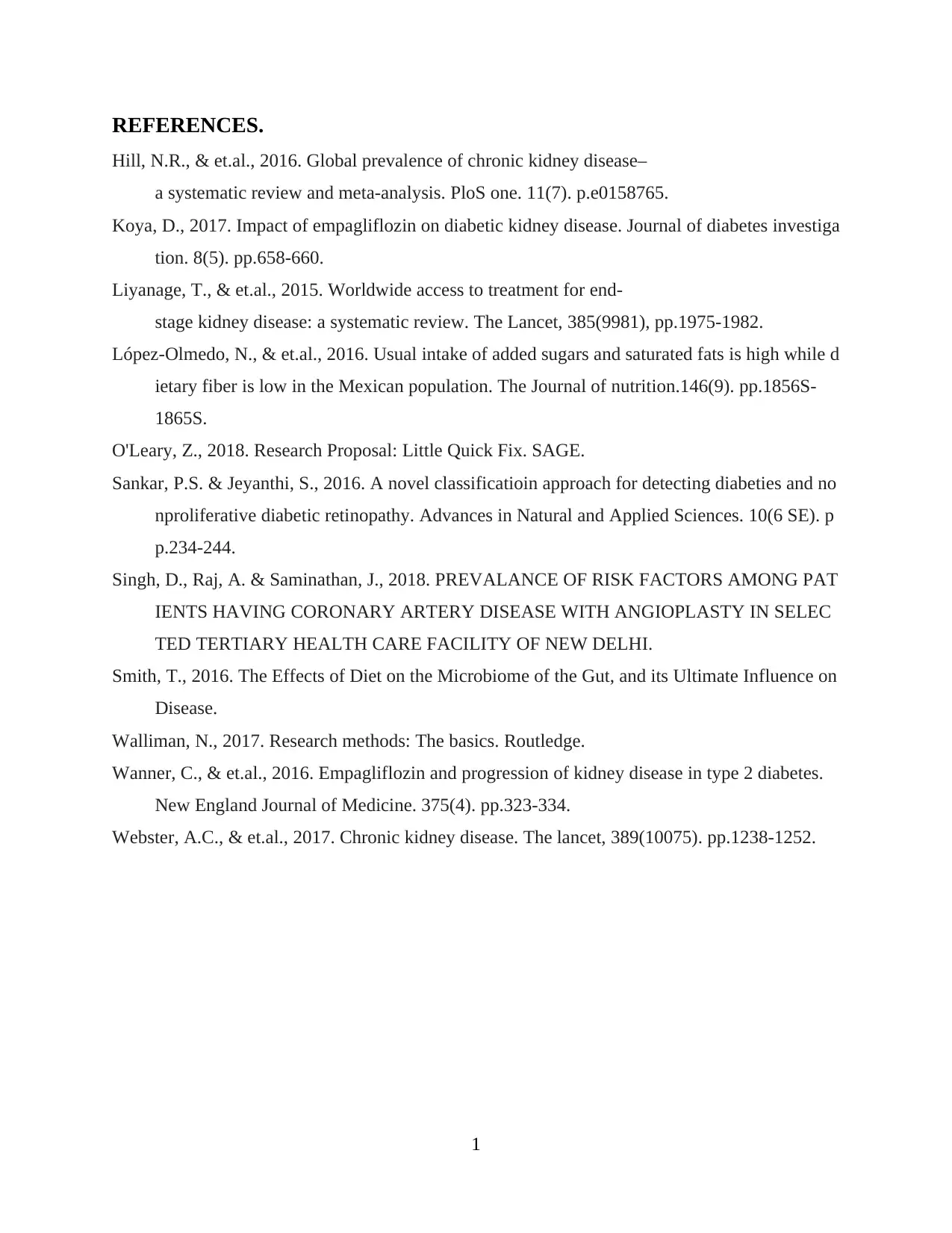
REFERENCES.
Hill, N.R., & et.al., 2016. Global prevalence of chronic kidney disease–
a systematic review and meta-analysis. PloS one. 11(7). p.e0158765.
Koya, D., 2017. Impact of empagliflozin on diabetic kidney disease. Journal of diabetes investiga
tion. 8(5). pp.658-660.
Liyanage, T., & et.al., 2015. Worldwide access to treatment for end-
stage kidney disease: a systematic review. The Lancet, 385(9981), pp.1975-1982.
López-Olmedo, N., & et.al., 2016. Usual intake of added sugars and saturated fats is high while d
ietary fiber is low in the Mexican population. The Journal of nutrition.146(9). pp.1856S-
1865S.
O'Leary, Z., 2018. Research Proposal: Little Quick Fix. SAGE.
Sankar, P.S. & Jeyanthi, S., 2016. A novel classificatioin approach for detecting diabeties and no
nproliferative diabetic retinopathy. Advances in Natural and Applied Sciences. 10(6 SE). p
p.234-244.
Singh, D., Raj, A. & Saminathan, J., 2018. PREVALANCE OF RISK FACTORS AMONG PAT
IENTS HAVING CORONARY ARTERY DISEASE WITH ANGIOPLASTY IN SELEC
TED TERTIARY HEALTH CARE FACILITY OF NEW DELHI.
Smith, T., 2016. The Effects of Diet on the Microbiome of the Gut, and its Ultimate Influence on
Disease.
Walliman, N., 2017. Research methods: The basics. Routledge.
Wanner, C., & et.al., 2016. Empagliflozin and progression of kidney disease in type 2 diabetes.
New England Journal of Medicine. 375(4). pp.323-334.
Webster, A.C., & et.al., 2017. Chronic kidney disease. The lancet, 389(10075). pp.1238-1252.
1
Hill, N.R., & et.al., 2016. Global prevalence of chronic kidney disease–
a systematic review and meta-analysis. PloS one. 11(7). p.e0158765.
Koya, D., 2017. Impact of empagliflozin on diabetic kidney disease. Journal of diabetes investiga
tion. 8(5). pp.658-660.
Liyanage, T., & et.al., 2015. Worldwide access to treatment for end-
stage kidney disease: a systematic review. The Lancet, 385(9981), pp.1975-1982.
López-Olmedo, N., & et.al., 2016. Usual intake of added sugars and saturated fats is high while d
ietary fiber is low in the Mexican population. The Journal of nutrition.146(9). pp.1856S-
1865S.
O'Leary, Z., 2018. Research Proposal: Little Quick Fix. SAGE.
Sankar, P.S. & Jeyanthi, S., 2016. A novel classificatioin approach for detecting diabeties and no
nproliferative diabetic retinopathy. Advances in Natural and Applied Sciences. 10(6 SE). p
p.234-244.
Singh, D., Raj, A. & Saminathan, J., 2018. PREVALANCE OF RISK FACTORS AMONG PAT
IENTS HAVING CORONARY ARTERY DISEASE WITH ANGIOPLASTY IN SELEC
TED TERTIARY HEALTH CARE FACILITY OF NEW DELHI.
Smith, T., 2016. The Effects of Diet on the Microbiome of the Gut, and its Ultimate Influence on
Disease.
Walliman, N., 2017. Research methods: The basics. Routledge.
Wanner, C., & et.al., 2016. Empagliflozin and progression of kidney disease in type 2 diabetes.
New England Journal of Medicine. 375(4). pp.323-334.
Webster, A.C., & et.al., 2017. Chronic kidney disease. The lancet, 389(10075). pp.1238-1252.
1
⊘ This is a preview!⊘
Do you want full access?
Subscribe today to unlock all pages.
Trusted by 1+ million students worldwide

2
Paraphrase This Document
Need a fresh take? Get an instant paraphrase of this document with our AI Paraphraser

3

4
⊘ This is a preview!⊘
Do you want full access?
Subscribe today to unlock all pages.
Trusted by 1+ million students worldwide

1 out of 14


Related Documents


Your All-in-One AI-Powered Toolkit for Academic Success.
+13062052269
info@desklib.com
Available 24*7 on WhatsApp / Email
![[object Object]](/_next/static/media/star-bottom.7253800d.svg)
Unlock your academic potential
Copyright © 2020–2026 A2Z Services. All Rights Reserved. Developed and managed by ZUCOL.