Climate Change's Impact on Business and Organizational Change
VerifiedAdded on 2023/01/13
|10
|2734
|36
Essay
AI Summary
This essay delves into the critical relationship between climate change and business operations, exploring the various ways in which organizations and their employees contribute to environmental issues. The report highlights key environmental concerns such as pollution, waste disposal, and climate change itself, emphasizing the need for sustainable practices. It discusses the impact of these issues on businesses, including the effects on employees, operational costs, and the necessity for adapting to changing environmental conditions. The essay outlines several models of organizational change, such as Lewin's model, to illustrate how companies can implement eco-friendly policies and practices. Furthermore, it presents different anti-pollution policies and provides examples of organizations that have adopted environment-friendly strategies, such as ASDA, McDonald's, and Costa Coffee. The conclusion reinforces the importance of integrating environmental considerations into business strategies for long-term sustainability and success.
Essay Discussion(FT &
Elective)-2019/20
Elective)-2019/20

Paraphrase This Document
Need a fresh take? Get an instant paraphrase of this document with our AI Paraphraser
Table of Contents
INTRODUCTION...........................................................................................................................3
How business is related to climate change.............................................................................4
Different policies that can be pursued for implementing anti pollution actions....................6
Few examples of organisations that have adopted environment friendly policies ................7
CONCLUSION ...............................................................................................................................8
REFERENCES ...............................................................................................................................9
\
INTRODUCTION...........................................................................................................................3
How business is related to climate change.............................................................................4
Different policies that can be pursued for implementing anti pollution actions....................6
Few examples of organisations that have adopted environment friendly policies ................7
CONCLUSION ...............................................................................................................................8
REFERENCES ...............................................................................................................................9
\
INTRODUCTION
The following report includes discussion on the topic - “ climate change is making us
rethink the way we work in organisations”. This report includes discussion about the way in
which organisation and employees are affecting climatic changes. This report includes models
of organisational change that are linked to the new changes that can be adopted within
companies for running businesses in a way that nature or climate is not harmed.
How business affect environment
There are various environmental issues that occur due to the operating of many factories
(Amran, amd et. al. 2016). There are few primary environmental issues which affects business
are pollution, water quality, waste disposal, supply issues and climate changes.
Business impact – Pollution is a major factor of environmental issues. Employees will
not like to work in a workplace where pollution is more (Anderson, Field, and Mach, 2017).
They need a pollution free city or area. Waste disposal is a factor that includes improper disposal
and foul smell. This kind of place or city is not feasible for employees to work. Thus,
organisations must ensure that they are providing good workplace environment.
Climate change is going to affect each and every individual -This is a global issue and it
has major influence on social, environmental, political, technological, economical and legal
factors. Some of the factors such as coastal flooding affects business and this leads to loss and
disruption in business. When there are conditions of high temperature in workplace, there is need
of using air conditioning. This costs a lot to business. Within some industries, there is need of
using natural resources like fossil fuels and water.
Mitigating risks - Environmental issue is a complex problem and it can only be solved
collaboratively by different sectors of business environment (Beck, 2016). All individuals
working in different companies have to become environmental stewards for keeping economy
thriving and moving.
Environmental crisis - Some environmental factors affects business and this continue to
affect production as well as economy. Few issues are loss of resources, inflation, storms, etc.
This complex issue needs to be solved by the cooperation of each and every sector. Different
business managers and leaders must consider impact on environment. This means business
corporations must work an meet regulations and needs of environment safety.
The following report includes discussion on the topic - “ climate change is making us
rethink the way we work in organisations”. This report includes discussion about the way in
which organisation and employees are affecting climatic changes. This report includes models
of organisational change that are linked to the new changes that can be adopted within
companies for running businesses in a way that nature or climate is not harmed.
How business affect environment
There are various environmental issues that occur due to the operating of many factories
(Amran, amd et. al. 2016). There are few primary environmental issues which affects business
are pollution, water quality, waste disposal, supply issues and climate changes.
Business impact – Pollution is a major factor of environmental issues. Employees will
not like to work in a workplace where pollution is more (Anderson, Field, and Mach, 2017).
They need a pollution free city or area. Waste disposal is a factor that includes improper disposal
and foul smell. This kind of place or city is not feasible for employees to work. Thus,
organisations must ensure that they are providing good workplace environment.
Climate change is going to affect each and every individual -This is a global issue and it
has major influence on social, environmental, political, technological, economical and legal
factors. Some of the factors such as coastal flooding affects business and this leads to loss and
disruption in business. When there are conditions of high temperature in workplace, there is need
of using air conditioning. This costs a lot to business. Within some industries, there is need of
using natural resources like fossil fuels and water.
Mitigating risks - Environmental issue is a complex problem and it can only be solved
collaboratively by different sectors of business environment (Beck, 2016). All individuals
working in different companies have to become environmental stewards for keeping economy
thriving and moving.
Environmental crisis - Some environmental factors affects business and this continue to
affect production as well as economy. Few issues are loss of resources, inflation, storms, etc.
This complex issue needs to be solved by the cooperation of each and every sector. Different
business managers and leaders must consider impact on environment. This means business
corporations must work an meet regulations and needs of environment safety.
⊘ This is a preview!⊘
Do you want full access?
Subscribe today to unlock all pages.

Trusted by 1+ million students worldwide
Opportunity - Businesses also have opportunities due to environmental issues that
includes showing employees and markets where the company stands and what are their plans in
mitigating risks (Bell, 2016). According to the Occupational safety and Health Administration, it
is said that work environment must ensure that employees are given healthy and pollution free
environment.
Environmental action is good for business - Business owners have objective to build an
organisation that is able to generate revenues and increasing profits. There are main issues like
environmental, effect on business and risk to future which are important for prevailing across the
globe (Harrison, Cullen, and Armstrong, 2017). It is necessary for making modifications which
are necessary for good environment.
How business is related to climate change
The development of industries and businesses has resulted in wealth and better life. On
the other hand, it is seen that increase in industries has affected climate change. The increase in
industries includes different technological innovation, economic as well as social transformation,
etc. The challenges faced by industries while working are coping up with high temperatures,
change in human life style, more extreme weather condition, change in human life style and
change in philosophies. Therefore, Companies are considering climate change and its
consequences while running industries. There are several businesses such as food processing
facilities, appliance manufacturers, warehouses. The residue of these products affects
environment in negative manner. Water that is discharged from these factories can pollute
various lakes and rivers as they include different substances like waste, chemicals, dyes, plastic ,
etc (Kellogg, 2019). Water pollution can lead to killing of wildlife and harming ecosystem.
Plastic that is main cause of pollution can pollute environment and it can pose hazard to animals.
It is essential that different industries and factories must practise responsible waste management
which includes recycling as well as waste disposal. The effects of industrial waste on
environment can be reduced by managing right techniques and having a proper waste
management plan. This can lead to ensure a safe and clean working environment.
There are few examples in which working companies damages environment -
The air conditioning and heating system pumps greenhouse gas emissions from offices
into the atmosphere (Kirby, And et. al., 2016). This uses lot of electricity and buildings must be
designed for including energy efficient system and technology for minimising heat and air
includes showing employees and markets where the company stands and what are their plans in
mitigating risks (Bell, 2016). According to the Occupational safety and Health Administration, it
is said that work environment must ensure that employees are given healthy and pollution free
environment.
Environmental action is good for business - Business owners have objective to build an
organisation that is able to generate revenues and increasing profits. There are main issues like
environmental, effect on business and risk to future which are important for prevailing across the
globe (Harrison, Cullen, and Armstrong, 2017). It is necessary for making modifications which
are necessary for good environment.
How business is related to climate change
The development of industries and businesses has resulted in wealth and better life. On
the other hand, it is seen that increase in industries has affected climate change. The increase in
industries includes different technological innovation, economic as well as social transformation,
etc. The challenges faced by industries while working are coping up with high temperatures,
change in human life style, more extreme weather condition, change in human life style and
change in philosophies. Therefore, Companies are considering climate change and its
consequences while running industries. There are several businesses such as food processing
facilities, appliance manufacturers, warehouses. The residue of these products affects
environment in negative manner. Water that is discharged from these factories can pollute
various lakes and rivers as they include different substances like waste, chemicals, dyes, plastic ,
etc (Kellogg, 2019). Water pollution can lead to killing of wildlife and harming ecosystem.
Plastic that is main cause of pollution can pollute environment and it can pose hazard to animals.
It is essential that different industries and factories must practise responsible waste management
which includes recycling as well as waste disposal. The effects of industrial waste on
environment can be reduced by managing right techniques and having a proper waste
management plan. This can lead to ensure a safe and clean working environment.
There are few examples in which working companies damages environment -
The air conditioning and heating system pumps greenhouse gas emissions from offices
into the atmosphere (Kirby, And et. al., 2016). This uses lot of electricity and buildings must be
designed for including energy efficient system and technology for minimising heat and air
Paraphrase This Document
Need a fresh take? Get an instant paraphrase of this document with our AI Paraphraser
conditioning (Lee, and Klassen, 2016). It is concluded that offices produce a lot of waste such
as equipment (especially computers), because companies regularly upgrade their equipment to
stay competitive. Other waste that is produced by companies include photocopiers and
computers which produces landfills.
Models of organisational change
There are different models of organisational change that are followed within business
environment. It is important for the companies to analyse change model of organisation when
there is need of implementation of new techniques and tools within the company (Maunder,
2019). Some of the models in context of climate change in business are mentioned below -
Lewin's organisational change model
There are three stages of the Kurt Lewin model and this is a planned approach for
analysing changes that occur within any company. As per this model, change within any
organisation is must. The present scenario in business environment is that all organisations must
focus upon impact that climate change has on running of business. In order to explain the process
of organisational change, there is an analogy used that means how company moulds itself while
working by adopting new change. This model is given below -
as equipment (especially computers), because companies regularly upgrade their equipment to
stay competitive. Other waste that is produced by companies include photocopiers and
computers which produces landfills.
Models of organisational change
There are different models of organisational change that are followed within business
environment. It is important for the companies to analyse change model of organisation when
there is need of implementation of new techniques and tools within the company (Maunder,
2019). Some of the models in context of climate change in business are mentioned below -
Lewin's organisational change model
There are three stages of the Kurt Lewin model and this is a planned approach for
analysing changes that occur within any company. As per this model, change within any
organisation is must. The present scenario in business environment is that all organisations must
focus upon impact that climate change has on running of business. In order to explain the process
of organisational change, there is an analogy used that means how company moulds itself while
working by adopting new change. This model is given below -
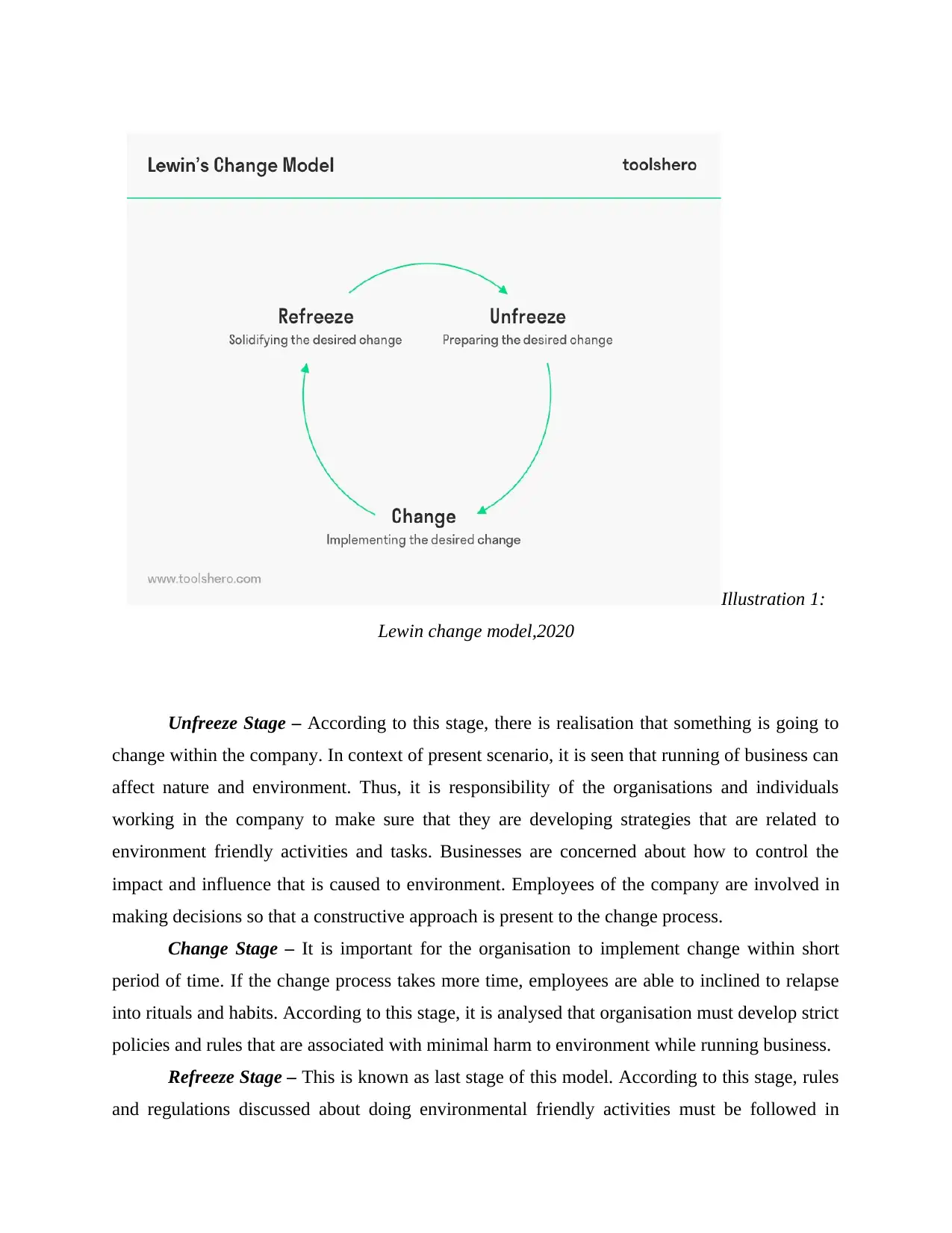
Unfreeze Stage – According to this stage, there is realisation that something is going to
change within the company. In context of present scenario, it is seen that running of business can
affect nature and environment. Thus, it is responsibility of the organisations and individuals
working in the company to make sure that they are developing strategies that are related to
environment friendly activities and tasks. Businesses are concerned about how to control the
impact and influence that is caused to environment. Employees of the company are involved in
making decisions so that a constructive approach is present to the change process.
Change Stage – It is important for the organisation to implement change within short
period of time. If the change process takes more time, employees are able to inclined to relapse
into rituals and habits. According to this stage, it is analysed that organisation must develop strict
policies and rules that are associated with minimal harm to environment while running business.
Refreeze Stage – This is known as last stage of this model. According to this stage, rules
and regulations discussed about doing environmental friendly activities must be followed in
Illustration 1:
Lewin change model,2020
change within the company. In context of present scenario, it is seen that running of business can
affect nature and environment. Thus, it is responsibility of the organisations and individuals
working in the company to make sure that they are developing strategies that are related to
environment friendly activities and tasks. Businesses are concerned about how to control the
impact and influence that is caused to environment. Employees of the company are involved in
making decisions so that a constructive approach is present to the change process.
Change Stage – It is important for the organisation to implement change within short
period of time. If the change process takes more time, employees are able to inclined to relapse
into rituals and habits. According to this stage, it is analysed that organisation must develop strict
policies and rules that are associated with minimal harm to environment while running business.
Refreeze Stage – This is known as last stage of this model. According to this stage, rules
and regulations discussed about doing environmental friendly activities must be followed in
Illustration 1:
Lewin change model,2020
⊘ This is a preview!⊘
Do you want full access?
Subscribe today to unlock all pages.
Trusted by 1+ million students worldwide
policy of the company. Managers and leaders of the company have to adopt various rules and
regulations related to implementing eco friendly tasks within company.
Different policies that can be pursued for implementing anti pollution actions
There are various opportunities for investing in organisational processes and efficiency
improvements, product quality improvement and minimising costs (McCright, and et. al., 2016).
It is responsibility of government to implement mix of policies and rules that will ensure
compliance that are predictable for engendering long term investment. There are new
technologies that can be adopted within the organisation for doing work in ethical manner and
not providing harm to environment and business. Some of the policies and regulatory
instruments that can be divided into three categories mentioned below -
Command and control approaches - According to this approach, an organisation must
adopt new technology and pollution standards that are flexible and business friendly. It is seen
that various regulatory measures and points are helpful in fostering innovation as well as creating
competition among marketplace.
Market based instruments - There are a lot of market base instruments like green taxes,
payment for ecosystem services and tradable permits. According to this approach different issues
related to environment harm can be treated. This approach is flexible, efficient and effective.
This enables in delivering environmental outcome with minimum cost. This relaxes trade off
between improved quality of environment and economic growth.
Information disclosure and voluntary policy tools – The policy makers are able to
devolve various responsibilities for protecting environmental protection to investors, consumers,
public, etc. This is difficult for enforcement officers in policing various polluters.
Few examples of organisations that have adopted environment friendly policies
Plastic bags can be found everywhere these days. In water, on land, flying in the air one
can find plastic bags hanging. The major reason behind overflow in swages is because they clog
up the ways through which drain flows. This has majorly affected our seas (Moyle, and et. al.
2018). It takes centuries for a plastic bag to decompose, due to which all of it is ending up in
water bodies. Many companies have now come forward to bring a change in this scenario. These
are the 5 major companies who started major movements to stop the usage of plastic bags.
ASDA: - ASDA made some bold commitments regarding pollution caused by plastic
bags. In year 2018 it made huge plans which included removing 2.4 million plastic straws. It also
regulations related to implementing eco friendly tasks within company.
Different policies that can be pursued for implementing anti pollution actions
There are various opportunities for investing in organisational processes and efficiency
improvements, product quality improvement and minimising costs (McCright, and et. al., 2016).
It is responsibility of government to implement mix of policies and rules that will ensure
compliance that are predictable for engendering long term investment. There are new
technologies that can be adopted within the organisation for doing work in ethical manner and
not providing harm to environment and business. Some of the policies and regulatory
instruments that can be divided into three categories mentioned below -
Command and control approaches - According to this approach, an organisation must
adopt new technology and pollution standards that are flexible and business friendly. It is seen
that various regulatory measures and points are helpful in fostering innovation as well as creating
competition among marketplace.
Market based instruments - There are a lot of market base instruments like green taxes,
payment for ecosystem services and tradable permits. According to this approach different issues
related to environment harm can be treated. This approach is flexible, efficient and effective.
This enables in delivering environmental outcome with minimum cost. This relaxes trade off
between improved quality of environment and economic growth.
Information disclosure and voluntary policy tools – The policy makers are able to
devolve various responsibilities for protecting environmental protection to investors, consumers,
public, etc. This is difficult for enforcement officers in policing various polluters.
Few examples of organisations that have adopted environment friendly policies
Plastic bags can be found everywhere these days. In water, on land, flying in the air one
can find plastic bags hanging. The major reason behind overflow in swages is because they clog
up the ways through which drain flows. This has majorly affected our seas (Moyle, and et. al.
2018). It takes centuries for a plastic bag to decompose, due to which all of it is ending up in
water bodies. Many companies have now come forward to bring a change in this scenario. These
are the 5 major companies who started major movements to stop the usage of plastic bags.
ASDA: - ASDA made some bold commitments regarding pollution caused by plastic
bags. In year 2018 it made huge plans which included removing 2.4 million plastic straws. It also
Paraphrase This Document
Need a fresh take? Get an instant paraphrase of this document with our AI Paraphraser
removed one time use cutleries. It had long term plans of developing recyclable packaging.
ASDA is owned by Walmart. If these changes are applicable to parent company as well, the
pollution caused through plastic can be avoided.
McDonald's: McDonald's own more than 36000 restaurants in about 122 locations
throughout the world. Any commitment it make will have an effect worldwide. In a statement by
executives of McDonald's it was mentioned that they will take all the required steps to make their
packaging 100% recyclable and renewable. They also brought up the matter that to attain this
goal company will work with local government. This is a huge step in part of company which
will move ample amount of waste from oceans.
Costa Coffee: Costa coffee has more than 3000 stores around the world. Other than just
avoiding use of plastic it has introduced some major schemes to influence customers to use
disposable cups. They provide special discounts on reusable cups (Pettenger, ed.Romm, 2018).
The wisest decision on their part is to pay the waste collector who bring them used cups which
can then be recycled. Other than removing the plastic from environment it will also boost up the
revenues of for recycling industry.
Evian: Evian is a world renowned company which sells bottled water. For bringing
change in environment the company has pledged to make bottles which are 100% recyclable. It
is even working on a circular model to do it. Other than this it has also introduced a new bottling
plant. This plant is a zero- carbon bottling plant. The company is already carbon free it plans on
going plastic free as well till year 2025. it also has a partnership with Veiola to make sure that
the used bottles do not end up in water bodies.
Tottenham Hotspur: In order to reach millions of people around the world entertainment
is the wise option. Sports have a reach around the world without engaging in any discrimination
on the basis of colour, creed or gender. Tottenham Hotspur has taken a great initiation under
which it had banned the use of all single- use plastic cups across the stadium. It constructed a
62000 seated open venue and applied this concept there. This will have a huge affect on the use
of non-biodegradable plastics.
CONCLUSION
From the above discussion, it is concluded that climate is affected badly by the way in
which industries are working. It is responsibility of companies to ensure that they are not
ASDA is owned by Walmart. If these changes are applicable to parent company as well, the
pollution caused through plastic can be avoided.
McDonald's: McDonald's own more than 36000 restaurants in about 122 locations
throughout the world. Any commitment it make will have an effect worldwide. In a statement by
executives of McDonald's it was mentioned that they will take all the required steps to make their
packaging 100% recyclable and renewable. They also brought up the matter that to attain this
goal company will work with local government. This is a huge step in part of company which
will move ample amount of waste from oceans.
Costa Coffee: Costa coffee has more than 3000 stores around the world. Other than just
avoiding use of plastic it has introduced some major schemes to influence customers to use
disposable cups. They provide special discounts on reusable cups (Pettenger, ed.Romm, 2018).
The wisest decision on their part is to pay the waste collector who bring them used cups which
can then be recycled. Other than removing the plastic from environment it will also boost up the
revenues of for recycling industry.
Evian: Evian is a world renowned company which sells bottled water. For bringing
change in environment the company has pledged to make bottles which are 100% recyclable. It
is even working on a circular model to do it. Other than this it has also introduced a new bottling
plant. This plant is a zero- carbon bottling plant. The company is already carbon free it plans on
going plastic free as well till year 2025. it also has a partnership with Veiola to make sure that
the used bottles do not end up in water bodies.
Tottenham Hotspur: In order to reach millions of people around the world entertainment
is the wise option. Sports have a reach around the world without engaging in any discrimination
on the basis of colour, creed or gender. Tottenham Hotspur has taken a great initiation under
which it had banned the use of all single- use plastic cups across the stadium. It constructed a
62000 seated open venue and applied this concept there. This will have a huge affect on the use
of non-biodegradable plastics.
CONCLUSION
From the above discussion, it is concluded that climate is affected badly by the way in
which industries are working. It is responsibility of companies to ensure that they are not
harming environment. Policies and rules must be developed within companies and industries for
working in ethical manner and minimise activities which harm environment. Employees and
managers working in the company have to take initiatives for fighting against issues that are
related to environment pollution and climate change.
working in ethical manner and minimise activities which harm environment. Employees and
managers working in the company have to take initiatives for fighting against issues that are
related to environment pollution and climate change.
⊘ This is a preview!⊘
Do you want full access?
Subscribe today to unlock all pages.
Trusted by 1+ million students worldwide
REFERENCES
Books and journals
Amran, A., amd et. al. 2016. Business strategy for climate change: An ASEAN
perspective. Corporate Social Responsibility and Environmental Management, 23(4),
pp.213-227.
Anderson, C.M., Field, C.B. and Mach, K.J., 2017. Forest offsets partner climate‐change
mitigation with conservation. Frontiers in Ecology and the Environment, 15(7), pp.359-
365.
Beck, U., 2016. The metamorphosis of the world: How climate change is transforming our
concept of the world. John Wiley & Sons.
Bell, A., 2016. Media (mis) communication on the science of climate change. Public
understanding of science.
Harrison, M.T., Cullen, B.R. and Armstrong, D., 2017. Management options for dairy farms
under climate change: Effects of intensification, adaptation and simplification on
pastures, milk production and profitability. Agricultural Systems, 155, pp.19-32.
Kellogg, W.W., 2019. Climate change and society: consequences of increasing atmospheric
carbon dioxide. Routledge.
Kirby, J.M. And et. al., 2016. The impact of climate change on regional water balances in
Bangladesh. Climatic change, 135(3-4), pp.481-491.
Lee, S.Y. and Klassen, R.D., 2016. Firms’ response to climate change: The interplay of business
uncertainty and organizational capabilities. Business Strategy and the
Environment, 25(8), pp.577-592.
Maunder, W.J., 2019. The uncertainty business: risks and opportunities in weather and climate.
Routledge.
McCright, A. M., and et. al., 2016. Ideology, capitalism, and climate: Explaining public views
about climate change in the United States. Energy Research & Social Science, 21,
pp.180-189.
Moyle, C.L.J., and et. al. 2018. Have Australia's tourism strategies incorporated climate
change?. Journal of Sustainable Tourism, 26(5), pp.703-721.
Pettenger, Mary E., ed. The social construction of climate change: Power, knowledge, norms,
discourses. Routledge, 2016.
Romm, J., 2018. Climate Change: What Everyone Needs to Know®. Oxford University Press.
Online
Lewin’s Change Model.2020. [Online]. Available through:<https://www.toolshero.com/change-
management/lewin-change-model/>
Books and journals
Amran, A., amd et. al. 2016. Business strategy for climate change: An ASEAN
perspective. Corporate Social Responsibility and Environmental Management, 23(4),
pp.213-227.
Anderson, C.M., Field, C.B. and Mach, K.J., 2017. Forest offsets partner climate‐change
mitigation with conservation. Frontiers in Ecology and the Environment, 15(7), pp.359-
365.
Beck, U., 2016. The metamorphosis of the world: How climate change is transforming our
concept of the world. John Wiley & Sons.
Bell, A., 2016. Media (mis) communication on the science of climate change. Public
understanding of science.
Harrison, M.T., Cullen, B.R. and Armstrong, D., 2017. Management options for dairy farms
under climate change: Effects of intensification, adaptation and simplification on
pastures, milk production and profitability. Agricultural Systems, 155, pp.19-32.
Kellogg, W.W., 2019. Climate change and society: consequences of increasing atmospheric
carbon dioxide. Routledge.
Kirby, J.M. And et. al., 2016. The impact of climate change on regional water balances in
Bangladesh. Climatic change, 135(3-4), pp.481-491.
Lee, S.Y. and Klassen, R.D., 2016. Firms’ response to climate change: The interplay of business
uncertainty and organizational capabilities. Business Strategy and the
Environment, 25(8), pp.577-592.
Maunder, W.J., 2019. The uncertainty business: risks and opportunities in weather and climate.
Routledge.
McCright, A. M., and et. al., 2016. Ideology, capitalism, and climate: Explaining public views
about climate change in the United States. Energy Research & Social Science, 21,
pp.180-189.
Moyle, C.L.J., and et. al. 2018. Have Australia's tourism strategies incorporated climate
change?. Journal of Sustainable Tourism, 26(5), pp.703-721.
Pettenger, Mary E., ed. The social construction of climate change: Power, knowledge, norms,
discourses. Routledge, 2016.
Romm, J., 2018. Climate Change: What Everyone Needs to Know®. Oxford University Press.
Online
Lewin’s Change Model.2020. [Online]. Available through:<https://www.toolshero.com/change-
management/lewin-change-model/>

1 out of 10


Related Documents


Your All-in-One AI-Powered Toolkit for Academic Success.
+13062052269
info@desklib.com
Available 24*7 on WhatsApp / Email
![[object Object]](/_next/static/media/star-bottom.7253800d.svg)
Unlock your academic potential
Copyright © 2020–2026 A2Z Services. All Rights Reserved. Developed and managed by ZUCOL.