Climate Change: Ethical Dilemmas and Proposed Solutions Report
VerifiedAdded on 2021/06/15
|9
|2211
|103
Report
AI Summary
This report delves into the ethical dimensions of climate change, examining two articles: "ADB: Climate Change Threatens Asia’s Development Gains" and "Australia faces potentially disastrous consequences of climate change, inquiry told." It identifies ethical issues such as the global nature of climate change, the tragedy of the commons, and intergenerational equity, discussing them through the lenses of utilitarianism and the categorical imperative. The report analyzes how climate change affects businesses, livelihoods, and security, emphasizing the need for ethical principles like harm prevention, equity, and sustainable development. It recommends individual and collective actions, including strict liability for non-compliance, and proposes an interim plan focusing on normative ethics-based guidelines, implementation frameworks, and a committee to address ethical dilemmas. The conclusion highlights the critical nature of fairness and responsibility in addressing climate change's ethical challenges.
Climate change 1
Climate Change
Climate Change

Paraphrase This Document
Need a fresh take? Get an instant paraphrase of this document with our AI Paraphraser
Climate Change 2
Executive summary:
This report discusses the ethical issues identified in two articles related to climate change, and
these two articles are:
ADB: Climate Change Threatens Asia’s Development Gains drafted by Anthony Fensom
on 17th July 2017 and this article was published by The Diplomat.
Australia faces potentially disastrous consequences of climate change, inquiry told
drafted by Ben Doherthy and Michael Slezak on 10th August 2017 and this article was
published by The Guardian.
This project highlights the ethical and moral issues related to climate change, and it is necessary
for organization to understand these issues for the purpose of taking appropriate action to deal
with these issues. There are number of normative ethical theories which deals with the climate
change issues such as utilitarianism theory in which climate change imposes two challenges, first
it states that issue related to greenhouse gas emission is associated with the increase in human
populations. Second issue deals with the preferences of existing human beings and also with the
future generations. On the other hand, categorical imperative theory of normative ethics which
impose obligations on human beings to act in such manner as defined by universal law. In
context of climate change, this theory ensures such actions from the human beings which ensure
climate protection and prevent its effects on other relevant areas. Lastly, paper stated that climate
change involves dangerous ethical issues at global level which includes intergenerational and
ecological dimensions.
Executive summary:
This report discusses the ethical issues identified in two articles related to climate change, and
these two articles are:
ADB: Climate Change Threatens Asia’s Development Gains drafted by Anthony Fensom
on 17th July 2017 and this article was published by The Diplomat.
Australia faces potentially disastrous consequences of climate change, inquiry told
drafted by Ben Doherthy and Michael Slezak on 10th August 2017 and this article was
published by The Guardian.
This project highlights the ethical and moral issues related to climate change, and it is necessary
for organization to understand these issues for the purpose of taking appropriate action to deal
with these issues. There are number of normative ethical theories which deals with the climate
change issues such as utilitarianism theory in which climate change imposes two challenges, first
it states that issue related to greenhouse gas emission is associated with the increase in human
populations. Second issue deals with the preferences of existing human beings and also with the
future generations. On the other hand, categorical imperative theory of normative ethics which
impose obligations on human beings to act in such manner as defined by universal law. In
context of climate change, this theory ensures such actions from the human beings which ensure
climate protection and prevent its effects on other relevant areas. Lastly, paper stated that climate
change involves dangerous ethical issues at global level which includes intergenerational and
ecological dimensions.
Climate Change 3
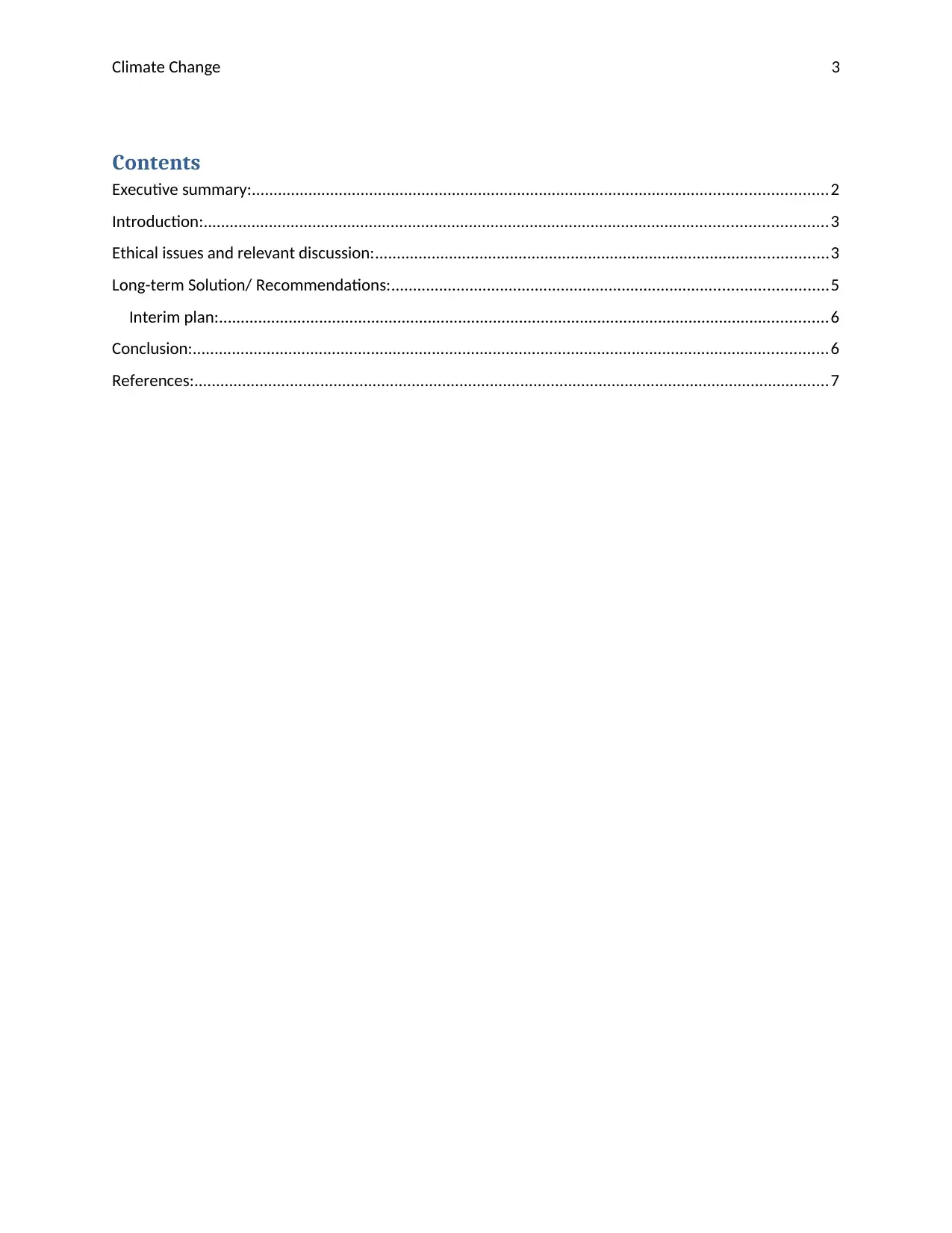
Contents
Executive summary:....................................................................................................................................2
Introduction:...............................................................................................................................................3
Ethical issues and relevant discussion:........................................................................................................3
Long-term Solution/ Recommendations:....................................................................................................5
Interim plan:............................................................................................................................................6
Conclusion:..................................................................................................................................................6
References:..................................................................................................................................................7
Contents
Executive summary:....................................................................................................................................2
Introduction:...............................................................................................................................................3
Ethical issues and relevant discussion:........................................................................................................3
Long-term Solution/ Recommendations:....................................................................................................5
Interim plan:............................................................................................................................................6
Conclusion:..................................................................................................................................................6
References:..................................................................................................................................................7
⊘ This is a preview!⊘
Do you want full access?
Subscribe today to unlock all pages.

Trusted by 1+ million students worldwide
Climate Change 4
Introduction:
Normative theories of ethics and moral theories are used to determine the rightness and
wrongness of any action, and the popular normative theories include utilitarianism, the
categorical imperative, Aristotelian virtue ethics, Stoic virtue ethics, and W. D. Ross’s
intuitionism. Changes occurred in the climate give rise to different questions in context of moral
of non-human nature completely and what resources are required if we accept these obligations
(Jamieson, 2003). Additionally, presence of scientific uncertainty and also the possibility for
disastrous results impose international pressure on the standard economic approach related to
environmental problems (Stern, 2007), and this also play important role in arguments related to
the safety concept in environmental law and policy.
This report discuss two ethical issues identified in two articles, and both issues are discussed in
lieu of ‘Normative theories of ethics’ which includes how stakeholders are affected and how can
their power, urgency, and legitimacy assist. This report also includes recommendations and
interim plan.
Ethical issues and relevant discussion:
First article- “ADB: Climate Change Threatens Asia’s Development Gains” drafted by
Anthony Fensom on 17th July 2017 and this article was published by The Diplomat.
In this article, author mainly focus on the effect on climate change on different countries of Asia
and how these changes directly affect the lives of human beings and other live creatures. These
article further states the issues arise because of the global warming and increased temperature,
and there effects on the business and livelihood of people (Fensom, 2017). Climate change has
been considered as the “perfect moral storm” because it reflects different ethical issues in a
collectively reinforcing manner (Gardiner, 2011). The first ethical issue in context of this article
is derived from the facts that climate change must be determined as truly global phenomenon.
Greenhouse gas emissions have potential to affect the climate on anywhere on the planet, and its
source does not matter (IPCC, 2007). Generally, it is reflected as result of the tragedy of the
Introduction:
Normative theories of ethics and moral theories are used to determine the rightness and
wrongness of any action, and the popular normative theories include utilitarianism, the
categorical imperative, Aristotelian virtue ethics, Stoic virtue ethics, and W. D. Ross’s
intuitionism. Changes occurred in the climate give rise to different questions in context of moral
of non-human nature completely and what resources are required if we accept these obligations
(Jamieson, 2003). Additionally, presence of scientific uncertainty and also the possibility for
disastrous results impose international pressure on the standard economic approach related to
environmental problems (Stern, 2007), and this also play important role in arguments related to
the safety concept in environmental law and policy.
This report discuss two ethical issues identified in two articles, and both issues are discussed in
lieu of ‘Normative theories of ethics’ which includes how stakeholders are affected and how can
their power, urgency, and legitimacy assist. This report also includes recommendations and
interim plan.
Ethical issues and relevant discussion:
First article- “ADB: Climate Change Threatens Asia’s Development Gains” drafted by
Anthony Fensom on 17th July 2017 and this article was published by The Diplomat.
In this article, author mainly focus on the effect on climate change on different countries of Asia
and how these changes directly affect the lives of human beings and other live creatures. These
article further states the issues arise because of the global warming and increased temperature,
and there effects on the business and livelihood of people (Fensom, 2017). Climate change has
been considered as the “perfect moral storm” because it reflects different ethical issues in a
collectively reinforcing manner (Gardiner, 2011). The first ethical issue in context of this article
is derived from the facts that climate change must be determined as truly global phenomenon.
Greenhouse gas emissions have potential to affect the climate on anywhere on the planet, and its
source does not matter (IPCC, 2007). Generally, it is reflected as result of the tragedy of the
Paraphrase This Document
Need a fresh take? Get an instant paraphrase of this document with our AI Paraphraser
Climate Change 5
commons. Collectively country takes actions to limit the global emissions for the purpose of
reducing the risk of these emissions, and while acting on individual basis each and every country
prefers to take projects which provide economic benefit but also produce hidden emission (Helm,
2008). This is unfair for the businesses and society and also results in negative consequences for
future generations.
This can be understood through Utilitarianism theory of the normative ethics, and as per this
theory action is judged on the basis of its consequences and not with the intention. An action is
considered as good action if it results in good and vice versa. In other words, if result of the
action taken by person is good for more number of people as compared to people for whom
results are bad then such action is considered as good action and in case result of the action is
bad for more number of people then such action is considered as bad action. Climate change
imposes two challenges for this theory, first it states that issue related to greenhouse gas emission
is associated with the increase in human populations. This fact is not adopted by followers of this
theory as they stated that more individuals enjoying their lives are a good thing. Second issue
deals with the preferences of existing human beings and also with the future generations
(Vernon, 2011). These issues cause unnecessary burden on the climate and make it more
deteriorate and it is important to prevent the population growth and focus on current fulfillment
of needs, but from the point of view of this theory any action which prevents the person from
living their life is bad.
This theory impose burden on the organizations by requiring that they must consider the interest
of stakeholders while conducting their actions and this burden affects the potential of the
organizations to increase their profitability. Projects taken by organization must be operated in
such manner as it ensures sustainable development of climate and prevent negative consequences
on the climate.
Second article- “Australia faces potentially disastrous consequences of climate change,
inquiry told” drafted by Ben Doherthy and Michael Slezak on 10th August 2017 and this
article was published by The Guardian.
commons. Collectively country takes actions to limit the global emissions for the purpose of
reducing the risk of these emissions, and while acting on individual basis each and every country
prefers to take projects which provide economic benefit but also produce hidden emission (Helm,
2008). This is unfair for the businesses and society and also results in negative consequences for
future generations.
This can be understood through Utilitarianism theory of the normative ethics, and as per this
theory action is judged on the basis of its consequences and not with the intention. An action is
considered as good action if it results in good and vice versa. In other words, if result of the
action taken by person is good for more number of people as compared to people for whom
results are bad then such action is considered as good action and in case result of the action is
bad for more number of people then such action is considered as bad action. Climate change
imposes two challenges for this theory, first it states that issue related to greenhouse gas emission
is associated with the increase in human populations. This fact is not adopted by followers of this
theory as they stated that more individuals enjoying their lives are a good thing. Second issue
deals with the preferences of existing human beings and also with the future generations
(Vernon, 2011). These issues cause unnecessary burden on the climate and make it more
deteriorate and it is important to prevent the population growth and focus on current fulfillment
of needs, but from the point of view of this theory any action which prevents the person from
living their life is bad.
This theory impose burden on the organizations by requiring that they must consider the interest
of stakeholders while conducting their actions and this burden affects the potential of the
organizations to increase their profitability. Projects taken by organization must be operated in
such manner as it ensures sustainable development of climate and prevent negative consequences
on the climate.
Second article- “Australia faces potentially disastrous consequences of climate change,
inquiry told” drafted by Ben Doherthy and Michael Slezak on 10th August 2017 and this
article was published by The Guardian.
Climate Change 6
In this article author focus on the potential disastrous results related to the climate change which
includes natural disasters, forced mitigation of number of peoples across the region, and also to
the security of Australia. In this article author stated that, climate change also affects the security
of the region because it becomes difficult for defenses to stay in remote areas because of the
climate change. The major ethical issue in this context is that our theoretical tools are
underdeveloped in different important areas such as international justice, intergenerational ethics,
scientific uncertainty and the proper relationship between the humans and the rest of the nature.
This can be understood through example, changes occurred in the climate raise different question
in context of non-human nature. For this issue we can apply categorical imperative theory of
normative ethics which impose obligations on human beings to act in such manner as defined by
universal law, which means humans must behave in such balanced manner that would be good
for other creatures also. In context of climate change, this theory ensures such actions from the
human beings which ensure climate protection and prevent its effects on other relevant areas.
Actions of human not only affect the climate of the country about also cause threat to the defense
security which is a serious issue (Grasso, 2007).
In case organization follows this theory then it will ensure sustainable development of the
country and also ensure interest of the stakeholders. Economy of the country is also affected
from the changes occurred in climate, as there are number of industries which directly get
affected such as tourist industry, security phenomena, food industry, etc. in case organizations
fulfill their duty then it will automatically assist rights & interest of different stakeholders.
After considering the above issues it can be said that normative theory of ethics consider major
issues of the climate change, and through these theories it become easy for organizations to deal
with ethical dilemmas in climate change.
Long-term Solution/ Recommendations:
Changes occurred in climate is a fundamental ethical issue, and in case people fail to deal with
this issue then it would result in disastrous results. Response to climate change in context of
ethical perspective is necessary otherwise it has potential to distress the complete community and
create new frameworks of inequity and misdistribution, and cause more bad to poor people. It is
In this article author focus on the potential disastrous results related to the climate change which
includes natural disasters, forced mitigation of number of peoples across the region, and also to
the security of Australia. In this article author stated that, climate change also affects the security
of the region because it becomes difficult for defenses to stay in remote areas because of the
climate change. The major ethical issue in this context is that our theoretical tools are
underdeveloped in different important areas such as international justice, intergenerational ethics,
scientific uncertainty and the proper relationship between the humans and the rest of the nature.
This can be understood through example, changes occurred in the climate raise different question
in context of non-human nature. For this issue we can apply categorical imperative theory of
normative ethics which impose obligations on human beings to act in such manner as defined by
universal law, which means humans must behave in such balanced manner that would be good
for other creatures also. In context of climate change, this theory ensures such actions from the
human beings which ensure climate protection and prevent its effects on other relevant areas.
Actions of human not only affect the climate of the country about also cause threat to the defense
security which is a serious issue (Grasso, 2007).
In case organization follows this theory then it will ensure sustainable development of the
country and also ensure interest of the stakeholders. Economy of the country is also affected
from the changes occurred in climate, as there are number of industries which directly get
affected such as tourist industry, security phenomena, food industry, etc. in case organizations
fulfill their duty then it will automatically assist rights & interest of different stakeholders.
After considering the above issues it can be said that normative theory of ethics consider major
issues of the climate change, and through these theories it become easy for organizations to deal
with ethical dilemmas in climate change.
Long-term Solution/ Recommendations:
Changes occurred in climate is a fundamental ethical issue, and in case people fail to deal with
this issue then it would result in disastrous results. Response to climate change in context of
ethical perspective is necessary otherwise it has potential to distress the complete community and
create new frameworks of inequity and misdistribution, and cause more bad to poor people. It is
⊘ This is a preview!⊘
Do you want full access?
Subscribe today to unlock all pages.
Trusted by 1+ million students worldwide
Climate Change 7
necessary for governments to create the set of ethical principles for dealing with this issue such
as harm prevention, equity and justice, sustainable development etc.
However, it is necessary to focus on individual efforts also instead of collective efforts only.
Generally, individuals’ responsibilities are mainly political in nature and they have very little
responsibility in context of climate protection. Individuals can also contribute in climate
protection by changing their needs and lifestyle choices. In other words, individuals must take
responsibilities of their choices and also recognize their effect on the climate.
Department can use above stated ethical principles to develop the plan which ensure resolution
of ethical dilemmas in context of climate change. Countries must develop provisions which
ensure moral duty on both collective and individual basis to protect the climate. Such provisions
must impose strict liability on individual if they fail to meet their moral obligations towards the
climate and other creatures on the earth (Barry, Mol & Jito, 2013).
Interim plan:
Proposal of interim plan in this regard include following points which must be considered by the
department while addressing above stated issues:
Development of principals on the basis of normative ethics theory which provide
guidance to the organizations in taking the projects and their responsibility towards the
stakeholders in context of climate change.
This guide must ensure strict implementation of the framework develop to protect climate
and to minimize its effect on the relevant areas of the country. Strict implementation can
be ensuring by introducing severe punishments on both collective and individual basis for
non-adherence of this framework.
Framework developed by this guide must consider all the above stated ethical principles
relevant in this context.
Department must set up an committee which ensures the implementation of this
framework and also decided the cases related to this framework.
necessary for governments to create the set of ethical principles for dealing with this issue such
as harm prevention, equity and justice, sustainable development etc.
However, it is necessary to focus on individual efforts also instead of collective efforts only.
Generally, individuals’ responsibilities are mainly political in nature and they have very little
responsibility in context of climate protection. Individuals can also contribute in climate
protection by changing their needs and lifestyle choices. In other words, individuals must take
responsibilities of their choices and also recognize their effect on the climate.
Department can use above stated ethical principles to develop the plan which ensure resolution
of ethical dilemmas in context of climate change. Countries must develop provisions which
ensure moral duty on both collective and individual basis to protect the climate. Such provisions
must impose strict liability on individual if they fail to meet their moral obligations towards the
climate and other creatures on the earth (Barry, Mol & Jito, 2013).
Interim plan:
Proposal of interim plan in this regard include following points which must be considered by the
department while addressing above stated issues:
Development of principals on the basis of normative ethics theory which provide
guidance to the organizations in taking the projects and their responsibility towards the
stakeholders in context of climate change.
This guide must ensure strict implementation of the framework develop to protect climate
and to minimize its effect on the relevant areas of the country. Strict implementation can
be ensuring by introducing severe punishments on both collective and individual basis for
non-adherence of this framework.
Framework developed by this guide must consider all the above stated ethical principles
relevant in this context.
Department must set up an committee which ensures the implementation of this
framework and also decided the cases related to this framework.
Paraphrase This Document
Need a fresh take? Get an instant paraphrase of this document with our AI Paraphraser
Climate Change 8
Conclusion:
After considering these theories, it can be said that climate change involves dangerous ethical
issues at global level which includes intergenerational and ecological dimensions. Instead of
challenges imposed by underdeveloped theories and realistic issues, there is something which
seriously considers the shape of these concerns that is fairness and responsibility. Ethical view in
context of climate change is an important area which offer different perspectives but within
which more work remains to be done. Economy of the country is also affected from the changes
occurred in climate, as there are number of industries which directly get affected.
References:
Barry, John, Mol, Arthur & Jito, Anthony 2013. “Climate change ethics, rights, and policies: an
introduction”, Environmental Politics, 22(3), 361-376.
https://doi.org/10.1080/09644016.2013.788861.
Doherthy, Ben & Slezak, Michael 2017. “Australia faces potentially disastrous consequences of
climate change, inquiry told”. https://www.theguardian.com/environment/2017/aug/11/australia-
potentially-disastrous-consequences-of-climate-change-inquiry-told.
Fensom, Anthony 2017. “ADB: Climate Change Threatens Asia’s Development Gains”.
https://thediplomat.com/2017/07/adb-climate-change-threatens-asias-development-gains/.
Gardiner, Stephen 2011. “A Perfect Moral Storm: The Ethical Challenge of Climate Change”.
Oxford, UK: Oxford University Press.
Grasso, Marco 2007. “A normative ethical framework in climate change”. International journal
of climate change, Volume 81(4). DOI 10.1007/s10584-006-9158-7.
Helm, Dieter 2008. “Climate-change policy: Why has so little been achieved?” Oxford Review
of Economic Policy 24, 211-238. https://doi.org/10.1093/oxrep/grn014.
IPCC (Intergovernmental Panel on Climate Change) 2007. “Climate Change 2007: The Physical
Science Basis. Cambridge”, UK: Cambridge University Press.
Conclusion:
After considering these theories, it can be said that climate change involves dangerous ethical
issues at global level which includes intergenerational and ecological dimensions. Instead of
challenges imposed by underdeveloped theories and realistic issues, there is something which
seriously considers the shape of these concerns that is fairness and responsibility. Ethical view in
context of climate change is an important area which offer different perspectives but within
which more work remains to be done. Economy of the country is also affected from the changes
occurred in climate, as there are number of industries which directly get affected.
References:
Barry, John, Mol, Arthur & Jito, Anthony 2013. “Climate change ethics, rights, and policies: an
introduction”, Environmental Politics, 22(3), 361-376.
https://doi.org/10.1080/09644016.2013.788861.
Doherthy, Ben & Slezak, Michael 2017. “Australia faces potentially disastrous consequences of
climate change, inquiry told”. https://www.theguardian.com/environment/2017/aug/11/australia-
potentially-disastrous-consequences-of-climate-change-inquiry-told.
Fensom, Anthony 2017. “ADB: Climate Change Threatens Asia’s Development Gains”.
https://thediplomat.com/2017/07/adb-climate-change-threatens-asias-development-gains/.
Gardiner, Stephen 2011. “A Perfect Moral Storm: The Ethical Challenge of Climate Change”.
Oxford, UK: Oxford University Press.
Grasso, Marco 2007. “A normative ethical framework in climate change”. International journal
of climate change, Volume 81(4). DOI 10.1007/s10584-006-9158-7.
Helm, Dieter 2008. “Climate-change policy: Why has so little been achieved?” Oxford Review
of Economic Policy 24, 211-238. https://doi.org/10.1093/oxrep/grn014.
IPCC (Intergovernmental Panel on Climate Change) 2007. “Climate Change 2007: The Physical
Science Basis. Cambridge”, UK: Cambridge University Press.
Climate Change 9
Jamieson, D ed. 2003. “A Companion to Environmental Philosophy”. Malden, MA: Blackwell
Publishing.
Stern, N 2007. “The Economics of Climate Change: The Stern Review”. Cambridge, UK:
Cambridge University Press.
Vernon, Mark 2011. “Without belief in moral truths, how can we care about climate change?”.
https://www.theguardian.com/commentisfree/belief/2011/may/25/peter-singer-utilitarianism-
climate-change.
Jamieson, D ed. 2003. “A Companion to Environmental Philosophy”. Malden, MA: Blackwell
Publishing.
Stern, N 2007. “The Economics of Climate Change: The Stern Review”. Cambridge, UK:
Cambridge University Press.
Vernon, Mark 2011. “Without belief in moral truths, how can we care about climate change?”.
https://www.theguardian.com/commentisfree/belief/2011/may/25/peter-singer-utilitarianism-
climate-change.
⊘ This is a preview!⊘
Do you want full access?
Subscribe today to unlock all pages.
Trusted by 1+ million students worldwide

1 out of 9


Your All-in-One AI-Powered Toolkit for Academic Success.
+13062052269
info@desklib.com
Available 24*7 on WhatsApp / Email
![[object Object]](/_next/static/media/star-bottom.7253800d.svg)
Unlock your academic potential
Copyright © 2020–2026 A2Z Services. All Rights Reserved. Developed and managed by ZUCOL.