Software Development Portfolio: Cloud Computing - ACCA4017 Module
VerifiedAdded on 2023/06/16
|6
|750
|320
Portfolio
AI Summary
This document presents a software development portfolio focused on cloud computing, specifically addressing the ACCA4017 module. It defines lists and their differences from variables, explains how to access list elements, and details five built-in list functions with examples (len(), max(), min(), clear(), sort()). The portfolio also discusses user-defined functions, emphasizing their importance in Python for code reusability and reducing repetitive code. The document includes examples of user-defined functions and provides references to books and journals used in its preparation. Desklib provides access to this and other solved assignments for students.
CLOUD COMPUTING
PORTFOLIO
PORTFOLIO
Paraphrase This Document
Need a fresh take? Get an instant paraphrase of this document with our AI Paraphraser


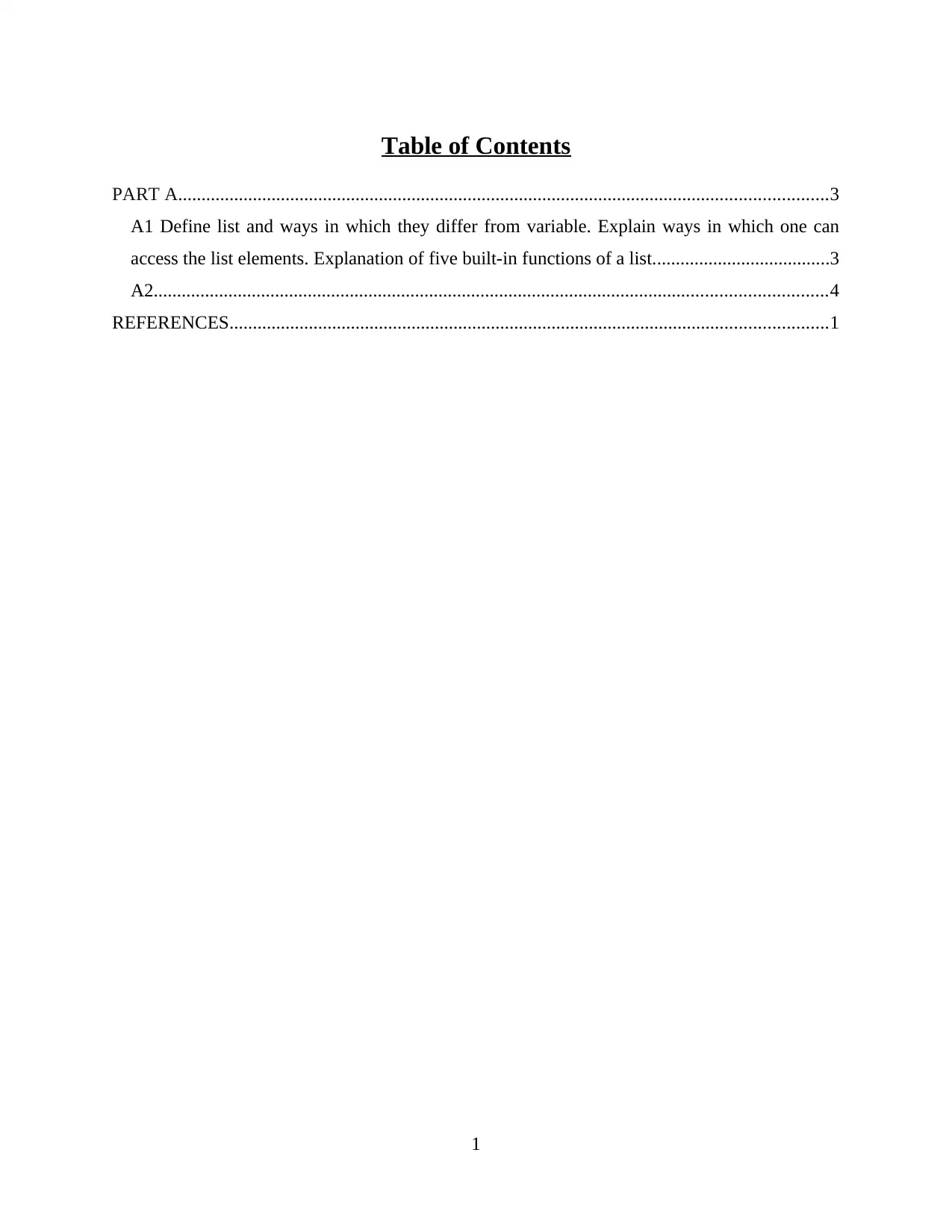
Table of Contents
PART A...........................................................................................................................................3
A1 Define list and ways in which they differ from variable. Explain ways in which one can
access the list elements. Explanation of five built-in functions of a list......................................3
A2................................................................................................................................................4
REFERENCES................................................................................................................................1
1
PART A...........................................................................................................................................3
A1 Define list and ways in which they differ from variable. Explain ways in which one can
access the list elements. Explanation of five built-in functions of a list......................................3
A2................................................................................................................................................4
REFERENCES................................................................................................................................1
1
⊘ This is a preview!⊘
Do you want full access?
Subscribe today to unlock all pages.

Trusted by 1+ million students worldwide

PART A
A1 Define list and ways in which they differ from variable. Explain ways in which one can
access the list elements. Explanation of five built-in functions of a list.
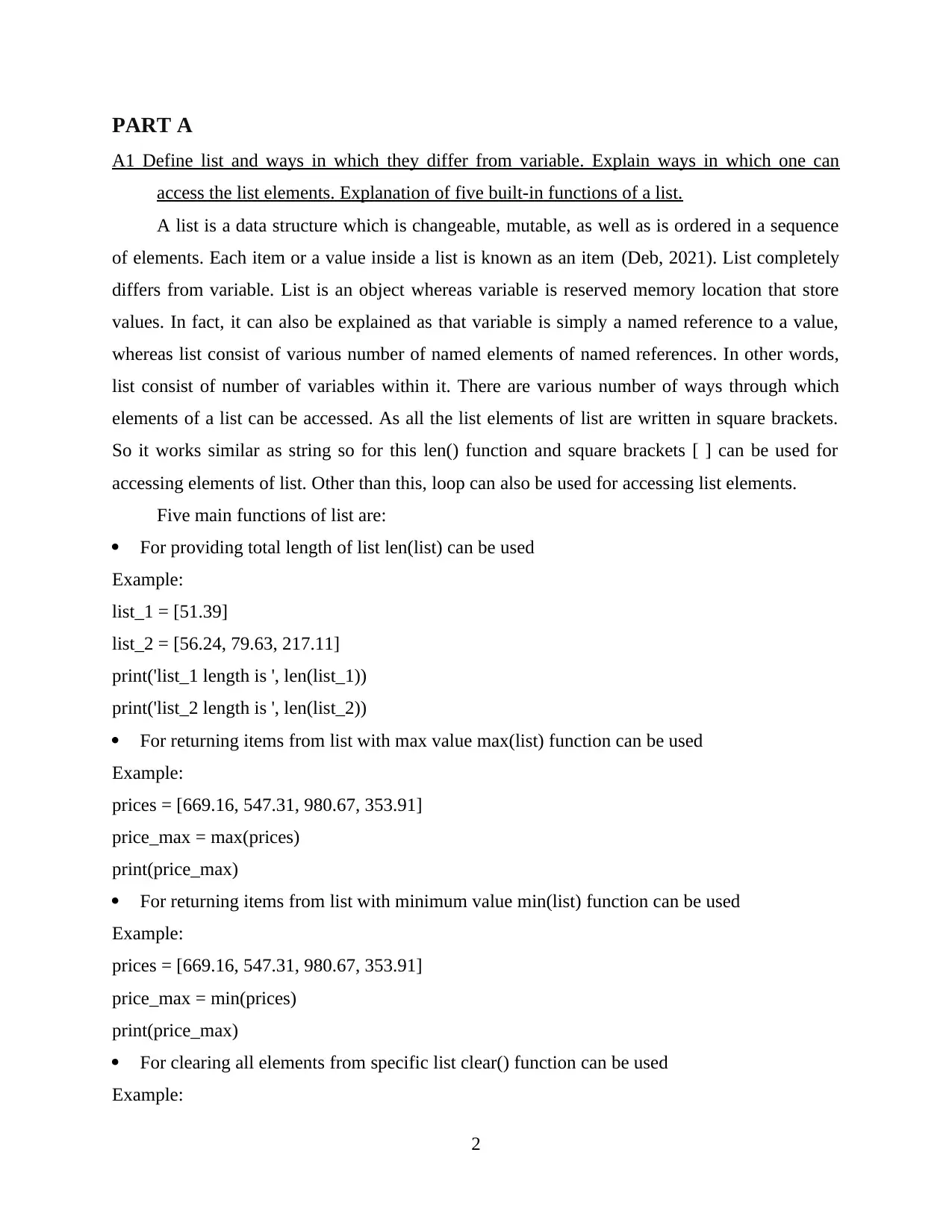
A list is a data structure which is changeable, mutable, as well as is ordered in a sequence
of elements. Each item or a value inside a list is known as an item (Deb, 2021). List completely
differs from variable. List is an object whereas variable is reserved memory location that store
values. In fact, it can also be explained as that variable is simply a named reference to a value,
whereas list consist of various number of named elements of named references. In other words,
list consist of number of variables within it. There are various number of ways through which
elements of a list can be accessed. As all the list elements of list are written in square brackets.
So it works similar as string so for this len() function and square brackets [ ] can be used for
accessing elements of list. Other than this, loop can also be used for accessing list elements.
Five main functions of list are:
For providing total length of list len(list) can be used
Example:
list_1 = [51.39]
list_2 = [56.24, 79.63, 217.11]
print('list_1 length is ', len(list_1))
print('list_2 length is ', len(list_2))
For returning items from list with max value max(list) function can be used
Example:
prices = [669.16, 547.31, 980.67, 353.91]
price_max = max(prices)
print(price_max)
For returning items from list with minimum value min(list) function can be used
Example:
prices = [669.16, 547.31, 980.67, 353.91]
price_max = min(prices)
print(price_max)
For clearing all elements from specific list clear() function can be used
Example:
2
A1 Define list and ways in which they differ from variable. Explain ways in which one can
access the list elements. Explanation of five built-in functions of a list.
A list is a data structure which is changeable, mutable, as well as is ordered in a sequence
of elements. Each item or a value inside a list is known as an item (Deb, 2021). List completely
differs from variable. List is an object whereas variable is reserved memory location that store
values. In fact, it can also be explained as that variable is simply a named reference to a value,
whereas list consist of various number of named elements of named references. In other words,
list consist of number of variables within it. There are various number of ways through which
elements of a list can be accessed. As all the list elements of list are written in square brackets.
So it works similar as string so for this len() function and square brackets [ ] can be used for
accessing elements of list. Other than this, loop can also be used for accessing list elements.
Five main functions of list are:
For providing total length of list len(list) can be used
Example:
list_1 = [51.39]
list_2 = [56.24, 79.63, 217.11]
print('list_1 length is ', len(list_1))
print('list_2 length is ', len(list_2))
For returning items from list with max value max(list) function can be used
Example:
prices = [669.16, 547.31, 980.67, 353.91]
price_max = max(prices)
print(price_max)
For returning items from list with minimum value min(list) function can be used
Example:
prices = [669.16, 547.31, 980.67, 353.91]
price_max = min(prices)
print(price_max)
For clearing all elements from specific list clear() function can be used
Example:
2
Paraphrase This Document
Need a fresh take? Get an instant paraphrase of this document with our AI Paraphraser

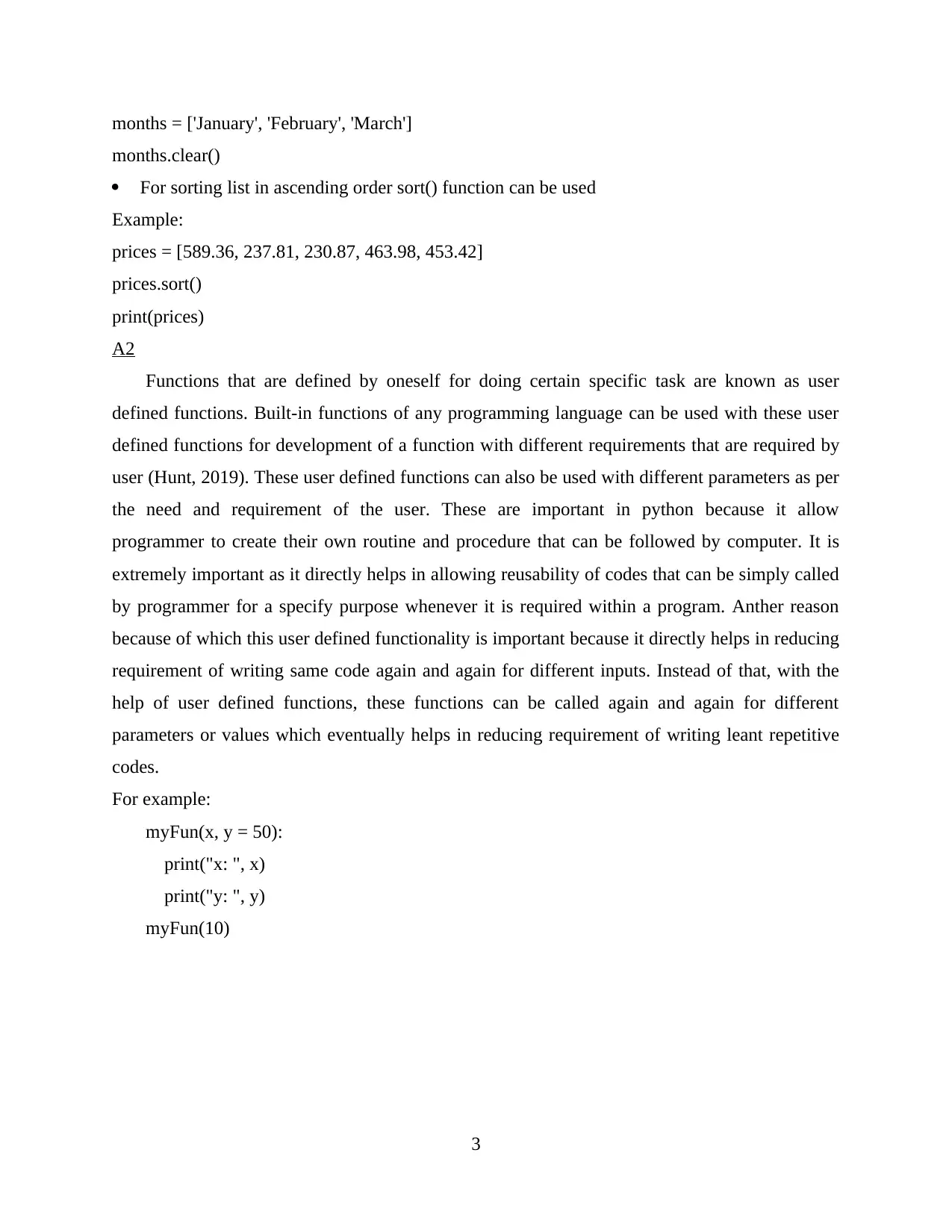
months = ['January', 'February', 'March']
months.clear()
For sorting list in ascending order sort() function can be used
Example:
prices = [589.36, 237.81, 230.87, 463.98, 453.42]
prices.sort()
print(prices)
A2
Functions that are defined by oneself for doing certain specific task are known as user
defined functions. Built-in functions of any programming language can be used with these user
defined functions for development of a function with different requirements that are required by
user (Hunt, 2019). These user defined functions can also be used with different parameters as per
the need and requirement of the user. These are important in python because it allow
programmer to create their own routine and procedure that can be followed by computer. It is
extremely important as it directly helps in allowing reusability of codes that can be simply called
by programmer for a specify purpose whenever it is required within a program. Anther reason
because of which this user defined functionality is important because it directly helps in reducing
requirement of writing same code again and again for different inputs. Instead of that, with the
help of user defined functions, these functions can be called again and again for different
parameters or values which eventually helps in reducing requirement of writing leant repetitive
codes.
For example:
myFun(x, y = 50):
print("x: ", x)
print("y: ", y)
myFun(10)
3
months.clear()
For sorting list in ascending order sort() function can be used
Example:
prices = [589.36, 237.81, 230.87, 463.98, 453.42]
prices.sort()
print(prices)
A2
Functions that are defined by oneself for doing certain specific task are known as user
defined functions. Built-in functions of any programming language can be used with these user
defined functions for development of a function with different requirements that are required by
user (Hunt, 2019). These user defined functions can also be used with different parameters as per
the need and requirement of the user. These are important in python because it allow
programmer to create their own routine and procedure that can be followed by computer. It is
extremely important as it directly helps in allowing reusability of codes that can be simply called
by programmer for a specify purpose whenever it is required within a program. Anther reason
because of which this user defined functionality is important because it directly helps in reducing
requirement of writing same code again and again for different inputs. Instead of that, with the
help of user defined functions, these functions can be called again and again for different
parameters or values which eventually helps in reducing requirement of writing leant repetitive
codes.
For example:
myFun(x, y = 50):
print("x: ", x)
print("y: ", y)
myFun(10)
3

REFERENCES
Books and journals
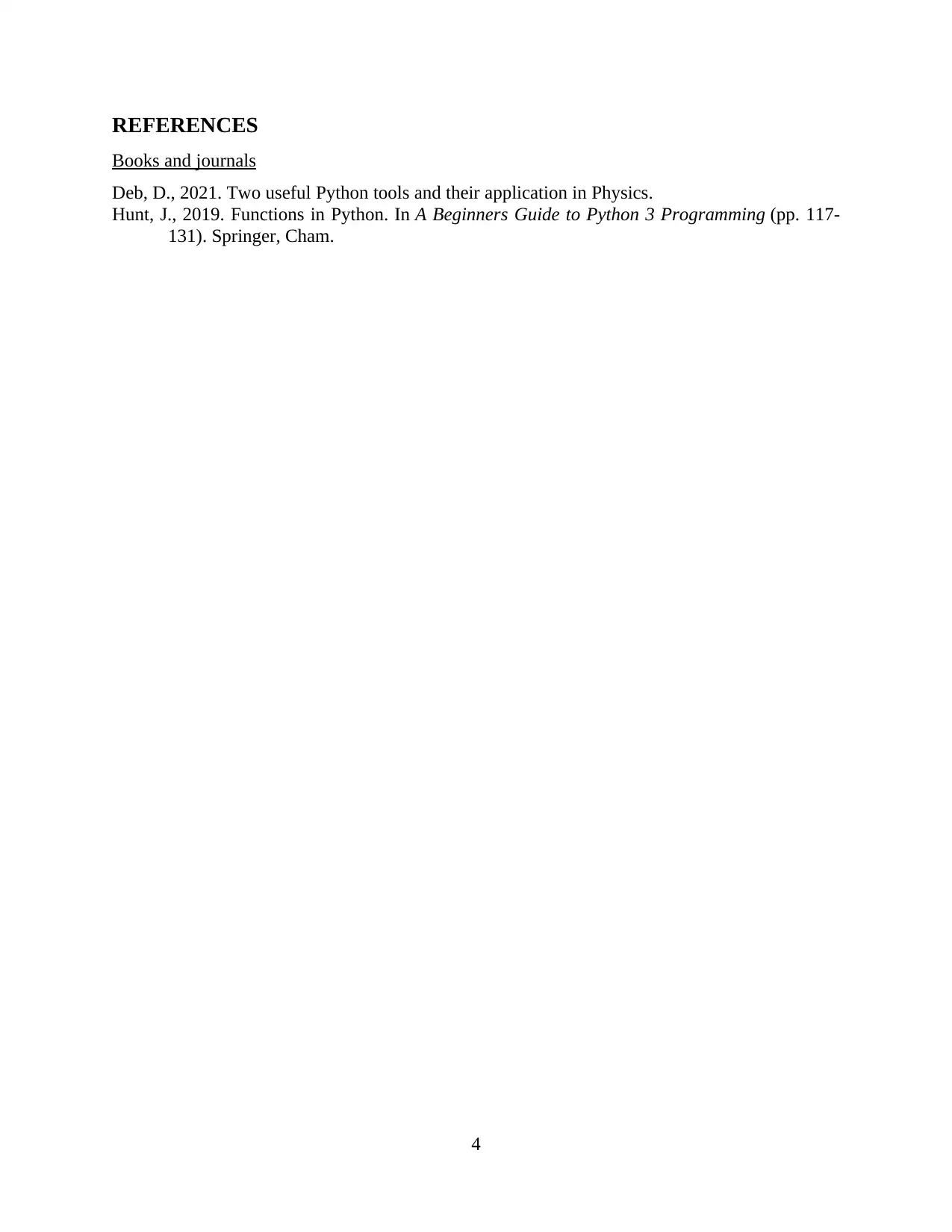
Deb, D., 2021. Two useful Python tools and their application in Physics.
Hunt, J., 2019. Functions in Python. In A Beginners Guide to Python 3 Programming (pp. 117-
131). Springer, Cham.
4
Books and journals
Deb, D., 2021. Two useful Python tools and their application in Physics.
Hunt, J., 2019. Functions in Python. In A Beginners Guide to Python 3 Programming (pp. 117-
131). Springer, Cham.
4
⊘ This is a preview!⊘
Do you want full access?
Subscribe today to unlock all pages.

Trusted by 1+ million students worldwide
1 out of 6
Related Documents
Your All-in-One AI-Powered Toolkit for Academic Success.
+13062052269
info@desklib.com
Available 24*7 on WhatsApp / Email
Unlock your academic potential
Copyright © 2020–2025 A2Z Services. All Rights Reserved. Developed and managed by ZUCOL.