A Comprehensive Report on Investigating Applied Coaching Practice
VerifiedAdded on 2023/06/17
|10
|2557
|186
Report
AI Summary
This report investigates the significance of the coach-athlete relationship in applied coaching practice. It explores the importance of building strong relationships between coaches and athletes, examining how communication, emotional support, and conflict resolution influence athlete performance. The research methodology employs a qualitative approach, utilizing both primary data collected through interviews with a Head Coach and secondary data from a literature review. Findings highlight the positive correlation between a healthy coach-athlete relationship and improved athlete performance, emphasizing the role of communication in fostering trust and loyalty. However, the report also acknowledges potential disadvantages, such as a lack of concentration resulting from overly close relationships. The conclusion underscores the comprehensive impact of the coach-athlete dynamic and the importance of maintaining a balanced, professional relationship to optimize athlete success. Desklib provides access to similar reports and solved assignments for students.
INVESTIGATING APPLIED
COUCHING PRACTICE
COUCHING PRACTICE

Paraphrase This Document
Need a fresh take? Get an instant paraphrase of this document with our AI Paraphraser
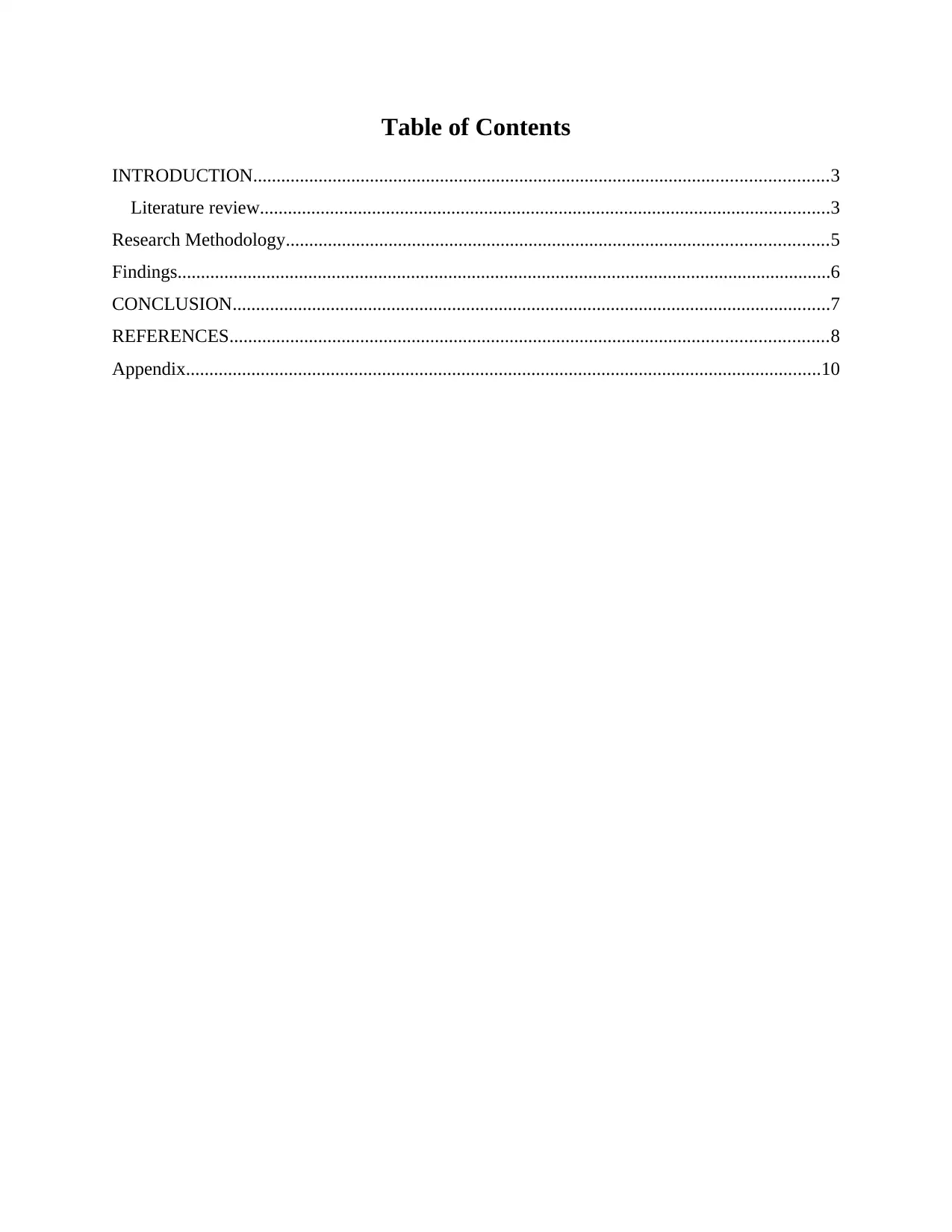
Table of Contents
INTRODUCTION...........................................................................................................................3
Literature review..........................................................................................................................3
Research Methodology....................................................................................................................5
Findings............................................................................................................................................6
CONCLUSION................................................................................................................................7
REFERENCES................................................................................................................................8
Appendix........................................................................................................................................10
INTRODUCTION...........................................................................................................................3
Literature review..........................................................................................................................3
Research Methodology....................................................................................................................5
Findings............................................................................................................................................6
CONCLUSION................................................................................................................................7
REFERENCES................................................................................................................................8
Appendix........................................................................................................................................10
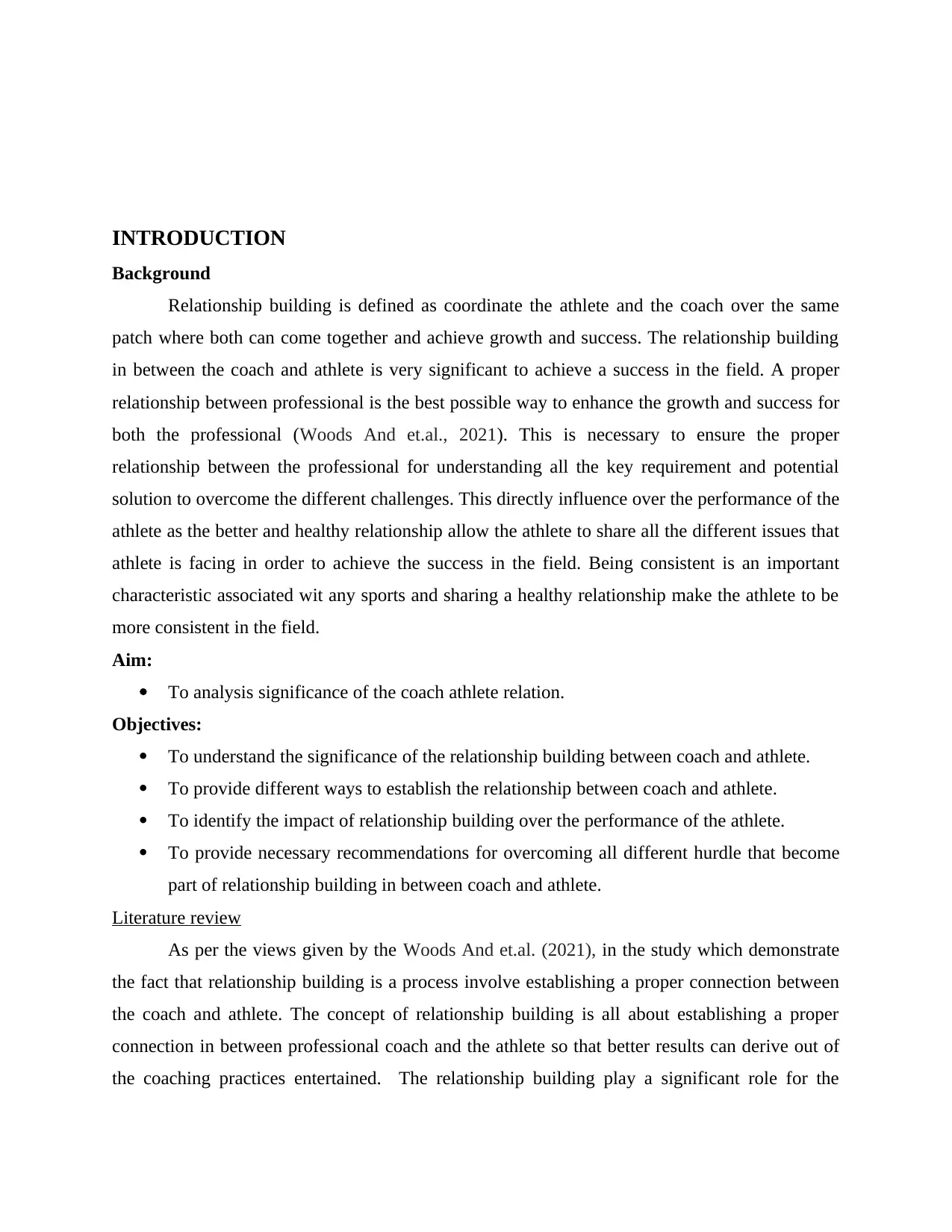
INTRODUCTION
Background
Relationship building is defined as coordinate the athlete and the coach over the same
patch where both can come together and achieve growth and success. The relationship building
in between the coach and athlete is very significant to achieve a success in the field. A proper
relationship between professional is the best possible way to enhance the growth and success for
both the professional (Woods And et.al., 2021). This is necessary to ensure the proper
relationship between the professional for understanding all the key requirement and potential
solution to overcome the different challenges. This directly influence over the performance of the
athlete as the better and healthy relationship allow the athlete to share all the different issues that
athlete is facing in order to achieve the success in the field. Being consistent is an important
characteristic associated wit any sports and sharing a healthy relationship make the athlete to be
more consistent in the field.
Aim:
To analysis significance of the coach athlete relation.
Objectives:
To understand the significance of the relationship building between coach and athlete.
To provide different ways to establish the relationship between coach and athlete.
To identify the impact of relationship building over the performance of the athlete.
To provide necessary recommendations for overcoming all different hurdle that become
part of relationship building in between coach and athlete.
Literature review
As per the views given by the Woods And et.al. (2021), in the study which demonstrate
the fact that relationship building is a process involve establishing a proper connection between
the coach and athlete. The concept of relationship building is all about establishing a proper
connection in between professional coach and the athlete so that better results can derive out of
the coaching practices entertained. The relationship building play a significant role for the
Background
Relationship building is defined as coordinate the athlete and the coach over the same
patch where both can come together and achieve growth and success. The relationship building
in between the coach and athlete is very significant to achieve a success in the field. A proper
relationship between professional is the best possible way to enhance the growth and success for
both the professional (Woods And et.al., 2021). This is necessary to ensure the proper
relationship between the professional for understanding all the key requirement and potential
solution to overcome the different challenges. This directly influence over the performance of the
athlete as the better and healthy relationship allow the athlete to share all the different issues that
athlete is facing in order to achieve the success in the field. Being consistent is an important
characteristic associated wit any sports and sharing a healthy relationship make the athlete to be
more consistent in the field.
Aim:
To analysis significance of the coach athlete relation.
Objectives:
To understand the significance of the relationship building between coach and athlete.
To provide different ways to establish the relationship between coach and athlete.
To identify the impact of relationship building over the performance of the athlete.
To provide necessary recommendations for overcoming all different hurdle that become
part of relationship building in between coach and athlete.
Literature review
As per the views given by the Woods And et.al. (2021), in the study which demonstrate
the fact that relationship building is a process involve establishing a proper connection between
the coach and athlete. The concept of relationship building is all about establishing a proper
connection in between professional coach and the athlete so that better results can derive out of
the coaching practices entertained. The relationship building play a significant role for the
⊘ This is a preview!⊘
Do you want full access?
Subscribe today to unlock all pages.

Trusted by 1+ million students worldwide
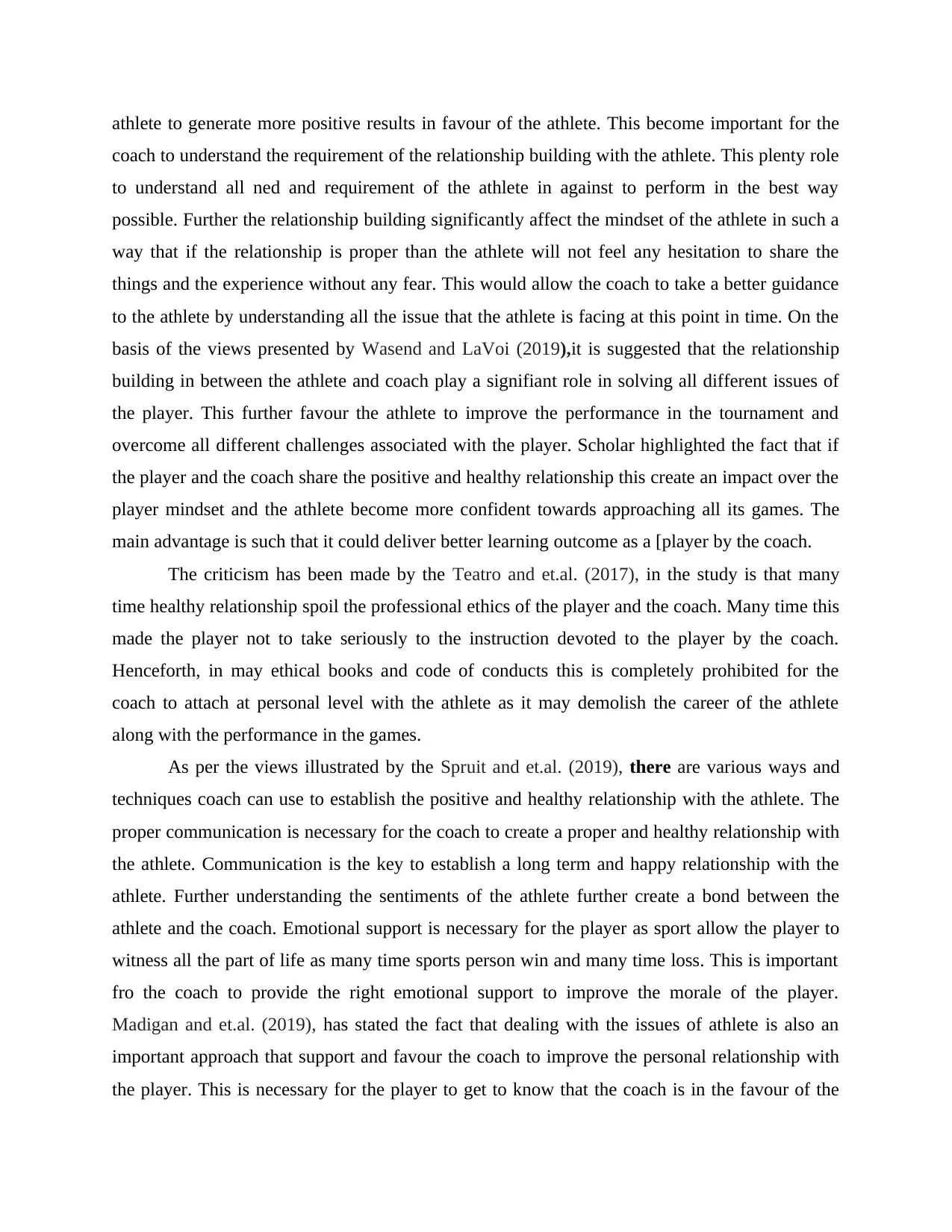
athlete to generate more positive results in favour of the athlete. This become important for the
coach to understand the requirement of the relationship building with the athlete. This plenty role
to understand all ned and requirement of the athlete in against to perform in the best way
possible. Further the relationship building significantly affect the mindset of the athlete in such a
way that if the relationship is proper than the athlete will not feel any hesitation to share the
things and the experience without any fear. This would allow the coach to take a better guidance
to the athlete by understanding all the issue that the athlete is facing at this point in time. On the
basis of the views presented by Wasend and LaVoi (2019),it is suggested that the relationship
building in between the athlete and coach play a signifiant role in solving all different issues of
the player. This further favour the athlete to improve the performance in the tournament and
overcome all different challenges associated with the player. Scholar highlighted the fact that if
the player and the coach share the positive and healthy relationship this create an impact over the
player mindset and the athlete become more confident towards approaching all its games. The
main advantage is such that it could deliver better learning outcome as a [player by the coach.
The criticism has been made by the Teatro and et.al. (2017), in the study is that many
time healthy relationship spoil the professional ethics of the player and the coach. Many time this
made the player not to take seriously to the instruction devoted to the player by the coach.
Henceforth, in may ethical books and code of conducts this is completely prohibited for the
coach to attach at personal level with the athlete as it may demolish the career of the athlete
along with the performance in the games.
As per the views illustrated by the Spruit and et.al. (2019), there are various ways and
techniques coach can use to establish the positive and healthy relationship with the athlete. The
proper communication is necessary for the coach to create a proper and healthy relationship with
the athlete. Communication is the key to establish a long term and happy relationship with the
athlete. Further understanding the sentiments of the athlete further create a bond between the
athlete and the coach. Emotional support is necessary for the player as sport allow the player to
witness all the part of life as many time sports person win and many time loss. This is important
fro the coach to provide the right emotional support to improve the morale of the player.
Madigan and et.al. (2019), has stated the fact that dealing with the issues of athlete is also an
important approach that support and favour the coach to improve the personal relationship with
the player. This is necessary for the player to get to know that the coach is in the favour of the
coach to understand the requirement of the relationship building with the athlete. This plenty role
to understand all ned and requirement of the athlete in against to perform in the best way
possible. Further the relationship building significantly affect the mindset of the athlete in such a
way that if the relationship is proper than the athlete will not feel any hesitation to share the
things and the experience without any fear. This would allow the coach to take a better guidance
to the athlete by understanding all the issue that the athlete is facing at this point in time. On the
basis of the views presented by Wasend and LaVoi (2019),it is suggested that the relationship
building in between the athlete and coach play a signifiant role in solving all different issues of
the player. This further favour the athlete to improve the performance in the tournament and
overcome all different challenges associated with the player. Scholar highlighted the fact that if
the player and the coach share the positive and healthy relationship this create an impact over the
player mindset and the athlete become more confident towards approaching all its games. The
main advantage is such that it could deliver better learning outcome as a [player by the coach.
The criticism has been made by the Teatro and et.al. (2017), in the study is that many
time healthy relationship spoil the professional ethics of the player and the coach. Many time this
made the player not to take seriously to the instruction devoted to the player by the coach.
Henceforth, in may ethical books and code of conducts this is completely prohibited for the
coach to attach at personal level with the athlete as it may demolish the career of the athlete
along with the performance in the games.
As per the views illustrated by the Spruit and et.al. (2019), there are various ways and
techniques coach can use to establish the positive and healthy relationship with the athlete. The
proper communication is necessary for the coach to create a proper and healthy relationship with
the athlete. Communication is the key to establish a long term and happy relationship with the
athlete. Further understanding the sentiments of the athlete further create a bond between the
athlete and the coach. Emotional support is necessary for the player as sport allow the player to
witness all the part of life as many time sports person win and many time loss. This is important
fro the coach to provide the right emotional support to improve the morale of the player.
Madigan and et.al. (2019), has stated the fact that dealing with the issues of athlete is also an
important approach that support and favour the coach to improve the personal relationship with
the player. This is necessary for the player to get to know that the coach is in the favour of the
Paraphrase This Document
Need a fresh take? Get an instant paraphrase of this document with our AI Paraphraser
athlete. Solving issues positively play a huge role for the coach to sustain the long term
relationship in order to develop and grow at the same time. This create a more stronger bond for
the athlete and the coach as the player understand that a complete support of the coach is there
for the athlete to overcome any kind of challenge that can resist the player to achieve all its
professional objectives.
The criticism has been made by the Kim, Kim and Won (2018), on the ground that a
coach need to look after to hundred of athlete. This do not allow and favour the athlete to not to
give proper attention to each individual player part of the coaching manual. This create a massive
issue and communication gap between the player and the coach. This create a huge role in
influencing the relationship of the athlete and the coach in the negative manner. Henceforth,
many time it completely spoil the relationship between the coach and the player. The scholar
further spotted that limitation of time for the coach create a huge difference for the athlete and
the coach. As many time due to the time limitation coach cannot devote the same level of enrgy
and the time to each individual player.
The Gürses and Kamis (2018), has summarises the fact that better relationship between
the athlete and the coach create a huge impact over the performance of the athlete. As the better
and healthy relationship allow the athlete to share all the issues and challenges which player is
facing in the match or after the match can be solved easily by the coach. This is an important
advantage that better and positive relationship between player and the coach if they share good
and healthy relation. This allow the freedom to the athlete for sharing all; kind of issues personal
as well professional. Many times due to personal reason athlete could not perform efficiently.
The proper relationship will further allow the coach to direct and guide the athlete in the right
direction which will fuehrer motivate the athlete to sustain a right balance between personal life
as well professional life.
As the criticism has been made by the González-García and Martinent (2020), in many
situation due to the personal interest of the coach they influence the guidance of the athlete. This
many time demolish the whole career of the player. This create a huge impact over the mindset
of the player that further lead to many mental or emotional diseases of the player.
Research Methodology
This researcher is more qualitative in nature. Further the study will be done with support
of inductive approach. The data will be collected with support of both primary as well secondary
relationship in order to develop and grow at the same time. This create a more stronger bond for
the athlete and the coach as the player understand that a complete support of the coach is there
for the athlete to overcome any kind of challenge that can resist the player to achieve all its
professional objectives.
The criticism has been made by the Kim, Kim and Won (2018), on the ground that a
coach need to look after to hundred of athlete. This do not allow and favour the athlete to not to
give proper attention to each individual player part of the coaching manual. This create a massive
issue and communication gap between the player and the coach. This create a huge role in
influencing the relationship of the athlete and the coach in the negative manner. Henceforth,
many time it completely spoil the relationship between the coach and the player. The scholar
further spotted that limitation of time for the coach create a huge difference for the athlete and
the coach. As many time due to the time limitation coach cannot devote the same level of enrgy
and the time to each individual player.
The Gürses and Kamis (2018), has summarises the fact that better relationship between
the athlete and the coach create a huge impact over the performance of the athlete. As the better
and healthy relationship allow the athlete to share all the issues and challenges which player is
facing in the match or after the match can be solved easily by the coach. This is an important
advantage that better and positive relationship between player and the coach if they share good
and healthy relation. This allow the freedom to the athlete for sharing all; kind of issues personal
as well professional. Many times due to personal reason athlete could not perform efficiently.
The proper relationship will further allow the coach to direct and guide the athlete in the right
direction which will fuehrer motivate the athlete to sustain a right balance between personal life
as well professional life.
As the criticism has been made by the González-García and Martinent (2020), in many
situation due to the personal interest of the coach they influence the guidance of the athlete. This
many time demolish the whole career of the player. This create a huge impact over the mindset
of the player that further lead to many mental or emotional diseases of the player.
Research Methodology
This researcher is more qualitative in nature. Further the study will be done with support
of inductive approach. The data will be collected with support of both primary as well secondary
sources of data collection. In case of the primary sources the questionnaire technique will be
used to collect the required information. On the other side for the secondary sources the literature
review will be done to collect the required information. Both primary and secondary method of
data collection will favour the scholar to improve the quality of study. Further the simple random
sampling technique will be sued while collecting the required information under the primary
research study. All principles of ethical code of conducts will meet by the scholar. The
confidentiality of the information source will be maintained.
Findings
The interview is conducted with the Head Coach . Further the interview is conducted
online. Description of the interview can be presented in the following manner.
Q.1) Do you believe that better performance is a result of better relationship
I agree as a Head Coach to the fact that better relationship between the athlete and the
coach allow the player to generate better results in the game. Better relationship between the
coach and the athlete would lead to better performance in the game. The Dehghansai and et.al.
(2020), has also suggested in its book that coach should maintain a positive relationship with the
athlete to improve the confidence and morale that further result into better performance of the
player in the game.
Q.2) Is it true that communication lead to better relationship
Being a Head Coach I feel that proper communication become the key to improve the
relationship between the player and the coach. Proper communication between the coach and the
athlete would lead to more positive relationship between the stakeholders. The views of
Contreira And et.al. (2019), also support this assumption with the fact that proper
communication become the key to establish the loyal relationship between the athlete and the
coach. Communication become the basis for the people to deliver better relation.
Q.3) Is it true that improve performance is a result of better relationship
I do agree that improving performance is the key advantage of positive relationship
between coach and athlete. Improved performance is the outcome of healthy relationship
between the coach and the athlete. The views of Barkoukis and et.al. (2019), also favour the
used to collect the required information. On the other side for the secondary sources the literature
review will be done to collect the required information. Both primary and secondary method of
data collection will favour the scholar to improve the quality of study. Further the simple random
sampling technique will be sued while collecting the required information under the primary
research study. All principles of ethical code of conducts will meet by the scholar. The
confidentiality of the information source will be maintained.
Findings
The interview is conducted with the Head Coach . Further the interview is conducted
online. Description of the interview can be presented in the following manner.
Q.1) Do you believe that better performance is a result of better relationship
I agree as a Head Coach to the fact that better relationship between the athlete and the
coach allow the player to generate better results in the game. Better relationship between the
coach and the athlete would lead to better performance in the game. The Dehghansai and et.al.
(2020), has also suggested in its book that coach should maintain a positive relationship with the
athlete to improve the confidence and morale that further result into better performance of the
player in the game.
Q.2) Is it true that communication lead to better relationship
Being a Head Coach I feel that proper communication become the key to improve the
relationship between the player and the coach. Proper communication between the coach and the
athlete would lead to more positive relationship between the stakeholders. The views of
Contreira And et.al. (2019), also support this assumption with the fact that proper
communication become the key to establish the loyal relationship between the athlete and the
coach. Communication become the basis for the people to deliver better relation.
Q.3) Is it true that improve performance is a result of better relationship
I do agree that improving performance is the key advantage of positive relationship
between coach and athlete. Improved performance is the outcome of healthy relationship
between the coach and the athlete. The views of Barkoukis and et.al. (2019), also favour the
⊘ This is a preview!⊘
Do you want full access?
Subscribe today to unlock all pages.
Trusted by 1+ million students worldwide
opinion that better relationship lead the coach to guide the athlete in more progressive manner
which result into high success for the athlete.
Q.4) Concentration lack is the disadvantage of better relationship between coach and
athlete
I have experienced many times the fact that lack of concentration is the disadvantage
against better relationship. Concentration lack is considered as the major disadvantage. Allan and
et.al. (2020), also stated this as the disadvantage in the study. The better relationship further lead
to lack in the concentration of the player.
CONCLUSION
The relationship between the coach and the athlete play a comprehensive role for the
player to improve the overall performance in the game. The communication become the key for
the player and the coach to share the healthy relationship. Many time the lack of concentration
become the disadvantage of sharing healthy relationship with the coach.
which result into high success for the athlete.
Q.4) Concentration lack is the disadvantage of better relationship between coach and
athlete
I have experienced many times the fact that lack of concentration is the disadvantage
against better relationship. Concentration lack is considered as the major disadvantage. Allan and
et.al. (2020), also stated this as the disadvantage in the study. The better relationship further lead
to lack in the concentration of the player.
CONCLUSION
The relationship between the coach and the athlete play a comprehensive role for the
player to improve the overall performance in the game. The communication become the key for
the player and the coach to share the healthy relationship. Many time the lack of concentration
become the disadvantage of sharing healthy relationship with the coach.
Paraphrase This Document
Need a fresh take? Get an instant paraphrase of this document with our AI Paraphraser
REFERENCES
Books and Journal
Allan, V. and et.al., 2020. From the athletes’ perspective: A social-relational understanding of
how coaches shape the disability sport experience. Journal of Applied Sport
Psychology. 32(6). pp.546-564.
Barkoukis, V. and et.al., 2019. The role of the athletes’ entourage on attitudes to doping. Journal
of sports sciences. 37(21). pp.2483-2491.
Contreira, A. R. And et.al., 2019. Psychometric properties of the brazilian version of the coach–
athlete relationship questionnaire for coaches. International Journal of Sports Science &
Coaching. 14(3). pp.285-293.
Dehghansai, N. and et.al., 2020. Olympic and Paralympic coach perspectives on effective skill
acquisition support and coach development. Sport, Education and Society. 25(6).
pp.667-680.
González-García, H. and Martinent, G., 2020. Relationships between perceived coach
leadership, athletes’ use of coping and emotions among competitive table tennis
players. European journal of sport science. 20(8). pp.1113-1123.
Gürses, V. V. and Kamis, O., 2018. The Relationship between Reaction Time and 60M
Performance in Elite Athletes. Journal of Education and Training Studies. 6(n12a).
pp.64-69.
Kim, M., Kim, Y. and Won, D., 2018. From commanding to serving athletes: Nurturing the
coach–athlete relationship. International Journal of Sports Science & Coaching. 13(6).
pp.891-901.
Madigan, D. J. and et.al., 2019. Development of perfectionism in junior athletes: A three-sample
study of coach and parental pressure. Journal of Sport and Exercise Psychology. 41(3).
pp.167-175.
Spruit, A. and et.al., 2019. The relationship between moral climate of sports and the moral
behavior of young athletes: A multilevel meta-analysis. Journal of youth and
adolescence. 48(2). pp.228-242.
Books and Journal
Allan, V. and et.al., 2020. From the athletes’ perspective: A social-relational understanding of
how coaches shape the disability sport experience. Journal of Applied Sport
Psychology. 32(6). pp.546-564.
Barkoukis, V. and et.al., 2019. The role of the athletes’ entourage on attitudes to doping. Journal
of sports sciences. 37(21). pp.2483-2491.
Contreira, A. R. And et.al., 2019. Psychometric properties of the brazilian version of the coach–
athlete relationship questionnaire for coaches. International Journal of Sports Science &
Coaching. 14(3). pp.285-293.
Dehghansai, N. and et.al., 2020. Olympic and Paralympic coach perspectives on effective skill
acquisition support and coach development. Sport, Education and Society. 25(6).
pp.667-680.
González-García, H. and Martinent, G., 2020. Relationships between perceived coach
leadership, athletes’ use of coping and emotions among competitive table tennis
players. European journal of sport science. 20(8). pp.1113-1123.
Gürses, V. V. and Kamis, O., 2018. The Relationship between Reaction Time and 60M
Performance in Elite Athletes. Journal of Education and Training Studies. 6(n12a).
pp.64-69.
Kim, M., Kim, Y. and Won, D., 2018. From commanding to serving athletes: Nurturing the
coach–athlete relationship. International Journal of Sports Science & Coaching. 13(6).
pp.891-901.
Madigan, D. J. and et.al., 2019. Development of perfectionism in junior athletes: A three-sample
study of coach and parental pressure. Journal of Sport and Exercise Psychology. 41(3).
pp.167-175.
Spruit, A. and et.al., 2019. The relationship between moral climate of sports and the moral
behavior of young athletes: A multilevel meta-analysis. Journal of youth and
adolescence. 48(2). pp.228-242.
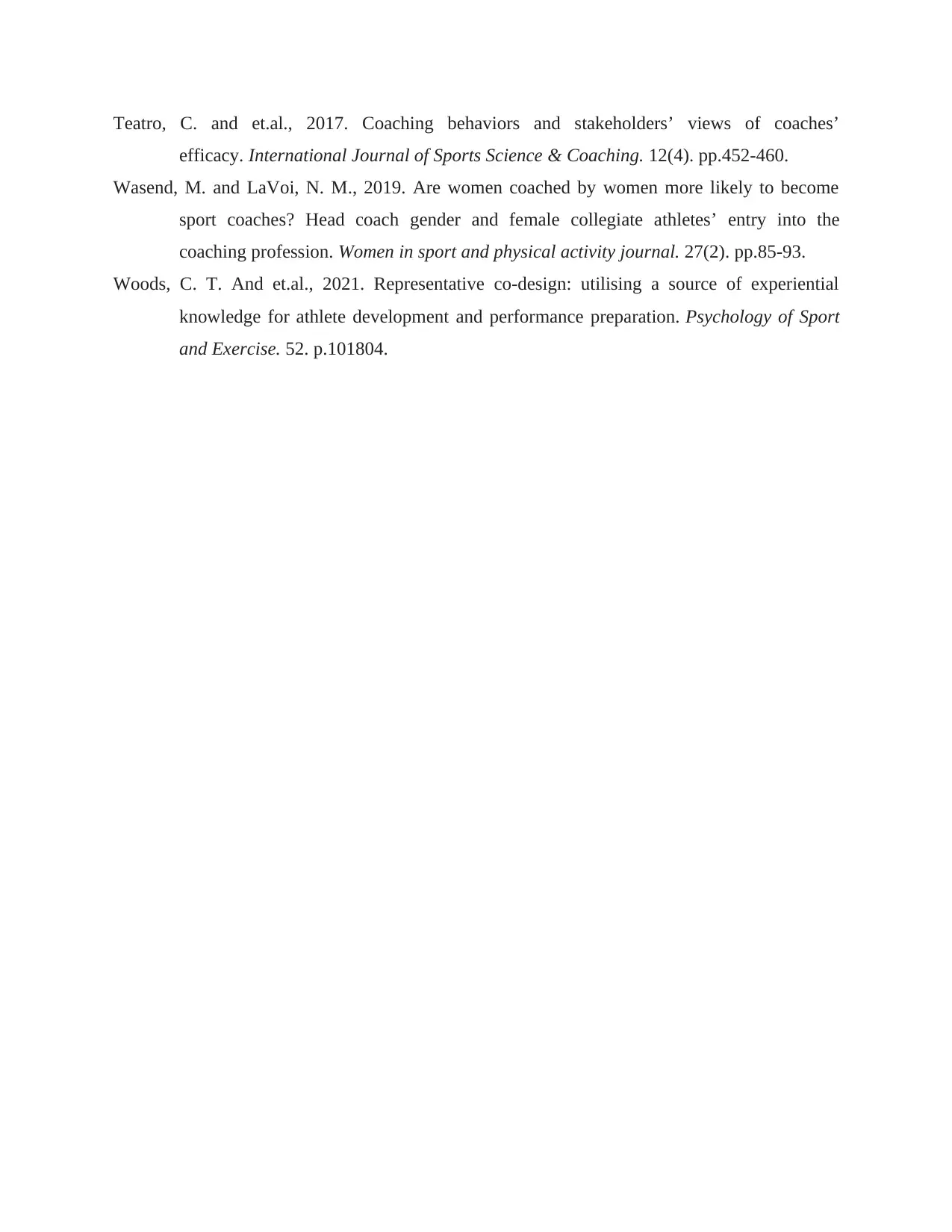
Teatro, C. and et.al., 2017. Coaching behaviors and stakeholders’ views of coaches’
efficacy. International Journal of Sports Science & Coaching. 12(4). pp.452-460.
Wasend, M. and LaVoi, N. M., 2019. Are women coached by women more likely to become
sport coaches? Head coach gender and female collegiate athletes’ entry into the
coaching profession. Women in sport and physical activity journal. 27(2). pp.85-93.
Woods, C. T. And et.al., 2021. Representative co-design: utilising a source of experiential
knowledge for athlete development and performance preparation. Psychology of Sport
and Exercise. 52. p.101804.
efficacy. International Journal of Sports Science & Coaching. 12(4). pp.452-460.
Wasend, M. and LaVoi, N. M., 2019. Are women coached by women more likely to become
sport coaches? Head coach gender and female collegiate athletes’ entry into the
coaching profession. Women in sport and physical activity journal. 27(2). pp.85-93.
Woods, C. T. And et.al., 2021. Representative co-design: utilising a source of experiential
knowledge for athlete development and performance preparation. Psychology of Sport
and Exercise. 52. p.101804.
⊘ This is a preview!⊘
Do you want full access?
Subscribe today to unlock all pages.
Trusted by 1+ million students worldwide
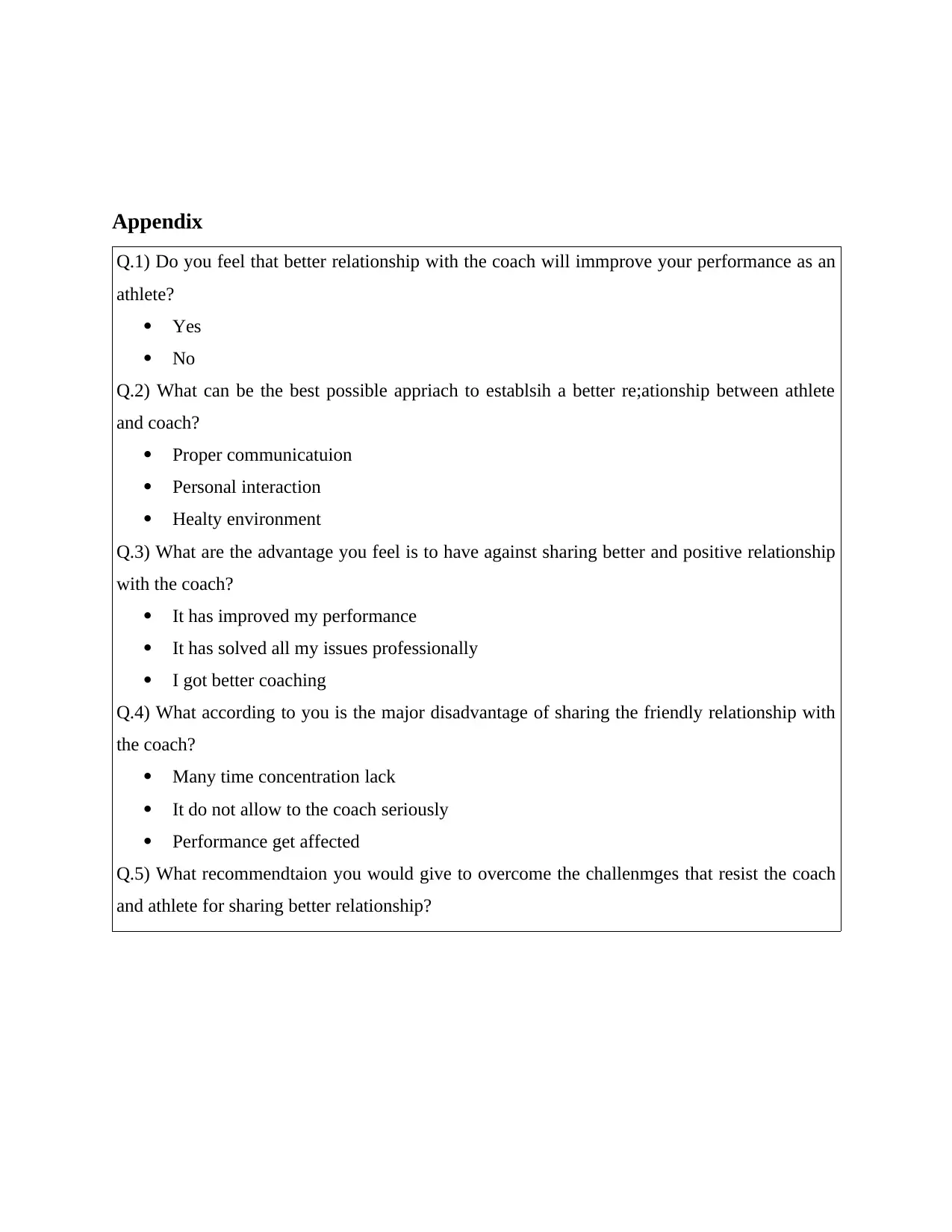
Appendix
Q.1) Do you feel that better relationship with the coach will immprove your performance as an
athlete?
Yes
No
Q.2) What can be the best possible appriach to establsih a better re;ationship between athlete
and coach?
Proper communicatuion
Personal interaction
Healty environment
Q.3) What are the advantage you feel is to have against sharing better and positive relationship
with the coach?
It has improved my performance
It has solved all my issues professionally
I got better coaching
Q.4) What according to you is the major disadvantage of sharing the friendly relationship with
the coach?
Many time concentration lack
It do not allow to the coach seriously
Performance get affected
Q.5) What recommendtaion you would give to overcome the challenmges that resist the coach
and athlete for sharing better relationship?
Q.1) Do you feel that better relationship with the coach will immprove your performance as an
athlete?
Yes
No
Q.2) What can be the best possible appriach to establsih a better re;ationship between athlete
and coach?
Proper communicatuion
Personal interaction
Healty environment
Q.3) What are the advantage you feel is to have against sharing better and positive relationship
with the coach?
It has improved my performance
It has solved all my issues professionally
I got better coaching
Q.4) What according to you is the major disadvantage of sharing the friendly relationship with
the coach?
Many time concentration lack
It do not allow to the coach seriously
Performance get affected
Q.5) What recommendtaion you would give to overcome the challenmges that resist the coach
and athlete for sharing better relationship?

1 out of 10


Related Documents


Your All-in-One AI-Powered Toolkit for Academic Success.
+13062052269
info@desklib.com
Available 24*7 on WhatsApp / Email
![[object Object]](/_next/static/media/star-bottom.7253800d.svg)
Unlock your academic potential
Copyright © 2020–2026 A2Z Services. All Rights Reserved. Developed and managed by ZUCOL.