Coaching Analysis Essay: Principles of Coaching - University Name
VerifiedAdded on 2023/04/07
|10
|2105
|139
Essay
AI Summary
This essay provides a detailed analysis of coaching principles, focusing on effective communication and leadership techniques within a coaching context. The paper begins with an introduction to coaching, outlining its role in employee development and performance improvement, and then delves into the background and qualifications of an observed coach. The essay explores the coach's environment, session plans, and applies coaching theories to appraise a coaching session. It includes an examination of communication skills, using models to identify strengths and weaknesses, and the importance of feedback. The analysis extends to recommendations for coaching improvements, highlighting crucial skills such as authority, mental strength, and patience, while also emphasizing the need for respect and approachability. The essay concludes with reflections on future coaching practices, suggesting the use of reflective workshops and mentoring programs to bridge communication gaps and improve coaching effectiveness. The analysis is supported by a range of references, ensuring a well-rounded perspective on coaching practices.
Running head: ANALYSIS ON COACHING
ANALYSIS ON COACHING
Name of the Student
Name of the University
Author Note
ANALYSIS ON COACHING
Name of the Student
Name of the University
Author Note

Paraphrase This Document
Need a fresh take? Get an instant paraphrase of this document with our AI Paraphraser
1ANALYSIS ON COACHING
Introduction
Coaching is a popular approach to the employee development, which is based on the
relationship between two people that is the coach and the individual. Here the individual
typically wants to improve the understanding of a particular situation where he or she wants to
learn new skills, prepare new situations as well as improve the performance areas. The coach
might provide the individual with a variety of services to improve his or her performances. For
example, a coach might help in understanding the problem and provide tools, which will help the
individual to understand the problem as well as suggest activities, which can lead to
improvement in the performance of the individual.
The aim of the study is to investigate the observed coach’s effectiveness and
communication skills. The paper will provide communication skills training for individuals who
wish to develop their interpersonal skills and build a rapport with others. The paper also covers
the effective communication strategies, which will enhance the understanding of verbal
communication with others.
Critical appraisal of coaching practice
The processes, which is involved in the communication skill are mostly listening,
questioning, observing, analyzing as well as evaluation. This means that through communication,
cooperation also occurs. For an effective process of communication there has to be a congruence
between the coach’s message sent as well as the message, which is received by the athlete. The
critical approach of the soccer coach in the process of communication seems to be limited when
observing the communication between the coach and the players. Developing a better
understanding of the coach as well as the player’s communication process there should be more
Introduction
Coaching is a popular approach to the employee development, which is based on the
relationship between two people that is the coach and the individual. Here the individual
typically wants to improve the understanding of a particular situation where he or she wants to
learn new skills, prepare new situations as well as improve the performance areas. The coach
might provide the individual with a variety of services to improve his or her performances. For
example, a coach might help in understanding the problem and provide tools, which will help the
individual to understand the problem as well as suggest activities, which can lead to
improvement in the performance of the individual.
The aim of the study is to investigate the observed coach’s effectiveness and
communication skills. The paper will provide communication skills training for individuals who
wish to develop their interpersonal skills and build a rapport with others. The paper also covers
the effective communication strategies, which will enhance the understanding of verbal
communication with others.
Critical appraisal of coaching practice
The processes, which is involved in the communication skill are mostly listening,
questioning, observing, analyzing as well as evaluation. This means that through communication,
cooperation also occurs. For an effective process of communication there has to be a congruence
between the coach’s message sent as well as the message, which is received by the athlete. The
critical approach of the soccer coach in the process of communication seems to be limited when
observing the communication between the coach and the players. Developing a better
understanding of the coach as well as the player’s communication process there should be more
2ANALYSIS ON COACHING
studies made in the natural settings which will be able to investigate both the perspective that is
both the coach and the player.
Coaching practice
Mohamed Nazri bin Nasir’s attitude is very positive towards the athletes when it comes
in respect of soccer game. Nazri had begun his career in Football Association of Premier League
in the year 1988, there he also won the President’s Cup in the year 1988 and 1989. He was sent
to Czech Club FC Nitra for two-month training. Nazri had also played for Sembawang Rangers
in the Singapore League Season. The kind of a team Mohamed Nazri bin Nasir wants is where
the team is physically strong, mentally strong, as well as ready to give their level best so as to
bring the team in a platform where it can show case a better result. According to MacLennan
(2017) where coaches have very good communication skill and a positive behavior towards the
athletes, those coaches are very helpful to the athletes who communicate in positive ways. It
does not mean that they will speak positive all the time but when they speak, they speak positive
to motivate the athlete. Everybody learns in a different way from the coaches. One can learn the
best when the coach is positive. Many athlete stated that it is very good to have a coach like
Mohamed Nazri bin Nasir because, it is very important to have a coach like Mohamed Nazri bin
Nasir because they will understand that everyone does not have a good day every day (Palmer,
2018).
An effective model of communication skills
In the book of (Boen, 2016)a model for the effective communication is provided which is
used so as identify a coach’s communicative skills in the paper. The components which are
required to explain the model is explained below:-
studies made in the natural settings which will be able to investigate both the perspective that is
both the coach and the player.
Coaching practice
Mohamed Nazri bin Nasir’s attitude is very positive towards the athletes when it comes
in respect of soccer game. Nazri had begun his career in Football Association of Premier League
in the year 1988, there he also won the President’s Cup in the year 1988 and 1989. He was sent
to Czech Club FC Nitra for two-month training. Nazri had also played for Sembawang Rangers
in the Singapore League Season. The kind of a team Mohamed Nazri bin Nasir wants is where
the team is physically strong, mentally strong, as well as ready to give their level best so as to
bring the team in a platform where it can show case a better result. According to MacLennan
(2017) where coaches have very good communication skill and a positive behavior towards the
athletes, those coaches are very helpful to the athletes who communicate in positive ways. It
does not mean that they will speak positive all the time but when they speak, they speak positive
to motivate the athlete. Everybody learns in a different way from the coaches. One can learn the
best when the coach is positive. Many athlete stated that it is very good to have a coach like
Mohamed Nazri bin Nasir because, it is very important to have a coach like Mohamed Nazri bin
Nasir because they will understand that everyone does not have a good day every day (Palmer,
2018).
An effective model of communication skills
In the book of (Boen, 2016)a model for the effective communication is provided which is
used so as identify a coach’s communicative skills in the paper. The components which are
required to explain the model is explained below:-
⊘ This is a preview!⊘
Do you want full access?
Subscribe today to unlock all pages.

Trusted by 1+ million students worldwide
3ANALYSIS ON COACHING
The Communicators, which includes both the sender as well as the receiver –The sender
and the receiver, are the communicators who are involved in the process of effective
communication. Both of the persons are involved in encoding and decoding the message.
An effective communication can be interfered by the receiver in the decoding phase.
Thus due to such reasons both the coach and the athlete’s characteristics plays a very
vital role in the communication process (Curd, 2011).
Message – The three vital things, which should be analyzed by the actual product from
the encoder is the code which is used to encode the message which is conveyed and the
content which is used in the message, as well as the proper understanding of the message.
For example a football coach is treating a message in a particular manner so as by
selecting the languages used in the communication, how technical will it be and at last
which kind of tone will be used in the delivery of the message.
Channel of communication –The term channel of communication means the channel
which is used to transfer the message.
Feedback – The reaction, which the decoder of the message or the receiver of the
message gives in respect to the effective communication flow, is known as feedback. If
an athlete is looking blank to the coach even after the coach has send the response to the
athlete. Then in this case, it means that the athlete has not understood what the coach has
meant to say.
Critical appraisal of coaching practice
Demonstration of the coaching theory
The Communicators, which includes both the sender as well as the receiver –The sender
and the receiver, are the communicators who are involved in the process of effective
communication. Both of the persons are involved in encoding and decoding the message.
An effective communication can be interfered by the receiver in the decoding phase.
Thus due to such reasons both the coach and the athlete’s characteristics plays a very
vital role in the communication process (Curd, 2011).
Message – The three vital things, which should be analyzed by the actual product from
the encoder is the code which is used to encode the message which is conveyed and the
content which is used in the message, as well as the proper understanding of the message.
For example a football coach is treating a message in a particular manner so as by
selecting the languages used in the communication, how technical will it be and at last
which kind of tone will be used in the delivery of the message.
Channel of communication –The term channel of communication means the channel
which is used to transfer the message.
Feedback – The reaction, which the decoder of the message or the receiver of the
message gives in respect to the effective communication flow, is known as feedback. If
an athlete is looking blank to the coach even after the coach has send the response to the
athlete. Then in this case, it means that the athlete has not understood what the coach has
meant to say.
Critical appraisal of coaching practice
Demonstration of the coaching theory
Paraphrase This Document
Need a fresh take? Get an instant paraphrase of this document with our AI Paraphraser
4ANALYSIS ON COACHING
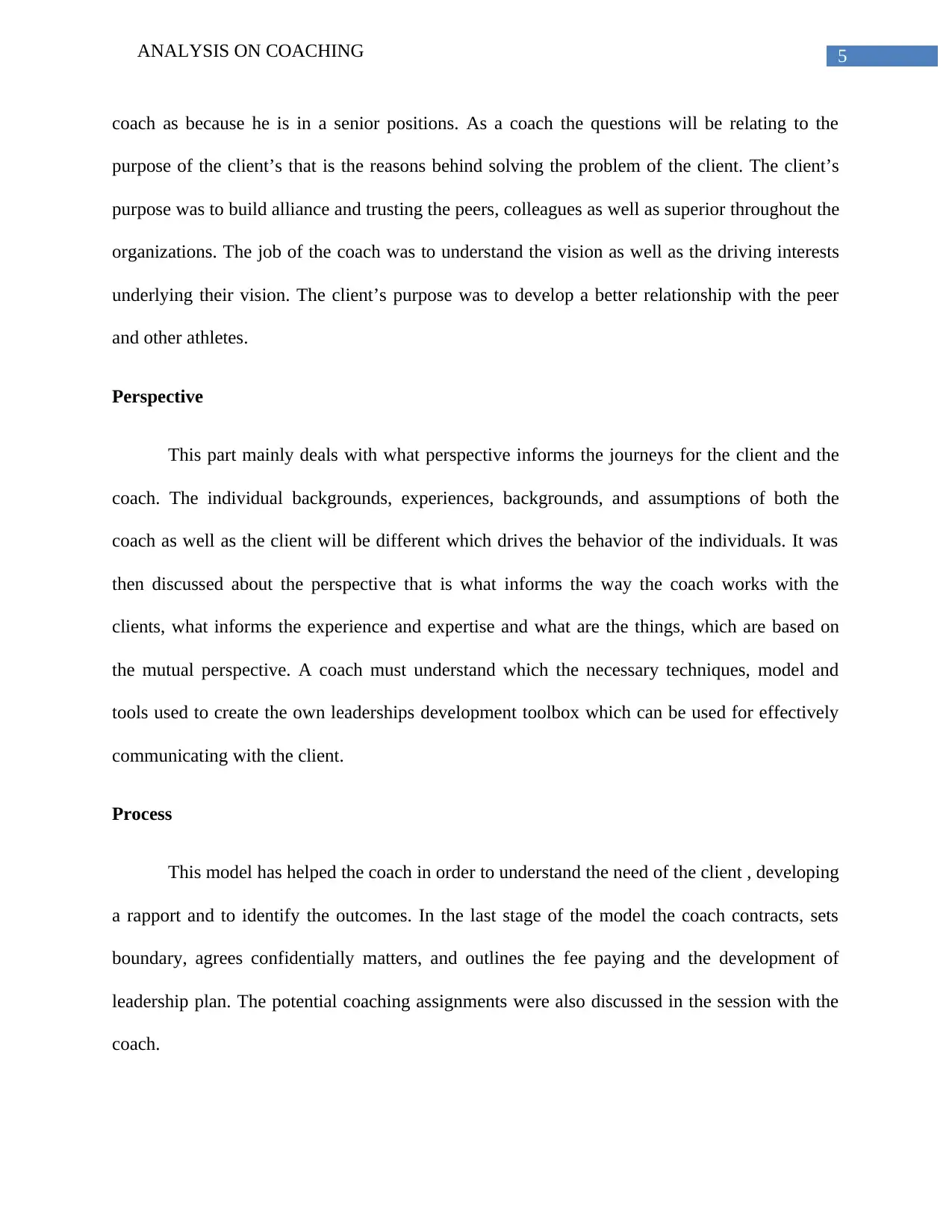
The Purpose, Perspective, Process model is used to appraise the coaching session which is
demonstrated below:-
Fig 1. Purpose, Perspective, Process.
Source: Greenlees (2015)
The key principle, which is used in order to convey from the above given diagram is that
it is very essential for a coach to adopt a structured approach in the coaching session. David Lane
from the Professional Development Foundation and the Work Based Unit of Learning from
Singapore’s Coaching Association has develop the above model
Purpose
The purpose section mainly deals with the purpose in working with the coach. What does
the coach want to achieve. For example a client is playing in a team said in the first session that
he is need of help as because everybody distrusts him in the game, and he wants help from the
PurposePerspectiveProcess
The Purpose, Perspective, Process model is used to appraise the coaching session which is
demonstrated below:-
Fig 1. Purpose, Perspective, Process.
Source: Greenlees (2015)
The key principle, which is used in order to convey from the above given diagram is that
it is very essential for a coach to adopt a structured approach in the coaching session. David Lane
from the Professional Development Foundation and the Work Based Unit of Learning from
Singapore’s Coaching Association has develop the above model
Purpose
The purpose section mainly deals with the purpose in working with the coach. What does
the coach want to achieve. For example a client is playing in a team said in the first session that
he is need of help as because everybody distrusts him in the game, and he wants help from the
PurposePerspectiveProcess
5ANALYSIS ON COACHING
coach as because he is in a senior positions. As a coach the questions will be relating to the
purpose of the client’s that is the reasons behind solving the problem of the client. The client’s
purpose was to build alliance and trusting the peers, colleagues as well as superior throughout the
organizations. The job of the coach was to understand the vision as well as the driving interests
underlying their vision. The client’s purpose was to develop a better relationship with the peer
and other athletes.
Perspective
This part mainly deals with what perspective informs the journeys for the client and the
coach. The individual backgrounds, experiences, backgrounds, and assumptions of both the
coach as well as the client will be different which drives the behavior of the individuals. It was
then discussed about the perspective that is what informs the way the coach works with the
clients, what informs the experience and expertise and what are the things, which are based on
the mutual perspective. A coach must understand which the necessary techniques, model and
tools used to create the own leaderships development toolbox which can be used for effectively
communicating with the client.
Process
This model has helped the coach in order to understand the need of the client , developing
a rapport and to identify the outcomes. In the last stage of the model the coach contracts, sets
boundary, agrees confidentially matters, and outlines the fee paying and the development of
leadership plan. The potential coaching assignments were also discussed in the session with the
coach.
coach as because he is in a senior positions. As a coach the questions will be relating to the
purpose of the client’s that is the reasons behind solving the problem of the client. The client’s
purpose was to build alliance and trusting the peers, colleagues as well as superior throughout the
organizations. The job of the coach was to understand the vision as well as the driving interests
underlying their vision. The client’s purpose was to develop a better relationship with the peer
and other athletes.
Perspective
This part mainly deals with what perspective informs the journeys for the client and the
coach. The individual backgrounds, experiences, backgrounds, and assumptions of both the
coach as well as the client will be different which drives the behavior of the individuals. It was
then discussed about the perspective that is what informs the way the coach works with the
clients, what informs the experience and expertise and what are the things, which are based on
the mutual perspective. A coach must understand which the necessary techniques, model and
tools used to create the own leaderships development toolbox which can be used for effectively
communicating with the client.
Process
This model has helped the coach in order to understand the need of the client , developing
a rapport and to identify the outcomes. In the last stage of the model the coach contracts, sets
boundary, agrees confidentially matters, and outlines the fee paying and the development of
leadership plan. The potential coaching assignments were also discussed in the session with the
coach.
⊘ This is a preview!⊘
Do you want full access?
Subscribe today to unlock all pages.
Trusted by 1+ million students worldwide
6ANALYSIS ON COACHING
Recommendation
Top skills, which can be, should can be implemented to improve the coaching skills are given
below:
Authority:- A good coach should always keep himself under control. To some players it
can be very easy but to other it may be quiet challenging. A good coach should always
keep the team under proper supervision (Packard, 2011).
Mental strength:- It does not matter how successful one is, sometimes it can be very
useful t be strong and bold so as to take the criticism. One should not make any negative
comments.
Sense of Humor:- Having a proper plan to lead the way to success is always preferred but
one should also keep a backup in mind if things go wrong and one should not be afraid in
admitting the mistake.
Patience:- Each and every player is different from one another. Coaching the youth
soccer players as because it takes a lot of time to help the players fulfill the potential.
However, the reward to the coach is only when the team works together.
Respect the rules:- A coach should be well aware of the rules and regulation of the game
(Din, 2019). It is vital when it comes to the match day, when reputation of the team
matters the most.
Approachability: A coach should not build walls between him and the players. The
Players need to feel that they should talk to the coach about the problems they face
(Westre, , & Weiss, 2018).Good observation skills:- A coach should watch what happens
when he is training. Different players develop different skills when they grow up. A
Recommendation
Top skills, which can be, should can be implemented to improve the coaching skills are given
below:
Authority:- A good coach should always keep himself under control. To some players it
can be very easy but to other it may be quiet challenging. A good coach should always
keep the team under proper supervision (Packard, 2011).
Mental strength:- It does not matter how successful one is, sometimes it can be very
useful t be strong and bold so as to take the criticism. One should not make any negative
comments.
Sense of Humor:- Having a proper plan to lead the way to success is always preferred but
one should also keep a backup in mind if things go wrong and one should not be afraid in
admitting the mistake.
Patience:- Each and every player is different from one another. Coaching the youth
soccer players as because it takes a lot of time to help the players fulfill the potential.
However, the reward to the coach is only when the team works together.
Respect the rules:- A coach should be well aware of the rules and regulation of the game
(Din, 2019). It is vital when it comes to the match day, when reputation of the team
matters the most.
Approachability: A coach should not build walls between him and the players. The
Players need to feel that they should talk to the coach about the problems they face
(Westre, , & Weiss, 2018).Good observation skills:- A coach should watch what happens
when he is training. Different players develop different skills when they grow up. A
Paraphrase This Document
Need a fresh take? Get an instant paraphrase of this document with our AI Paraphraser
7ANALYSIS ON COACHING
coach should take note of the skills developed and should advice how to implement those
at right time.
Reflections for future practice
Personal reflection is often thought to be limited by own knowledge base. It is suggested
that sharing one’s own experiences can overcome such limitations by facilitating the
interchanging of the views. The soccer coach in this study is reported to use several interesting
themes which are associate din sharing the reflection. Within the undergraduate curriculum, there
should be action-leading groups in the form of the reflective workshops which allows the sport
coaches from a range of sports to share their reflection, knowledge and skills. It is also suggested
that mentoring programs can be assisted in bridging the communication gap.
coach should take note of the skills developed and should advice how to implement those
at right time.
Reflections for future practice
Personal reflection is often thought to be limited by own knowledge base. It is suggested
that sharing one’s own experiences can overcome such limitations by facilitating the
interchanging of the views. The soccer coach in this study is reported to use several interesting
themes which are associate din sharing the reflection. Within the undergraduate curriculum, there
should be action-leading groups in the form of the reflective workshops which allows the sport
coaches from a range of sports to share their reflection, knowledge and skills. It is also suggested
that mentoring programs can be assisted in bridging the communication gap.
8ANALYSIS ON COACHING
References
Barr, M. (2018). An introduction to coaching skills: a practical guide.
Byrd, K. L. (2018). Coaching Styles and the Basic Psychological Need Fulfillment of College
Athletes.
de Haan, E., Culpin, V., & Curd, J. (2011). Executive coaching in practice: what determines helpfulness
for clients of coaching?. Personnel Review, 40(1), 24-44.
Fransen, K., Decroos, S., Broek, G. V., & Boen, F. (2016). Leading from the top or leading from
within? A comparison between coaches’ and athletes’ leadership as predictors of team
identification, team confidence, and team cohesion. International Journal of Sports Science &
Coaching, 11(6), 757-771.
Heydarinejad, S. E. D. I. G. H. E., & Adman, O. M. I. D. (2010). Relationship between coaching leadership
styles and team cohesion in football teams of the Iranian university league. Studies in physical culture and
tourism, 17(4), 367-72.
Horn, T. S., Bloom, P., Berglund, K. M., & Packard, S. (2014). Relationship between collegiate athletes’
psychological characteristics and their preferences for different types of coaching behavior. The Sport
Psychologist, 25(2), 190-211.
Huffington, C. (2018). A contextualized approach to coaching. In Executive Coaching (pp. 41-
77). Routledge.
Lancer, N., Clutterbuck, D., & Megginson, D. (2016). Techniques for coaching and mentoring.
Routledge.
MacLennan, N. (2017). Coaching and mentoring. Routledge.
References
Barr, M. (2018). An introduction to coaching skills: a practical guide.
Byrd, K. L. (2018). Coaching Styles and the Basic Psychological Need Fulfillment of College
Athletes.
de Haan, E., Culpin, V., & Curd, J. (2011). Executive coaching in practice: what determines helpfulness
for clients of coaching?. Personnel Review, 40(1), 24-44.
Fransen, K., Decroos, S., Broek, G. V., & Boen, F. (2016). Leading from the top or leading from
within? A comparison between coaches’ and athletes’ leadership as predictors of team
identification, team confidence, and team cohesion. International Journal of Sports Science &
Coaching, 11(6), 757-771.
Heydarinejad, S. E. D. I. G. H. E., & Adman, O. M. I. D. (2010). Relationship between coaching leadership
styles and team cohesion in football teams of the Iranian university league. Studies in physical culture and
tourism, 17(4), 367-72.
Horn, T. S., Bloom, P., Berglund, K. M., & Packard, S. (2014). Relationship between collegiate athletes’
psychological characteristics and their preferences for different types of coaching behavior. The Sport
Psychologist, 25(2), 190-211.
Huffington, C. (2018). A contextualized approach to coaching. In Executive Coaching (pp. 41-
77). Routledge.
Lancer, N., Clutterbuck, D., & Megginson, D. (2016). Techniques for coaching and mentoring.
Routledge.
MacLennan, N. (2017). Coaching and mentoring. Routledge.
⊘ This is a preview!⊘
Do you want full access?
Subscribe today to unlock all pages.
Trusted by 1+ million students worldwide
9ANALYSIS ON COACHING
Martens, R. (2018). Successful coaching. Human Kinetics.
Martin, S. B., Jackson, A. W., Richardson, P. A., & Weiller, K. H. (2015). Coaching preferences of
adolescent youths and their parents. Journal of Applied Sport Psychology, 11(2), 247-262.
Nazarudin, M. N. B., Fauzee, O. S. M, M., ., Jamalis Geok, K. S., & Din, A. (2019). Coaching leadership
styles and athlete satisfaction among Malaysian University Basketball team. Research journal of
international studies, 9(1), 4-11.
Neenan, M., & Palmer, S. (2018). Cognitive behavioural coaching. Routledge.
Pope, J. P., & Wilson, P. M. (2015). Testing a sequence of relationships from interpersonal
coaching styles to rugby performance, guided by the coach–athlete motivation
model. International Journal of Sport and Exercise Psychology, 13(3), 258-272.
Szedlak, C., Smith, M. J., Day, M. C., & Greenlees, I. A. (2015). Effective behaviours of
strength and conditioning coaches as perceived by athletes. International Journal of Sports
Science & Coaching, 10(5), 967-984.
Van Nieuwerburgh, C. (2017). An introduction to coaching skills: A practical guide. Sage.
Weinberg, R. S., & Gould, D. (2018). Foundations of Sport and Exercise Psychology, 7E.
Human Kinetics.
Westre, K. R., & Weiss, M. R. (2018). The relationship between perceived coaching behaviors and group
cohesion in high school football teams. The Sport Psychologist, 5(1), 41-54.
Martens, R. (2018). Successful coaching. Human Kinetics.
Martin, S. B., Jackson, A. W., Richardson, P. A., & Weiller, K. H. (2015). Coaching preferences of
adolescent youths and their parents. Journal of Applied Sport Psychology, 11(2), 247-262.
Nazarudin, M. N. B., Fauzee, O. S. M, M., ., Jamalis Geok, K. S., & Din, A. (2019). Coaching leadership
styles and athlete satisfaction among Malaysian University Basketball team. Research journal of
international studies, 9(1), 4-11.
Neenan, M., & Palmer, S. (2018). Cognitive behavioural coaching. Routledge.
Pope, J. P., & Wilson, P. M. (2015). Testing a sequence of relationships from interpersonal
coaching styles to rugby performance, guided by the coach–athlete motivation
model. International Journal of Sport and Exercise Psychology, 13(3), 258-272.
Szedlak, C., Smith, M. J., Day, M. C., & Greenlees, I. A. (2015). Effective behaviours of
strength and conditioning coaches as perceived by athletes. International Journal of Sports
Science & Coaching, 10(5), 967-984.
Van Nieuwerburgh, C. (2017). An introduction to coaching skills: A practical guide. Sage.
Weinberg, R. S., & Gould, D. (2018). Foundations of Sport and Exercise Psychology, 7E.
Human Kinetics.
Westre, K. R., & Weiss, M. R. (2018). The relationship between perceived coaching behaviors and group
cohesion in high school football teams. The Sport Psychologist, 5(1), 41-54.

1 out of 10


Your All-in-One AI-Powered Toolkit for Academic Success.
+13062052269
info@desklib.com
Available 24*7 on WhatsApp / Email
![[object Object]](/_next/static/media/star-bottom.7253800d.svg)
Unlock your academic potential
Copyright © 2020–2026 A2Z Services. All Rights Reserved. Developed and managed by ZUCOL.