MITS5505 Case Study: Codification and Knowledge Management
VerifiedAdded on 2022/09/11
|10
|1696
|10
Case Study
AI Summary
This case study explores the principles of knowledge management within an organizational context. It examines two case studies, the first focusing on troubleshooting a printer using decision tables and trees to codify the IT support expert's knowledge. The second case study delves into capturing and retaining knowledge from retiring employees. It highlights the importance of converting tacit knowledge into explicit forms through strategies like exit interviews, tailored to individual personality traits (extrovert vs. introvert), and the implementation of knowledge harvesting techniques. The case study also discusses various repositories for knowledge retention, emphasizing the value of structured approaches and the use of organizational culture, experienced individuals, and formal systems. The solution demonstrates the application of these strategies to improve productivity and cost savings within an organization, in line with the MITS5505 course objectives.
Running head: CODIFICATION AND KNOWLEDGE MANAGEMENT
CODIFICATION AND KNOWLEDGE MANAGEMENT
Name of the student:
Name of the university:
Author Note:
CODIFICATION AND KNOWLEDGE MANAGEMENT
Name of the student:
Name of the university:
Author Note:
Paraphrase This Document
Need a fresh take? Get an instant paraphrase of this document with our AI Paraphraser

1CODIFICATION AND KNOWLEDGE MANAGEMENT
Table of Contents
Case Study 1...............................................................................................................................2
Case Study 2...............................................................................................................................3
References..................................................................................................................................7
Table of Contents
Case Study 1...............................................................................................................................2
Case Study 2...............................................................................................................................3
References..................................................................................................................................7

2CODIFICATION AND KNOWLEDGE MANAGEMENT
Case Study 1
a)
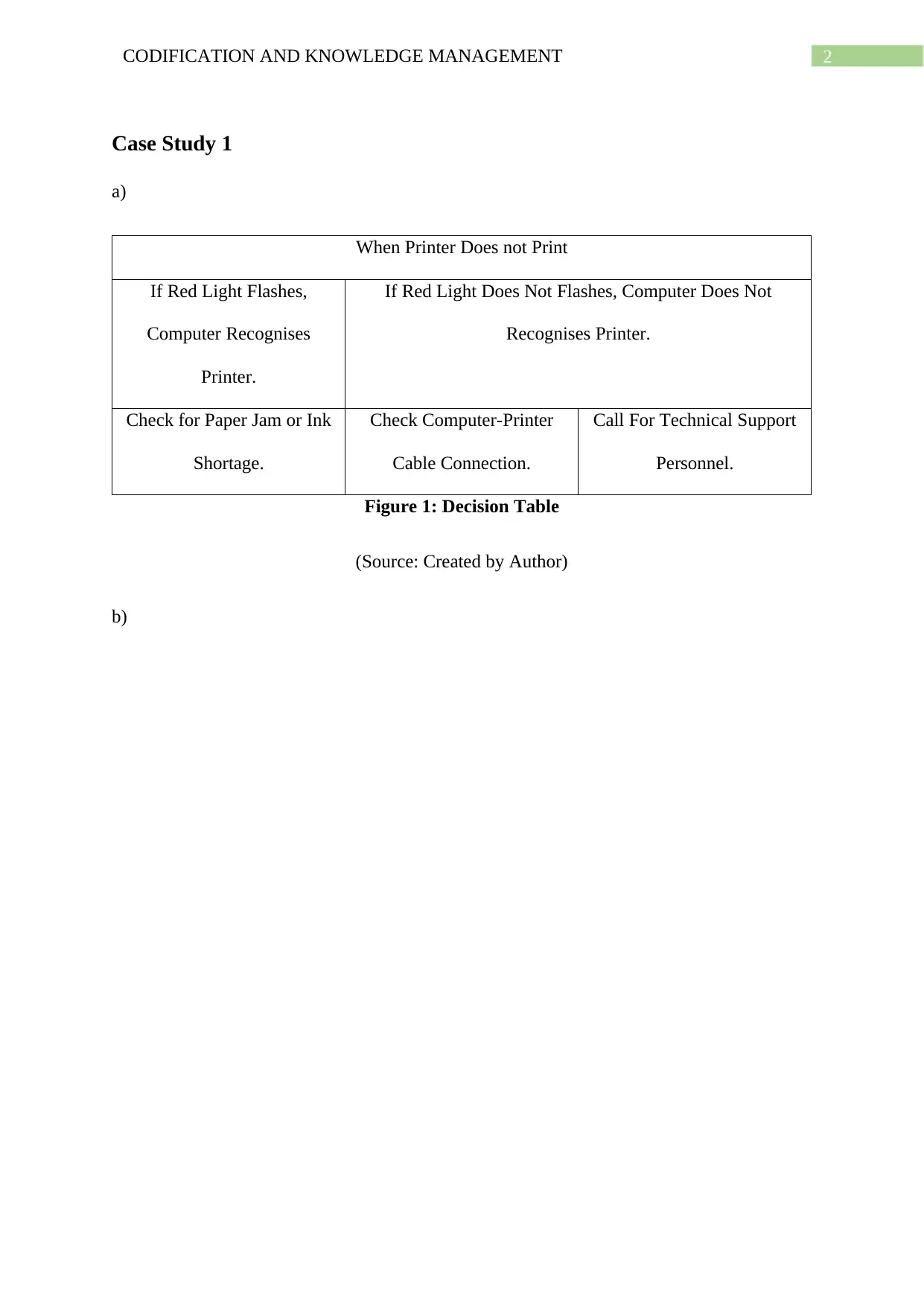
When Printer Does not Print
If Red Light Flashes,
Computer Recognises
Printer.
If Red Light Does Not Flashes, Computer Does Not
Recognises Printer.
Check for Paper Jam or Ink
Shortage.
Check Computer-Printer
Cable Connection.
Call For Technical Support
Personnel.
Figure 1: Decision Table
(Source: Created by Author)
b)
Case Study 1
a)
When Printer Does not Print
If Red Light Flashes,
Computer Recognises
Printer.
If Red Light Does Not Flashes, Computer Does Not
Recognises Printer.
Check for Paper Jam or Ink
Shortage.
Check Computer-Printer
Cable Connection.
Call For Technical Support
Personnel.
Figure 1: Decision Table
(Source: Created by Author)
b)
⊘ This is a preview!⊘
Do you want full access?
Subscribe today to unlock all pages.

Trusted by 1+ million students worldwide

3CODIFICATION AND KNOWLEDGE MANAGEMENT
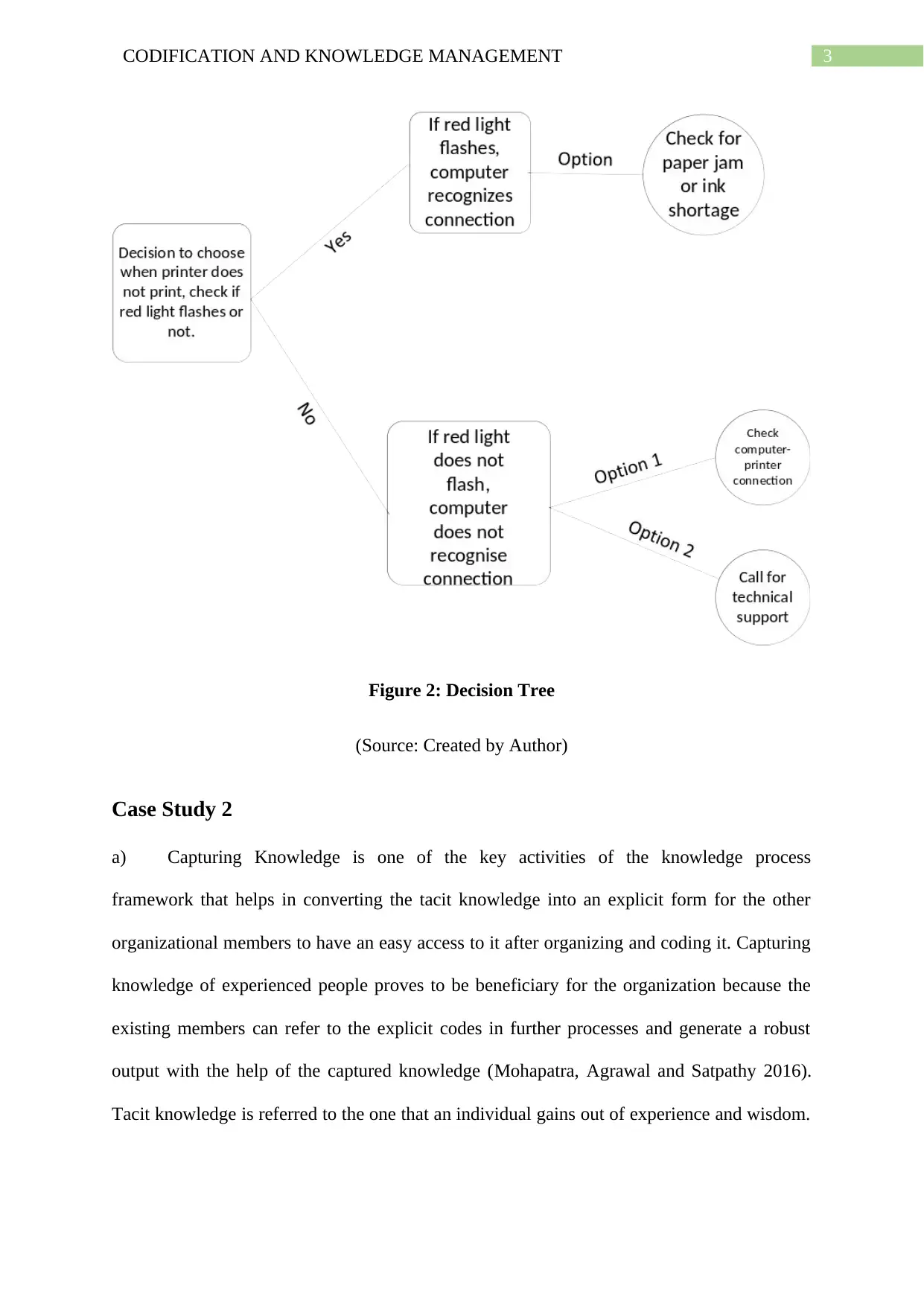
Figure 2: Decision Tree
(Source: Created by Author)
Case Study 2
a) Capturing Knowledge is one of the key activities of the knowledge process
framework that helps in converting the tacit knowledge into an explicit form for the other
organizational members to have an easy access to it after organizing and coding it. Capturing
knowledge of experienced people proves to be beneficiary for the organization because the
existing members can refer to the explicit codes in further processes and generate a robust
output with the help of the captured knowledge (Mohapatra, Agrawal and Satpathy 2016).
Tacit knowledge is referred to the one that an individual gains out of experience and wisdom.
Figure 2: Decision Tree
(Source: Created by Author)
Case Study 2
a) Capturing Knowledge is one of the key activities of the knowledge process
framework that helps in converting the tacit knowledge into an explicit form for the other
organizational members to have an easy access to it after organizing and coding it. Capturing
knowledge of experienced people proves to be beneficiary for the organization because the
existing members can refer to the explicit codes in further processes and generate a robust
output with the help of the captured knowledge (Mohapatra, Agrawal and Satpathy 2016).
Tacit knowledge is referred to the one that an individual gains out of experience and wisdom.
Paraphrase This Document
Need a fresh take? Get an instant paraphrase of this document with our AI Paraphraser

4CODIFICATION AND KNOWLEDGE MANAGEMENT
Converting tacit knowledge into explicit form is a difficult task because the individuals
possessing it might have different behavioural characteristics.
In the given scenario, the methodology that can be applied to both the individuals that
are retiring from the organization is the ‘Exit Interview’, irrespective of their behavioural
patterns and attributes (Imran et al. 2016). Since, they are retiring, it is evident that they have
spent a substantial amount of time in the organization and have been successful in gathering
ample quantity of information from their experiences in different projects. Hence,
interviewing both of them will be the best tool to capture their knowledge about the
organizational projects. However, since the individuals differ in characteristics, the method of
interviewing them will be different for extracting knowledge out of them.
In case of the first person, who is socially active and is extrovert by nature can afford
the method of ‘stories’ or ‘learning by being told’ while imparting knowledge to the other
people of the company (Jennex 2019). The interviewer on behalf of the company can ask the
outgoing retiring employee to narrate his experiences about managerial actions such that it
proves to be useful for the young progressive managers of other departments. Through his
stories, the employee can highlight the methods of interacting with other employees and
stakeholders to impart an in-depth knowledge about employee interaction tactics. He can also
comment on the culture and pattern about the other intra-organizational events and involve
other employees in this procedure apart from the interviewer. The organization can also
arrange for meetings and mentoring programs where the extrovert employee can highlight the
younger members with his experiences about various projects and technical operations
(Handzic 2017). These sessions although might consume the production time that will not be
beneficial for the company, but the knowledge gained by the other employees will be of great
help for the organizational progress.
Converting tacit knowledge into explicit form is a difficult task because the individuals
possessing it might have different behavioural characteristics.
In the given scenario, the methodology that can be applied to both the individuals that
are retiring from the organization is the ‘Exit Interview’, irrespective of their behavioural
patterns and attributes (Imran et al. 2016). Since, they are retiring, it is evident that they have
spent a substantial amount of time in the organization and have been successful in gathering
ample quantity of information from their experiences in different projects. Hence,
interviewing both of them will be the best tool to capture their knowledge about the
organizational projects. However, since the individuals differ in characteristics, the method of
interviewing them will be different for extracting knowledge out of them.
In case of the first person, who is socially active and is extrovert by nature can afford
the method of ‘stories’ or ‘learning by being told’ while imparting knowledge to the other
people of the company (Jennex 2019). The interviewer on behalf of the company can ask the
outgoing retiring employee to narrate his experiences about managerial actions such that it
proves to be useful for the young progressive managers of other departments. Through his
stories, the employee can highlight the methods of interacting with other employees and
stakeholders to impart an in-depth knowledge about employee interaction tactics. He can also
comment on the culture and pattern about the other intra-organizational events and involve
other employees in this procedure apart from the interviewer. The organization can also
arrange for meetings and mentoring programs where the extrovert employee can highlight the
younger members with his experiences about various projects and technical operations
(Handzic 2017). These sessions although might consume the production time that will not be
beneficial for the company, but the knowledge gained by the other employees will be of great
help for the organizational progress.

5CODIFICATION AND KNOWLEDGE MANAGEMENT
On the other hand, the retiring employee who is introvert by nature will not be
comfortable in attending such mentoring programs and debrief the younger ones with his
experiences and wisdom about the organizational culture and activities. Thus, to extract
knowledge out of him, the interviewer of the company needs to follow the ‘structured
interview’ procedure and conduct a face-to-face interaction while conducting the interview.
The interviewer should prepare a list of pre-defined questions and send it to the employee in
advance such that he can recall his memories about his experiences in the organization and be
prepared with the answers in advance (Song, Li and Zhao 2019). By this process, the
employee can provide with honest and elaborate answers that the interviewer should record
while carrying out the interview. This record will later on be provided to the employees to
hear and gain lessons from it.
b) While the old-age employees depart from the organizations, they are requested to
share their knowledge based on their learning experiences to make it available for the
younger employees such that they can learn about the organizational culture and processes
effectively. Hence, ‘Exit Interviews’ are a popular method of questioning the retiring
employees and deriving learning lessons from them. However, these retained information
needs to be stored in the organization such that they can be coded and retained for the other
employees to learn from them (Shah and Hussin 2018). There are some simple rules that will
help the organizations retain tacit knowledge, formulize them and store them in databases,
intranets, and search engines and so on.
Ensuring the right people for knowledge retention is the first step in this process. Not
everyone is capable of imparting knowledge about the culture of the organization as well as
the processes in it. Hence, executive or technical personnel who works closely with the teams
in operations or project management activities have the practical knowledge about the key
On the other hand, the retiring employee who is introvert by nature will not be
comfortable in attending such mentoring programs and debrief the younger ones with his
experiences and wisdom about the organizational culture and activities. Thus, to extract
knowledge out of him, the interviewer of the company needs to follow the ‘structured
interview’ procedure and conduct a face-to-face interaction while conducting the interview.
The interviewer should prepare a list of pre-defined questions and send it to the employee in
advance such that he can recall his memories about his experiences in the organization and be
prepared with the answers in advance (Song, Li and Zhao 2019). By this process, the
employee can provide with honest and elaborate answers that the interviewer should record
while carrying out the interview. This record will later on be provided to the employees to
hear and gain lessons from it.
b) While the old-age employees depart from the organizations, they are requested to
share their knowledge based on their learning experiences to make it available for the
younger employees such that they can learn about the organizational culture and processes
effectively. Hence, ‘Exit Interviews’ are a popular method of questioning the retiring
employees and deriving learning lessons from them. However, these retained information
needs to be stored in the organization such that they can be coded and retained for the other
employees to learn from them (Shah and Hussin 2018). There are some simple rules that will
help the organizations retain tacit knowledge, formulize them and store them in databases,
intranets, and search engines and so on.
Ensuring the right people for knowledge retention is the first step in this process. Not
everyone is capable of imparting knowledge about the culture of the organization as well as
the processes in it. Hence, executive or technical personnel who works closely with the teams
in operations or project management activities have the practical knowledge about the key
⊘ This is a preview!⊘
Do you want full access?
Subscribe today to unlock all pages.

Trusted by 1+ million students worldwide

6CODIFICATION AND KNOWLEDGE MANAGEMENT
terms and projects and their information will prove to be helpful for enriching the other
employees with lessons of wisdom.
The second step is to detect what kind of knowledge needs to be retained for
beneficiary purposes of the organization (Ahammad et al. 2016). For instance, for retail
organizations, knowledge about customer service solutions will help the existing employees
deal the customers in a better way and enhance the customer relationship strategies for the
organization. Hence, the organizations can store real-time data or record the interaction of the
service associates with the customer for further training purposes of the new employees.
The next step is to follow a structured approach to retain the knowledge after its
collection. The best technique for this structured methodology is ‘Knowledge Harvesting’
that refers to the accumulation of various types of knowledge such as procedural, structural,
systematic, technical and many similar types and codifying them to gather deep insights on
each type of knowledge (McRae, Vallett and Jewiss 2018). This methodology follows seven
modules that comprises of focusing on the topic, finding the useful documents and
information, eliciting the documents through interview sessions, organizing and packaging
the information and adapting tools to impart these documents to the learners.
The objective of the structured ‘Knowledge Harvesting’ approach is to gather the real-
time data from the processes that will produce an effective understanding amongst the
learners in the organization, help in improving the functionalities of the team’s processes and
can be reused for similar projects in future (Youngs, Miller and Perrone 2017). The
organization can also refer to the five repositories that retains information about the
organizational processes and its associated culture. The first repository are the experienced
individuals of the ongoing projects who can guide his team members with his experiences.
The second repository is the culture of the company that refers to the supporting framework
terms and projects and their information will prove to be helpful for enriching the other
employees with lessons of wisdom.
The second step is to detect what kind of knowledge needs to be retained for
beneficiary purposes of the organization (Ahammad et al. 2016). For instance, for retail
organizations, knowledge about customer service solutions will help the existing employees
deal the customers in a better way and enhance the customer relationship strategies for the
organization. Hence, the organizations can store real-time data or record the interaction of the
service associates with the customer for further training purposes of the new employees.
The next step is to follow a structured approach to retain the knowledge after its
collection. The best technique for this structured methodology is ‘Knowledge Harvesting’
that refers to the accumulation of various types of knowledge such as procedural, structural,
systematic, technical and many similar types and codifying them to gather deep insights on
each type of knowledge (McRae, Vallett and Jewiss 2018). This methodology follows seven
modules that comprises of focusing on the topic, finding the useful documents and
information, eliciting the documents through interview sessions, organizing and packaging
the information and adapting tools to impart these documents to the learners.
The objective of the structured ‘Knowledge Harvesting’ approach is to gather the real-
time data from the processes that will produce an effective understanding amongst the
learners in the organization, help in improving the functionalities of the team’s processes and
can be reused for similar projects in future (Youngs, Miller and Perrone 2017). The
organization can also refer to the five repositories that retains information about the
organizational processes and its associated culture. The first repository are the experienced
individuals of the ongoing projects who can guide his team members with his experiences.
The second repository is the culture of the company that refers to the supporting framework
Paraphrase This Document
Need a fresh take? Get an instant paraphrase of this document with our AI Paraphraser

7CODIFICATION AND KNOWLEDGE MANAGEMENT
of the organization. The third repository is the transformation of the organization in respect to
operations and formalised systems. These systems contains embedded knowledge that are
useful to carry out similar projects in future. The structural design of the organization is
another repository that explain the link of the employees in the organization and is highly
used by the new joiners (Bowling 2017). The external activities such as interviewing expert
personnel and storing these recordings or documenting them for training session is also
another repository for knowledge retention in the organizations.
of the organization. The third repository is the transformation of the organization in respect to
operations and formalised systems. These systems contains embedded knowledge that are
useful to carry out similar projects in future. The structural design of the organization is
another repository that explain the link of the employees in the organization and is highly
used by the new joiners (Bowling 2017). The external activities such as interviewing expert
personnel and storing these recordings or documenting them for training session is also
another repository for knowledge retention in the organizations.

8CODIFICATION AND KNOWLEDGE MANAGEMENT
References
Ahammad, M.F., Tarba, S.Y., Liu, Y. and Glaister, K.W., 2016. Knowledge transfer and
cross-border acquisition performance: The impact of cultural distance and employee
retention. International business review, 25(1), pp.66-75.
Bowling, J., 2017. The Effect of Repetitive Text Messages on the Retention of Knowledge
Among Clinical Staff.
Handzic, M., 2017. Individual Preference for a Personal Knowledge Management Strategy.
In 18th European Conference on Knowledge Management (ECKM 2017). Academic
Conferences and publishing limited.
Imran, M.K., Rehman, C.A., Aslam, U. and Bilal, A.R., 2016. What’s organization
knowledge management strategy for successful change implementation?. Journal of
Organizational Change Management.
Jennex, M.E., 2019. Towards Understanding Knowledge Management
Strategy. ISOneWorld, Information Institute.
McRae, G., Vallett, C. and Jewiss, J., 2018. Vermont Agency of Transportation Employee
Retention and Knowledge Management Study.
Mohapatra, S., Agrawal, A. and Satpathy, A., 2016. Designing knowledge management
strategy. In Designing Knowledge Management-Enabled Business Strategies (pp. 55-88).
Springer, Cham.
Shah, K.M. and Hussin, N., 2018. From Knowledge Retention to Knowledge
Transfer. International Journal of Academic Research in Business and Social Sciences, 8(9),
pp.329-334.
References
Ahammad, M.F., Tarba, S.Y., Liu, Y. and Glaister, K.W., 2016. Knowledge transfer and
cross-border acquisition performance: The impact of cultural distance and employee
retention. International business review, 25(1), pp.66-75.
Bowling, J., 2017. The Effect of Repetitive Text Messages on the Retention of Knowledge
Among Clinical Staff.
Handzic, M., 2017. Individual Preference for a Personal Knowledge Management Strategy.
In 18th European Conference on Knowledge Management (ECKM 2017). Academic
Conferences and publishing limited.
Imran, M.K., Rehman, C.A., Aslam, U. and Bilal, A.R., 2016. What’s organization
knowledge management strategy for successful change implementation?. Journal of
Organizational Change Management.
Jennex, M.E., 2019. Towards Understanding Knowledge Management
Strategy. ISOneWorld, Information Institute.
McRae, G., Vallett, C. and Jewiss, J., 2018. Vermont Agency of Transportation Employee
Retention and Knowledge Management Study.
Mohapatra, S., Agrawal, A. and Satpathy, A., 2016. Designing knowledge management
strategy. In Designing Knowledge Management-Enabled Business Strategies (pp. 55-88).
Springer, Cham.
Shah, K.M. and Hussin, N., 2018. From Knowledge Retention to Knowledge
Transfer. International Journal of Academic Research in Business and Social Sciences, 8(9),
pp.329-334.
⊘ This is a preview!⊘
Do you want full access?
Subscribe today to unlock all pages.

Trusted by 1+ million students worldwide

9CODIFICATION AND KNOWLEDGE MANAGEMENT
Song, B., Li, Y. and Zhao, L., 2019. Complementary Effect of Knowledge Management
Strategy on Firm Performance: Evidence from Chinese Firms. Sustainability, 11(13), p.3616.
Youngs, P., Miller, J. and Perrone, F., 2017. Using Measures of Person-Organization Fit and
Person-Group Fit to Predict Beginning Teacher Retention.
Song, B., Li, Y. and Zhao, L., 2019. Complementary Effect of Knowledge Management
Strategy on Firm Performance: Evidence from Chinese Firms. Sustainability, 11(13), p.3616.
Youngs, P., Miller, J. and Perrone, F., 2017. Using Measures of Person-Organization Fit and
Person-Group Fit to Predict Beginning Teacher Retention.
1 out of 10
Related Documents
Your All-in-One AI-Powered Toolkit for Academic Success.
+13062052269
info@desklib.com
Available 24*7 on WhatsApp / Email
Unlock your academic potential
Copyright © 2020–2026 A2Z Services. All Rights Reserved. Developed and managed by ZUCOL.