An In-Depth Analysis of Cognitive Development Using Piaget's Theory
VerifiedAdded on 2023/04/22
|6
|1530
|342
Essay
AI Summary
This essay provides an analysis of cognitive development in the context of Jean Piaget's theory, examining the different stages of cognitive development from the sensorimotor stage to the formal operational stage. It discusses the strengths of Piaget's theory in assessing cognitive development across different age groups, while also addressing its limitations, such as the lack of consideration for the impact of language and social environment as emphasized by theorists like Vygotsky. The essay further explores the challenges in conducting psychological experiments on human subjects, particularly children, and the difficulties in obtaining comprehensive data on cognitive development due to individual variability and environmental factors. The study concludes by highlighting the importance of cognitive development research and the need for a comprehensive framework that considers various influencing factors to provide a holistic understanding of cognitive development in individuals.
Running head: COGNITIVE DEVELOPMENT
Cognitive Development
Name of the Student
Name of the University
Author Note
Cognitive Development
Name of the Student
Name of the University
Author Note
Paraphrase This Document
Need a fresh take? Get an instant paraphrase of this document with our AI Paraphraser

1COGNITIVE DEVELOPMENT
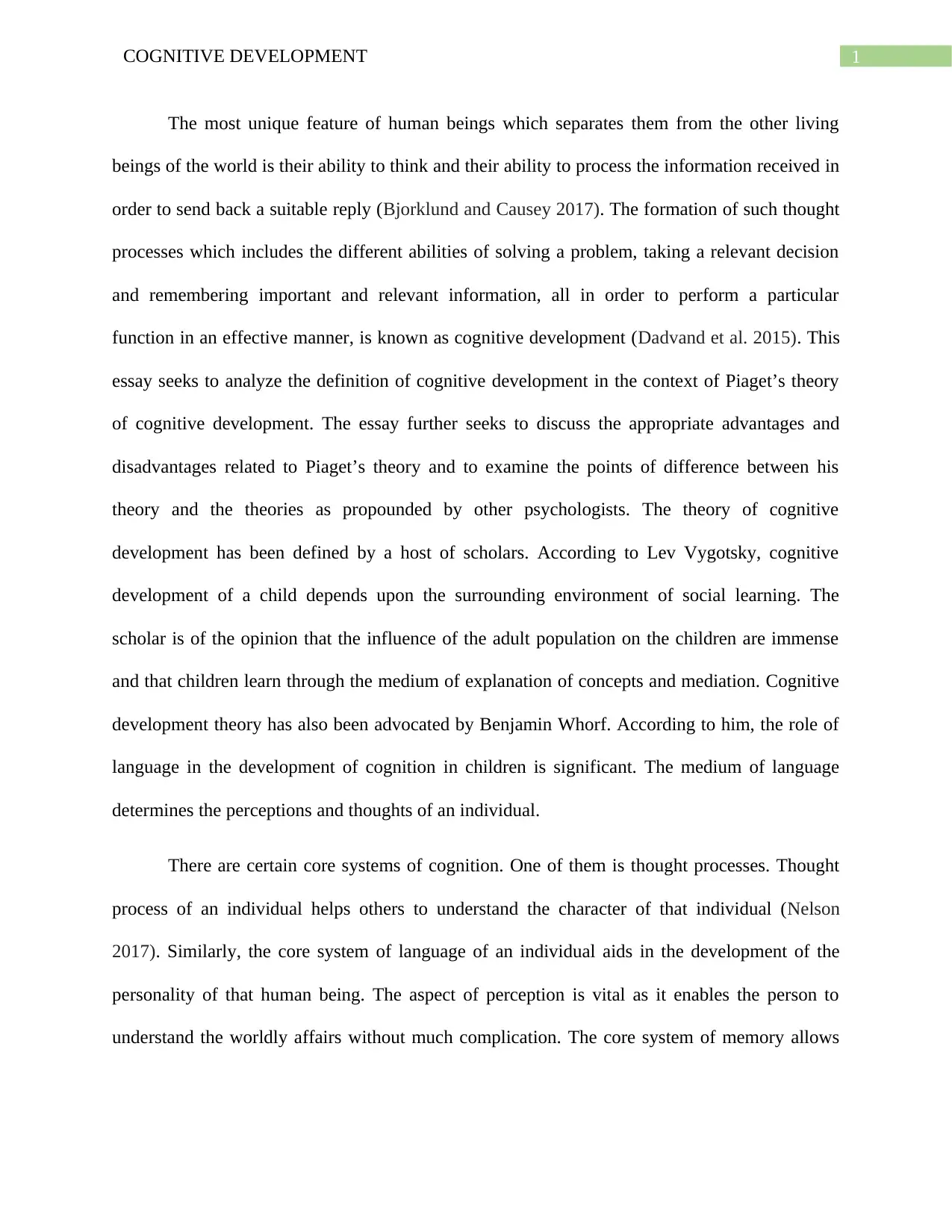
The most unique feature of human beings which separates them from the other living
beings of the world is their ability to think and their ability to process the information received in
order to send back a suitable reply (Bjorklund and Causey 2017). The formation of such thought
processes which includes the different abilities of solving a problem, taking a relevant decision
and remembering important and relevant information, all in order to perform a particular
function in an effective manner, is known as cognitive development (Dadvand et al. 2015). This
essay seeks to analyze the definition of cognitive development in the context of Piaget’s theory
of cognitive development. The essay further seeks to discuss the appropriate advantages and
disadvantages related to Piaget’s theory and to examine the points of difference between his
theory and the theories as propounded by other psychologists. The theory of cognitive
development has been defined by a host of scholars. According to Lev Vygotsky, cognitive
development of a child depends upon the surrounding environment of social learning. The
scholar is of the opinion that the influence of the adult population on the children are immense
and that children learn through the medium of explanation of concepts and mediation. Cognitive
development theory has also been advocated by Benjamin Whorf. According to him, the role of
language in the development of cognition in children is significant. The medium of language
determines the perceptions and thoughts of an individual.
There are certain core systems of cognition. One of them is thought processes. Thought
process of an individual helps others to understand the character of that individual (Nelson
2017). Similarly, the core system of language of an individual aids in the development of the
personality of that human being. The aspect of perception is vital as it enables the person to
understand the worldly affairs without much complication. The core system of memory allows
The most unique feature of human beings which separates them from the other living
beings of the world is their ability to think and their ability to process the information received in
order to send back a suitable reply (Bjorklund and Causey 2017). The formation of such thought
processes which includes the different abilities of solving a problem, taking a relevant decision
and remembering important and relevant information, all in order to perform a particular
function in an effective manner, is known as cognitive development (Dadvand et al. 2015). This
essay seeks to analyze the definition of cognitive development in the context of Piaget’s theory
of cognitive development. The essay further seeks to discuss the appropriate advantages and
disadvantages related to Piaget’s theory and to examine the points of difference between his
theory and the theories as propounded by other psychologists. The theory of cognitive
development has been defined by a host of scholars. According to Lev Vygotsky, cognitive
development of a child depends upon the surrounding environment of social learning. The
scholar is of the opinion that the influence of the adult population on the children are immense
and that children learn through the medium of explanation of concepts and mediation. Cognitive
development theory has also been advocated by Benjamin Whorf. According to him, the role of
language in the development of cognition in children is significant. The medium of language
determines the perceptions and thoughts of an individual.
There are certain core systems of cognition. One of them is thought processes. Thought
process of an individual helps others to understand the character of that individual (Nelson
2017). Similarly, the core system of language of an individual aids in the development of the
personality of that human being. The aspect of perception is vital as it enables the person to
understand the worldly affairs without much complication. The core system of memory allows

2COGNITIVE DEVELOPMENT
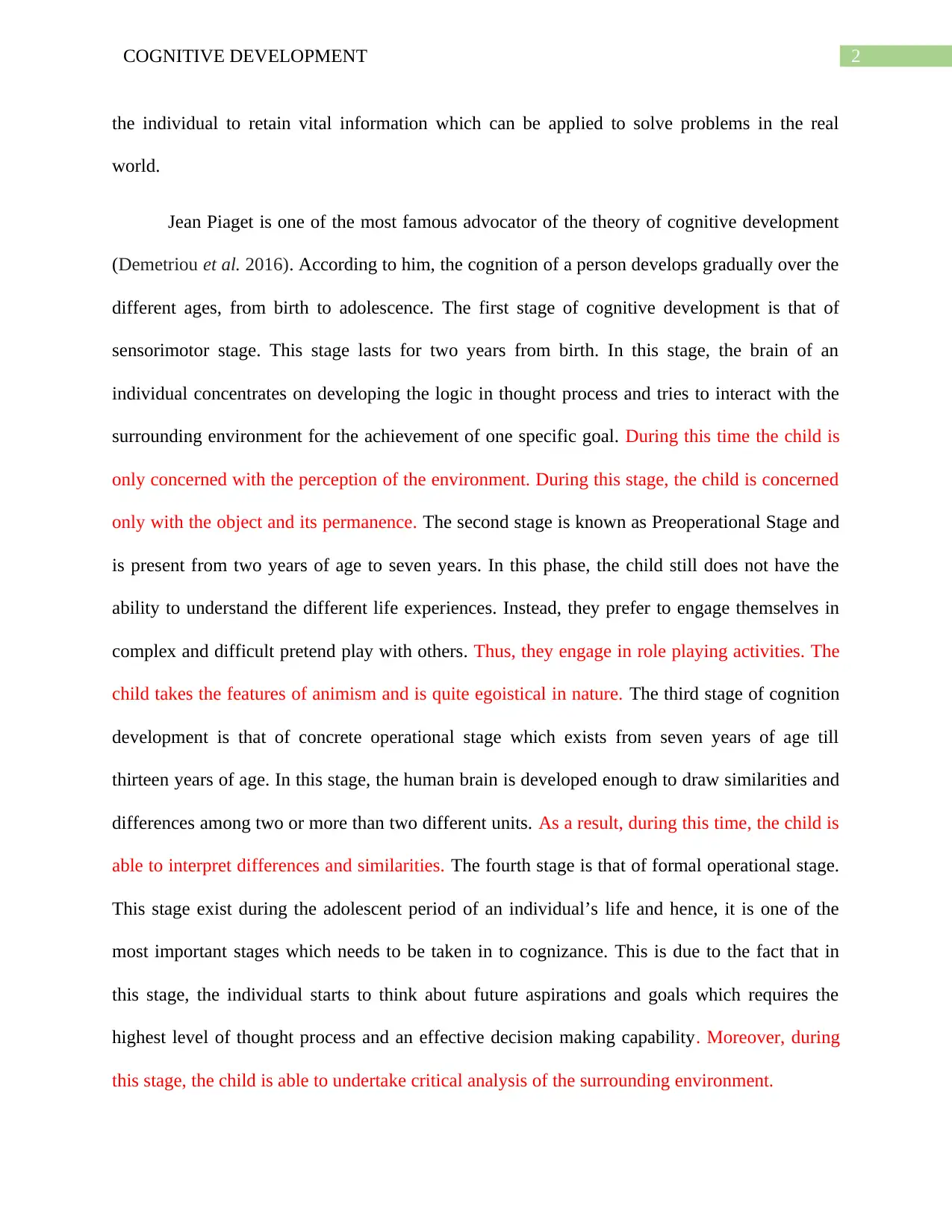
the individual to retain vital information which can be applied to solve problems in the real
world.
Jean Piaget is one of the most famous advocator of the theory of cognitive development
(Demetriou et al. 2016). According to him, the cognition of a person develops gradually over the
different ages, from birth to adolescence. The first stage of cognitive development is that of
sensorimotor stage. This stage lasts for two years from birth. In this stage, the brain of an
individual concentrates on developing the logic in thought process and tries to interact with the
surrounding environment for the achievement of one specific goal. During this time the child is
only concerned with the perception of the environment. During this stage, the child is concerned
only with the object and its permanence. The second stage is known as Preoperational Stage and
is present from two years of age to seven years. In this phase, the child still does not have the
ability to understand the different life experiences. Instead, they prefer to engage themselves in
complex and difficult pretend play with others. Thus, they engage in role playing activities. The
child takes the features of animism and is quite egoistical in nature. The third stage of cognition
development is that of concrete operational stage which exists from seven years of age till
thirteen years of age. In this stage, the human brain is developed enough to draw similarities and
differences among two or more than two different units. As a result, during this time, the child is
able to interpret differences and similarities. The fourth stage is that of formal operational stage.
This stage exist during the adolescent period of an individual’s life and hence, it is one of the
most important stages which needs to be taken in to cognizance. This is due to the fact that in
this stage, the individual starts to think about future aspirations and goals which requires the
highest level of thought process and an effective decision making capability. Moreover, during
this stage, the child is able to undertake critical analysis of the surrounding environment.
the individual to retain vital information which can be applied to solve problems in the real
world.
Jean Piaget is one of the most famous advocator of the theory of cognitive development
(Demetriou et al. 2016). According to him, the cognition of a person develops gradually over the
different ages, from birth to adolescence. The first stage of cognitive development is that of
sensorimotor stage. This stage lasts for two years from birth. In this stage, the brain of an
individual concentrates on developing the logic in thought process and tries to interact with the
surrounding environment for the achievement of one specific goal. During this time the child is
only concerned with the perception of the environment. During this stage, the child is concerned
only with the object and its permanence. The second stage is known as Preoperational Stage and
is present from two years of age to seven years. In this phase, the child still does not have the
ability to understand the different life experiences. Instead, they prefer to engage themselves in
complex and difficult pretend play with others. Thus, they engage in role playing activities. The
child takes the features of animism and is quite egoistical in nature. The third stage of cognition
development is that of concrete operational stage which exists from seven years of age till
thirteen years of age. In this stage, the human brain is developed enough to draw similarities and
differences among two or more than two different units. As a result, during this time, the child is
able to interpret differences and similarities. The fourth stage is that of formal operational stage.
This stage exist during the adolescent period of an individual’s life and hence, it is one of the
most important stages which needs to be taken in to cognizance. This is due to the fact that in
this stage, the individual starts to think about future aspirations and goals which requires the
highest level of thought process and an effective decision making capability. Moreover, during
this stage, the child is able to undertake critical analysis of the surrounding environment.
⊘ This is a preview!⊘
Do you want full access?
Subscribe today to unlock all pages.

Trusted by 1+ million students worldwide

3COGNITIVE DEVELOPMENT
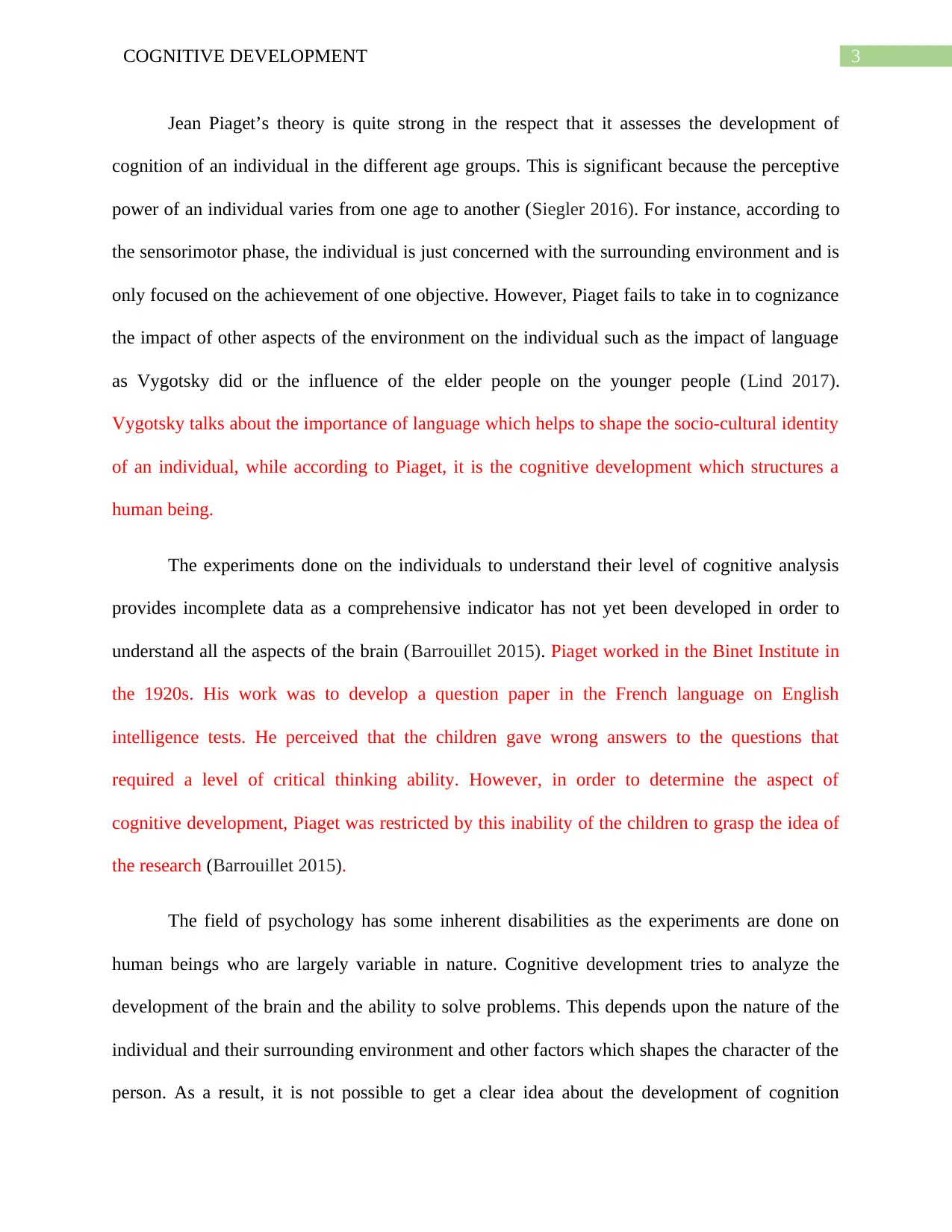
Jean Piaget’s theory is quite strong in the respect that it assesses the development of
cognition of an individual in the different age groups. This is significant because the perceptive
power of an individual varies from one age to another (Siegler 2016). For instance, according to
the sensorimotor phase, the individual is just concerned with the surrounding environment and is
only focused on the achievement of one objective. However, Piaget fails to take in to cognizance
the impact of other aspects of the environment on the individual such as the impact of language
as Vygotsky did or the influence of the elder people on the younger people (Lind 2017).
Vygotsky talks about the importance of language which helps to shape the socio-cultural identity
of an individual, while according to Piaget, it is the cognitive development which structures a
human being.
The experiments done on the individuals to understand their level of cognitive analysis
provides incomplete data as a comprehensive indicator has not yet been developed in order to
understand all the aspects of the brain (Barrouillet 2015). Piaget worked in the Binet Institute in
the 1920s. His work was to develop a question paper in the French language on English
intelligence tests. He perceived that the children gave wrong answers to the questions that
required a level of critical thinking ability. However, in order to determine the aspect of
cognitive development, Piaget was restricted by this inability of the children to grasp the idea of
the research (Barrouillet 2015).
The field of psychology has some inherent disabilities as the experiments are done on
human beings who are largely variable in nature. Cognitive development tries to analyze the
development of the brain and the ability to solve problems. This depends upon the nature of the
individual and their surrounding environment and other factors which shapes the character of the
person. As a result, it is not possible to get a clear idea about the development of cognition
Jean Piaget’s theory is quite strong in the respect that it assesses the development of
cognition of an individual in the different age groups. This is significant because the perceptive
power of an individual varies from one age to another (Siegler 2016). For instance, according to
the sensorimotor phase, the individual is just concerned with the surrounding environment and is
only focused on the achievement of one objective. However, Piaget fails to take in to cognizance
the impact of other aspects of the environment on the individual such as the impact of language
as Vygotsky did or the influence of the elder people on the younger people (Lind 2017).
Vygotsky talks about the importance of language which helps to shape the socio-cultural identity
of an individual, while according to Piaget, it is the cognitive development which structures a
human being.
The experiments done on the individuals to understand their level of cognitive analysis
provides incomplete data as a comprehensive indicator has not yet been developed in order to
understand all the aspects of the brain (Barrouillet 2015). Piaget worked in the Binet Institute in
the 1920s. His work was to develop a question paper in the French language on English
intelligence tests. He perceived that the children gave wrong answers to the questions that
required a level of critical thinking ability. However, in order to determine the aspect of
cognitive development, Piaget was restricted by this inability of the children to grasp the idea of
the research (Barrouillet 2015).
The field of psychology has some inherent disabilities as the experiments are done on
human beings who are largely variable in nature. Cognitive development tries to analyze the
development of the brain and the ability to solve problems. This depends upon the nature of the
individual and their surrounding environment and other factors which shapes the character of the
person. As a result, it is not possible to get a clear idea about the development of cognition
Paraphrase This Document
Need a fresh take? Get an instant paraphrase of this document with our AI Paraphraser

4COGNITIVE DEVELOPMENT
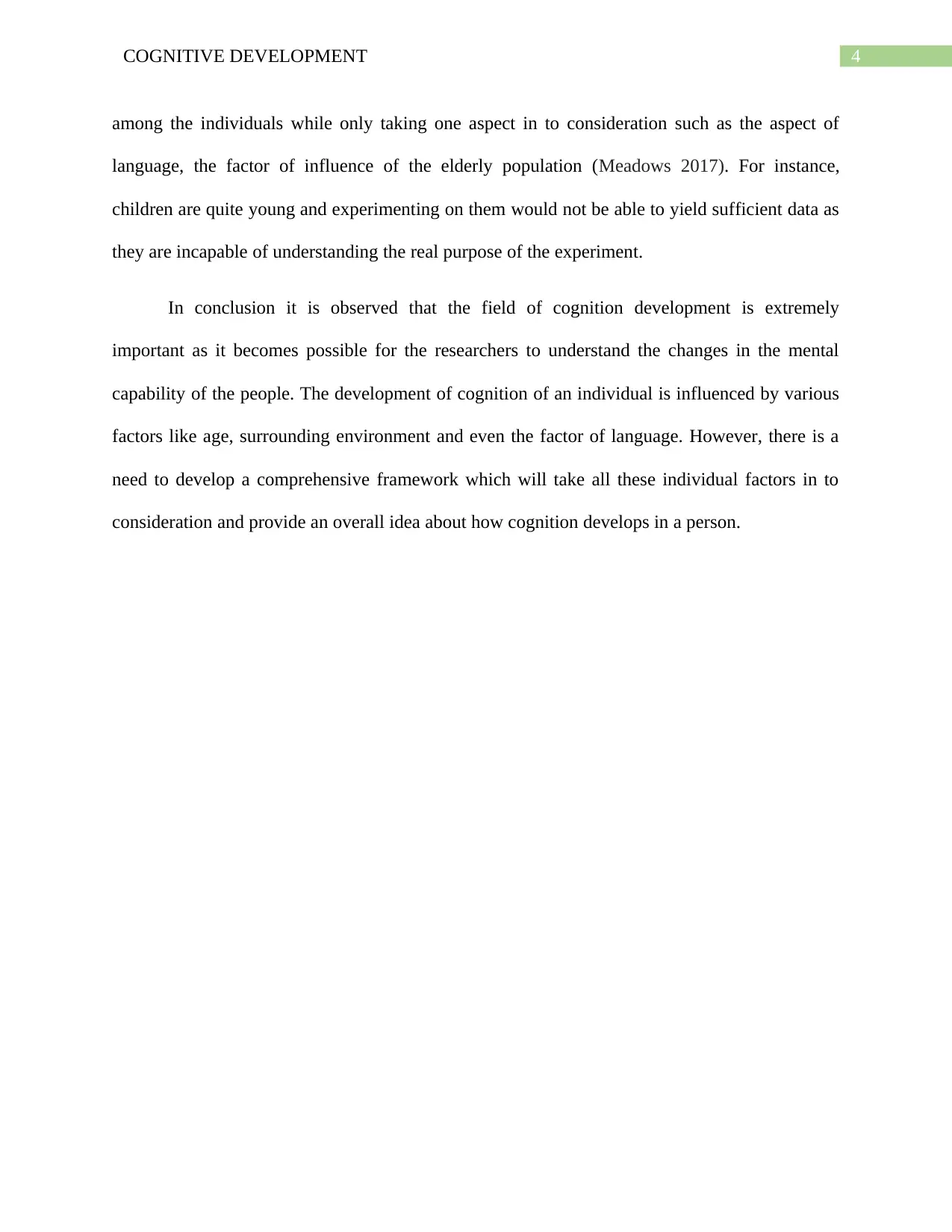
among the individuals while only taking one aspect in to consideration such as the aspect of
language, the factor of influence of the elderly population (Meadows 2017). For instance,
children are quite young and experimenting on them would not be able to yield sufficient data as
they are incapable of understanding the real purpose of the experiment.
In conclusion it is observed that the field of cognition development is extremely
important as it becomes possible for the researchers to understand the changes in the mental
capability of the people. The development of cognition of an individual is influenced by various
factors like age, surrounding environment and even the factor of language. However, there is a
need to develop a comprehensive framework which will take all these individual factors in to
consideration and provide an overall idea about how cognition develops in a person.
among the individuals while only taking one aspect in to consideration such as the aspect of
language, the factor of influence of the elderly population (Meadows 2017). For instance,
children are quite young and experimenting on them would not be able to yield sufficient data as
they are incapable of understanding the real purpose of the experiment.
In conclusion it is observed that the field of cognition development is extremely
important as it becomes possible for the researchers to understand the changes in the mental
capability of the people. The development of cognition of an individual is influenced by various
factors like age, surrounding environment and even the factor of language. However, there is a
need to develop a comprehensive framework which will take all these individual factors in to
consideration and provide an overall idea about how cognition develops in a person.

5COGNITIVE DEVELOPMENT
References:
Barrouillet, P., 2015. Theories of cognitive development: From Piaget to today.
Bjorklund, D.F. and Causey, K.B., 2017. Children's thinking: Cognitive development and
individual differences. Sage Publications.
Dadvand, P., Nieuwenhuijsen, M.J., Esnaola, M., Forns, J., Basagaña, X., Alvarez-Pedrerol, M.,
Rivas, I., López-Vicente, M., Pascual, M.D.C., Su, J. and Jerrett, M., 2015. Green spaces and
cognitive development in primary schoolchildren. Proceedings of the National Academy of
Sciences, 112(26), pp.7937-7942.
Demetriou, A., Shayer, M. and Efklides, A., 2016. Neo-Piagetian theories of cognitive
development: Implications and applications for education. Routledge.
Lind, G., 2017. The Theory of Moral-Cognitive Development A Socio-Psychological
Assessment. In Moral Judgments and Social Education (pp. 25-48). Routledge.
Meadows, S., 2017. Developing thinking: approaches to children's cognitive development.
Routledge.
Nelson, K., 2017. Cognitive development and the acquisition of concepts. In Schooling and the
acquisition of knowledge(pp. 215-239). Routledge.
Siegler, R.S., 2016. Continuity and change in the field of cognitive development and in the
perspectives of one cognitive developmentalist. Child Development Perspectives, 10(2), pp.128-
133.
References:
Barrouillet, P., 2015. Theories of cognitive development: From Piaget to today.
Bjorklund, D.F. and Causey, K.B., 2017. Children's thinking: Cognitive development and
individual differences. Sage Publications.
Dadvand, P., Nieuwenhuijsen, M.J., Esnaola, M., Forns, J., Basagaña, X., Alvarez-Pedrerol, M.,
Rivas, I., López-Vicente, M., Pascual, M.D.C., Su, J. and Jerrett, M., 2015. Green spaces and
cognitive development in primary schoolchildren. Proceedings of the National Academy of
Sciences, 112(26), pp.7937-7942.
Demetriou, A., Shayer, M. and Efklides, A., 2016. Neo-Piagetian theories of cognitive
development: Implications and applications for education. Routledge.
Lind, G., 2017. The Theory of Moral-Cognitive Development A Socio-Psychological
Assessment. In Moral Judgments and Social Education (pp. 25-48). Routledge.
Meadows, S., 2017. Developing thinking: approaches to children's cognitive development.
Routledge.
Nelson, K., 2017. Cognitive development and the acquisition of concepts. In Schooling and the
acquisition of knowledge(pp. 215-239). Routledge.
Siegler, R.S., 2016. Continuity and change in the field of cognitive development and in the
perspectives of one cognitive developmentalist. Child Development Perspectives, 10(2), pp.128-
133.
⊘ This is a preview!⊘
Do you want full access?
Subscribe today to unlock all pages.

Trusted by 1+ million students worldwide
1 out of 6
Related Documents
Your All-in-One AI-Powered Toolkit for Academic Success.
+13062052269
info@desklib.com
Available 24*7 on WhatsApp / Email
Unlock your academic potential
Copyright © 2020–2025 A2Z Services. All Rights Reserved. Developed and managed by ZUCOL.