Clinical Psychology: Case Studies, Diagnosis, and Treatment Plans
VerifiedAdded on 2022/09/15
|7
|1737
|17
Case Study
AI Summary
This assignment presents three clinical psychology case studies, each detailing a client's symptoms, behaviors, and history. The student analyzes the biological, psychological, and social symptoms, identifies abnormal behaviors, and notes patterns. For each case, the student provides a principal diagnosis based on DSM-5 criteria, offering a thorough rationale for how the client meets the criteria. Differential diagnoses are also considered, with explanations of the process used to rule them out. Case study 1 focuses on a client displaying narcissistic traits, case study 2 on a client with obsessive-compulsive tendencies, and case study 3 on a client exhibiting borderline personality disorder. The assignment demonstrates an understanding of personality disorders and diagnostic processes.
Running head: CLINICAL PSYCHOLOGY
CLINICAL PSYCHOLOGY
Name of the Student
Name of the University
Author Note
CLINICAL PSYCHOLOGY
Name of the Student
Name of the University
Author Note
Paraphrase This Document
Need a fresh take? Get an instant paraphrase of this document with our AI Paraphraser

1CLINICAL PSYCHOLOGY
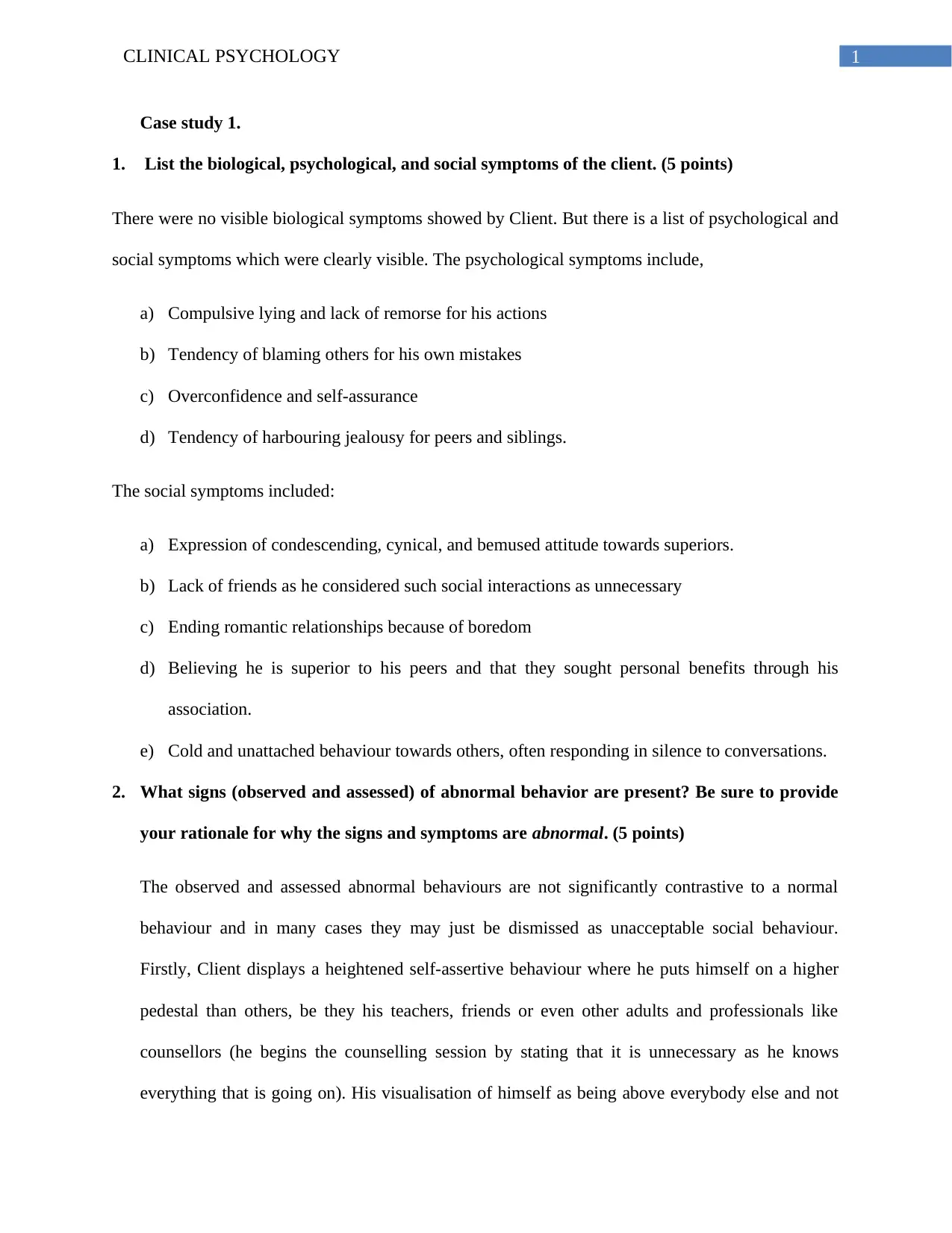
Case study 1.
1. List the biological, psychological, and social symptoms of the client. (5 points)
There were no visible biological symptoms showed by Client. But there is a list of psychological and
social symptoms which were clearly visible. The psychological symptoms include,
a) Compulsive lying and lack of remorse for his actions
b) Tendency of blaming others for his own mistakes
c) Overconfidence and self-assurance
d) Tendency of harbouring jealousy for peers and siblings.
The social symptoms included:
a) Expression of condescending, cynical, and bemused attitude towards superiors.
b) Lack of friends as he considered such social interactions as unnecessary
c) Ending romantic relationships because of boredom
d) Believing he is superior to his peers and that they sought personal benefits through his
association.
e) Cold and unattached behaviour towards others, often responding in silence to conversations.
2. What signs (observed and assessed) of abnormal behavior are present? Be sure to provide
your rationale for why the signs and symptoms are abnormal. (5 points)
The observed and assessed abnormal behaviours are not significantly contrastive to a normal
behaviour and in many cases they may just be dismissed as unacceptable social behaviour.
Firstly, Client displays a heightened self-assertive behaviour where he puts himself on a higher
pedestal than others, be they his teachers, friends or even other adults and professionals like
counsellors (he begins the counselling session by stating that it is unnecessary as he knows
everything that is going on). His visualisation of himself as being above everybody else and not
Case study 1.
1. List the biological, psychological, and social symptoms of the client. (5 points)
There were no visible biological symptoms showed by Client. But there is a list of psychological and
social symptoms which were clearly visible. The psychological symptoms include,
a) Compulsive lying and lack of remorse for his actions
b) Tendency of blaming others for his own mistakes
c) Overconfidence and self-assurance
d) Tendency of harbouring jealousy for peers and siblings.
The social symptoms included:
a) Expression of condescending, cynical, and bemused attitude towards superiors.
b) Lack of friends as he considered such social interactions as unnecessary
c) Ending romantic relationships because of boredom
d) Believing he is superior to his peers and that they sought personal benefits through his
association.
e) Cold and unattached behaviour towards others, often responding in silence to conversations.
2. What signs (observed and assessed) of abnormal behavior are present? Be sure to provide
your rationale for why the signs and symptoms are abnormal. (5 points)
The observed and assessed abnormal behaviours are not significantly contrastive to a normal
behaviour and in many cases they may just be dismissed as unacceptable social behaviour.
Firstly, Client displays a heightened self-assertive behaviour where he puts himself on a higher
pedestal than others, be they his teachers, friends or even other adults and professionals like
counsellors (he begins the counselling session by stating that it is unnecessary as he knows
everything that is going on). His visualisation of himself as being above everybody else and not

2CLINICAL PSYCHOLOGY
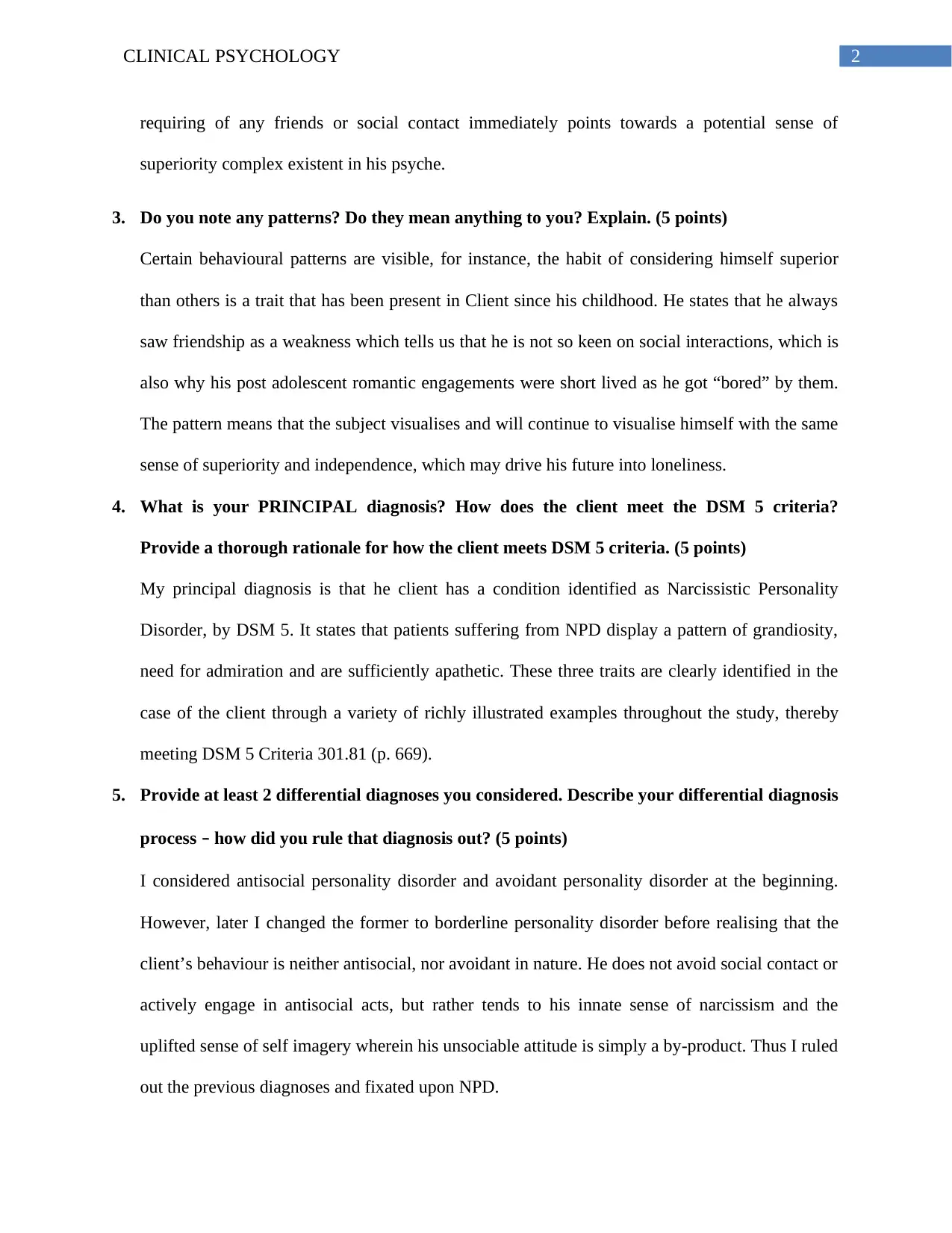
requiring of any friends or social contact immediately points towards a potential sense of
superiority complex existent in his psyche.
3. Do you note any patterns? Do they mean anything to you? Explain. (5 points)
Certain behavioural patterns are visible, for instance, the habit of considering himself superior
than others is a trait that has been present in Client since his childhood. He states that he always
saw friendship as a weakness which tells us that he is not so keen on social interactions, which is
also why his post adolescent romantic engagements were short lived as he got “bored” by them.
The pattern means that the subject visualises and will continue to visualise himself with the same
sense of superiority and independence, which may drive his future into loneliness.
4. What is your PRINCIPAL diagnosis? How does the client meet the DSM 5 criteria?
Provide a thorough rationale for how the client meets DSM 5 criteria. (5 points)
My principal diagnosis is that he client has a condition identified as Narcissistic Personality
Disorder, by DSM 5. It states that patients suffering from NPD display a pattern of grandiosity,
need for admiration and are sufficiently apathetic. These three traits are clearly identified in the
case of the client through a variety of richly illustrated examples throughout the study, thereby
meeting DSM 5 Criteria 301.81 (p. 669).
5. Provide at least 2 differential diagnoses you considered. Describe your differential diagnosis
process – how did you rule that diagnosis out? (5 points)
I considered antisocial personality disorder and avoidant personality disorder at the beginning.
However, later I changed the former to borderline personality disorder before realising that the
client’s behaviour is neither antisocial, nor avoidant in nature. He does not avoid social contact or
actively engage in antisocial acts, but rather tends to his innate sense of narcissism and the
uplifted sense of self imagery wherein his unsociable attitude is simply a by-product. Thus I ruled
out the previous diagnoses and fixated upon NPD.
requiring of any friends or social contact immediately points towards a potential sense of
superiority complex existent in his psyche.
3. Do you note any patterns? Do they mean anything to you? Explain. (5 points)
Certain behavioural patterns are visible, for instance, the habit of considering himself superior
than others is a trait that has been present in Client since his childhood. He states that he always
saw friendship as a weakness which tells us that he is not so keen on social interactions, which is
also why his post adolescent romantic engagements were short lived as he got “bored” by them.
The pattern means that the subject visualises and will continue to visualise himself with the same
sense of superiority and independence, which may drive his future into loneliness.
4. What is your PRINCIPAL diagnosis? How does the client meet the DSM 5 criteria?
Provide a thorough rationale for how the client meets DSM 5 criteria. (5 points)
My principal diagnosis is that he client has a condition identified as Narcissistic Personality
Disorder, by DSM 5. It states that patients suffering from NPD display a pattern of grandiosity,
need for admiration and are sufficiently apathetic. These three traits are clearly identified in the
case of the client through a variety of richly illustrated examples throughout the study, thereby
meeting DSM 5 Criteria 301.81 (p. 669).
5. Provide at least 2 differential diagnoses you considered. Describe your differential diagnosis
process – how did you rule that diagnosis out? (5 points)
I considered antisocial personality disorder and avoidant personality disorder at the beginning.
However, later I changed the former to borderline personality disorder before realising that the
client’s behaviour is neither antisocial, nor avoidant in nature. He does not avoid social contact or
actively engage in antisocial acts, but rather tends to his innate sense of narcissism and the
uplifted sense of self imagery wherein his unsociable attitude is simply a by-product. Thus I ruled
out the previous diagnoses and fixated upon NPD.
⊘ This is a preview!⊘
Do you want full access?
Subscribe today to unlock all pages.

Trusted by 1+ million students worldwide

3CLINICAL PSYCHOLOGY
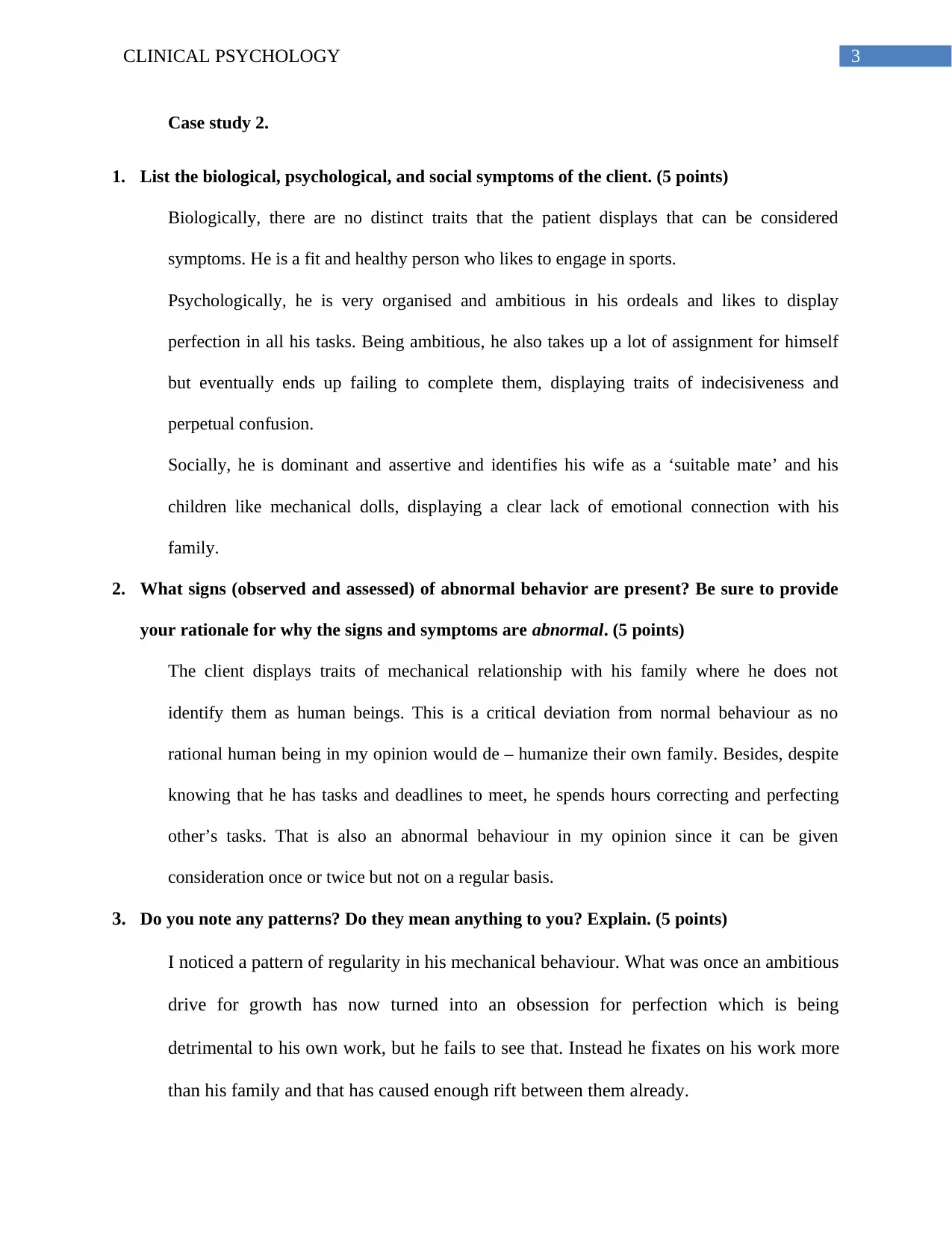
Case study 2.
1. List the biological, psychological, and social symptoms of the client. (5 points)
Biologically, there are no distinct traits that the patient displays that can be considered
symptoms. He is a fit and healthy person who likes to engage in sports.
Psychologically, he is very organised and ambitious in his ordeals and likes to display
perfection in all his tasks. Being ambitious, he also takes up a lot of assignment for himself
but eventually ends up failing to complete them, displaying traits of indecisiveness and
perpetual confusion.
Socially, he is dominant and assertive and identifies his wife as a ‘suitable mate’ and his
children like mechanical dolls, displaying a clear lack of emotional connection with his
family.
2. What signs (observed and assessed) of abnormal behavior are present? Be sure to provide
your rationale for why the signs and symptoms are abnormal. (5 points)
The client displays traits of mechanical relationship with his family where he does not
identify them as human beings. This is a critical deviation from normal behaviour as no
rational human being in my opinion would de – humanize their own family. Besides, despite
knowing that he has tasks and deadlines to meet, he spends hours correcting and perfecting
other’s tasks. That is also an abnormal behaviour in my opinion since it can be given
consideration once or twice but not on a regular basis.
3. Do you note any patterns? Do they mean anything to you? Explain. (5 points)
I noticed a pattern of regularity in his mechanical behaviour. What was once an ambitious
drive for growth has now turned into an obsession for perfection which is being
detrimental to his own work, but he fails to see that. Instead he fixates on his work more
than his family and that has caused enough rift between them already.
Case study 2.
1. List the biological, psychological, and social symptoms of the client. (5 points)
Biologically, there are no distinct traits that the patient displays that can be considered
symptoms. He is a fit and healthy person who likes to engage in sports.
Psychologically, he is very organised and ambitious in his ordeals and likes to display
perfection in all his tasks. Being ambitious, he also takes up a lot of assignment for himself
but eventually ends up failing to complete them, displaying traits of indecisiveness and
perpetual confusion.
Socially, he is dominant and assertive and identifies his wife as a ‘suitable mate’ and his
children like mechanical dolls, displaying a clear lack of emotional connection with his
family.
2. What signs (observed and assessed) of abnormal behavior are present? Be sure to provide
your rationale for why the signs and symptoms are abnormal. (5 points)
The client displays traits of mechanical relationship with his family where he does not
identify them as human beings. This is a critical deviation from normal behaviour as no
rational human being in my opinion would de – humanize their own family. Besides, despite
knowing that he has tasks and deadlines to meet, he spends hours correcting and perfecting
other’s tasks. That is also an abnormal behaviour in my opinion since it can be given
consideration once or twice but not on a regular basis.
3. Do you note any patterns? Do they mean anything to you? Explain. (5 points)
I noticed a pattern of regularity in his mechanical behaviour. What was once an ambitious
drive for growth has now turned into an obsession for perfection which is being
detrimental to his own work, but he fails to see that. Instead he fixates on his work more
than his family and that has caused enough rift between them already.
Paraphrase This Document
Need a fresh take? Get an instant paraphrase of this document with our AI Paraphraser

4CLINICAL PSYCHOLOGY
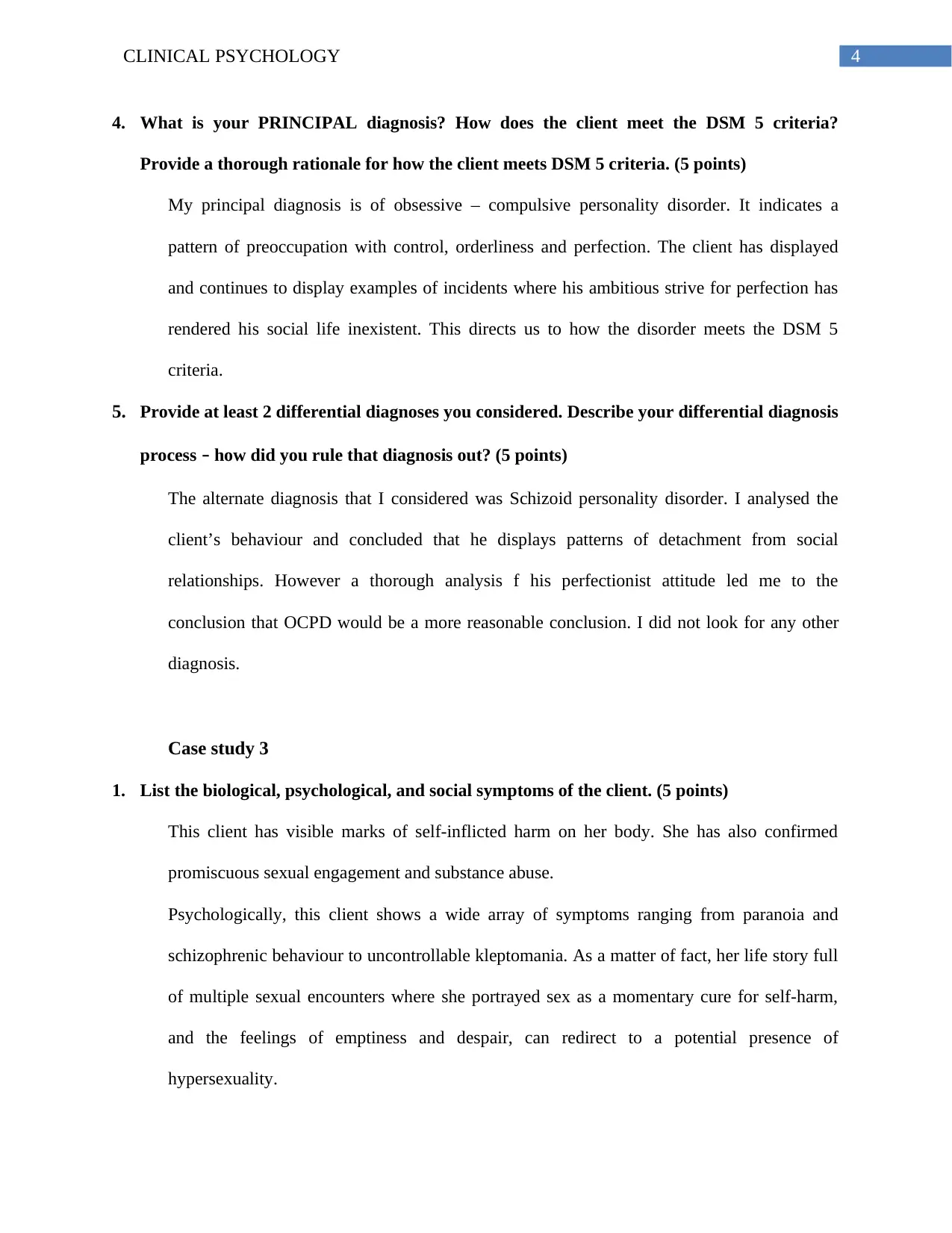
4. What is your PRINCIPAL diagnosis? How does the client meet the DSM 5 criteria?
Provide a thorough rationale for how the client meets DSM 5 criteria. (5 points)
My principal diagnosis is of obsessive – compulsive personality disorder. It indicates a
pattern of preoccupation with control, orderliness and perfection. The client has displayed
and continues to display examples of incidents where his ambitious strive for perfection has
rendered his social life inexistent. This directs us to how the disorder meets the DSM 5
criteria.
5. Provide at least 2 differential diagnoses you considered. Describe your differential diagnosis
process – how did you rule that diagnosis out? (5 points)
The alternate diagnosis that I considered was Schizoid personality disorder. I analysed the
client’s behaviour and concluded that he displays patterns of detachment from social
relationships. However a thorough analysis f his perfectionist attitude led me to the
conclusion that OCPD would be a more reasonable conclusion. I did not look for any other
diagnosis.
Case study 3
1. List the biological, psychological, and social symptoms of the client. (5 points)
This client has visible marks of self-inflicted harm on her body. She has also confirmed
promiscuous sexual engagement and substance abuse.
Psychologically, this client shows a wide array of symptoms ranging from paranoia and
schizophrenic behaviour to uncontrollable kleptomania. As a matter of fact, her life story full
of multiple sexual encounters where she portrayed sex as a momentary cure for self-harm,
and the feelings of emptiness and despair, can redirect to a potential presence of
hypersexuality.
4. What is your PRINCIPAL diagnosis? How does the client meet the DSM 5 criteria?
Provide a thorough rationale for how the client meets DSM 5 criteria. (5 points)
My principal diagnosis is of obsessive – compulsive personality disorder. It indicates a
pattern of preoccupation with control, orderliness and perfection. The client has displayed
and continues to display examples of incidents where his ambitious strive for perfection has
rendered his social life inexistent. This directs us to how the disorder meets the DSM 5
criteria.
5. Provide at least 2 differential diagnoses you considered. Describe your differential diagnosis
process – how did you rule that diagnosis out? (5 points)
The alternate diagnosis that I considered was Schizoid personality disorder. I analysed the
client’s behaviour and concluded that he displays patterns of detachment from social
relationships. However a thorough analysis f his perfectionist attitude led me to the
conclusion that OCPD would be a more reasonable conclusion. I did not look for any other
diagnosis.
Case study 3
1. List the biological, psychological, and social symptoms of the client. (5 points)
This client has visible marks of self-inflicted harm on her body. She has also confirmed
promiscuous sexual engagement and substance abuse.
Psychologically, this client shows a wide array of symptoms ranging from paranoia and
schizophrenic behaviour to uncontrollable kleptomania. As a matter of fact, her life story full
of multiple sexual encounters where she portrayed sex as a momentary cure for self-harm,
and the feelings of emptiness and despair, can redirect to a potential presence of
hypersexuality.

5CLINICAL PSYCHOLOGY
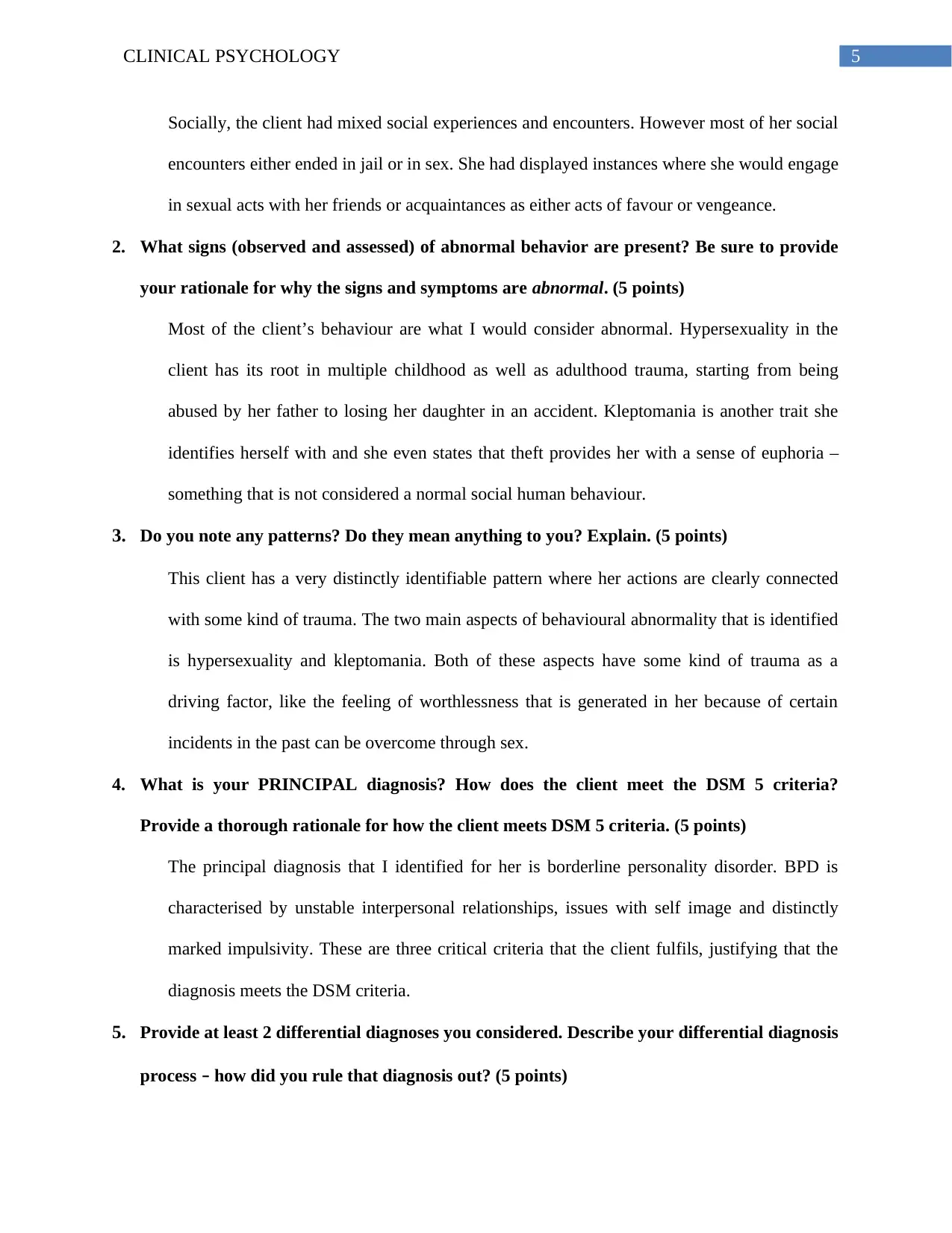
Socially, the client had mixed social experiences and encounters. However most of her social
encounters either ended in jail or in sex. She had displayed instances where she would engage
in sexual acts with her friends or acquaintances as either acts of favour or vengeance.
2. What signs (observed and assessed) of abnormal behavior are present? Be sure to provide
your rationale for why the signs and symptoms are abnormal. (5 points)
Most of the client’s behaviour are what I would consider abnormal. Hypersexuality in the
client has its root in multiple childhood as well as adulthood trauma, starting from being
abused by her father to losing her daughter in an accident. Kleptomania is another trait she
identifies herself with and she even states that theft provides her with a sense of euphoria –
something that is not considered a normal social human behaviour.
3. Do you note any patterns? Do they mean anything to you? Explain. (5 points)
This client has a very distinctly identifiable pattern where her actions are clearly connected
with some kind of trauma. The two main aspects of behavioural abnormality that is identified
is hypersexuality and kleptomania. Both of these aspects have some kind of trauma as a
driving factor, like the feeling of worthlessness that is generated in her because of certain
incidents in the past can be overcome through sex.
4. What is your PRINCIPAL diagnosis? How does the client meet the DSM 5 criteria?
Provide a thorough rationale for how the client meets DSM 5 criteria. (5 points)
The principal diagnosis that I identified for her is borderline personality disorder. BPD is
characterised by unstable interpersonal relationships, issues with self image and distinctly
marked impulsivity. These are three critical criteria that the client fulfils, justifying that the
diagnosis meets the DSM criteria.
5. Provide at least 2 differential diagnoses you considered. Describe your differential diagnosis
process – how did you rule that diagnosis out? (5 points)
Socially, the client had mixed social experiences and encounters. However most of her social
encounters either ended in jail or in sex. She had displayed instances where she would engage
in sexual acts with her friends or acquaintances as either acts of favour or vengeance.
2. What signs (observed and assessed) of abnormal behavior are present? Be sure to provide
your rationale for why the signs and symptoms are abnormal. (5 points)
Most of the client’s behaviour are what I would consider abnormal. Hypersexuality in the
client has its root in multiple childhood as well as adulthood trauma, starting from being
abused by her father to losing her daughter in an accident. Kleptomania is another trait she
identifies herself with and she even states that theft provides her with a sense of euphoria –
something that is not considered a normal social human behaviour.
3. Do you note any patterns? Do they mean anything to you? Explain. (5 points)
This client has a very distinctly identifiable pattern where her actions are clearly connected
with some kind of trauma. The two main aspects of behavioural abnormality that is identified
is hypersexuality and kleptomania. Both of these aspects have some kind of trauma as a
driving factor, like the feeling of worthlessness that is generated in her because of certain
incidents in the past can be overcome through sex.
4. What is your PRINCIPAL diagnosis? How does the client meet the DSM 5 criteria?
Provide a thorough rationale for how the client meets DSM 5 criteria. (5 points)
The principal diagnosis that I identified for her is borderline personality disorder. BPD is
characterised by unstable interpersonal relationships, issues with self image and distinctly
marked impulsivity. These are three critical criteria that the client fulfils, justifying that the
diagnosis meets the DSM criteria.
5. Provide at least 2 differential diagnoses you considered. Describe your differential diagnosis
process – how did you rule that diagnosis out? (5 points)
⊘ This is a preview!⊘
Do you want full access?
Subscribe today to unlock all pages.

Trusted by 1+ million students worldwide

6CLINICAL PSYCHOLOGY
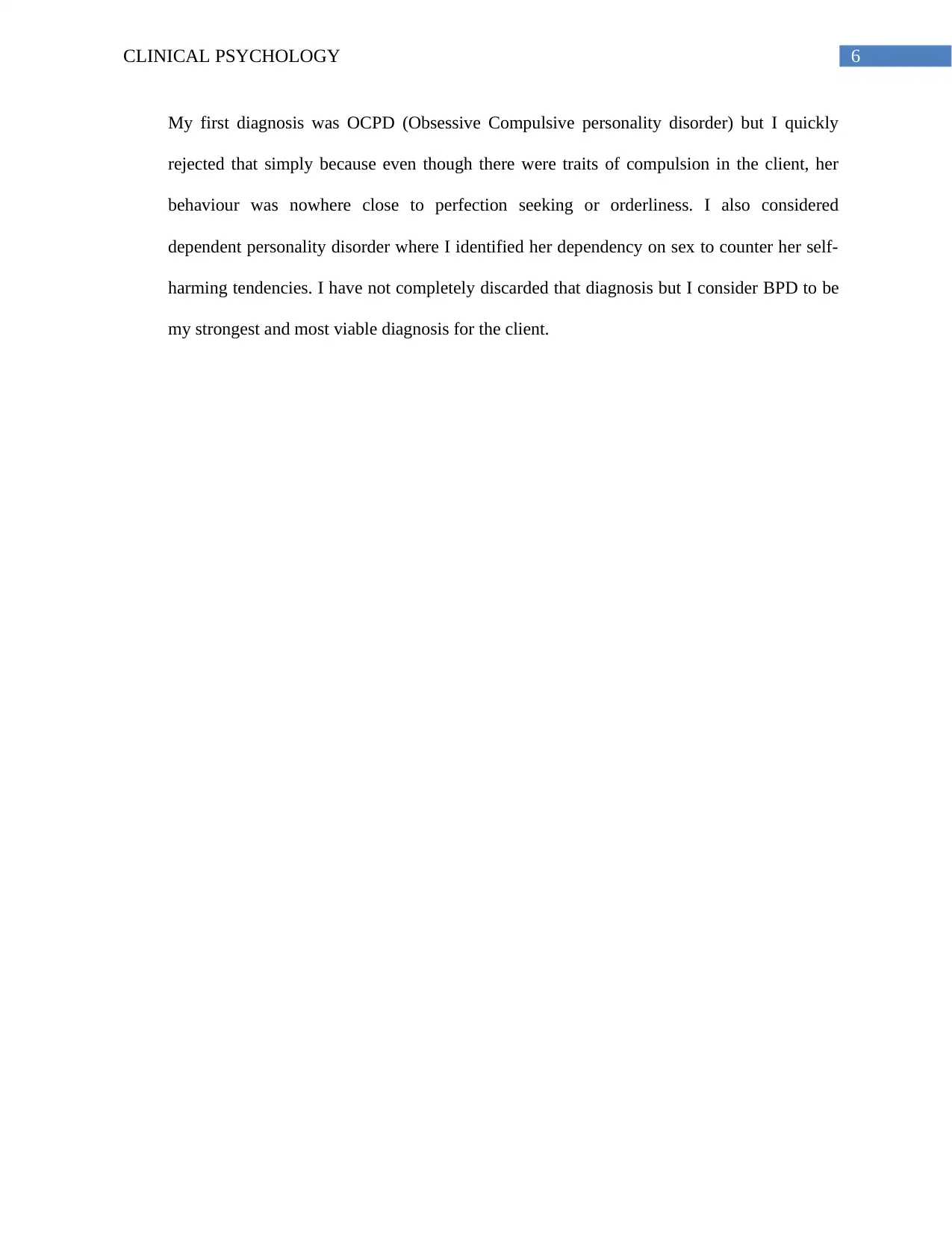
My first diagnosis was OCPD (Obsessive Compulsive personality disorder) but I quickly
rejected that simply because even though there were traits of compulsion in the client, her
behaviour was nowhere close to perfection seeking or orderliness. I also considered
dependent personality disorder where I identified her dependency on sex to counter her self-
harming tendencies. I have not completely discarded that diagnosis but I consider BPD to be
my strongest and most viable diagnosis for the client.
My first diagnosis was OCPD (Obsessive Compulsive personality disorder) but I quickly
rejected that simply because even though there were traits of compulsion in the client, her
behaviour was nowhere close to perfection seeking or orderliness. I also considered
dependent personality disorder where I identified her dependency on sex to counter her self-
harming tendencies. I have not completely discarded that diagnosis but I consider BPD to be
my strongest and most viable diagnosis for the client.
1 out of 7
Related Documents
Your All-in-One AI-Powered Toolkit for Academic Success.
+13062052269
info@desklib.com
Available 24*7 on WhatsApp / Email
Unlock your academic potential
Copyright © 2020–2026 A2Z Services. All Rights Reserved. Developed and managed by ZUCOL.