Combination Syndrome: Prosthetics Management in Anterior Maxilla
VerifiedAdded on 2023/06/10
|9
|1685
|428
Report
AI Summary
This report provides a comprehensive overview of Combination Syndrome, a set of complications affecting individuals with a completely edentulous maxilla and a partially edentulous mandible. The report explores the sequential progression of these complications, including bone loss, overgrowth of tuberosities, papillary hyperplasia, and extrusion of lower anterior teeth. It highlights the importance of prosthetics in managing the syndrome, focusing on the development of occlusal schemes to reduce excessive pressure in the maxillary anterior regions. The research aims to investigate the effects of prosthetics in managing Combination Syndrome in the anterior maxilla. The literature review examines relevant factors such as patient history, radiological evaluations, and the impact of prosthetic implants. The methodology involves secondary research using databases like Google Scholar and PubMed to gather data from articles published within the last 12 years, with thematic analysis to identify solutions to the research questions. The timeline outlines the stages of the study, from conducting searches to the final presentation of results. References to key research papers are provided.
Running head: COMBINATION SYNDROME
Combination Syndrome
Name of the student
University name
Author’s note
Combination Syndrome
Name of the student
University name
Author’s note

Paraphrase This Document
Need a fresh take? Get an instant paraphrase of this document with our AI Paraphraser
1
COMBINATION SYNDROME
Table of Contents
Proposal:.....................................................................................................................................2
Introduction................................................................................................................................2
Literature review........................................................................................................................3
Methodology..............................................................................................................................4
Timeline.....................................................................................................................................5
References..................................................................................................................................7
COMBINATION SYNDROME
Table of Contents
Proposal:.....................................................................................................................................2
Introduction................................................................................................................................2
Literature review........................................................................................................................3
Methodology..............................................................................................................................4
Timeline.....................................................................................................................................5
References..................................................................................................................................7
2
COMBINATION SYNDROME
Proposal:
Introduction
Combination syndrome refers to a group of complications which are noted in a person
with a completely edentulous maxilla and partially edentulous mandible. The complications
are linked to one another and progress in a sequential manner. Some of the clinical features
which have been noted in combination syndrome are- loss of bone from anterior part of
maxillary ridge, over growth of tuberosities, papilliary hyperplasia in the hard palate, loss of
bone under partial denture base and extrusion of lower anterior teeth.
The complications arise as the patients concentrate most of the pressure from the
basic activities such as eating and chewing on the remaining set of tooth rather than
prosthetically settled teeth. This leads to increased resorption of the anterior part of the
maxilla, which later gets replaced by flabby tissue. The occlusal plane gets tilted anterior
upwards and posterior downwards. One of the prime objectives behind the treatment methods
for compartment syndrome are to develop an occlusal scheme, which discourages build up of
excess occlusal pressure in the maxilliary anterior regions in both centric and eccentric
positions. The treatment methods followed and implemented over here mainly aimed to
reduce the extent of the destructive changes. However, there have been different views
regarding the benefits of the mandibular implants over the maxillary implants.
Research aim
The research aims to find out the effects of prosthetics in the management of combination
syndrome in anterior of maxilla
COMBINATION SYNDROME
Proposal:
Introduction
Combination syndrome refers to a group of complications which are noted in a person
with a completely edentulous maxilla and partially edentulous mandible. The complications
are linked to one another and progress in a sequential manner. Some of the clinical features
which have been noted in combination syndrome are- loss of bone from anterior part of
maxillary ridge, over growth of tuberosities, papilliary hyperplasia in the hard palate, loss of
bone under partial denture base and extrusion of lower anterior teeth.
The complications arise as the patients concentrate most of the pressure from the
basic activities such as eating and chewing on the remaining set of tooth rather than
prosthetically settled teeth. This leads to increased resorption of the anterior part of the
maxilla, which later gets replaced by flabby tissue. The occlusal plane gets tilted anterior
upwards and posterior downwards. One of the prime objectives behind the treatment methods
for compartment syndrome are to develop an occlusal scheme, which discourages build up of
excess occlusal pressure in the maxilliary anterior regions in both centric and eccentric
positions. The treatment methods followed and implemented over here mainly aimed to
reduce the extent of the destructive changes. However, there have been different views
regarding the benefits of the mandibular implants over the maxillary implants.
Research aim
The research aims to find out the effects of prosthetics in the management of combination
syndrome in anterior of maxilla
⊘ This is a preview!⊘
Do you want full access?
Subscribe today to unlock all pages.

Trusted by 1+ million students worldwide
3
COMBINATION SYNDROME
Research objectives
To reduce the effect of destructive changes due to combination syndrome
To analyse the effect of prosthetics in management of combination syndrome
To deduce the effect of combination syndrome on normal eating and chewing
activities
The above stated research objectives have been analysed through the paper and developed
into a research question:
How could prosthetics manage combination syndrome in anterior of maxilla?
Literature review
The current study focuses upon the aspect of compartment syndrome where a set of
destructive change are seen to progress in a sequential manner which causes discomfort as
well as bring about considerable changes within the maxillofacial structure of an individual.
The compartment syndrome is most often seen in the anterior portion of the maxilla. It could
be best managed with prosthetics. As argued by Carlino et al. (2014), a number of factors
need to be taken into consideration over here such as the past medical history of the patient,
radiological evaluation of both soft and hard tissues, evaluation of susceptibility of patients
to infection caused by prosthodontic implants. As mentioned by Panahi et al. (2014), for the
purpose of the prosthodontic implants a number of primary conditions needs to be taken
into consideration such as flabby tissue, papillary hyperplasia, enlarged tuberosities etc.
Occurrence of combination syndrome
The combination syndrome is more common in patients with a completely edentulous
maxilla which is opposed by a bilateral distal extension removable partial denture. Some of
these conditions make prosthetic treatment more difficult. As reported by Ogino et al.
COMBINATION SYNDROME
Research objectives
To reduce the effect of destructive changes due to combination syndrome
To analyse the effect of prosthetics in management of combination syndrome
To deduce the effect of combination syndrome on normal eating and chewing
activities
The above stated research objectives have been analysed through the paper and developed
into a research question:
How could prosthetics manage combination syndrome in anterior of maxilla?
Literature review
The current study focuses upon the aspect of compartment syndrome where a set of
destructive change are seen to progress in a sequential manner which causes discomfort as
well as bring about considerable changes within the maxillofacial structure of an individual.
The compartment syndrome is most often seen in the anterior portion of the maxilla. It could
be best managed with prosthetics. As argued by Carlino et al. (2014), a number of factors
need to be taken into consideration over here such as the past medical history of the patient,
radiological evaluation of both soft and hard tissues, evaluation of susceptibility of patients
to infection caused by prosthodontic implants. As mentioned by Panahi et al. (2014), for the
purpose of the prosthodontic implants a number of primary conditions needs to be taken
into consideration such as flabby tissue, papillary hyperplasia, enlarged tuberosities etc.
Occurrence of combination syndrome
The combination syndrome is more common in patients with a completely edentulous
maxilla which is opposed by a bilateral distal extension removable partial denture. Some of
these conditions make prosthetic treatment more difficult. As reported by Ogino et al.
Paraphrase This Document
Need a fresh take? Get an instant paraphrase of this document with our AI Paraphraser
4
COMBINATION SYNDROME
(2015), combination syndrome has a prevalence rate of 24% for the denture patients. Some
of the features which are observed over here are increased pressure on the premaxillary
alveolar ridge and loss of adequate posterior occlusal contacts. Some of the recent techniques
such as the mucostatic impression technique with relief at the anterior maxillary flabby tissue
had been applied for recording of the entire functional denture bearing area. As mentioned by
Eerdekens et al. (2015), for better distribution of occlusal force anterior contacts could be
eliminated along with use of remounting techniques.
Pressure settlement in combination syndrome
The changes in the combination syndrome are interrelated as bone resorption beneath
mandibular bilateral distal extension bases is usually the first step of the cycle of change. The
loss of mandibular posterior support results in increase in anterior occlusal load (Sadowsky et
al. 2015). The resorption of the mandible tissues could result in various degrees of
redundancy, which could make the provision of prosthetics surgery difficult. The negative
pressure may promote overgrowth of the fibrous tuberosities. As mentioned by Monteiro et
al. (2015), the problems still lies with the rate of resorption of residual alveolar ridge and
prevention of changes brought about in the secondary bone structure due to bone loss. As
reported by De Bruyn et al. (2014), some of the underlying hormonal, metabolic and
nutritional factors have been seen to contribute majorly in this regard. It has been seen that
eating right and supplementing oneself with the right nutrients can remove or reduce the
chances of papilliary hyperplasia within the patients.
Methodology
In order to gather sufficient knowledge based upon the above topic of combination
syndrome a secondary research had been undertaken where data has been collected from a
number of articles and journals. Some of these have been collected through secondary
COMBINATION SYNDROME
(2015), combination syndrome has a prevalence rate of 24% for the denture patients. Some
of the features which are observed over here are increased pressure on the premaxillary
alveolar ridge and loss of adequate posterior occlusal contacts. Some of the recent techniques
such as the mucostatic impression technique with relief at the anterior maxillary flabby tissue
had been applied for recording of the entire functional denture bearing area. As mentioned by
Eerdekens et al. (2015), for better distribution of occlusal force anterior contacts could be
eliminated along with use of remounting techniques.
Pressure settlement in combination syndrome
The changes in the combination syndrome are interrelated as bone resorption beneath
mandibular bilateral distal extension bases is usually the first step of the cycle of change. The
loss of mandibular posterior support results in increase in anterior occlusal load (Sadowsky et
al. 2015). The resorption of the mandible tissues could result in various degrees of
redundancy, which could make the provision of prosthetics surgery difficult. The negative
pressure may promote overgrowth of the fibrous tuberosities. As mentioned by Monteiro et
al. (2015), the problems still lies with the rate of resorption of residual alveolar ridge and
prevention of changes brought about in the secondary bone structure due to bone loss. As
reported by De Bruyn et al. (2014), some of the underlying hormonal, metabolic and
nutritional factors have been seen to contribute majorly in this regard. It has been seen that
eating right and supplementing oneself with the right nutrients can remove or reduce the
chances of papilliary hyperplasia within the patients.
Methodology
In order to gather sufficient knowledge based upon the above topic of combination
syndrome a secondary research had been undertaken where data has been collected from a
number of articles and journals. Some of these have been collected through secondary
5
COMBINATION SYNDROME
databases such as google scholar, pubmed, NCBI etc. The data collected have been evaluated
for the identification of similar and dissimilar ideas which have been further used for
conducting a thematic analysis.
For the gathering and collection of relevant data an effective search criteria will be
applied. In this respect, different combination of keywords will be applied for sorting and
identification of the articles. Some of these are ‘combination syndrome’, ‘combination
syndrome in anterior of maxilla’, ‘use of prosthetics in combination syndrome’. The searches
generated apart from the keywords used above will be neglected by the researcher.
Additionally, the articles which have been published within the last 12 years will only be
taken into consideration. In this respect, the articles which have been printed in English only
will be taken into consideration. The rest which have been printed in any other vernacular
language will be eliminated. The journal articles will be used by the researcher for the
formation of particular themes. The themes will be further analysed for finding out the
solution to the research problem. These will be analysed in accordance with the research
questions. Additionally, the research objectives will be used for the development of effective
themes.
In this respect, a number of ethical factors will be taken into consideration. The
researcher will use proper citation for the journal articles as it will give the researcher his
due credit. The researcher need to ensure that no journal articles should be used without
proper citation as pivotal information revealed without proper citation will be considered
a breach of academic integrity.
COMBINATION SYNDROME
databases such as google scholar, pubmed, NCBI etc. The data collected have been evaluated
for the identification of similar and dissimilar ideas which have been further used for
conducting a thematic analysis.
For the gathering and collection of relevant data an effective search criteria will be
applied. In this respect, different combination of keywords will be applied for sorting and
identification of the articles. Some of these are ‘combination syndrome’, ‘combination
syndrome in anterior of maxilla’, ‘use of prosthetics in combination syndrome’. The searches
generated apart from the keywords used above will be neglected by the researcher.
Additionally, the articles which have been published within the last 12 years will only be
taken into consideration. In this respect, the articles which have been printed in English only
will be taken into consideration. The rest which have been printed in any other vernacular
language will be eliminated. The journal articles will be used by the researcher for the
formation of particular themes. The themes will be further analysed for finding out the
solution to the research problem. These will be analysed in accordance with the research
questions. Additionally, the research objectives will be used for the development of effective
themes.
In this respect, a number of ethical factors will be taken into consideration. The
researcher will use proper citation for the journal articles as it will give the researcher his
due credit. The researcher need to ensure that no journal articles should be used without
proper citation as pivotal information revealed without proper citation will be considered
a breach of academic integrity.
⊘ This is a preview!⊘
Do you want full access?
Subscribe today to unlock all pages.
Trusted by 1+ million students worldwide
6
COMBINATION SYNDROME
Timeline
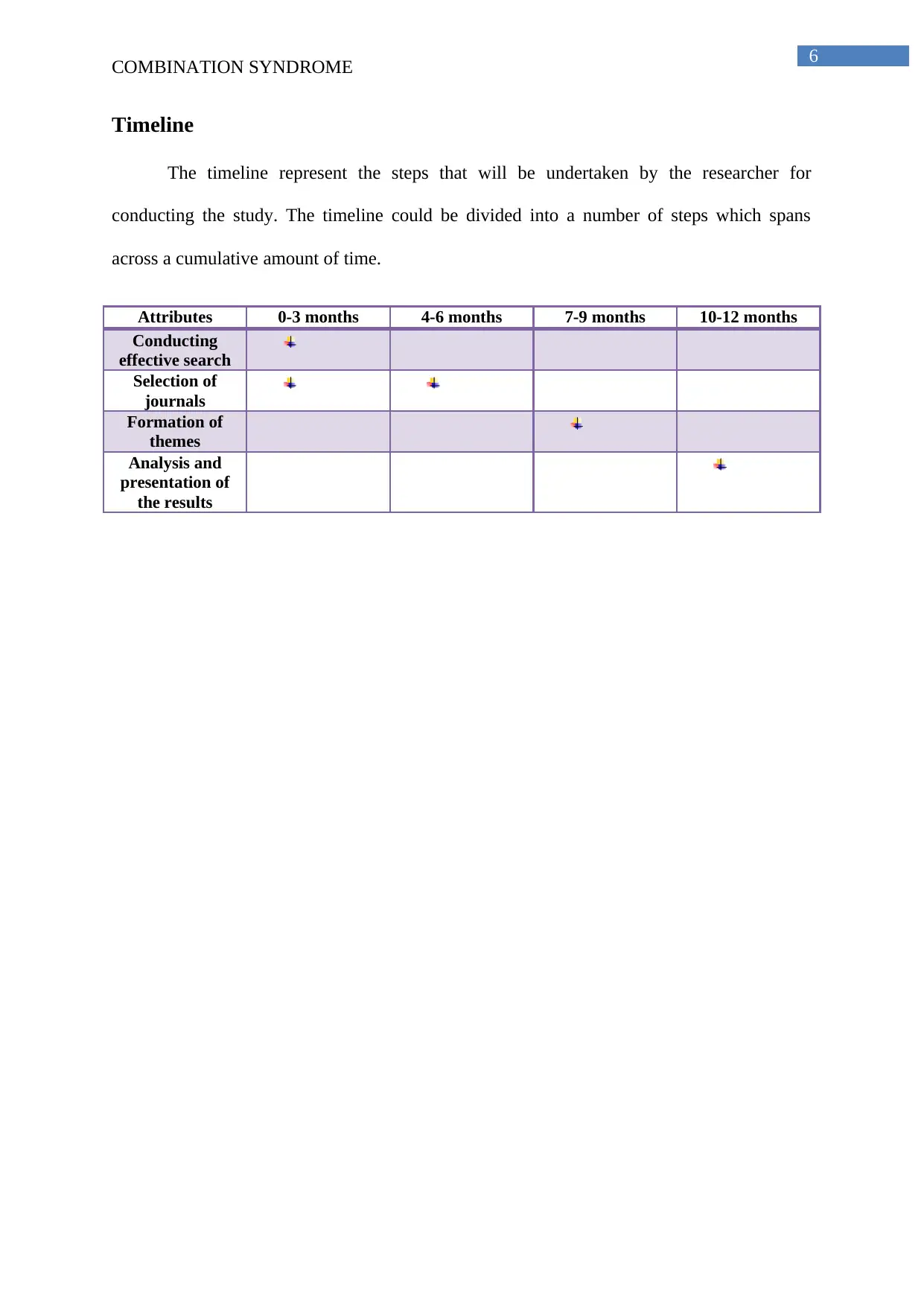
The timeline represent the steps that will be undertaken by the researcher for
conducting the study. The timeline could be divided into a number of steps which spans
across a cumulative amount of time.
Attributes 0-3 months 4-6 months 7-9 months 10-12 months
Conducting
effective search
Selection of
journals
Formation of
themes
Analysis and
presentation of
the results
COMBINATION SYNDROME
Timeline
The timeline represent the steps that will be undertaken by the researcher for
conducting the study. The timeline could be divided into a number of steps which spans
across a cumulative amount of time.
Attributes 0-3 months 4-6 months 7-9 months 10-12 months
Conducting
effective search
Selection of
journals
Formation of
themes
Analysis and
presentation of
the results
Paraphrase This Document
Need a fresh take? Get an instant paraphrase of this document with our AI Paraphraser
7
COMBINATION SYNDROME
References
Carlino, P., Pettini, F., Cantore, S., Ballini, A., Grassi, F.R. and Pepe, V., 2014. Surgical and
prosthetic rehabilitation of combination syndrome. Case reports in dentistry, 2014.
De Bruyn, H., Raes, S., Östman, P.O. and Cosyn, J., 2014. Immediate loading in partially and
completely edentulous jaws: a review of the literature with clinical
guidelines. Periodontology 2000, 66(1), pp.153-187.
Eerdekens, L., Schols, M., Coelst, L., Quirynen, M. and Naert, I., 2015. A 5‐year prospective
study on cone‐anchored implants in the edentulous maxilla. Clinical implant dentistry and
related research, 17, pp.e621-e632.
Jokstad, A., Gussgard, A.M., Fava, J., Lin, M., Shokati, B., Somogyi-Ganss, E., Winnett, B.
and Zahran, M., 2017. Benchmarking Outcomes in Implant Prosthodontics: Partial Fixed
Dental Prostheses and Crowns Supported by Implants with a Turned Surface over 10 to 28
Years at the University of Toronto. International Journal of Oral & Maxillofacial
Implants, 32(4).
Monteiro, D.R., Silva, E.V., Pellizzer, E.P., Magro Filho, O. and Goiato, M.C., 2015.
Posterior partially edentulous jaws, planning a rehabilitation with dental implants. World
Journal of Clinical Cases: WJCC, 3(1), p.65.
Ogino, Y., Kihara, M., Yamada, J., Toriya, K. and Koyano, K., 2015. Implant treatments for
edentulous maxilla with anterior hyperfunction. Journal of Oral Implantology, 41(6), pp.731-
735.
Panahi, Y., Hosseini, M.S., Khalili, N., Naimi, E., Majeed, M. and Sahebkar, A., 2015.
Antioxidant and anti-inflammatory effects of curcuminoid-piperine combination in subjects
COMBINATION SYNDROME
References
Carlino, P., Pettini, F., Cantore, S., Ballini, A., Grassi, F.R. and Pepe, V., 2014. Surgical and
prosthetic rehabilitation of combination syndrome. Case reports in dentistry, 2014.
De Bruyn, H., Raes, S., Östman, P.O. and Cosyn, J., 2014. Immediate loading in partially and
completely edentulous jaws: a review of the literature with clinical
guidelines. Periodontology 2000, 66(1), pp.153-187.
Eerdekens, L., Schols, M., Coelst, L., Quirynen, M. and Naert, I., 2015. A 5‐year prospective
study on cone‐anchored implants in the edentulous maxilla. Clinical implant dentistry and
related research, 17, pp.e621-e632.
Jokstad, A., Gussgard, A.M., Fava, J., Lin, M., Shokati, B., Somogyi-Ganss, E., Winnett, B.
and Zahran, M., 2017. Benchmarking Outcomes in Implant Prosthodontics: Partial Fixed
Dental Prostheses and Crowns Supported by Implants with a Turned Surface over 10 to 28
Years at the University of Toronto. International Journal of Oral & Maxillofacial
Implants, 32(4).
Monteiro, D.R., Silva, E.V., Pellizzer, E.P., Magro Filho, O. and Goiato, M.C., 2015.
Posterior partially edentulous jaws, planning a rehabilitation with dental implants. World
Journal of Clinical Cases: WJCC, 3(1), p.65.
Ogino, Y., Kihara, M., Yamada, J., Toriya, K. and Koyano, K., 2015. Implant treatments for
edentulous maxilla with anterior hyperfunction. Journal of Oral Implantology, 41(6), pp.731-
735.
Panahi, Y., Hosseini, M.S., Khalili, N., Naimi, E., Majeed, M. and Sahebkar, A., 2015.
Antioxidant and anti-inflammatory effects of curcuminoid-piperine combination in subjects

8
COMBINATION SYNDROME
with metabolic syndrome: a randomized controlled trial and an updated meta-
analysis. Clinical nutrition, 34(6), pp.1101-1108.
Sadowsky, S.J., Fitzpatrick, B. and Curtis, D.A., 2015. Evidence‐Based Criteria for
Differential Treatment Planning of Implant Restorations for the Maxillary Edentulous
Patient. Journal of prosthodontics, 24(6), pp.433-446.
COMBINATION SYNDROME
with metabolic syndrome: a randomized controlled trial and an updated meta-
analysis. Clinical nutrition, 34(6), pp.1101-1108.
Sadowsky, S.J., Fitzpatrick, B. and Curtis, D.A., 2015. Evidence‐Based Criteria for
Differential Treatment Planning of Implant Restorations for the Maxillary Edentulous
Patient. Journal of prosthodontics, 24(6), pp.433-446.
⊘ This is a preview!⊘
Do you want full access?
Subscribe today to unlock all pages.
Trusted by 1+ million students worldwide

1 out of 9


Your All-in-One AI-Powered Toolkit for Academic Success.
+13062052269
info@desklib.com
Available 24*7 on WhatsApp / Email
![[object Object]](/_next/static/media/star-bottom.7253800d.svg)
Unlock your academic potential
Copyright © 2020–2025 A2Z Services. All Rights Reserved. Developed and managed by ZUCOL.