Communication in Health and Social Care: Theories, Barriers & ICT Use
VerifiedAdded on 2023/06/05
|9
|2742
|271
Report
AI Summary
This report provides a comprehensive overview of communication in health and social care, comparing humanistic and cognitive theoretical approaches. It identifies main types of communication, barriers, and alternative methods for users with special requirements, emphasizing confidentiality and the Caldicott Principles. The report discusses the benefits of ICT for both service users and practitioners, explaining the Data Protection Act and its application in health and social care. It explores verbal and non-verbal communication, the importance of active listening, and the use of aided and unaided communication systems to overcome communication challenges. This analysis highlights the critical role of effective communication and data protection in enhancing healthcare services.
Communicating in Health and
Social Care
Social Care

Paraphrase This Document
Need a fresh take? Get an instant paraphrase of this document with our AI Paraphraser
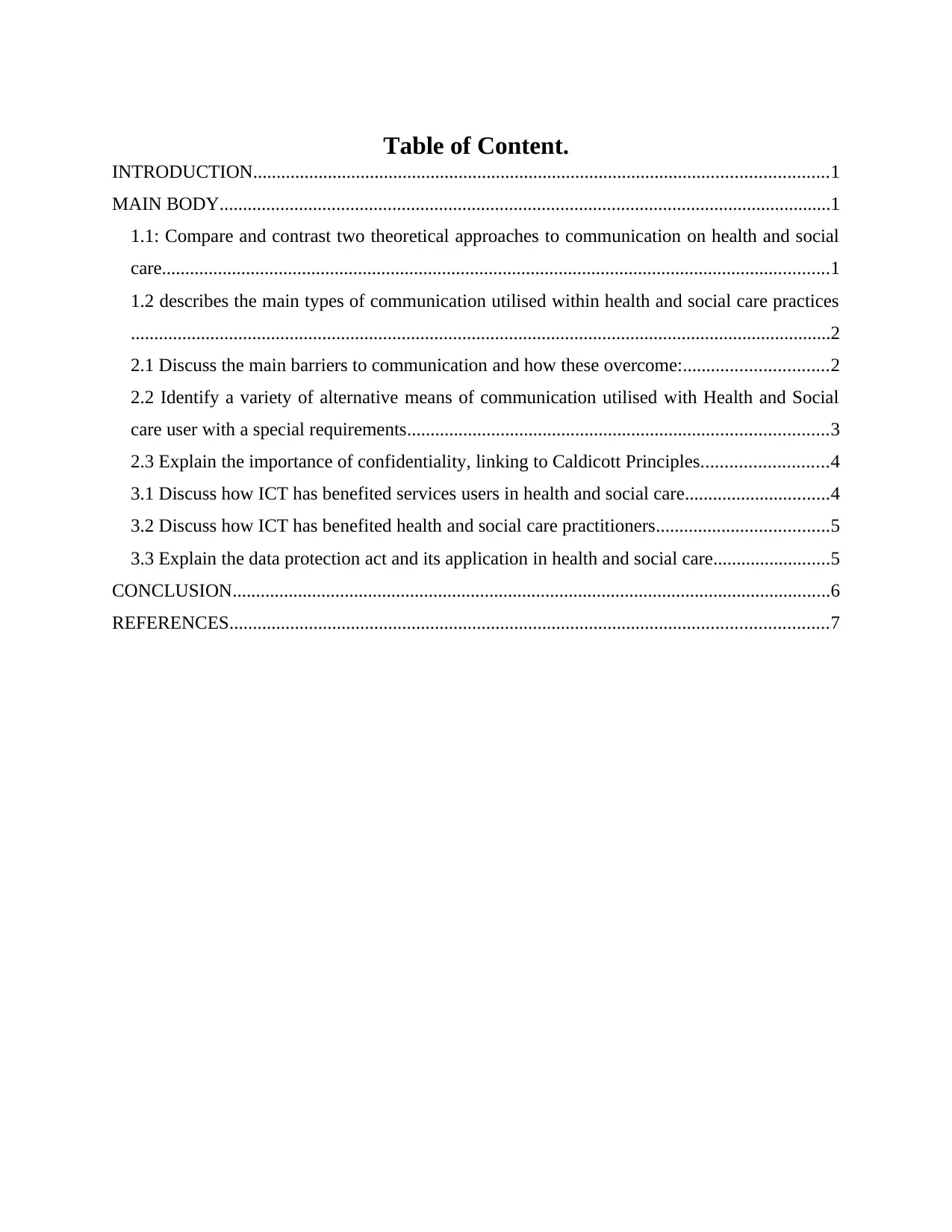
Table of Content.
INTRODUCTION...........................................................................................................................1
MAIN BODY...................................................................................................................................1
1.1: Compare and contrast two theoretical approaches to communication on health and social
care...............................................................................................................................................1
1.2 describes the main types of communication utilised within health and social care practices
......................................................................................................................................................2
2.1 Discuss the main barriers to communication and how these overcome:...............................2
2.2 Identify a variety of alternative means of communication utilised with Health and Social
care user with a special requirements..........................................................................................3
2.3 Explain the importance of confidentiality, linking to Caldicott Principles...........................4
3.1 Discuss how ICT has benefited services users in health and social care...............................4
3.2 Discuss how ICT has benefited health and social care practitioners.....................................5
3.3 Explain the data protection act and its application in health and social care.........................5
CONCLUSION................................................................................................................................6
REFERENCES................................................................................................................................7
INTRODUCTION...........................................................................................................................1
MAIN BODY...................................................................................................................................1
1.1: Compare and contrast two theoretical approaches to communication on health and social
care...............................................................................................................................................1
1.2 describes the main types of communication utilised within health and social care practices
......................................................................................................................................................2
2.1 Discuss the main barriers to communication and how these overcome:...............................2
2.2 Identify a variety of alternative means of communication utilised with Health and Social
care user with a special requirements..........................................................................................3
2.3 Explain the importance of confidentiality, linking to Caldicott Principles...........................4
3.1 Discuss how ICT has benefited services users in health and social care...............................4
3.2 Discuss how ICT has benefited health and social care practitioners.....................................5
3.3 Explain the data protection act and its application in health and social care.........................5
CONCLUSION................................................................................................................................6
REFERENCES................................................................................................................................7
INTRODUCTION
Care workers in health and social care are required to have the ability to empathize when
they are needed as well as talk about the potentially complicated procedure as well as issues
calmly. Good communication assists in the makes patients feel valued, and cared for and put
them at ease. These help to improve the care services and also build a good working
environment for carers. These also build more transparency as well as openness which are
associated with the daily task environment. This project is considering the two theoretical
approaches which are associated with communication in health and social care. This also
includes the several aspects which affect the communication process in health and social care.
There are several benefits and challenges are presents which are associated with information and
communication technologies (Bajwah et. al., 2020).
MAIN BODY
1.1: Compare and contrast two theoretical approaches to communication in health and social care
The communication theories are gives a manner of talking about as well as analysing key
events, processes and commitments that together form communication. The communication
theories provide the tool to answer empirical, conceptual and practical communication questions.
Health and social care essentially need good communication skills to develop the relationship
between the care provider and service user. There are several theories are present which are
applied in health and social care. Abraham Maslow proposed some theories which include
humanistic, behaviourist, psychoanalytical, cognitive, biological and social (Bhatt and Bathija,
2018).
Humanistic theory: This theory is associated with the patients who need care and it
emphasizes individual choice as well as responsibilities. This theory adopts holistic
approaches that are aimed at human potential as well as self-discovery. This theory is
used to develop strength and a healthy sense of self, explore feelings, find meaning and
aimed at strengths. It is engaged with social skills, intellect, artistic skills, intellect, and
practical skills as well as more as part of their education.
Cognitive theory: The cognitive theory provides an agentic conceptual framework
within which to analyse the determinants as well as psychosocial mechanisms through
which symbolic communication influences human thought, affect as well as actions. The
1
Care workers in health and social care are required to have the ability to empathize when
they are needed as well as talk about the potentially complicated procedure as well as issues
calmly. Good communication assists in the makes patients feel valued, and cared for and put
them at ease. These help to improve the care services and also build a good working
environment for carers. These also build more transparency as well as openness which are
associated with the daily task environment. This project is considering the two theoretical
approaches which are associated with communication in health and social care. This also
includes the several aspects which affect the communication process in health and social care.
There are several benefits and challenges are presents which are associated with information and
communication technologies (Bajwah et. al., 2020).
MAIN BODY
1.1: Compare and contrast two theoretical approaches to communication in health and social care
The communication theories are gives a manner of talking about as well as analysing key
events, processes and commitments that together form communication. The communication
theories provide the tool to answer empirical, conceptual and practical communication questions.
Health and social care essentially need good communication skills to develop the relationship
between the care provider and service user. There are several theories are present which are
applied in health and social care. Abraham Maslow proposed some theories which include
humanistic, behaviourist, psychoanalytical, cognitive, biological and social (Bhatt and Bathija,
2018).
Humanistic theory: This theory is associated with the patients who need care and it
emphasizes individual choice as well as responsibilities. This theory adopts holistic
approaches that are aimed at human potential as well as self-discovery. This theory is
used to develop strength and a healthy sense of self, explore feelings, find meaning and
aimed at strengths. It is engaged with social skills, intellect, artistic skills, intellect, and
practical skills as well as more as part of their education.
Cognitive theory: The cognitive theory provides an agentic conceptual framework
within which to analyse the determinants as well as psychosocial mechanisms through
which symbolic communication influences human thought, affect as well as actions. The
1
⊘ This is a preview!⊘
Do you want full access?
Subscribe today to unlock all pages.

Trusted by 1+ million students worldwide
main aim of this theory is that thoughts are the primary determinant of emotions as well
as behaviours. This is also associated with the brain as well as the intelligence of patients
and this is related to the processing as well as storage of specific information (Hagen and
et. al., 2018).
1.2 describes the main types of communication utilized within health and social care practices
The care workers of health and social care use different types of communication at the
time of providing care to patients. There is considered verbal communication skills which are
used for talking and listening and non-verbal communication which is associated with touch, eye
contact and facial expression of the patients. These are plays a significant role for care workers
in providing care, giving and receiving information about the care that is being provided for
individuals and providing emotional support to the patients and their families (Chan and et. al.,
2018).
Verbal communication: Verbal communication is used for sharing information with
other people. These can be considered spoken as well as written communication. Verbal
communication skills are essential for giving responses to questions and find about the
problems and needs of patients. Provide support to others as well as deal with problems
and complaints.
Non-verbal communication: Non-verbal communication is associated with facial
expression, gestures, paralinguistic, personal space, body language, appearance and
artefacts. These all help in the identification of good care providers (Venkatesh and
Edirappuli, 2020).
2.1 Discuss the main barriers to communication and how these are overcome:
Effective communication plays a significant role in the maintenance of health care and
the needs of the individual about culture and language minorities. Culture is associated with the
collection of information, knowledge, rules, habits, attitudes, beliefs as well as costumes that
assist in identifying a group of people at a specific time. There are several barriers present in
communication which are explained as:
Beliefs: The patients may feel uncomfortable while communicating with other people
which are from other religions because of assumptions about the other's beliefs as well as
opinions.
2
as behaviours. This is also associated with the brain as well as the intelligence of patients
and this is related to the processing as well as storage of specific information (Hagen and
et. al., 2018).
1.2 describes the main types of communication utilized within health and social care practices
The care workers of health and social care use different types of communication at the
time of providing care to patients. There is considered verbal communication skills which are
used for talking and listening and non-verbal communication which is associated with touch, eye
contact and facial expression of the patients. These are plays a significant role for care workers
in providing care, giving and receiving information about the care that is being provided for
individuals and providing emotional support to the patients and their families (Chan and et. al.,
2018).
Verbal communication: Verbal communication is used for sharing information with
other people. These can be considered spoken as well as written communication. Verbal
communication skills are essential for giving responses to questions and find about the
problems and needs of patients. Provide support to others as well as deal with problems
and complaints.
Non-verbal communication: Non-verbal communication is associated with facial
expression, gestures, paralinguistic, personal space, body language, appearance and
artefacts. These all help in the identification of good care providers (Venkatesh and
Edirappuli, 2020).
2.1 Discuss the main barriers to communication and how these are overcome:
Effective communication plays a significant role in the maintenance of health care and
the needs of the individual about culture and language minorities. Culture is associated with the
collection of information, knowledge, rules, habits, attitudes, beliefs as well as costumes that
assist in identifying a group of people at a specific time. There are several barriers present in
communication which are explained as:
Beliefs: The patients may feel uncomfortable while communicating with other people
which are from other religions because of assumptions about the other's beliefs as well as
opinions.
2
Paraphrase This Document
Need a fresh take? Get an instant paraphrase of this document with our AI Paraphraser
Age: Age is a barrier due to contextual factors which are educational and labour
institutions as well as the assumption that older people have lost interest in learning and
have a lower learning capacity. These result in several sensory as well as cognitive
changes that impose limits on communication.
Sex: The care providers are giving special treatment to female patients. The female
patients do not feel comfortable communicating with the care providers.
Education: Education is a common barrier to effective communication and these are
associated with listening barriers, perception barriers, culture barriers and oral barriers.
There are also some barriers present which include the emotional barrier, differences in
perception and viewpoints, physical disabilities such as hearing and problems, physical barriers
to non-verbal communication and lack of attention, interest, distraction or irrelevance to the
receivers (McLoughlin and et. al., 2018).
These barriers are overcome by the skilled communicator and these are assisting in the
healthcare providers to be more sensitive to the challenges faced by their patients. The care
providers are also taking some steps to decrease or overcome barriers to increase the quality of
care. These can be overcome as:
Active listening is a skill that can be increased by practice. These assist in decreasing
distraction and prioritizing listening over speaking.
The care provider needs to check whether it is a good time as well as a place to
communicate with the individual.
The care provider is clear and uses suitable and understandable language the individual
understands.
These are needed to communicate one thing at a time and respect a patient's desire to not
communicate.
Checking that the patient has understood the care provider correctly and communicating
in a location that is free of distractions.
2.2 Identify a variety of alternative means of communication utilized with Health and Social care
user with special requirements
The alternative means of communication refers to the tools as well as strategies that are
used to overcome the communication challenges faced by patients who face difficulties using
3
institutions as well as the assumption that older people have lost interest in learning and
have a lower learning capacity. These result in several sensory as well as cognitive
changes that impose limits on communication.
Sex: The care providers are giving special treatment to female patients. The female
patients do not feel comfortable communicating with the care providers.
Education: Education is a common barrier to effective communication and these are
associated with listening barriers, perception barriers, culture barriers and oral barriers.
There are also some barriers present which include the emotional barrier, differences in
perception and viewpoints, physical disabilities such as hearing and problems, physical barriers
to non-verbal communication and lack of attention, interest, distraction or irrelevance to the
receivers (McLoughlin and et. al., 2018).
These barriers are overcome by the skilled communicator and these are assisting in the
healthcare providers to be more sensitive to the challenges faced by their patients. The care
providers are also taking some steps to decrease or overcome barriers to increase the quality of
care. These can be overcome as:
Active listening is a skill that can be increased by practice. These assist in decreasing
distraction and prioritizing listening over speaking.
The care provider needs to check whether it is a good time as well as a place to
communicate with the individual.
The care provider is clear and uses suitable and understandable language the individual
understands.
These are needed to communicate one thing at a time and respect a patient's desire to not
communicate.
Checking that the patient has understood the care provider correctly and communicating
in a location that is free of distractions.
2.2 Identify a variety of alternative means of communication utilized with Health and Social care
user with special requirements
The alternative means of communication refers to the tools as well as strategies that are
used to overcome the communication challenges faced by patients who face difficulties using
3
oral speech. There are two types of alternative communication systems which include the
unaided communication system as well an aided communication system.
Unaided communication system: This system includes the non-spoken means of natural
communication as well as mutual signs and American sign language. The modes of
communication are often needed equal to motor control and communication partners who can
understand the intended message.
Aided communication system: This system is included those approaches that are needed
some external support, such as communication boards with symbols. The aided communication
system requires the tool as well as equipment and includes some electronic communication aids
which assist the individual to create symbolic messages (Williams and et. al., 2018).
2.3 Explain the importance of confidentiality, linking to Caldicott Principles.
Confidentiality plays a significant role and it protects individual preferences and rights.
This is associated with the patient as well as a care provider having confidence that they can
share information and this is highly important to ensure they get the care they need. The
Caldicott Principles are the basic principles that the health and social care organization should
follow to protect any information that could identify patients which include their names and
other records. These also ensure that this information and data are only used and shared when it
is needed. There are seven principle of Caldicott principles which are mentioned as:
Justify the aim for using confidential information in the health and social care.
Do not use personal confidential data unless absolutely essential.
The duty to share information can be as significant as the duty to protect patient
confidentiality.
Understand as well as comply with the law.
Everyone with access to personal confidential data should be aware of their
responsibility.
Access to personal confidential data should be on a strict need-to-know basis.
Use the minimum essential personal confidential data.
3.1 Discuss how ICT has benefited services users in health and social care
Information and communication technologies are the infrastructure and components that
enable modern computing. It is used to develop, find, analyse and present information and to
model the condition as well as solve problems. There are several advantages if health support, as
4
unaided communication system as well an aided communication system.
Unaided communication system: This system includes the non-spoken means of natural
communication as well as mutual signs and American sign language. The modes of
communication are often needed equal to motor control and communication partners who can
understand the intended message.
Aided communication system: This system is included those approaches that are needed
some external support, such as communication boards with symbols. The aided communication
system requires the tool as well as equipment and includes some electronic communication aids
which assist the individual to create symbolic messages (Williams and et. al., 2018).
2.3 Explain the importance of confidentiality, linking to Caldicott Principles.
Confidentiality plays a significant role and it protects individual preferences and rights.
This is associated with the patient as well as a care provider having confidence that they can
share information and this is highly important to ensure they get the care they need. The
Caldicott Principles are the basic principles that the health and social care organization should
follow to protect any information that could identify patients which include their names and
other records. These also ensure that this information and data are only used and shared when it
is needed. There are seven principle of Caldicott principles which are mentioned as:
Justify the aim for using confidential information in the health and social care.
Do not use personal confidential data unless absolutely essential.
The duty to share information can be as significant as the duty to protect patient
confidentiality.
Understand as well as comply with the law.
Everyone with access to personal confidential data should be aware of their
responsibility.
Access to personal confidential data should be on a strict need-to-know basis.
Use the minimum essential personal confidential data.
3.1 Discuss how ICT has benefited services users in health and social care
Information and communication technologies are the infrastructure and components that
enable modern computing. It is used to develop, find, analyse and present information and to
model the condition as well as solve problems. There are several advantages if health support, as
4
⊘ This is a preview!⊘
Do you want full access?
Subscribe today to unlock all pages.
Trusted by 1+ million students worldwide
well as safety services, are very important for entrusting operative healthcare providers. These
have the advantages of the potential to promote patient-centred healthcare at a lower cost and
increase the quality of care and information sharing, encourage a new form of relationship
between patients and their care providers, educates the care providers and individual and
decrease the travel time (Odendaal and et. al., 2020).
These are also improving the coordination which has been aimed at healthcare for some
time and it is significantly increasing the services being provided and bringing behavioural
changes. These technologies help to care providers, hospitals, healthcare professionals and the
general public in improving their services. This also facilitates the E-Health services possible. It
also increases the effectiveness and increases the capabilities to reallocate expenditure on health
as well as social care services rendering it to be cost and time effective.
3.2 Discuss how ICT has benefited the health and social care practitioners
Information and communication technologies are based on the development of digital
technologies, databases as well as applications that are used to prevent illness, treatment of
disease, and manage chronic illness. These are also increasing the healthcare for patients and
communities and also give the ability for system efficacy and decrease the medical errors. The
ICT allows for control of the care and provides interdisciplinary clinical support and increases
knowledge and support. These help to increase the quality of care and data sharing between the
healthcare workers and also monitor the public health threat. These are increasing the health and
safety environment for caretakers and patients. Healthcare practitioners constitute the largest
health providers and these represent a significant target for the ICT implementation process. This
promotes patient-centred healthcare at a lower cost, increasing the quality of care and
information sharing (Ceross, 2018).
3.3 Explain the data protection act and its application in health and social care
The Data protection act 2018 is associated with the control of the personal information or
data used by the organization, business or government. These help people and organizations
from holding as well as using accurate as well as appropriate information on patients. The data
protection act is applied to information regarding both private lives and business. The data
protection act is the UK's implementation of the General Data Protection Regulation. It protects
the personal data of patients and lays down rules about the uses of the information. The GDPR is
is gives the seven principles for the lawful processing of personal knowledge and data. The
5
have the advantages of the potential to promote patient-centred healthcare at a lower cost and
increase the quality of care and information sharing, encourage a new form of relationship
between patients and their care providers, educates the care providers and individual and
decrease the travel time (Odendaal and et. al., 2020).
These are also improving the coordination which has been aimed at healthcare for some
time and it is significantly increasing the services being provided and bringing behavioural
changes. These technologies help to care providers, hospitals, healthcare professionals and the
general public in improving their services. This also facilitates the E-Health services possible. It
also increases the effectiveness and increases the capabilities to reallocate expenditure on health
as well as social care services rendering it to be cost and time effective.
3.2 Discuss how ICT has benefited the health and social care practitioners
Information and communication technologies are based on the development of digital
technologies, databases as well as applications that are used to prevent illness, treatment of
disease, and manage chronic illness. These are also increasing the healthcare for patients and
communities and also give the ability for system efficacy and decrease the medical errors. The
ICT allows for control of the care and provides interdisciplinary clinical support and increases
knowledge and support. These help to increase the quality of care and data sharing between the
healthcare workers and also monitor the public health threat. These are increasing the health and
safety environment for caretakers and patients. Healthcare practitioners constitute the largest
health providers and these represent a significant target for the ICT implementation process. This
promotes patient-centred healthcare at a lower cost, increasing the quality of care and
information sharing (Ceross, 2018).
3.3 Explain the data protection act and its application in health and social care
The Data protection act 2018 is associated with the control of the personal information or
data used by the organization, business or government. These help people and organizations
from holding as well as using accurate as well as appropriate information on patients. The data
protection act is applied to information regarding both private lives and business. The data
protection act is the UK's implementation of the General Data Protection Regulation. It protects
the personal data of patients and lays down rules about the uses of the information. The GDPR is
is gives the seven principles for the lawful processing of personal knowledge and data. The
5
Paraphrase This Document
Need a fresh take? Get an instant paraphrase of this document with our AI Paraphraser
processing considers organization, collection, restriction, erasure, structuring, alteration,
consultation, communication and destruction of personal data. These seven principles include
purpose limitation, data minimization, lawfulness, fairness and transparency, accuracy, integrity
and confidentiality, storage limitation as well as accountability. All of the data controllers are
responsible for following the principles and regulations. These are also responsible for their
processing and must establish their compliances (Custers and et. al., 2018).
CONCLUSION
From the above discussion, it has been concluded that communication skill is plays a
significant role in the express and sharing information with others as well in an effective manner.
There are various forms of communication skills are used in health and social care and increase
the importance of delivery of services. This also considers the several communication systems
which are used in care centres and their impact on several aspects of the system. It also includes
the information communication technologies tools which are the set of currently developed
technologies that allow more efficient communication of information. Several relevant theories
of communication are applicable in health and social care. The data protection act regulates the
processing of personal data of individuals.
6
consultation, communication and destruction of personal data. These seven principles include
purpose limitation, data minimization, lawfulness, fairness and transparency, accuracy, integrity
and confidentiality, storage limitation as well as accountability. All of the data controllers are
responsible for following the principles and regulations. These are also responsible for their
processing and must establish their compliances (Custers and et. al., 2018).
CONCLUSION
From the above discussion, it has been concluded that communication skill is plays a
significant role in the express and sharing information with others as well in an effective manner.
There are various forms of communication skills are used in health and social care and increase
the importance of delivery of services. This also considers the several communication systems
which are used in care centres and their impact on several aspects of the system. It also includes
the information communication technologies tools which are the set of currently developed
technologies that allow more efficient communication of information. Several relevant theories
of communication are applicable in health and social care. The data protection act regulates the
processing of personal data of individuals.
6
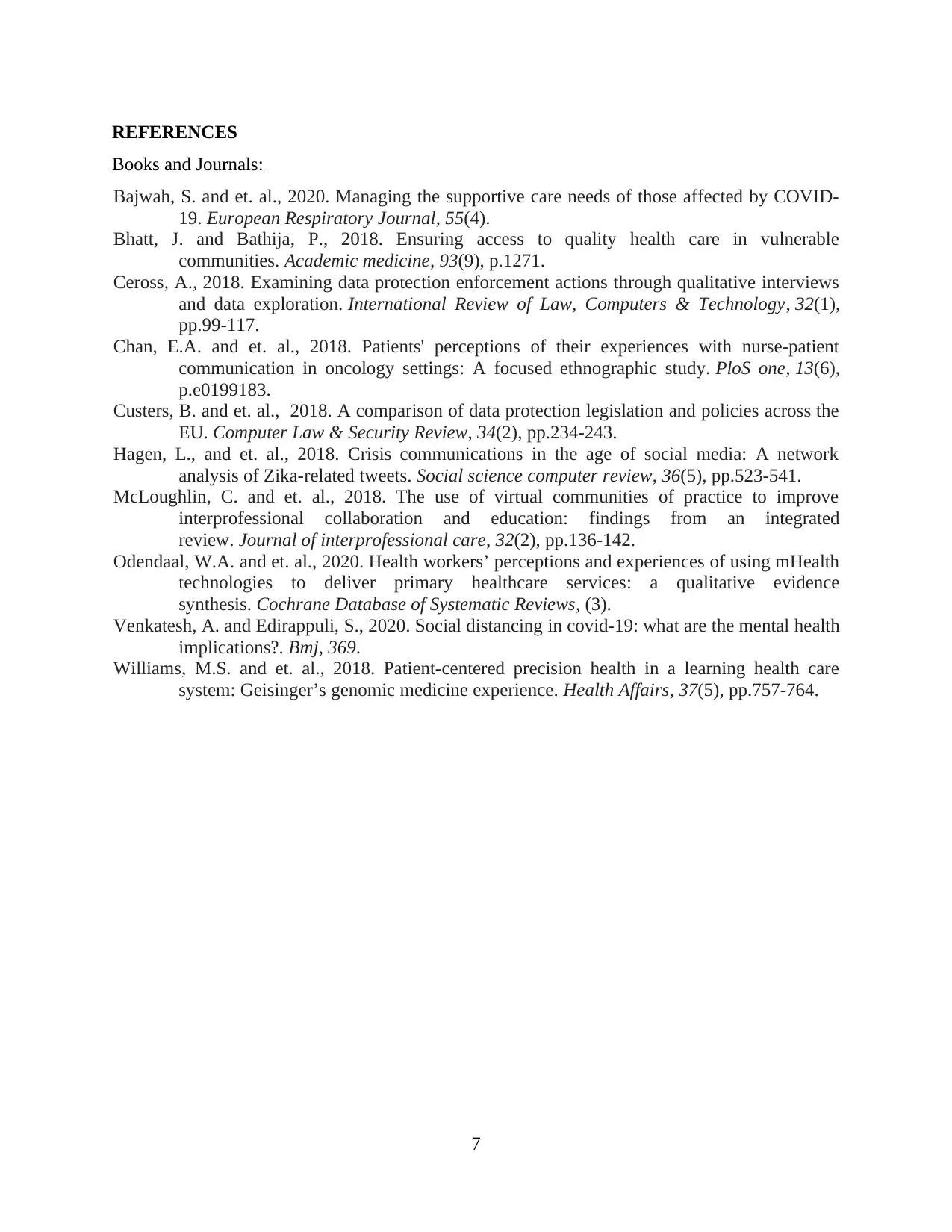
REFERENCES
Books and Journals:
Bajwah, S. and et. al., 2020. Managing the supportive care needs of those affected by COVID-
19. European Respiratory Journal, 55(4).
Bhatt, J. and Bathija, P., 2018. Ensuring access to quality health care in vulnerable
communities. Academic medicine, 93(9), p.1271.
Ceross, A., 2018. Examining data protection enforcement actions through qualitative interviews
and data exploration. International Review of Law, Computers & Technology, 32(1),
pp.99-117.
Chan, E.A. and et. al., 2018. Patients' perceptions of their experiences with nurse-patient
communication in oncology settings: A focused ethnographic study. PloS one, 13(6),
p.e0199183.
Custers, B. and et. al., 2018. A comparison of data protection legislation and policies across the
EU. Computer Law & Security Review, 34(2), pp.234-243.
Hagen, L., and et. al., 2018. Crisis communications in the age of social media: A network
analysis of Zika-related tweets. Social science computer review, 36(5), pp.523-541.
McLoughlin, C. and et. al., 2018. The use of virtual communities of practice to improve
interprofessional collaboration and education: findings from an integrated
review. Journal of interprofessional care, 32(2), pp.136-142.
Odendaal, W.A. and et. al., 2020. Health workers’ perceptions and experiences of using mHealth
technologies to deliver primary healthcare services: a qualitative evidence
synthesis. Cochrane Database of Systematic Reviews, (3).
Venkatesh, A. and Edirappuli, S., 2020. Social distancing in covid-19: what are the mental health
implications?. Bmj, 369.
Williams, M.S. and et. al., 2018. Patient-centered precision health in a learning health care
system: Geisinger’s genomic medicine experience. Health Affairs, 37(5), pp.757-764.
7
Books and Journals:
Bajwah, S. and et. al., 2020. Managing the supportive care needs of those affected by COVID-
19. European Respiratory Journal, 55(4).
Bhatt, J. and Bathija, P., 2018. Ensuring access to quality health care in vulnerable
communities. Academic medicine, 93(9), p.1271.
Ceross, A., 2018. Examining data protection enforcement actions through qualitative interviews
and data exploration. International Review of Law, Computers & Technology, 32(1),
pp.99-117.
Chan, E.A. and et. al., 2018. Patients' perceptions of their experiences with nurse-patient
communication in oncology settings: A focused ethnographic study. PloS one, 13(6),
p.e0199183.
Custers, B. and et. al., 2018. A comparison of data protection legislation and policies across the
EU. Computer Law & Security Review, 34(2), pp.234-243.
Hagen, L., and et. al., 2018. Crisis communications in the age of social media: A network
analysis of Zika-related tweets. Social science computer review, 36(5), pp.523-541.
McLoughlin, C. and et. al., 2018. The use of virtual communities of practice to improve
interprofessional collaboration and education: findings from an integrated
review. Journal of interprofessional care, 32(2), pp.136-142.
Odendaal, W.A. and et. al., 2020. Health workers’ perceptions and experiences of using mHealth
technologies to deliver primary healthcare services: a qualitative evidence
synthesis. Cochrane Database of Systematic Reviews, (3).
Venkatesh, A. and Edirappuli, S., 2020. Social distancing in covid-19: what are the mental health
implications?. Bmj, 369.
Williams, M.S. and et. al., 2018. Patient-centered precision health in a learning health care
system: Geisinger’s genomic medicine experience. Health Affairs, 37(5), pp.757-764.
7
⊘ This is a preview!⊘
Do you want full access?
Subscribe today to unlock all pages.
Trusted by 1+ million students worldwide

1 out of 9


Related Documents


Your All-in-One AI-Powered Toolkit for Academic Success.
+13062052269
info@desklib.com
Available 24*7 on WhatsApp / Email
![[object Object]](/_next/static/media/star-bottom.7253800d.svg)
Unlock your academic potential
Copyright © 2020–2026 A2Z Services. All Rights Reserved. Developed and managed by ZUCOL.