HRM440/INB340: Toyota Case Study - Compensation, Benefits, Performance
VerifiedAdded on 2023/06/14
|22
|5724
|81
Case Study
AI Summary
This case study examines the impact of compensation and benefits on employee performance, focusing on Toyota as a multinational corporation. It clarifies key terms, provides background, and states the research problem concerning the effectiveness and potential drawbacks of Toyota's compensation strategies, including rotational shifts. The literature review covers compensation types (monetary, non-monetary, direct, indirect) and related issues, such as economic constraints and work-life balance. The methodology relies on secondary data analysis to evaluate the research questions. The study concludes with recommendations for overcoming challenges in implementing compensation and benefit programs to improve employee motivation and performance. This document is available on Desklib, a platform offering study tools and solved assignments for students.
Running head: HUMAN RESOURCE MANAGEMENT
Human Resource Management
Impact of Compensation and Benefits on Employee Performance
(Case Study of Toyota)
Name of the Student
Name of the University
Author’s Note
Human Resource Management
Impact of Compensation and Benefits on Employee Performance
(Case Study of Toyota)
Name of the Student
Name of the University
Author’s Note

Paraphrase This Document
Need a fresh take? Get an instant paraphrase of this document with our AI Paraphraser
1HUMAN RESOURCE MANAGEMENT
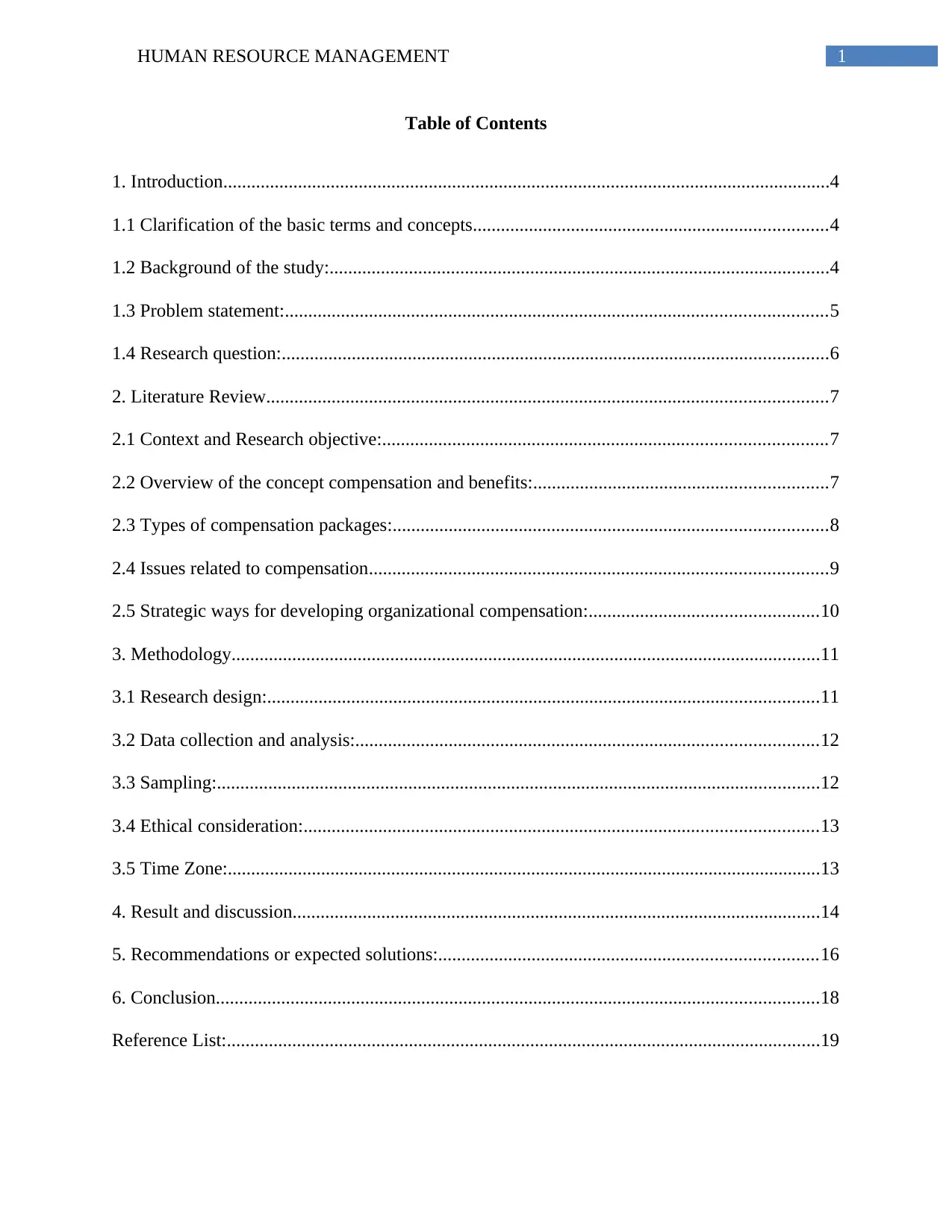
Table of Contents
1. Introduction..................................................................................................................................4
1.1 Clarification of the basic terms and concepts............................................................................4
1.2 Background of the study:...........................................................................................................4
1.3 Problem statement:....................................................................................................................5
1.4 Research question:.....................................................................................................................6
2. Literature Review........................................................................................................................7
2.1 Context and Research objective:...............................................................................................7
2.2 Overview of the concept compensation and benefits:...............................................................7
2.3 Types of compensation packages:.............................................................................................8
2.4 Issues related to compensation..................................................................................................9
2.5 Strategic ways for developing organizational compensation:.................................................10
3. Methodology..............................................................................................................................11
3.1 Research design:......................................................................................................................11
3.2 Data collection and analysis:...................................................................................................12
3.3 Sampling:.................................................................................................................................12
3.4 Ethical consideration:..............................................................................................................13
3.5 Time Zone:...............................................................................................................................13
4. Result and discussion.................................................................................................................14
5. Recommendations or expected solutions:.................................................................................16
6. Conclusion.................................................................................................................................18
Reference List:...............................................................................................................................19
Table of Contents
1. Introduction..................................................................................................................................4
1.1 Clarification of the basic terms and concepts............................................................................4
1.2 Background of the study:...........................................................................................................4
1.3 Problem statement:....................................................................................................................5
1.4 Research question:.....................................................................................................................6
2. Literature Review........................................................................................................................7
2.1 Context and Research objective:...............................................................................................7
2.2 Overview of the concept compensation and benefits:...............................................................7
2.3 Types of compensation packages:.............................................................................................8
2.4 Issues related to compensation..................................................................................................9
2.5 Strategic ways for developing organizational compensation:.................................................10
3. Methodology..............................................................................................................................11
3.1 Research design:......................................................................................................................11
3.2 Data collection and analysis:...................................................................................................12
3.3 Sampling:.................................................................................................................................12
3.4 Ethical consideration:..............................................................................................................13
3.5 Time Zone:...............................................................................................................................13
4. Result and discussion.................................................................................................................14
5. Recommendations or expected solutions:.................................................................................16
6. Conclusion.................................................................................................................................18
Reference List:...............................................................................................................................19
2HUMAN RESOURCE MANAGEMENT
Abstract
The study provided critical overview about the Impact of Compensation and Benefits on
Employee Performance. Numerous researchers and practitioners have provided their point of
views from different perspectives. As a result, the entire study has been conducted based on
secondary source of research. Compensation and benefit is considered as one of the most
effective tools based on which business experts encourages the employees for providing their
best endeavor towards services. The overarching concept compensation signifies both monetary
and non-monetary benefits and facilities providing towards employees in order to achieve their
best performances. In the literature review, a critical evaluation has been conducted about the
various positive and negative impacts of compensation and benefits. By using appropriate
methodological tools, the result of the research issue is critically analyzed. At the end, the study
provided relevant recommendations as well.
Abstract
The study provided critical overview about the Impact of Compensation and Benefits on
Employee Performance. Numerous researchers and practitioners have provided their point of
views from different perspectives. As a result, the entire study has been conducted based on
secondary source of research. Compensation and benefit is considered as one of the most
effective tools based on which business experts encourages the employees for providing their
best endeavor towards services. The overarching concept compensation signifies both monetary
and non-monetary benefits and facilities providing towards employees in order to achieve their
best performances. In the literature review, a critical evaluation has been conducted about the
various positive and negative impacts of compensation and benefits. By using appropriate
methodological tools, the result of the research issue is critically analyzed. At the end, the study
provided relevant recommendations as well.
⊘ This is a preview!⊘
Do you want full access?
Subscribe today to unlock all pages.

Trusted by 1+ million students worldwide
3HUMAN RESOURCE MANAGEMENT
1. Introduction
1.1 Clarification of the basic terms and concepts
In today’s business scenario, employees are considered as one of the most important
assets and resources for rendering organizational success. Therefore, employees should be
managed professionally as well as excellently. Human resource managers have to take the major
initiative for motivating the employees so that they can performance well towards the services.
Compensation and benefit is considered as one of the most effective tools based on which
business experts encourages the employees for providing their best endeavor towards services
(Bryant & Allen, 2013). The overarching concept compensation signifies both monetary and
non-monetary benefits and facilities providing towards employees in order to achieve their best
performances.
Compensation is of several types including non-monetary, monetary, direct
compensation and indirect compensation. In order to maintain employee retention plan business
organization has to implement different motivational strategies and policies for getting the best
endeavor from employees. Implementation of Compensation and benefit is one of the most
effective human resource strategies and policies for grabbing the attention of organizational
employees.
1.2 Background of the study:
This very specific study has focused to provide detailed overview about the impact of
Compensation and benefit on overall performance level of employees especially evaluating the
case study of Toyota. Toyota is one of the most prestigious multinational automotive
1. Introduction
1.1 Clarification of the basic terms and concepts
In today’s business scenario, employees are considered as one of the most important
assets and resources for rendering organizational success. Therefore, employees should be
managed professionally as well as excellently. Human resource managers have to take the major
initiative for motivating the employees so that they can performance well towards the services.
Compensation and benefit is considered as one of the most effective tools based on which
business experts encourages the employees for providing their best endeavor towards services
(Bryant & Allen, 2013). The overarching concept compensation signifies both monetary and
non-monetary benefits and facilities providing towards employees in order to achieve their best
performances.
Compensation is of several types including non-monetary, monetary, direct
compensation and indirect compensation. In order to maintain employee retention plan business
organization has to implement different motivational strategies and policies for getting the best
endeavor from employees. Implementation of Compensation and benefit is one of the most
effective human resource strategies and policies for grabbing the attention of organizational
employees.
1.2 Background of the study:
This very specific study has focused to provide detailed overview about the impact of
Compensation and benefit on overall performance level of employees especially evaluating the
case study of Toyota. Toyota is one of the most prestigious multinational automotive
Paraphrase This Document
Need a fresh take? Get an instant paraphrase of this document with our AI Paraphraser
4HUMAN RESOURCE MANAGEMENT
manufacturers occupying a recognizable place all over the World. Headquartered in Japan this
very specific organization has already gained immense reputation for maintaining excellent work
environment (toyota-global.com., 2018). The employees associated with this organization have
showed their level of satisfaction for excellent pay and benefit structure of Toyota. In addition,
this particular organization provides very effective non-monetary benefits as well. By
maintaining an agile work environment, the employees can feel relaxed at the workplace.
However, in last five years the organization is facing several issues regarding their human
resource policy.
It is undeniable that Toyota provides limitless career advancement opportunity,
competitive benefits, collaborative and supportive culture and so many. The primary problem
that the employees are facing in achieving this compensation and benefit plan includes in
maintaining two weeks rotating shifts. In quest of earning additional money, employees show
their interest in following this rotational shift (Xavier, 2014). As a result, employees have to face
serious health issue, psychological issue and so on. However, after evaluating this particular
study based on the case study of Toyota, it is undeniable that Compensation and benefit strategy
ultimately enhances the performance level of the employees though this policy is not devoid of
some of its major negative effect.
1.3 Problem statement:
It has been observed that Toyota is currently positioned as the market leader in the realm
of Automobile industry. Compensation and benefit strategy of Toyota is one of the most
effective policies based on which the organization has drawn the large number of customers.
Numerous eminent scholars have provided their own opinion regarding the impact of
manufacturers occupying a recognizable place all over the World. Headquartered in Japan this
very specific organization has already gained immense reputation for maintaining excellent work
environment (toyota-global.com., 2018). The employees associated with this organization have
showed their level of satisfaction for excellent pay and benefit structure of Toyota. In addition,
this particular organization provides very effective non-monetary benefits as well. By
maintaining an agile work environment, the employees can feel relaxed at the workplace.
However, in last five years the organization is facing several issues regarding their human
resource policy.
It is undeniable that Toyota provides limitless career advancement opportunity,
competitive benefits, collaborative and supportive culture and so many. The primary problem
that the employees are facing in achieving this compensation and benefit plan includes in
maintaining two weeks rotating shifts. In quest of earning additional money, employees show
their interest in following this rotational shift (Xavier, 2014). As a result, employees have to face
serious health issue, psychological issue and so on. However, after evaluating this particular
study based on the case study of Toyota, it is undeniable that Compensation and benefit strategy
ultimately enhances the performance level of the employees though this policy is not devoid of
some of its major negative effect.
1.3 Problem statement:
It has been observed that Toyota is currently positioned as the market leader in the realm
of Automobile industry. Compensation and benefit strategy of Toyota is one of the most
effective policies based on which the organization has drawn the large number of customers.
Numerous eminent scholars have provided their own opinion regarding the impact of
5HUMAN RESOURCE MANAGEMENT
Compensation and benefit strategy on the overall employee performances. As stated by some of
the most eminent personalities, this particular human resource policy has left major positive
impact on the overall performance of the organization (Sengupta et al., 2012). People from
various geographical backgrounds and attitudes are associated with the organization. After
getting innumerable facilities in terms of both monetary as well as non-monetary from the
organization, the employees have provided their interest of giving best endeavor to achieve the
business target. As per the opinion of some of the eminent scholar, compensation and benefits
are not always effective for motivating the employees. After analyzing case study of Toyota, it is
identified that the employees have to meet some of the major criteria in order to get those
additional benefits. Among those criteria, the impact of maintaining rotational shift is the most
prominent (Lawler, Benson & McDermott, 2012). People of various geographical backgrounds
have to follow rotational shift as well as long work hour in order to achieve bonus or incentive. It
was affecting on the health and psychology of employees. As a result, few years before the
organization has faced immense employee turnover being de-motivated towards the services.
While evaluating the research issue most of the scholars have provided their opinion that people
belonging to various geographical boundaries and attitudes have received immense positive
motivation from Compensation and benefit strategy.
1.4 Research question:
Primary questions related to the research issue are as follows:
What is the impact of Compensation and Benefits on Employee Performance?
What are the primary issues organization has to face in implementing Compensation and
benefit?
Compensation and benefit strategy on the overall employee performances. As stated by some of
the most eminent personalities, this particular human resource policy has left major positive
impact on the overall performance of the organization (Sengupta et al., 2012). People from
various geographical backgrounds and attitudes are associated with the organization. After
getting innumerable facilities in terms of both monetary as well as non-monetary from the
organization, the employees have provided their interest of giving best endeavor to achieve the
business target. As per the opinion of some of the eminent scholar, compensation and benefits
are not always effective for motivating the employees. After analyzing case study of Toyota, it is
identified that the employees have to meet some of the major criteria in order to get those
additional benefits. Among those criteria, the impact of maintaining rotational shift is the most
prominent (Lawler, Benson & McDermott, 2012). People of various geographical backgrounds
have to follow rotational shift as well as long work hour in order to achieve bonus or incentive. It
was affecting on the health and psychology of employees. As a result, few years before the
organization has faced immense employee turnover being de-motivated towards the services.
While evaluating the research issue most of the scholars have provided their opinion that people
belonging to various geographical boundaries and attitudes have received immense positive
motivation from Compensation and benefit strategy.
1.4 Research question:
Primary questions related to the research issue are as follows:
What is the impact of Compensation and Benefits on Employee Performance?
What are the primary issues organization has to face in implementing Compensation and
benefit?
⊘ This is a preview!⊘
Do you want full access?
Subscribe today to unlock all pages.
Trusted by 1+ million students worldwide
6HUMAN RESOURCE MANAGEMENT
What should be the recommendations of overcoming the challenges in implementing
Compensation and benefit?
2. Literature Review
2.1 Context and Research objective:
Evaluating the impact of Compensation and Benefits on Employee Performance is the
primary context of this very specific study. In order to collect appropriate data and information in
this very specific context the study has focused to meet some of the major objectives. The
objectives are as follows:
To evaluate the impact of Compensation and Benefits on Employee Performance
To identify the issues organization has to face in implementing Compensation and benefit
To provide some of the most relevant recommendations of overcoming the challenges in
implementing Compensation and benefit
2.2 Overview of the concept compensation and benefits:
The overarching term compensation and benefits is sub-discipline of human resource
department focused on employee motivation. As opined by Leigh and Marcin (2012), the success
of a particular organization is highly dependent on overall performance level of the employees.
As a result, every business experts focus on implementing some rewards and recognitions
policies for encouraging the employees towards proper services. Numerous scholars tend to
misinterpret regarding the term compensation. Compensation does not signify monetary benefits
and facilities. In order to retain the employees business organization tends to provide numerous
health facilities as well. This particular benefit enables to overcome any kind of health issue at
What should be the recommendations of overcoming the challenges in implementing
Compensation and benefit?
2. Literature Review
2.1 Context and Research objective:
Evaluating the impact of Compensation and Benefits on Employee Performance is the
primary context of this very specific study. In order to collect appropriate data and information in
this very specific context the study has focused to meet some of the major objectives. The
objectives are as follows:
To evaluate the impact of Compensation and Benefits on Employee Performance
To identify the issues organization has to face in implementing Compensation and benefit
To provide some of the most relevant recommendations of overcoming the challenges in
implementing Compensation and benefit
2.2 Overview of the concept compensation and benefits:
The overarching term compensation and benefits is sub-discipline of human resource
department focused on employee motivation. As opined by Leigh and Marcin (2012), the success
of a particular organization is highly dependent on overall performance level of the employees.
As a result, every business experts focus on implementing some rewards and recognitions
policies for encouraging the employees towards proper services. Numerous scholars tend to
misinterpret regarding the term compensation. Compensation does not signify monetary benefits
and facilities. In order to retain the employees business organization tends to provide numerous
health facilities as well. This particular benefit enables to overcome any kind of health issue at
Paraphrase This Document
Need a fresh take? Get an instant paraphrase of this document with our AI Paraphraser
7HUMAN RESOURCE MANAGEMENT
the workplace. However, compensation may be monetary, non-monetary; direct or indirect.
Spieler and Burton (2012) stated that the entire purpose of implementing this particular human
resource discipline is providing employee motivation towards services.
2.3 Types of compensation packages:
Compensation packages are constituted with several types including non-monetary,
monetary, direct compensation and indirect compensation.
Non-monetary compensation:
Benefits, which are not involved within tangible value, are otherwise named as Non-
monetary compensation. Daley (2012) opined that praise from the employers, opportunity for
career growth, social rewards such as job security, providing agile work environment, allowing
flexibility in maintaining effective communication are the necessary ways for getting Non-
monetary compensation. Business organizations in order to encourage the employees towards
services tend to provide flexible work environment so that they can enjoy the pace of work.
Monetary compensation:
As emphasized by Adler and Ghiselli (2015), monetary benefit is highly appreciable on
behalf of the employees for providing their best endeavor. Large number of multi-national
corporations is there who provides customer support for 24 hours. The employees associated
with the organization have to take overburden of pressure by extending their shift hour. In this
kind of situation, the organization has to pay additional amount of money for motivating the
employees towards services.
Direct compensation
the workplace. However, compensation may be monetary, non-monetary; direct or indirect.
Spieler and Burton (2012) stated that the entire purpose of implementing this particular human
resource discipline is providing employee motivation towards services.
2.3 Types of compensation packages:
Compensation packages are constituted with several types including non-monetary,
monetary, direct compensation and indirect compensation.
Non-monetary compensation:
Benefits, which are not involved within tangible value, are otherwise named as Non-
monetary compensation. Daley (2012) opined that praise from the employers, opportunity for
career growth, social rewards such as job security, providing agile work environment, allowing
flexibility in maintaining effective communication are the necessary ways for getting Non-
monetary compensation. Business organizations in order to encourage the employees towards
services tend to provide flexible work environment so that they can enjoy the pace of work.
Monetary compensation:
As emphasized by Adler and Ghiselli (2015), monetary benefit is highly appreciable on
behalf of the employees for providing their best endeavor. Large number of multi-national
corporations is there who provides customer support for 24 hours. The employees associated
with the organization have to take overburden of pressure by extending their shift hour. In this
kind of situation, the organization has to pay additional amount of money for motivating the
employees towards services.
Direct compensation
8HUMAN RESOURCE MANAGEMENT
Direct compensation is the increment of employee wage that can reflect on employees’
annual salary or hourly wages. Madhani (2014) stated that business organizations like to pay this
particular amount of money in the form of basic pay, incentive pay, bonus and so on. As a result,
employees do not show their reluctant attitude for providing their services by extending shifts.
Indirect compensation:
Moore and Viscusi (2014) stated that indirect compensation includes health insurance
program, resolving public health issue, pension planning, paid leaves and child care or moving
expenses and so many. While providing services employees may have to face innumerable health
issues. In this situation, the employees feel completely de-motivated in being associated with the
organization. In order to overcome this kind of workplace hazards, the employers provide health
insurances for giving necessary benefits and facilities.
2.4 Issues related to compensation
As per the opinion of Griffin (2013), several eminent personalities have showed their
own point of view regarding the issues that most of the business organizations have to face in
implementing compensation and benefit strategies and policies. Economic strength is one of the
most significant barriers due to which human resource managers fail to implement this kind of
tools at the workplace. If the business organization cannot maintain an effective balance between
profit and loss, the entire process of business becomes failure. As a result, the business experts
cannot take any kind of additional initiatives at that time. In order to implement recognition and
reward policy, incentive plans, bonus system, the organization have to invest large amount of
money.
Direct compensation is the increment of employee wage that can reflect on employees’
annual salary or hourly wages. Madhani (2014) stated that business organizations like to pay this
particular amount of money in the form of basic pay, incentive pay, bonus and so on. As a result,
employees do not show their reluctant attitude for providing their services by extending shifts.
Indirect compensation:
Moore and Viscusi (2014) stated that indirect compensation includes health insurance
program, resolving public health issue, pension planning, paid leaves and child care or moving
expenses and so many. While providing services employees may have to face innumerable health
issues. In this situation, the employees feel completely de-motivated in being associated with the
organization. In order to overcome this kind of workplace hazards, the employers provide health
insurances for giving necessary benefits and facilities.
2.4 Issues related to compensation
As per the opinion of Griffin (2013), several eminent personalities have showed their
own point of view regarding the issues that most of the business organizations have to face in
implementing compensation and benefit strategies and policies. Economic strength is one of the
most significant barriers due to which human resource managers fail to implement this kind of
tools at the workplace. If the business organization cannot maintain an effective balance between
profit and loss, the entire process of business becomes failure. As a result, the business experts
cannot take any kind of additional initiatives at that time. In order to implement recognition and
reward policy, incentive plans, bonus system, the organization have to invest large amount of
money.
⊘ This is a preview!⊘
Do you want full access?
Subscribe today to unlock all pages.
Trusted by 1+ million students worldwide
9HUMAN RESOURCE MANAGEMENT
In addition, in quest of achieving the criteria of compensation and benefit employees
have to invest a long time for extending their shift. As a result, their work life balance is getting
affected day by day. Cerdin and Brewster (2014) opined that employees are losing their
motivation in providing good services. The quality of work is getting affected in quest of
increasing random productivity. In this kind of situation, the organization has to face immense
difficulties in fulfilling the satisfaction level of the employees. Hectic work schedule is one of
the most important reasons for dealing with the customers effectively. People from various
geographical backgrounds and attitudes may not show their positive attitude in maintaining
extended shifts for achieving compensation and benefits.
2.5 Strategic ways for developing organizational compensation:
Human resource managers should allocate a certain amount of budget for maintaining
compensation and benefits at the workplace. Based on that very specific budget the HR
managers should segregate the compensation plans as per monetary, non-monetary, direct and
indirect perspectives. As a result, the organizational managers do not have to face difficulties in
spending money for compensation and benefits purposes. In addition, Miner (2015) stated that
large number of multinational corporations are unable to implement effective plans and policies
in compensation and benefits due to economic strength.
In this situation, they intend to increase the salary structure of the employees for
providing them enough motivation. However, apart from going any kind of monitory benefit the
organization can focus on providing some social rewards as well. Praise from the employers,
opportunity for career growth, social rewards such as job security, providing agile work
environment, allowing flexibility in maintaining effective communication are the necessary ways
In addition, in quest of achieving the criteria of compensation and benefit employees
have to invest a long time for extending their shift. As a result, their work life balance is getting
affected day by day. Cerdin and Brewster (2014) opined that employees are losing their
motivation in providing good services. The quality of work is getting affected in quest of
increasing random productivity. In this kind of situation, the organization has to face immense
difficulties in fulfilling the satisfaction level of the employees. Hectic work schedule is one of
the most important reasons for dealing with the customers effectively. People from various
geographical backgrounds and attitudes may not show their positive attitude in maintaining
extended shifts for achieving compensation and benefits.
2.5 Strategic ways for developing organizational compensation:
Human resource managers should allocate a certain amount of budget for maintaining
compensation and benefits at the workplace. Based on that very specific budget the HR
managers should segregate the compensation plans as per monetary, non-monetary, direct and
indirect perspectives. As a result, the organizational managers do not have to face difficulties in
spending money for compensation and benefits purposes. In addition, Miner (2015) stated that
large number of multinational corporations are unable to implement effective plans and policies
in compensation and benefits due to economic strength.
In this situation, they intend to increase the salary structure of the employees for
providing them enough motivation. However, apart from going any kind of monitory benefit the
organization can focus on providing some social rewards as well. Praise from the employers,
opportunity for career growth, social rewards such as job security, providing agile work
environment, allowing flexibility in maintaining effective communication are the necessary ways
Paraphrase This Document
Need a fresh take? Get an instant paraphrase of this document with our AI Paraphraser
10HUMAN RESOURCE MANAGEMENT
for getting social awards. Bronchetti and McInerney (2012) has opined that in order to provide
mental support to the employees organization does not have to invest additional amount of
money.
However, the study has focused to provide an in-depth overview about the necessary
impact of compensation and benefits for enhancing the performance level of employees. In order
implement this specific tool human resource managers should follow this very specific strategy
based on which employees can gain their enthusiastic attitude in performing well towards the
services. Greene (2014) stated that in addition, while running the entire process of business
organizational managers should implement health and safety act based on which employees can
get necessary benefits and facilities regarding their health issue while serving at the workplace.
3. Methodology
3.1 Research design:
Research methodology is the systematic method of conducing the entire process of
research based on methodological as well as data collection tools and instruments. In order to
observe, analyze and evaluate the research issue the researcher has to use appropriate research
philosophy, approach, design, and data collection technique (Custers, 2012). Research
philosophy is the method of evaluating data based on facts and information collected through
keen observation. In this very specific study, the researcher has used positivism research
philosophy for evaluating the research issue based on keen observation. By implementing
deductive approach, the researcher has conducted an effective case study based on research
issue. By using the existing theories and various components of Compensation and benefit
for getting social awards. Bronchetti and McInerney (2012) has opined that in order to provide
mental support to the employees organization does not have to invest additional amount of
money.
However, the study has focused to provide an in-depth overview about the necessary
impact of compensation and benefits for enhancing the performance level of employees. In order
implement this specific tool human resource managers should follow this very specific strategy
based on which employees can gain their enthusiastic attitude in performing well towards the
services. Greene (2014) stated that in addition, while running the entire process of business
organizational managers should implement health and safety act based on which employees can
get necessary benefits and facilities regarding their health issue while serving at the workplace.
3. Methodology
3.1 Research design:
Research methodology is the systematic method of conducing the entire process of
research based on methodological as well as data collection tools and instruments. In order to
observe, analyze and evaluate the research issue the researcher has to use appropriate research
philosophy, approach, design, and data collection technique (Custers, 2012). Research
philosophy is the method of evaluating data based on facts and information collected through
keen observation. In this very specific study, the researcher has used positivism research
philosophy for evaluating the research issue based on keen observation. By implementing
deductive approach, the researcher has conducted an effective case study based on research
issue. By using the existing theories and various components of Compensation and benefit
11HUMAN RESOURCE MANAGEMENT
strategy, the researcher has analyzed data by using descriptive research design (Park & Sturman,
2012). Descriptive research design helps the researcher in gathering data and analyzing its
essence from various point of views without showing any kind of interpretation.
3.2 Data collection and analysis:
Data collection is the technique of gathering appropriate information as well as data from
different reliable resources. Data collection technique is primarily constituted with two major
types including primary and secondary (Anitha, 2014). In order to collect primary data
researcher tends to involve large number of participants directly associated with the research
issue in order to gather immediate response. On the other hand, in order to collect secondary data
collection researcher has to follow various books, journals, magazines, websites and so on.
In this very specific study secondary data collection is used in order to evaluate the
research issue based on the opinion of different eminent scholars from journal articles, books,
newspaper articles and so many. Data analysis on the other hand is the method of showing the
findings of data and information (Oladapo, 2014). In order to conduct secondary data collection
technique the researcher tends to use three types of analysis primarily. It includes case study
analysis, thematic analysis and observational analysis. In this very specific study, thematic
analysis is conducted for evaluating and analyzing necessary information.
3.3 Sampling:
This particular study has focused to conduct the entire research based on secondary data
analysis. Sampling is the method of acquiring effective data and information based on selected
sources amidst large number of population (Stone & Dulebohn, 2013). Sampling is primarily
strategy, the researcher has analyzed data by using descriptive research design (Park & Sturman,
2012). Descriptive research design helps the researcher in gathering data and analyzing its
essence from various point of views without showing any kind of interpretation.
3.2 Data collection and analysis:
Data collection is the technique of gathering appropriate information as well as data from
different reliable resources. Data collection technique is primarily constituted with two major
types including primary and secondary (Anitha, 2014). In order to collect primary data
researcher tends to involve large number of participants directly associated with the research
issue in order to gather immediate response. On the other hand, in order to collect secondary data
collection researcher has to follow various books, journals, magazines, websites and so on.
In this very specific study secondary data collection is used in order to evaluate the
research issue based on the opinion of different eminent scholars from journal articles, books,
newspaper articles and so many. Data analysis on the other hand is the method of showing the
findings of data and information (Oladapo, 2014). In order to conduct secondary data collection
technique the researcher tends to use three types of analysis primarily. It includes case study
analysis, thematic analysis and observational analysis. In this very specific study, thematic
analysis is conducted for evaluating and analyzing necessary information.
3.3 Sampling:
This particular study has focused to conduct the entire research based on secondary data
analysis. Sampling is the method of acquiring effective data and information based on selected
sources amidst large number of population (Stone & Dulebohn, 2013). Sampling is primarily
⊘ This is a preview!⊘
Do you want full access?
Subscribe today to unlock all pages.
Trusted by 1+ million students worldwide

1 out of 22


Related Documents


Your All-in-One AI-Powered Toolkit for Academic Success.
+13062052269
info@desklib.com
Available 24*7 on WhatsApp / Email
![[object Object]](/_next/static/media/star-bottom.7253800d.svg)
Unlock your academic potential
Copyright © 2020–2026 A2Z Services. All Rights Reserved. Developed and managed by ZUCOL.