Stakeholder Engagement: Key Challenges in Complex Defence Projects

Verified

Added on  2023/04/11

|5
|763
|57
Case Study
AI Summary
This case study identifies key challenges in managing stakeholders within complex defense projects, including inadequate project planning, defective evaluation processes, inoperative project outlines, delayed project activation, and ineffective support mechanisms. It emphasizes the importance of stakeholder analysis, effective communication, commitment to stakeholder involvement, and understanding stakeholder motivations. The study also proposes a four-step strategy involving stakeholder identification, understanding stakeholder input, ensuring stakeholder involvement, and stakeholder stimulation to mitigate risks and achieve project success. The document is available on Desklib, a platform offering study tools and solved assignments for students.
Document Page
Running head: CASE STUDY 1
Case study
Student’s Name
Institutional Affiliation
tabler-icon-diamond-filled.svg

Paraphrase This Document

Need a fresh take? Get an instant paraphrase of this document with our AI Paraphraser
Document Page
Running head: CASE STUDY 2
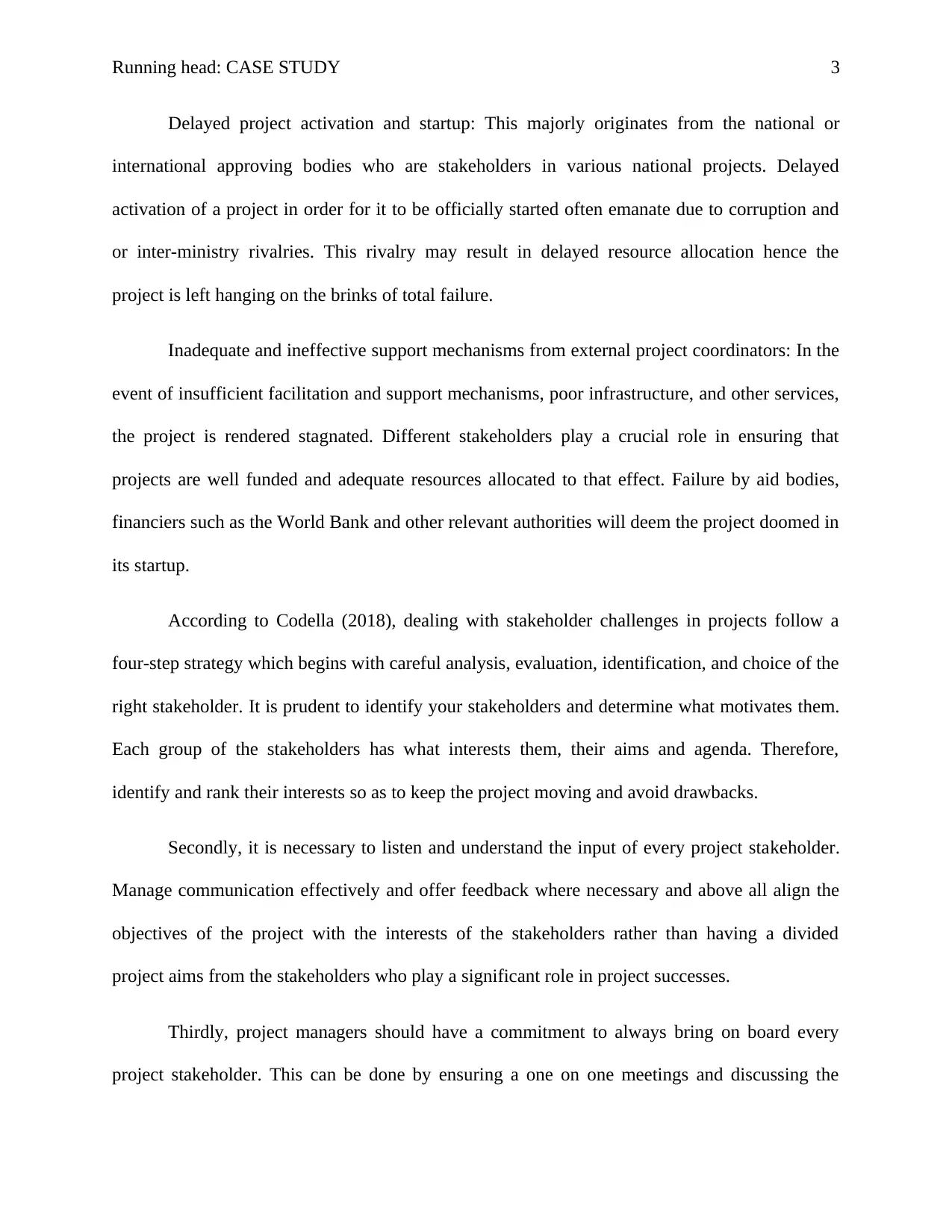
Challenges for managing stakeholders for complex defense projects
Stakeholder engagement in most complex projects often come with a number of
bottlenecks that make the achievement of project objectives very difficult hence affecting the
project timeline. Dennis (1976) notes that these challenges that affect the management of
different players in executing a project have broad classification in terms of political, social,
economic, operational and physical difficulties.
Inadequate project planning and preparation: Dennis (1976) identifies that the national
planning board and/or ministries as a stakeholder for defense programs fail in project planning
by failing to adequately identify and prepare procedures for executing the projects. Central
governing authority such as the government at times fail to disburse the necessary resources as a
result of flawed financial budgeting.
Defective evaluation and choice processes: Lack of a clear definition of project aims and
the expected output hinder the execution of projects making them fail at the initial stages. Project
owners and planners fail to realize the available mechanisms to evaluate and choose routes that
objectively streamlines the project into the anticipated objectives and hence the desired output.
This, in essence, affects the project since more emphasis is laid on the financial availability and
not the productive aspect (William, Eckert, Stawiski & Zhao, 2016).
Inoperative project outline: Whenever the anticipated project is inappropriate to the local
conditions, the needs, and the capacity, the project will have jitters. Project stakeholders often
fail in determining the real resource need for the project and end up having heavy and intended
capital borrowing to further finance the project. Sometimes, project designers’ failure to properly
design the project may lead to change of designs and capital allocation for such mistakes.
Document Page
Running head: CASE STUDY 3
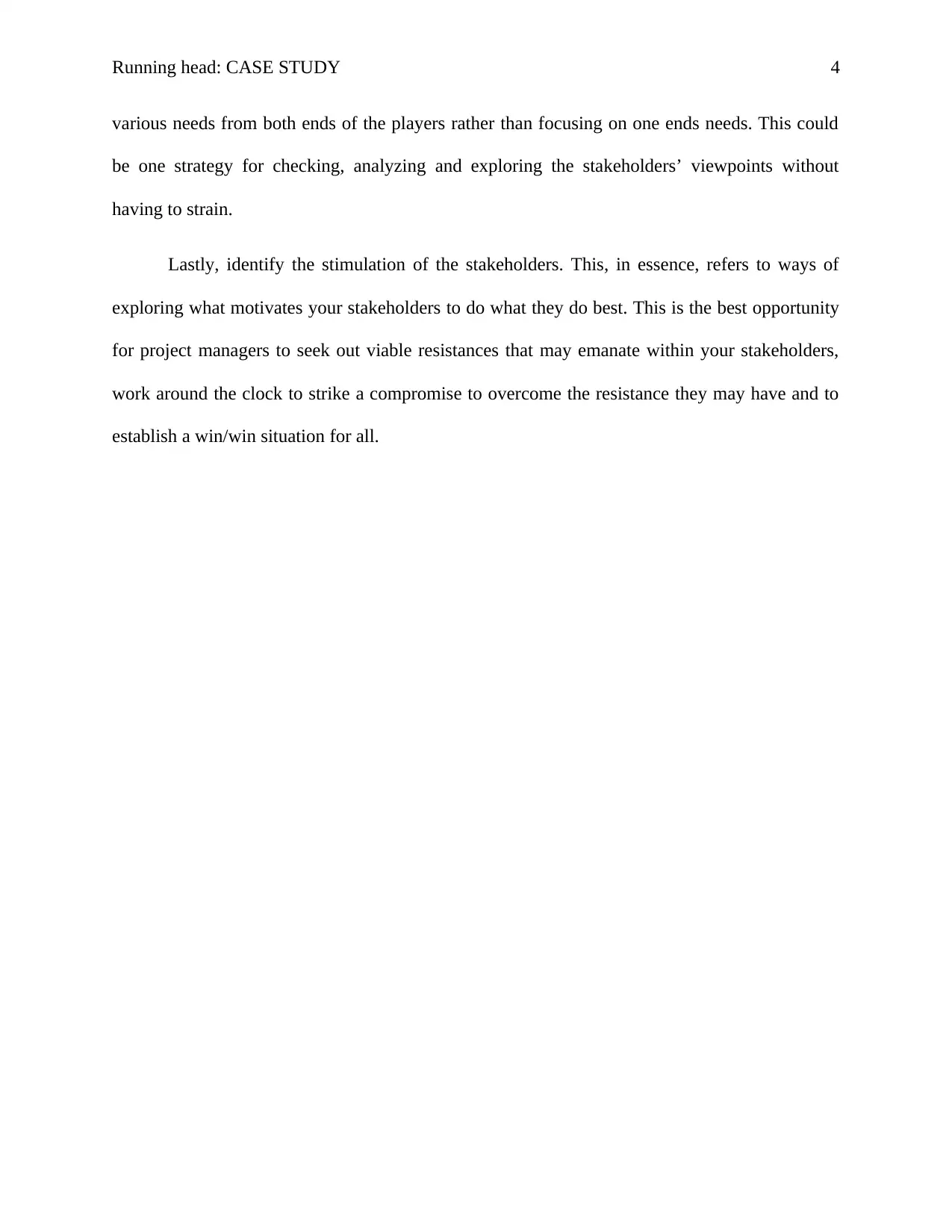
Delayed project activation and startup: This majorly originates from the national or
international approving bodies who are stakeholders in various national projects. Delayed
activation of a project in order for it to be officially started often emanate due to corruption and
or inter-ministry rivalries. This rivalry may result in delayed resource allocation hence the
project is left hanging on the brinks of total failure.
Inadequate and ineffective support mechanisms from external project coordinators: In the
event of insufficient facilitation and support mechanisms, poor infrastructure, and other services,
the project is rendered stagnated. Different stakeholders play a crucial role in ensuring that
projects are well funded and adequate resources allocated to that effect. Failure by aid bodies,
financiers such as the World Bank and other relevant authorities will deem the project doomed in
its startup.
According to Codella (2018), dealing with stakeholder challenges in projects follow a
four-step strategy which begins with careful analysis, evaluation, identification, and choice of the
right stakeholder. It is prudent to identify your stakeholders and determine what motivates them.
Each group of the stakeholders has what interests them, their aims and agenda. Therefore,
identify and rank their interests so as to keep the project moving and avoid drawbacks.
Secondly, it is necessary to listen and understand the input of every project stakeholder.
Manage communication effectively and offer feedback where necessary and above all align the
objectives of the project with the interests of the stakeholders rather than having a divided
project aims from the stakeholders who play a significant role in project successes.
Thirdly, project managers should have a commitment to always bring on board every
project stakeholder. This can be done by ensuring a one on one meetings and discussing the
Document Page
Running head: CASE STUDY 4
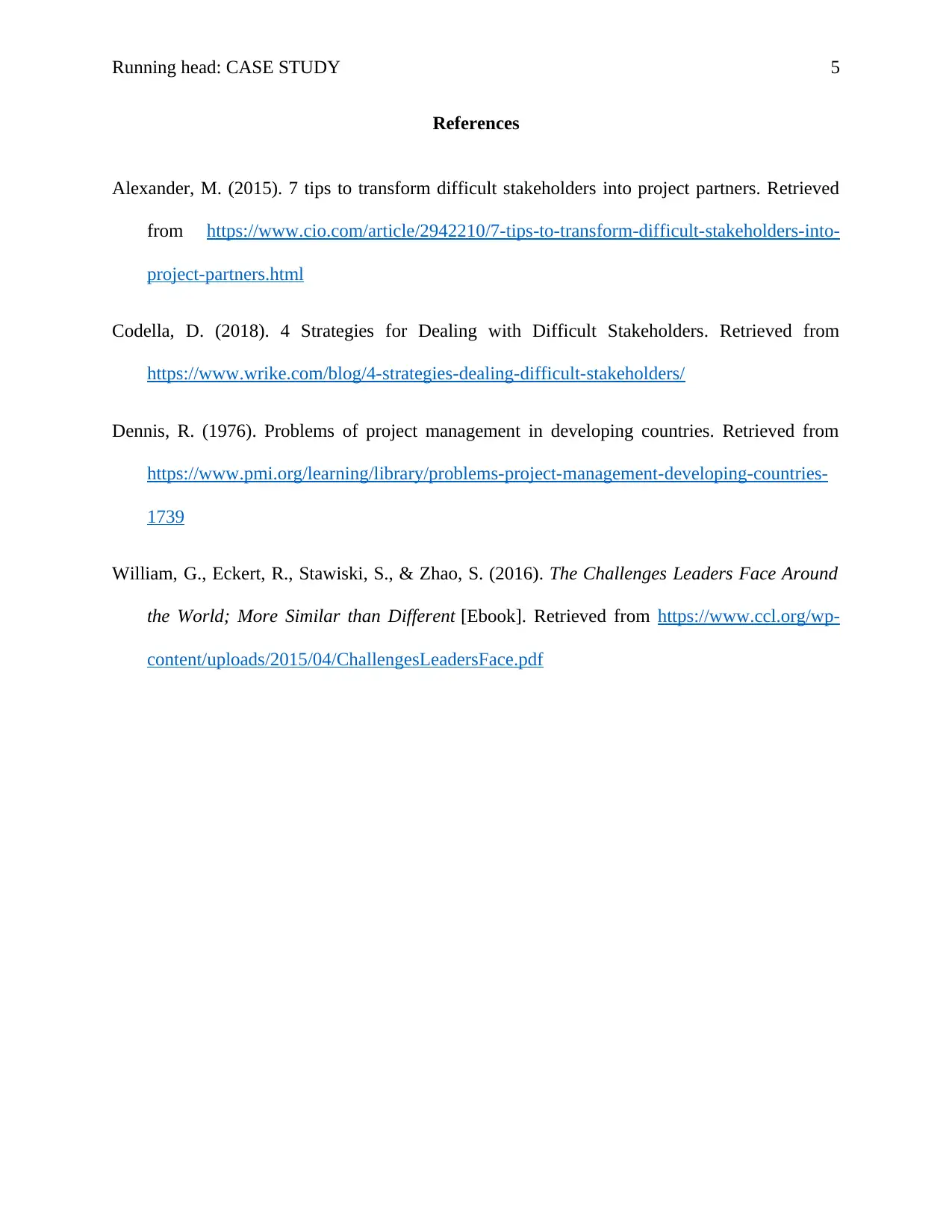
various needs from both ends of the players rather than focusing on one ends needs. This could
be one strategy for checking, analyzing and exploring the stakeholders’ viewpoints without
having to strain.
Lastly, identify the stimulation of the stakeholders. This, in essence, refers to ways of
exploring what motivates your stakeholders to do what they do best. This is the best opportunity
for project managers to seek out viable resistances that may emanate within your stakeholders,
work around the clock to strike a compromise to overcome the resistance they may have and to
establish a win/win situation for all.
tabler-icon-diamond-filled.svg

Paraphrase This Document

Need a fresh take? Get an instant paraphrase of this document with our AI Paraphraser
Document Page
Running head: CASE STUDY 5
References
Alexander, M. (2015). 7 tips to transform difficult stakeholders into project partners. Retrieved
from https://www.cio.com/article/2942210/7-tips-to-transform-difficult-stakeholders-into-
project-partners.html
Codella, D. (2018). 4 Strategies for Dealing with Difficult Stakeholders. Retrieved from
https://www.wrike.com/blog/4-strategies-dealing-difficult-stakeholders/
Dennis, R. (1976). Problems of project management in developing countries. Retrieved from
https://www.pmi.org/learning/library/problems-project-management-developing-countries-
1739
William, G., Eckert, R., Stawiski, S., & Zhao, S. (2016). The Challenges Leaders Face Around
the World; More Similar than Different [Ebook]. Retrieved from https://www.ccl.org/wp-
content/uploads/2015/04/ChallengesLeadersFace.pdf
chevron_up_icon
1 out of 5
circle_padding
hide_on_mobile
zoom_out_icon
[object Object]