Research Report: Complexity within the Big Projects Management
VerifiedAdded on  2023/06/10
|10
|2198
|322
Report
AI Summary
This report delves into the complexities inherent in large projects, aiming to identify, define, and model these complexities within the project management field to facilitate better management practices. It addresses the basic complexities related to projects, analyzes them to devise a solving framework, and proposes solutions for future project complexity challenges. The research questions focus on the project's ability to handle complexities and general solutions to address these issues. Through a literature review, the report defines project complexity, distinguishing between organizational and technological aspects, and emphasizes the importance of perceived complexity for project managers. The report also identifies factors contributing to project complexity, such as project size, variety, interdependencies, and context dependency. The research methodology involves collecting primary data through interviews with experienced project managers to gather insights on managing complexities. Desklib offers a wealth of similar resources, including past papers and solved assignments, to aid students in their academic endeavors.

Running head: COMPLEXITY WITHIN THE BIG PROJECTS
COMPLEXITY WITHIN THE BIG PROJECTS
Name of the Student
Name of the University
Author’s note
COMPLEXITY WITHIN THE BIG PROJECTS
Name of the Student
Name of the University
Author’s note
Paraphrase This Document
Need a fresh take? Get an instant paraphrase of this document with our AI Paraphraser

1COMPLEXITY WITHIN THE BIG PROJECTS
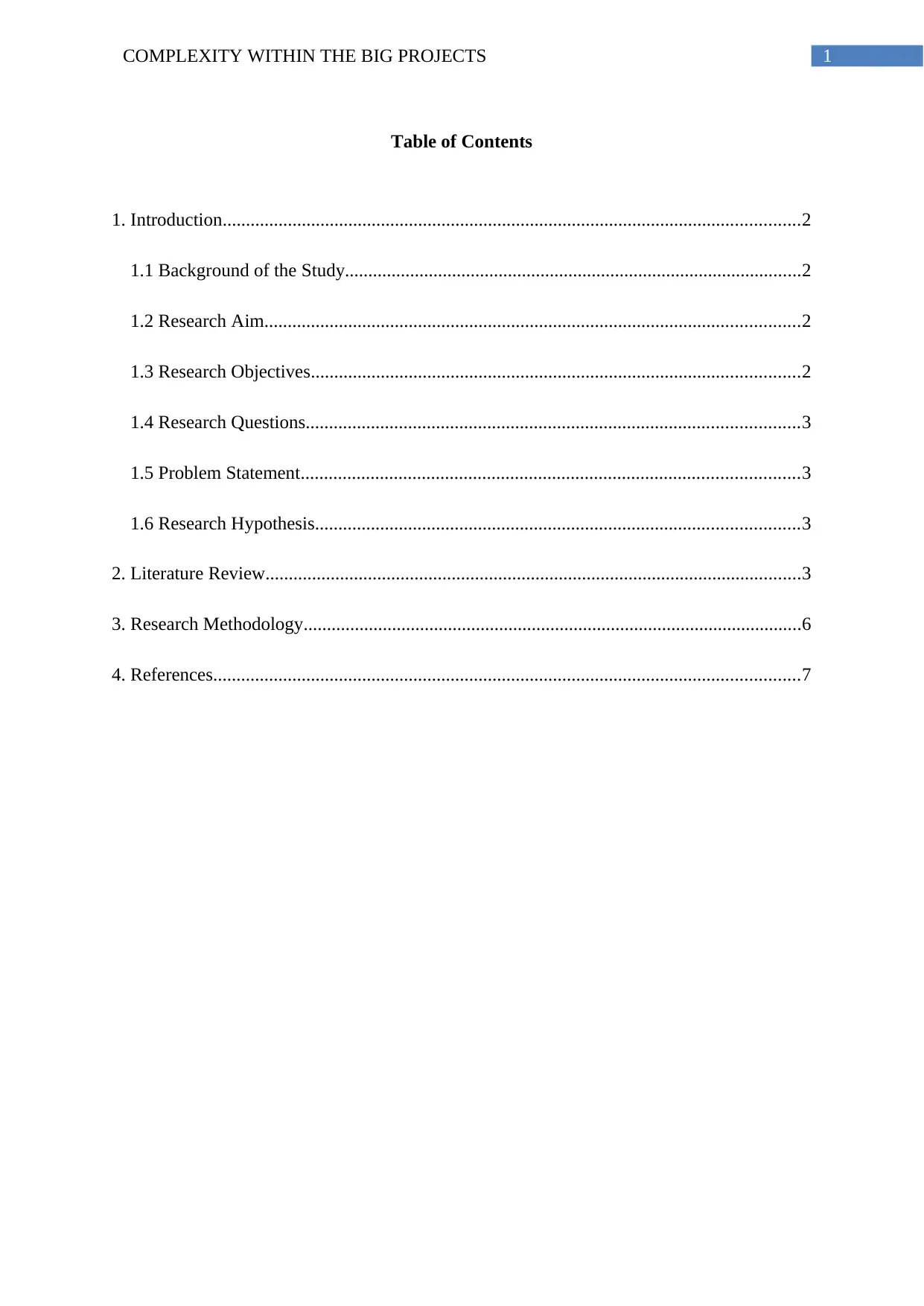
Table of Contents
1. Introduction............................................................................................................................2
1.1 Background of the Study..................................................................................................2
1.2 Research Aim...................................................................................................................2
1.3 Research Objectives.........................................................................................................2
1.4 Research Questions..........................................................................................................3
1.5 Problem Statement...........................................................................................................3
1.6 Research Hypothesis........................................................................................................3
2. Literature Review...................................................................................................................3
3. Research Methodology...........................................................................................................6
4. References..............................................................................................................................7
Table of Contents
1. Introduction............................................................................................................................2
1.1 Background of the Study..................................................................................................2
1.2 Research Aim...................................................................................................................2
1.3 Research Objectives.........................................................................................................2
1.4 Research Questions..........................................................................................................3
1.5 Problem Statement...........................................................................................................3
1.6 Research Hypothesis........................................................................................................3
2. Literature Review...................................................................................................................3
3. Research Methodology...........................................................................................................6
4. References..............................................................................................................................7

2COMPLEXITY WITHIN THE BIG PROJECTS
1. Introduction
A project could be defined as a unique and temporary endeavor in order to deliver a
certain result. There are several resources and a certain amount of time, which would be
needed in order to produce certain results. The management of projects has been able to set
theories, methodologies, practices and principles that are included sometimes within the
standard body of knowledge (Ahern, Leavy and Byrne 2014).
1.1 Background of the Study
A particular project could be considered as a system. A project would exist within a
particular environment and this would aim to achieve certain objectives (Harrison and Lock
2017). The complexity within a project could be thought as the concepts based on the
technological complexities and the organizational based complexities. This research would
aim to bridge the gap between the real and the perceived complexity. This could be achieved
by defining the problem, describing and defining a model, which would be better than the
real complexity of the project (Svejvig and Andersen 2015).
1.2 Research Aim
The research based on the project complexity within large projects would aim to
identify, define and model the complexity within the project management field for the
purpose of better management of the conditions of complexity.
1.3 Research Objectives
ï‚· To understand the basic complexities related to the project
ï‚· To analyze the complexities and decide a framework for solving the complexities.
ï‚· To decide upon a solution in order to solve the future scope of project complexity
within large projects (Bakhshi, Ireland and Gorod 2016)
1. Introduction
A project could be defined as a unique and temporary endeavor in order to deliver a
certain result. There are several resources and a certain amount of time, which would be
needed in order to produce certain results. The management of projects has been able to set
theories, methodologies, practices and principles that are included sometimes within the
standard body of knowledge (Ahern, Leavy and Byrne 2014).
1.1 Background of the Study
A particular project could be considered as a system. A project would exist within a
particular environment and this would aim to achieve certain objectives (Harrison and Lock
2017). The complexity within a project could be thought as the concepts based on the
technological complexities and the organizational based complexities. This research would
aim to bridge the gap between the real and the perceived complexity. This could be achieved
by defining the problem, describing and defining a model, which would be better than the
real complexity of the project (Svejvig and Andersen 2015).
1.2 Research Aim
The research based on the project complexity within large projects would aim to
identify, define and model the complexity within the project management field for the
purpose of better management of the conditions of complexity.
1.3 Research Objectives
ï‚· To understand the basic complexities related to the project
ï‚· To analyze the complexities and decide a framework for solving the complexities.
ï‚· To decide upon a solution in order to solve the future scope of project complexity
within large projects (Bakhshi, Ireland and Gorod 2016)
⊘ This is a preview!⊘
Do you want full access?
Subscribe today to unlock all pages.

Trusted by 1+ million students worldwide

3COMPLEXITY WITHIN THE BIG PROJECTS
1.4 Research Questions
ï‚· Would the project be able to deal with the issues of complexities within the
management of project?
ï‚· What would be the general solutions to address the issues?
1.5 Problem Statement
There are several forms of problems, which exists during the forming of a large
project. These complexities could form a hindrance for the development stage of the project.
Hence, the problem statement would be helpful in understanding the problem at hand.
1.6 Research Hypothesis
H1: The various complexities within the large projects would be understood and hence
would be solved.
H0: The various complexities within the project would not be understood and hence
the problem cannot be solved.
2. Literature Review
This section would help in defining the problem in a brief manner. This section would
also be able to propose an original framework and the proper definition of the complexity of
the project (Mir and Pinnington 2014).
Project Complexity
The organizational and the technological complexity could be considered as one of
the major concepts of the complexity of the project (Thamhain 2013). The perceived
complexity considers the level of complexity as subjective since the topic of the complexity
could be understood improperly through the perception level of an observer. The two
approaches could be applied to the complexity of the project and the complexity of the
1.4 Research Questions
ï‚· Would the project be able to deal with the issues of complexities within the
management of project?
ï‚· What would be the general solutions to address the issues?
1.5 Problem Statement
There are several forms of problems, which exists during the forming of a large
project. These complexities could form a hindrance for the development stage of the project.
Hence, the problem statement would be helpful in understanding the problem at hand.
1.6 Research Hypothesis
H1: The various complexities within the large projects would be understood and hence
would be solved.
H0: The various complexities within the project would not be understood and hence
the problem cannot be solved.
2. Literature Review
This section would help in defining the problem in a brief manner. This section would
also be able to propose an original framework and the proper definition of the complexity of
the project (Mir and Pinnington 2014).
Project Complexity
The organizational and the technological complexity could be considered as one of
the major concepts of the complexity of the project (Thamhain 2013). The perceived
complexity considers the level of complexity as subjective since the topic of the complexity
could be understood improperly through the perception level of an observer. The two
approaches could be applied to the complexity of the project and the complexity of the
Paraphrase This Document
Need a fresh take? Get an instant paraphrase of this document with our AI Paraphraser

4COMPLEXITY WITHIN THE BIG PROJECTS
project management. For the purpose of practical, a manager of a project should deal with the
perceived level of complexity. This is due to the fact that the project manager would not be
able to understand and thus deal with the entire reality and the project complexity. As a result
of this, this research would be able to link the traditional methods of complexity. As a person
who would be involved with the perceived complexity, this research proposal would aim to
establish a direct link between the real complexity and the perceived complexity by the
process of defining the complexity, describing and by the process of modelling of better level
of real complexity (Remington and Pollack 2016). This new form of references would be
helpful in enabling any person in order to share the representation for perceiving the reality of
the project. The problem of complexity could be defined in several form of ways not only
within their fields but also with different implications. The model could be defined as the
primary level of the perception of the project. The perception could be defined as the second
layer during the proper understanding of the model of the project (Mutka and Aaltonen
2013).
The complexity within a large project could be defined as the property of a system,
which is the reason behind the emergence of newer form of properties. This would define that
none of the elements of the system is owned. On the other hand, the phenomena of apparition
is not predictable. Hence, the complexity within the large projects could have a negative
impact along with a positive impact on the system of the project based on the emergence of
newer form of opportunities (Dalkir 2013).
From the vision of the complexity, the system of the project could be considered as a
complex system although some level of work should be done for the purpose of clarifying the
basic notion of the complexity of the project. This would help them in coping with the system
in an efficient manner.
project management. For the purpose of practical, a manager of a project should deal with the
perceived level of complexity. This is due to the fact that the project manager would not be
able to understand and thus deal with the entire reality and the project complexity. As a result
of this, this research would be able to link the traditional methods of complexity. As a person
who would be involved with the perceived complexity, this research proposal would aim to
establish a direct link between the real complexity and the perceived complexity by the
process of defining the complexity, describing and by the process of modelling of better level
of real complexity (Remington and Pollack 2016). This new form of references would be
helpful in enabling any person in order to share the representation for perceiving the reality of
the project. The problem of complexity could be defined in several form of ways not only
within their fields but also with different implications. The model could be defined as the
primary level of the perception of the project. The perception could be defined as the second
layer during the proper understanding of the model of the project (Mutka and Aaltonen
2013).
The complexity within a large project could be defined as the property of a system,
which is the reason behind the emergence of newer form of properties. This would define that
none of the elements of the system is owned. On the other hand, the phenomena of apparition
is not predictable. Hence, the complexity within the large projects could have a negative
impact along with a positive impact on the system of the project based on the emergence of
newer form of opportunities (Dalkir 2013).
From the vision of the complexity, the system of the project could be considered as a
complex system although some level of work should be done for the purpose of clarifying the
basic notion of the complexity of the project. This would help them in coping with the system
in an efficient manner.

5COMPLEXITY WITHIN THE BIG PROJECTS
Factors of Project Complexity
The complexity of the project could be classified into four different kinds, which are
mainly based on the factors of risk. These include:
1) All the mandatory and the non-sufficient conditions for the complexity of the
project. The first family would incorporate the factors of the size of the project.
2) The second factor would gather the various factor related to the variety of the
project.
3) The third factor would gather those that would be inn relation with the
interdependencies and the interrelations within the system of the project.
4) The fourth factor would be able to deal with the complexity of the project based on
the dependency of the context (Albrecht and Spang 2014).
Size of the Project
The complexity of the project is dependent on the size of the project. Hence, the size
of the system of the project is a factor of project complexity. Identifying the parameters,
which would characterize the project size would provide the driver list of the complexity of
the project.
Proposing the definition of the Complexity of the Project
The complexity of the project is one type of the project related property that would be
able to understand and keep the behavior under control (Kerzner 2017).
The Stakes of the Complexity of the Project
Factors of Project Complexity
The complexity of the project could be classified into four different kinds, which are
mainly based on the factors of risk. These include:
1) All the mandatory and the non-sufficient conditions for the complexity of the
project. The first family would incorporate the factors of the size of the project.
2) The second factor would gather the various factor related to the variety of the
project.
3) The third factor would gather those that would be inn relation with the
interdependencies and the interrelations within the system of the project.
4) The fourth factor would be able to deal with the complexity of the project based on
the dependency of the context (Albrecht and Spang 2014).
Size of the Project
The complexity of the project is dependent on the size of the project. Hence, the size
of the system of the project is a factor of project complexity. Identifying the parameters,
which would characterize the project size would provide the driver list of the complexity of
the project.
Proposing the definition of the Complexity of the Project
The complexity of the project is one type of the project related property that would be
able to understand and keep the behavior under control (Kerzner 2017).
The Stakes of the Complexity of the Project
⊘ This is a preview!⊘
Do you want full access?
Subscribe today to unlock all pages.

Trusted by 1+ million students worldwide

6COMPLEXITY WITHIN THE BIG PROJECTS
The consequences of the complexity of the project should be understood. This would
be helpful in understanding the stakes of the management of the project complexity. This
would be helpful in characterizing and how it could be helpful in assisting the global
management of the project. The links between the complexities of the project, risks of the
project, performance of the project and project uncertainty. The project complexity could
appear to be the main reason of the unpredictability within the projects though the relation
between the complexity and the risks should be needed to be clarified. As defined by the
framework of project complexity, there is a major number and higher diversity of the objects
to be managed with a wide variety of parameters that would be able to be characterized.
The global issue of the management of the complexity of the project is essential for
the project manager in order to be aware of the seizure of the various opportunities, which
would emerge from the level of complexity. The project manager should also the techniques
in order to avoid the complexity or reduce the negative effects of the complexity. This is the
main reason of focusing on the primary reasons of the complexity of the project.
For the practical purposes, the framework of the project complexity is insufficient to
identify the induced risks of complexity within the large projects. Hence there is a major need
to the complexity modelling for the purpose of identifying and assessing the risks within the
model. This model would be helpful in encompassing every aspects of the complexity of the
project such as the size of the project, variety of the project, interactions within the project
and the various elements of context. This model should be implemented in order to take the
complexity based challenges in order to assess, identify, prevent the complexity of the risks
induced (Fang and Marle 2013).
The consequences of the complexity of the project should be understood. This would
be helpful in understanding the stakes of the management of the project complexity. This
would be helpful in characterizing and how it could be helpful in assisting the global
management of the project. The links between the complexities of the project, risks of the
project, performance of the project and project uncertainty. The project complexity could
appear to be the main reason of the unpredictability within the projects though the relation
between the complexity and the risks should be needed to be clarified. As defined by the
framework of project complexity, there is a major number and higher diversity of the objects
to be managed with a wide variety of parameters that would be able to be characterized.
The global issue of the management of the complexity of the project is essential for
the project manager in order to be aware of the seizure of the various opportunities, which
would emerge from the level of complexity. The project manager should also the techniques
in order to avoid the complexity or reduce the negative effects of the complexity. This is the
main reason of focusing on the primary reasons of the complexity of the project.
For the practical purposes, the framework of the project complexity is insufficient to
identify the induced risks of complexity within the large projects. Hence there is a major need
to the complexity modelling for the purpose of identifying and assessing the risks within the
model. This model would be helpful in encompassing every aspects of the complexity of the
project such as the size of the project, variety of the project, interactions within the project
and the various elements of context. This model should be implemented in order to take the
complexity based challenges in order to assess, identify, prevent the complexity of the risks
induced (Fang and Marle 2013).
Paraphrase This Document
Need a fresh take? Get an instant paraphrase of this document with our AI Paraphraser

7COMPLEXITY WITHIN THE BIG PROJECTS
3. Research Methodology
The research would be mainly conducted with the help of collecting information from
the primary sources. This would include the conduction of interviews from the project
managers. They have their experiences within the field of project management. Throughout
all these years, the managers of various projects have experienced a lot within the
organizations in which they have served. Their experiences would be very much essential in
dealing with the issues of dealing with the various form of the complexities of the project.
Primary data should be needed to be collected from the project managers and their
experiences would be needed to be collected. Based on the various experiences from the
different project managers, there would arise a conclusion about the methods that should be
taken for executing a plan for eradicating the various complexities within the large projects.
This would prove to be a major help for the growth in the rise of the projects, which face a
huge level of complexity for the project managers. They would thus be able to solve the
various complexities within the project and thus help in developing a smooth working of the
project.
3. Research Methodology
The research would be mainly conducted with the help of collecting information from
the primary sources. This would include the conduction of interviews from the project
managers. They have their experiences within the field of project management. Throughout
all these years, the managers of various projects have experienced a lot within the
organizations in which they have served. Their experiences would be very much essential in
dealing with the issues of dealing with the various form of the complexities of the project.
Primary data should be needed to be collected from the project managers and their
experiences would be needed to be collected. Based on the various experiences from the
different project managers, there would arise a conclusion about the methods that should be
taken for executing a plan for eradicating the various complexities within the large projects.
This would prove to be a major help for the growth in the rise of the projects, which face a
huge level of complexity for the project managers. They would thus be able to solve the
various complexities within the project and thus help in developing a smooth working of the
project.

8COMPLEXITY WITHIN THE BIG PROJECTS
4. References
Ahern, T., Leavy, B. and Byrne, P.J., 2014. Knowledge formation and learning in the
management of projects: A problem solving perspective. International Journal of Project
Management, 32(8), pp.1423-1431.
Albrecht, J.C. and Spang, K., 2014. Linking the benefits of project management maturity to
project complexity: Insights from a multiple case study. International Journal of Managing
Projects in Business, 7(2), pp.285-301.
Bakhshi, J., Ireland, V. and Gorod, A., 2016. Clarifying the project complexity construct:
Past, present and future. International Journal of Project Management, 34(7), pp.1199-1213.
Dalkir, K., 2013. Knowledge management in theory and practice. Routledge.
Fang, C. and Marle, F., 2013. Dealing with project complexity by matrix-based propagation
modelling for project risk analysis. Journal of Engineering Design, 24(4), pp.239-256.
Harrison, F. and Lock, D., 2017. Advanced project management: a structured approach.
Routledge.
Kerzner, H., 2017. Project management metrics, KPIs, and dashboards: a guide to
measuring and monitoring project performance. John Wiley & Sons.
Mir, F.A. and Pinnington, A.H., 2014. Exploring the value of project management: linking
project management performance and project success. International journal of project
management, 32(2), pp.202-217.
Mutka, S. and Aaltonen, P., 2013. The impact of a delivery project's business model in a
project-based firm. International Journal of Project Management, 31(2), pp.166-176.
Remington, K. and Pollack, J., 2016. Tools for complex projects. Routledge.
4. References
Ahern, T., Leavy, B. and Byrne, P.J., 2014. Knowledge formation and learning in the
management of projects: A problem solving perspective. International Journal of Project
Management, 32(8), pp.1423-1431.
Albrecht, J.C. and Spang, K., 2014. Linking the benefits of project management maturity to
project complexity: Insights from a multiple case study. International Journal of Managing
Projects in Business, 7(2), pp.285-301.
Bakhshi, J., Ireland, V. and Gorod, A., 2016. Clarifying the project complexity construct:
Past, present and future. International Journal of Project Management, 34(7), pp.1199-1213.
Dalkir, K., 2013. Knowledge management in theory and practice. Routledge.
Fang, C. and Marle, F., 2013. Dealing with project complexity by matrix-based propagation
modelling for project risk analysis. Journal of Engineering Design, 24(4), pp.239-256.
Harrison, F. and Lock, D., 2017. Advanced project management: a structured approach.
Routledge.
Kerzner, H., 2017. Project management metrics, KPIs, and dashboards: a guide to
measuring and monitoring project performance. John Wiley & Sons.
Mir, F.A. and Pinnington, A.H., 2014. Exploring the value of project management: linking
project management performance and project success. International journal of project
management, 32(2), pp.202-217.
Mutka, S. and Aaltonen, P., 2013. The impact of a delivery project's business model in a
project-based firm. International Journal of Project Management, 31(2), pp.166-176.
Remington, K. and Pollack, J., 2016. Tools for complex projects. Routledge.
⊘ This is a preview!⊘
Do you want full access?
Subscribe today to unlock all pages.

Trusted by 1+ million students worldwide

9COMPLEXITY WITHIN THE BIG PROJECTS
Svejvig, P. and Andersen, P., 2015. Rethinking project management: A structured literature
review with a critical look at the brave new world. International Journal of Project
Management, 33(2), pp.278-290.
Thamhain, H., 2013. Managing risks in complex projects. Project management
journal, 44(2), pp.20-35.
Svejvig, P. and Andersen, P., 2015. Rethinking project management: A structured literature
review with a critical look at the brave new world. International Journal of Project
Management, 33(2), pp.278-290.
Thamhain, H., 2013. Managing risks in complex projects. Project management
journal, 44(2), pp.20-35.
1 out of 10
Related Documents
Your All-in-One AI-Powered Toolkit for Academic Success.
 +13062052269
info@desklib.com
Available 24*7 on WhatsApp / Email
Unlock your academic potential
Copyright © 2020–2025 A2Z Services. All Rights Reserved. Developed and managed by ZUCOL.