Computer Evolution: A Comprehensive Overview of Computer Generations
VerifiedAdded on 2019/09/24
|10
|2676
|127
Report
AI Summary
This report provides a detailed overview of the evolution of computers, starting with the early mechanical devices and progressing through the six generations of computer technology. It explores the key advancements in each generation, including the shift from vacuum tubes to transistors, integrated circuits, and microprocessors. The report highlights the impact of technological innovations such as the introduction of programming languages, operating systems, and the development of computer networks. It covers the evolution of hardware and software, including the rise of parallel processing and the increasing capabilities of computers in terms of size, speed, and efficiency. The report concludes with a look at the current state of computing and the ongoing advancements in computer technology.

COMPUTER EVOLUTION

Paraphrase This Document
Need a fresh take? Get an instant paraphrase of this document with our AI Paraphraser
Brief History of Computer Technology
Computers is defined as a machines that has helped in automating processes in which data acts as
a input, which is then processes and display the result as output. However, this process of
computer has not be established at one go and has seen evolution with time. Computer has seen a
long history that includes introduction of wide range of devices such as the use of ancient
Chinese abacus, the Jacquard loom, Charles Babbage and others. All these types of devices are
seen to introduce over time since 1800s. Further, there has also been evolution in the architecture
of mechanical, analog and digital computing system. All this together has helped in the evolution
of computers that everyone uses in today’s world. 1960s saw the development of mechanical
devices which was known as Marchant calculator and played an important role in calculating.
This device is still found in some of the areas of science and engineering. During the early years
of development of the computers there was various arguments seen in relation to the merits that
digital and analog computers has on the society. The first half of the 1960s witnessed the use of
analog computers in many areas, however, in the late 1960s digital computers took to power
because they had the economics and scalability is necessary for large scale computations. Since
then digital technology and computing took over the computing world and has been operating in
all areas from hand calculator to the super computer.
There are different versions of computers that has evolved over time and each had differences in
its functionality, cost, size and others. The very beginning saw the introduction of the Mainframe
computers that was costly and very different to handle. This computer was huge and required
more staffs to handle the operation. This model was suspended and replaced by the
Minicomputer that was introduced with improvement in software system that can help support
multiple tasks. This was an improved version with a reduced size and cost. This was followed by
Computers is defined as a machines that has helped in automating processes in which data acts as
a input, which is then processes and display the result as output. However, this process of
computer has not be established at one go and has seen evolution with time. Computer has seen a
long history that includes introduction of wide range of devices such as the use of ancient
Chinese abacus, the Jacquard loom, Charles Babbage and others. All these types of devices are
seen to introduce over time since 1800s. Further, there has also been evolution in the architecture
of mechanical, analog and digital computing system. All this together has helped in the evolution
of computers that everyone uses in today’s world. 1960s saw the development of mechanical
devices which was known as Marchant calculator and played an important role in calculating.
This device is still found in some of the areas of science and engineering. During the early years
of development of the computers there was various arguments seen in relation to the merits that
digital and analog computers has on the society. The first half of the 1960s witnessed the use of
analog computers in many areas, however, in the late 1960s digital computers took to power
because they had the economics and scalability is necessary for large scale computations. Since
then digital technology and computing took over the computing world and has been operating in
all areas from hand calculator to the super computer.
There are different versions of computers that has evolved over time and each had differences in
its functionality, cost, size and others. The very beginning saw the introduction of the Mainframe
computers that was costly and very different to handle. This computer was huge and required
more staffs to handle the operation. This model was suspended and replaced by the
Minicomputer that was introduced with improvement in software system that can help support
multiple tasks. This was an improved version with a reduced size and cost. This was followed by
other types of computer such as microcomputers that appeared to be the advanced version with
microprocessors. the most advanced version of the computer used today is the supercomputers
which is smaller is size, however, heavily powerful and can be used for many types of tasks. The
development is also seen in the hardware and software device that is installed in the computer
device. There has been two types of software development over time with the evolution of
computer such as application software and system software. Thus, the evolution has been seen in
both the computers along with its internal systems.
The evolution of computers that is seen in digital technologies is often referred as generations of
computers. There are sixth generation computers that has evolved over time and each of them
has different characteristics and has gained improvements from the previous generations. The
differences lies in the ways each generations are built, the internal computing system used and
the programming languages installed. Thus, each of the new generation is seen to be an advanced
version of its previous ones and led to the evolution in the computing system.
Generations of Computers
First Generation Computers
The first evolution of the computers after the mechanical era is the first generation computer that
had three main features such as use of vacuum tubes, were expensive and use of machine
language for computing. These computers were the bulkiest computers from all the generations
and were also expensive. Further, such computers were seen to be slow and was able to solve
only one problem at a time. Further, these computers lacked the capability of multi-tasking or
handle complex task at a time. In the time of first generation computers it was seen that 1937
saw the development of concept theoretical turning machine. In the same year there were other
microprocessors. the most advanced version of the computer used today is the supercomputers
which is smaller is size, however, heavily powerful and can be used for many types of tasks. The
development is also seen in the hardware and software device that is installed in the computer
device. There has been two types of software development over time with the evolution of
computer such as application software and system software. Thus, the evolution has been seen in
both the computers along with its internal systems.
The evolution of computers that is seen in digital technologies is often referred as generations of
computers. There are sixth generation computers that has evolved over time and each of them
has different characteristics and has gained improvements from the previous generations. The
differences lies in the ways each generations are built, the internal computing system used and
the programming languages installed. Thus, each of the new generation is seen to be an advanced
version of its previous ones and led to the evolution in the computing system.
Generations of Computers
First Generation Computers
The first evolution of the computers after the mechanical era is the first generation computer that
had three main features such as use of vacuum tubes, were expensive and use of machine
language for computing. These computers were the bulkiest computers from all the generations
and were also expensive. Further, such computers were seen to be slow and was able to solve
only one problem at a time. Further, these computers lacked the capability of multi-tasking or
handle complex task at a time. In the time of first generation computers it was seen that 1937
saw the development of concept theoretical turning machine. In the same year there were other
⊘ This is a preview!⊘
Do you want full access?
Subscribe today to unlock all pages.

Trusted by 1+ million students worldwide
technology that came up such as the first digital electronic computer which was invented by John
V. Atanasoff. In addition to this, the first generation computer also saw other development such
as electromechanical Z machines Colossus, Electronic Numerical Integrated and Computer and
others.
The Z machine was the first type of machine that include binary and floating point arithmetic and
various types of programmability. The development of ENIAC in 1945 that was witnessed by
this generation was known as the first general purpose electronic computer. However, soon it
was realized that ENIAC had many flaws in its programming and architecture and the developers
initiated to develop a better version of this electronic computer. The new architecture that was
develop for improvement was known as the stored program or von Neumann architecture. Since
then every computer development projects started using this architecture and slowly became the
part of the definition used for computers. In addition to this, there are other development seen
during this generation such as the IBM 702 Electronic Data Processing Machine, UNIVAC and
others.
Second Generation Computers
The first generation of computer was soon followed by second generation of computers that also
had three main features such as transistors, punched cards for inputs and an assembly language
for computing. These three characteristics were inbuilt in the second generation of computers
and was known as transistor based computers. These computers were made after the vacuum
based computers were all used up. These new version of computers are smaller and cheaper in
nature compared to the first generation computers. These computers were also made energy
efficient than its previous version so that it can help in saving large amount of energy. However,
this generation of computers proved to be bad when the transistors started generating large
V. Atanasoff. In addition to this, the first generation computer also saw other development such
as electromechanical Z machines Colossus, Electronic Numerical Integrated and Computer and
others.
The Z machine was the first type of machine that include binary and floating point arithmetic and
various types of programmability. The development of ENIAC in 1945 that was witnessed by
this generation was known as the first general purpose electronic computer. However, soon it
was realized that ENIAC had many flaws in its programming and architecture and the developers
initiated to develop a better version of this electronic computer. The new architecture that was
develop for improvement was known as the stored program or von Neumann architecture. Since
then every computer development projects started using this architecture and slowly became the
part of the definition used for computers. In addition to this, there are other development seen
during this generation such as the IBM 702 Electronic Data Processing Machine, UNIVAC and
others.
Second Generation Computers
The first generation of computer was soon followed by second generation of computers that also
had three main features such as transistors, punched cards for inputs and an assembly language
for computing. These three characteristics were inbuilt in the second generation of computers
and was known as transistor based computers. These computers were made after the vacuum
based computers were all used up. These new version of computers are smaller and cheaper in
nature compared to the first generation computers. These computers were also made energy
efficient than its previous version so that it can help in saving large amount of energy. However,
this generation of computers proved to be bad when the transistors started generating large
Paraphrase This Document
Need a fresh take? Get an instant paraphrase of this document with our AI Paraphraser
amount of heat. Electronic switches in this era was made up of discrete diode technology with a
switching time of 0.3 microseconds. There were also innovation in the architecture of the
computer in this generation such as index registers that helps in controlling loops and a floating
points that helps for calculations of real numbers in this generation computers. Further, during
the era when second generation computers were introduced many programming language were
also introduced such as FORTRAN, Algol and COBOL. The second generation also saw some
evidences and designs of the first two supercomputers that can be used for numeric processing
applications.
Third Generation Computer
The second generation computers were followed by third generation computers that used
integrated circuits, operating system in the user interface to computing and increased speed and
efficiency. This helped in increasing the speed and efficiency of the computers. This generation
saw the introduction of BASICS in 1964 that was designed by John George Kemeny and
Thomas Eugene Kurtz. Computers for the first time started using mouse with the development of
mouse prototype in 1963 and mouse was used along with the computers. The development
during this generation did not stop there and was followed by video display terminal, invention
of color graphics adapter and also enhanced graphics adapters. Further, IBM known as one of the
most developed company of that time helped in adding color to the computer holidays. All
through the third generation it was seen that the computer monitors of these computers used CRT
technology, which was replaced by LCD display in 2000s. In addition this, the other
development seen in this generation are the introduction of computer keyboard, computer storage
devices such as floppy disks, the first minicomputer known as PDP-8, development of
ARPANET and others. Thus, the third generation computer slowly gathered the features that are
switching time of 0.3 microseconds. There were also innovation in the architecture of the
computer in this generation such as index registers that helps in controlling loops and a floating
points that helps for calculations of real numbers in this generation computers. Further, during
the era when second generation computers were introduced many programming language were
also introduced such as FORTRAN, Algol and COBOL. The second generation also saw some
evidences and designs of the first two supercomputers that can be used for numeric processing
applications.
Third Generation Computer
The second generation computers were followed by third generation computers that used
integrated circuits, operating system in the user interface to computing and increased speed and
efficiency. This helped in increasing the speed and efficiency of the computers. This generation
saw the introduction of BASICS in 1964 that was designed by John George Kemeny and
Thomas Eugene Kurtz. Computers for the first time started using mouse with the development of
mouse prototype in 1963 and mouse was used along with the computers. The development
during this generation did not stop there and was followed by video display terminal, invention
of color graphics adapter and also enhanced graphics adapters. Further, IBM known as one of the
most developed company of that time helped in adding color to the computer holidays. All
through the third generation it was seen that the computer monitors of these computers used CRT
technology, which was replaced by LCD display in 2000s. In addition this, the other
development seen in this generation are the introduction of computer keyboard, computer storage
devices such as floppy disks, the first minicomputer known as PDP-8, development of
ARPANET and others. Thus, the third generation computer slowly gathered the features that are
seen in computers of today’s world. This also formed the base for the upcoming pipelining and
various kinds of parallel processing.
Fourth Generation Computer
The next generation computer that came up in 1972 till 1984 was a much developed one that
used large scale integration in the processing of computer system. During this generation it was
seen that the entire processor of the computer was able to fit in one single chip and this helped in
reducing the size of the computer to a large extent. Further, in this generation computer it was
seen that semiconductor memories replaced the core memories, however, it was limited to
registers and cache. A better version of the computers started to emerge with better and large
main memory such as the CRAY 2. Moreover, there were various kinds of architectures that
evolved during this period and were more experimental in nature. There were introduction of
microcomputers and workstations which were an alternative to mainframe computers. Thousands
of integrated circuits were seen to be on the silicon chip that made up the entire microprocessor
of this generation of computer. Intel took over the computer generating industry and produced
the large scale integrated circuits in 1971. Everything at that time that made up the computer was
Intel along with other companies coming with their version of computers. Apple was one that
company that brought the personal computer known as Macintosh in 1984. Computer by this
time became an important part of the life of the people around United States where 45 million
computers were in use at that time.
Fifth Generation Computer
This is the next generation of computers that came up in 1984 to 1990 and is majorly
characterized by parallel processing. Before this generation of computer came up the parallel
various kinds of parallel processing.
Fourth Generation Computer
The next generation computer that came up in 1972 till 1984 was a much developed one that
used large scale integration in the processing of computer system. During this generation it was
seen that the entire processor of the computer was able to fit in one single chip and this helped in
reducing the size of the computer to a large extent. Further, in this generation computer it was
seen that semiconductor memories replaced the core memories, however, it was limited to
registers and cache. A better version of the computers started to emerge with better and large
main memory such as the CRAY 2. Moreover, there were various kinds of architectures that
evolved during this period and were more experimental in nature. There were introduction of
microcomputers and workstations which were an alternative to mainframe computers. Thousands
of integrated circuits were seen to be on the silicon chip that made up the entire microprocessor
of this generation of computer. Intel took over the computer generating industry and produced
the large scale integrated circuits in 1971. Everything at that time that made up the computer was
Intel along with other companies coming with their version of computers. Apple was one that
company that brought the personal computer known as Macintosh in 1984. Computer by this
time became an important part of the life of the people around United States where 45 million
computers were in use at that time.
Fifth Generation Computer
This is the next generation of computers that came up in 1984 to 1990 and is majorly
characterized by parallel processing. Before this generation of computer came up the parallel
⊘ This is a preview!⊘
Do you want full access?
Subscribe today to unlock all pages.
Trusted by 1+ million students worldwide
processing was just limited to pipelining and vector processing. This generation came up with
the computers that had hundreds of processors in which every processors were able to work on
different parts of the single program without much issue. The most relevant and important
development seen in this generation was the introduction of computer networks and the
implementation of single user workstations. Thus, it was the first time people got to know about
the networks and the importance it holds in handling of multiple things together. This generation
was the best development phase that showed the development of computer over time from a
huge and heavy machine to a portable and most efficient one. Intel came up with various other
approaches such as Ipsc-1 which they nicknamed as the Hypercube that started using memory
module. Intel was able to connect each of the processor to their own memory and connected the
processors with the help of networks. This type architecture that was used in this generation of
computer by Intel was called the distributed memory architecture in which the memory that was
used was no longer a bottleneck and needed a built up of a larger systems. The only thing that
did not change in this type of computers were the use of vector processing. However, various
networking joint this vector processing such as wide area network and local area network and it
developed at a very fast pace and led to a transition from a traditional mainframe computer
system to a distributed computing environment. Along with this there were other tremendous
development that took place that helped in the formation of the type of computers that people use
today and helped in bringing gains in the computations system with a relatively low cost
workstations and servers.
Sixth Generation Computer
This is the final evolution seen in the computing system and since then the computing system is
upgrading in a slow pace. All types of tremendous change in the computing system was seen
the computers that had hundreds of processors in which every processors were able to work on
different parts of the single program without much issue. The most relevant and important
development seen in this generation was the introduction of computer networks and the
implementation of single user workstations. Thus, it was the first time people got to know about
the networks and the importance it holds in handling of multiple things together. This generation
was the best development phase that showed the development of computer over time from a
huge and heavy machine to a portable and most efficient one. Intel came up with various other
approaches such as Ipsc-1 which they nicknamed as the Hypercube that started using memory
module. Intel was able to connect each of the processor to their own memory and connected the
processors with the help of networks. This type architecture that was used in this generation of
computer by Intel was called the distributed memory architecture in which the memory that was
used was no longer a bottleneck and needed a built up of a larger systems. The only thing that
did not change in this type of computers were the use of vector processing. However, various
networking joint this vector processing such as wide area network and local area network and it
developed at a very fast pace and led to a transition from a traditional mainframe computer
system to a distributed computing environment. Along with this there were other tremendous
development that took place that helped in the formation of the type of computers that people use
today and helped in bringing gains in the computations system with a relatively low cost
workstations and servers.
Sixth Generation Computer
This is the final evolution seen in the computing system and since then the computing system is
upgrading in a slow pace. All types of tremendous change in the computing system was seen
Paraphrase This Document
Need a fresh take? Get an instant paraphrase of this document with our AI Paraphraser
before this generation. The major gain in this generation computer is the parallel computing both
seen in hardware and in the understanding of the algorithms. The algorithms helped to exploit
diverse, massively parallel architectures in the computing system. One of the most dramatic
changes that is seen in sixth generation is the introduction of wide area network. The bandwidth
of the network was seen to expand tremendously during this generation and since then it has
continue to improve every several years. Thus, these are the development that the computer saw
since the time of its evolution from year after years with huge transmission happening in various
area such as size, capabilities, efficiencies and intelligence.
The Flower of Computing
The evolution of computer was also seen through four stages such as hardware, software, people
and community. There were development seen in each of these areas separately such as the
development in hardware was seen such as ENIAC, Intel 8080, IBM PC, Macintosh and others.
Similarly in software there were development such as MS DOS and MS Office. The
development in community area was seen such as development of social media platforms
through Facebook, Twitter and Youtube. People also faced development in their search engines
such as introduction of Yahoo Search and Google search. Evolution in computing is still thriving
as more and more people are using computers to do different things such as engineering,
computer science, health, business and others. The flower of computing helps in showing and
explaining various kinds of disciplines, however, it belongs to none of them.
seen in hardware and in the understanding of the algorithms. The algorithms helped to exploit
diverse, massively parallel architectures in the computing system. One of the most dramatic
changes that is seen in sixth generation is the introduction of wide area network. The bandwidth
of the network was seen to expand tremendously during this generation and since then it has
continue to improve every several years. Thus, these are the development that the computer saw
since the time of its evolution from year after years with huge transmission happening in various
area such as size, capabilities, efficiencies and intelligence.
The Flower of Computing
The evolution of computer was also seen through four stages such as hardware, software, people
and community. There were development seen in each of these areas separately such as the
development in hardware was seen such as ENIAC, Intel 8080, IBM PC, Macintosh and others.
Similarly in software there were development such as MS DOS and MS Office. The
development in community area was seen such as development of social media platforms
through Facebook, Twitter and Youtube. People also faced development in their search engines
such as introduction of Yahoo Search and Google search. Evolution in computing is still thriving
as more and more people are using computers to do different things such as engineering,
computer science, health, business and others. The flower of computing helps in showing and
explaining various kinds of disciplines, however, it belongs to none of them.
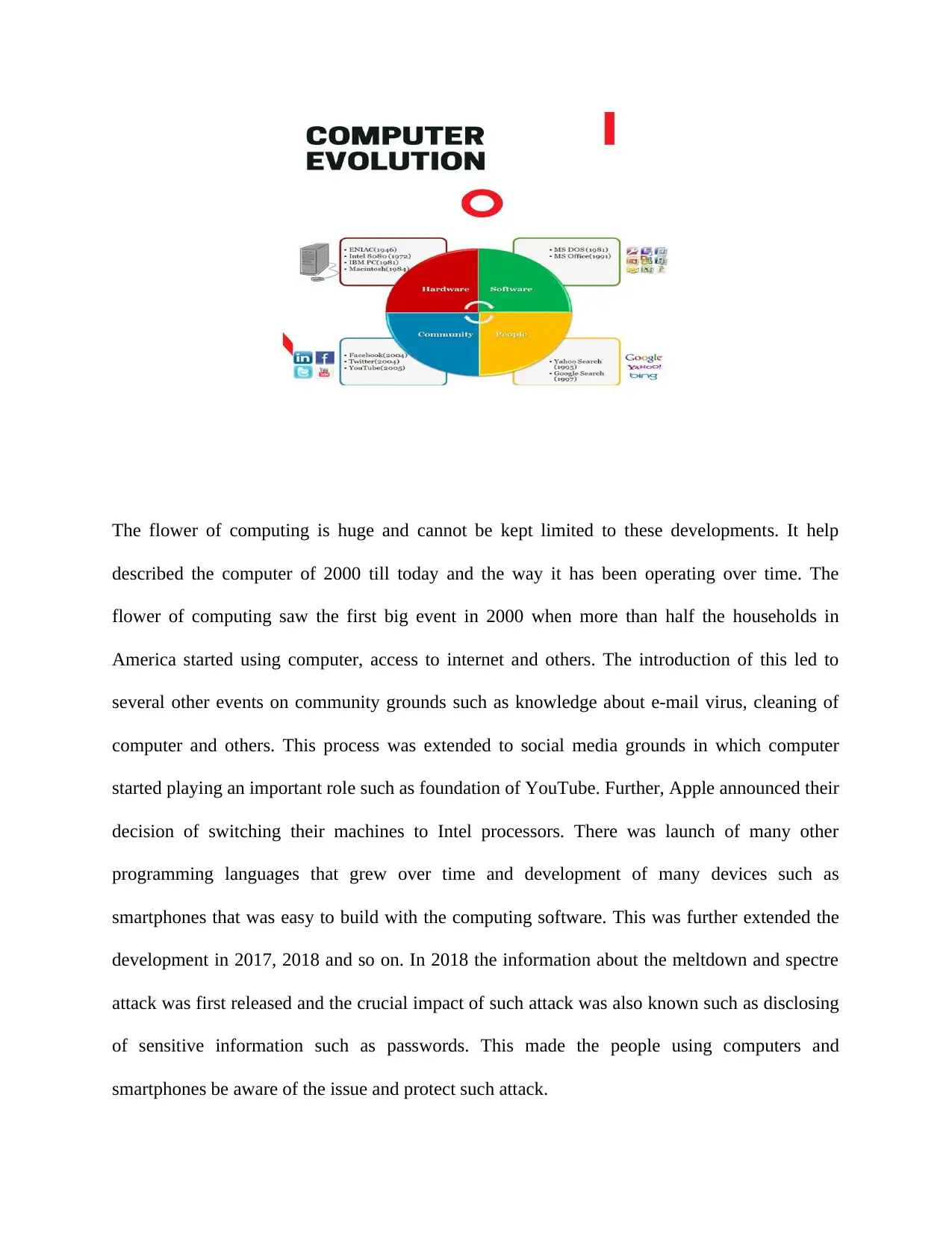
The flower of computing is huge and cannot be kept limited to these developments. It help
described the computer of 2000 till today and the way it has been operating over time. The
flower of computing saw the first big event in 2000 when more than half the households in
America started using computer, access to internet and others. The introduction of this led to
several other events on community grounds such as knowledge about e-mail virus, cleaning of
computer and others. This process was extended to social media grounds in which computer
started playing an important role such as foundation of YouTube. Further, Apple announced their
decision of switching their machines to Intel processors. There was launch of many other
programming languages that grew over time and development of many devices such as
smartphones that was easy to build with the computing software. This was further extended the
development in 2017, 2018 and so on. In 2018 the information about the meltdown and spectre
attack was first released and the crucial impact of such attack was also known such as disclosing
of sensitive information such as passwords. This made the people using computers and
smartphones be aware of the issue and protect such attack.
described the computer of 2000 till today and the way it has been operating over time. The
flower of computing saw the first big event in 2000 when more than half the households in
America started using computer, access to internet and others. The introduction of this led to
several other events on community grounds such as knowledge about e-mail virus, cleaning of
computer and others. This process was extended to social media grounds in which computer
started playing an important role such as foundation of YouTube. Further, Apple announced their
decision of switching their machines to Intel processors. There was launch of many other
programming languages that grew over time and development of many devices such as
smartphones that was easy to build with the computing software. This was further extended the
development in 2017, 2018 and so on. In 2018 the information about the meltdown and spectre
attack was first released and the crucial impact of such attack was also known such as disclosing
of sensitive information such as passwords. This made the people using computers and
smartphones be aware of the issue and protect such attack.
⊘ This is a preview!⊘
Do you want full access?
Subscribe today to unlock all pages.
Trusted by 1+ million students worldwide
The new type of computer products and services that saw its introduction during 2018 included
Google Pay, Zen by AMD, Surface Go by Microsoft, Surface Studio 2 by Microsoft and others.
the development of this computer enabled devices did not stop there and continue even today in
2019 such as the release of Apex Legends, shut down of Google plus by Google, shut down of
ultraviolet service and others. This showed that the evolution of computer, its devices and
services did not stop anytime and will continue to evolve over time even after this. This is
because there is not end to the development of computer and scientists are working day and night
to bring a better version of laptops, notebooks, desktops and others. Each generation will be a
better one with increased automation of services over time better security to the system and
information being stored in the computer.
Google Pay, Zen by AMD, Surface Go by Microsoft, Surface Studio 2 by Microsoft and others.
the development of this computer enabled devices did not stop there and continue even today in
2019 such as the release of Apex Legends, shut down of Google plus by Google, shut down of
ultraviolet service and others. This showed that the evolution of computer, its devices and
services did not stop anytime and will continue to evolve over time even after this. This is
because there is not end to the development of computer and scientists are working day and night
to bring a better version of laptops, notebooks, desktops and others. Each generation will be a
better one with increased automation of services over time better security to the system and
information being stored in the computer.

1 out of 10


Related Documents


Your All-in-One AI-Powered Toolkit for Academic Success.
+13062052269
info@desklib.com
Available 24*7 on WhatsApp / Email
![[object Object]](/_next/static/media/star-bottom.7253800d.svg)
Unlock your academic potential
Copyright © 2020–2026 A2Z Services. All Rights Reserved. Developed and managed by ZUCOL.