Analyzing Elasticity of Demand to Optimize Agility Logistics' Pricing

Verified

Added on  2023/05/27

|7
|1693
|341
Report
AI Summary
This report explores the application of demand elasticity within Agility Logistics Limited, focusing on how this economic concept can inform and optimize the company's pricing strategies. It begins with a comprehensive overview of the concept of elasticity of demand, explaining its types (elastic, inelastic, unitary elastic) and the factors that influence it, such as substitutes, time frame, percentage of income, and necessity. The report then delves into the various uses of the elasticity of demand formula, including forecasting potential total revenue, identifying the presence of substitutes, enabling price differentiation, and informing taxation decisions. The core of the report emphasizes the importance of price elasticity of demand (PED) in business decision-making, particularly within international trade, factor pricing, monopolist decisions, and government policy formulation, and its relevance in understanding the paradox of poverty amid plenty. The report concludes by underscoring the necessity of understanding PED for businesses involved in the production process to effectively manage pricing strategies. The report uses references to support its findings.
Document Page
INTRODUCTION
The main purpose of this study is to discuss how a company (Agility logistics limited)
can use the concept of elasticity of demand regarding pricing strategy, prior to been
employed as the transport and logistics manager.
Concept of Elasticity of Demand
The law of demand explains the kind of relationship between price and quantity
demanded and shows how a decrease in price will result in an increase in quantity
demanded and vice versa. Managers are more concerned with determining the
magnitude of the change or the degree of consumer responsiveness to a change in any
determinants or variables when there has been a change in the price, the consumer's
income, the price of other goods, or the cost of advertisements, in addition to the
direction of the change in quantity demanded. Utilizing the idea of demand elasticity,
they quantify this. Demand elasticity indicates how much a given change in a particular
factor affecting demand (such as the item's price, changes in customers' income, or
changes in the cost of related goods and advertisements, etc.) affects the quantity
demanded.
A reasonable explanation for the rule of demand is that the up and down movement in
pricing for goods on the market influences the movement in quantity of goods on the
market and also tells how customers react to the number of items they buy. The amount
of items that will be demanded and how much the price will change are not, however,
specified by this law. The ideas of demand elasticity come into play here.
Demand elasticity is also known as price elasticity of demand. However, it has sparked
a lot of debate in a variety of schools of thought and has contributed to the development
of economic theories regarding the responsiveness to customer demand for quantity of
commodities in relation to price fluctuation. Different theories of demand elasticity exist.
Based on the elasticity of demand, which is influenced by a good's price, the average
income of its consumers, the pricing of comparable items, etc., a good's demand can be
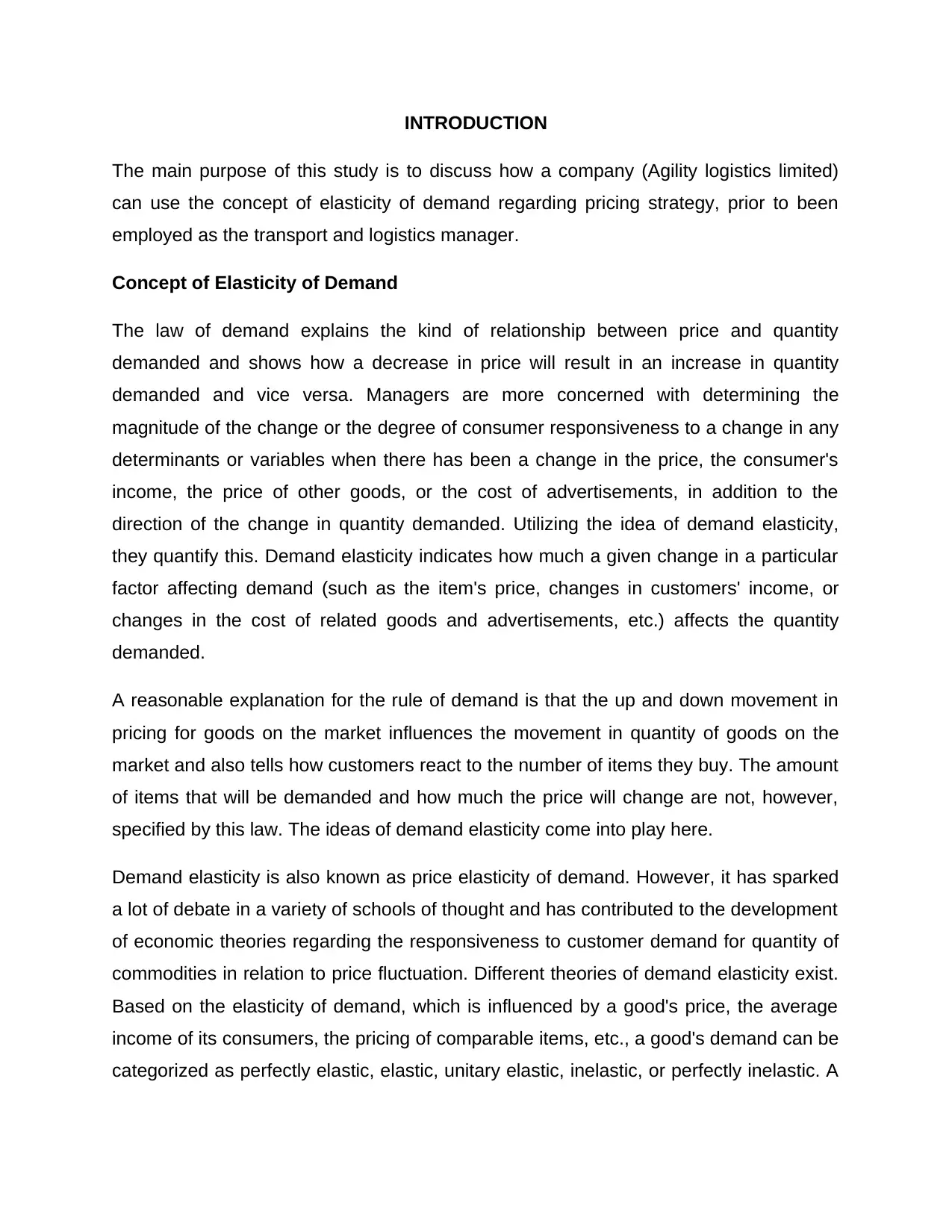
categorized as perfectly elastic, elastic, unitary elastic, inelastic, or perfectly inelastic. A
tabler-icon-diamond-filled.svg

Paraphrase This Document

Need a fresh take? Get an instant paraphrase of this document with our AI Paraphraser
Document Page
change in the size of any of these demand drivers will alter the quantity requested for an
item.
Accordingly, the concepts of elasticity of demand refer to the degree of responsiveness
of the quantity sought of items to a change in its value or price, salary, and costs of
connected goods.
Types of Elasticity of Demand
There are two types of demand elasticity. The kind is determined by the ED formula's
ultimate result.
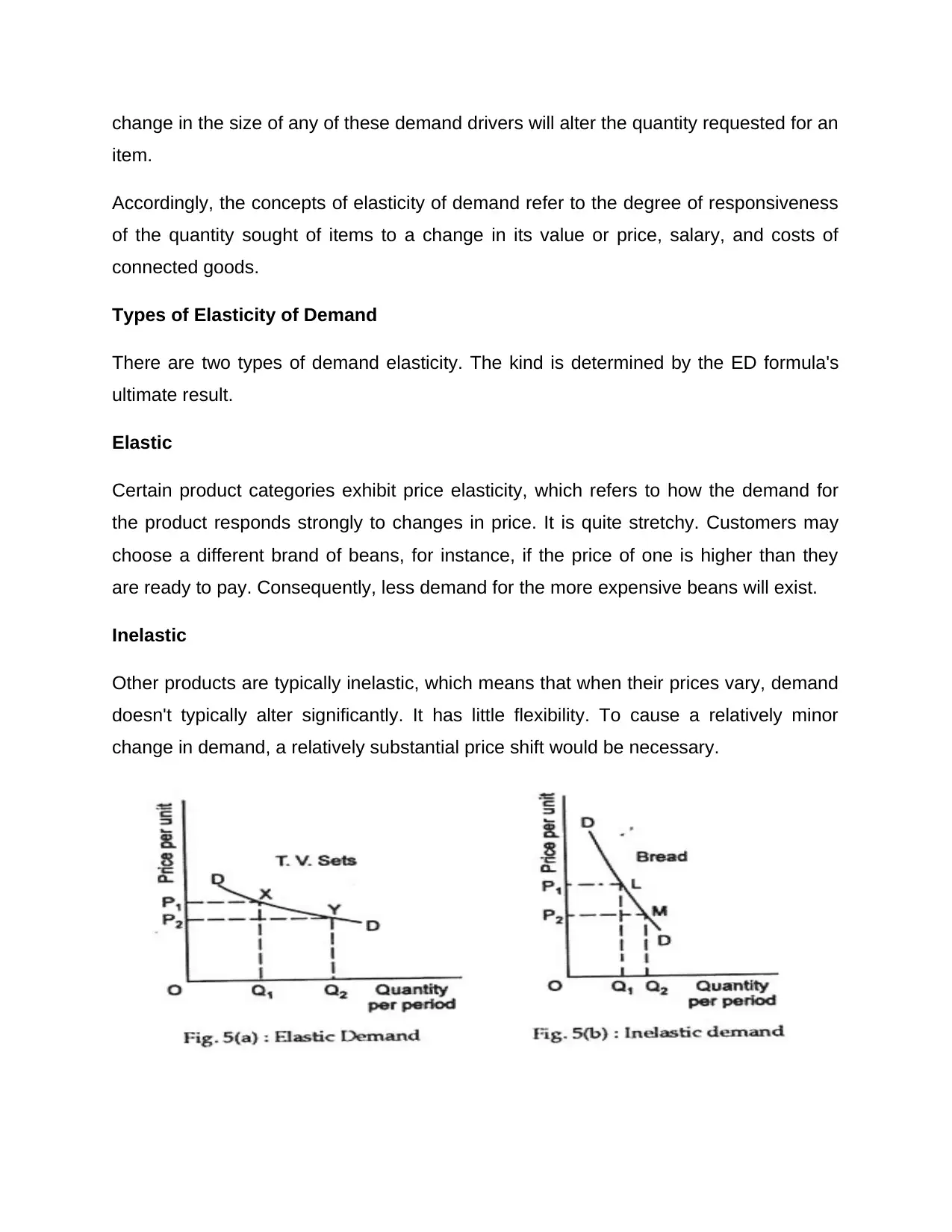
Elastic
Certain product categories exhibit price elasticity, which refers to how the demand for
the product responds strongly to changes in price. It is quite stretchy. Customers may
choose a different brand of beans, for instance, if the price of one is higher than they
are ready to pay. Consequently, less demand for the more expensive beans will exist.
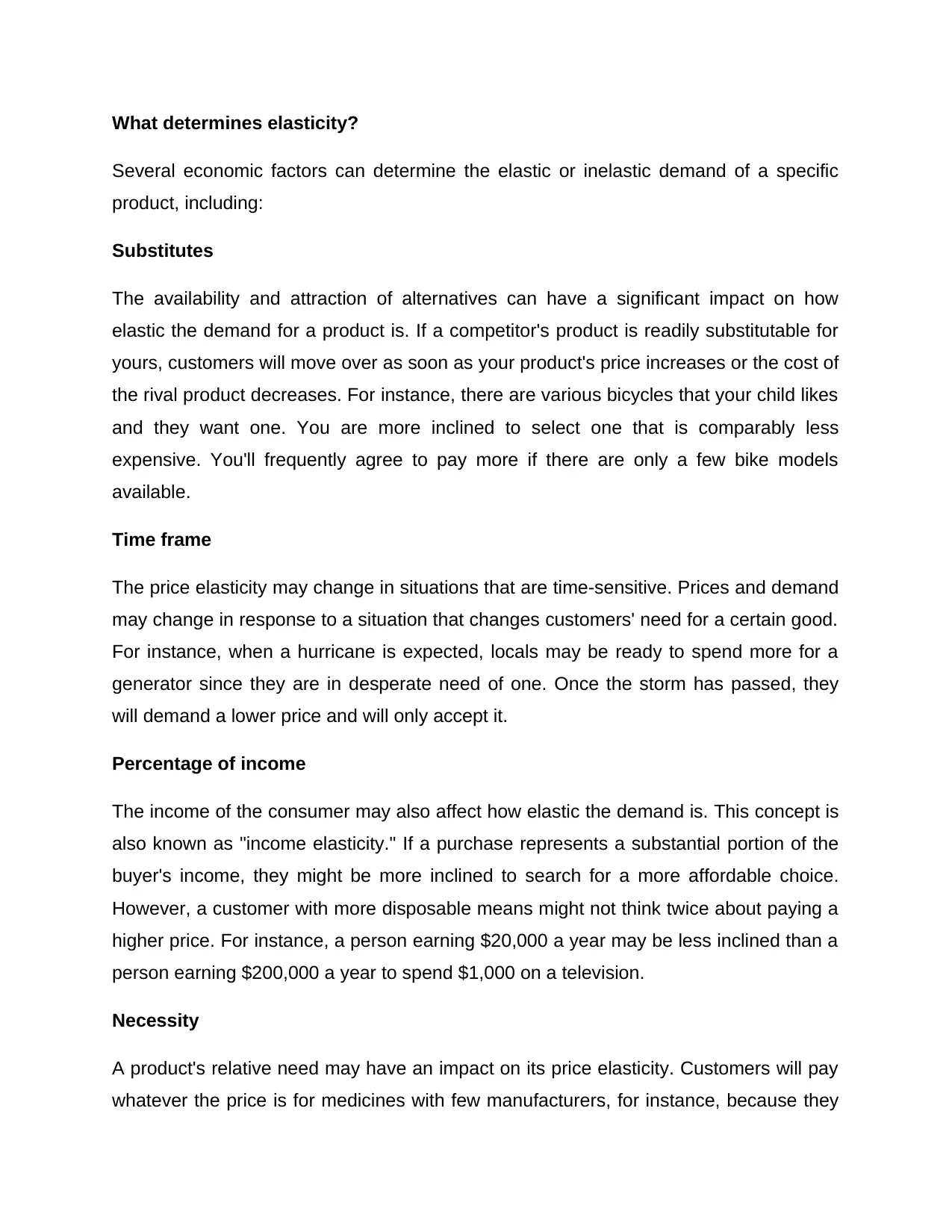
Inelastic
Other products are typically inelastic, which means that when their prices vary, demand
doesn't typically alter significantly. It has little flexibility. To cause a relatively minor
change in demand, a relatively substantial price shift would be necessary.
Document Page
What determines elasticity?
Several economic factors can determine the elastic or inelastic demand of a specific
product, including:
Substitutes
The availability and attraction of alternatives can have a significant impact on how
elastic the demand for a product is. If a competitor's product is readily substitutable for
yours, customers will move over as soon as your product's price increases or the cost of
the rival product decreases. For instance, there are various bicycles that your child likes
and they want one. You are more inclined to select one that is comparably less
expensive. You'll frequently agree to pay more if there are only a few bike models
available.
Time frame
The price elasticity may change in situations that are time-sensitive. Prices and demand
may change in response to a situation that changes customers' need for a certain good.
For instance, when a hurricane is expected, locals may be ready to spend more for a
generator since they are in desperate need of one. Once the storm has passed, they
will demand a lower price and will only accept it.
Percentage of income
The income of the consumer may also affect how elastic the demand is. This concept is
also known as "income elasticity." If a purchase represents a substantial portion of the
buyer's income, they might be more inclined to search for a more affordable choice.
However, a customer with more disposable means might not think twice about paying a
higher price. For instance, a person earning $20,000 a year may be less inclined than a
person earning $200,000 a year to spend $1,000 on a television.
Necessity
A product's relative need may have an impact on its price elasticity. Customers will pay
whatever the price is for medicines with few manufacturers, for instance, because they
Document Page
have a medical necessity. Because buyers may decide against purchasing a luxury item
if they believe the price is too high, such as a designer handbag, the elasticity of
demand for such a product may be lower.
Different uses for the elasticity of demand formula
The following details can be ascertained using the elasticity of demand formula:
Potential total revenue
Demand elasticity can assist a company in forecasting how much revenue a product will
bring in given market conditions. Making educated decisions about prices and products
can be aided by understanding how much money your company might make at a
particular price point.
Presence of substitutes
You can determine whether there are competing products on the market by knowing the
elasticity of demand for a product. If you observe that demand for your goods fluctuates
more or less than you expected when determining your prices, it's possible that
alternative goods are grabbing customers' attention.
Price differentiation
A company can use price elasticity of demand to analyze whether it would be OK to
charge certain amounts under various conditions. This technique, for instance, may be
used to estimate whether it would be viable to offer a tiered subscription model with
various price points if you provide a movie subscription service.
Taxation
If a company wants to know whether they should account for the cost of any new taxes
when determining prices for their products, demand elasticity can be helpful. You might
wish to include all or a portion of the tax in your rates for goods like alcohol and
cigarettes, which are frequently taxed.
tabler-icon-diamond-filled.svg

Paraphrase This Document

Need a fresh take? Get an instant paraphrase of this document with our AI Paraphraser
Document Page
Different conceptions of elasticity of demand exist, but the Price Elasticity of Demand
(PED) concept is the most significant when it comes to making or taking decisions in
business, organizations, governments, and on a global scale. From the perspective of
international trade, it is important.
Government policy formulation, monopolist decisions, factor pricing, and the paradox of
poverty in a world of plenty
IMPORTANCE OF ELASTICITY OF DEMAND
International trade: Organizations in charge of trades and businesses that do
business with other nations need to understand the elasticity of demand for the
products they sell because if they set a high price for a good and assume that
demand will be inelastic until the product is imported, the company will have to
lower its price.
Element pricing: Businesses utilize the price elasticity of demand to calculate the
price to be paid for a production element at a particular period.
Monopolist decision: Monopolists utilize the PED to determine whether to
arrange their prices to be elastic or inelastic so they will know whether to lower or
raise their prices.
Price elasticity of demand is necessary in the creation of government policies,
particularly in the formulation of the taxation policy so that inelastic commodities
can be taxed more heavily and elastic items can be taxed less heavily.
The paradox of poverty with a plenty of goods and services is mostly connected
to inelastic demand. The price drops at this stage, and ultimately, the revenue
drops as well, for products where supplies are large due to unplanned
manufacturing.
Conclusion
In particular, the idea and knowledge of PED can be used in a wide variety of life and
work situations, as I have explained at the importance of price elasticity of demand: for
instance, the international trade perspective, the formulation of government policies,
factor pricing, decisions made by monopolists, and the paradox of poverty amidst
Document Page
plenty. To know when to raise or lower the price of the items in the market, however,
and for all businesses involved in the production process, price elasticity of demand is a
must.
Document Page
REFERENCES
Parkin, Michael; Powell, Melanie; Matthews, Kent (2002). Economics. Harlow:
Addison-Wesley.
Sloman, John (2006). Economics. Financial Times Prentice Hall. Retrieved 5
March 2010.
Economics: Private and Public Choice, James D. Gwartney and Richard L.
Stroup, eighth edition 1997, seventh edition 1995
Hendrick S. Houthakker and Lester D. Taylor, Consumer Demand in the United
States, 1929-1970 (Cambridge: Harvard University Press, 1966,1970)
Douglas R. Bohi, Analyzing Demand Behavior (Baltimore: Johns Hopkins
University Press, 1981)
chevron_up_icon
1 out of 7
circle_padding
hide_on_mobile
zoom_out_icon
[object Object]