Conflict Management Case Study: Departmental Heads' Conflict Analysis
VerifiedAdded on 2019/09/20
|9
|3458
|339
Case Study
AI Summary
This case study analyzes an interpersonal conflict within a Canadian private enterprise, focusing on a dispute between the head of research and development and the head of the production department regarding resource allocation. The conflict arose from differing objectives, with the R&D department prioritizing customer needs research and the production department aiming to meet sales quotas. The case explores conflict as perception, feeling, and action, detailing the negotiation process and strategies employed to resolve the issue. The author, acting as a negotiator, utilized various negotiation skills at each stage, including encoding social indications, interpreting cues, and evaluating strategies such as collaboration. The study highlights the importance of understanding differing needs, preferences, and leveraging these differences to create value and resolve workplace conflicts. The case concludes with a successful negotiation, resulting in an agreement on resource allocation and organizational goals.

Conflict Management
[Document subtitle]
[DATE]
[Company name]
[Company address]
[Document subtitle]
[DATE]
[Company name]
[Company address]

Paraphrase This Document
Need a fresh take? Get an instant paraphrase of this document with our AI Paraphraser
Conflict Management 1
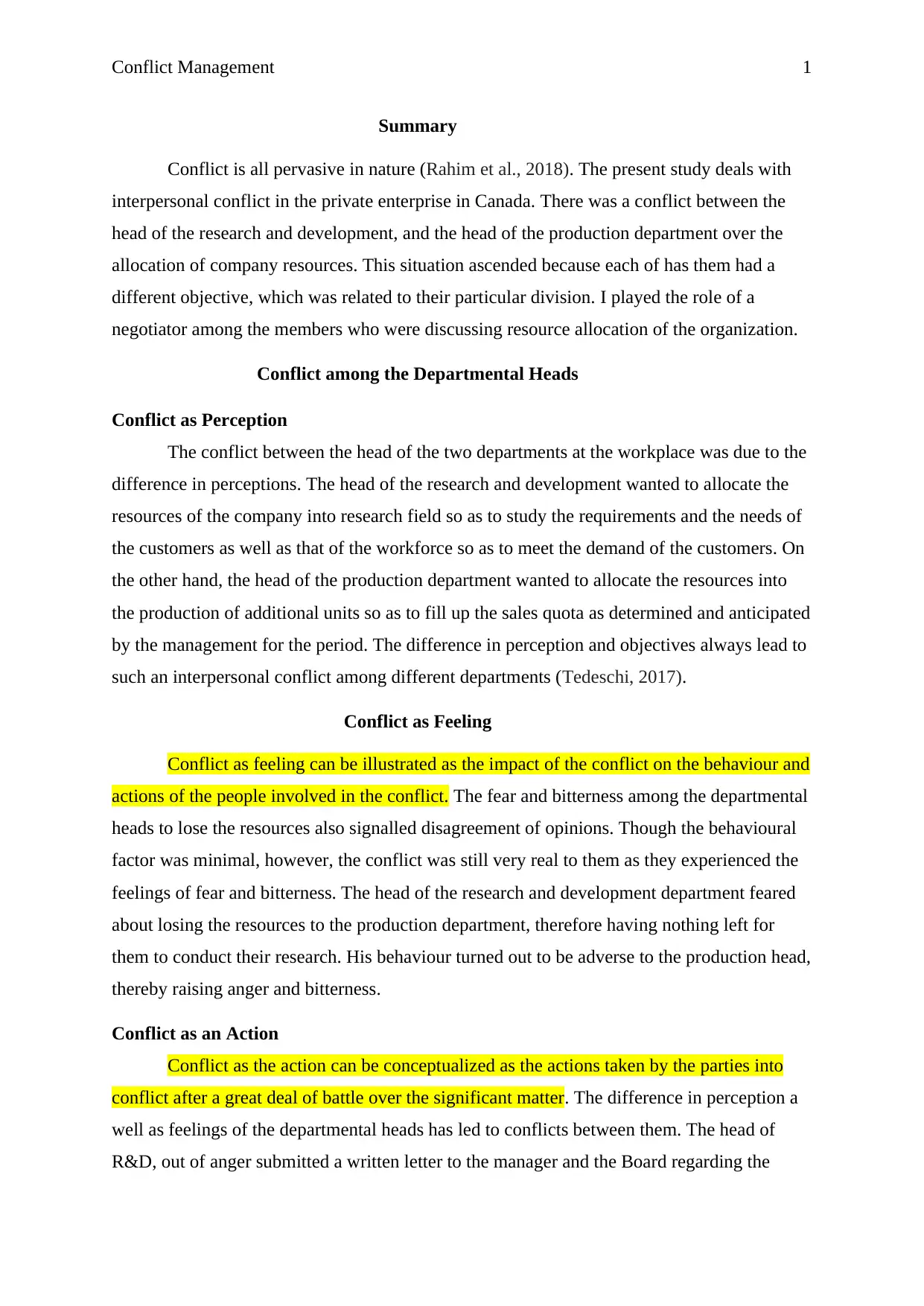
Summary
Conflict is all pervasive in nature (Rahim et al., 2018). The present study deals with
interpersonal conflict in the private enterprise in Canada. There was a conflict between the
head of the research and development, and the head of the production department over the
allocation of company resources. This situation ascended because each of has them had a
different objective, which was related to their particular division. I played the role of a
negotiator among the members who were discussing resource allocation of the organization.
Conflict among the Departmental Heads
Conflict as Perception
The conflict between the head of the two departments at the workplace was due to the
difference in perceptions. The head of the research and development wanted to allocate the
resources of the company into research field so as to study the requirements and the needs of
the customers as well as that of the workforce so as to meet the demand of the customers. On
the other hand, the head of the production department wanted to allocate the resources into
the production of additional units so as to fill up the sales quota as determined and anticipated
by the management for the period. The difference in perception and objectives always lead to
such an interpersonal conflict among different departments (Tedeschi, 2017).
Conflict as Feeling
Conflict as feeling can be illustrated as the impact of the conflict on the behaviour and
actions of the people involved in the conflict. The fear and bitterness among the departmental
heads to lose the resources also signalled disagreement of opinions. Though the behavioural
factor was minimal, however, the conflict was still very real to them as they experienced the
feelings of fear and bitterness. The head of the research and development department feared
about losing the resources to the production department, therefore having nothing left for
them to conduct their research. His behaviour turned out to be adverse to the production head,
thereby raising anger and bitterness.
Conflict as an Action
Conflict as the action can be conceptualized as the actions taken by the parties into
conflict after a great deal of battle over the significant matter. The difference in perception a
well as feelings of the departmental heads has led to conflicts between them. The head of
R&D, out of anger submitted a written letter to the manager and the Board regarding the
Summary
Conflict is all pervasive in nature (Rahim et al., 2018). The present study deals with
interpersonal conflict in the private enterprise in Canada. There was a conflict between the
head of the research and development, and the head of the production department over the
allocation of company resources. This situation ascended because each of has them had a
different objective, which was related to their particular division. I played the role of a
negotiator among the members who were discussing resource allocation of the organization.
Conflict among the Departmental Heads
Conflict as Perception
The conflict between the head of the two departments at the workplace was due to the
difference in perceptions. The head of the research and development wanted to allocate the
resources of the company into research field so as to study the requirements and the needs of
the customers as well as that of the workforce so as to meet the demand of the customers. On
the other hand, the head of the production department wanted to allocate the resources into
the production of additional units so as to fill up the sales quota as determined and anticipated
by the management for the period. The difference in perception and objectives always lead to
such an interpersonal conflict among different departments (Tedeschi, 2017).
Conflict as Feeling
Conflict as feeling can be illustrated as the impact of the conflict on the behaviour and
actions of the people involved in the conflict. The fear and bitterness among the departmental
heads to lose the resources also signalled disagreement of opinions. Though the behavioural
factor was minimal, however, the conflict was still very real to them as they experienced the
feelings of fear and bitterness. The head of the research and development department feared
about losing the resources to the production department, therefore having nothing left for
them to conduct their research. His behaviour turned out to be adverse to the production head,
thereby raising anger and bitterness.
Conflict as an Action
Conflict as the action can be conceptualized as the actions taken by the parties into
conflict after a great deal of battle over the significant matter. The difference in perception a
well as feelings of the departmental heads has led to conflicts between them. The head of
R&D, out of anger submitted a written letter to the manager and the Board regarding the
Conflict Management 2
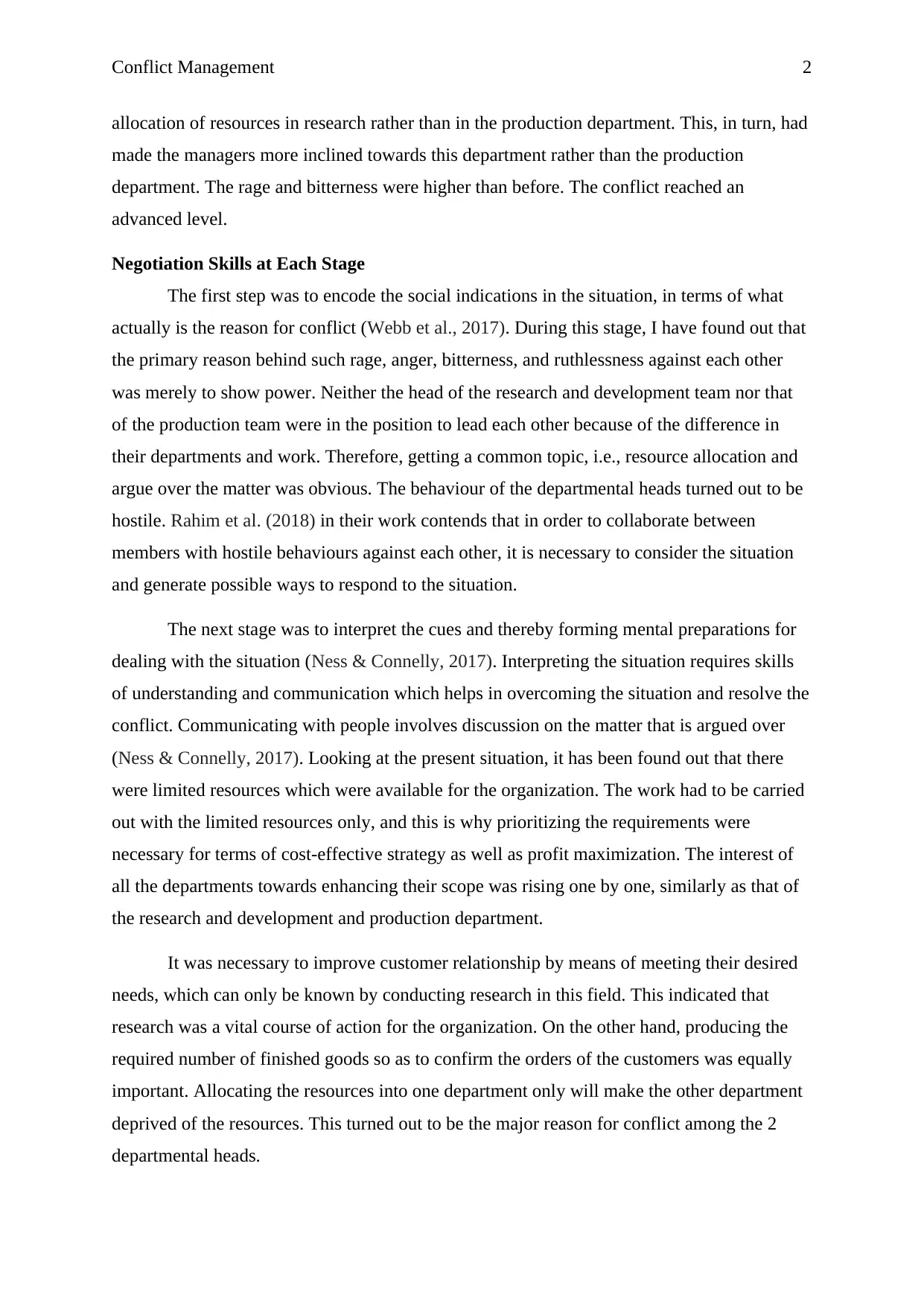
allocation of resources in research rather than in the production department. This, in turn, had
made the managers more inclined towards this department rather than the production
department. The rage and bitterness were higher than before. The conflict reached an
advanced level.
Negotiation Skills at Each Stage
The first step was to encode the social indications in the situation, in terms of what
actually is the reason for conflict (Webb et al., 2017). During this stage, I have found out that
the primary reason behind such rage, anger, bitterness, and ruthlessness against each other
was merely to show power. Neither the head of the research and development team nor that
of the production team were in the position to lead each other because of the difference in
their departments and work. Therefore, getting a common topic, i.e., resource allocation and
argue over the matter was obvious. The behaviour of the departmental heads turned out to be
hostile. Rahim et al. (2018) in their work contends that in order to collaborate between
members with hostile behaviours against each other, it is necessary to consider the situation
and generate possible ways to respond to the situation.
The next stage was to interpret the cues and thereby forming mental preparations for
dealing with the situation (Ness & Connelly, 2017). Interpreting the situation requires skills
of understanding and communication which helps in overcoming the situation and resolve the
conflict. Communicating with people involves discussion on the matter that is argued over
(Ness & Connelly, 2017). Looking at the present situation, it has been found out that there
were limited resources which were available for the organization. The work had to be carried
out with the limited resources only, and this is why prioritizing the requirements were
necessary for terms of cost-effective strategy as well as profit maximization. The interest of
all the departments towards enhancing their scope was rising one by one, similarly as that of
the research and development and production department.
It was necessary to improve customer relationship by means of meeting their desired
needs, which can only be known by conducting research in this field. This indicated that
research was a vital course of action for the organization. On the other hand, producing the
required number of finished goods so as to confirm the orders of the customers was equally
important. Allocating the resources into one department only will make the other department
deprived of the resources. This turned out to be the major reason for conflict among the 2
departmental heads.
allocation of resources in research rather than in the production department. This, in turn, had
made the managers more inclined towards this department rather than the production
department. The rage and bitterness were higher than before. The conflict reached an
advanced level.
Negotiation Skills at Each Stage
The first step was to encode the social indications in the situation, in terms of what
actually is the reason for conflict (Webb et al., 2017). During this stage, I have found out that
the primary reason behind such rage, anger, bitterness, and ruthlessness against each other
was merely to show power. Neither the head of the research and development team nor that
of the production team were in the position to lead each other because of the difference in
their departments and work. Therefore, getting a common topic, i.e., resource allocation and
argue over the matter was obvious. The behaviour of the departmental heads turned out to be
hostile. Rahim et al. (2018) in their work contends that in order to collaborate between
members with hostile behaviours against each other, it is necessary to consider the situation
and generate possible ways to respond to the situation.
The next stage was to interpret the cues and thereby forming mental preparations for
dealing with the situation (Ness & Connelly, 2017). Interpreting the situation requires skills
of understanding and communication which helps in overcoming the situation and resolve the
conflict. Communicating with people involves discussion on the matter that is argued over
(Ness & Connelly, 2017). Looking at the present situation, it has been found out that there
were limited resources which were available for the organization. The work had to be carried
out with the limited resources only, and this is why prioritizing the requirements were
necessary for terms of cost-effective strategy as well as profit maximization. The interest of
all the departments towards enhancing their scope was rising one by one, similarly as that of
the research and development and production department.
It was necessary to improve customer relationship by means of meeting their desired
needs, which can only be known by conducting research in this field. This indicated that
research was a vital course of action for the organization. On the other hand, producing the
required number of finished goods so as to confirm the orders of the customers was equally
important. Allocating the resources into one department only will make the other department
deprived of the resources. This turned out to be the major reason for conflict among the 2
departmental heads.
⊘ This is a preview!⊘
Do you want full access?
Subscribe today to unlock all pages.

Trusted by 1+ million students worldwide

Conflict Management 3
The next step was evaluating the strategies which are most suitable to resolve the
conflict (Ness & Connelly, 2017). According to the point of view of the academics Webb et
al. (2017), there are a number of alternative strategies which can be used so as to resolve
conflicts among team members. These include accommodation, avoidance, compromise, and
collaboration. Rahim et al. (2018) contend that immense skills are necessary for negotiation.
Sometimes, even being experts in compromising and avoiding situations do not help in
resolving the issues. It might worsen the situation as well. Therefore, people must be aware of
the situations before dealing with the conflicts. In addition to this, it is also essential for the
management of an organization that is dealing with conflicts and resolving the same is
essential for the reason that it might lead to unforeseen circumstances as well. As a result of
this, the productivity and performance of the company might get hampered in no cause.
Accommodation involves giving one party what they need and fulfil their desire (Ness
& Connelly, 2017). This will end the situation; however, it might keep the other party
deprived of their desires. Avoiding the situation would cause more conflict and ruin the
stability of the workplace environment. According to Rahim (2017) avoiding the situations
reflects low esteem and low power and unproductive employee. This is why it is an
inappropriate strategy for negotiation and thus must not be tried in the present situation. On
the other hand, compromise is said to be a strategy of mutual understanding with one another.
It is also evident that this strategy most often prevails in such conflicts where both the parties
hold equivalent power approximately (Ness & Connelly, 2017). In the present case, both the
parties held equal power; however, they were not ready to compromise with each other,
assuming that they might lose something valuable.
With my negotiation skills, I tried to calm down the departmental heads. I applied the
collaboration strategy for conflict resolution, i.e., integrated the ideas set out by the
departmental heads together, so as to come to an appropriate solution by the end of the day.
The foundation of trust, as well as optimism, has enabled me to collaborate among the
departmental heads so as to reach agreement on seemingly peripheral issues. Using this skill,
I was able to unite the heads with the equitable and fair agreement as a principle and interest-
based negotiation skill.
Negotiating with the members was not an easy task, as the biggest dilemma occurred
when the head of research and development acted competitively and tried to take advantage
of the collaborative approach. However, I did not turn weak and rather, I showed my own
The next step was evaluating the strategies which are most suitable to resolve the
conflict (Ness & Connelly, 2017). According to the point of view of the academics Webb et
al. (2017), there are a number of alternative strategies which can be used so as to resolve
conflicts among team members. These include accommodation, avoidance, compromise, and
collaboration. Rahim et al. (2018) contend that immense skills are necessary for negotiation.
Sometimes, even being experts in compromising and avoiding situations do not help in
resolving the issues. It might worsen the situation as well. Therefore, people must be aware of
the situations before dealing with the conflicts. In addition to this, it is also essential for the
management of an organization that is dealing with conflicts and resolving the same is
essential for the reason that it might lead to unforeseen circumstances as well. As a result of
this, the productivity and performance of the company might get hampered in no cause.
Accommodation involves giving one party what they need and fulfil their desire (Ness
& Connelly, 2017). This will end the situation; however, it might keep the other party
deprived of their desires. Avoiding the situation would cause more conflict and ruin the
stability of the workplace environment. According to Rahim (2017) avoiding the situations
reflects low esteem and low power and unproductive employee. This is why it is an
inappropriate strategy for negotiation and thus must not be tried in the present situation. On
the other hand, compromise is said to be a strategy of mutual understanding with one another.
It is also evident that this strategy most often prevails in such conflicts where both the parties
hold equivalent power approximately (Ness & Connelly, 2017). In the present case, both the
parties held equal power; however, they were not ready to compromise with each other,
assuming that they might lose something valuable.
With my negotiation skills, I tried to calm down the departmental heads. I applied the
collaboration strategy for conflict resolution, i.e., integrated the ideas set out by the
departmental heads together, so as to come to an appropriate solution by the end of the day.
The foundation of trust, as well as optimism, has enabled me to collaborate among the
departmental heads so as to reach agreement on seemingly peripheral issues. Using this skill,
I was able to unite the heads with the equitable and fair agreement as a principle and interest-
based negotiation skill.
Negotiating with the members was not an easy task, as the biggest dilemma occurred
when the head of research and development acted competitively and tried to take advantage
of the collaborative approach. However, I did not turn weak and rather, I showed my own
Paraphrase This Document
Need a fresh take? Get an instant paraphrase of this document with our AI Paraphraser
Conflict Management 4
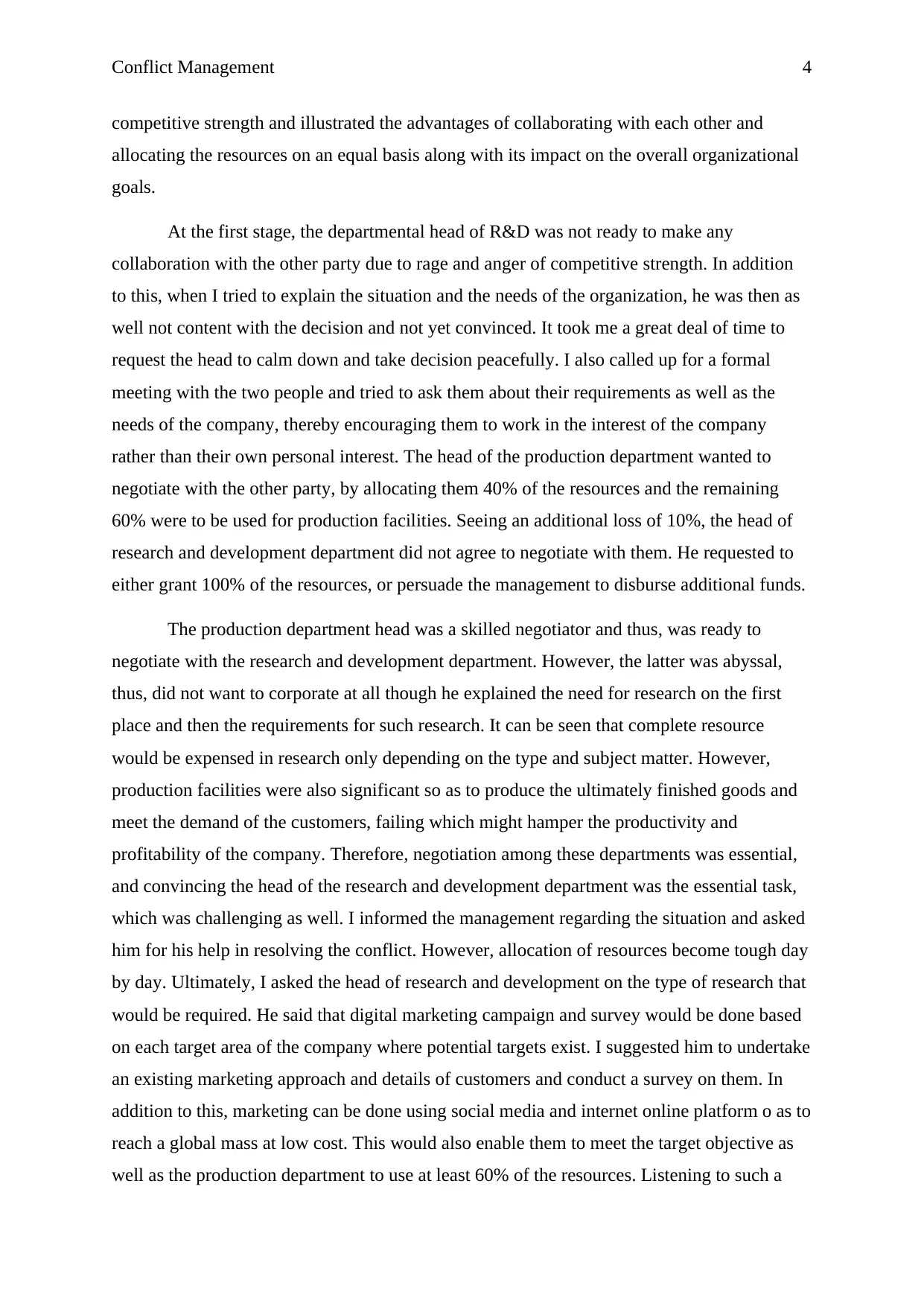
competitive strength and illustrated the advantages of collaborating with each other and
allocating the resources on an equal basis along with its impact on the overall organizational
goals.
At the first stage, the departmental head of R&D was not ready to make any
collaboration with the other party due to rage and anger of competitive strength. In addition
to this, when I tried to explain the situation and the needs of the organization, he was then as
well not content with the decision and not yet convinced. It took me a great deal of time to
request the head to calm down and take decision peacefully. I also called up for a formal
meeting with the two people and tried to ask them about their requirements as well as the
needs of the company, thereby encouraging them to work in the interest of the company
rather than their own personal interest. The head of the production department wanted to
negotiate with the other party, by allocating them 40% of the resources and the remaining
60% were to be used for production facilities. Seeing an additional loss of 10%, the head of
research and development department did not agree to negotiate with them. He requested to
either grant 100% of the resources, or persuade the management to disburse additional funds.
The production department head was a skilled negotiator and thus, was ready to
negotiate with the research and development department. However, the latter was abyssal,
thus, did not want to corporate at all though he explained the need for research on the first
place and then the requirements for such research. It can be seen that complete resource
would be expensed in research only depending on the type and subject matter. However,
production facilities were also significant so as to produce the ultimately finished goods and
meet the demand of the customers, failing which might hamper the productivity and
profitability of the company. Therefore, negotiation among these departments was essential,
and convincing the head of the research and development department was the essential task,
which was challenging as well. I informed the management regarding the situation and asked
him for his help in resolving the conflict. However, allocation of resources become tough day
by day. Ultimately, I asked the head of research and development on the type of research that
would be required. He said that digital marketing campaign and survey would be done based
on each target area of the company where potential targets exist. I suggested him to undertake
an existing marketing approach and details of customers and conduct a survey on them. In
addition to this, marketing can be done using social media and internet online platform o as to
reach a global mass at low cost. This would also enable them to meet the target objective as
well as the production department to use at least 60% of the resources. Listening to such a
competitive strength and illustrated the advantages of collaborating with each other and
allocating the resources on an equal basis along with its impact on the overall organizational
goals.
At the first stage, the departmental head of R&D was not ready to make any
collaboration with the other party due to rage and anger of competitive strength. In addition
to this, when I tried to explain the situation and the needs of the organization, he was then as
well not content with the decision and not yet convinced. It took me a great deal of time to
request the head to calm down and take decision peacefully. I also called up for a formal
meeting with the two people and tried to ask them about their requirements as well as the
needs of the company, thereby encouraging them to work in the interest of the company
rather than their own personal interest. The head of the production department wanted to
negotiate with the other party, by allocating them 40% of the resources and the remaining
60% were to be used for production facilities. Seeing an additional loss of 10%, the head of
research and development department did not agree to negotiate with them. He requested to
either grant 100% of the resources, or persuade the management to disburse additional funds.
The production department head was a skilled negotiator and thus, was ready to
negotiate with the research and development department. However, the latter was abyssal,
thus, did not want to corporate at all though he explained the need for research on the first
place and then the requirements for such research. It can be seen that complete resource
would be expensed in research only depending on the type and subject matter. However,
production facilities were also significant so as to produce the ultimately finished goods and
meet the demand of the customers, failing which might hamper the productivity and
profitability of the company. Therefore, negotiation among these departments was essential,
and convincing the head of the research and development department was the essential task,
which was challenging as well. I informed the management regarding the situation and asked
him for his help in resolving the conflict. However, allocation of resources become tough day
by day. Ultimately, I asked the head of research and development on the type of research that
would be required. He said that digital marketing campaign and survey would be done based
on each target area of the company where potential targets exist. I suggested him to undertake
an existing marketing approach and details of customers and conduct a survey on them. In
addition to this, marketing can be done using social media and internet online platform o as to
reach a global mass at low cost. This would also enable them to meet the target objective as
well as the production department to use at least 60% of the resources. Listening to such a
Conflict Management 5
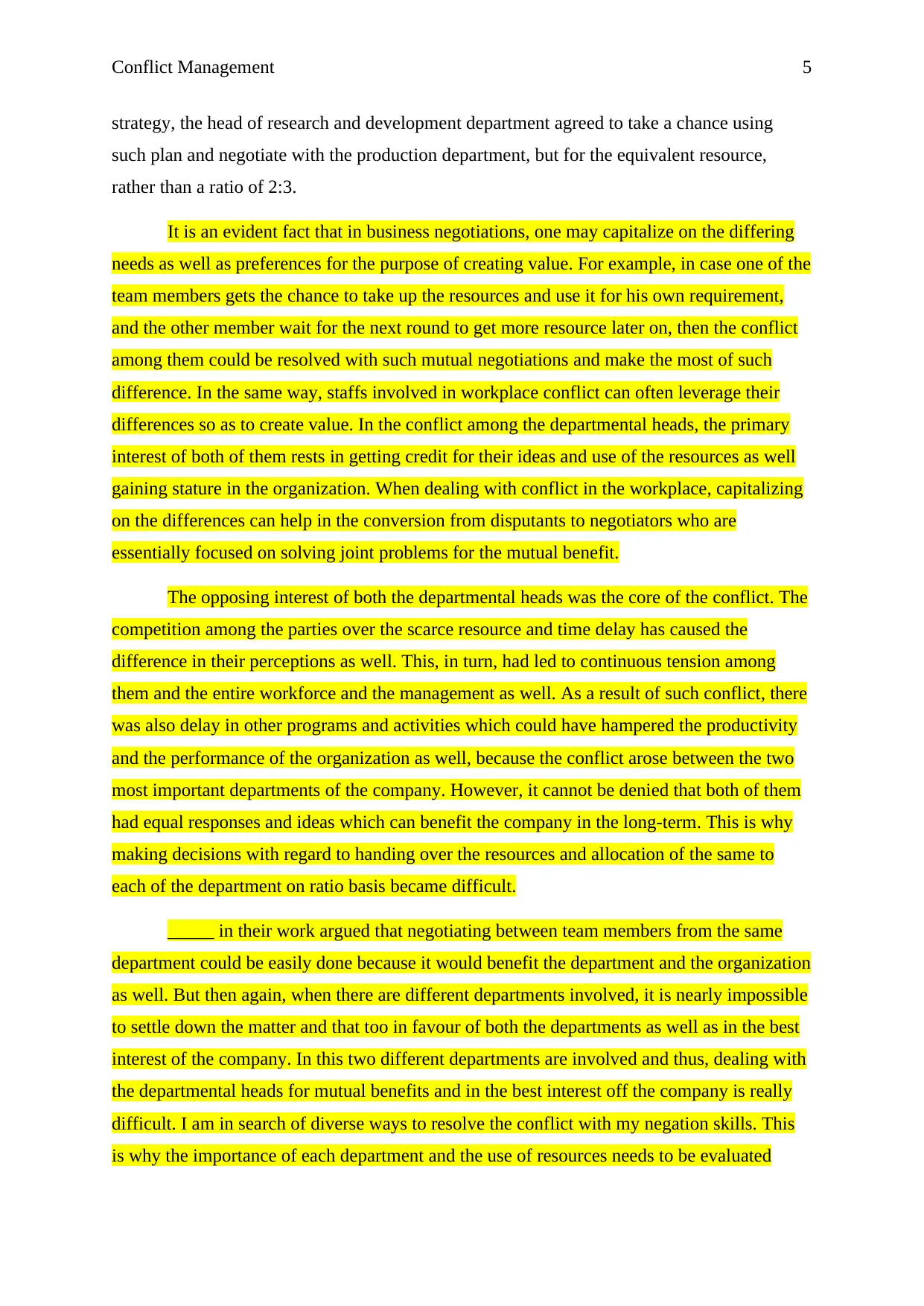
strategy, the head of research and development department agreed to take a chance using
such plan and negotiate with the production department, but for the equivalent resource,
rather than a ratio of 2:3.
It is an evident fact that in business negotiations, one may capitalize on the differing
needs as well as preferences for the purpose of creating value. For example, in case one of the
team members gets the chance to take up the resources and use it for his own requirement,
and the other member wait for the next round to get more resource later on, then the conflict
among them could be resolved with such mutual negotiations and make the most of such
difference. In the same way, staffs involved in workplace conflict can often leverage their
differences so as to create value. In the conflict among the departmental heads, the primary
interest of both of them rests in getting credit for their ideas and use of the resources as well
gaining stature in the organization. When dealing with conflict in the workplace, capitalizing
on the differences can help in the conversion from disputants to negotiators who are
essentially focused on solving joint problems for the mutual benefit.
The opposing interest of both the departmental heads was the core of the conflict. The
competition among the parties over the scarce resource and time delay has caused the
difference in their perceptions as well. This, in turn, had led to continuous tension among
them and the entire workforce and the management as well. As a result of such conflict, there
was also delay in other programs and activities which could have hampered the productivity
and the performance of the organization as well, because the conflict arose between the two
most important departments of the company. However, it cannot be denied that both of them
had equal responses and ideas which can benefit the company in the long-term. This is why
making decisions with regard to handing over the resources and allocation of the same to
each of the department on ratio basis became difficult.
_____ in their work argued that negotiating between team members from the same
department could be easily done because it would benefit the department and the organization
as well. But then again, when there are different departments involved, it is nearly impossible
to settle down the matter and that too in favour of both the departments as well as in the best
interest of the company. In this two different departments are involved and thus, dealing with
the departmental heads for mutual benefits and in the best interest off the company is really
difficult. I am in search of diverse ways to resolve the conflict with my negation skills. This
is why the importance of each department and the use of resources needs to be evaluated
strategy, the head of research and development department agreed to take a chance using
such plan and negotiate with the production department, but for the equivalent resource,
rather than a ratio of 2:3.
It is an evident fact that in business negotiations, one may capitalize on the differing
needs as well as preferences for the purpose of creating value. For example, in case one of the
team members gets the chance to take up the resources and use it for his own requirement,
and the other member wait for the next round to get more resource later on, then the conflict
among them could be resolved with such mutual negotiations and make the most of such
difference. In the same way, staffs involved in workplace conflict can often leverage their
differences so as to create value. In the conflict among the departmental heads, the primary
interest of both of them rests in getting credit for their ideas and use of the resources as well
gaining stature in the organization. When dealing with conflict in the workplace, capitalizing
on the differences can help in the conversion from disputants to negotiators who are
essentially focused on solving joint problems for the mutual benefit.
The opposing interest of both the departmental heads was the core of the conflict. The
competition among the parties over the scarce resource and time delay has caused the
difference in their perceptions as well. This, in turn, had led to continuous tension among
them and the entire workforce and the management as well. As a result of such conflict, there
was also delay in other programs and activities which could have hampered the productivity
and the performance of the organization as well, because the conflict arose between the two
most important departments of the company. However, it cannot be denied that both of them
had equal responses and ideas which can benefit the company in the long-term. This is why
making decisions with regard to handing over the resources and allocation of the same to
each of the department on ratio basis became difficult.
_____ in their work argued that negotiating between team members from the same
department could be easily done because it would benefit the department and the organization
as well. But then again, when there are different departments involved, it is nearly impossible
to settle down the matter and that too in favour of both the departments as well as in the best
interest of the company. In this two different departments are involved and thus, dealing with
the departmental heads for mutual benefits and in the best interest off the company is really
difficult. I am in search of diverse ways to resolve the conflict with my negation skills. This
is why the importance of each department and the use of resources needs to be evaluated
⊘ This is a preview!⊘
Do you want full access?
Subscribe today to unlock all pages.
Trusted by 1+ million students worldwide
Conflict Management 6
based on the current requirements as well as the existing performance of both the departments
and its impact on the company.
It is an evident fact that research is one of the most significant steps for an
organization, which helps in attracting customers (Tedeschi, 2017). But generating sales from
the customers is also important (Powell & Mwangi-Powell, 2017). It cannot be denied that
without research in any field, it becomes a challenging task to identify the potentials and
targets which needs to be achieved. But then again, not meeting the entire targets based on
the survey or research is a shameful act which could be riskier and result in the
ineffectiveness of the team and the organization as well.
I decided to take help from the managerial head to evaluate the use of scarce
resources. On taking the evaluation report from the managerial head, I became aware that not
only research but also production department has performed very well during the past few
months as well as last 4 quarters whenever resources were allocated to them. They used the
resources with full potentials and had effectively improved the performance as well as
productivity of the company. Thus, it again made it difficult to justify the allocation of
resources to any of the party leaving behind the other one.
It is true that most negotiation encompasses situations where we need an ongoing
relationship with the other individual. However, in the present case, there is the corporate
relationship with the two parties in the conflict, and the decisions are to be taken based on the
benefit of both the teams as well as that of the organizational performance. The risk and
challenges of inappropriate resource allocation can cost the company a huge amount. This is
why it is necessary to employ efficient negotiation skills at each stage.
I finally got an opportunity to take my final verdict that production facility must not
stop because it takes more time to produce a finished product. Whereas, research will hardly
take any time to be conducted on any particular target. Moreover, research could be done in
fewer funds and limited resources, whereas production depends on raw materials, labour and
expenses towards the same. This requires not only time but also enormous capital as well.
Therefore, I tried to convince the head of research and development to negotiate with the
other team and work in the interest of the company. In addition to this, I also informed the
departmental head that working with limited resources would not hamper the research, but
the overall production because the process of production is long enough. The behaviour of
the departmental head again turned out to be hostile towards the production team. He started
based on the current requirements as well as the existing performance of both the departments
and its impact on the company.
It is an evident fact that research is one of the most significant steps for an
organization, which helps in attracting customers (Tedeschi, 2017). But generating sales from
the customers is also important (Powell & Mwangi-Powell, 2017). It cannot be denied that
without research in any field, it becomes a challenging task to identify the potentials and
targets which needs to be achieved. But then again, not meeting the entire targets based on
the survey or research is a shameful act which could be riskier and result in the
ineffectiveness of the team and the organization as well.
I decided to take help from the managerial head to evaluate the use of scarce
resources. On taking the evaluation report from the managerial head, I became aware that not
only research but also production department has performed very well during the past few
months as well as last 4 quarters whenever resources were allocated to them. They used the
resources with full potentials and had effectively improved the performance as well as
productivity of the company. Thus, it again made it difficult to justify the allocation of
resources to any of the party leaving behind the other one.
It is true that most negotiation encompasses situations where we need an ongoing
relationship with the other individual. However, in the present case, there is the corporate
relationship with the two parties in the conflict, and the decisions are to be taken based on the
benefit of both the teams as well as that of the organizational performance. The risk and
challenges of inappropriate resource allocation can cost the company a huge amount. This is
why it is necessary to employ efficient negotiation skills at each stage.
I finally got an opportunity to take my final verdict that production facility must not
stop because it takes more time to produce a finished product. Whereas, research will hardly
take any time to be conducted on any particular target. Moreover, research could be done in
fewer funds and limited resources, whereas production depends on raw materials, labour and
expenses towards the same. This requires not only time but also enormous capital as well.
Therefore, I tried to convince the head of research and development to negotiate with the
other team and work in the interest of the company. In addition to this, I also informed the
departmental head that working with limited resources would not hamper the research, but
the overall production because the process of production is long enough. The behaviour of
the departmental head again turned out to be hostile towards the production team. He started
Paraphrase This Document
Need a fresh take? Get an instant paraphrase of this document with our AI Paraphraser
Conflict Management 7
yelling over me regarding the decision take for negotiating with the other team. He said that
this has not only hurt his sentiments but also his ego as he required to negotiate in terms and
conditions with the other team head. I tried to calm him down by ensuring him that the
company will send another member from the organization for dealing with the research and
make budgets on the essential activities of both the department and sort out the matter clearly
and allocate resources as per the requirements.
This convinced the head, and he was ready to make negotiations. However, it took me
longer to take this step due to fear of taking the wrong decision and allocating half of the
resource to the production department. This fear turned out to be my weakness. I could have
made a better deal with the parties if I had the expertise of leading. It did not meet the criteria
of leadership and control.
Working under a senior manager had made me dependent on their decision and
opinion. This could have been improved if I had taken less time to convince the research
department head. This skill could be improved in the future with more practice and
situational influences on ethical sensemaking. I would be further taking training for
managerial leadership skills so as to take up several opportunities to manage interpersonal or
intrapersonal conflicts as well and in favour of the organizational interest.
yelling over me regarding the decision take for negotiating with the other team. He said that
this has not only hurt his sentiments but also his ego as he required to negotiate in terms and
conditions with the other team head. I tried to calm him down by ensuring him that the
company will send another member from the organization for dealing with the research and
make budgets on the essential activities of both the department and sort out the matter clearly
and allocate resources as per the requirements.
This convinced the head, and he was ready to make negotiations. However, it took me
longer to take this step due to fear of taking the wrong decision and allocating half of the
resource to the production department. This fear turned out to be my weakness. I could have
made a better deal with the parties if I had the expertise of leading. It did not meet the criteria
of leadership and control.
Working under a senior manager had made me dependent on their decision and
opinion. This could have been improved if I had taken less time to convince the research
department head. This skill could be improved in the future with more practice and
situational influences on ethical sensemaking. I would be further taking training for
managerial leadership skills so as to take up several opportunities to manage interpersonal or
intrapersonal conflicts as well and in favour of the organizational interest.
Conflict Management 8
References
Ness, A. M., & Connelly, S. (2017). Situational influences on ethical sensemaking:
Performance pressure, interpersonal conflict, and the recipient of
consequences. Human Performance, 30(2-3), 57-78
Powell, R. A., & Mwangi-Powell, F. N. (2017). Female genital mutilation and the
Sustainable Development Goals: The importance of research. Health Care For
Women International, 38(6), 521-526.
Rahim, A. R. A., Noranee, S., Othman, A. K., Shabudin, A., & Anis, A. (2018). Organisation
Restructuring: The Influence of Interpersonal Conflict, Anomie, and Trust in
Management on Counterproductive Work Behaviour. International Journal of
Management and Sustainability, 7(2), 83-92.
Rahim, M. A. (2017). Managing conflict in organizations. Routledge.
Tedeschi, J. T. (2017). Conflict, power, and games: The experimental study of interpersonal
relations. Routledge.
Webb, C. E., Rossignac-Milon, M., & Higgins, E. T. (2017). Stepping forward together:
Could walking facilitate interpersonal conflict resolution?. American
Psychologist, 72(4), 374.
References
Ness, A. M., & Connelly, S. (2017). Situational influences on ethical sensemaking:
Performance pressure, interpersonal conflict, and the recipient of
consequences. Human Performance, 30(2-3), 57-78
Powell, R. A., & Mwangi-Powell, F. N. (2017). Female genital mutilation and the
Sustainable Development Goals: The importance of research. Health Care For
Women International, 38(6), 521-526.
Rahim, A. R. A., Noranee, S., Othman, A. K., Shabudin, A., & Anis, A. (2018). Organisation
Restructuring: The Influence of Interpersonal Conflict, Anomie, and Trust in
Management on Counterproductive Work Behaviour. International Journal of
Management and Sustainability, 7(2), 83-92.
Rahim, M. A. (2017). Managing conflict in organizations. Routledge.
Tedeschi, J. T. (2017). Conflict, power, and games: The experimental study of interpersonal
relations. Routledge.
Webb, C. E., Rossignac-Milon, M., & Higgins, E. T. (2017). Stepping forward together:
Could walking facilitate interpersonal conflict resolution?. American
Psychologist, 72(4), 374.
⊘ This is a preview!⊘
Do you want full access?
Subscribe today to unlock all pages.
Trusted by 1+ million students worldwide

1 out of 9


Related Documents


Your All-in-One AI-Powered Toolkit for Academic Success.
+13062052269
info@desklib.com
Available 24*7 on WhatsApp / Email
![[object Object]](/_next/static/media/star-bottom.7253800d.svg)
Unlock your academic potential
Copyright © 2020–2026 A2Z Services. All Rights Reserved. Developed and managed by ZUCOL.