New Zealand Financial Arrangement Rules: Tax Analysis Assignment

Verified

Added on  2022/08/28

|3
|612
|44
Homework Assignment
AI Summary
This assignment delves into the application of financial arrangement rules within the context of New Zealand tax law. It examines a scenario involving debentures, interest income, and monetary losses, providing a detailed analysis of how these elements are treated under the relevant regulations. The solution addresses the concept of a cash basis person, base price adjustments, and exceptions related to the decline of creditworthiness and cancellation of liability. The assignment further explores a case study involving a US Dollar bond issued by Cammacorp Limited, detailing the financial transactions, exchange rate fluctuations, and the impact of credit rating downgrades on the taxpayer's income. The calculations include interest income earned and received, and the final settlement of debenture investments, all of which contribute to the determination of financial arrangement income, emphasizing the importance of understanding these rules for accurate tax compliance.
Document Page
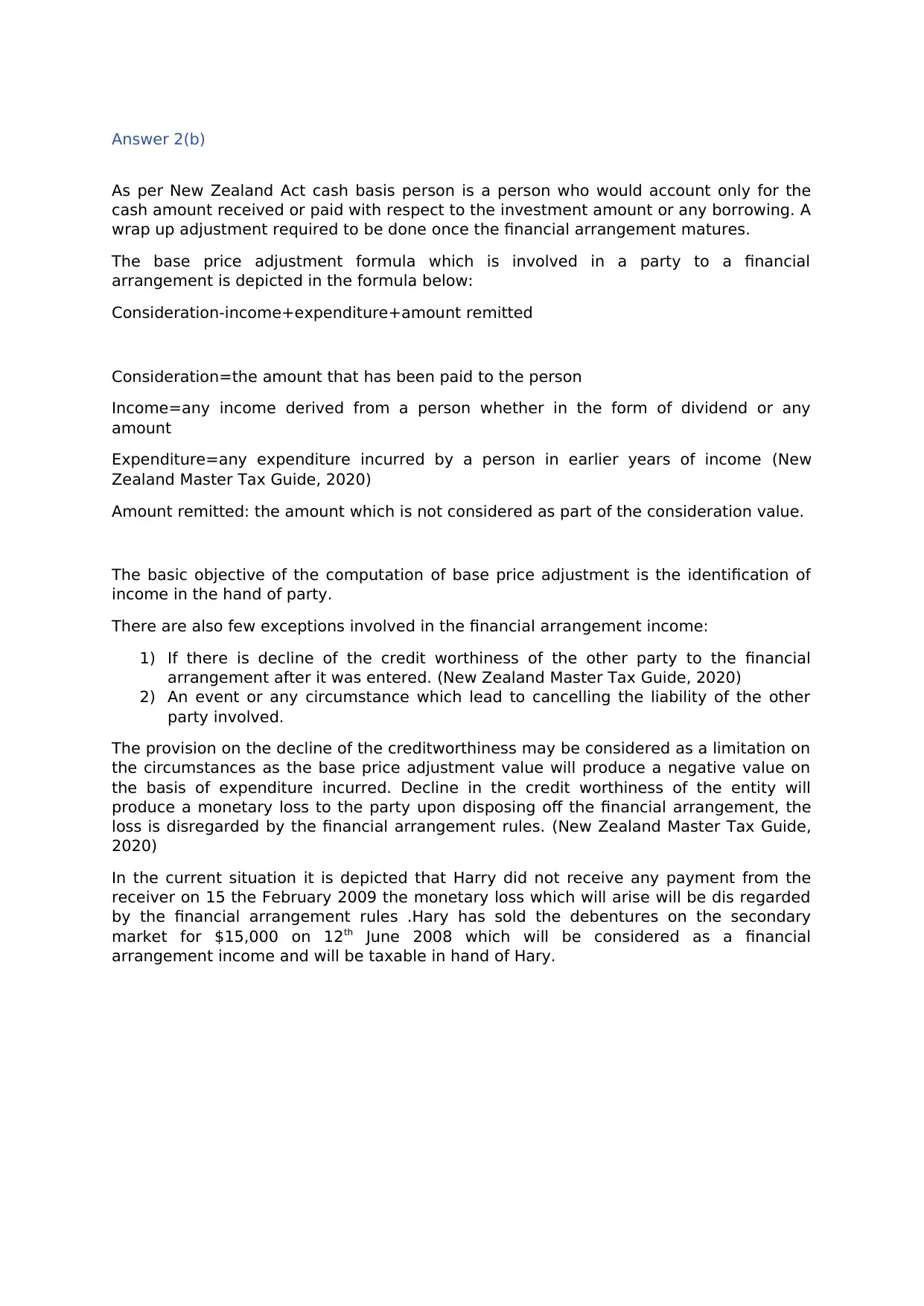
Answer 2(b)
As per New Zealand Act cash basis person is a person who would account only for the
cash amount received or paid with respect to the investment amount or any borrowing. A
wrap up adjustment required to be done once the financial arrangement matures.
The base price adjustment formula which is involved in a party to a financial
arrangement is depicted in the formula below:
Consideration-income+expenditure+amount remitted
Consideration=the amount that has been paid to the person
Income=any income derived from a person whether in the form of dividend or any
amount
Expenditure=any expenditure incurred by a person in earlier years of income (New
Zealand Master Tax Guide, 2020)
Amount remitted: the amount which is not considered as part of the consideration value.
The basic objective of the computation of base price adjustment is the identification of
income in the hand of party.
There are also few exceptions involved in the financial arrangement income:
1) If there is decline of the credit worthiness of the other party to the financial
arrangement after it was entered. (New Zealand Master Tax Guide, 2020)
2) An event or any circumstance which lead to cancelling the liability of the other
party involved.
The provision on the decline of the creditworthiness may be considered as a limitation on
the circumstances as the base price adjustment value will produce a negative value on
the basis of expenditure incurred. Decline in the credit worthiness of the entity will
produce a monetary loss to the party upon disposing off the financial arrangement, the
loss is disregarded by the financial arrangement rules. (New Zealand Master Tax Guide,
2020)
In the current situation it is depicted that Harry did not receive any payment from the
receiver on 15 the February 2009 the monetary loss which will arise will be dis regarded
by the financial arrangement rules .Hary has sold the debentures on the secondary
market for $15,000 on 12th June 2008 which will be considered as a financial
arrangement income and will be taxable in hand of Hary.
tabler-icon-diamond-filled.svg

Paraphrase This Document

Need a fresh take? Get an instant paraphrase of this document with our AI Paraphraser
Document Page
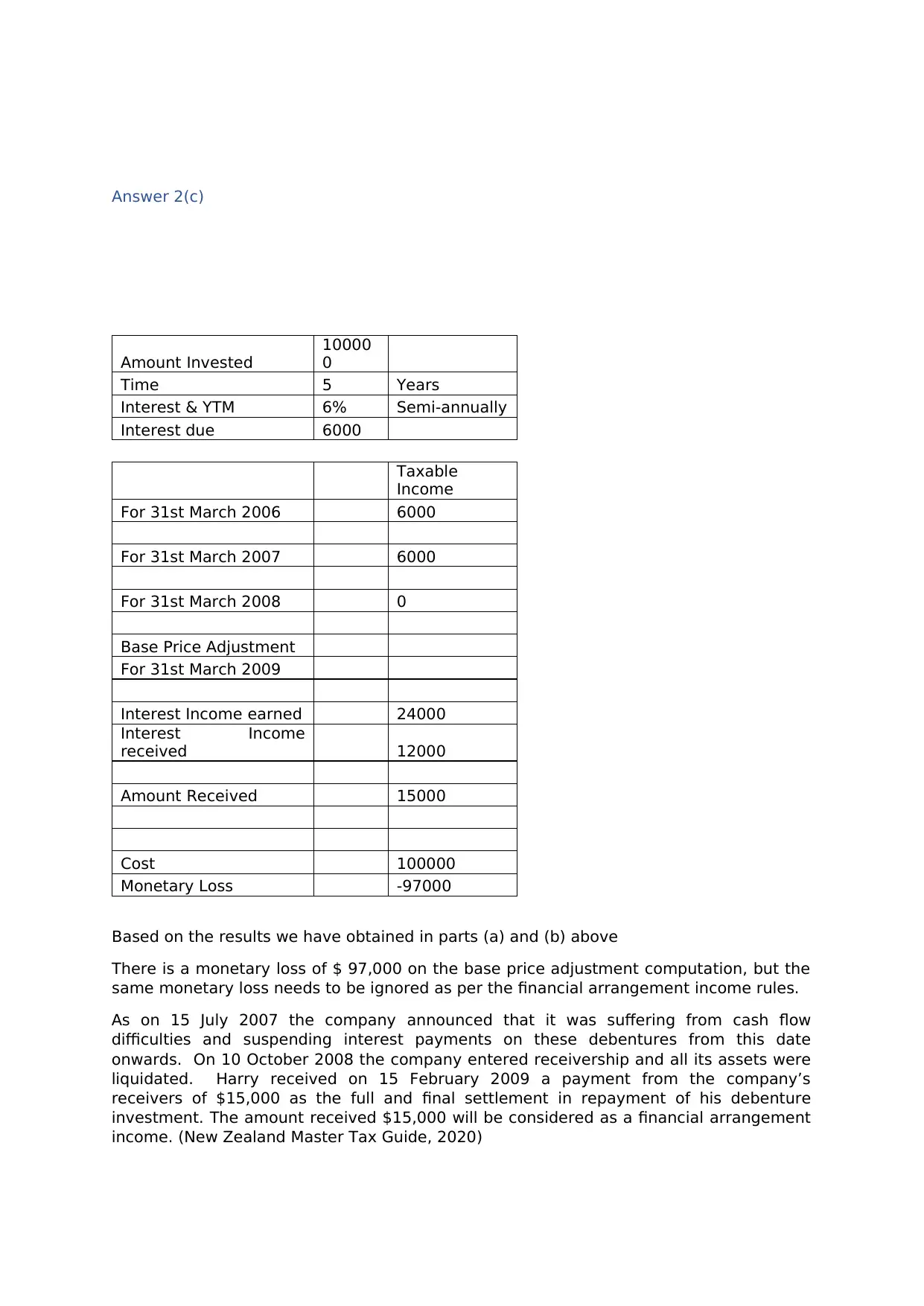
Answer 2(c)
Amount Invested
10000
0
Time 5 Years
Interest & YTM 6% Semi-annually
Interest due 6000
Taxable
Income
For 31st March 2006 6000
For 31st March 2007 6000
For 31st March 2008 0
Base Price Adjustment
For 31st March 2009
Interest Income earned 24000
Interest Income
received 12000
Amount Received 15000
Cost 100000
Monetary Loss -97000
Based on the results we have obtained in parts (a) and (b) above
There is a monetary loss of $ 97,000 on the base price adjustment computation, but the
same monetary loss needs to be ignored as per the financial arrangement income rules.
As on 15 July 2007 the company announced that it was suffering from cash flow
difficulties and suspending interest payments on these debentures from this date
onwards. On 10 October 2008 the company entered receivership and all its assets were
liquidated. Harry received on 15 February 2009 a payment from the company’s
receivers of $15,000 as the full and final settlement in repayment of his debenture
investment. The amount received $15,000 will be considered as a financial arrangement
income. (New Zealand Master Tax Guide, 2020)
Document Page
References
New Zealand Master Tax Guide. (2020, April 5). Retrieved from books.google.co.in:
https://books.google.co.in/books?
id=aZkwAAAAQBAJ&pg=PA392&lpg=PA392&dq=Default+in+payment+treatment+under+ne
w+zealand&source=bl&ots=Xes1bG77KF&sig=ACfU3U3_uOFMXpT5MaG1aacMnFNv2CjEAg
&hl=en&sa=X&ved=2ahUKEwjF8OjP6dHoAhXpIbcAHb_rBjsQ6AEwCXoECA0QMQ#v=onepag
e&
chevron_up_icon
1 out of 3
circle_padding
hide_on_mobile
zoom_out_icon
[object Object]