Constitutional Law Research: Kruger v Commonwealth Case Analysis, 2020
VerifiedAdded on 2023/01/12
|10
|3313
|83
Report
AI Summary
This report provides a comprehensive analysis of the Kruger v. Commonwealth case, focusing on the interpretation of the Aboriginals Ordinance Act (1918) in relation to the Genocide Convention. The report examines the core issue of whether actions authorized by the Ordinance fell within the definition of genocide, as presented to the High Court of Australia. It begins with an introduction to constitutional law, defining its role in defining the roles, power as well as structure of several entities in a state or a nation and the importance of constitutional rights. The main body of the report assesses the majority and minority judgments, exploring the characterization of the legislation, the interpretive approaches used by the judges, and the application of leading decisions. The analysis delves into the claims made by the plaintiffs, including breaches of separation of powers, right to equality, freedom of movement and association, freedom from genocide, and freedom of religion. The report discusses the judges' reasoning, the key legal precedents applied, and the outcomes of each claim. The report concludes by summarizing the preferable interpretive approach based on the analysis and provides a detailed examination of the case's legal and constitutional implications.
Constitutional Law

Paraphrase This Document
Need a fresh take? Get an instant paraphrase of this document with our AI Paraphraser
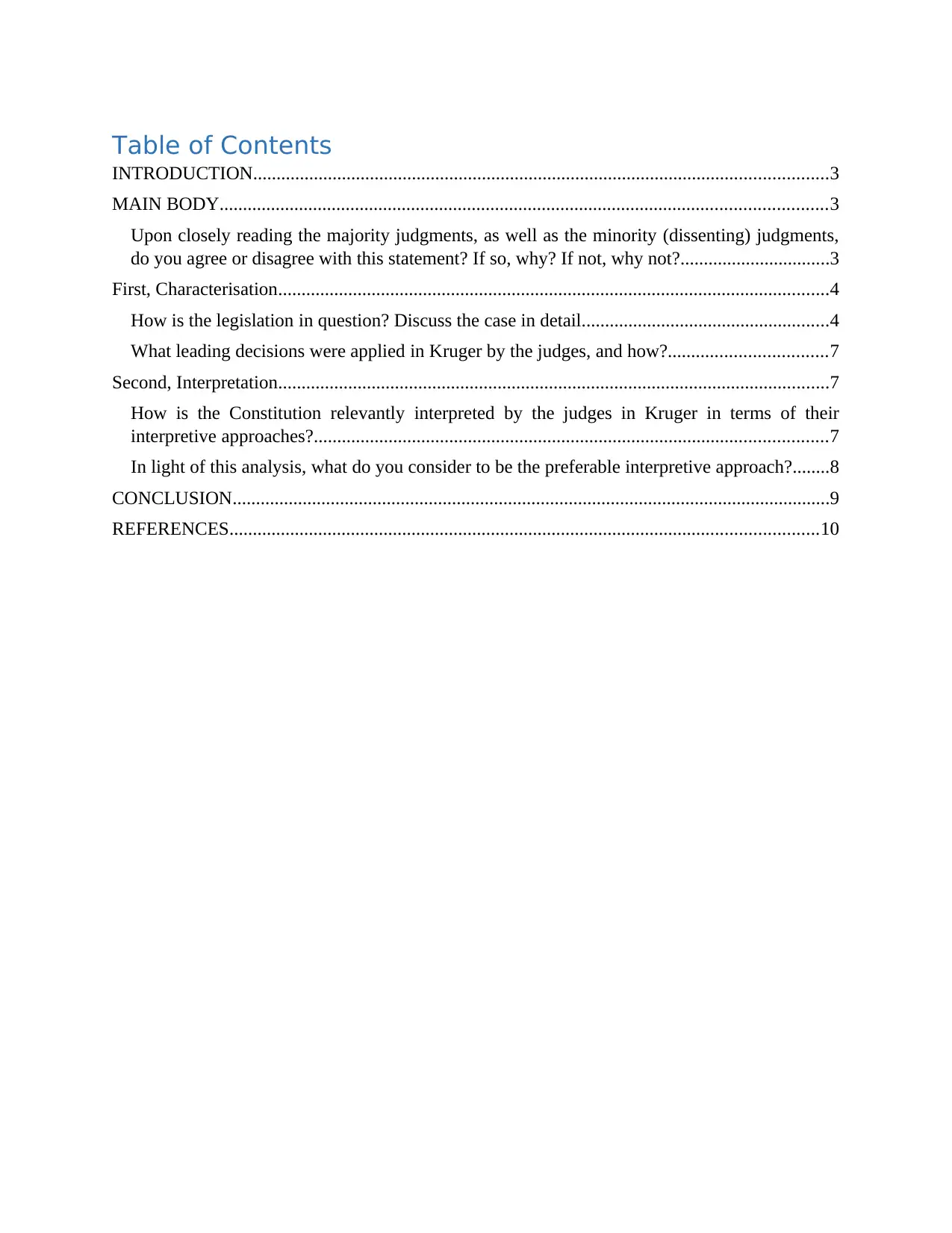
Table of Contents
INTRODUCTION...........................................................................................................................3
MAIN BODY..................................................................................................................................3
Upon closely reading the majority judgments, as well as the minority (dissenting) judgments,
do you agree or disagree with this statement? If so, why? If not, why not?................................3
First, Characterisation......................................................................................................................4
How is the legislation in question? Discuss the case in detail.....................................................4
What leading decisions were applied in Kruger by the judges, and how?..................................7
Second, Interpretation......................................................................................................................7
How is the Constitution relevantly interpreted by the judges in Kruger in terms of their
interpretive approaches?..............................................................................................................7
In light of this analysis, what do you consider to be the preferable interpretive approach?........8
CONCLUSION................................................................................................................................9
REFERENCES..............................................................................................................................10
INTRODUCTION...........................................................................................................................3
MAIN BODY..................................................................................................................................3
Upon closely reading the majority judgments, as well as the minority (dissenting) judgments,
do you agree or disagree with this statement? If so, why? If not, why not?................................3
First, Characterisation......................................................................................................................4
How is the legislation in question? Discuss the case in detail.....................................................4
What leading decisions were applied in Kruger by the judges, and how?..................................7
Second, Interpretation......................................................................................................................7
How is the Constitution relevantly interpreted by the judges in Kruger in terms of their
interpretive approaches?..............................................................................................................7
In light of this analysis, what do you consider to be the preferable interpretive approach?........8
CONCLUSION................................................................................................................................9
REFERENCES..............................................................................................................................10
INTRODUCTION
Constitutional law can be defined as the body of law which simply defines the roles, power
as well as structure of several entities in a state or a nation. It is among one of the most crucial
law which provides the rights and responsibility to every individual which must be followed and
even guides that how any of the decision is required to be taken. In any of the situation breaching
the terms and condition of the law can create huge issue for the person and even legal actions can
be taken easily. The majority of the law which has been developed from the state and federal
supreme court has interpreted the constitutional as well as the law which has passed by
legislation so that chances of violation of the constitutional limits remain almost zero. In context
of the case, there will be discussion about the case which had taken place in 1997 in Australia.
The case had taken place between Kruger v Commonwealth (1997). In this particular case, there
will be major focus on the majority judgement and even the judgement given by minority.
MAIN BODY
Upon closely reading the majority judgments, as well as the minority (dissenting) judgments, do
you agree or disagree with this statement? If so, why? If not, why not?
The case between Kruger and other V. The Commonwealth of Australia had number of
people who were connected with the case. In this respective case, the case was headed in the
category of Genocide. In simple words Genocide means an action taken by some people with the
intention of destroying an individual or a group of people weather completely or in a part. In
other words, it can be also understood as the violation of human rights or right to freedom due to
which people has to face number of problem in their life. In context of the case, there were
different parties whose involvement in the case can be seen easily as they as the one who has to
suffer and against who the decision was being declared by the ruling Commonwealth of
Australia. Those parties are Alec Kruger, Hilda Muir, Connie Cole, Peter Hansen, Kim Hill,
Rosie Napangardi McClary, George Ernest Bray, Janet Zita Wallace, Marjorie Foster, The
Commonwealth of Australia. Looking at the senior and the judgment which was declared by the
Court to dismiss the case of plaintiff to dismiss the case was completely wrong as it directly or
indirectly affect the human right as Right to Freedom and live happily1. It is necessary to
understands for any of the person Right to have freedom plays the most important role and that
1 Kruger v Commonwealth [1997] HCA 27; (1997) 190 CLR 1; (1997) 146 ALR 126; (1997) 71 ALJR 991 (31 July
1997). 2012.
Constitutional law can be defined as the body of law which simply defines the roles, power
as well as structure of several entities in a state or a nation. It is among one of the most crucial
law which provides the rights and responsibility to every individual which must be followed and
even guides that how any of the decision is required to be taken. In any of the situation breaching
the terms and condition of the law can create huge issue for the person and even legal actions can
be taken easily. The majority of the law which has been developed from the state and federal
supreme court has interpreted the constitutional as well as the law which has passed by
legislation so that chances of violation of the constitutional limits remain almost zero. In context
of the case, there will be discussion about the case which had taken place in 1997 in Australia.
The case had taken place between Kruger v Commonwealth (1997). In this particular case, there
will be major focus on the majority judgement and even the judgement given by minority.
MAIN BODY
Upon closely reading the majority judgments, as well as the minority (dissenting) judgments, do
you agree or disagree with this statement? If so, why? If not, why not?
The case between Kruger and other V. The Commonwealth of Australia had number of
people who were connected with the case. In this respective case, the case was headed in the
category of Genocide. In simple words Genocide means an action taken by some people with the
intention of destroying an individual or a group of people weather completely or in a part. In
other words, it can be also understood as the violation of human rights or right to freedom due to
which people has to face number of problem in their life. In context of the case, there were
different parties whose involvement in the case can be seen easily as they as the one who has to
suffer and against who the decision was being declared by the ruling Commonwealth of
Australia. Those parties are Alec Kruger, Hilda Muir, Connie Cole, Peter Hansen, Kim Hill,
Rosie Napangardi McClary, George Ernest Bray, Janet Zita Wallace, Marjorie Foster, The
Commonwealth of Australia. Looking at the senior and the judgment which was declared by the
Court to dismiss the case of plaintiff to dismiss the case was completely wrong as it directly or
indirectly affect the human right as Right to Freedom and live happily1. It is necessary to
understands for any of the person Right to have freedom plays the most important role and that
1 Kruger v Commonwealth [1997] HCA 27; (1997) 190 CLR 1; (1997) 146 ALR 126; (1997) 71 ALJR 991 (31 July
1997). 2012.
⊘ This is a preview!⊘
Do you want full access?
Subscribe today to unlock all pages.

Trusted by 1+ million students worldwide
must not be affected in any of the situation. In addition, the jury of the court has mentioned that
at the time of constituting the law the residents of the Northern Territory had no part to play in
the constitutionally prescribed system of government or the amendment procedure, there was no
implied freedom of movement.
There were number of loop holes in the judgement which was declared by the judges
because they had not considered any of the point related to freedom of movement which is
completely against the law. In addition, they even didn’t consider the point related to Genocide
which is against the constitution and must had understand that people had to face lots of problem
after they were stolen from their family2. If judges would have tried to identified the case in
detail, the judgement which had been declared could have been totally different and even it
would have allowed to bring out the positive outcomes for the affected Aborigines.
First, Characterisation
How is the legislation in question? Discuss the case in detail.
While discussing about the case in detail, it would be important to understand that what
where the main reason that legislation was under the question from the judgement which was
given the case between Kruger v. Commonwealth 1997. It can be easily said that the
interpretation of the law and legal languages and section where implied in the landmark case was
not relevant due to which innocent people who were affected in the case had to suffer a lot in this
particular case. Here, in the case different section of the law Aboriginals Ordinance Act 1918
was used were section 122 played the most significant role for declaring the result. Section 122
gives power to the federal government that constitute the law for government ruling the
territories 3. Altogether, five different claims were made by the plaintiff in this respective case.
the first claim was for Breach of the doctrine of Separation of Judicial Power. Whereas Claim
second was made for Right to Equality. The third claim expresses about Freedom of Movement
as well as Association. In the fourth instance, it can be clearly seen that claim was made for the
freedom from Genocide. Lastly, the fifth claim was for freedom of religion. These were the main
thing which were identified by applicant where they were willing to get justice.
2 Alan J. Ward, "Exporting The British Constitution: Responsible Government In New
Zealand, Canada, Australia And Ireland" (2011) 25(1) The Journal of Commonwealth
& Comparative Politics.
3 Kruger v The Commonwealth.
at the time of constituting the law the residents of the Northern Territory had no part to play in
the constitutionally prescribed system of government or the amendment procedure, there was no
implied freedom of movement.
There were number of loop holes in the judgement which was declared by the judges
because they had not considered any of the point related to freedom of movement which is
completely against the law. In addition, they even didn’t consider the point related to Genocide
which is against the constitution and must had understand that people had to face lots of problem
after they were stolen from their family2. If judges would have tried to identified the case in
detail, the judgement which had been declared could have been totally different and even it
would have allowed to bring out the positive outcomes for the affected Aborigines.
First, Characterisation
How is the legislation in question? Discuss the case in detail.
While discussing about the case in detail, it would be important to understand that what
where the main reason that legislation was under the question from the judgement which was
given the case between Kruger v. Commonwealth 1997. It can be easily said that the
interpretation of the law and legal languages and section where implied in the landmark case was
not relevant due to which innocent people who were affected in the case had to suffer a lot in this
particular case. Here, in the case different section of the law Aboriginals Ordinance Act 1918
was used were section 122 played the most significant role for declaring the result. Section 122
gives power to the federal government that constitute the law for government ruling the
territories 3. Altogether, five different claims were made by the plaintiff in this respective case.
the first claim was for Breach of the doctrine of Separation of Judicial Power. Whereas Claim
second was made for Right to Equality. The third claim expresses about Freedom of Movement
as well as Association. In the fourth instance, it can be clearly seen that claim was made for the
freedom from Genocide. Lastly, the fifth claim was for freedom of religion. These were the main
thing which were identified by applicant where they were willing to get justice.
2 Alan J. Ward, "Exporting The British Constitution: Responsible Government In New
Zealand, Canada, Australia And Ireland" (2011) 25(1) The Journal of Commonwealth
& Comparative Politics.
3 Kruger v The Commonwealth.
Paraphrase This Document
Need a fresh take? Get an instant paraphrase of this document with our AI Paraphraser
Looking at the first Claim, it can be clearly seen that plaintiff was willing that the alleged
which were used for the detention power conferred by Ordinance but in the case of judicial
power it invalidly granted on the Chief Protector which is itself a non-judicial body. Also,
claimant took the help of Chu Kheng Lim v. Minister of Immigration case. In this respective
claim the judges simply explain that the case cannot be claimed because of current standards
which is being followed by the Commonwealth. The panel of judges also discusses that as per
current judicial power adaptation will be one of the most beneficial part for infant aborigines. In
addition, Judges Gaudron describes that law itself authorize the detention in custody. She just
simply discussed that detention with the order of law or through non-judicial authority is not
possible to distinguish. looking at the federal and state law, Gaudron J didn’t found any of the
breach of law and on the other side other judges like Brennan CJ, Dawson and McHugh JJ took
the decision that principle of separation is not operated with the help of federal law under section
122 of Constitution law4. In short, all of the judges did not found that claim can be made against
separation of judicial power. It is the reason that Commonwealth government will retain the
power to take the custody of any citizen against their will and without the involvement of judicial
permission.
In second claim which was made by plaintiff was related with right to equality where
they took the help of Leeth v Commonwealth Case where judges explain that everyone should
be treated equally as per the constitution. But, taking the relevant Ordinance provision into the
consideration, it can be clearly seen that there was the discrimination against the Aborigines.
Here, in this case, judges of this case clarify that this claim is not possible to be made because
there is no substantive doctrine of equality in the Commonwealth Constitution. In addition, the
Judge named Dawson J even gave the socking statement that even there are some of the
circumstances in which Commonwealth Constitution itself allows for the discrimination against
the people. Here, he took the help of some of the section like ss Sl(xix) and Sl(xxvi) which
enable the Commonwealth to pass laws for the benefit or detriment for certain people who
belongs to different race5. He also explained that in future period doctrine can be introduced for
legal equality of every single people.
4 "Commonwealth Developments" (2013) 29(2).
5 Kruger v Commonwealth: Constitutional Rights and the Stolen Generations. 2015
which were used for the detention power conferred by Ordinance but in the case of judicial
power it invalidly granted on the Chief Protector which is itself a non-judicial body. Also,
claimant took the help of Chu Kheng Lim v. Minister of Immigration case. In this respective
claim the judges simply explain that the case cannot be claimed because of current standards
which is being followed by the Commonwealth. The panel of judges also discusses that as per
current judicial power adaptation will be one of the most beneficial part for infant aborigines. In
addition, Judges Gaudron describes that law itself authorize the detention in custody. She just
simply discussed that detention with the order of law or through non-judicial authority is not
possible to distinguish. looking at the federal and state law, Gaudron J didn’t found any of the
breach of law and on the other side other judges like Brennan CJ, Dawson and McHugh JJ took
the decision that principle of separation is not operated with the help of federal law under section
122 of Constitution law4. In short, all of the judges did not found that claim can be made against
separation of judicial power. It is the reason that Commonwealth government will retain the
power to take the custody of any citizen against their will and without the involvement of judicial
permission.
In second claim which was made by plaintiff was related with right to equality where
they took the help of Leeth v Commonwealth Case where judges explain that everyone should
be treated equally as per the constitution. But, taking the relevant Ordinance provision into the
consideration, it can be clearly seen that there was the discrimination against the Aborigines.
Here, in this case, judges of this case clarify that this claim is not possible to be made because
there is no substantive doctrine of equality in the Commonwealth Constitution. In addition, the
Judge named Dawson J even gave the socking statement that even there are some of the
circumstances in which Commonwealth Constitution itself allows for the discrimination against
the people. Here, he took the help of some of the section like ss Sl(xix) and Sl(xxvi) which
enable the Commonwealth to pass laws for the benefit or detriment for certain people who
belongs to different race5. He also explained that in future period doctrine can be introduced for
legal equality of every single people.
4 "Commonwealth Developments" (2013) 29(2).
5 Kruger v Commonwealth: Constitutional Rights and the Stolen Generations. 2015
The third claim was made for freedom of movement and association where it was found
that judges in the case explained that constitution do not grant the freedom of movement as well
as association. But, on the other side, it is also necessary to understand that in any of the situation
people must be provided the freedom to spend their life happily. One of the judge among the
panel explained that some of the law like ss6 and ss 16 of an Ordinance do not allow the people
to enjoy the freedom of movement and association where she also explained that some of the
changes are also required in it for the betterment of a public. There were other judges also, who
found that the freedom of law is not applicable to operate with fetter law which was described
under s 122. Also, Honorable Brenan CJ also denied certain suggested related to freedoms of
association and movement. These liberties may exist only as a logical consequence to the
implicit freedom of political communication. His Honor discovered that somehow the impugned
clauses are not meant to hinder safe contact. If steps were taken that actually impeded political
communication, 'the impermissibility should target at the measures taken, not at the clause that
allegedly approved the action.' In short, Brenan CJ denied for the freedom of Movement and
association 6. Also, this was more than enough to take case ahead for obtaining the effective
result.
The fourth claim was all about Freedom for the Genocide. Here, the claim failed because
there were number of judges who simply expressed that the points which has been raised is not
permissible as per the Convention. The judges relied on the Convention of Genocide where it is
permissible for systematic racial discrimination. The judge’s focuses on the convention where it
is majorly focused about the separation of families on the basis of race. Also, the major focus
was done just for the purpose of controlling the reproduction of indigenous with the help of
removing mixed caste children. But, one of the judge Gaudron J expressed about the right to
freedom for the genocide in the Commonwealth Constitution. It has been explained under section
122 which does not confer power to pass the law against genocide. The fifth claim was made for
Freedom of religion where they claimed that people are separated from their family due to which
they are unable to exercise their religions where they took the help of section 116 of
Constitution. Here, law has been formed which explained about the prohibition for following the
religion. On this particular situation, the judges mutually decided that claim should be rejected
on the ground that all of the terms and condition are not fulfilled as per the guidelines of section
6 "Race Segregation Ordinance Invalid" (2015) 31(3).
that judges in the case explained that constitution do not grant the freedom of movement as well
as association. But, on the other side, it is also necessary to understand that in any of the situation
people must be provided the freedom to spend their life happily. One of the judge among the
panel explained that some of the law like ss6 and ss 16 of an Ordinance do not allow the people
to enjoy the freedom of movement and association where she also explained that some of the
changes are also required in it for the betterment of a public. There were other judges also, who
found that the freedom of law is not applicable to operate with fetter law which was described
under s 122. Also, Honorable Brenan CJ also denied certain suggested related to freedoms of
association and movement. These liberties may exist only as a logical consequence to the
implicit freedom of political communication. His Honor discovered that somehow the impugned
clauses are not meant to hinder safe contact. If steps were taken that actually impeded political
communication, 'the impermissibility should target at the measures taken, not at the clause that
allegedly approved the action.' In short, Brenan CJ denied for the freedom of Movement and
association 6. Also, this was more than enough to take case ahead for obtaining the effective
result.
The fourth claim was all about Freedom for the Genocide. Here, the claim failed because
there were number of judges who simply expressed that the points which has been raised is not
permissible as per the Convention. The judges relied on the Convention of Genocide where it is
permissible for systematic racial discrimination. The judge’s focuses on the convention where it
is majorly focused about the separation of families on the basis of race. Also, the major focus
was done just for the purpose of controlling the reproduction of indigenous with the help of
removing mixed caste children. But, one of the judge Gaudron J expressed about the right to
freedom for the genocide in the Commonwealth Constitution. It has been explained under section
122 which does not confer power to pass the law against genocide. The fifth claim was made for
Freedom of religion where they claimed that people are separated from their family due to which
they are unable to exercise their religions where they took the help of section 116 of
Constitution. Here, law has been formed which explained about the prohibition for following the
religion. On this particular situation, the judges mutually decided that claim should be rejected
on the ground that all of the terms and condition are not fulfilled as per the guidelines of section
6 "Race Segregation Ordinance Invalid" (2015) 31(3).
⊘ This is a preview!⊘
Do you want full access?
Subscribe today to unlock all pages.
Trusted by 1+ million students worldwide
116 as it has apparent the limited utility. On this respective ground and different section, all of
the claim were rejected and due to which it not possible to entertain the case in any of the
circumstances. It certainly had the negative impact on plaintiff as they were the one who has to
suffer from lots of problem and even the case was no resolved due to which other people has to
face the same.
What leading decisions were applied in Kruger by the judges, and how?
After having the analysis on the above characterization, it was easy to determine that the
decision which taken by the judges for the purpose of declaring the decision was based on
Constitution and the different convention. The major use was taken of section 122 which states
about the rights and responsibility given to constitute to Federal government. Even there were
number of convention for Genocide where it has been discussed about the freedom of movement
and association. Also, about the separation of children from their family. To declare the decision
the judges just not limit themselves as there were number of situation where they states that
changes are required within the constitution but still it is not possible to overrule the current law
and according to that the judgement which were taken were appropriate from their point of view.
Second, Interpretation
How is the Constitution relevantly interpreted by the judges in Kruger in terms of their
interpretive approaches?
While having the interpretation of the law and constitution, it can be clearly stated that
judges of this case have not overview the case as per the requirement of law. Fir find out the
judgement they had just mainly focused upon the legal terms and condition and the way it has
expressed to deal with any of the situation. In any of the circumstances, the judges had not tried
that how they can out the people who has been suffering since long time period. They had also
taken the help of section 122 of Constitution which expresses about the fettered by constitutional
rights, on which three of the judges had agreed. On the other side, three of the judged had
constructed the plenary language with the help of section 122 which directly excludes the
application of the rights which were asked by Kruger and other Aboriginals7. Even judges that
there was no involvement has been seen by the government at the time of formation which do
7 "From The Guest Editors: Raphael Lemkin: The “Founder Of The United Nation's
Genocide Convention” As A Historian Of Mass Violence" (2015) 7(4).
the claim were rejected and due to which it not possible to entertain the case in any of the
circumstances. It certainly had the negative impact on plaintiff as they were the one who has to
suffer from lots of problem and even the case was no resolved due to which other people has to
face the same.
What leading decisions were applied in Kruger by the judges, and how?
After having the analysis on the above characterization, it was easy to determine that the
decision which taken by the judges for the purpose of declaring the decision was based on
Constitution and the different convention. The major use was taken of section 122 which states
about the rights and responsibility given to constitute to Federal government. Even there were
number of convention for Genocide where it has been discussed about the freedom of movement
and association. Also, about the separation of children from their family. To declare the decision
the judges just not limit themselves as there were number of situation where they states that
changes are required within the constitution but still it is not possible to overrule the current law
and according to that the judgement which were taken were appropriate from their point of view.
Second, Interpretation
How is the Constitution relevantly interpreted by the judges in Kruger in terms of their
interpretive approaches?
While having the interpretation of the law and constitution, it can be clearly stated that
judges of this case have not overview the case as per the requirement of law. Fir find out the
judgement they had just mainly focused upon the legal terms and condition and the way it has
expressed to deal with any of the situation. In any of the circumstances, the judges had not tried
that how they can out the people who has been suffering since long time period. They had also
taken the help of section 122 of Constitution which expresses about the fettered by constitutional
rights, on which three of the judges had agreed. On the other side, three of the judged had
constructed the plenary language with the help of section 122 which directly excludes the
application of the rights which were asked by Kruger and other Aboriginals7. Even judges that
there was no involvement has been seen by the government at the time of formation which do
7 "From The Guest Editors: Raphael Lemkin: The “Founder Of The United Nation's
Genocide Convention” As A Historian Of Mass Violence" (2015) 7(4).
Paraphrase This Document
Need a fresh take? Get an instant paraphrase of this document with our AI Paraphraser
not allow to raise any of the question in this respective case. When it comes to human rights and
freedom it was found that there were very limited rights have been offer to the public due to
which it is not possible to make any of the claim against the Commonwealth Constitution. On all
of this ground the case was rejected and didn’t allow the Kruger and his team to proceed ahead in
this respective case. Although, there were some of the points which has been expressed by the
judges as per the different laws of constitution but those were not enough to satisfy other person
in the jury. This were the main points due to which case failed to proceed for the next process of
hearing or to obtain the outcome in the case.
In light of this analysis, what do you consider to be the preferable interpretive approach?
In the lights of above analysis, the preferable interpretive approach would have been that if
government judges could have taken the help of common law to prepare the new rules and try to
find out the best alternative solution. Here, judges had even not interpreted the law by saying that
there are limited number of freedom rights to the public but in this respective circumstance, it
would have been effective to take the help of international law or other case judgement which
would had similar form of nature. There were number of time were judges questioned the
Constitution but support from the panel was not being seen in this particular case due to which
decision was not able to be declared in the favor of Kruger. Toohey J was among the panel who
raised the question in one of the related to the rights where breach of terms and condition can be
seen but later on other judges ignored as relied on the Constitution that there are limited number
of rights 8. In short, the decision in this case could have been given much better but to the
negligence at the time of formation of constitution and even the lack of knowledge of judges
didn’t allowed to proceed this case to next stage.
CONCLUSION
From the above, essay on Kruger V. Commonwealth, it can be clearly identified that there
are some of the loop whole in the constitution which must be addressed. Also, changes are to
made in Aborigine Convention where number of rights are not being provided to them. Uplifting
of law, doctrine and standards will allow to treat each and every people equally in any of the
state.
8 Hilary Earl, "Prosecuting Genocide Before The Genocide Convention: Raphael
Lemkin And The Nuremberg Trials, 1945–1949" (2013) 15(3) Journal of Genocide
Research.
freedom it was found that there were very limited rights have been offer to the public due to
which it is not possible to make any of the claim against the Commonwealth Constitution. On all
of this ground the case was rejected and didn’t allow the Kruger and his team to proceed ahead in
this respective case. Although, there were some of the points which has been expressed by the
judges as per the different laws of constitution but those were not enough to satisfy other person
in the jury. This were the main points due to which case failed to proceed for the next process of
hearing or to obtain the outcome in the case.
In light of this analysis, what do you consider to be the preferable interpretive approach?
In the lights of above analysis, the preferable interpretive approach would have been that if
government judges could have taken the help of common law to prepare the new rules and try to
find out the best alternative solution. Here, judges had even not interpreted the law by saying that
there are limited number of freedom rights to the public but in this respective circumstance, it
would have been effective to take the help of international law or other case judgement which
would had similar form of nature. There were number of time were judges questioned the
Constitution but support from the panel was not being seen in this particular case due to which
decision was not able to be declared in the favor of Kruger. Toohey J was among the panel who
raised the question in one of the related to the rights where breach of terms and condition can be
seen but later on other judges ignored as relied on the Constitution that there are limited number
of rights 8. In short, the decision in this case could have been given much better but to the
negligence at the time of formation of constitution and even the lack of knowledge of judges
didn’t allowed to proceed this case to next stage.
CONCLUSION
From the above, essay on Kruger V. Commonwealth, it can be clearly identified that there
are some of the loop whole in the constitution which must be addressed. Also, changes are to
made in Aborigine Convention where number of rights are not being provided to them. Uplifting
of law, doctrine and standards will allow to treat each and every people equally in any of the
state.
8 Hilary Earl, "Prosecuting Genocide Before The Genocide Convention: Raphael
Lemkin And The Nuremberg Trials, 1945–1949" (2013) 15(3) Journal of Genocide
Research.

⊘ This is a preview!⊘
Do you want full access?
Subscribe today to unlock all pages.
Trusted by 1+ million students worldwide
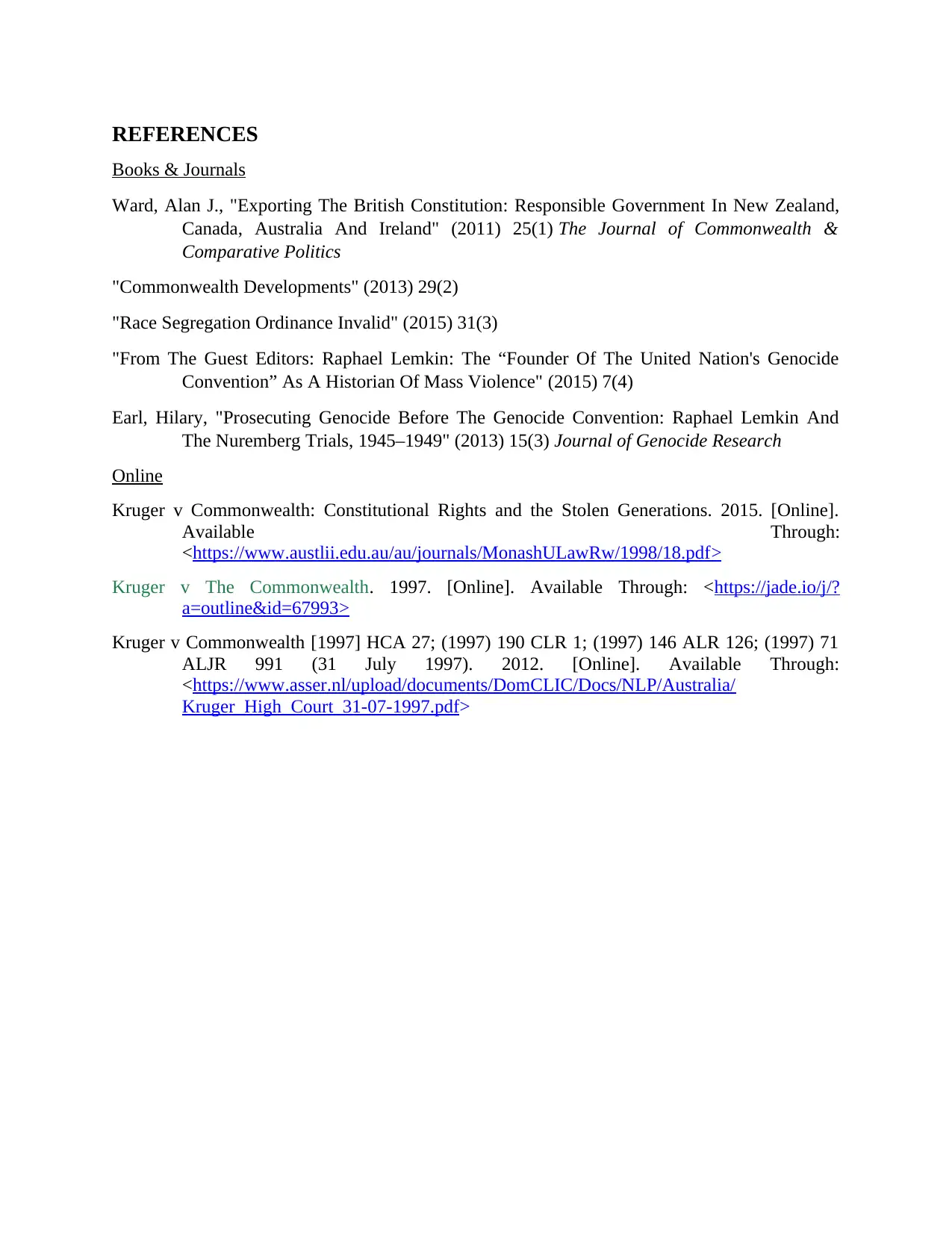
REFERENCES
Books & Journals
Ward, Alan J., "Exporting The British Constitution: Responsible Government In New Zealand,
Canada, Australia And Ireland" (2011) 25(1) The Journal of Commonwealth &
Comparative Politics
"Commonwealth Developments" (2013) 29(2)
"Race Segregation Ordinance Invalid" (2015) 31(3)
"From The Guest Editors: Raphael Lemkin: The “Founder Of The United Nation's Genocide
Convention” As A Historian Of Mass Violence" (2015) 7(4)
Earl, Hilary, "Prosecuting Genocide Before The Genocide Convention: Raphael Lemkin And
The Nuremberg Trials, 1945–1949" (2013) 15(3) Journal of Genocide Research
Online
Kruger v Commonwealth: Constitutional Rights and the Stolen Generations. 2015. [Online].
Available Through:
<https://www.austlii.edu.au/au/journals/MonashULawRw/1998/18.pdf>
Kruger v The Commonwealth. 1997. [Online]. Available Through: <https://jade.io/j/?
a=outline&id=67993>
Kruger v Commonwealth [1997] HCA 27; (1997) 190 CLR 1; (1997) 146 ALR 126; (1997) 71
ALJR 991 (31 July 1997). 2012. [Online]. Available Through:
<https://www.asser.nl/upload/documents/DomCLIC/Docs/NLP/Australia/
Kruger_High_Court_31-07-1997.pdf>
Books & Journals
Ward, Alan J., "Exporting The British Constitution: Responsible Government In New Zealand,
Canada, Australia And Ireland" (2011) 25(1) The Journal of Commonwealth &
Comparative Politics
"Commonwealth Developments" (2013) 29(2)
"Race Segregation Ordinance Invalid" (2015) 31(3)
"From The Guest Editors: Raphael Lemkin: The “Founder Of The United Nation's Genocide
Convention” As A Historian Of Mass Violence" (2015) 7(4)
Earl, Hilary, "Prosecuting Genocide Before The Genocide Convention: Raphael Lemkin And
The Nuremberg Trials, 1945–1949" (2013) 15(3) Journal of Genocide Research
Online
Kruger v Commonwealth: Constitutional Rights and the Stolen Generations. 2015. [Online].
Available Through:
<https://www.austlii.edu.au/au/journals/MonashULawRw/1998/18.pdf>
Kruger v The Commonwealth. 1997. [Online]. Available Through: <https://jade.io/j/?
a=outline&id=67993>
Kruger v Commonwealth [1997] HCA 27; (1997) 190 CLR 1; (1997) 146 ALR 126; (1997) 71
ALJR 991 (31 July 1997). 2012. [Online]. Available Through:
<https://www.asser.nl/upload/documents/DomCLIC/Docs/NLP/Australia/
Kruger_High_Court_31-07-1997.pdf>

1 out of 10


Related Documents


Your All-in-One AI-Powered Toolkit for Academic Success.
+13062052269
info@desklib.com
Available 24*7 on WhatsApp / Email
![[object Object]](/_next/static/media/star-bottom.7253800d.svg)
Unlock your academic potential
Copyright © 2020–2026 A2Z Services. All Rights Reserved. Developed and managed by ZUCOL.