Construction Technology: Building Design, Infrastructure & Services
VerifiedAdded on 2023/06/15
|12
|4012
|234
Report
AI Summary
This report provides a comprehensive overview of construction technology, focusing on various aspects of building design and infrastructure. It begins by differentiating between residential, commercial, and industrial buildings, highlighting key factors such as location, facilities, and sustainability practices. The report then delves into substructures, discussing pre-design studies and foundation types, including shallow and deep foundations, and their suitability for different structures, emphasizing the impact of site information on foundation design. Furthermore, it examines superstructures, outlining functional characteristics and design selection criteria for walls, roofs, floors, windows, doors, staircases, and finishes, alongside pre-design studies and information collected. The report also touches upon civil engineering infrastructure and building services, providing a holistic view of the elements involved in modern construction projects. The document is available on Desklib, a platform offering a wide range of study tools and solved assignments for students.
Construction Technology
Table of Contents
Table of Contents

Paraphrase This Document
Need a fresh take? Get an instant paraphrase of this document with our AI Paraphraser
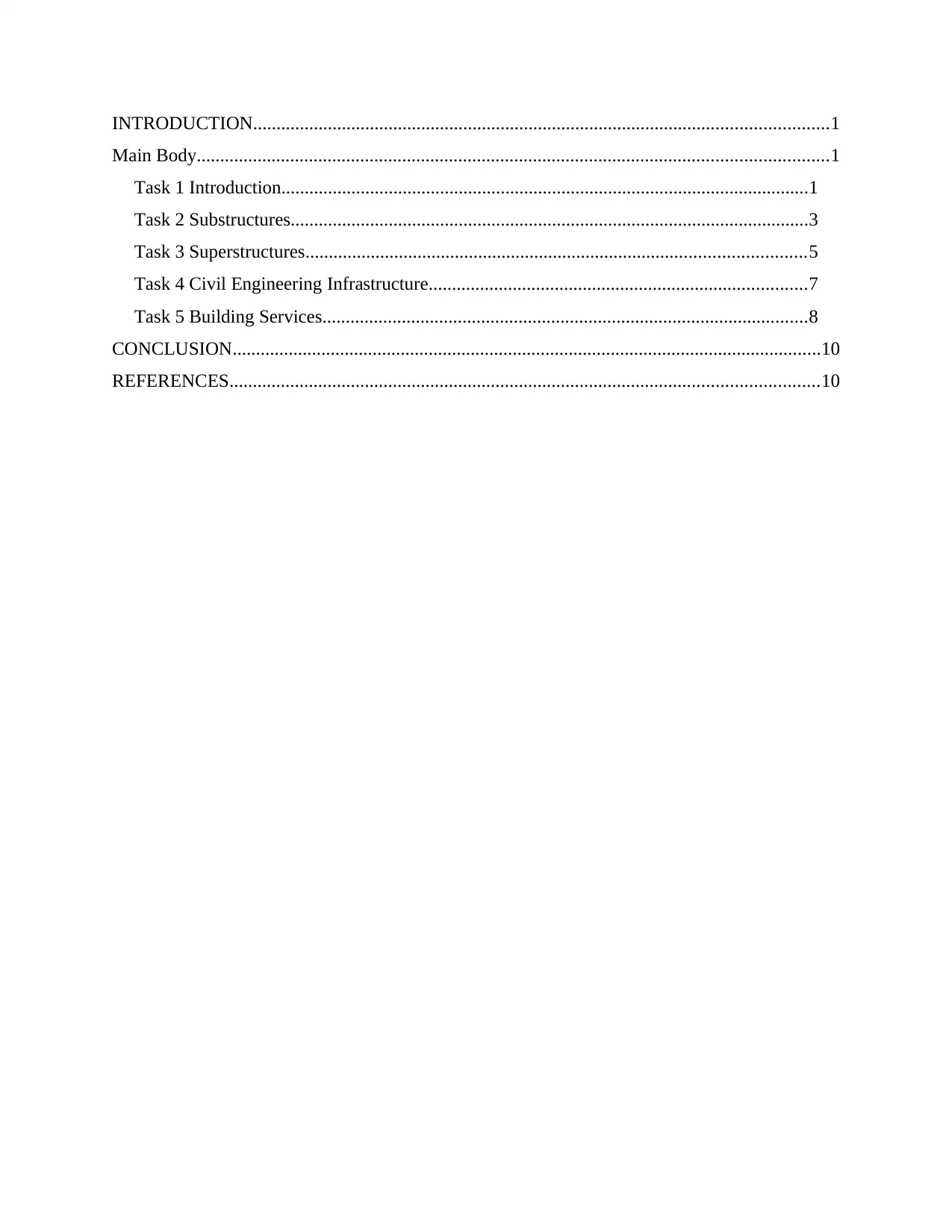
INTRODUCTION...........................................................................................................................1
Main Body.......................................................................................................................................1
Task 1 Introduction.................................................................................................................1
Task 2 Substructures...............................................................................................................3
Task 3 Superstructures...........................................................................................................5
Task 4 Civil Engineering Infrastructure.................................................................................7
Task 5 Building Services........................................................................................................8
CONCLUSION..............................................................................................................................10
REFERENCES..............................................................................................................................10
Main Body.......................................................................................................................................1
Task 1 Introduction.................................................................................................................1
Task 2 Substructures...............................................................................................................3
Task 3 Superstructures...........................................................................................................5
Task 4 Civil Engineering Infrastructure.................................................................................7
Task 5 Building Services........................................................................................................8
CONCLUSION..............................................................................................................................10
REFERENCES..............................................................................................................................10
INTRODUCTION
Construction technology tend to refer to the sum total of the innovative tools, software and
machinery which are applied and used at various phase of a project to ensure effective
construction (Lu and et. al., 2020). The current construction project comprises of the Hotel
building complex that us need to be constructed near the motorway that is tending to link an
international airport along within the UK, that are situated at the Heathrow to the specific.
Further, it includes a discussion about the difference between the residential, commercial and
industrial building along with analysis of substructures. Beside this, it also includes discussion
about the superstructures, civil engineering infrastructure and Building services.
Main Body
Task 1 Introduction
Differences between residential, commercial and industrial buildings.
It has been seen and analsysed that the construction and type of building tend to base on
the reason behind its construction that is mainly divided into residential, commercial and
industrial building. Further, the main difference among these three main type of building
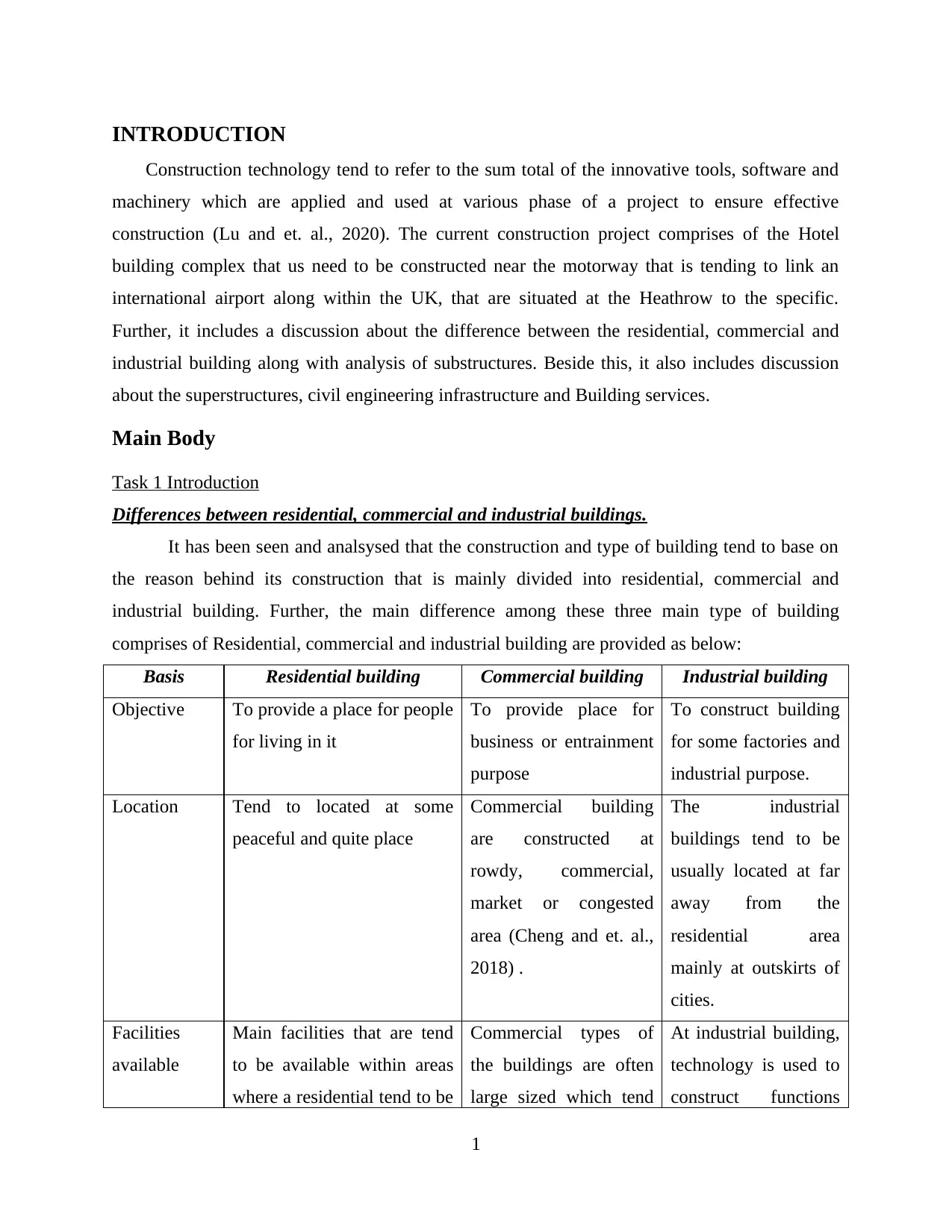
comprises of Residential, commercial and industrial building are provided as below:
Basis Residential building Commercial building Industrial building
Objective To provide a place for people
for living in it
To provide place for
business or entrainment
purpose
To construct building
for some factories and
industrial purpose.
Location Tend to located at some
peaceful and quite place
Commercial building
are constructed at
rowdy, commercial,
market or congested
area (Cheng and et. al.,
2018) .
The industrial
buildings tend to be
usually located at far
away from the
residential area
mainly at outskirts of
cities.
Facilities
available
Main facilities that are tend
to be available within areas
where a residential tend to be
Commercial types of
the buildings are often
large sized which tend
At industrial building,
technology is used to
construct functions
1
Construction technology tend to refer to the sum total of the innovative tools, software and
machinery which are applied and used at various phase of a project to ensure effective
construction (Lu and et. al., 2020). The current construction project comprises of the Hotel
building complex that us need to be constructed near the motorway that is tending to link an
international airport along within the UK, that are situated at the Heathrow to the specific.
Further, it includes a discussion about the difference between the residential, commercial and
industrial building along with analysis of substructures. Beside this, it also includes discussion
about the superstructures, civil engineering infrastructure and Building services.
Main Body
Task 1 Introduction
Differences between residential, commercial and industrial buildings.
It has been seen and analsysed that the construction and type of building tend to base on
the reason behind its construction that is mainly divided into residential, commercial and
industrial building. Further, the main difference among these three main type of building
comprises of Residential, commercial and industrial building are provided as below:
Basis Residential building Commercial building Industrial building
Objective To provide a place for people
for living in it
To provide place for
business or entrainment
purpose
To construct building
for some factories and
industrial purpose.
Location Tend to located at some
peaceful and quite place
Commercial building
are constructed at
rowdy, commercial,
market or congested
area (Cheng and et. al.,
2018) .
The industrial
buildings tend to be
usually located at far
away from the
residential area
mainly at outskirts of
cities.
Facilities
available
Main facilities that are tend
to be available within areas
where a residential tend to be
Commercial types of
the buildings are often
large sized which tend
At industrial building,
technology is used to
construct functions
1
⊘ This is a preview!⊘
Do you want full access?
Subscribe today to unlock all pages.

Trusted by 1+ million students worldwide
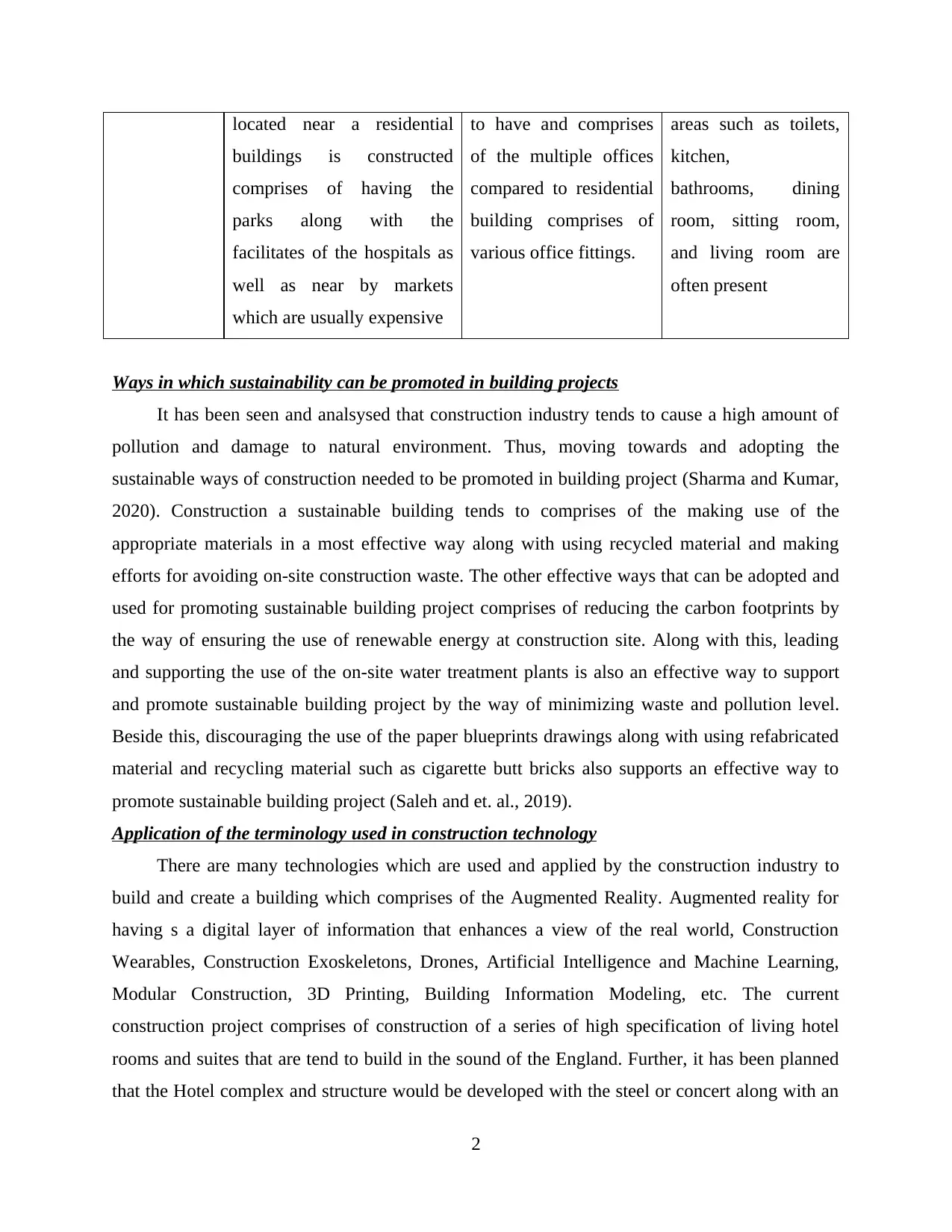
located near a residential
buildings is constructed
comprises of having the
parks along with the
facilitates of the hospitals as
well as near by markets
which are usually expensive
to have and comprises
of the multiple offices
compared to residential
building comprises of
various office fittings.
areas such as toilets,
kitchen,
bathrooms, dining
room, sitting room,
and living room are
often present
Ways in which sustainability can be promoted in building projects
It has been seen and analsysed that construction industry tends to cause a high amount of
pollution and damage to natural environment. Thus, moving towards and adopting the
sustainable ways of construction needed to be promoted in building project (Sharma and Kumar,
2020). Construction a sustainable building tends to comprises of the making use of the
appropriate materials in a most effective way along with using recycled material and making
efforts for avoiding on-site construction waste. The other effective ways that can be adopted and
used for promoting sustainable building project comprises of reducing the carbon footprints by
the way of ensuring the use of renewable energy at construction site. Along with this, leading
and supporting the use of the on-site water treatment plants is also an effective way to support
and promote sustainable building project by the way of minimizing waste and pollution level.
Beside this, discouraging the use of the paper blueprints drawings along with using refabricated
material and recycling material such as cigarette butt bricks also supports an effective way to
promote sustainable building project (Saleh and et. al., 2019).
Application of the terminology used in construction technology
There are many technologies which are used and applied by the construction industry to
build and create a building which comprises of the Augmented Reality. Augmented reality for
having s a digital layer of information that enhances a view of the real world, Construction
Wearables, Construction Exoskeletons, Drones, Artificial Intelligence and Machine Learning,
Modular Construction, 3D Printing, Building Information Modeling, etc. The current
construction project comprises of construction of a series of high specification of living hotel
rooms and suites that are tend to build in the sound of the England. Further, it has been planned
that the Hotel complex and structure would be developed with the steel or concert along with an
2
buildings is constructed
comprises of having the
parks along with the
facilitates of the hospitals as
well as near by markets
which are usually expensive
to have and comprises
of the multiple offices
compared to residential
building comprises of
various office fittings.
areas such as toilets,
kitchen,
bathrooms, dining
room, sitting room,
and living room are
often present
Ways in which sustainability can be promoted in building projects
It has been seen and analsysed that construction industry tends to cause a high amount of
pollution and damage to natural environment. Thus, moving towards and adopting the
sustainable ways of construction needed to be promoted in building project (Sharma and Kumar,
2020). Construction a sustainable building tends to comprises of the making use of the
appropriate materials in a most effective way along with using recycled material and making
efforts for avoiding on-site construction waste. The other effective ways that can be adopted and
used for promoting sustainable building project comprises of reducing the carbon footprints by
the way of ensuring the use of renewable energy at construction site. Along with this, leading
and supporting the use of the on-site water treatment plants is also an effective way to support
and promote sustainable building project by the way of minimizing waste and pollution level.
Beside this, discouraging the use of the paper blueprints drawings along with using refabricated
material and recycling material such as cigarette butt bricks also supports an effective way to
promote sustainable building project (Saleh and et. al., 2019).
Application of the terminology used in construction technology
There are many technologies which are used and applied by the construction industry to
build and create a building which comprises of the Augmented Reality. Augmented reality for
having s a digital layer of information that enhances a view of the real world, Construction
Wearables, Construction Exoskeletons, Drones, Artificial Intelligence and Machine Learning,
Modular Construction, 3D Printing, Building Information Modeling, etc. The current
construction project comprises of construction of a series of high specification of living hotel
rooms and suites that are tend to build in the sound of the England. Further, it has been planned
that the Hotel complex and structure would be developed with the steel or concert along with an
2
Paraphrase This Document
Need a fresh take? Get an instant paraphrase of this document with our AI Paraphraser
infrastructure road that is flexible or rigid across the stream and walkway across the motorway
(Emmitt, 2018). Thus, for having effective presentation and analysis of the all the information
and options use of Augmented Reality has been made which enhances the view of construction
site with the help of AR capabilities. Further, proper construction wearables are also sued to
ensure the safety of staff such as smart boots, smart hard hat and gloves. Along with this, use of
drones has been also made to have construction of hotel complex as it supported better review of
the construction site and locations. Beside this, implication of the 3D printing has been also
made to have layer by layer design of current project and finally use of only renewable and
natural materials are made to maintain the sustainability of current project (Kim and Kim, 2018).
Task 2 Substructures
Pre-design studies to design the most suitable foundation type for different types of structures
It has been analysed and find out that the there are various pre design study that are vital to
deliver a design that provides longer return and improved review and implication of the
information in order to supports and leads to selection of a suitable foundation for the different
types of the structures. It has been seen that the pre deign study tend to the first step for the
property development and for construction of any project as it is the first phase where the
architect and managers tend to establish and analyse a set of conditions and research to evaluate
information which set out a framework for building development (Gélinas-Bronsard and et. al.,
2019).
Further, the core and most vital pre-deigning studies tend to comprises of the site
analysis, zoning along with having and leading effective analysis of the budgeting as well as
reviewing other studies associated with the programming use requirements. Along with this, it
has been seen ad reviewed that Business justification, Brief development, Feasibility studies,
Options appraisals, Concept design, Design development, Technical design, Procurement and
construction are main pre design studies and information that need to be collated in order to
design the most suitable foundation type for different types of structures.
Construction of different types of foundations and their suitability for use with different types
of structures
There are different types of the building foundations that are being used by a contractor for
development of a formwork and structure for a project. The different types of the foundations an
3
(Emmitt, 2018). Thus, for having effective presentation and analysis of the all the information
and options use of Augmented Reality has been made which enhances the view of construction
site with the help of AR capabilities. Further, proper construction wearables are also sued to
ensure the safety of staff such as smart boots, smart hard hat and gloves. Along with this, use of
drones has been also made to have construction of hotel complex as it supported better review of
the construction site and locations. Beside this, implication of the 3D printing has been also
made to have layer by layer design of current project and finally use of only renewable and
natural materials are made to maintain the sustainability of current project (Kim and Kim, 2018).
Task 2 Substructures
Pre-design studies to design the most suitable foundation type for different types of structures
It has been analysed and find out that the there are various pre design study that are vital to
deliver a design that provides longer return and improved review and implication of the
information in order to supports and leads to selection of a suitable foundation for the different
types of the structures. It has been seen that the pre deign study tend to the first step for the
property development and for construction of any project as it is the first phase where the
architect and managers tend to establish and analyse a set of conditions and research to evaluate
information which set out a framework for building development (Gélinas-Bronsard and et. al.,
2019).
Further, the core and most vital pre-deigning studies tend to comprises of the site
analysis, zoning along with having and leading effective analysis of the budgeting as well as
reviewing other studies associated with the programming use requirements. Along with this, it
has been seen ad reviewed that Business justification, Brief development, Feasibility studies,
Options appraisals, Concept design, Design development, Technical design, Procurement and
construction are main pre design studies and information that need to be collated in order to
design the most suitable foundation type for different types of structures.
Construction of different types of foundations and their suitability for use with different types
of structures
There are different types of the building foundations that are being used by a contractor for
development of a formwork and structure for a project. The different types of the foundations an
3
there suitability for the use within different types of structures has been provided and discussed
as below:
Shallow foundation
Individual footing or isolated footing- it is one of the most common type of the
foundation used for building constructing that is most suitable for a structure compering
of single column where the shape of individual footing is the square or rectangle.
Combined footing- this form of foundation is most suitable and used within a combined
footing construction structure where two or more columns are tend to be close enough
and there isolated part of the footing is taken as overlap within each other based on differ
within the structural feign (Construction Technology to Watch in 2021, 2021).
Strip foundation- this type of construction foundation tends to comprises and suitable for
a structure whose base is wider as compared to a typical load breaking wall foundations.
Thus, strip foundation are useful to provide a wider base for structure that ensures the
weight from the building structure must be spread over more area which tends to provide
a better stability level (Luo and et. al., 2021).
Raft or mat foundation- this types of foundation are sued with the structure which are
spared across the entire arear of the building thus tend to supports a heavy structural
loads coming from the columns and walls. Thus, mat foundation is tend to suitable and
used for columns and walls foundation where it is needed as the loads from the structure
on the columns as well as the walls tend to be high.
Deep Foundation
Pile foundation- it is type of a deep foundation within a used with a structure where there
is need to transfer heavy loads from the structure towards to a hard rock and strata that is
much deeper below the stated ground level.
Drilled Shafts or caissons- this type of foundations tend to use with a deep structure
where it is used to resists loads from structure through shaft resistance, toe resistance
and/or combination of both of these (Rongrong, 2020).
Site information impact on foundation design
Site Conditions tend to comprises of the condition of the Lands which tend to also include
the overall physical as well as the geophysical condition of construction site. Along with this, the
site information also tends to provide and supports the information about the climatic nature of
4
as below:
Shallow foundation
Individual footing or isolated footing- it is one of the most common type of the
foundation used for building constructing that is most suitable for a structure compering
of single column where the shape of individual footing is the square or rectangle.
Combined footing- this form of foundation is most suitable and used within a combined
footing construction structure where two or more columns are tend to be close enough
and there isolated part of the footing is taken as overlap within each other based on differ
within the structural feign (Construction Technology to Watch in 2021, 2021).
Strip foundation- this type of construction foundation tends to comprises and suitable for
a structure whose base is wider as compared to a typical load breaking wall foundations.
Thus, strip foundation are useful to provide a wider base for structure that ensures the
weight from the building structure must be spread over more area which tends to provide
a better stability level (Luo and et. al., 2021).
Raft or mat foundation- this types of foundation are sued with the structure which are
spared across the entire arear of the building thus tend to supports a heavy structural
loads coming from the columns and walls. Thus, mat foundation is tend to suitable and
used for columns and walls foundation where it is needed as the loads from the structure
on the columns as well as the walls tend to be high.
Deep Foundation
Pile foundation- it is type of a deep foundation within a used with a structure where there
is need to transfer heavy loads from the structure towards to a hard rock and strata that is
much deeper below the stated ground level.
Drilled Shafts or caissons- this type of foundations tend to use with a deep structure
where it is used to resists loads from structure through shaft resistance, toe resistance
and/or combination of both of these (Rongrong, 2020).
Site information impact on foundation design
Site Conditions tend to comprises of the condition of the Lands which tend to also include
the overall physical as well as the geophysical condition of construction site. Along with this, the
site information also tends to provide and supports the information about the climatic nature of
4
⊘ This is a preview!⊘
Do you want full access?
Subscribe today to unlock all pages.
Trusted by 1+ million students worldwide
the construction site along with the complete ecological, environmental, geotechnical and
archaeological conditions of construction site. Thus, site information tends to comprises of all
the information about the factors such as footing depth and passing along with soil settlement,
soil erosion as well as the loose and other collapsible soils that tend to have great impact on
selection of foundation to provide a string base for structure. For instance, if there is loam, rock
and sand or gravel are seen at the construction site that is become essential and necessary to
make up for good, foundation-friendly soil (Sanjayan, Nazari and Nematollahi, 2019).
Task 3 Superstructures
Functional characteristics and the design selection criteria
Walls- the main functional characteristics of the wall comprises of having high level of
strength, stability, durability and sound resistance. Thus, the design selection criteria for
wall comprises of fact that it need to be weather and ground resistance along with fire
safety and resistance to heat and sound.
Roofs- The main characteristics of the roof comprises of weather resistance along with
higher level of strength and stability. While the design selection criteria for roofs tend to
include the heat protection along with sound insulation and fire resistance.
Floors – ground and intermediate- the main characteristics of the floors tend to comprises
of the higher level of strength and stability along with easy maintenance and resistance
from slip and moisture. The deign selection criteria for floor tend to comprise of pleasing
appearance along with conformity with building and hardness and comfort (Holt and et.
al., 2019).
Windows and doors- characteristics of windows and doors comprises of leading security
and prevention of the unauthorised entry along with strength and stability that resistance
weather. The deign criteria of windows and doors comprises of resistance from passing of
heat and sound along with higher durability to have freedom form maintenance.
Staircases- strength and stabile are the main characteristics of the staircases while safety
in use and horizontal surface area are tend to be main design selection criteria.
Finishes- dimensional stability is the main characteristics while the security against
burglary, comfort and convenience are tending to main design criteria (Gunasekera and
Chong, 2018).
Pre-design studies carried out and types of information collected
5
archaeological conditions of construction site. Thus, site information tends to comprises of all
the information about the factors such as footing depth and passing along with soil settlement,
soil erosion as well as the loose and other collapsible soils that tend to have great impact on
selection of foundation to provide a string base for structure. For instance, if there is loam, rock
and sand or gravel are seen at the construction site that is become essential and necessary to
make up for good, foundation-friendly soil (Sanjayan, Nazari and Nematollahi, 2019).
Task 3 Superstructures
Functional characteristics and the design selection criteria
Walls- the main functional characteristics of the wall comprises of having high level of
strength, stability, durability and sound resistance. Thus, the design selection criteria for
wall comprises of fact that it need to be weather and ground resistance along with fire
safety and resistance to heat and sound.
Roofs- The main characteristics of the roof comprises of weather resistance along with
higher level of strength and stability. While the design selection criteria for roofs tend to
include the heat protection along with sound insulation and fire resistance.
Floors – ground and intermediate- the main characteristics of the floors tend to comprises
of the higher level of strength and stability along with easy maintenance and resistance
from slip and moisture. The deign selection criteria for floor tend to comprise of pleasing
appearance along with conformity with building and hardness and comfort (Holt and et.
al., 2019).
Windows and doors- characteristics of windows and doors comprises of leading security
and prevention of the unauthorised entry along with strength and stability that resistance
weather. The deign criteria of windows and doors comprises of resistance from passing of
heat and sound along with higher durability to have freedom form maintenance.
Staircases- strength and stabile are the main characteristics of the staircases while safety
in use and horizontal surface area are tend to be main design selection criteria.
Finishes- dimensional stability is the main characteristics while the security against
burglary, comfort and convenience are tending to main design criteria (Gunasekera and
Chong, 2018).
Pre-design studies carried out and types of information collected
5
Paraphrase This Document
Need a fresh take? Get an instant paraphrase of this document with our AI Paraphraser
the core and most vital pre-deigning studies which are conducted for current project
comprises of the site analysis and zoning. Further, the effective review of the Business
justification, Feasibility studies, Design development and Technical design are main pre deign
studies that are analysed for collection of information. Business justification tend to supported
the process for completing the design and construction of a building is often divided into stages.
Further, the feasibility studies comprise of the preliminary studies undertaken in the very early
stage of a project to check the profitability and success level of the project. Along with this, the
Detailed design is also evaluated as pre-deign studies as it supports the process of taking on and
developing the approved concept design. Further, technical design are also evaluates as
supported process for completing the design and construction of a building (Cong and et. al.,
2020).
Component parts of an element allow it to fulfil its function
The component part of a construction project tends to comprises of the foundation, floors,
walls, beams, columns, roof, stair, etc. All of these elements tend to serve the main purpose and
function of the effectively supporting as well as properly enclosing and protecting the building
structure to ensure improved construction of the project.
Different types of structural frame
The different type of the structural frame work comprises of the Rigid Frame Systems and
Braced frame system. Rigid frame system is also known as moment frame system which tend to
consist and comprises of liner element like beams or some form of columns that enhances the
ability to resist the deformation within the superstructure. A comparison of this can be made with
the braced frame system that comprises of beams and columns that are tend to be pin connected
with the bracing to effectively resist lateral loads of superstructure (Wang, 2021).
Task 4 Civil Engineering Infrastructure
Techniques used for remediating the site prior to construction commencing
The main types and forms techniques used for remediating the site prior to construction
comprises of the containment along with having and making use of a pump-and-treat. Beside
this, in some cases use of the extraction along with some form of the stabilization/solidification,
together with soil washing are also used for remediating the site prior to construction
commencing. Apart from this, making the use of the air stripping and precipitation along with
6
comprises of the site analysis and zoning. Further, the effective review of the Business
justification, Feasibility studies, Design development and Technical design are main pre deign
studies that are analysed for collection of information. Business justification tend to supported
the process for completing the design and construction of a building is often divided into stages.
Further, the feasibility studies comprise of the preliminary studies undertaken in the very early
stage of a project to check the profitability and success level of the project. Along with this, the
Detailed design is also evaluated as pre-deign studies as it supports the process of taking on and
developing the approved concept design. Further, technical design are also evaluates as
supported process for completing the design and construction of a building (Cong and et. al.,
2020).
Component parts of an element allow it to fulfil its function
The component part of a construction project tends to comprises of the foundation, floors,
walls, beams, columns, roof, stair, etc. All of these elements tend to serve the main purpose and
function of the effectively supporting as well as properly enclosing and protecting the building
structure to ensure improved construction of the project.
Different types of structural frame
The different type of the structural frame work comprises of the Rigid Frame Systems and
Braced frame system. Rigid frame system is also known as moment frame system which tend to
consist and comprises of liner element like beams or some form of columns that enhances the
ability to resist the deformation within the superstructure. A comparison of this can be made with
the braced frame system that comprises of beams and columns that are tend to be pin connected
with the bracing to effectively resist lateral loads of superstructure (Wang, 2021).
Task 4 Civil Engineering Infrastructure
Techniques used for remediating the site prior to construction commencing
The main types and forms techniques used for remediating the site prior to construction
comprises of the containment along with having and making use of a pump-and-treat. Beside
this, in some cases use of the extraction along with some form of the stabilization/solidification,
together with soil washing are also used for remediating the site prior to construction
commencing. Apart from this, making the use of the air stripping and precipitation along with
6
having the verification and thermal desorption as well as the biological remediation also forms
effective way to have effective remediating while commencing construction.
Types of substructure works required for the infrastructures
The substructure tends to be the one that is determined by considering the type of
superstructure, construction method, ground conditions, and aesthetic factors. The types of the
substructure work that are required for the infrastructures piers (columns), foundations
(footings), and abutments. The piers substructure tends to associated with the elements that are
used for effectively supporting the spans that tend to exists between the embankment berms are
piers. The implication of the foundation substructure tends to comprises of the portion of the
bridge that is applied to supports the entire structure on the given surrounding soil (Rongrong,
2020).
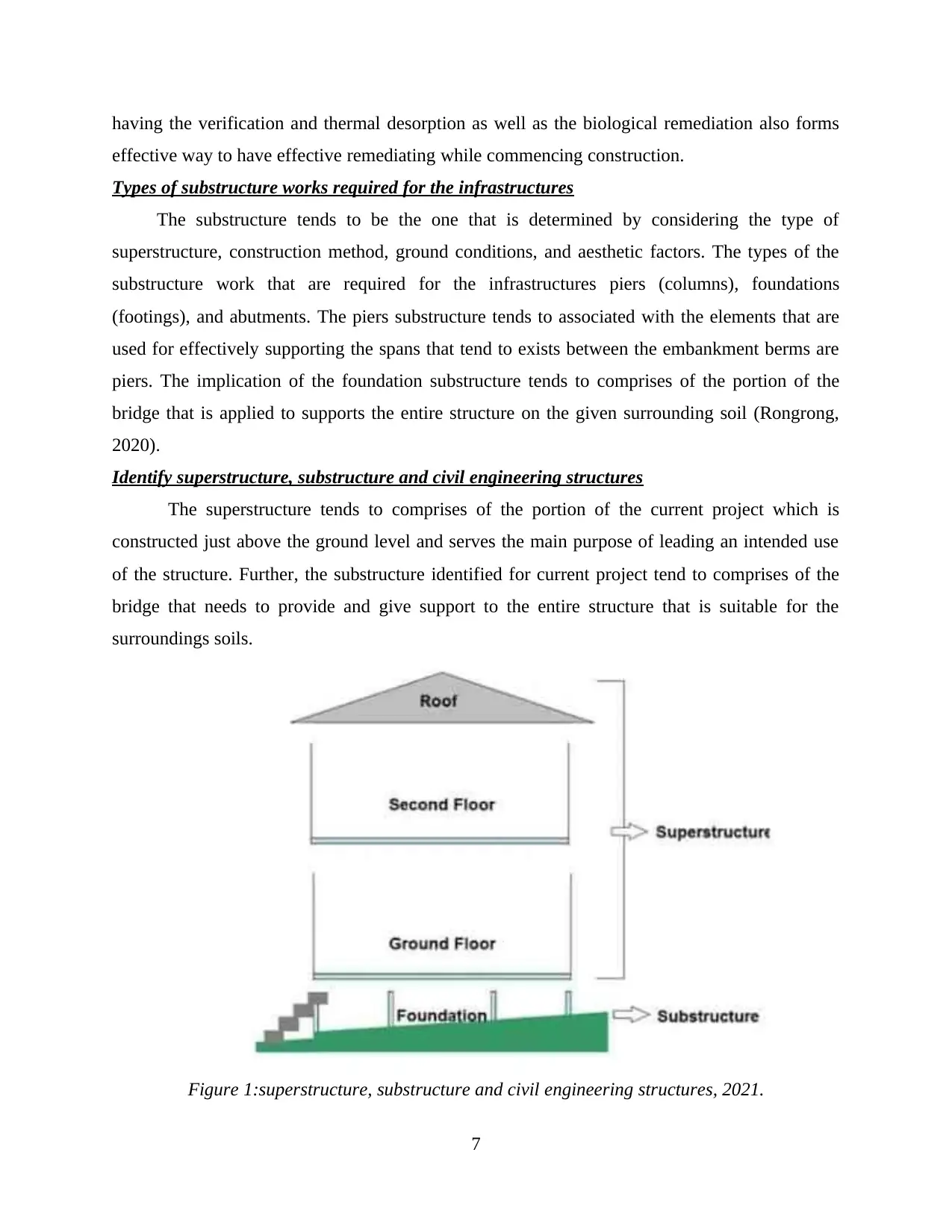
Identify superstructure, substructure and civil engineering structures
The superstructure tends to comprises of the portion of the current project which is
constructed just above the ground level and serves the main purpose of leading an intended use
of the structure. Further, the substructure identified for current project tend to comprises of the
bridge that needs to provide and give support to the entire structure that is suitable for the
surroundings soils.
Figure 1:superstructure, substructure and civil engineering structures, 2021.
7
effective way to have effective remediating while commencing construction.
Types of substructure works required for the infrastructures
The substructure tends to be the one that is determined by considering the type of
superstructure, construction method, ground conditions, and aesthetic factors. The types of the
substructure work that are required for the infrastructures piers (columns), foundations
(footings), and abutments. The piers substructure tends to associated with the elements that are
used for effectively supporting the spans that tend to exists between the embankment berms are
piers. The implication of the foundation substructure tends to comprises of the portion of the
bridge that is applied to supports the entire structure on the given surrounding soil (Rongrong,
2020).
Identify superstructure, substructure and civil engineering structures
The superstructure tends to comprises of the portion of the current project which is
constructed just above the ground level and serves the main purpose of leading an intended use
of the structure. Further, the substructure identified for current project tend to comprises of the
bridge that needs to provide and give support to the entire structure that is suitable for the
surroundings soils.
Figure 1:superstructure, substructure and civil engineering structures, 2021.
7
⊘ This is a preview!⊘
Do you want full access?
Subscribe today to unlock all pages.
Trusted by 1+ million students worldwide
Further, the architecture and managers has also ensured that involvement of the qualified
geotechnical engineers to have a proper substructure for current project that tend to bridge deign
and help in selecting the appropriate foundation type. Along with this, the civil engineering
structures, project tend to incudes the natural terrain which are needed to enable the completion
of project comprising of columns, beams, slab upwards including all finishes, door and window
schedules, flooring, roofing, lintels, and parapets (Sanjayan, Nazari and Nematollahi, 2019).
Task 5 Building Services
Supply arrangements for primary services.
The arrangements for the primary services tend to comprises of the basic and vital daily
running services of the building which has been presented with the help of following diagram.
Figure 2: Supply arrangements for primary services, 2021.
Along with this, the other primary building sources comprises of the control systems,
energy distribution, energy supply, escalators, lifts, façade engineering along with for safety,
detection and protection. Use of various contracts and updated technology has been made to
supply the arrangements of these primary services (Holt and et. al., 2019).
Distribution arrangements for primary services
The distribution and bifurcation arrangements for the primary services tend to comprises
of electrical services along with proper plumbing facilitates together with an effective
mechanical system within a building. For this reason and meeting these arrangements for the
primary services implication and use of the MEP services, for mechanical, electrical, and
plumbing has been made within current project.
The elements of the superstructure used to facilitate the primary services
8
geotechnical engineers to have a proper substructure for current project that tend to bridge deign
and help in selecting the appropriate foundation type. Along with this, the civil engineering
structures, project tend to incudes the natural terrain which are needed to enable the completion
of project comprising of columns, beams, slab upwards including all finishes, door and window
schedules, flooring, roofing, lintels, and parapets (Sanjayan, Nazari and Nematollahi, 2019).
Task 5 Building Services
Supply arrangements for primary services.
The arrangements for the primary services tend to comprises of the basic and vital daily
running services of the building which has been presented with the help of following diagram.
Figure 2: Supply arrangements for primary services, 2021.
Along with this, the other primary building sources comprises of the control systems,
energy distribution, energy supply, escalators, lifts, façade engineering along with for safety,
detection and protection. Use of various contracts and updated technology has been made to
supply the arrangements of these primary services (Holt and et. al., 2019).
Distribution arrangements for primary services
The distribution and bifurcation arrangements for the primary services tend to comprises
of electrical services along with proper plumbing facilitates together with an effective
mechanical system within a building. For this reason and meeting these arrangements for the
primary services implication and use of the MEP services, for mechanical, electrical, and
plumbing has been made within current project.
The elements of the superstructure used to facilitate the primary services
8
Paraphrase This Document
Need a fresh take? Get an instant paraphrase of this document with our AI Paraphraser
It has been analysed and find out that the most basic components of superstructure of a
building tend to forms out a vital part of the primary services comprises of the columns, beams,
along with the fitting of the slab and wall. It has been also reviewed that these elements and
components of the superstructure are tend to safely transfer the dead loads as well as the live
loads and other loads to the substructure which consists of the foundation and plinth. After that,
these elements of the superstructure also tend to further distributes this load to the underlying
earth to maintain the strength and stability of the construction and building (Gunasekera and
Chong, 2018).
Distribution of the primary services impact on the overall design of the building
It has been reviewed that the distribution of the primary services tends to have a vital
impact on the overall design of the building as the it plays a central role in effective contributing
the deign and structure of the building not only in terms of the strategies and standards to achieve
along with also focuses on the overall façade engineering. It has been seen that the Distribution
of the primary service have a direct impact and related with the engineering aspects of
construction such as weight, sizes and location of site that plays a vital role and impact on
selection of plant and equipment used for building. Along with this, it has been also seen that
Distribution of the primary services tends to effect the position of the vertical service risers along
with routes for distribution of loads that tend to impact the overall design and installation of the
building (Cong and et. al., 2020).
CONCLUSION
It has been concluded that the residential buildings are the one which are tend to be
constructed with the main objective of providing place for people for looking in it and location of
these building tend to be dependent on the type of building constructed. It has been also
summarized that the commercial building tends to be the once that are sued by the businesses
and involves big project such as creating offices and other business establishment. Further, a
conclusion about the effective ways that can be adopted and used for promoting sustainable
building project comprises of reducing the carbon footprints by the way of ensuring the use of
renewable energy at construction site has been also made. Finally, it has seen also concluded that
the building foundation tend to forms out the one of the most critical and vital element of the aby
project that tend to refer to the lower part of structure which is designed with the main aim of the
9
building tend to forms out a vital part of the primary services comprises of the columns, beams,
along with the fitting of the slab and wall. It has been also reviewed that these elements and
components of the superstructure are tend to safely transfer the dead loads as well as the live
loads and other loads to the substructure which consists of the foundation and plinth. After that,
these elements of the superstructure also tend to further distributes this load to the underlying
earth to maintain the strength and stability of the construction and building (Gunasekera and
Chong, 2018).
Distribution of the primary services impact on the overall design of the building
It has been reviewed that the distribution of the primary services tends to have a vital
impact on the overall design of the building as the it plays a central role in effective contributing
the deign and structure of the building not only in terms of the strategies and standards to achieve
along with also focuses on the overall façade engineering. It has been seen that the Distribution
of the primary service have a direct impact and related with the engineering aspects of
construction such as weight, sizes and location of site that plays a vital role and impact on
selection of plant and equipment used for building. Along with this, it has been also seen that
Distribution of the primary services tends to effect the position of the vertical service risers along
with routes for distribution of loads that tend to impact the overall design and installation of the
building (Cong and et. al., 2020).
CONCLUSION
It has been concluded that the residential buildings are the one which are tend to be
constructed with the main objective of providing place for people for looking in it and location of
these building tend to be dependent on the type of building constructed. It has been also
summarized that the commercial building tends to be the once that are sued by the businesses
and involves big project such as creating offices and other business establishment. Further, a
conclusion about the effective ways that can be adopted and used for promoting sustainable
building project comprises of reducing the carbon footprints by the way of ensuring the use of
renewable energy at construction site has been also made. Finally, it has seen also concluded that
the building foundation tend to forms out the one of the most critical and vital element of the aby
project that tend to refer to the lower part of structure which is designed with the main aim of the
9
distributing the weight of the building in an evenly manner to provide a firm footing for
construction project.
REFERENCES
Books and journal
Cheng, J. and et. al., 2018. Construction of Interactive Teaching System for Course of
Mechanical Drawing Based on Mobile Augmented Reality Technology. International
Journal of Emerging Technologies in Learning (iJET), 13(2), pp.126-139.
Cong, L. and et. al., 2020. The energy consumption and emission of polyurethane pavement
construction based on life cycle assessment. Journal of Cleaner Production, 256,
p.120395.
Emmitt, S., 2018. Barry's introduction to construction of buildings. John Wiley & Sons.
Gélinas-Bronsard, D. and et. al., 2019. Co-construction of an Internet-based intervention for
older assistive technology users and their family caregivers: stakeholders’
perceptions. Disability and Rehabilitation: Assistive Technology, 14(6), pp.602-611.
Gunasekera, V.S. and Chong, S.C., 2018. Knowledge management for construction
organisations: a research agenda. Kybernetes.
Holt, C. and et. al., 2019. Construction 3D printing. In 3D Concrete Printing Technology (pp.
349-370). Butterworth-Heinemann.
Kim, J.W. and Kim, J.J., 2018. Disaster Risk Assessment by Work Unit of Construction Work
for Improve the Efficiency of Design for Safety Task. Journal of the Architectural
institute of Korea structure & Construction, 34(6), pp.45-53.
Lu, H. and et. al., 2020. Trenchless construction technologies for oil and gas pipelines: state-of-
the-art review. Journal of Construction Engineering and Management, 146(6),
p.03120001.
Luo, T. and et. al., 2021. A systematic overview of prefabricated construction policies in
China. Journal of Cleaner Production, 280, p.124371.
Rongrong, Y.A.N.G., 2020. Research on Implementation Scheme of Expressway Construction in
Xi'an. Urban Roads Bridges & Flood Control.
Saleh, S.A. and et. al., 2019. Solid-state transformers for distribution systems–Part I: Technology
and construction. IEEE Transactions on Industry Applications, 55(5), pp.4524-4535.
Sanjayan, J.G., Nazari, A. and Nematollahi, B., 2019. 3D concrete printing technology:
construction and building applications. Butterworth-Heinemann.
Sharma, M.G. and Kumar, S., 2020. The implication of blockchain as a disruptive technology for
construction industry. IIM Kozhikode Society & Management Review, 9(2), pp.177-188.
Wang, D., 2021, March. Construction of Knowledge Graph Corpus Under the Framework of
Artificial Intelligence. In The International Conference on Cyber Security Intelligence
and Analytics (pp. 41-48). Springer, Cham.
Online:
Construction Technology to Watch in 2021. 2021. [Online] Available Through:<
https://www.bigrentz.com/blog/construction-technology >.
10
construction project.
REFERENCES
Books and journal
Cheng, J. and et. al., 2018. Construction of Interactive Teaching System for Course of
Mechanical Drawing Based on Mobile Augmented Reality Technology. International
Journal of Emerging Technologies in Learning (iJET), 13(2), pp.126-139.
Cong, L. and et. al., 2020. The energy consumption and emission of polyurethane pavement
construction based on life cycle assessment. Journal of Cleaner Production, 256,
p.120395.
Emmitt, S., 2018. Barry's introduction to construction of buildings. John Wiley & Sons.
Gélinas-Bronsard, D. and et. al., 2019. Co-construction of an Internet-based intervention for
older assistive technology users and their family caregivers: stakeholders’
perceptions. Disability and Rehabilitation: Assistive Technology, 14(6), pp.602-611.
Gunasekera, V.S. and Chong, S.C., 2018. Knowledge management for construction
organisations: a research agenda. Kybernetes.
Holt, C. and et. al., 2019. Construction 3D printing. In 3D Concrete Printing Technology (pp.
349-370). Butterworth-Heinemann.
Kim, J.W. and Kim, J.J., 2018. Disaster Risk Assessment by Work Unit of Construction Work
for Improve the Efficiency of Design for Safety Task. Journal of the Architectural
institute of Korea structure & Construction, 34(6), pp.45-53.
Lu, H. and et. al., 2020. Trenchless construction technologies for oil and gas pipelines: state-of-
the-art review. Journal of Construction Engineering and Management, 146(6),
p.03120001.
Luo, T. and et. al., 2021. A systematic overview of prefabricated construction policies in
China. Journal of Cleaner Production, 280, p.124371.
Rongrong, Y.A.N.G., 2020. Research on Implementation Scheme of Expressway Construction in
Xi'an. Urban Roads Bridges & Flood Control.
Saleh, S.A. and et. al., 2019. Solid-state transformers for distribution systems–Part I: Technology
and construction. IEEE Transactions on Industry Applications, 55(5), pp.4524-4535.
Sanjayan, J.G., Nazari, A. and Nematollahi, B., 2019. 3D concrete printing technology:
construction and building applications. Butterworth-Heinemann.
Sharma, M.G. and Kumar, S., 2020. The implication of blockchain as a disruptive technology for
construction industry. IIM Kozhikode Society & Management Review, 9(2), pp.177-188.
Wang, D., 2021, March. Construction of Knowledge Graph Corpus Under the Framework of
Artificial Intelligence. In The International Conference on Cyber Security Intelligence
and Analytics (pp. 41-48). Springer, Cham.
Online:
Construction Technology to Watch in 2021. 2021. [Online] Available Through:<
https://www.bigrentz.com/blog/construction-technology >.
10
⊘ This is a preview!⊘
Do you want full access?
Subscribe today to unlock all pages.
Trusted by 1+ million students worldwide

1 out of 12


Related Documents


Your All-in-One AI-Powered Toolkit for Academic Success.
+13062052269
info@desklib.com
Available 24*7 on WhatsApp / Email
![[object Object]](/_next/static/media/star-bottom.7253800d.svg)
Unlock your academic potential
Copyright © 2020–2026 A2Z Services. All Rights Reserved. Developed and managed by ZUCOL.