Construction Value Management: Public Sector Infrastructure Analysis
VerifiedAdded on 2023/02/02
|9
|2970
|100
Report
AI Summary
This report delves into the concept of construction value management (CVM), focusing on its application within public sector infrastructure projects. It begins by defining Value for Money (VFM) and its key components: economy, efficiency, effectiveness, and equity. The report then examines various factors that impact VFM, including interest rates, inflation, balance of payments, political instability, government debt, and investor speculation. Furthermore, it outlines strategies to mitigate the failures of these factors, such as monetary and fiscal policies, and interest rate risk management. Finally, the report identifies opportunities for value management within public sector infrastructure organizations, emphasizing education, training, and the utilization of environmental prediction techniques and technological innovations to enhance sustainability and create value for stakeholders. The report provides a thorough analysis of CVM and its practical applications within the construction industry.

Construction Value
Management
Management

Paraphrase This Document
Need a fresh take? Get an instant paraphrase of this document with our AI Paraphraser
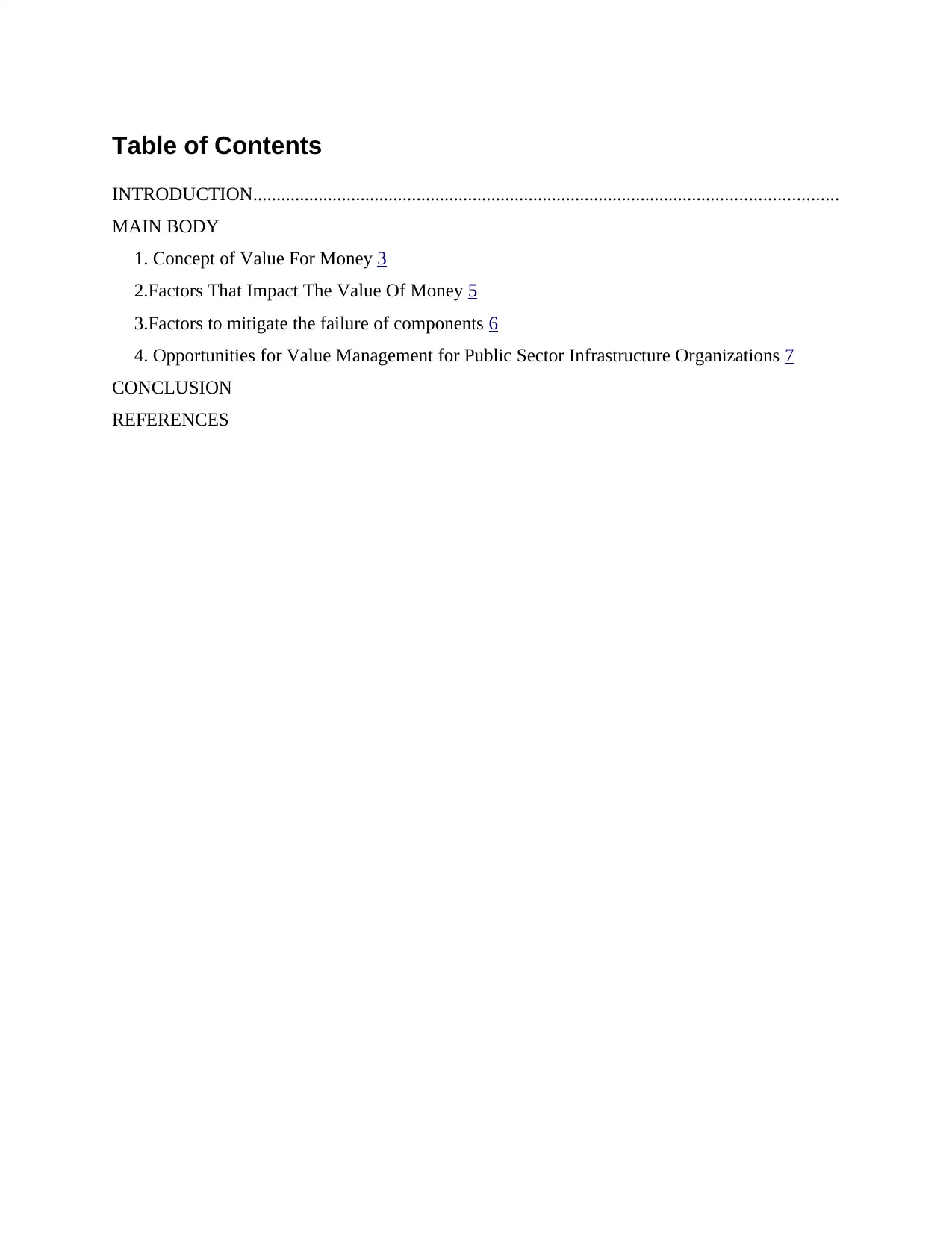
Table of Contents
INTRODUCTION.............................................................................................................................
MAIN BODY
1. Concept of Value For Money 3
2.Factors That Impact The Value Of Money 5
3.Factors to mitigate the failure of components 6
4. Opportunities for Value Management for Public Sector Infrastructure Organizations 7
CONCLUSION
REFERENCES
INTRODUCTION.............................................................................................................................
MAIN BODY
1. Concept of Value For Money 3
2.Factors That Impact The Value Of Money 5
3.Factors to mitigate the failure of components 6
4. Opportunities for Value Management for Public Sector Infrastructure Organizations 7
CONCLUSION
REFERENCES
INTRODUCTION
Public sector organizations are those organisations whose controllers, managers and
operators are either government or government authorized agencies. There main objectives are to
provide good quality products and services to the customers and conduct all those activities
which are for the beneficial of the public. Construction is the process of making building or
infrastructure. It takes place at particular location. Construction is also an industry which
contributes 6 to 9% of the gross domestic product (GDP). It is a long process which starts with
the planning and ends until the project is built and prepare for the use. Value management refers
to the management of value in order to improve and sustain the balance between the needs and
wants of the stakeholders and resources which can be used to satisfy their needs and wants.
Report will highlight the concept of value for money (VFM), its failure factors and
solutions/approaches to mitigate the failure factors. Report will also describe the opportunities
for value management in public sector infrastructure.
MAIN BODY
1. Concept of Value For Money
VALUE FOR MONEY (VFM)
Value For Money (VFM) is the term which refers to the measurement of the
effectiveness, equity, economy spent and efficiency of the product. It also refers to the optimum
combination of cost, quality and conformable to meet the needs and wants of the customers.
In simple words, Value For Money (VFM) is the assessment of the maximum benefits
and utility from the products that customers has gained within the boundary of the available
resources. The variable used to measure the benefits and utility of the products involve cost,
money, quality, convenience, resources use, fitness for purpose, timeliness/availability,
customers' objectives and materials etc.
There are four key terms (which are generally known as 4E )which is used by UK’s
public sector audit agencies in Value of Money's definition (McKevitt, 2015). These 4 key terms
are as follows -
Value for money development should be Economic.
The public sector organizations of UK should buy raw materials and inputs at low cost
for the relevant and good quality. If the price of raw materials and inputs are high, this would
Public sector organizations are those organisations whose controllers, managers and
operators are either government or government authorized agencies. There main objectives are to
provide good quality products and services to the customers and conduct all those activities
which are for the beneficial of the public. Construction is the process of making building or
infrastructure. It takes place at particular location. Construction is also an industry which
contributes 6 to 9% of the gross domestic product (GDP). It is a long process which starts with
the planning and ends until the project is built and prepare for the use. Value management refers
to the management of value in order to improve and sustain the balance between the needs and
wants of the stakeholders and resources which can be used to satisfy their needs and wants.
Report will highlight the concept of value for money (VFM), its failure factors and
solutions/approaches to mitigate the failure factors. Report will also describe the opportunities
for value management in public sector infrastructure.
MAIN BODY
1. Concept of Value For Money
VALUE FOR MONEY (VFM)
Value For Money (VFM) is the term which refers to the measurement of the
effectiveness, equity, economy spent and efficiency of the product. It also refers to the optimum
combination of cost, quality and conformable to meet the needs and wants of the customers.
In simple words, Value For Money (VFM) is the assessment of the maximum benefits
and utility from the products that customers has gained within the boundary of the available
resources. The variable used to measure the benefits and utility of the products involve cost,
money, quality, convenience, resources use, fitness for purpose, timeliness/availability,
customers' objectives and materials etc.
There are four key terms (which are generally known as 4E )which is used by UK’s
public sector audit agencies in Value of Money's definition (McKevitt, 2015). These 4 key terms
are as follows -
Value for money development should be Economic.
The public sector organizations of UK should buy raw materials and inputs at low cost
for the relevant and good quality. If the price of raw materials and inputs are high, this would
⊘ This is a preview!⊘
Do you want full access?
Subscribe today to unlock all pages.

Trusted by 1+ million students worldwide
lead products' price to be high. Thus, organizations should be careful during the usage of raw
materials and inputs in order to save money, time and efforts.
Value for money development should be Efficient.
Efficiency refers to the cost of outputs in relations to the cost of inputs at the relevant and
good quality. It is measurement of production of products by public sector organizations.
Organizations should produce the products in order to able to deliver the good quality products at
the reasonable price, in speedy time and with less exertion.
Value for money development should be Effective.
Effectiveness refers to the quality of outputs in relations to the cost of inputs at the
relevant and good quality. It measures the qualitative and quantitative aspects. Organizations of
public sector should produce products which impact the outcomes and improve its cost-
efficiency (Hennig-Thurau and Houston, 2019).
Value for money development should be Equitable.
Equitable refers to the term which ensures that benefits of products produce by
organizations should be equally and fairly distributed between customers groups.
PRINCIPLES OF VFM
The National Audit has given some principles through which public sector organizations
can achieve VFM. These principles are as follows -
Strategic Approach to Procurement Of Infrastructure
For the adoption of strategic approach, organizations firstly need to know what is
happening in infrastructure industry through Swot and Pestle analysis of industry and analysis of
products & services provided and its costs. Also, it is obligatory by the company to get to know
about the staffs involve in the procurement of infrastructure process.
Manage Procurement Risk
There are so many risks involve in procurement which need to be manage and mitigate
by the organizations time to time. These risks are as follows – non-delivery of products on time,
bad quality of products, wastages of products etc.
Partnerships
Public sector organizations can involve in Public Private Partnerships (PPP), which
includes a variety of different arrangements, including the use of funding and expertise of private
sector organizations (Muda and Hasibuan, 2018).
materials and inputs in order to save money, time and efforts.
Value for money development should be Efficient.
Efficiency refers to the cost of outputs in relations to the cost of inputs at the relevant and
good quality. It is measurement of production of products by public sector organizations.
Organizations should produce the products in order to able to deliver the good quality products at
the reasonable price, in speedy time and with less exertion.
Value for money development should be Effective.
Effectiveness refers to the quality of outputs in relations to the cost of inputs at the
relevant and good quality. It measures the qualitative and quantitative aspects. Organizations of
public sector should produce products which impact the outcomes and improve its cost-
efficiency (Hennig-Thurau and Houston, 2019).
Value for money development should be Equitable.
Equitable refers to the term which ensures that benefits of products produce by
organizations should be equally and fairly distributed between customers groups.
PRINCIPLES OF VFM
The National Audit has given some principles through which public sector organizations
can achieve VFM. These principles are as follows -
Strategic Approach to Procurement Of Infrastructure
For the adoption of strategic approach, organizations firstly need to know what is
happening in infrastructure industry through Swot and Pestle analysis of industry and analysis of
products & services provided and its costs. Also, it is obligatory by the company to get to know
about the staffs involve in the procurement of infrastructure process.
Manage Procurement Risk
There are so many risks involve in procurement which need to be manage and mitigate
by the organizations time to time. These risks are as follows – non-delivery of products on time,
bad quality of products, wastages of products etc.
Partnerships
Public sector organizations can involve in Public Private Partnerships (PPP), which
includes a variety of different arrangements, including the use of funding and expertise of private
sector organizations (Muda and Hasibuan, 2018).
Paraphrase This Document
Need a fresh take? Get an instant paraphrase of this document with our AI Paraphraser
2.Factors That Impact The Value Of Money
Value of money expects to have stable background and taken as a medium of exchange, thus,
currency value fluctuate based on various elements. However, factors that affects the value of
money of public sector additionally rely on objective and concepts concerning the financial
position of the country (Al-Marhubi,2018).
Moreover, The value of money of public sector on UK fluctuates frequently due to a
large scale have an effect on its economic system. It's far apparent that a nation’s economic
components extensively have an effect on the value of currency. Further, the value of money is
imperative to its functionality to buy goods and its standard wealth. Thus, by considering the
position of the foreign money value and developments is method to preserve up with
globalization. However, economic factors influence the value of money in particular way of the
demand and supply. For examples there are some factors that directly influences the value of
money of public sector of UK like interest rates, inflation, economic boom and political balance
etc.
Interest Rates: the primary issue contributing to the failure of value of money
performance in the public sector of UK is the changes in the interest rate. However, interest costs
are the quantity it expenses to borrow cash. Further, the interest rate degree is increased or
decrease via a primary financial institution to either increase or slow down an economy. Thus,
higher interest rate impose a greater expensive fee to borrow cash whilst lower interest prices
reduces the charge and typically urge extra borrowing in an economy (Krause and Moyen,
2016).
Inflation rates: Inflation is some other monetary element that affects the value of money
of public sector of UK. However, Inflation is an obvious upward push in the prices regarding
goods and services. Moreover, an upward thrust in price of certain goods or offerings is an
extensive increment to a thriving financial system and excessive inflation on the other hand
lowers the purchasing power of the people accordingly reducing the value of currency.
Balance of payment: The third element that will leads to the failure of value of money of
public sector of UK is a country’s balance of payments and debt among imports and exports,
and foreign investments. However, if a country is spending extra on imports than it receives from
export of goods and offerings that means higher amount of money is flowing from the economy
which leads to depreciating value of money (Palley, 2015). Further, more amount of debts are
Value of money expects to have stable background and taken as a medium of exchange, thus,
currency value fluctuate based on various elements. However, factors that affects the value of
money of public sector additionally rely on objective and concepts concerning the financial
position of the country (Al-Marhubi,2018).
Moreover, The value of money of public sector on UK fluctuates frequently due to a
large scale have an effect on its economic system. It's far apparent that a nation’s economic
components extensively have an effect on the value of currency. Further, the value of money is
imperative to its functionality to buy goods and its standard wealth. Thus, by considering the
position of the foreign money value and developments is method to preserve up with
globalization. However, economic factors influence the value of money in particular way of the
demand and supply. For examples there are some factors that directly influences the value of
money of public sector of UK like interest rates, inflation, economic boom and political balance
etc.
Interest Rates: the primary issue contributing to the failure of value of money
performance in the public sector of UK is the changes in the interest rate. However, interest costs
are the quantity it expenses to borrow cash. Further, the interest rate degree is increased or
decrease via a primary financial institution to either increase or slow down an economy. Thus,
higher interest rate impose a greater expensive fee to borrow cash whilst lower interest prices
reduces the charge and typically urge extra borrowing in an economy (Krause and Moyen,
2016).
Inflation rates: Inflation is some other monetary element that affects the value of money
of public sector of UK. However, Inflation is an obvious upward push in the prices regarding
goods and services. Moreover, an upward thrust in price of certain goods or offerings is an
extensive increment to a thriving financial system and excessive inflation on the other hand
lowers the purchasing power of the people accordingly reducing the value of currency.
Balance of payment: The third element that will leads to the failure of value of money of
public sector of UK is a country’s balance of payments and debt among imports and exports,
and foreign investments. However, if a country is spending extra on imports than it receives from
export of goods and offerings that means higher amount of money is flowing from the economy
which leads to depreciating value of money (Palley, 2015). Further, more amount of debts are
much less possibly to gain foreign capital which means that they'll ought to inflow extra money
into the economy by way of elevating inflation tiers.
Political instability: This factor is very critical economic component that impacts the
value of currency of public sector of UK. However, a reduction in investor and customer
purchasing power is what leads to political instability (Cahan,and Potrafke,2018). Thus, the
absence of political imbalance negatively have an effect on financial condition which in leads to
the failure of performance of value of money.
Government Debt: Governments with large amount of debt owed to the public sector and
different overseas international locations decreases the value of money. However, buyers have a
tendency to keep away from buying the currency as they are worried that the government
authorities is going to default on its money owed, similarly devaluing the value of money of
public sector.
Investor hypothesis: traders affect value for money through marketplace hypothesis
inside a specific country. However, in the event that they assume the economic system is
developing, they make investments more closely in the public sector's money, causing the value
to boom from reduced supply but on the other hand if they assume that the economy is declining,
they sell their currency which enhances the supply and in turn leads to the decline in the value
for money of public sector of UK.
3.Factors to mitigate the failure of components
There are many elements and policies which could be adopted by public sector of UK to
eliminate the failure of value of money.
Monetary policy:The authorities of public sector of UK takes numerous measures and
frames guidelines to control the value of money. Thus, monetary policy is one of the most
common measure taken by way of the authorities to manipulate inflation rate. Further, in this
policy, interest rate on borrowings provided by commercial banks will be revised by the central
bank. As an end result, commercial banks will boom their interest rate on credit score for the
citizens of the people (Elbahnasawy,Ellis and Adom,2016). Thus, in this case, people prefer to
keep money rather than investing in new funds. However, this will lead to decline in cash supply
inside the marketplace, which, in turn, controls inflation. Moreover, the financial institution
lowers the credit creative activity banks to control inflation which in turn increases the value for
money in the public sector of UK.
into the economy by way of elevating inflation tiers.
Political instability: This factor is very critical economic component that impacts the
value of currency of public sector of UK. However, a reduction in investor and customer
purchasing power is what leads to political instability (Cahan,and Potrafke,2018). Thus, the
absence of political imbalance negatively have an effect on financial condition which in leads to
the failure of performance of value of money.
Government Debt: Governments with large amount of debt owed to the public sector and
different overseas international locations decreases the value of money. However, buyers have a
tendency to keep away from buying the currency as they are worried that the government
authorities is going to default on its money owed, similarly devaluing the value of money of
public sector.
Investor hypothesis: traders affect value for money through marketplace hypothesis
inside a specific country. However, in the event that they assume the economic system is
developing, they make investments more closely in the public sector's money, causing the value
to boom from reduced supply but on the other hand if they assume that the economy is declining,
they sell their currency which enhances the supply and in turn leads to the decline in the value
for money of public sector of UK.
3.Factors to mitigate the failure of components
There are many elements and policies which could be adopted by public sector of UK to
eliminate the failure of value of money.
Monetary policy:The authorities of public sector of UK takes numerous measures and
frames guidelines to control the value of money. Thus, monetary policy is one of the most
common measure taken by way of the authorities to manipulate inflation rate. Further, in this
policy, interest rate on borrowings provided by commercial banks will be revised by the central
bank. As an end result, commercial banks will boom their interest rate on credit score for the
citizens of the people (Elbahnasawy,Ellis and Adom,2016). Thus, in this case, people prefer to
keep money rather than investing in new funds. However, this will lead to decline in cash supply
inside the marketplace, which, in turn, controls inflation. Moreover, the financial institution
lowers the credit creative activity banks to control inflation which in turn increases the value for
money in the public sector of UK.
⊘ This is a preview!⊘
Do you want full access?
Subscribe today to unlock all pages.
Trusted by 1+ million students worldwide
Interest rate risk: In order to deal with fluctuations of interest rate risk can be mitigated
by the following three strategies namely interest rate futures, selling short term bonds, buying
high yield bonds. Wherein, investors of public sector of UK purchase futures contracts of
government bonds and such investments allow them decide their future interest price and hedge
their portfolios which ultimately increases the value for money. On the other hand, investors of
public sector can hedge in opposition to growing interest rate by selling bonds, which leads to
decrease in price as yields rise, mainly in bonds with long maturity date and lower discounted
rate. Further, investors of public sector of UK can also hedge against growing rates via
conversion their bond portfolios to short term bonds like high yield bonds, or floating charge
bonds etc. which will increase the value for money.
Fiscal policies: Other than financial coverage, the government additionally can make use
of fiscal measures to control inflation. However, the two important elements of fiscal policy are
government income and expenditure (Nightingale,2017). Thus, in this policy the authorities
controls inflation both by means of reducing personal spending or through lowering the
expenditure, or via the usage of both. However, it reduces personal spending by increasing taxes
on private owned companies. Whilst private spending is greater, the authorities reduces its
expenditure to govern inflation. Thus, through this policy the authorities of public sector of UK
can increase the value for money.
4. Opportunities for Value Management for Public Sector Infrastructure Organizations
Organizations are facing so many sustainability issues which can negatively impact the
clients, societies and environment. Thus, company should use Value management which
possesses many qualities through which company can improve its sustainability issues within
project plans, designs and decisions. This would lead to increase in value and enable company to
give best outputs among its competitors.
Organizations can give education and trainings about the value management, its
application in infrastructure organizations, its approaches and strategies which can improve
employees' working style, productivity and efficiency. This would lead company to become a
successful business and create a good value for the organisation (Ossa, García and Botero, 2016).
Organisation can use various environmental prediction techniques in order to evaluate the
environmental factors which can affect the construction and procurement process of the
company. This would lead company to work effectively and efficiency in order to prevent their
by the following three strategies namely interest rate futures, selling short term bonds, buying
high yield bonds. Wherein, investors of public sector of UK purchase futures contracts of
government bonds and such investments allow them decide their future interest price and hedge
their portfolios which ultimately increases the value for money. On the other hand, investors of
public sector can hedge in opposition to growing interest rate by selling bonds, which leads to
decrease in price as yields rise, mainly in bonds with long maturity date and lower discounted
rate. Further, investors of public sector of UK can also hedge against growing rates via
conversion their bond portfolios to short term bonds like high yield bonds, or floating charge
bonds etc. which will increase the value for money.
Fiscal policies: Other than financial coverage, the government additionally can make use
of fiscal measures to control inflation. However, the two important elements of fiscal policy are
government income and expenditure (Nightingale,2017). Thus, in this policy the authorities
controls inflation both by means of reducing personal spending or through lowering the
expenditure, or via the usage of both. However, it reduces personal spending by increasing taxes
on private owned companies. Whilst private spending is greater, the authorities reduces its
expenditure to govern inflation. Thus, through this policy the authorities of public sector of UK
can increase the value for money.
4. Opportunities for Value Management for Public Sector Infrastructure Organizations
Organizations are facing so many sustainability issues which can negatively impact the
clients, societies and environment. Thus, company should use Value management which
possesses many qualities through which company can improve its sustainability issues within
project plans, designs and decisions. This would lead to increase in value and enable company to
give best outputs among its competitors.
Organizations can give education and trainings about the value management, its
application in infrastructure organizations, its approaches and strategies which can improve
employees' working style, productivity and efficiency. This would lead company to become a
successful business and create a good value for the organisation (Ossa, García and Botero, 2016).
Organisation can use various environmental prediction techniques in order to evaluate the
environmental factors which can affect the construction and procurement process of the
company. This would lead company to work effectively and efficiency in order to prevent their
Paraphrase This Document
Need a fresh take? Get an instant paraphrase of this document with our AI Paraphraser
efforts from negative impact of factors. These techniques can improve the quality of work and
create value for its stakeholders. This will create opportunities for the organisation in competitive
environment and market.
Companies can use technology innovations in order to navigate the complex business
environment, focus on delivery the full value to the customer and achieve the organisational
strategies. This all lead company to improve its value management cycle and create good value
and opportunities for the organisations.
Companies can use various waste management approaches in order to reduce the waste
during constructions and recycling those materials in order to reduce the too much usage of
materials. This would lead to low cost, low materials and low time. This cause company to give
valuable outputs to its customers which can create a great opportunity for the company (Finkel,
2015).
Company also can use various quality management strategies for the determination of
standard quality. This would lead company to produce outputs at that standard quality at the
reasonable cost. Thus, customers will get good quality outputs at reasonable price. This lead
company to enhance its brand image and sustain its operations and industry in the long term
period at the global and national level. This would also create opportunities for the company.
Company can also focus on the construction on smart building. Here smart building
means automated building. This would make customers' life style more comfortable. This would
lead customers to be satisfied and happy. Here, company can create value for the customers and
company. This lead company to gain opportunities in competitive industry (Ashworth and
Perera, 2018).
CONCLUSION
This report briefly summaries about concept of value for money in the public sector of the UK.
Further, the project have highlighted about factors that leads to the failure of value of money
performance of public sector of UK like inflation rate, interest rate, political instability,
government debt, investor speculation etc. On the other hand, the report have outlined the factors
to mitigate the failure of value of money like monetary policy, fiscal policy, short term bonds,
high yield bonds, interest rate futures etc. Eventually, the assignment have highlighted about the
opportunities for value management and briefing of public sector infrastructure.
create value for its stakeholders. This will create opportunities for the organisation in competitive
environment and market.
Companies can use technology innovations in order to navigate the complex business
environment, focus on delivery the full value to the customer and achieve the organisational
strategies. This all lead company to improve its value management cycle and create good value
and opportunities for the organisations.
Companies can use various waste management approaches in order to reduce the waste
during constructions and recycling those materials in order to reduce the too much usage of
materials. This would lead to low cost, low materials and low time. This cause company to give
valuable outputs to its customers which can create a great opportunity for the company (Finkel,
2015).
Company also can use various quality management strategies for the determination of
standard quality. This would lead company to produce outputs at that standard quality at the
reasonable cost. Thus, customers will get good quality outputs at reasonable price. This lead
company to enhance its brand image and sustain its operations and industry in the long term
period at the global and national level. This would also create opportunities for the company.
Company can also focus on the construction on smart building. Here smart building
means automated building. This would make customers' life style more comfortable. This would
lead customers to be satisfied and happy. Here, company can create value for the customers and
company. This lead company to gain opportunities in competitive industry (Ashworth and
Perera, 2018).
CONCLUSION
This report briefly summaries about concept of value for money in the public sector of the UK.
Further, the project have highlighted about factors that leads to the failure of value of money
performance of public sector of UK like inflation rate, interest rate, political instability,
government debt, investor speculation etc. On the other hand, the report have outlined the factors
to mitigate the failure of value of money like monetary policy, fiscal policy, short term bonds,
high yield bonds, interest rate futures etc. Eventually, the assignment have highlighted about the
opportunities for value management and briefing of public sector infrastructure.
REFERENCES
Books and Journals
Ashworth, A. and Perera, S., 2018. Contractual procedures in the construction industry.
Routledge.
Finkel, G., 2015. The economics of the construction industry. Routledge.
Ossa, A., García, J.L. and Botero, E., 2016. Use of recycled construction and demolition waste
(CDW) aggregates: a sustainable alternative for the pavement construction industry.
Journal of Cleaner Production. 135. pp.379-386.
Muda, I. and Hasibuan, A.N., 2018. Public Discovery of the Concept of Time Value of Money
with Economic Value of Time. In Proceedings of MICoMS 2017. (pp. 251-257).
Emerald Publishing Limited.
Hennig-Thurau, T. and Houston, M.B., 2019. Creating Value, Making Money: Essential
Business Models for Entertainment Products. In Entertainment Science. (pp. 151-231).
Springer, Cham.
McKevitt, D., 2015. Debate: Value for money—in search of a definition. Public Money &
Management. 35(2). pp.99-100.
Al-Marhubi, F., 2018. Political Capacity and Economic Determinants of Inflation. In Political
Capacity And Economic Behavior (pp. 67-77). Routledge.
Krause, M.U. and Moyen, S., 2016. Public debt and changing inflation targets. American
Economic Journal: Macroeconomics.8(4).pp.142-76.
Palley, T.I., 2015. Money, fiscal policy, and interest rates: A critique of Modern Monetary
Theory. Review of Political Economy.27(1).pp.1-23.
Cahan, D. and Potrafke, N., 2018. Public Sector Economics.
Elbahnasawy, N.G., Ellis, M.A. and Adom, A.D., 2016. Political instability and the informal
economy. World Development.85.pp.31-42.
Nightingale, A.J., 2017. Power and politics in climate change adaptation efforts: Struggles over
authority and recognition in the context of political instability.Geoforum.84.pp.11-20.
Online
What Affects the Value of Money? 2019.[Online] Available through :
<https://www.sapling.com/6299248/affects-value-money>
Books and Journals
Ashworth, A. and Perera, S., 2018. Contractual procedures in the construction industry.
Routledge.
Finkel, G., 2015. The economics of the construction industry. Routledge.
Ossa, A., García, J.L. and Botero, E., 2016. Use of recycled construction and demolition waste
(CDW) aggregates: a sustainable alternative for the pavement construction industry.
Journal of Cleaner Production. 135. pp.379-386.
Muda, I. and Hasibuan, A.N., 2018. Public Discovery of the Concept of Time Value of Money
with Economic Value of Time. In Proceedings of MICoMS 2017. (pp. 251-257).
Emerald Publishing Limited.
Hennig-Thurau, T. and Houston, M.B., 2019. Creating Value, Making Money: Essential
Business Models for Entertainment Products. In Entertainment Science. (pp. 151-231).
Springer, Cham.
McKevitt, D., 2015. Debate: Value for money—in search of a definition. Public Money &
Management. 35(2). pp.99-100.
Al-Marhubi, F., 2018. Political Capacity and Economic Determinants of Inflation. In Political
Capacity And Economic Behavior (pp. 67-77). Routledge.
Krause, M.U. and Moyen, S., 2016. Public debt and changing inflation targets. American
Economic Journal: Macroeconomics.8(4).pp.142-76.
Palley, T.I., 2015. Money, fiscal policy, and interest rates: A critique of Modern Monetary
Theory. Review of Political Economy.27(1).pp.1-23.
Cahan, D. and Potrafke, N., 2018. Public Sector Economics.
Elbahnasawy, N.G., Ellis, M.A. and Adom, A.D., 2016. Political instability and the informal
economy. World Development.85.pp.31-42.
Nightingale, A.J., 2017. Power and politics in climate change adaptation efforts: Struggles over
authority and recognition in the context of political instability.Geoforum.84.pp.11-20.
Online
What Affects the Value of Money? 2019.[Online] Available through :
<https://www.sapling.com/6299248/affects-value-money>
⊘ This is a preview!⊘
Do you want full access?
Subscribe today to unlock all pages.
Trusted by 1+ million students worldwide

1 out of 9


Related Documents


Your All-in-One AI-Powered Toolkit for Academic Success.
+13062052269
info@desklib.com
Available 24*7 on WhatsApp / Email
![[object Object]](/_next/static/media/star-bottom.7253800d.svg)
Unlock your academic potential
Copyright © 2020–2026 A2Z Services. All Rights Reserved. Developed and managed by ZUCOL.