International Construction Waste Management: HK vs Australia
VerifiedAdded on 2019/09/23
|9
|1606
|201
Report
AI Summary
This report provides a comparative analysis of construction waste management practices in Hong Kong and Australia. It begins with an introduction to the construction industry and the importance of sustainable waste management. The report then offers brief information about the economies and construction industries of both Hong Kong and Australia, including building regulations and construction waste management approaches. It highlights similarities, such as the nature of construction waste and steps taken to control it, as well as differences in policies, measures, charges, methods of disposal, and implementation strategies. The report concludes by summarizing the key findings and emphasizing the importance of sustainability in construction waste management in both regions, with references to relevant sources.

1
International Construction
International Construction

Paraphrase This Document
Need a fresh take? Get an instant paraphrase of this document with our AI Paraphraser
2
Table of Contents
1.0 INTRODUCTION.....................................................................................................................3
2.0 BRIEF INFORMATION OF HONG KONG............................................................................3
2.1 ECONOMY...........................................................................................................................3
2.2 CONSTRUCTION INDUSTRY...........................................................................................4
2.3 BUILDING REGULATIONS...............................................................................................4
2.4 CONSTRUCTION WASTE MANAGEMENT....................................................................4
3.0 SIMILARITIES AUSTRALIA AND HK IN CONSTRUCTION WASTE MANAGEMENT
.........................................................................................................................................................5
3.1 EXTENT OF CONSTRUCTION WASTE...........................................................................5
3.2 STEPS TO CONTROL CONSTRUCTION WASTE...........................................................5
4.0 DIFFERENCES AUSTRALIA AND HK IN CONSTRUCTION WASTE MANAGEMENT
.........................................................................................................................................................5
4.1 POLICY OF CONSTRUCTION WASTE MANAGEMENT..............................................5
4.2 MEASURES OF CONSTRUCTION WASTE MANAGEMENT.......................................6
4.3 CHARGES OF DISPOSAL..................................................................................................6
4.4 METHODS OF DISPOSAL..................................................................................................6
4.5 IMPLEMENTATION OF CONSTRUCTION WASTE MANAGEMENT.........................7
5.0 CONCLUSION..........................................................................................................................7
6.0 REFERENCES..........................................................................................................................8
Table of Contents
1.0 INTRODUCTION.....................................................................................................................3
2.0 BRIEF INFORMATION OF HONG KONG............................................................................3
2.1 ECONOMY...........................................................................................................................3
2.2 CONSTRUCTION INDUSTRY...........................................................................................4
2.3 BUILDING REGULATIONS...............................................................................................4
2.4 CONSTRUCTION WASTE MANAGEMENT....................................................................4
3.0 SIMILARITIES AUSTRALIA AND HK IN CONSTRUCTION WASTE MANAGEMENT
.........................................................................................................................................................5
3.1 EXTENT OF CONSTRUCTION WASTE...........................................................................5
3.2 STEPS TO CONTROL CONSTRUCTION WASTE...........................................................5
4.0 DIFFERENCES AUSTRALIA AND HK IN CONSTRUCTION WASTE MANAGEMENT
.........................................................................................................................................................5
4.1 POLICY OF CONSTRUCTION WASTE MANAGEMENT..............................................5
4.2 MEASURES OF CONSTRUCTION WASTE MANAGEMENT.......................................6
4.3 CHARGES OF DISPOSAL..................................................................................................6
4.4 METHODS OF DISPOSAL..................................................................................................6
4.5 IMPLEMENTATION OF CONSTRUCTION WASTE MANAGEMENT.........................7
5.0 CONCLUSION..........................................................................................................................7
6.0 REFERENCES..........................................................................................................................8
3
1.0 INTRODUCTION
Construction is one of the rapidly growing industries across the globe. The activities in this
industry generate huge amount of waste. The conventional waste disposal practices of the
construction industry cause adverse impacts on the environment. As an effect, the focus of the
national governments to promote sustainability in the construction waste management. Hong
Kong and Australia are two countries that are adopting the sustainable policies in the waste
management. The current research focuses of comparing the construction waste management
approaches adopted by these two nations.
2.0 BRIEF INFORMATION OF HONG KONG
2.1 ECONOMY
The economy of Hong Kong expanded at the rate of by 0.6% year-on-year in the first quarter of
2019 (HKTDC, 2019). The growth rate in the preceding quarter was 1.2% (HKTDC, 2019). The
economic growth is influenced by the higher level of uncertainties in the external environment
and the deceleration of the expansion rate of the global economy. The overall consumer prices in
the economy increased by 2.8% in May 2019 and 2.9% in April 2019 (HKTDC, 2019). The retail
sales value has reduced by 4.5% in April ,2019 than the rate in the previous year (HKTDC,
2019). The rate of unemployment is 2.8% in May, 2019. It is the lowest rate in last 20 years
(HKTDC, 2019). There is a reduction in the Merchandise exports. The rate of Merchandise
exports reduced by 2.4% in May 2019 (HKTDC, 2019).
1.0 INTRODUCTION
Construction is one of the rapidly growing industries across the globe. The activities in this
industry generate huge amount of waste. The conventional waste disposal practices of the
construction industry cause adverse impacts on the environment. As an effect, the focus of the
national governments to promote sustainability in the construction waste management. Hong
Kong and Australia are two countries that are adopting the sustainable policies in the waste
management. The current research focuses of comparing the construction waste management
approaches adopted by these two nations.
2.0 BRIEF INFORMATION OF HONG KONG
2.1 ECONOMY
The economy of Hong Kong expanded at the rate of by 0.6% year-on-year in the first quarter of
2019 (HKTDC, 2019). The growth rate in the preceding quarter was 1.2% (HKTDC, 2019). The
economic growth is influenced by the higher level of uncertainties in the external environment
and the deceleration of the expansion rate of the global economy. The overall consumer prices in
the economy increased by 2.8% in May 2019 and 2.9% in April 2019 (HKTDC, 2019). The retail
sales value has reduced by 4.5% in April ,2019 than the rate in the previous year (HKTDC,
2019). The rate of unemployment is 2.8% in May, 2019. It is the lowest rate in last 20 years
(HKTDC, 2019). There is a reduction in the Merchandise exports. The rate of Merchandise
exports reduced by 2.4% in May 2019 (HKTDC, 2019).
⊘ This is a preview!⊘
Do you want full access?
Subscribe today to unlock all pages.

Trusted by 1+ million students worldwide
4
2.2 CONSTRUCTION INDUSTRY
The organizations in the construction industry are reputed for rapid construction of apartments
and towers. The unique architectural design is another expertise of the organizations in the
construction industry of Hong Kong. The industry in the country is growing rapidly. The total
value of construction wastes in Hong Kong increased by 2.5% in 2017. The rapid growth
indicates that the industry generates significant amount of waste every year.
2.3 BUILDING REGULATIONS
The Building Regulations in Hong Kong focus on promoting safety and sustainability. The
building regulation Cap. 123, section 38 is followed while carrying out the construction works.
The regulations ensure that the construction of any building is not causing any adverse effect on
the environment. The building regulations also focus on specifying the raw materials which
require being used in the construction works.
2.4 CONSTRUCTION WASTE MANAGEMENT
The construction waste management in Hong Kong is done using the five pronged approach. The
key strategies are reduction of the raw materials at sources, appropriate disposal of the food
wastes, promotion of clean recycling, reduction of energy wastes, promotion of hygienic
landfilling (Epd.gov.hk, 2019). The waste management approach indicates that the organizations
in the construction industry of Hong Kong are encouraged to use the raw materials in sustainable
manner to reduce the waste generation. However, the five pronged approach is a general policy
adopted by the Hong Kong government to manage different types of wastes generated by
different industries. There is no specific policy for the construction waste management in Hong
Kong.
2.2 CONSTRUCTION INDUSTRY
The organizations in the construction industry are reputed for rapid construction of apartments
and towers. The unique architectural design is another expertise of the organizations in the
construction industry of Hong Kong. The industry in the country is growing rapidly. The total
value of construction wastes in Hong Kong increased by 2.5% in 2017. The rapid growth
indicates that the industry generates significant amount of waste every year.
2.3 BUILDING REGULATIONS
The Building Regulations in Hong Kong focus on promoting safety and sustainability. The
building regulation Cap. 123, section 38 is followed while carrying out the construction works.
The regulations ensure that the construction of any building is not causing any adverse effect on
the environment. The building regulations also focus on specifying the raw materials which
require being used in the construction works.
2.4 CONSTRUCTION WASTE MANAGEMENT
The construction waste management in Hong Kong is done using the five pronged approach. The
key strategies are reduction of the raw materials at sources, appropriate disposal of the food
wastes, promotion of clean recycling, reduction of energy wastes, promotion of hygienic
landfilling (Epd.gov.hk, 2019). The waste management approach indicates that the organizations
in the construction industry of Hong Kong are encouraged to use the raw materials in sustainable
manner to reduce the waste generation. However, the five pronged approach is a general policy
adopted by the Hong Kong government to manage different types of wastes generated by
different industries. There is no specific policy for the construction waste management in Hong
Kong.
Paraphrase This Document
Need a fresh take? Get an instant paraphrase of this document with our AI Paraphraser
5
3.0 SIMILARITIES AUSTRALIA AND HK IN CONSTRUCTION WASTE
MANAGEMENT
3.1 EXTENT OF CONSTRUCTION WASTE
The construction waste management in Hong Kong and Australia are similar in the terms of the
nature of wastes. In both the countries, the construction wastes are generated due to construction,
demolition, demolition, road works and land excavation. The materials are inert and non-inert in
nature. In both the countries, a significant portion of the wastes are used in landfilling.
3.2 STEPS TO CONTROL CONSTRUCTION WASTE
In both the countries, the construction waste management is done as per the general waste
management policies adopted across the nation. In both the countries, no specific policy is
followed for waste management in the construction industry. However, in both the nations, the
waste management principles are based on the concept of sustainability. In both the countries,
recycling of wastes and reducing use of the raw material in the processes.
4.0 DIFFERENCES AUSTRALIA AND HK IN CONSTRUCTION WASTE
MANAGEMENT
4.1 POLICY OF CONSTRUCTION WASTE MANAGEMENT
In Australia, the responsibility of the sustainable waste management is shared by the state and
territory governments as well as by the national governments. In the case of Hong Kong, the
organizations in the construction industry are responsible for promoting sustainable waste
management. In Australia, the legal framework is used to promote sustainability in the waste
3.0 SIMILARITIES AUSTRALIA AND HK IN CONSTRUCTION WASTE
MANAGEMENT
3.1 EXTENT OF CONSTRUCTION WASTE
The construction waste management in Hong Kong and Australia are similar in the terms of the
nature of wastes. In both the countries, the construction wastes are generated due to construction,
demolition, demolition, road works and land excavation. The materials are inert and non-inert in
nature. In both the countries, a significant portion of the wastes are used in landfilling.
3.2 STEPS TO CONTROL CONSTRUCTION WASTE
In both the countries, the construction waste management is done as per the general waste
management policies adopted across the nation. In both the countries, no specific policy is
followed for waste management in the construction industry. However, in both the nations, the
waste management principles are based on the concept of sustainability. In both the countries,
recycling of wastes and reducing use of the raw material in the processes.
4.0 DIFFERENCES AUSTRALIA AND HK IN CONSTRUCTION WASTE
MANAGEMENT
4.1 POLICY OF CONSTRUCTION WASTE MANAGEMENT
In Australia, the responsibility of the sustainable waste management is shared by the state and
territory governments as well as by the national governments. In the case of Hong Kong, the
organizations in the construction industry are responsible for promoting sustainable waste
management. In Australia, the legal framework is used to promote sustainability in the waste
6
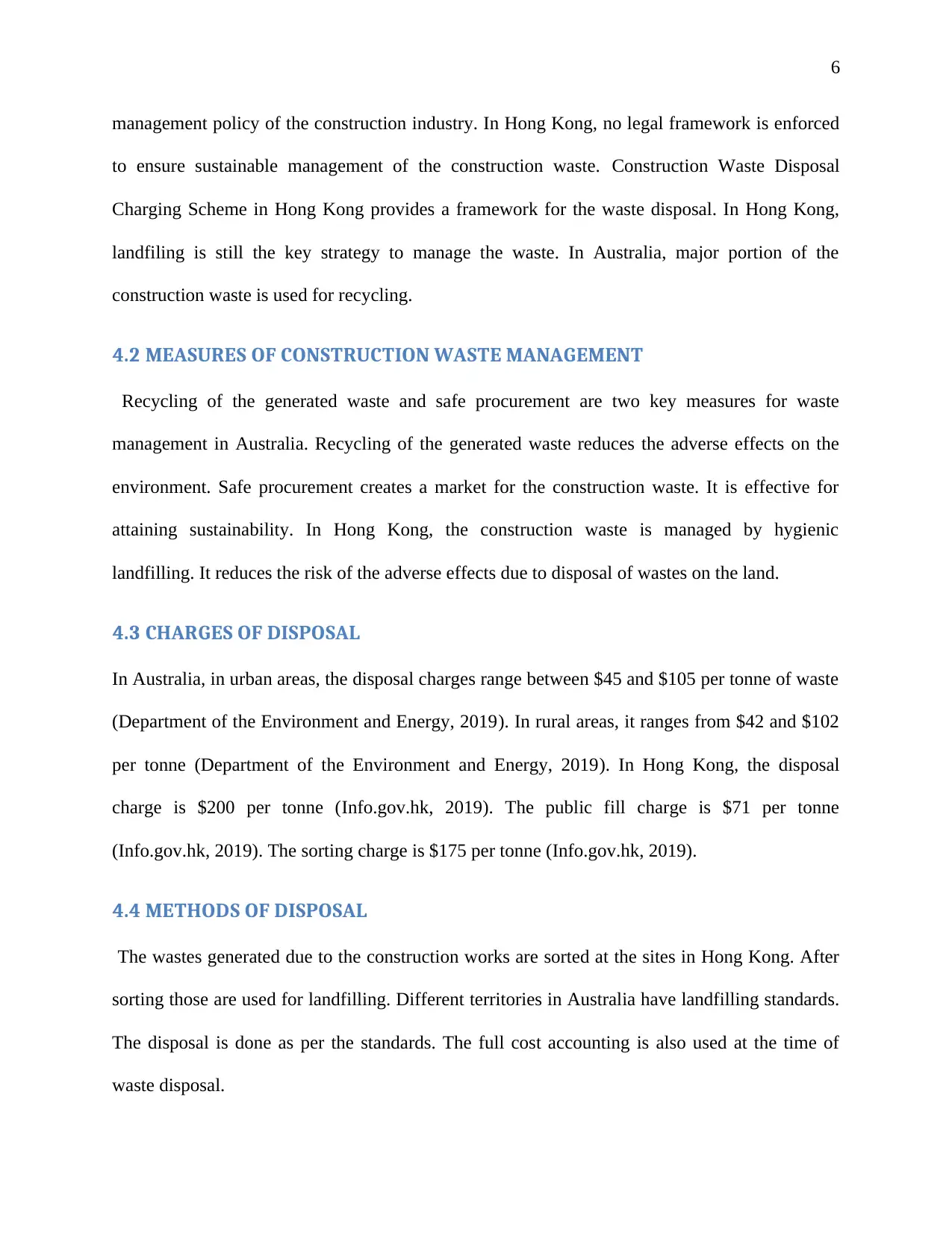
management policy of the construction industry. In Hong Kong, no legal framework is enforced
to ensure sustainable management of the construction waste. Construction Waste Disposal
Charging Scheme in Hong Kong provides a framework for the waste disposal. In Hong Kong,
landfiling is still the key strategy to manage the waste. In Australia, major portion of the
construction waste is used for recycling.
4.2 MEASURES OF CONSTRUCTION WASTE MANAGEMENT
Recycling of the generated waste and safe procurement are two key measures for waste
management in Australia. Recycling of the generated waste reduces the adverse effects on the
environment. Safe procurement creates a market for the construction waste. It is effective for
attaining sustainability. In Hong Kong, the construction waste is managed by hygienic
landfilling. It reduces the risk of the adverse effects due to disposal of wastes on the land.
4.3 CHARGES OF DISPOSAL
In Australia, in urban areas, the disposal charges range between $45 and $105 per tonne of waste
(Department of the Environment and Energy, 2019). In rural areas, it ranges from $42 and $102
per tonne (Department of the Environment and Energy, 2019). In Hong Kong, the disposal
charge is $200 per tonne (Info.gov.hk, 2019). The public fill charge is $71 per tonne
(Info.gov.hk, 2019). The sorting charge is $175 per tonne (Info.gov.hk, 2019).
4.4 METHODS OF DISPOSAL
The wastes generated due to the construction works are sorted at the sites in Hong Kong. After
sorting those are used for landfilling. Different territories in Australia have landfilling standards.
The disposal is done as per the standards. The full cost accounting is also used at the time of
waste disposal.
management policy of the construction industry. In Hong Kong, no legal framework is enforced
to ensure sustainable management of the construction waste. Construction Waste Disposal
Charging Scheme in Hong Kong provides a framework for the waste disposal. In Hong Kong,
landfiling is still the key strategy to manage the waste. In Australia, major portion of the
construction waste is used for recycling.
4.2 MEASURES OF CONSTRUCTION WASTE MANAGEMENT
Recycling of the generated waste and safe procurement are two key measures for waste
management in Australia. Recycling of the generated waste reduces the adverse effects on the
environment. Safe procurement creates a market for the construction waste. It is effective for
attaining sustainability. In Hong Kong, the construction waste is managed by hygienic
landfilling. It reduces the risk of the adverse effects due to disposal of wastes on the land.
4.3 CHARGES OF DISPOSAL
In Australia, in urban areas, the disposal charges range between $45 and $105 per tonne of waste
(Department of the Environment and Energy, 2019). In rural areas, it ranges from $42 and $102
per tonne (Department of the Environment and Energy, 2019). In Hong Kong, the disposal
charge is $200 per tonne (Info.gov.hk, 2019). The public fill charge is $71 per tonne
(Info.gov.hk, 2019). The sorting charge is $175 per tonne (Info.gov.hk, 2019).
4.4 METHODS OF DISPOSAL
The wastes generated due to the construction works are sorted at the sites in Hong Kong. After
sorting those are used for landfilling. Different territories in Australia have landfilling standards.
The disposal is done as per the standards. The full cost accounting is also used at the time of
waste disposal.
⊘ This is a preview!⊘
Do you want full access?
Subscribe today to unlock all pages.
Trusted by 1+ million students worldwide
7
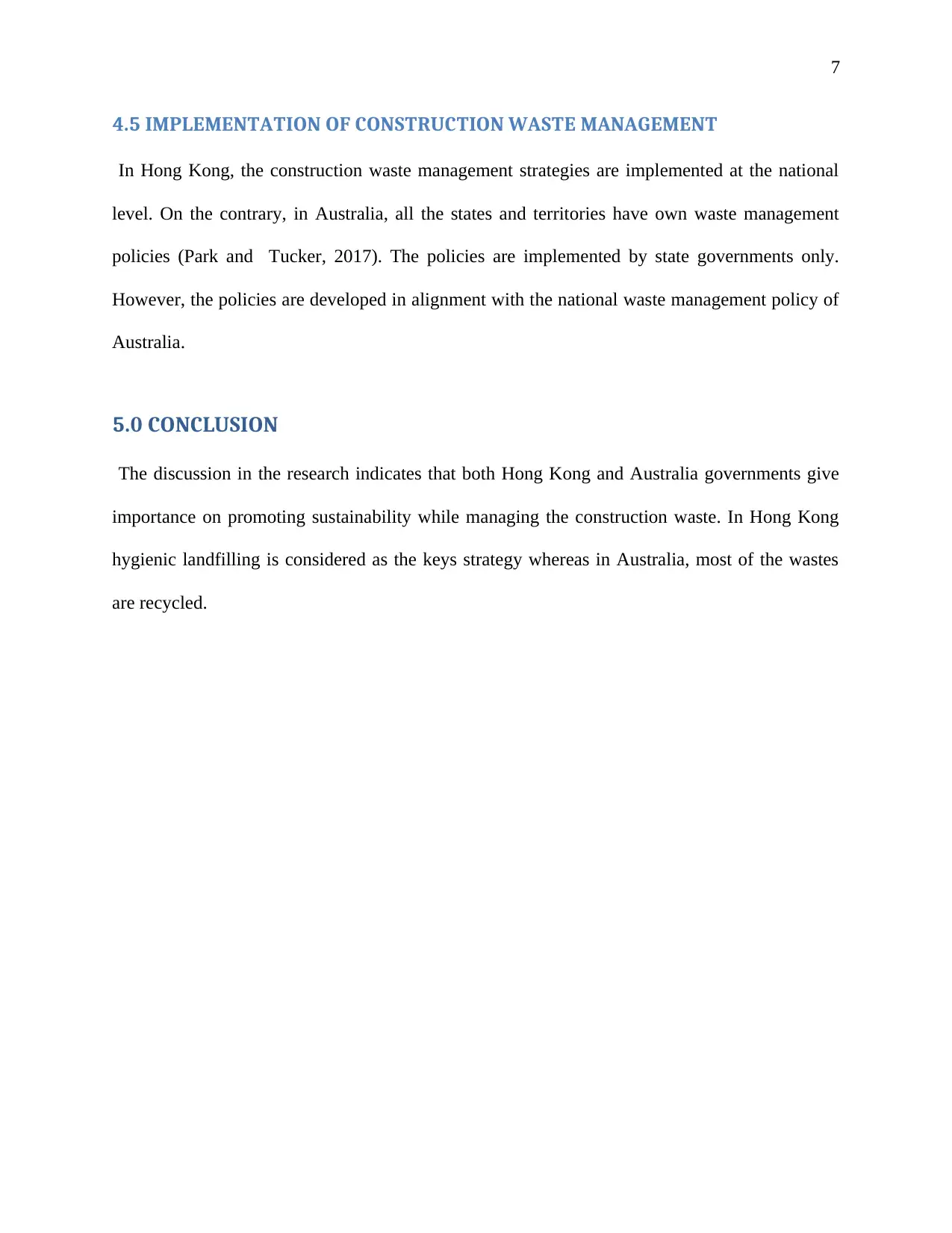
4.5 IMPLEMENTATION OF CONSTRUCTION WASTE MANAGEMENT
In Hong Kong, the construction waste management strategies are implemented at the national
level. On the contrary, in Australia, all the states and territories have own waste management
policies (Park and Tucker, 2017). The policies are implemented by state governments only.
However, the policies are developed in alignment with the national waste management policy of
Australia.
5.0 CONCLUSION
The discussion in the research indicates that both Hong Kong and Australia governments give
importance on promoting sustainability while managing the construction waste. In Hong Kong
hygienic landfilling is considered as the keys strategy whereas in Australia, most of the wastes
are recycled.
4.5 IMPLEMENTATION OF CONSTRUCTION WASTE MANAGEMENT
In Hong Kong, the construction waste management strategies are implemented at the national
level. On the contrary, in Australia, all the states and territories have own waste management
policies (Park and Tucker, 2017). The policies are implemented by state governments only.
However, the policies are developed in alignment with the national waste management policy of
Australia.
5.0 CONCLUSION
The discussion in the research indicates that both Hong Kong and Australia governments give
importance on promoting sustainability while managing the construction waste. In Hong Kong
hygienic landfilling is considered as the keys strategy whereas in Australia, most of the wastes
are recycled.
Paraphrase This Document
Need a fresh take? Get an instant paraphrase of this document with our AI Paraphraser
8
6.0 REFERENCES
Department of the Environment and Energy (2019). Department of the Environment and Energy.
[online] Department of the Environment and Energy. Available at:
https://www.environment.gov.au/protection/waste-resource-recovery/publications/full-
cost-landfill-disposal-australia [Accessed 2 Jul. 2019].
Department of the Environment and Energy 2019. Department of the Environment and Energy.
[online] Department of the Environment and Energy. Available at:
https://www.environment.gov.au/protection/waste-resource-recovery/national-waste-
policy [Accessed 2 Jul. 2019].
Department of the Environment and Energy 2019. Department of the Environment and Energy.
[online] Department of the Environment and Energy. Available at:
http://www.environment.gov.au/protection/waste-resource-recovery/publications/
construction-and-demolition-waste-status-report [Accessed 2 Jul. 2019].
Epd.gov.hk (2019). Waste | Environmental Protection Department. [online] Epd.gov.hk.
Available at:
https://www.epd.gov.hk/epd/english/environmentinhk/waste/waste_maincontent.html
[Accessed 2 Jul. 2019].
HKTDC (2019). Economic and Trade Information on Hong Kong | HKTDC. [online] Hong-
kong-economy-research.hktdc.com. Available at: http://hong-kong-economy-
research.hktdc.com/business-news/article/Market-Environment/Economic-and-Trade-
6.0 REFERENCES
Department of the Environment and Energy (2019). Department of the Environment and Energy.
[online] Department of the Environment and Energy. Available at:
https://www.environment.gov.au/protection/waste-resource-recovery/publications/full-
cost-landfill-disposal-australia [Accessed 2 Jul. 2019].
Department of the Environment and Energy 2019. Department of the Environment and Energy.
[online] Department of the Environment and Energy. Available at:
https://www.environment.gov.au/protection/waste-resource-recovery/national-waste-
policy [Accessed 2 Jul. 2019].
Department of the Environment and Energy 2019. Department of the Environment and Energy.
[online] Department of the Environment and Energy. Available at:
http://www.environment.gov.au/protection/waste-resource-recovery/publications/
construction-and-demolition-waste-status-report [Accessed 2 Jul. 2019].
Epd.gov.hk (2019). Waste | Environmental Protection Department. [online] Epd.gov.hk.
Available at:
https://www.epd.gov.hk/epd/english/environmentinhk/waste/waste_maincontent.html
[Accessed 2 Jul. 2019].
HKTDC (2019). Economic and Trade Information on Hong Kong | HKTDC. [online] Hong-
kong-economy-research.hktdc.com. Available at: http://hong-kong-economy-
research.hktdc.com/business-news/article/Market-Environment/Economic-and-Trade-
9
Information-on-Hong-Kong/etihk/en/1/1X000000/1X09OVUL.htm [Accessed 2 Jul.
2019].
Info.gov.hk (2019). Construction waste disposal charges to be adjusted on April 7. [online]
Info.gov.hk. Available at:
https://www.info.gov.hk/gia/general/201704/04/P2017040300594.htm [Accessed 2 Jul.
2019].
Park, J., and Tucker, R. 2017. Overcoming barriers to the reuse of construction waste material in
Australia: a review of the literature. International Journal of Construction
Management, 17(3), 228-237.
Information-on-Hong-Kong/etihk/en/1/1X000000/1X09OVUL.htm [Accessed 2 Jul.
2019].
Info.gov.hk (2019). Construction waste disposal charges to be adjusted on April 7. [online]
Info.gov.hk. Available at:
https://www.info.gov.hk/gia/general/201704/04/P2017040300594.htm [Accessed 2 Jul.
2019].
Park, J., and Tucker, R. 2017. Overcoming barriers to the reuse of construction waste material in
Australia: a review of the literature. International Journal of Construction
Management, 17(3), 228-237.
⊘ This is a preview!⊘
Do you want full access?
Subscribe today to unlock all pages.
Trusted by 1+ million students worldwide

1 out of 9


Your All-in-One AI-Powered Toolkit for Academic Success.
+13062052269
info@desklib.com
Available 24*7 on WhatsApp / Email
![[object Object]](/_next/static/media/star-bottom.7253800d.svg)
Unlock your academic potential
Copyright © 2020–2026 A2Z Services. All Rights Reserved. Developed and managed by ZUCOL.