BUMKT5902 Marketing Management: Consumer Behavior Analysis & Insights
VerifiedAdded on 2023/06/13
|17
|3664
|314
Report
AI Summary
This report provides an in-depth analysis of consumer behavior in the context of marketing management, focusing on the purchase decisions of a consumer named Paul Millsap. It explores the various factors influencing his buying behavior, including psychological, economic, social, and cultural aspects. The analysis covers his routine purchases throughout the week and a high-involvement product purchase (a car), using relevant marketing and consumer behavior theories such as the Marshallian model, Veblenian social-psychological model, reasoned action theory, and Maslow’s hierarchy of needs. The report compares the purchase behaviors exhibited in both scenarios, highlighting similarities and differences in rationality, convenience, and financial considerations. Key insights include brand preference and the use of the internet in the decision-making process.
i
Marketing Management
Student’s name
Professor’s name
Course title
Institution
Date
Page i of 17
Marketing Management
Student’s name
Professor’s name
Course title
Institution
Date
Page i of 17

Paraphrase This Document
Need a fresh take? Get an instant paraphrase of this document with our AI Paraphraser
ii
Executive Summary
Understanding consumer behavior is a core feature in marketing management. Consumers
go through specific process in their purchasing. The main aspects involved are identification
of their needs, collection of information, evaluation of possible alternatives and proceeding to
make the decision. There are significant factors that help make these steps. Psychological
and economic aspects are especially critical in this case. The consumer behavior is
influenced by group values, environmental factors, cultural and social aspects.
The analysis is based on Paul Millsap, a part time student and worker. The consumer
behavior describes the purchases he makes through a week of his normal routine. This is
followed by description and analysis of a high involvement product. The purchase behavior
exhibited can be analysed using relevant theories of marketing and consumer behavior.
The purchase behavior is mostly based on personal interests and satisfaction of the
consumer. The products bought through the week are mainly due to his needs and
preferences. There is also influence brought about by the environment. The social aspect of
his life such as peers and place residence factor in his purchase behavior. The Marshallian
model is useful in explaining consumer behavior that is displayed. Veblenian social-
psychological model, reasoned action and Maslow’s hierarchy of needs are other theories
involved in the analysis.
Purchase of the high involvement product is a much more thorough consumer purchase
process. The purchase of the product and consumer behavior displayed over the course of
the week show some similarities and differences. Rationality, convenience and financial
Page ii of 17
Executive Summary
Understanding consumer behavior is a core feature in marketing management. Consumers
go through specific process in their purchasing. The main aspects involved are identification
of their needs, collection of information, evaluation of possible alternatives and proceeding to
make the decision. There are significant factors that help make these steps. Psychological
and economic aspects are especially critical in this case. The consumer behavior is
influenced by group values, environmental factors, cultural and social aspects.
The analysis is based on Paul Millsap, a part time student and worker. The consumer
behavior describes the purchases he makes through a week of his normal routine. This is
followed by description and analysis of a high involvement product. The purchase behavior
exhibited can be analysed using relevant theories of marketing and consumer behavior.
The purchase behavior is mostly based on personal interests and satisfaction of the
consumer. The products bought through the week are mainly due to his needs and
preferences. There is also influence brought about by the environment. The social aspect of
his life such as peers and place residence factor in his purchase behavior. The Marshallian
model is useful in explaining consumer behavior that is displayed. Veblenian social-
psychological model, reasoned action and Maslow’s hierarchy of needs are other theories
involved in the analysis.
Purchase of the high involvement product is a much more thorough consumer purchase
process. The purchase of the product and consumer behavior displayed over the course of
the week show some similarities and differences. Rationality, convenience and financial
Page ii of 17
iii
considerations are common in both cases. Key insights in the case include brand preference
and use of internet in the decision making process.
Page iii of 17
considerations are common in both cases. Key insights in the case include brand preference
and use of internet in the decision making process.
Page iii of 17
⊘ This is a preview!⊘
Do you want full access?
Subscribe today to unlock all pages.

Trusted by 1+ million students worldwide
iv
Executive Summary ................................................................................................................i
Table of content……………………………………………………………………………………...iv
Marketing Management .........................................................................................................1
Introduction ................................................................................................................ 1
Description of consumer…………………………………………………………………………. 1,2
Demographics……………………………………………………………………………….2-4
Psychographics………………………………………………………………………………4
Consumer traits…………………………………………………………………………….4-5
Analysis of overall behavior……………………………………………………………………...5-9
Comparison……………………………………………………………………………………….9-10
Key insight…………………………………………………………………………………………10
References……………………………………………………………………………………….11-13
Page iv of 17
Executive Summary ................................................................................................................i
Table of content……………………………………………………………………………………...iv
Marketing Management .........................................................................................................1
Introduction ................................................................................................................ 1
Description of consumer…………………………………………………………………………. 1,2
Demographics……………………………………………………………………………….2-4
Psychographics………………………………………………………………………………4
Consumer traits…………………………………………………………………………….4-5
Analysis of overall behavior……………………………………………………………………...5-9
Comparison……………………………………………………………………………………….9-10
Key insight…………………………………………………………………………………………10
References……………………………………………………………………………………….11-13
Page iv of 17
Paraphrase This Document
Need a fresh take? Get an instant paraphrase of this document with our AI Paraphraser
1
Marketing Management
Introduction
A major part of marketing management involves consumers. Consumers provide the
necessary market for the products and goods of business establishments. It is thus essential
to understand consumer behavior and decision making. In a broad sense, this relates to the
decisions, actions and processes involved in consumer purchases. There are a myriad of
factors that influence consumer behavior which include personal preferences, prevailing
economic conditions, influence, marketing campaigns by brands and the purchasing power
of the consumers (Gbadamosi, 2013; Armstrong et al, 2015).
The report provides an in-depth analysis of consumer purchase behavior. The analysis
includes concepts and theories relevant to marketing management. The report aims to
provide insight in consumer decision-making process and the influential aspects that affect
purchase of products. Following the introduction of consumer and product, the report
proceeds to the analysis of purchase behavior that the consumer displays. The purchase of
a high involvement product and other general products purchased are then compared.
Description of the consumer
The consumer involved in the report is Paul Millsap. This is an individual with 26 years of
age, male and the marital status is single. He is from a family of five including parents and
two siblings. Currently, Paul is enrolled in a university pursuing a master’s degree part time.
He is also an employee of a pharmaceutical company. Paul is part of the generation
comprising of millennials. His demeanor befits specific value segments which are social
awareness and highly optimistic (Roy Morgan, 2018). He portrays careful and detailed
decision-making process and also has high value in achievements, reaching milestones and
getting gainful experiences.
Paul places major significance in the decisions he makes involving purchases of products
with high value such as the car in this case. His purchasing behavior follows a painstaking
Page 1 of 17
Marketing Management
Introduction
A major part of marketing management involves consumers. Consumers provide the
necessary market for the products and goods of business establishments. It is thus essential
to understand consumer behavior and decision making. In a broad sense, this relates to the
decisions, actions and processes involved in consumer purchases. There are a myriad of
factors that influence consumer behavior which include personal preferences, prevailing
economic conditions, influence, marketing campaigns by brands and the purchasing power
of the consumers (Gbadamosi, 2013; Armstrong et al, 2015).
The report provides an in-depth analysis of consumer purchase behavior. The analysis
includes concepts and theories relevant to marketing management. The report aims to
provide insight in consumer decision-making process and the influential aspects that affect
purchase of products. Following the introduction of consumer and product, the report
proceeds to the analysis of purchase behavior that the consumer displays. The purchase of
a high involvement product and other general products purchased are then compared.
Description of the consumer
The consumer involved in the report is Paul Millsap. This is an individual with 26 years of
age, male and the marital status is single. He is from a family of five including parents and
two siblings. Currently, Paul is enrolled in a university pursuing a master’s degree part time.
He is also an employee of a pharmaceutical company. Paul is part of the generation
comprising of millennials. His demeanor befits specific value segments which are social
awareness and highly optimistic (Roy Morgan, 2018). He portrays careful and detailed
decision-making process and also has high value in achievements, reaching milestones and
getting gainful experiences.
Paul places major significance in the decisions he makes involving purchases of products
with high value such as the car in this case. His purchasing behavior follows a painstaking
Page 1 of 17
2
and very elaborate process. The profile displayed by Paul’s shopping is in line with the
theory of reasoned action created by Martin Fishbein and Icek Ajzen (Ohio, 2018). This
theory depicts that consumers act or behave based on achieving outcome in mind (Solomon,
Russell-Bennett & Previte, 2012). The consumer behavior portrayed shows much emphasis
placed on the expected outcome following the decision to purchase. The decision that Paul
makes is based on rationality and is done with best interests at heart. Throughout the course
of decision making on the purchase, Paul can change his mind and follow a different course
of action (Palmer, 2012).
Demopraphics
The purchases that are made in a week are substantial for most consumers. Paul Millsap
shows detailed purchase of products that are wide ranging. The products are purchased for
different purposes with many factors playing part in the decisions that Paul makes. There are
several purchase factors in this case. Products are purchased based on the prices of the
products, quality, convenience and health impact. Other factors considered are the
incentives involved with purchasing specific items, the alternative products available, the
taste of particular food products and the services provided by entities. The purchases that
Paul makes are based on his needs, preferences and peer influence. The payment methods
that Paul uses are in form of cash, credits and debit cards.
The purchase of consumer products can be explained using different theories which are able
to adequately define the buyer behavior. The Marshallian model is relevant to the purchase
actions that Paul makes. According to Alfred Marshall, consumers buy products and services
based on the satisfaction that they can gain as a result. There are concerns with the theory
due to implications surrounding acting on one’s best interest. However, this explains many of
purchases that Paul and other consumers make. In the restaurants and stores, Paul buys
foods and other products according to his interests that involve taste of the products and
Page 2 of 17
and very elaborate process. The profile displayed by Paul’s shopping is in line with the
theory of reasoned action created by Martin Fishbein and Icek Ajzen (Ohio, 2018). This
theory depicts that consumers act or behave based on achieving outcome in mind (Solomon,
Russell-Bennett & Previte, 2012). The consumer behavior portrayed shows much emphasis
placed on the expected outcome following the decision to purchase. The decision that Paul
makes is based on rationality and is done with best interests at heart. Throughout the course
of decision making on the purchase, Paul can change his mind and follow a different course
of action (Palmer, 2012).
Demopraphics
The purchases that are made in a week are substantial for most consumers. Paul Millsap
shows detailed purchase of products that are wide ranging. The products are purchased for
different purposes with many factors playing part in the decisions that Paul makes. There are
several purchase factors in this case. Products are purchased based on the prices of the
products, quality, convenience and health impact. Other factors considered are the
incentives involved with purchasing specific items, the alternative products available, the
taste of particular food products and the services provided by entities. The purchases that
Paul makes are based on his needs, preferences and peer influence. The payment methods
that Paul uses are in form of cash, credits and debit cards.
The purchase of consumer products can be explained using different theories which are able
to adequately define the buyer behavior. The Marshallian model is relevant to the purchase
actions that Paul makes. According to Alfred Marshall, consumers buy products and services
based on the satisfaction that they can gain as a result. There are concerns with the theory
due to implications surrounding acting on one’s best interest. However, this explains many of
purchases that Paul and other consumers make. In the restaurants and stores, Paul buys
foods and other products according to his interests that involve taste of the products and
Page 2 of 17
⊘ This is a preview!⊘
Do you want full access?
Subscribe today to unlock all pages.
Trusted by 1+ million students worldwide
3
quality of the locales that provide the services. This shows that he prefers those very items
over others and this forms the basis of his decision making as concerns what he eats. In a
week, a major part of his expenditure is on food items (Palmer, 2012).
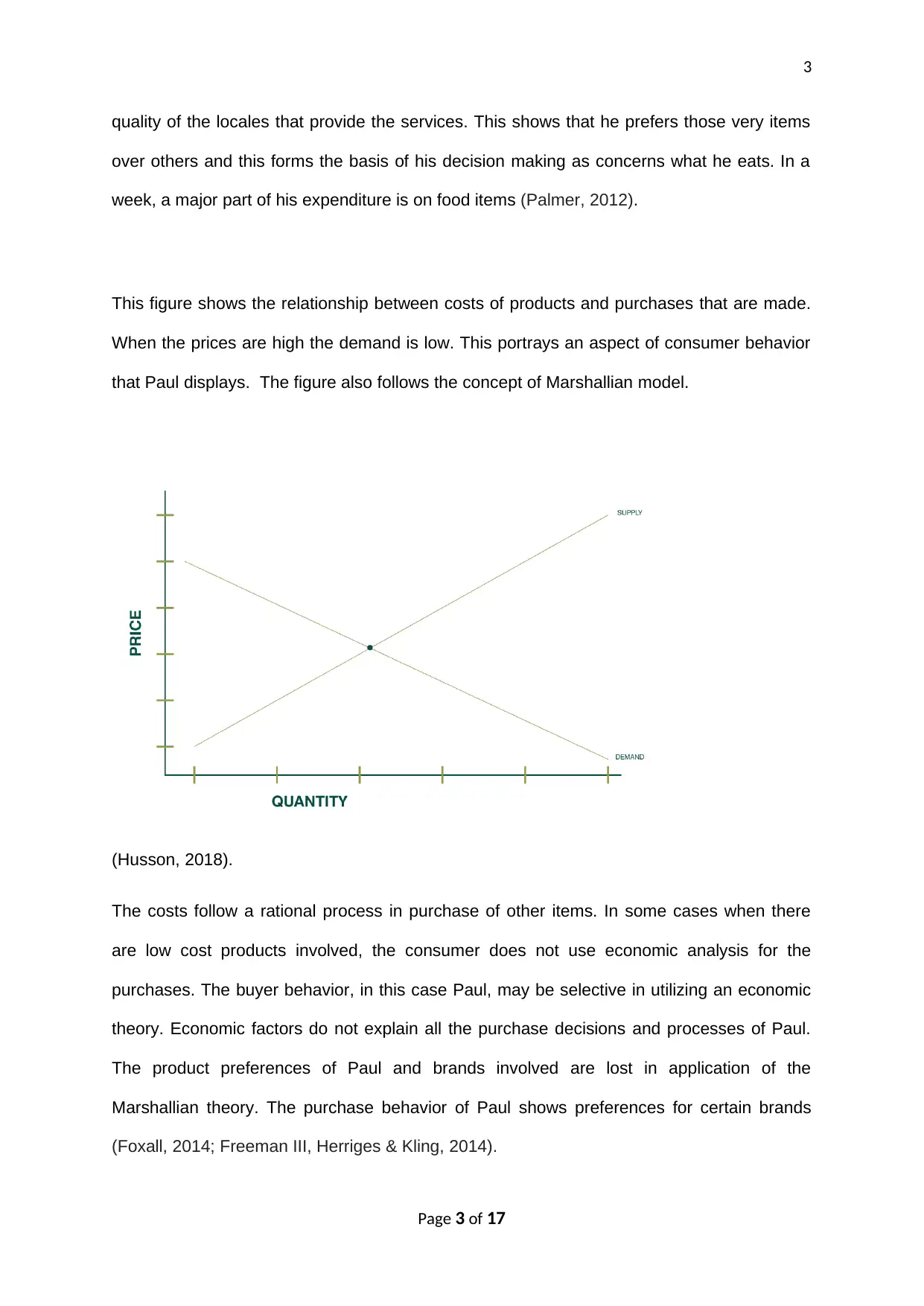
This figure shows the relationship between costs of products and purchases that are made.
When the prices are high the demand is low. This portrays an aspect of consumer behavior
that Paul displays. The figure also follows the concept of Marshallian model.
(Husson, 2018).
The costs follow a rational process in purchase of other items. In some cases when there
are low cost products involved, the consumer does not use economic analysis for the
purchases. The buyer behavior, in this case Paul, may be selective in utilizing an economic
theory. Economic factors do not explain all the purchase decisions and processes of Paul.
The product preferences of Paul and brands involved are lost in application of the
Marshallian theory. The purchase behavior of Paul shows preferences for certain brands
(Foxall, 2014; Freeman III, Herriges & Kling, 2014).
Page 3 of 17
quality of the locales that provide the services. This shows that he prefers those very items
over others and this forms the basis of his decision making as concerns what he eats. In a
week, a major part of his expenditure is on food items (Palmer, 2012).
This figure shows the relationship between costs of products and purchases that are made.
When the prices are high the demand is low. This portrays an aspect of consumer behavior
that Paul displays. The figure also follows the concept of Marshallian model.
(Husson, 2018).
The costs follow a rational process in purchase of other items. In some cases when there
are low cost products involved, the consumer does not use economic analysis for the
purchases. The buyer behavior, in this case Paul, may be selective in utilizing an economic
theory. Economic factors do not explain all the purchase decisions and processes of Paul.
The product preferences of Paul and brands involved are lost in application of the
Marshallian theory. The purchase behavior of Paul shows preferences for certain brands
(Foxall, 2014; Freeman III, Herriges & Kling, 2014).
Page 3 of 17
Paraphrase This Document
Need a fresh take? Get an instant paraphrase of this document with our AI Paraphraser
4
Change factor is less than essential. Paul shows clear choices based on what he likes which
means making changes does not come easy. However, convenience has huge impact. Most
of the purchases that Paul makes are convenient for him. The location of many of the
entities where he makes his purchases are within the area that he has his affairs and
obligations (Hosany & Martin, 2012).
Psychographics
A part of Paul’s purchase decision can be defined by the Veblenian social-psychological
model. Thorstein Veblen proposed that persons embrace the standards that are set by the
social circles. This theory explains the influence that Paul received from his peers. In this
scenario, Paul develops needs and interests as influenced by others who have certain buyer
behavior. Individuals in the university have habits which have caught on with Paul. Case in
point, the University restaurant (Lantos, 2015).
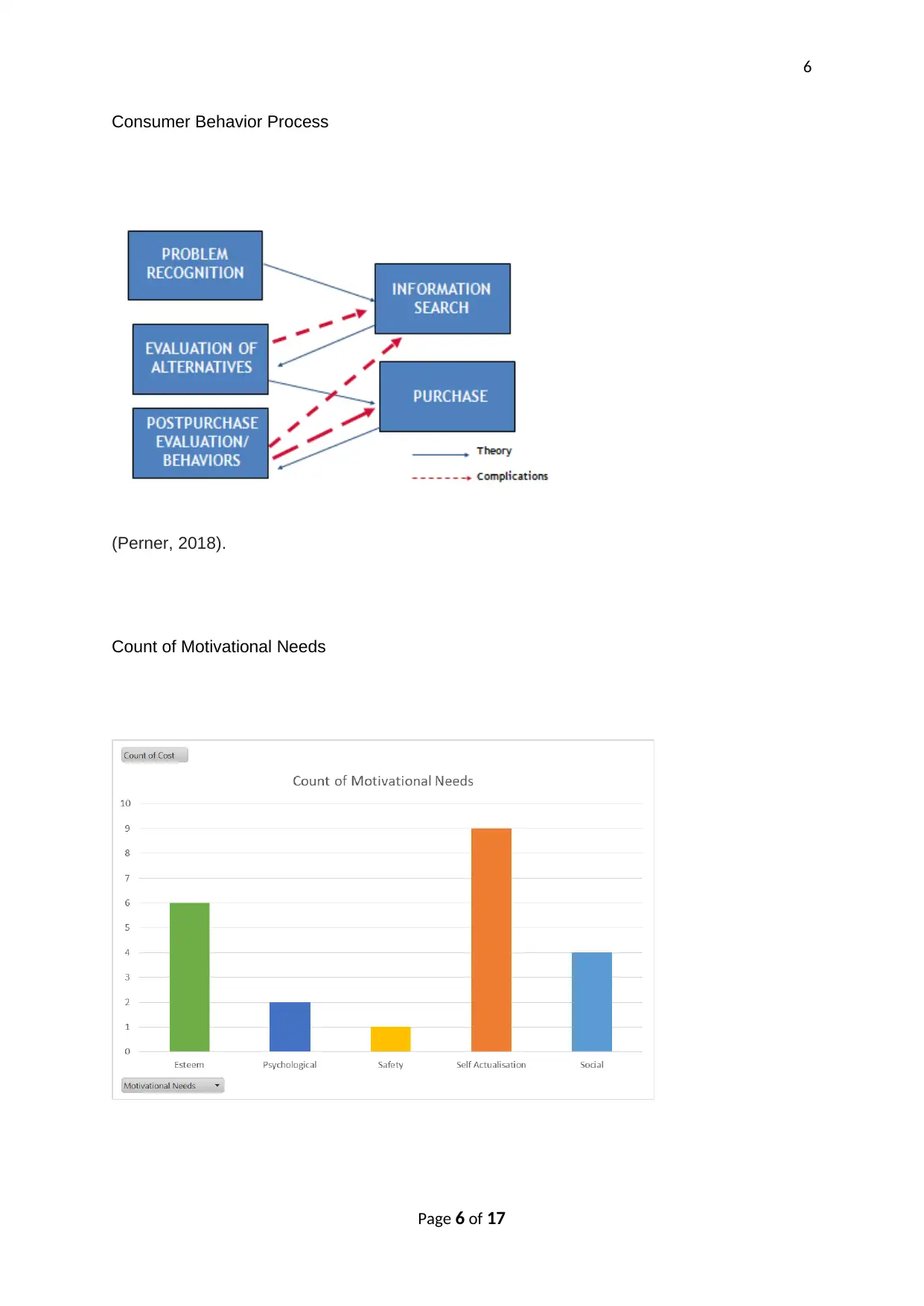
Consumer decision model helps explain Paul’s purchases. Some products are obtained
based on need. Paul can recognize need for specific products such as the internet while
acknowledging the difference between desirable state and otherwise. This propels him to
search for means of solving the issue at hand. Other factors are impactful in evaluating
alternative options. Convenience and necessity affect the options of Paul in different levels.
Consumer traits
The best interests of an individual are brought about by some factors. One factor is peer
influence. Peer influence plays a role in the decisions that Paul makes. Most of this influence
falls in the category of foods. In public restaurants, individuals appreciate the quality of
products and services that are offered. This leads to spread of word to others. This kind of
influence has led Paul to make certain buyer decisions. Other factors play part in these
decisions. As much there is peer influence involved, the final purchase decision rests on
whether the items meet the preferences that Paul has. Different factors are able to align for
the Paul to purchase the products. With personal preference and peer influence at hand,
Page 4 of 17
Change factor is less than essential. Paul shows clear choices based on what he likes which
means making changes does not come easy. However, convenience has huge impact. Most
of the purchases that Paul makes are convenient for him. The location of many of the
entities where he makes his purchases are within the area that he has his affairs and
obligations (Hosany & Martin, 2012).
Psychographics
A part of Paul’s purchase decision can be defined by the Veblenian social-psychological
model. Thorstein Veblen proposed that persons embrace the standards that are set by the
social circles. This theory explains the influence that Paul received from his peers. In this
scenario, Paul develops needs and interests as influenced by others who have certain buyer
behavior. Individuals in the university have habits which have caught on with Paul. Case in
point, the University restaurant (Lantos, 2015).
Consumer decision model helps explain Paul’s purchases. Some products are obtained
based on need. Paul can recognize need for specific products such as the internet while
acknowledging the difference between desirable state and otherwise. This propels him to
search for means of solving the issue at hand. Other factors are impactful in evaluating
alternative options. Convenience and necessity affect the options of Paul in different levels.
Consumer traits
The best interests of an individual are brought about by some factors. One factor is peer
influence. Peer influence plays a role in the decisions that Paul makes. Most of this influence
falls in the category of foods. In public restaurants, individuals appreciate the quality of
products and services that are offered. This leads to spread of word to others. This kind of
influence has led Paul to make certain buyer decisions. Other factors play part in these
decisions. As much there is peer influence involved, the final purchase decision rests on
whether the items meet the preferences that Paul has. Different factors are able to align for
the Paul to purchase the products. With personal preference and peer influence at hand,
Page 4 of 17
5
other factors that are relevant are the costs, change of grounds and convenience. The role
of costs is considerably significant but not consistent which can be explained by financial
flexibility of the consumer. Still, the Marshallian theory explains this behavior as low prices
lead to more purchases (Caruana, Carrington & Chatzidakis, 2016).
Analysis of overall purchase behaviour
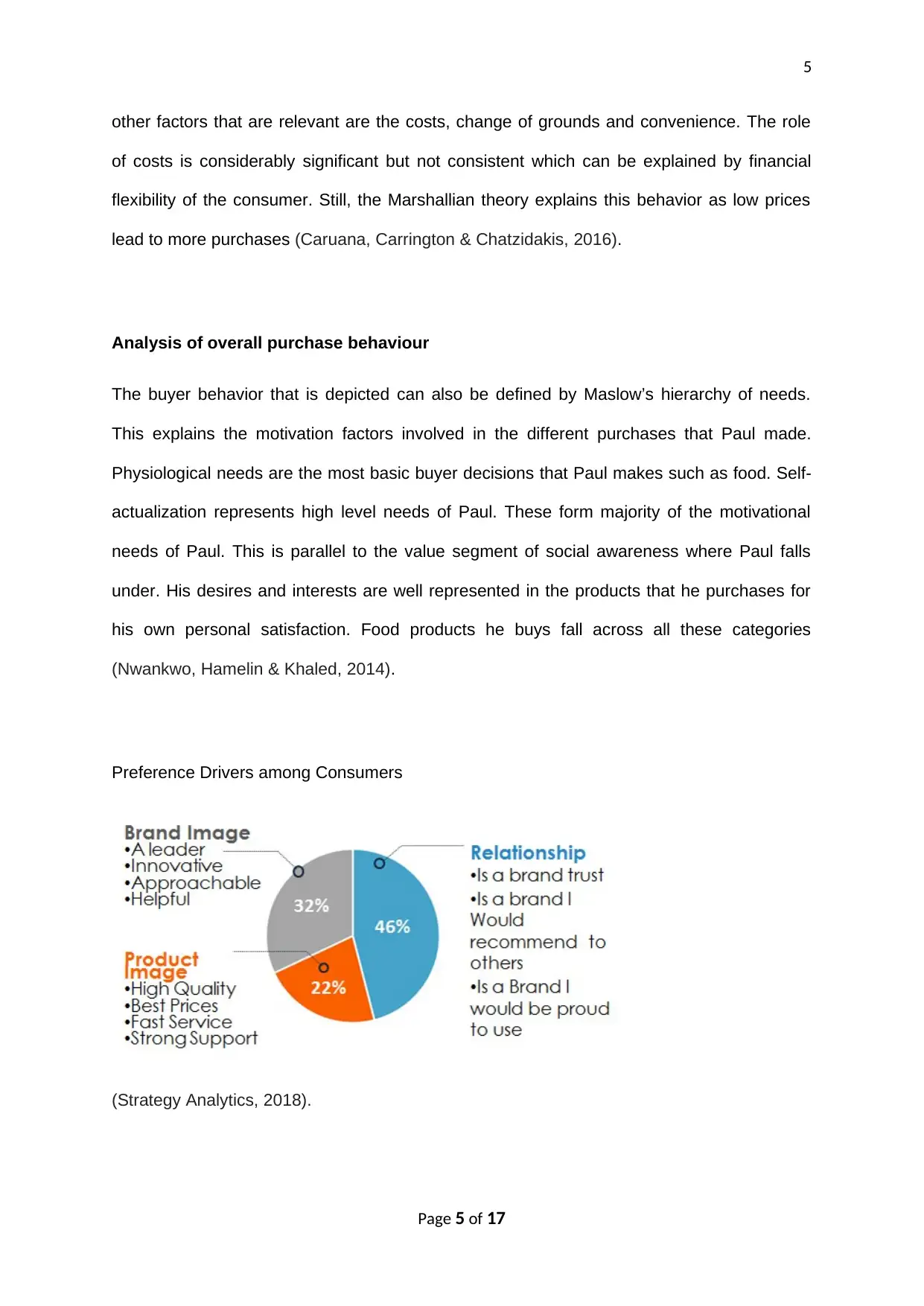
The buyer behavior that is depicted can also be defined by Maslow’s hierarchy of needs.
This explains the motivation factors involved in the different purchases that Paul made.
Physiological needs are the most basic buyer decisions that Paul makes such as food. Self-
actualization represents high level needs of Paul. These form majority of the motivational
needs of Paul. This is parallel to the value segment of social awareness where Paul falls
under. His desires and interests are well represented in the products that he purchases for
his own personal satisfaction. Food products he buys fall across all these categories
(Nwankwo, Hamelin & Khaled, 2014).
Preference Drivers among Consumers
(Strategy Analytics, 2018).
Page 5 of 17
other factors that are relevant are the costs, change of grounds and convenience. The role
of costs is considerably significant but not consistent which can be explained by financial
flexibility of the consumer. Still, the Marshallian theory explains this behavior as low prices
lead to more purchases (Caruana, Carrington & Chatzidakis, 2016).
Analysis of overall purchase behaviour
The buyer behavior that is depicted can also be defined by Maslow’s hierarchy of needs.
This explains the motivation factors involved in the different purchases that Paul made.
Physiological needs are the most basic buyer decisions that Paul makes such as food. Self-
actualization represents high level needs of Paul. These form majority of the motivational
needs of Paul. This is parallel to the value segment of social awareness where Paul falls
under. His desires and interests are well represented in the products that he purchases for
his own personal satisfaction. Food products he buys fall across all these categories
(Nwankwo, Hamelin & Khaled, 2014).
Preference Drivers among Consumers
(Strategy Analytics, 2018).
Page 5 of 17
⊘ This is a preview!⊘
Do you want full access?
Subscribe today to unlock all pages.
Trusted by 1+ million students worldwide
6
Consumer Behavior Process
(Perner, 2018).
Count of Motivational Needs
Page 6 of 17
Consumer Behavior Process
(Perner, 2018).
Count of Motivational Needs
Page 6 of 17
Paraphrase This Document
Need a fresh take? Get an instant paraphrase of this document with our AI Paraphraser
7
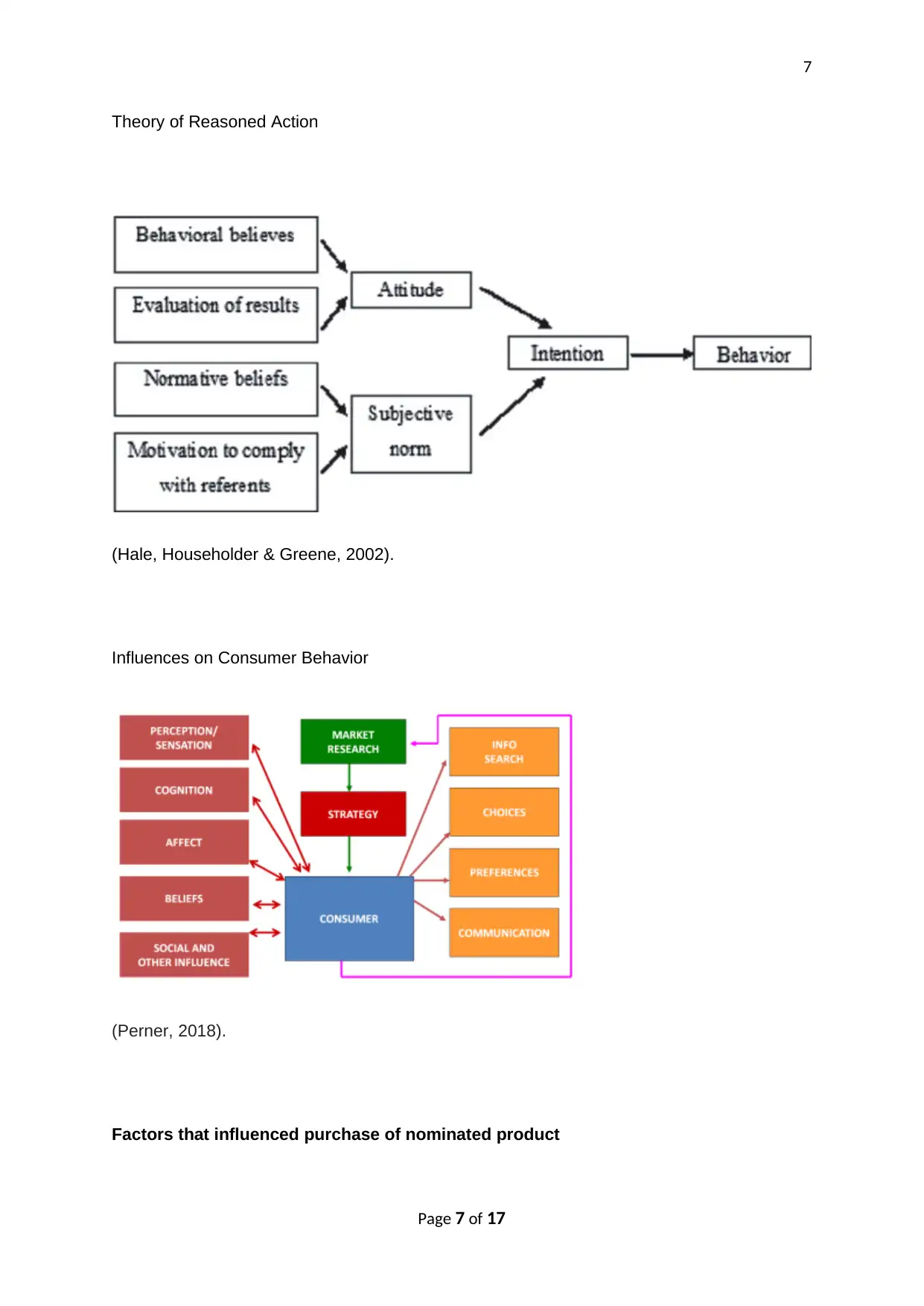
Theory of Reasoned Action
(Hale, Householder & Greene, 2002).
Influences on Consumer Behavior
(Perner, 2018).
Factors that influenced purchase of nominated product
Page 7 of 17
Theory of Reasoned Action
(Hale, Householder & Greene, 2002).
Influences on Consumer Behavior
(Perner, 2018).
Factors that influenced purchase of nominated product
Page 7 of 17
8
The product in question is a vehicle. Paul purchased a car of model Toyota Yaris YRS worth
$13,500. The purchase was made through Gumtree. This presents a definitive high
involvement product for analysis.
This decision process can be explained in relation to some of the theories in marketing and
consumer management. Given this is a high involvement product, Paul must put a lot of
thought to the decision. Theory of reasoned action comes in to play in this case. There is a
outcome that Paul expects to achieve as a result of buying this car. This is created from his
intention to buy the car. Paul will be aided significantly in his movement about his
businesses. The vehicle is very helpful specifically in traveling between to and from the
university, workplace and home. The theory of reasoned action asserts that rationality is
involved in this decision to buy the car. Paul does with his bets interests in mind and having
much thought to this decision (Montano & Kasprzyk, 2015; Hale et al, 2002).
Engel, Kollet, Blackwell (EKB) Model is a great basis for understanding the consumer
behavior that Paul has presented. EKB has a 5-step process of making buyer decisions
(Shahnaei, 2012). Paul’s case follows the steps distinctly. His first step is the input where he
absorbs the marketing content on the car through the internet, on TV sets or newspapers.
Paul uses this data that he has collected, processes the information while comparing his
expectations. This helps to apply rational insight when making the decision to make the
purchase. An important aspect to note is that Paul’s decision is impacted by external
influences and variables in the process. He envisions himself in the car before making the
purchase.
The purchase of the car was influenced by several factors. The brand of the car is an
important that Paul considered, and this is based on his preference or taste in cars. The
specifications of the vehicle justify this choice. The car has affordable pricing for Paul. It is
very economical in that it is not expensive to maintain has good fuel economy and has high
reliability. The car is stylish and has vital convenient and safety features. It is also easy to
Page 8 of 17
The product in question is a vehicle. Paul purchased a car of model Toyota Yaris YRS worth
$13,500. The purchase was made through Gumtree. This presents a definitive high
involvement product for analysis.
This decision process can be explained in relation to some of the theories in marketing and
consumer management. Given this is a high involvement product, Paul must put a lot of
thought to the decision. Theory of reasoned action comes in to play in this case. There is a
outcome that Paul expects to achieve as a result of buying this car. This is created from his
intention to buy the car. Paul will be aided significantly in his movement about his
businesses. The vehicle is very helpful specifically in traveling between to and from the
university, workplace and home. The theory of reasoned action asserts that rationality is
involved in this decision to buy the car. Paul does with his bets interests in mind and having
much thought to this decision (Montano & Kasprzyk, 2015; Hale et al, 2002).
Engel, Kollet, Blackwell (EKB) Model is a great basis for understanding the consumer
behavior that Paul has presented. EKB has a 5-step process of making buyer decisions
(Shahnaei, 2012). Paul’s case follows the steps distinctly. His first step is the input where he
absorbs the marketing content on the car through the internet, on TV sets or newspapers.
Paul uses this data that he has collected, processes the information while comparing his
expectations. This helps to apply rational insight when making the decision to make the
purchase. An important aspect to note is that Paul’s decision is impacted by external
influences and variables in the process. He envisions himself in the car before making the
purchase.
The purchase of the car was influenced by several factors. The brand of the car is an
important that Paul considered, and this is based on his preference or taste in cars. The
specifications of the vehicle justify this choice. The car has affordable pricing for Paul. It is
very economical in that it is not expensive to maintain has good fuel economy and has high
reliability. The car is stylish and has vital convenient and safety features. It is also easy to
Page 8 of 17
⊘ This is a preview!⊘
Do you want full access?
Subscribe today to unlock all pages.
Trusted by 1+ million students worldwide

1 out of 17


Related Documents


Your All-in-One AI-Powered Toolkit for Academic Success.
+13062052269
info@desklib.com
Available 24*7 on WhatsApp / Email
![[object Object]](/_next/static/media/star-bottom.7253800d.svg)
Unlock your academic potential
Copyright © 2020–2026 A2Z Services. All Rights Reserved. Developed and managed by ZUCOL.