Comprehensive Report on Contemporary Business Economics

Verified

Added on  2022/12/01

|8
|1774
|182
Report
AI Summary
This report provides a comprehensive overview of contemporary business economics, delving into the fundamental concepts of the law of demand and the law of supply, explaining their relationship with price and quantity. It then contrasts modern and old economic theories, including the neoclassical model, endogenous growth theories, and Keynesian economics, highlighting their impact on economic growth and development. The report discusses the importance of capital, labor, and technological advancements in economic growth, along with the role of institutional arrangements and the constraints on growth. Finally, it concludes by emphasizing the significance of income distribution and the impact of inequality and poverty on economic development, referencing relevant literature to support its arguments.
Document Page
Contemporary business
economics
tabler-icon-diamond-filled.svg

Paraphrase This Document

Need a fresh take? Get an instant paraphrase of this document with our AI Paraphraser
Document Page
Table of Contents
INTRODUCTION...........................................................................................................................3
MAIN BODY..................................................................................................................................3
Law of demand............................................................................................................................3
Law of supply..............................................................................................................................4
Modern and old economics..........................................................................................................6
CONCLUSION................................................................................................................................7
REFERENCES................................................................................................................................8
Document Page
INTRODUCTION
MAIN BODY
Law of demand
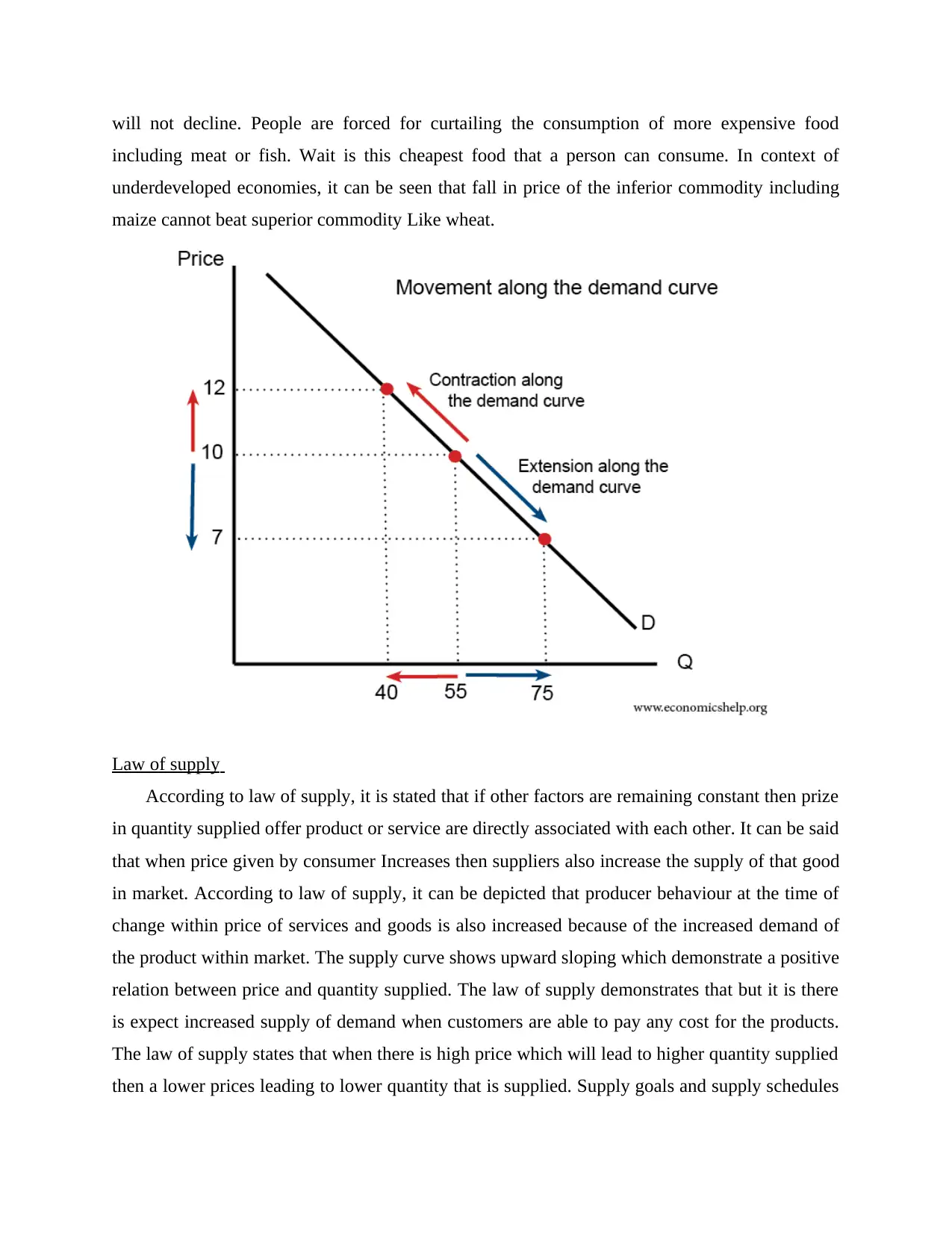
The law of demand is used for expressing relationship between price and quantity that is
demanded. According to the words given by Marshall, it is analysed that the amount demanded
can increase with fall in price. it is also seen that it diminishes with rise in price. It can be
expressed that an inverse relationship between pricing demand can be analysed from the graph.
According to this law, there is reference to the direction in which quantities demanded according
to the changes and it creates change in price. It is also associated with these slope of demand
curve that is negative throughout the length. The inverse price demand relationship depends upon
the other remaining things which are equal. The phrase points together different important
assumptions which are based upon this law.There are basically three assumptions involved in
law of demand which are mentioned below:
There is no change in preference and taste of consumer
The income of consumer is constant
There is no change in custom
In context of law of demand, commodity that is used is not conferred extension on the
consumer. There are no substitutes of the commodity which is used. There should be no change
according to the price of other products. It should not be involved in the quality of product. The
habits of consumers are not remaining unchanged. According to these conditions, law of demand
is actually operating. When there is change in one of the conditions then love demand stops
operating. According to the law of demand, it is evaluated that this slope from left to right
demonstrates a positive slope. According to certain circumstances, consumers are involved in
buying more when price of commodity rises and less when price falls. There are several reasons
for the Attribution of upward slope demand curve full stops when there is shortage in fearing of
anticipation of war then people are not start buying for building stocks and holding even when
the price is rising. In context of depression, it is seen that price of commodities is also lower and
demand of them also declines. The reason behind this is that lack of purchasing power with the
customers. When the commodity happens to be necessary for people then price goes up but
demand does not diminish is. For example, if the price of wheat or rice increases then demand
Document Page
will not decline. People are forced for curtailing the consumption of more expensive food
including meat or fish. Wait is this cheapest food that a person can consume. In context of
underdeveloped economies, it can be seen that fall in price of the inferior commodity including
maize cannot beat superior commodity Like wheat.
Law of supply
According to law of supply, it is stated that if other factors are remaining constant then prize
in quantity supplied offer product or service are directly associated with each other. It can be said
that when price given by consumer Increases then suppliers also increase the supply of that good
in market. According to law of supply, it can be depicted that producer behaviour at the time of
change within price of services and goods is also increased because of the increased demand of
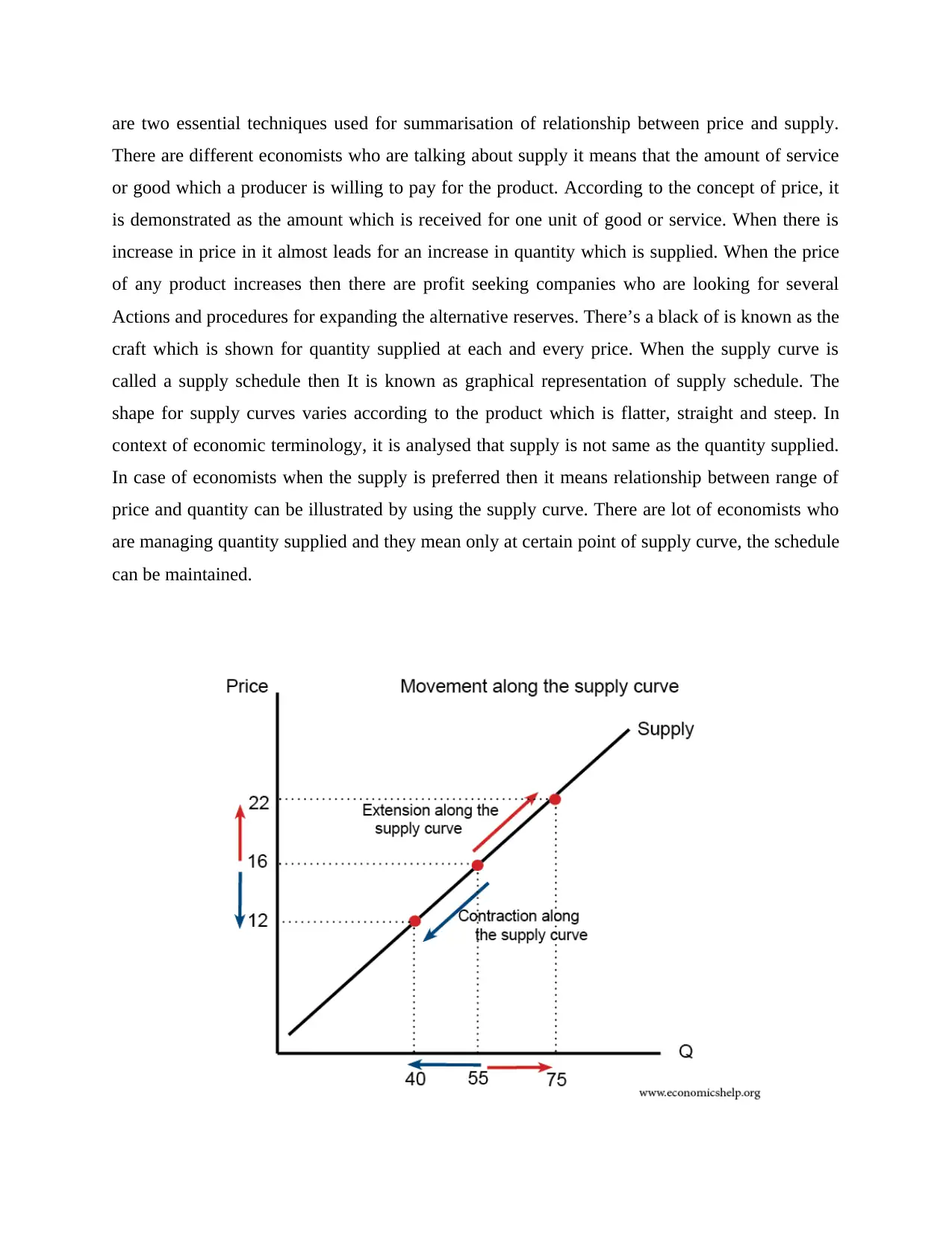
the product within market. The supply curve shows upward sloping which demonstrate a positive
relation between price and quantity supplied. The law of supply demonstrates that but it is there
is expect increased supply of demand when customers are able to pay any cost for the products.
The law of supply states that when there is high price which will lead to higher quantity supplied
then a lower prices leading to lower quantity that is supplied. Supply goals and supply schedules
tabler-icon-diamond-filled.svg

Paraphrase This Document

Need a fresh take? Get an instant paraphrase of this document with our AI Paraphraser
Document Page
are two essential techniques used for summarisation of relationship between price and supply.
There are different economists who are talking about supply it means that the amount of service
or good which a producer is willing to pay for the product. According to the concept of price, it
is demonstrated as the amount which is received for one unit of good or service. When there is
increase in price in it almost leads for an increase in quantity which is supplied. When the price
of any product increases then there are profit seeking companies who are looking for several
Actions and procedures for expanding the alternative reserves. There’s a black of is known as the
craft which is shown for quantity supplied at each and every price. When the supply curve is
called a supply schedule then It is known as graphical representation of supply schedule. The
shape for supply curves varies according to the product which is flatter, straight and steep. In
context of economic terminology, it is analysed that supply is not same as the quantity supplied.
In case of economists when the supply is preferred then it means relationship between range of
price and quantity can be illustrated by using the supply curve. There are lot of economists who
are managing quantity supplied and they mean only at certain point of supply curve, the schedule
can be maintained.
Document Page
Modern and old economics
According to the neoclassical theory of economic development, more capital or labor produces
minimal benefit. As a result, increasing capital has only a short-term or minimal influence on
economic growth. The economy sustains its steady-state level of economic development as
investment rises. In the Solow/Swan model, increasing the economic growth rate requires:
An rise in the percentage of GDP spent – but this is restricted since a larger percentage of
investment leads to lower returns and converge on the constant of gdp. Technological
advancement that boosts capital/labor production. It argues that impoverished nations that
engage further can experience an increase in their GDP.
Endogenous growth theories claim that human capital and technical innovation have a substantial
effect on economic growth. A neo-classical model is the Harrod-Domar model. It claims that the
rate of growth is a consequence of the interest rate. Domestic savings are emphasized heavily in
certain growth models. Savings offer the money required to fund investment. This investment is
what propels the company forward. It has been a significant contributor to Asia's economic
prosperity. Nevertheless, it is contingent on the investment's efficiency. People cannot afford to
consume if their savings are too large, resulting in reduced development. Paul Romer and Robert
Lucas created endogenous growth models that put a larger focus on the idea of human capital.
How workers with more knowledge, education, and training may aid in the growth of
technology. They place a larger emphasis on governments' active encouragement of technical
progress. Firms may have little motivation to invest in new technology, they claim, because they
will struggle to prosper in competitive marketplaces, according to the free market classical
approach. The approach emphasizes both capital and labor productivity increases. It claims that
rising labor productivity has growing rewards rather than declining rewards. The relevance of
institutional arrangements in economic growth, social behavior, financial transmission range, and
quality in the market is therefore highlighted by the network-based theory of modernisation.
According to the research, in countries with inadequate formal institutions, numerous minuscule
businesses cohabit with big corporations. The hypothesis predicts that minuscule enterprises will
go extinct at a greater degree of economic growth, which will be sustained by powerful formal
institutions. In contrast to previous research. This disparity in industry organization between
degrees of economic growth has been highlighted as ineffective.
Document Page
Demand-side Keynesianism — Keynes thought that aggregate demand might influence short-
and medium-term consumer spending. Despite the fact that most growth models neglect the
importance of aggregate demand, some analysts predict that financial crises can produce
hysteresis effects, resulting in slower long-term development.
Growth Constraints – From an engineering perspective, some claim that resource deterioration
and climate change will hinder economic growth in the long run. This suggests that economic
expansion may be coming to an end, akin to Malthus' beliefs.
CONCLUSION
From the above report, it is concluded that economic development is properly concerned with the
distribution of this increased income among the people. Inequality and poverty are two major
characteristics of income distribution. If average income rises but income disparity develops, an
egalitarian view would consider the latter to be a bad component of economic progress. If
poverty, defined as a population with an income below a socially acceptable level, rises at the
same time, this is another negative mark against growing average income when evaluating
economic development. Between course, the real impact on poverty will be determined by the
combination of average income and inequality, as well as which of the two is more prevalent.
tabler-icon-diamond-filled.svg

Paraphrase This Document

Need a fresh take? Get an instant paraphrase of this document with our AI Paraphraser
Document Page
REFERENCES
Books and Journals
Song, H., Yu, S., Liu, F., Sun, X. and Sun, T., 2020, December. Optimal Subsidy Support for
Market-Oriented Transformation of Elderly Care: Focus on the Gap between Supply and
Demand in Aging Regions of China. In Healthcare (Vol. 8, No. 4, p. 441). Multidisciplinary
Digital Publishing Institute.
Woodring, D., Hyde, T. and McLennan, J., 2021. There's Demand For Recyclate, But Little
Supply: Recycled and virgin plastics pricing decouple as global supply gap widens. Plastics
Engineering, 77(2), pp.39-41.
Žic, J. and Žic, S., Experimental analysis of market demand influence on greenhouse gas
emissions in supply chains. In Proceedings of 10th International Scientific Conference on
Management of Technology-Step to Sustainable Production (MOTSP 2018)/Ćosić, Predrag-
Zagreb: Croatian Association for PLM, 2018 (p. 128).
chevron_up_icon
1 out of 8
circle_padding
hide_on_mobile
zoom_out_icon
[object Object]