Content Analysis Report: Corporate Culture, College-to-Work Transition

Verified

Added on  2023/01/23

|8
|1654
|90
Report
AI Summary
This report presents a content analysis of interview transcripts, focusing on the experiences of participants within a corporate culture and their transition from college to work. The methodology section details the preparation of the data, theme identification, development of a coding scheme, pre-testing, and the coding process itself, utilizing a deductive approach with qualitative comparative analysis. The results section discusses the validity and reliability of the coding, and inferences drawn from the identified themes. The analysis examines participant responses regarding their work experiences, job satisfaction, and the application of their college education in their professional careers. The report also touches upon challenges faced during the transition and provides an overview of the presentation of the results derived from the interviews.
Document Page
Running head: CONTENT ANALYSIS 1
Content Analysis of Transcripts
tabler-icon-diamond-filled.svg

Paraphrase This Document

Need a fresh take? Get an instant paraphrase of this document with our AI Paraphraser
Document Page
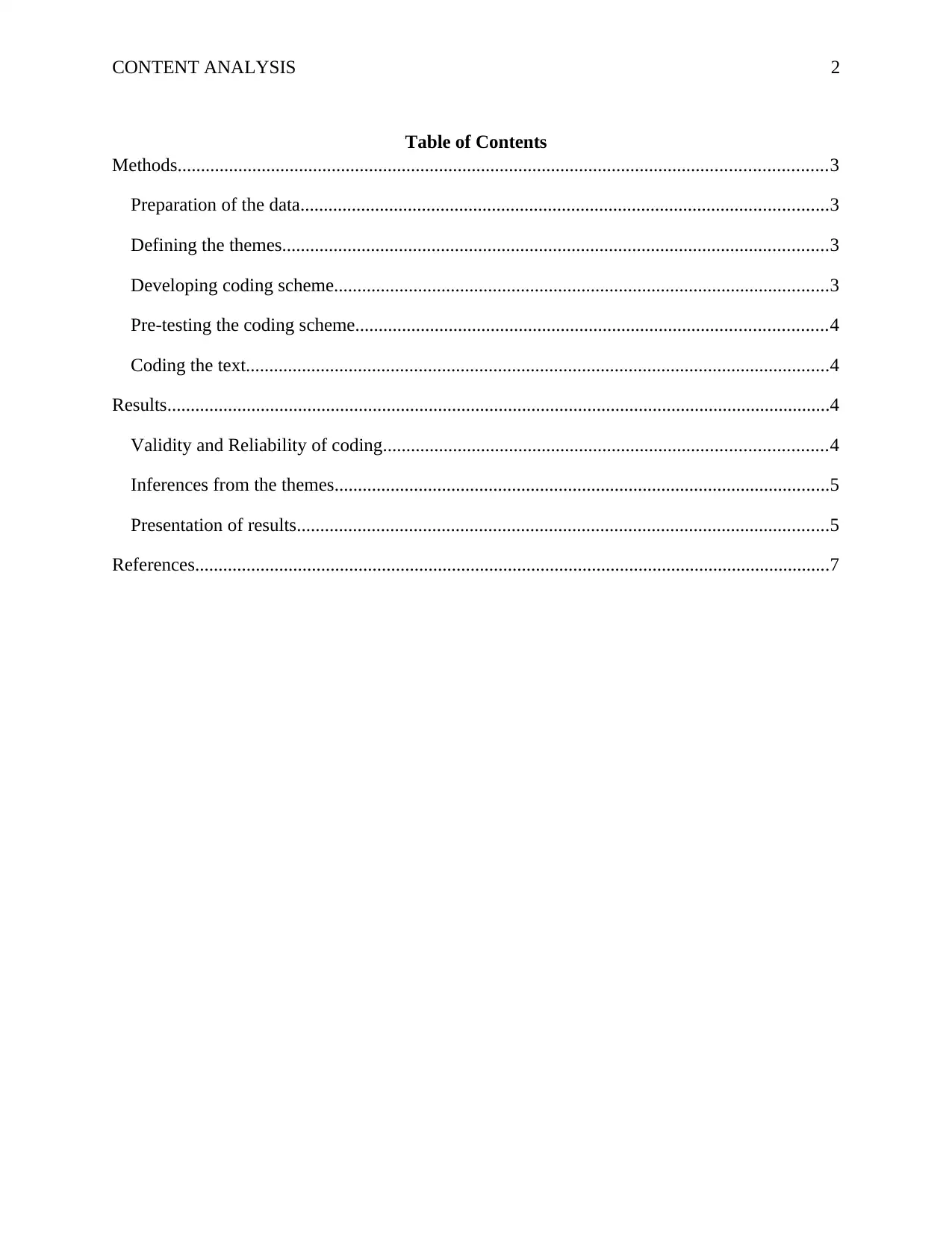
CONTENT ANALYSIS 2
Table of Contents
Methods...........................................................................................................................................3
Preparation of the data.................................................................................................................3
Defining the themes.....................................................................................................................3
Developing coding scheme..........................................................................................................3
Pre-testing the coding scheme.....................................................................................................4
Coding the text.............................................................................................................................4
Results..............................................................................................................................................4
Validity and Reliability of coding...............................................................................................4
Inferences from the themes..........................................................................................................5
Presentation of results..................................................................................................................5
References........................................................................................................................................7
Document Page
CONTENT ANALYSIS 3
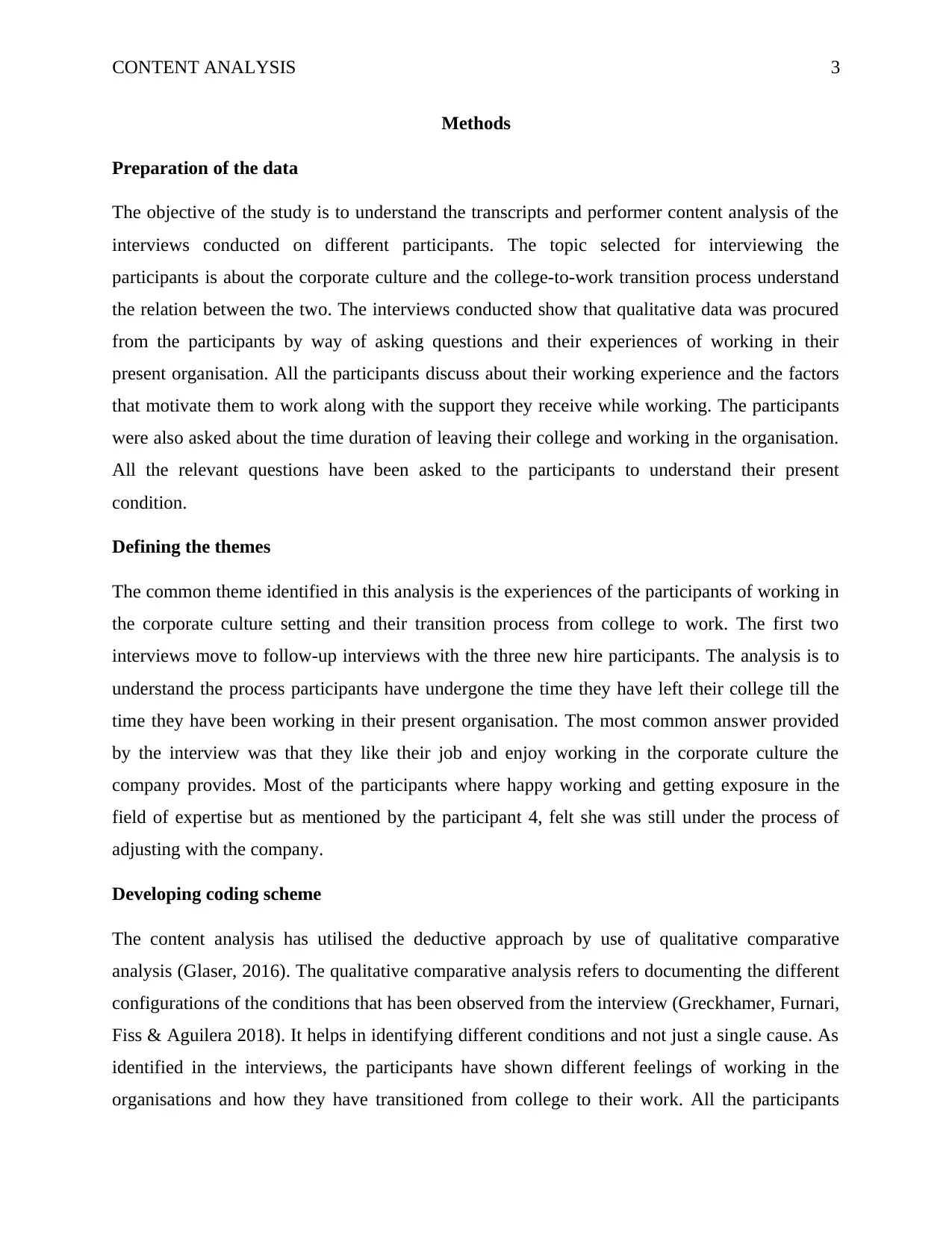
Methods
Preparation of the data
The objective of the study is to understand the transcripts and performer content analysis of the
interviews conducted on different participants. The topic selected for interviewing the
participants is about the corporate culture and the college-to-work transition process understand
the relation between the two. The interviews conducted show that qualitative data was procured
from the participants by way of asking questions and their experiences of working in their
present organisation. All the participants discuss about their working experience and the factors
that motivate them to work along with the support they receive while working. The participants
were also asked about the time duration of leaving their college and working in the organisation.
All the relevant questions have been asked to the participants to understand their present
condition.
Defining the themes
The common theme identified in this analysis is the experiences of the participants of working in
the corporate culture setting and their transition process from college to work. The first two
interviews move to follow-up interviews with the three new hire participants. The analysis is to
understand the process participants have undergone the time they have left their college till the
time they have been working in their present organisation. The most common answer provided
by the interview was that they like their job and enjoy working in the corporate culture the
company provides. Most of the participants where happy working and getting exposure in the
field of expertise but as mentioned by the participant 4, felt she was still under the process of
adjusting with the company.
Developing coding scheme
The content analysis has utilised the deductive approach by use of qualitative comparative
analysis (Glaser, 2016). The qualitative comparative analysis refers to documenting the different
configurations of the conditions that has been observed from the interview (Greckhamer, Furnari,
Fiss & Aguilera 2018). It helps in identifying different conditions and not just a single cause. As
identified in the interviews, the participants have shown different feelings of working in the
organisations and how they have transitioned from college to their work. All the participants
Document Page
CONTENT ANALYSIS 4
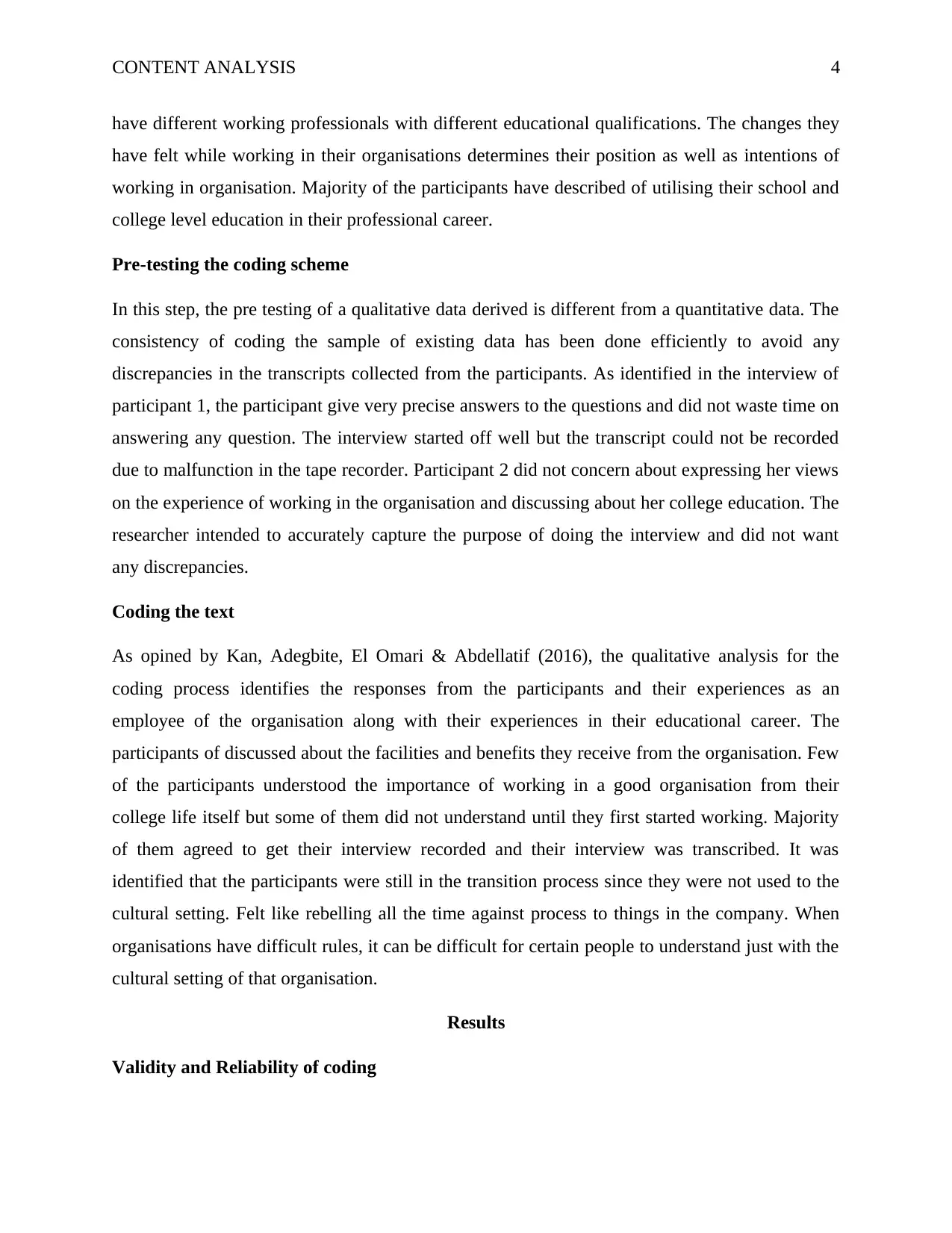
have different working professionals with different educational qualifications. The changes they
have felt while working in their organisations determines their position as well as intentions of
working in organisation. Majority of the participants have described of utilising their school and
college level education in their professional career.
Pre-testing the coding scheme
In this step, the pre testing of a qualitative data derived is different from a quantitative data. The
consistency of coding the sample of existing data has been done efficiently to avoid any
discrepancies in the transcripts collected from the participants. As identified in the interview of
participant 1, the participant give very precise answers to the questions and did not waste time on
answering any question. The interview started off well but the transcript could not be recorded
due to malfunction in the tape recorder. Participant 2 did not concern about expressing her views
on the experience of working in the organisation and discussing about her college education. The
researcher intended to accurately capture the purpose of doing the interview and did not want
any discrepancies.
Coding the text
As opined by Kan, Adegbite, El Omari & Abdellatif (2016), the qualitative analysis for the
coding process identifies the responses from the participants and their experiences as an
employee of the organisation along with their experiences in their educational career. The
participants of discussed about the facilities and benefits they receive from the organisation. Few
of the participants understood the importance of working in a good organisation from their
college life itself but some of them did not understand until they first started working. Majority
of them agreed to get their interview recorded and their interview was transcribed. It was
identified that the participants were still in the transition process since they were not used to the
cultural setting. Felt like rebelling all the time against process to things in the company. When
organisations have difficult rules, it can be difficult for certain people to understand just with the
cultural setting of that organisation.
Results
Validity and Reliability of coding
tabler-icon-diamond-filled.svg

Paraphrase This Document

Need a fresh take? Get an instant paraphrase of this document with our AI Paraphraser
Document Page
CONTENT ANALYSIS 5
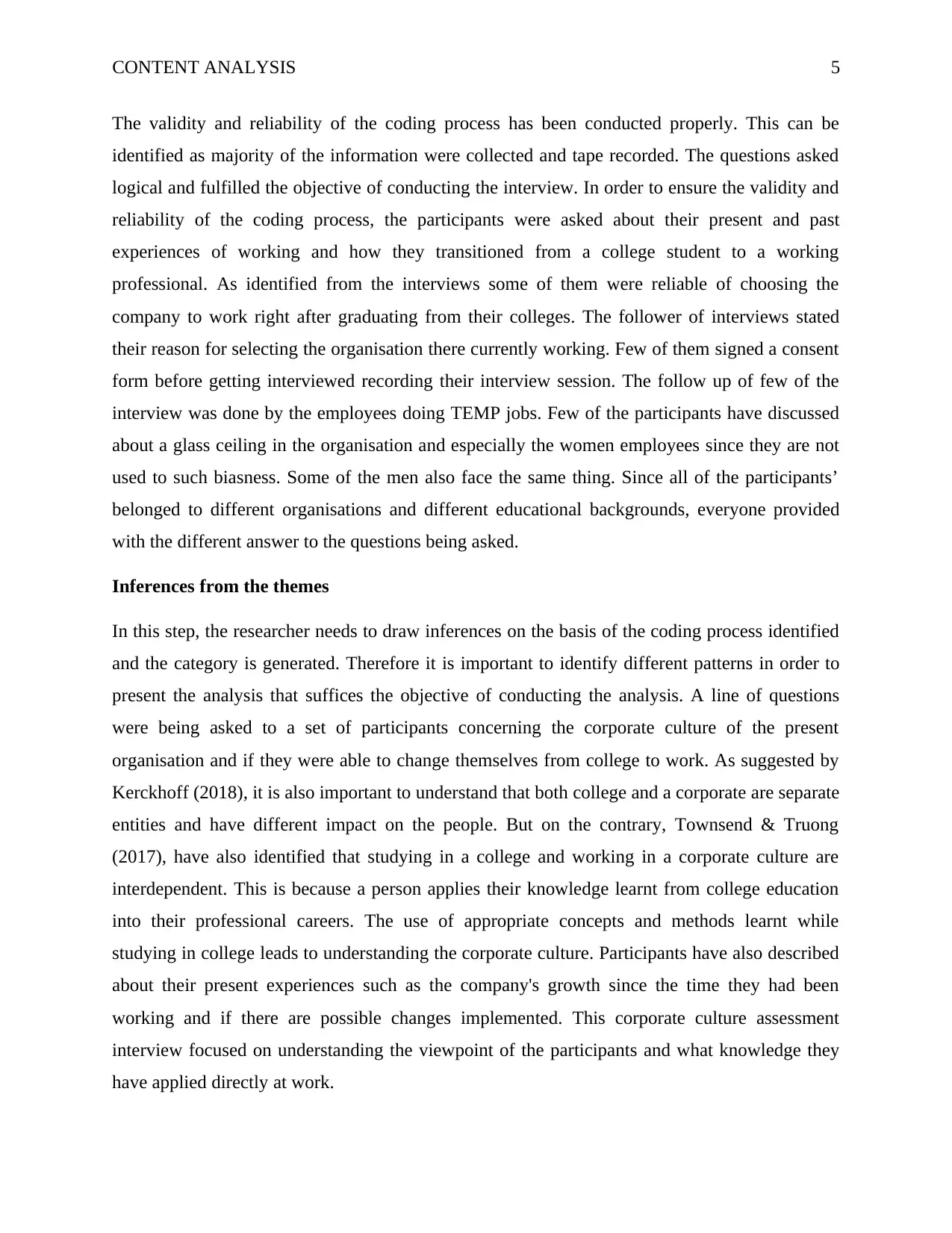
The validity and reliability of the coding process has been conducted properly. This can be
identified as majority of the information were collected and tape recorded. The questions asked
logical and fulfilled the objective of conducting the interview. In order to ensure the validity and
reliability of the coding process, the participants were asked about their present and past
experiences of working and how they transitioned from a college student to a working
professional. As identified from the interviews some of them were reliable of choosing the
company to work right after graduating from their colleges. The follower of interviews stated
their reason for selecting the organisation there currently working. Few of them signed a consent
form before getting interviewed recording their interview session. The follow up of few of the
interview was done by the employees doing TEMP jobs. Few of the participants have discussed
about a glass ceiling in the organisation and especially the women employees since they are not
used to such biasness. Some of the men also face the same thing. Since all of the participants’
belonged to different organisations and different educational backgrounds, everyone provided
with the different answer to the questions being asked.
Inferences from the themes
In this step, the researcher needs to draw inferences on the basis of the coding process identified
and the category is generated. Therefore it is important to identify different patterns in order to
present the analysis that suffices the objective of conducting the analysis. A line of questions
were being asked to a set of participants concerning the corporate culture of the present
organisation and if they were able to change themselves from college to work. As suggested by
Kerckhoff (2018), it is also important to understand that both college and a corporate are separate
entities and have different impact on the people. But on the contrary, Townsend & Truong
(2017), have also identified that studying in a college and working in a corporate culture are
interdependent. This is because a person applies their knowledge learnt from college education
into their professional careers. The use of appropriate concepts and methods learnt while
studying in college leads to understanding the corporate culture. Participants have also described
about their present experiences such as the company's growth since the time they had been
working and if there are possible changes implemented. This corporate culture assessment
interview focused on understanding the viewpoint of the participants and what knowledge they
have applied directly at work.
Document Page
CONTENT ANALYSIS 6
Presentation of results
The presentation of the interviews have been provided by way of questions being asked to the
participants. As discussed earlier about the questions that are being asked to the participants, it
can be analyzed that majority of them were in favor of gaining substantial knowledge from their
college education. This helped them to become familiar with the corporate culture, working
styles and environment prevailing within the organization they chose to work for. Generally, as
opined by Aronson, Callahan & Davis (2015), the transition process can be difficult for many
people since they are not accustomed working for an organization. This is the underlying reason
why it is important for people to understanding their college education and apply them into
practical life.
Document Page
CONTENT ANALYSIS 7
References
Aronson, P., Callahan, T., & Davis, T. (2015). The transition from college to work during the
great recession: employment, financial, and identity challenges. Journal of Youth
Studies, 18(9), 1097-1118.
Glaser, K. (2016). News from the pragmatics classroom: Contrasting the inductive and the
deductive approach in the teaching of pragmatic competence. Intercultural
pragmatics, 13(4), 529-561.
Greckhamer, T., Furnari, S., Fiss, P. C., & Aguilera, R. V. (2018). Studying configurations with
qualitative comparative analysis: Best practices in strategy and organization
research. Strategic Organization, 16(4), 482-495.
Kan, A. K. S., Adegbite, E., El Omari, S., & Abdellatif, M. (2016). On the use of qualitative
comparative analysis in management. Journal of Business Research, 69(4), 1458-1463.
Kerckhoff, A. C. (2018). Building conceptual and empirical bridges between studies of
educational and labor force careers. In Generating social stratification (pp. 37-56).
Routledge.
Townsend, S. S., & Truong, M. (2017). Cultural models of self and social class disparities at
organizational gateways and pathways. Current opinion in psychology, 18, 93-98.
tabler-icon-diamond-filled.svg

Paraphrase This Document

Need a fresh take? Get an instant paraphrase of this document with our AI Paraphraser
Document Page
CONTENT ANALYSIS 8
chevron_up_icon
1 out of 8
circle_padding
hide_on_mobile
zoom_out_icon
[object Object]