Business Environment Analysis Report: Nike and Sport Industry
VerifiedAdded on 2021/10/29
|22
|9278
|343
Report
AI Summary
This report provides a comprehensive business environment analysis, focusing on Nike and the sports industry in Vietnam. It begins with an introduction to different types of organizations (public, private, and voluntary sectors) and their legal forms (sole trader, partnership, and corporation). The report then delves into an industry analysis, providing an overview of the sports industry in Vietnam and a specific analysis of Nike, including its organizational structure and the relationships between different organizational functions. The analysis covers the size and scope of organizations, examining the characteristics of SMB/SME, mid-market businesses, and large enterprises, as well as the wide and narrow scopes based on customers, geographical location, and business activities. The report highlights the importance of the sports industry in Vietnam, including the football industry, and discusses how organizations operate within this market. It also examines the relationships among different organizational functions, linking them to the overall organizational structure of the chosen companies. The report concludes with a summary of the key findings and insights gained from the analysis.
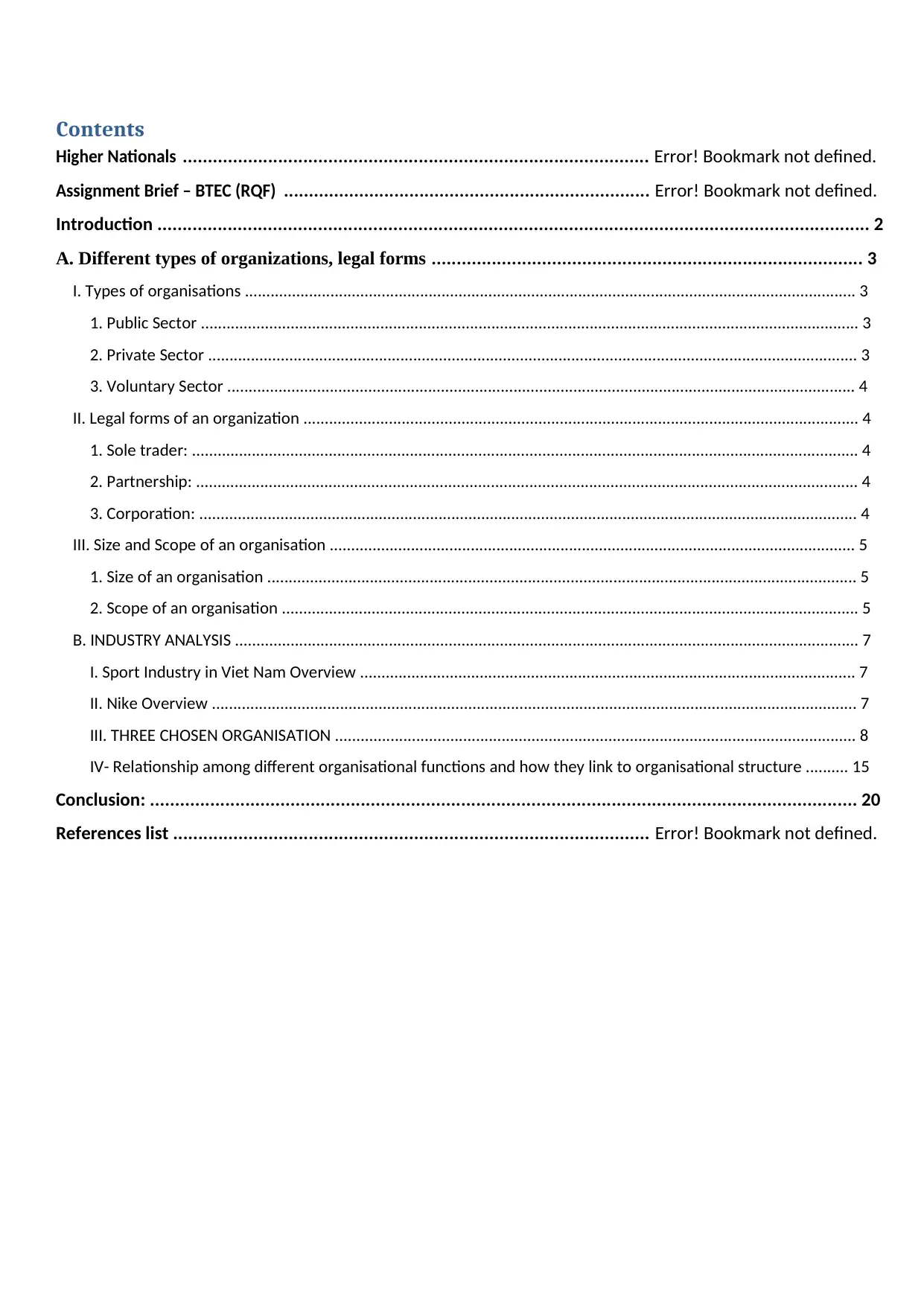
Contents
Higher Nationals ............................................................................................. Error! Bookmark not defined.
Assignment Brief – BTEC (RQF) ......................................................................... Error! Bookmark not defined.
Introduction .............................................................................................................................................. 2
A. Different types of organizations, legal forms ...................................................................................... 3
I. Types of organisations ............................................................................................................................................... 3
1. Public Sector .......................................................................................................................................................... 3
2. Private Sector ........................................................................................................................................................ 3
3. Voluntary Sector ................................................................................................................................................... 4
II. Legal forms of an organization .................................................................................................................................. 4
1. Sole trader: ............................................................................................................................................................ 4
2. Partnership: ........................................................................................................................................................... 4
3. Corporation: .......................................................................................................................................................... 4
III. Size and Scope of an organisation ........................................................................................................................... 5
1. Size of an organisation .......................................................................................................................................... 5
2. Scope of an organisation ....................................................................................................................................... 5
B. INDUSTRY ANALYSIS .................................................................................................................................................. 7
I. Sport Industry in Viet Nam Overview .................................................................................................................... 7
II. Nike Overview ....................................................................................................................................................... 7
III. THREE CHOSEN ORGANISATION .......................................................................................................................... 8
IV- Relationship among different organisational functions and how they link to organisational structure .......... 15
Conclusion: ............................................................................................................................................. 20
References list ............................................................................................... Error! Bookmark not defined.
Higher Nationals ............................................................................................. Error! Bookmark not defined.
Assignment Brief – BTEC (RQF) ......................................................................... Error! Bookmark not defined.
Introduction .............................................................................................................................................. 2
A. Different types of organizations, legal forms ...................................................................................... 3
I. Types of organisations ............................................................................................................................................... 3
1. Public Sector .......................................................................................................................................................... 3
2. Private Sector ........................................................................................................................................................ 3
3. Voluntary Sector ................................................................................................................................................... 4
II. Legal forms of an organization .................................................................................................................................. 4
1. Sole trader: ............................................................................................................................................................ 4
2. Partnership: ........................................................................................................................................................... 4
3. Corporation: .......................................................................................................................................................... 4
III. Size and Scope of an organisation ........................................................................................................................... 5
1. Size of an organisation .......................................................................................................................................... 5
2. Scope of an organisation ....................................................................................................................................... 5
B. INDUSTRY ANALYSIS .................................................................................................................................................. 7
I. Sport Industry in Viet Nam Overview .................................................................................................................... 7
II. Nike Overview ....................................................................................................................................................... 7
III. THREE CHOSEN ORGANISATION .......................................................................................................................... 8
IV- Relationship among different organisational functions and how they link to organisational structure .......... 15
Conclusion: ............................................................................................................................................. 20
References list ............................................................................................... Error! Bookmark not defined.

Paraphrase This Document
Need a fresh take? Get an instant paraphrase of this document with our AI Paraphraser
Introduction
Business Environment provides the total backgrounds of an organization, the functions in the organization,
investigates the expansion or the influences of the organization in its business’s field. Basically, Business
Environment analyzes the different types of organization (legal forms, profit or non-profit), their size and
scope (SMB/SME or large enterprise, local or global trade), internal and external factors (employees,
customer needs, expectations, management, supply, demand,), and the formulation of operation in the
organization. This information is really important to define an organization in the market and totally affects
how the organization works directly and indirectly as well as the environment and situations that an
organization is facing with.
In this article, as a role of Junior Insights Strategist for the Strategic Planning team of Nike, we will conduct
a research to support data and business analyses to develop business plan, measure business performance to
compare actual data to forecasted values, execute market research projects and gathering intelligence on
current industry, technology and consumer trends. This industry analysis also involve the research and
analysis of overall market size (international or national) and different sub-sectors (public, private,
voluntary), and the organizational mapping of one of the highest-performing companies.
Business Environment provides the total backgrounds of an organization, the functions in the organization,
investigates the expansion or the influences of the organization in its business’s field. Basically, Business
Environment analyzes the different types of organization (legal forms, profit or non-profit), their size and
scope (SMB/SME or large enterprise, local or global trade), internal and external factors (employees,
customer needs, expectations, management, supply, demand,), and the formulation of operation in the
organization. This information is really important to define an organization in the market and totally affects
how the organization works directly and indirectly as well as the environment and situations that an
organization is facing with.
In this article, as a role of Junior Insights Strategist for the Strategic Planning team of Nike, we will conduct
a research to support data and business analyses to develop business plan, measure business performance to
compare actual data to forecasted values, execute market research projects and gathering intelligence on
current industry, technology and consumer trends. This industry analysis also involve the research and
analysis of overall market size (international or national) and different sub-sectors (public, private,
voluntary), and the organizational mapping of one of the highest-performing companies.
A. Different types of organizations, legal forms
An organisation is defined as a group of people mobilising and gathering with a same attitude and
effort to contribute, and work effectively for a communal aspiration
I. Types of organisations
In this day and age, there are various type of organisation, but mostly organisations is classified into
three main types: public sector, private sector and voluntary sector.
1. Public Sector
In genral “business and industries that are owned and controlled by government” is public sector
(Cambridge), “the public sector consists of governments and all publicly controlled or publicly funded
agencies, enterprises, and other entities that deliver public programs, goods, or services.” (Sikhungo Dube,
Daniela Danescu, CIA, CGAP, 2011). These kinds of services are provided by the government through the
income from taxation.
The public sector usually provide the services that not only meet the requirements of each
individuals but also for the society’s conveniences such as military,law application, infrastructure (public
roads, bridges, tunnels, water supply and drainage, sewer systems, grids electricity, telecommunications,
etc.), public transportation, community education, along with health care and government workers
Normally, the public sectors is allocated as four levels:
- International (multistate entities or partnerships). …
- National (an independent state). …
- Regional (a province/state within a national state). …
- Local (a municipal-level body such as a city or county).
(Sikhungo Dube, Daniela Danescu, CIA, CGAP, 2011)
Public sector workers tend to be more assured about their benefit plans and the job security than
private sector workers; for example, once a probationary period concludes, many government positions
become permanent appointments, moving among public sector positions while retaining the same benefits,
holiday entitlements, and sick pay is relatively easy while receiving pay increases and promotions is
difficult. Working with a public agency provides a more stable work environment free of market pressures,
unlike working in the private sector. (Investopedia, 2020)
2. Private Sector
The private sector is basically “businesses and industries that are not owned and controlled by
governement” (Cambridge). In further detail, The private sector is the part of the organisation’s types where
goods and services are produced and sold by private individuals or corporations such as shops,
manufacturers, financial services,etc.
The private sector has an aim for profit and revenue, they want to maximize their profit; therefore,
they employ more workers than the public sector.
The entities that form the private sector include:
- Private limited company;
- Partnership
- Small and medium business
- Trade and professional associations
- Union
An organisation is defined as a group of people mobilising and gathering with a same attitude and
effort to contribute, and work effectively for a communal aspiration
I. Types of organisations
In this day and age, there are various type of organisation, but mostly organisations is classified into
three main types: public sector, private sector and voluntary sector.
1. Public Sector
In genral “business and industries that are owned and controlled by government” is public sector
(Cambridge), “the public sector consists of governments and all publicly controlled or publicly funded
agencies, enterprises, and other entities that deliver public programs, goods, or services.” (Sikhungo Dube,
Daniela Danescu, CIA, CGAP, 2011). These kinds of services are provided by the government through the
income from taxation.
The public sector usually provide the services that not only meet the requirements of each
individuals but also for the society’s conveniences such as military,law application, infrastructure (public
roads, bridges, tunnels, water supply and drainage, sewer systems, grids electricity, telecommunications,
etc.), public transportation, community education, along with health care and government workers
Normally, the public sectors is allocated as four levels:
- International (multistate entities or partnerships). …
- National (an independent state). …
- Regional (a province/state within a national state). …
- Local (a municipal-level body such as a city or county).
(Sikhungo Dube, Daniela Danescu, CIA, CGAP, 2011)
Public sector workers tend to be more assured about their benefit plans and the job security than
private sector workers; for example, once a probationary period concludes, many government positions
become permanent appointments, moving among public sector positions while retaining the same benefits,
holiday entitlements, and sick pay is relatively easy while receiving pay increases and promotions is
difficult. Working with a public agency provides a more stable work environment free of market pressures,
unlike working in the private sector. (Investopedia, 2020)
2. Private Sector
The private sector is basically “businesses and industries that are not owned and controlled by
governement” (Cambridge). In further detail, The private sector is the part of the organisation’s types where
goods and services are produced and sold by private individuals or corporations such as shops,
manufacturers, financial services,etc.
The private sector has an aim for profit and revenue, they want to maximize their profit; therefore,
they employ more workers than the public sector.
The entities that form the private sector include:
- Private limited company;
- Partnership
- Small and medium business
- Trade and professional associations
- Union
⊘ This is a preview!⊘
Do you want full access?
Subscribe today to unlock all pages.

Trusted by 1+ million students worldwide
Private sector workers have many benefits, they tend to have higher salaries, more opportunities in jobs,
and easier to get promotions. However, there are also some drawbacks to job security, and private sectors
also have less extensive benefits plan public that might need to be concerned (Investopedia, 2020)
3. Voluntary Sector
The voluntary sector usually comprises organizations that are independent of the local or national
government. These kinds of organizations tend to work to create a social impact rather than making a profit.
It is often called the third sector, civil society, or the not-for-profit sector. There are various types of
voluntary sectors that work for different purposes and could not be exactly classified. Charities are one of
the most common levels in the categories of the voluntary.
II. Legal forms of an organization
The first thing that must be done when establishing an organization is choosing the suitable legal sort of
ownership. The legal forms would be the first decision that affects the total organization’s structures,
resources, and assets.
Basically, there are three basic forms of business:
1. Sole trader:
A sole trader business form which is owned and established by one person
An individual establish an organization which a sole trader form aspires to be their own boss sole trader
business form which is owned and established by one person
From a legal perspective, the firm and its owner are considered one and the same. On the plus side, this
means that all profits are the property of the owner (after taxes are paid, of course). On the minus side,
however, the owner is personally responsible for the firm’s losses and debts. (Edwards, 2014)
2. Partnership:
A partnership form is defined in UK law as “the relation which subsists between persons carrying on a
business in common with a view to profit”. Partnership form is the same with the sole trader in the way that
the only beneficiaries of the firm’s profits, but they are also responsible for any losses and debts.
From a practical standpoint, a partnership allows a person to take time off without closing down the business
temporarily. In a partnership of two home builders, if one were to suffer a serious injury, the other partner
could take over supervising his or her partner’s projects and see them through to completion. Had the builder
been a sole proprietor, the customers and the business would have suffered greatly. However, a person who
chooses to be part of a partnership rather than operating alone as a sole proprietor also takes on some risk;
your partner could make bad decisions that end up costing you a lot of money. Thus developing trust and
confidence in one’s partner is very important. (Edwards, 2014)
3. Corporation:
The corporation form is the largest firm that is organized as a corporation. The major difference between
corporations and other forms is that Corporation forms involve ownership and management separately. In
this case, the corporates with corporation forms are established, owned by a group of people, and often being
purchased publicly in the stock market, whereas, they are being managed by professional executives. These
executives may own a significant portion of the corporation’s stock, but this is not a legal requirement.
A Joint Stock Company is the most common type of corporation. Joint Stock Company can be determined in
two types: Private Limited Company and Public Limited Company
and easier to get promotions. However, there are also some drawbacks to job security, and private sectors
also have less extensive benefits plan public that might need to be concerned (Investopedia, 2020)
3. Voluntary Sector
The voluntary sector usually comprises organizations that are independent of the local or national
government. These kinds of organizations tend to work to create a social impact rather than making a profit.
It is often called the third sector, civil society, or the not-for-profit sector. There are various types of
voluntary sectors that work for different purposes and could not be exactly classified. Charities are one of
the most common levels in the categories of the voluntary.
II. Legal forms of an organization
The first thing that must be done when establishing an organization is choosing the suitable legal sort of
ownership. The legal forms would be the first decision that affects the total organization’s structures,
resources, and assets.
Basically, there are three basic forms of business:
1. Sole trader:
A sole trader business form which is owned and established by one person
An individual establish an organization which a sole trader form aspires to be their own boss sole trader
business form which is owned and established by one person
From a legal perspective, the firm and its owner are considered one and the same. On the plus side, this
means that all profits are the property of the owner (after taxes are paid, of course). On the minus side,
however, the owner is personally responsible for the firm’s losses and debts. (Edwards, 2014)
2. Partnership:
A partnership form is defined in UK law as “the relation which subsists between persons carrying on a
business in common with a view to profit”. Partnership form is the same with the sole trader in the way that
the only beneficiaries of the firm’s profits, but they are also responsible for any losses and debts.
From a practical standpoint, a partnership allows a person to take time off without closing down the business
temporarily. In a partnership of two home builders, if one were to suffer a serious injury, the other partner
could take over supervising his or her partner’s projects and see them through to completion. Had the builder
been a sole proprietor, the customers and the business would have suffered greatly. However, a person who
chooses to be part of a partnership rather than operating alone as a sole proprietor also takes on some risk;
your partner could make bad decisions that end up costing you a lot of money. Thus developing trust and
confidence in one’s partner is very important. (Edwards, 2014)
3. Corporation:
The corporation form is the largest firm that is organized as a corporation. The major difference between
corporations and other forms is that Corporation forms involve ownership and management separately. In
this case, the corporates with corporation forms are established, owned by a group of people, and often being
purchased publicly in the stock market, whereas, they are being managed by professional executives. These
executives may own a significant portion of the corporation’s stock, but this is not a legal requirement.
A Joint Stock Company is the most common type of corporation. Joint Stock Company can be determined in
two types: Private Limited Company and Public Limited Company
Paraphrase This Document
Need a fresh take? Get an instant paraphrase of this document with our AI Paraphraser
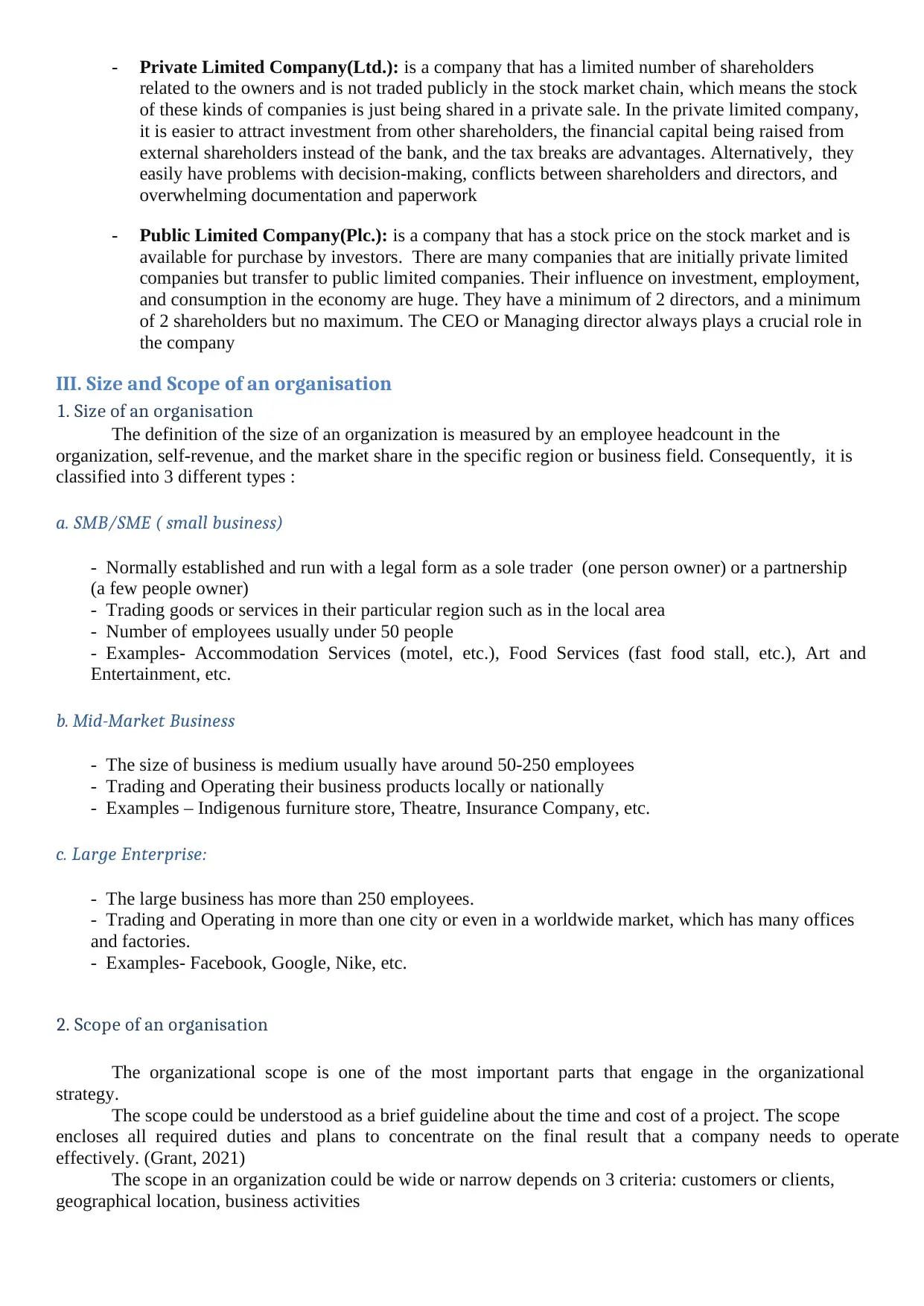
- Private Limited Company(Ltd.): is a company that has a limited number of shareholders
related to the owners and is not traded publicly in the stock market chain, which means the stock
of these kinds of companies is just being shared in a private sale. In the private limited company,
it is easier to attract investment from other shareholders, the financial capital being raised from
external shareholders instead of the bank, and the tax breaks are advantages. Alternatively, they
easily have problems with decision-making, conflicts between shareholders and directors, and
overwhelming documentation and paperwork
- Public Limited Company(Plc.): is a company that has a stock price on the stock market and is
available for purchase by investors. There are many companies that are initially private limited
companies but transfer to public limited companies. Their influence on investment, employment,
and consumption in the economy are huge. They have a minimum of 2 directors, and a minimum
of 2 shareholders but no maximum. The CEO or Managing director always plays a crucial role in
the company
III. Size and Scope of an organisation
1. Size of an organisation
The definition of the size of an organization is measured by an employee headcount in the
organization, self-revenue, and the market share in the specific region or business field. Consequently, it is
classified into 3 different types :
a. SMB/SME ( small business)
- Normally established and run with a legal form as a sole trader (one person owner) or a partnership
(a few people owner)
- Trading goods or services in their particular region such as in the local area
- Number of employees usually under 50 people
- Examples- Accommodation Services (motel, etc.), Food Services (fast food stall, etc.), Art and
Entertainment, etc.
b. Mid-Market Business
- The size of business is medium usually have around 50-250 employees
- Trading and Operating their business products locally or nationally
- Examples – Indigenous furniture store, Theatre, Insurance Company, etc.
c. Large Enterprise:
- The large business has more than 250 employees.
- Trading and Operating in more than one city or even in a worldwide market, which has many offices
and factories.
- Examples- Facebook, Google, Nike, etc.
2. Scope of an organisation
The organizational scope is one of the most important parts that engage in the organizational
strategy.
The scope could be understood as a brief guideline about the time and cost of a project. The scope
encloses all required duties and plans to concentrate on the final result that a company needs to operate
effectively. (Grant, 2021)
The scope in an organization could be wide or narrow depends on 3 criteria: customers or clients,
geographical location, business activities
related to the owners and is not traded publicly in the stock market chain, which means the stock
of these kinds of companies is just being shared in a private sale. In the private limited company,
it is easier to attract investment from other shareholders, the financial capital being raised from
external shareholders instead of the bank, and the tax breaks are advantages. Alternatively, they
easily have problems with decision-making, conflicts between shareholders and directors, and
overwhelming documentation and paperwork
- Public Limited Company(Plc.): is a company that has a stock price on the stock market and is
available for purchase by investors. There are many companies that are initially private limited
companies but transfer to public limited companies. Their influence on investment, employment,
and consumption in the economy are huge. They have a minimum of 2 directors, and a minimum
of 2 shareholders but no maximum. The CEO or Managing director always plays a crucial role in
the company
III. Size and Scope of an organisation
1. Size of an organisation
The definition of the size of an organization is measured by an employee headcount in the
organization, self-revenue, and the market share in the specific region or business field. Consequently, it is
classified into 3 different types :
a. SMB/SME ( small business)
- Normally established and run with a legal form as a sole trader (one person owner) or a partnership
(a few people owner)
- Trading goods or services in their particular region such as in the local area
- Number of employees usually under 50 people
- Examples- Accommodation Services (motel, etc.), Food Services (fast food stall, etc.), Art and
Entertainment, etc.
b. Mid-Market Business
- The size of business is medium usually have around 50-250 employees
- Trading and Operating their business products locally or nationally
- Examples – Indigenous furniture store, Theatre, Insurance Company, etc.
c. Large Enterprise:
- The large business has more than 250 employees.
- Trading and Operating in more than one city or even in a worldwide market, which has many offices
and factories.
- Examples- Facebook, Google, Nike, etc.
2. Scope of an organisation
The organizational scope is one of the most important parts that engage in the organizational
strategy.
The scope could be understood as a brief guideline about the time and cost of a project. The scope
encloses all required duties and plans to concentrate on the final result that a company needs to operate
effectively. (Grant, 2021)
The scope in an organization could be wide or narrow depends on 3 criteria: customers or clients,
geographical location, business activities
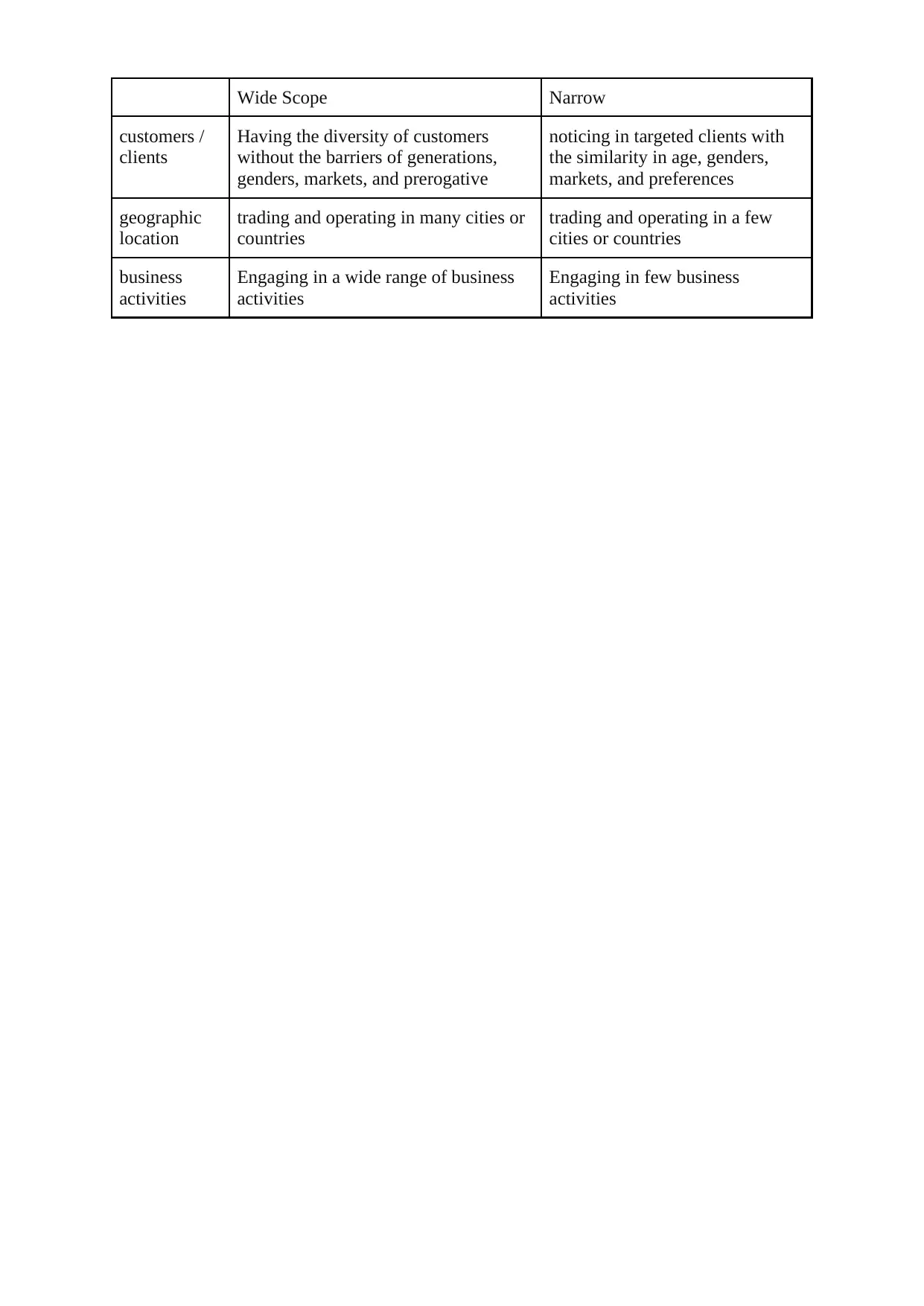
Wide Scope Narrow
customers /
clients
Having the diversity of customers
without the barriers of generations,
genders, markets, and prerogative
noticing in targeted clients with
the similarity in age, genders,
markets, and preferences
geographic
location
trading and operating in many cities or
countries
trading and operating in a few
cities or countries
business
activities
Engaging in a wide range of business
activities
Engaging in few business
activities
customers /
clients
Having the diversity of customers
without the barriers of generations,
genders, markets, and prerogative
noticing in targeted clients with
the similarity in age, genders,
markets, and preferences
geographic
location
trading and operating in many cities or
countries
trading and operating in a few
cities or countries
business
activities
Engaging in a wide range of business
activities
Engaging in few business
activities
⊘ This is a preview!⊘
Do you want full access?
Subscribe today to unlock all pages.
Trusted by 1+ million students worldwide
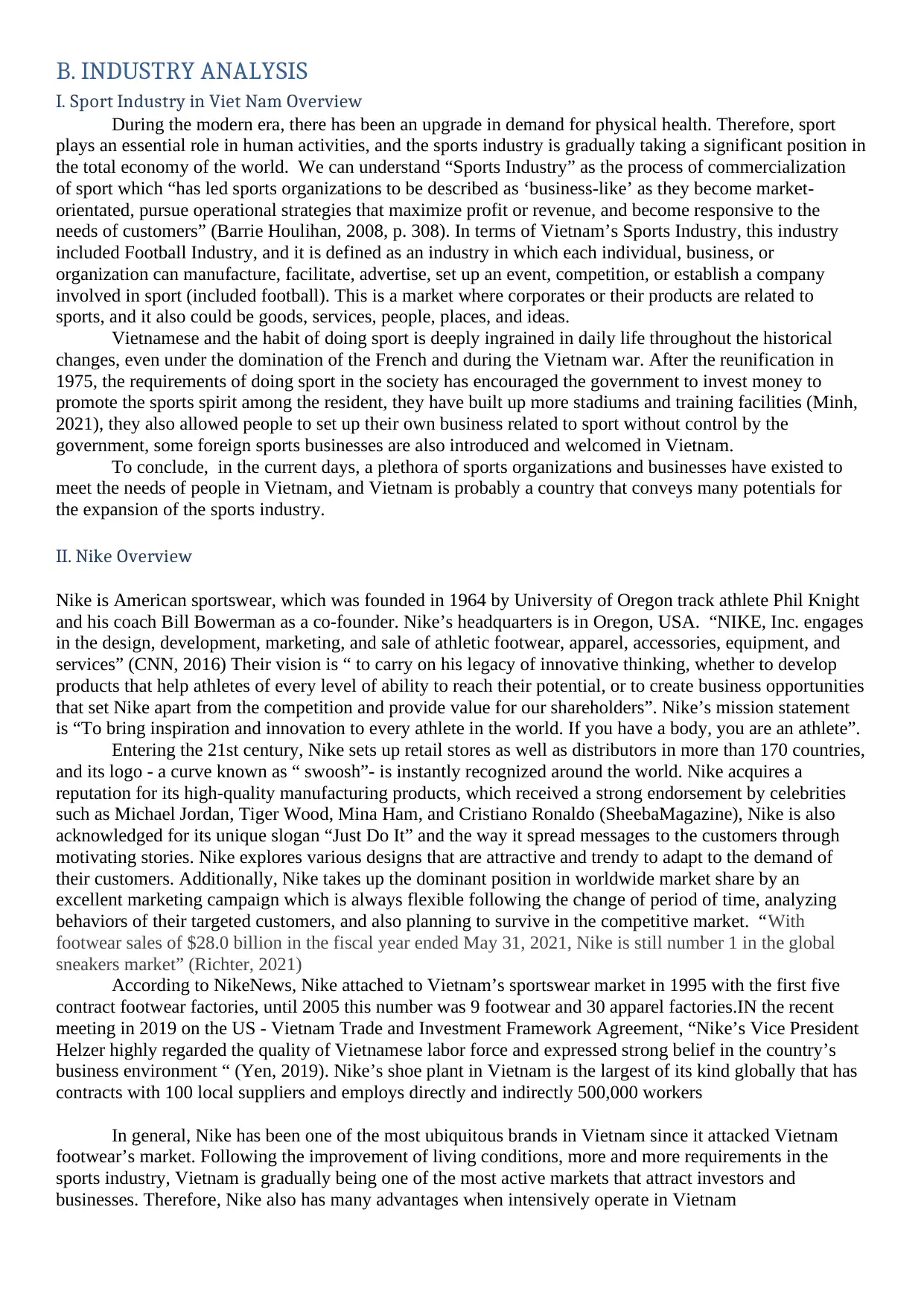
B. INDUSTRY ANALYSIS
I. Sport Industry in Viet Nam Overview
During the modern era, there has been an upgrade in demand for physical health. Therefore, sport
plays an essential role in human activities, and the sports industry is gradually taking a significant position in
the total economy of the world. We can understand “Sports Industry” as the process of commercialization
of sport which “has led sports organizations to be described as ‘business-like’ as they become market-
orientated, pursue operational strategies that maximize profit or revenue, and become responsive to the
needs of customers” (Barrie Houlihan, 2008, p. 308). In terms of Vietnam’s Sports Industry, this industry
included Football Industry, and it is defined as an industry in which each individual, business, or
organization can manufacture, facilitate, advertise, set up an event, competition, or establish a company
involved in sport (included football). This is a market where corporates or their products are related to
sports, and it also could be goods, services, people, places, and ideas.
Vietnamese and the habit of doing sport is deeply ingrained in daily life throughout the historical
changes, even under the domination of the French and during the Vietnam war. After the reunification in
1975, the requirements of doing sport in the society has encouraged the government to invest money to
promote the sports spirit among the resident, they have built up more stadiums and training facilities (Minh,
2021), they also allowed people to set up their own business related to sport without control by the
government, some foreign sports businesses are also introduced and welcomed in Vietnam.
To conclude, in the current days, a plethora of sports organizations and businesses have existed to
meet the needs of people in Vietnam, and Vietnam is probably a country that conveys many potentials for
the expansion of the sports industry.
II. Nike Overview
Nike is American sportswear, which was founded in 1964 by University of Oregon track athlete Phil Knight
and his coach Bill Bowerman as a co-founder. Nike’s headquarters is in Oregon, USA. “NIKE, Inc. engages
in the design, development, marketing, and sale of athletic footwear, apparel, accessories, equipment, and
services” (CNN, 2016) Their vision is “ to carry on his legacy of innovative thinking, whether to develop
products that help athletes of every level of ability to reach their potential, or to create business opportunities
that set Nike apart from the competition and provide value for our shareholders”. Nike’s mission statement
is “To bring inspiration and innovation to every athlete in the world. If you have a body, you are an athlete”.
Entering the 21st century, Nike sets up retail stores as well as distributors in more than 170 countries,
and its logo - a curve known as “ swoosh”- is instantly recognized around the world. Nike acquires a
reputation for its high-quality manufacturing products, which received a strong endorsement by celebrities
such as Michael Jordan, Tiger Wood, Mina Ham, and Cristiano Ronaldo (SheebaMagazine), Nike is also
acknowledged for its unique slogan “Just Do It” and the way it spread messages to the customers through
motivating stories. Nike explores various designs that are attractive and trendy to adapt to the demand of
their customers. Additionally, Nike takes up the dominant position in worldwide market share by an
excellent marketing campaign which is always flexible following the change of period of time, analyzing
behaviors of their targeted customers, and also planning to survive in the competitive market. “With
footwear sales of $28.0 billion in the fiscal year ended May 31, 2021, Nike is still number 1 in the global
sneakers market” (Richter, 2021)
According to NikeNews, Nike attached to Vietnam’s sportswear market in 1995 with the first five
contract footwear factories, until 2005 this number was 9 footwear and 30 apparel factories.IN the recent
meeting in 2019 on the US - Vietnam Trade and Investment Framework Agreement, “Nike’s Vice President
Helzer highly regarded the quality of Vietnamese labor force and expressed strong belief in the country’s
business environment “ (Yen, 2019). Nike’s shoe plant in Vietnam is the largest of its kind globally that has
contracts with 100 local suppliers and employs directly and indirectly 500,000 workers
In general, Nike has been one of the most ubiquitous brands in Vietnam since it attacked Vietnam
footwear’s market. Following the improvement of living conditions, more and more requirements in the
sports industry, Vietnam is gradually being one of the most active markets that attract investors and
businesses. Therefore, Nike also has many advantages when intensively operate in Vietnam
I. Sport Industry in Viet Nam Overview
During the modern era, there has been an upgrade in demand for physical health. Therefore, sport
plays an essential role in human activities, and the sports industry is gradually taking a significant position in
the total economy of the world. We can understand “Sports Industry” as the process of commercialization
of sport which “has led sports organizations to be described as ‘business-like’ as they become market-
orientated, pursue operational strategies that maximize profit or revenue, and become responsive to the
needs of customers” (Barrie Houlihan, 2008, p. 308). In terms of Vietnam’s Sports Industry, this industry
included Football Industry, and it is defined as an industry in which each individual, business, or
organization can manufacture, facilitate, advertise, set up an event, competition, or establish a company
involved in sport (included football). This is a market where corporates or their products are related to
sports, and it also could be goods, services, people, places, and ideas.
Vietnamese and the habit of doing sport is deeply ingrained in daily life throughout the historical
changes, even under the domination of the French and during the Vietnam war. After the reunification in
1975, the requirements of doing sport in the society has encouraged the government to invest money to
promote the sports spirit among the resident, they have built up more stadiums and training facilities (Minh,
2021), they also allowed people to set up their own business related to sport without control by the
government, some foreign sports businesses are also introduced and welcomed in Vietnam.
To conclude, in the current days, a plethora of sports organizations and businesses have existed to
meet the needs of people in Vietnam, and Vietnam is probably a country that conveys many potentials for
the expansion of the sports industry.
II. Nike Overview
Nike is American sportswear, which was founded in 1964 by University of Oregon track athlete Phil Knight
and his coach Bill Bowerman as a co-founder. Nike’s headquarters is in Oregon, USA. “NIKE, Inc. engages
in the design, development, marketing, and sale of athletic footwear, apparel, accessories, equipment, and
services” (CNN, 2016) Their vision is “ to carry on his legacy of innovative thinking, whether to develop
products that help athletes of every level of ability to reach their potential, or to create business opportunities
that set Nike apart from the competition and provide value for our shareholders”. Nike’s mission statement
is “To bring inspiration and innovation to every athlete in the world. If you have a body, you are an athlete”.
Entering the 21st century, Nike sets up retail stores as well as distributors in more than 170 countries,
and its logo - a curve known as “ swoosh”- is instantly recognized around the world. Nike acquires a
reputation for its high-quality manufacturing products, which received a strong endorsement by celebrities
such as Michael Jordan, Tiger Wood, Mina Ham, and Cristiano Ronaldo (SheebaMagazine), Nike is also
acknowledged for its unique slogan “Just Do It” and the way it spread messages to the customers through
motivating stories. Nike explores various designs that are attractive and trendy to adapt to the demand of
their customers. Additionally, Nike takes up the dominant position in worldwide market share by an
excellent marketing campaign which is always flexible following the change of period of time, analyzing
behaviors of their targeted customers, and also planning to survive in the competitive market. “With
footwear sales of $28.0 billion in the fiscal year ended May 31, 2021, Nike is still number 1 in the global
sneakers market” (Richter, 2021)
According to NikeNews, Nike attached to Vietnam’s sportswear market in 1995 with the first five
contract footwear factories, until 2005 this number was 9 footwear and 30 apparel factories.IN the recent
meeting in 2019 on the US - Vietnam Trade and Investment Framework Agreement, “Nike’s Vice President
Helzer highly regarded the quality of Vietnamese labor force and expressed strong belief in the country’s
business environment “ (Yen, 2019). Nike’s shoe plant in Vietnam is the largest of its kind globally that has
contracts with 100 local suppliers and employs directly and indirectly 500,000 workers
In general, Nike has been one of the most ubiquitous brands in Vietnam since it attacked Vietnam
footwear’s market. Following the improvement of living conditions, more and more requirements in the
sports industry, Vietnam is gradually being one of the most active markets that attract investors and
businesses. Therefore, Nike also has many advantages when intensively operate in Vietnam
Paraphrase This Document
Need a fresh take? Get an instant paraphrase of this document with our AI Paraphraser
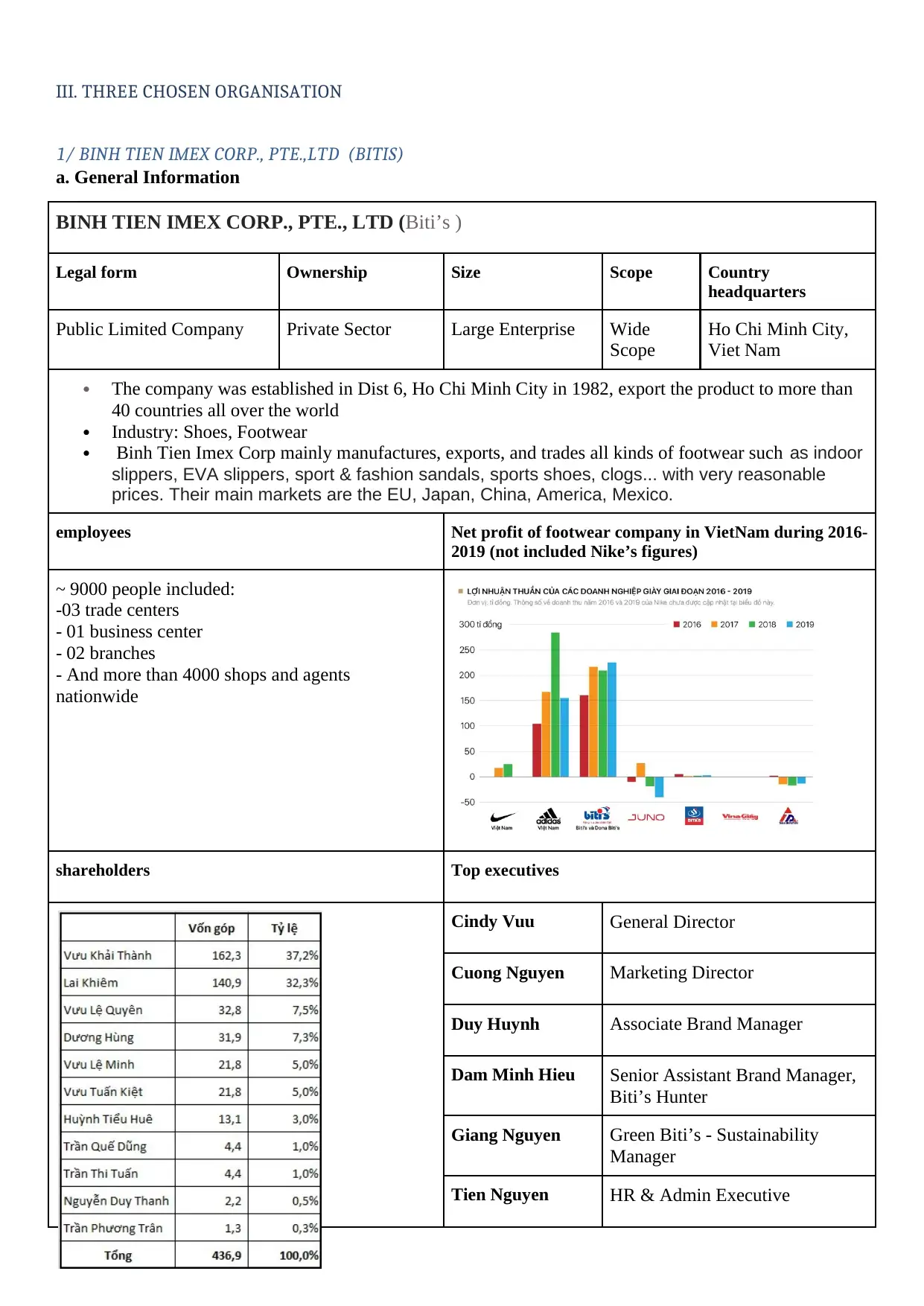
III. THREE CHOSEN ORGANISATION
1/ BINH TIEN IMEX CORP., PTE.,LTD (BITIS)
a. General Information
BINH TIEN IMEX CORP., PTE., LTD (Biti’s )
Legal form Ownership Size Scope Country
headquarters
Public Limited Company Private Sector Large Enterprise Wide
Scope
Ho Chi Minh City,
Viet Nam
The company was established in Dist 6, Ho Chi Minh City in 1982, export the product to more than
40 countries all over the world
Industry: Shoes, Footwear
Binh Tien Imex Corp mainly manufactures, exports, and trades all kinds of footwear such as indoor
slippers, EVA slippers, sport & fashion sandals, sports shoes, clogs... with very reasonable
prices. Their main markets are the EU, Japan, China, America, Mexico.
employees Net profit of footwear company in VietNam during 2016-
2019 (not included Nike’s figures)
~ 9000 people included:
-03 trade centers
- 01 business center
- 02 branches
- And more than 4000 shops and agents
nationwide
shareholders Top executives
Cindy Vuu General Director
Cuong Nguyen Marketing Director
Duy Huynh Associate Brand Manager
Dam Minh Hieu Senior Assistant Brand Manager,
Biti’s Hunter
Giang Nguyen Green Biti’s - Sustainability
Manager
Tien Nguyen HR & Admin Executive
1/ BINH TIEN IMEX CORP., PTE.,LTD (BITIS)
a. General Information
BINH TIEN IMEX CORP., PTE., LTD (Biti’s )
Legal form Ownership Size Scope Country
headquarters
Public Limited Company Private Sector Large Enterprise Wide
Scope
Ho Chi Minh City,
Viet Nam
The company was established in Dist 6, Ho Chi Minh City in 1982, export the product to more than
40 countries all over the world
Industry: Shoes, Footwear
Binh Tien Imex Corp mainly manufactures, exports, and trades all kinds of footwear such as indoor
slippers, EVA slippers, sport & fashion sandals, sports shoes, clogs... with very reasonable
prices. Their main markets are the EU, Japan, China, America, Mexico.
employees Net profit of footwear company in VietNam during 2016-
2019 (not included Nike’s figures)
~ 9000 people included:
-03 trade centers
- 01 business center
- 02 branches
- And more than 4000 shops and agents
nationwide
shareholders Top executives
Cindy Vuu General Director
Cuong Nguyen Marketing Director
Duy Huynh Associate Brand Manager
Dam Minh Hieu Senior Assistant Brand Manager,
Biti’s Hunter
Giang Nguyen Green Biti’s - Sustainability
Manager
Tien Nguyen HR & Admin Executive
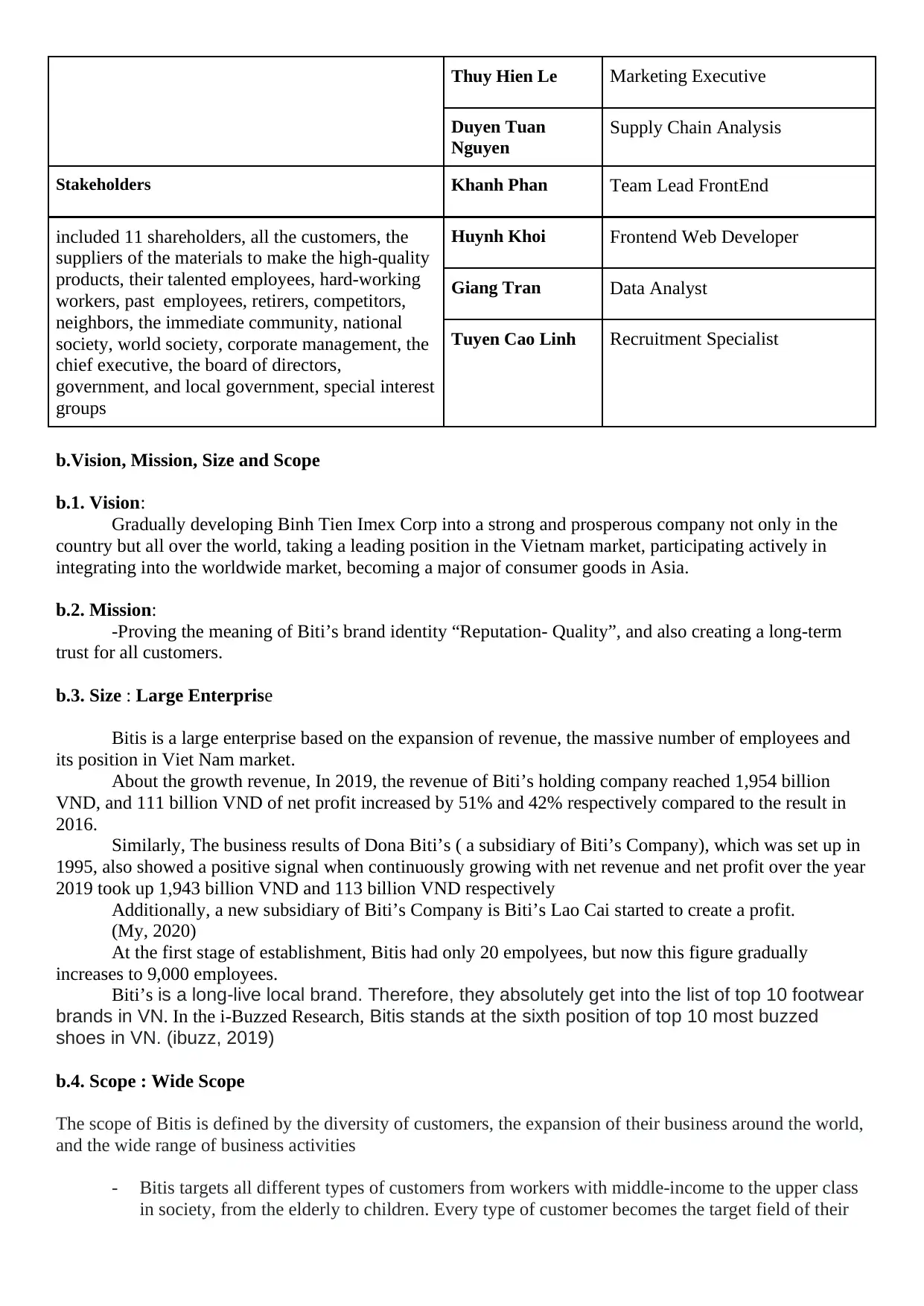
Thuy Hien Le Marketing Executive
Duyen Tuan
Nguyen
Supply Chain Analysis
Stakeholders Khanh Phan Team Lead FrontEnd
included 11 shareholders, all the customers, the
suppliers of the materials to make the high-quality
products, their talented employees, hard-working
workers, past employees, retirers, competitors,
neighbors, the immediate community, national
society, world society, corporate management, the
chief executive, the board of directors,
government, and local government, special interest
groups
Huynh Khoi Frontend Web Developer
Giang Tran Data Analyst
Tuyen Cao Linh Recruitment Specialist
b.Vision, Mission, Size and Scope
b.1. Vision:
Gradually developing Binh Tien Imex Corp into a strong and prosperous company not only in the
country but all over the world, taking a leading position in the Vietnam market, participating actively in
integrating into the worldwide market, becoming a major of consumer goods in Asia.
b.2. Mission:
-Proving the meaning of Biti’s brand identity “Reputation- Quality”, and also creating a long-term
trust for all customers.
b.3. Size : Large Enterprise
Bitis is a large enterprise based on the expansion of revenue, the massive number of employees and
its position in Viet Nam market.
About the growth revenue, In 2019, the revenue of Biti’s holding company reached 1,954 billion
VND, and 111 billion VND of net profit increased by 51% and 42% respectively compared to the result in
2016.
Similarly, The business results of Dona Biti’s ( a subsidiary of Biti’s Company), which was set up in
1995, also showed a positive signal when continuously growing with net revenue and net profit over the year
2019 took up 1,943 billion VND and 113 billion VND respectively
Additionally, a new subsidiary of Biti’s Company is Biti’s Lao Cai started to create a profit.
(My, 2020)
At the first stage of establishment, Bitis had only 20 empolyees, but now this figure gradually
increases to 9,000 employees.
Biti’s is a long-live local brand. Therefore, they absolutely get into the list of top 10 footwear
brands in VN. In the i-Buzzed Research, Bitis stands at the sixth position of top 10 most buzzed
shoes in VN. (ibuzz, 2019)
b.4. Scope : Wide Scope
The scope of Bitis is defined by the diversity of customers, the expansion of their business around the world,
and the wide range of business activities
- Bitis targets all different types of customers from workers with middle-income to the upper class
in society, from the elderly to children. Every type of customer becomes the target field of their
Duyen Tuan
Nguyen
Supply Chain Analysis
Stakeholders Khanh Phan Team Lead FrontEnd
included 11 shareholders, all the customers, the
suppliers of the materials to make the high-quality
products, their talented employees, hard-working
workers, past employees, retirers, competitors,
neighbors, the immediate community, national
society, world society, corporate management, the
chief executive, the board of directors,
government, and local government, special interest
groups
Huynh Khoi Frontend Web Developer
Giang Tran Data Analyst
Tuyen Cao Linh Recruitment Specialist
b.Vision, Mission, Size and Scope
b.1. Vision:
Gradually developing Binh Tien Imex Corp into a strong and prosperous company not only in the
country but all over the world, taking a leading position in the Vietnam market, participating actively in
integrating into the worldwide market, becoming a major of consumer goods in Asia.
b.2. Mission:
-Proving the meaning of Biti’s brand identity “Reputation- Quality”, and also creating a long-term
trust for all customers.
b.3. Size : Large Enterprise
Bitis is a large enterprise based on the expansion of revenue, the massive number of employees and
its position in Viet Nam market.
About the growth revenue, In 2019, the revenue of Biti’s holding company reached 1,954 billion
VND, and 111 billion VND of net profit increased by 51% and 42% respectively compared to the result in
2016.
Similarly, The business results of Dona Biti’s ( a subsidiary of Biti’s Company), which was set up in
1995, also showed a positive signal when continuously growing with net revenue and net profit over the year
2019 took up 1,943 billion VND and 113 billion VND respectively
Additionally, a new subsidiary of Biti’s Company is Biti’s Lao Cai started to create a profit.
(My, 2020)
At the first stage of establishment, Bitis had only 20 empolyees, but now this figure gradually
increases to 9,000 employees.
Biti’s is a long-live local brand. Therefore, they absolutely get into the list of top 10 footwear
brands in VN. In the i-Buzzed Research, Bitis stands at the sixth position of top 10 most buzzed
shoes in VN. (ibuzz, 2019)
b.4. Scope : Wide Scope
The scope of Bitis is defined by the diversity of customers, the expansion of their business around the world,
and the wide range of business activities
- Bitis targets all different types of customers from workers with middle-income to the upper class
in society, from the elderly to children. Every type of customer becomes the target field of their
⊘ This is a preview!⊘
Do you want full access?
Subscribe today to unlock all pages.
Trusted by 1+ million students worldwide
business. The business will definitely respond to every customer’s request about the types of
products that they need.
- Biti’s products are traded to more than 40 countries and regions around the world, including the
most famous and fastidious markets. Domestically, Biti’s distribution system includes 03 trade
centers, 01 business center, 02 branches, and more than 4000 shops and agents nationwide.
- Bitis’s business activities are comprised of designing new and eye-catching models,
manufacturers, exporting, and trading many kinds of high-quality footwear such as indoor
slippers, EVA slippers, sport & fashion sandals, sports shoes, clogs, etc.
*Conclusion:
Bitis is the large enterprise and working with wide scope, they have wide range of products and
services, they also receive the trust of their clients not only in Vietnam but also in many countries that they
aim to expand their business
With the vision “gradualy developing Bitis’s business into a strong and progerous company not only
in the country but all over the world, taking the leeading position in the Vietnamese market, participating
actively in intergrating into the worldwide market, becoming major of consumer goods in Asia”. We can
clarify that Bitis’s goal is want to become the top 1 in the Vietnam footwear market, and they also want to
develop a strong foothold in the international econnomy.
Additionally, the mission is to prove the meaning of Bitis’s bran identity “Reputation-Quality” and
create a long-term trust for all customers. Their objectives is to commit to persistently improving, upgrading
the quality of supplying products, constantly responding to the high and diverse requirements of customers.
Setting up the suitable mission, vision at the first stage of establishment helps Bitis have the right
direction to operate their business. It is also the guiding to become a large enterprise with a wide scope. For
future prediction, Bitis might be follow their own initial mission and vision to operate, and enhance their
business position not only in Viet Nam but also in the wordwide market.
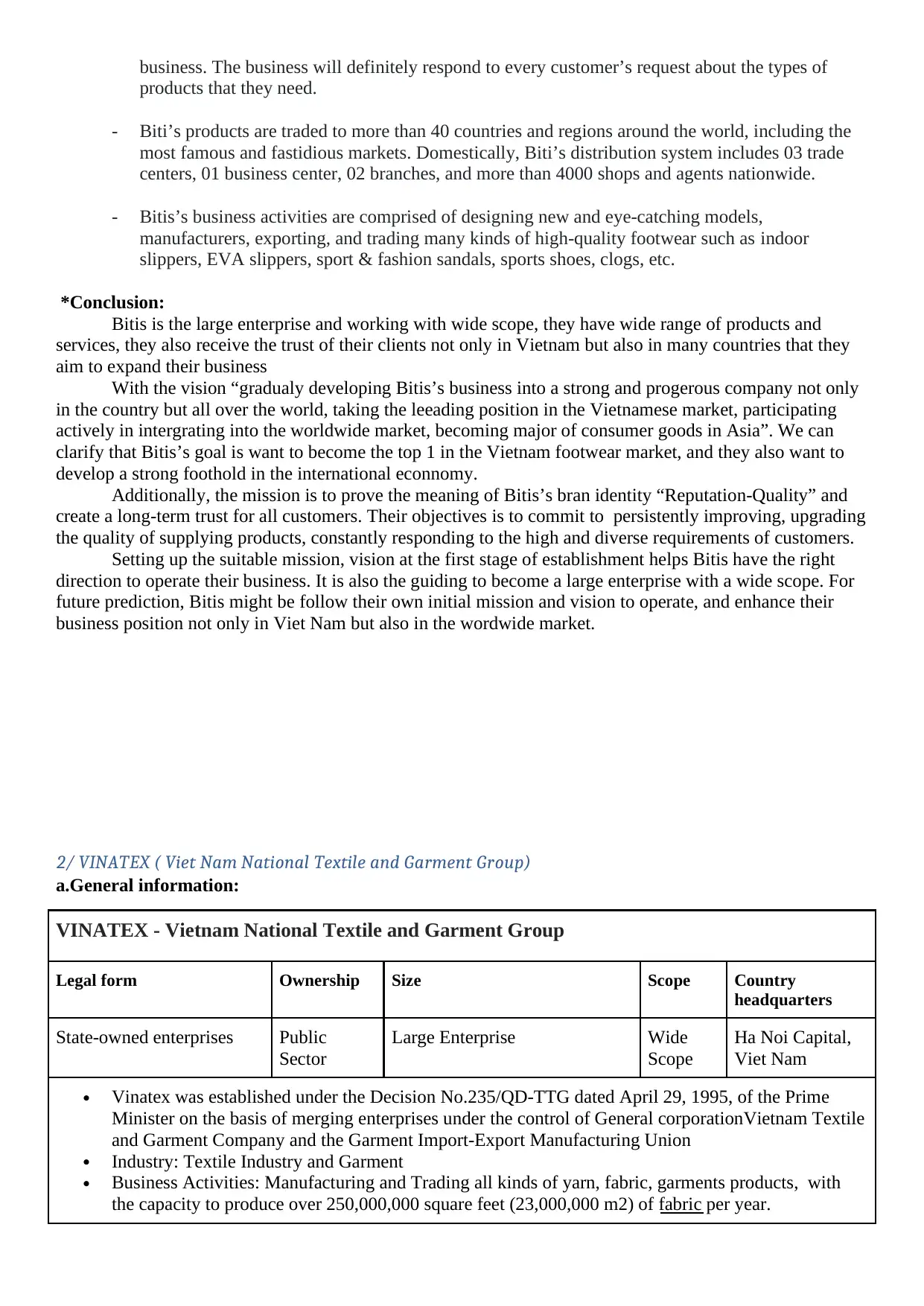
2/ VINATEX ( Viet Nam National Textile and Garment Group)
a.General information:
VINATEX - Vietnam National Textile and Garment Group
Legal form Ownership Size Scope Country
headquarters
State-owned enterprises Public
Sector
Large Enterprise Wide
Scope
Ha Noi Capital,
Viet Nam
Vinatex was established under the Decision No.235/QD-TTG dated April 29, 1995, of the Prime
Minister on the basis of merging enterprises under the control of General corporationVietnam Textile
and Garment Company and the Garment Import-Export Manufacturing Union
Industry: Textile Industry and Garment
Business Activities: Manufacturing and Trading all kinds of yarn, fabric, garments products, with
the capacity to produce over 250,000,000 square feet (23,000,000 m2) of fabric per year.
products that they need.
- Biti’s products are traded to more than 40 countries and regions around the world, including the
most famous and fastidious markets. Domestically, Biti’s distribution system includes 03 trade
centers, 01 business center, 02 branches, and more than 4000 shops and agents nationwide.
- Bitis’s business activities are comprised of designing new and eye-catching models,
manufacturers, exporting, and trading many kinds of high-quality footwear such as indoor
slippers, EVA slippers, sport & fashion sandals, sports shoes, clogs, etc.
*Conclusion:
Bitis is the large enterprise and working with wide scope, they have wide range of products and
services, they also receive the trust of their clients not only in Vietnam but also in many countries that they
aim to expand their business
With the vision “gradualy developing Bitis’s business into a strong and progerous company not only
in the country but all over the world, taking the leeading position in the Vietnamese market, participating
actively in intergrating into the worldwide market, becoming major of consumer goods in Asia”. We can
clarify that Bitis’s goal is want to become the top 1 in the Vietnam footwear market, and they also want to
develop a strong foothold in the international econnomy.
Additionally, the mission is to prove the meaning of Bitis’s bran identity “Reputation-Quality” and
create a long-term trust for all customers. Their objectives is to commit to persistently improving, upgrading
the quality of supplying products, constantly responding to the high and diverse requirements of customers.
Setting up the suitable mission, vision at the first stage of establishment helps Bitis have the right
direction to operate their business. It is also the guiding to become a large enterprise with a wide scope. For
future prediction, Bitis might be follow their own initial mission and vision to operate, and enhance their
business position not only in Viet Nam but also in the wordwide market.
2/ VINATEX ( Viet Nam National Textile and Garment Group)
a.General information:
VINATEX - Vietnam National Textile and Garment Group
Legal form Ownership Size Scope Country
headquarters
State-owned enterprises Public
Sector
Large Enterprise Wide
Scope
Ha Noi Capital,
Viet Nam
Vinatex was established under the Decision No.235/QD-TTG dated April 29, 1995, of the Prime
Minister on the basis of merging enterprises under the control of General corporationVietnam Textile
and Garment Company and the Garment Import-Export Manufacturing Union
Industry: Textile Industry and Garment
Business Activities: Manufacturing and Trading all kinds of yarn, fabric, garments products, with
the capacity to produce over 250,000,000 square feet (23,000,000 m2) of fabric per year.
Paraphrase This Document
Need a fresh take? Get an instant paraphrase of this document with our AI Paraphraser
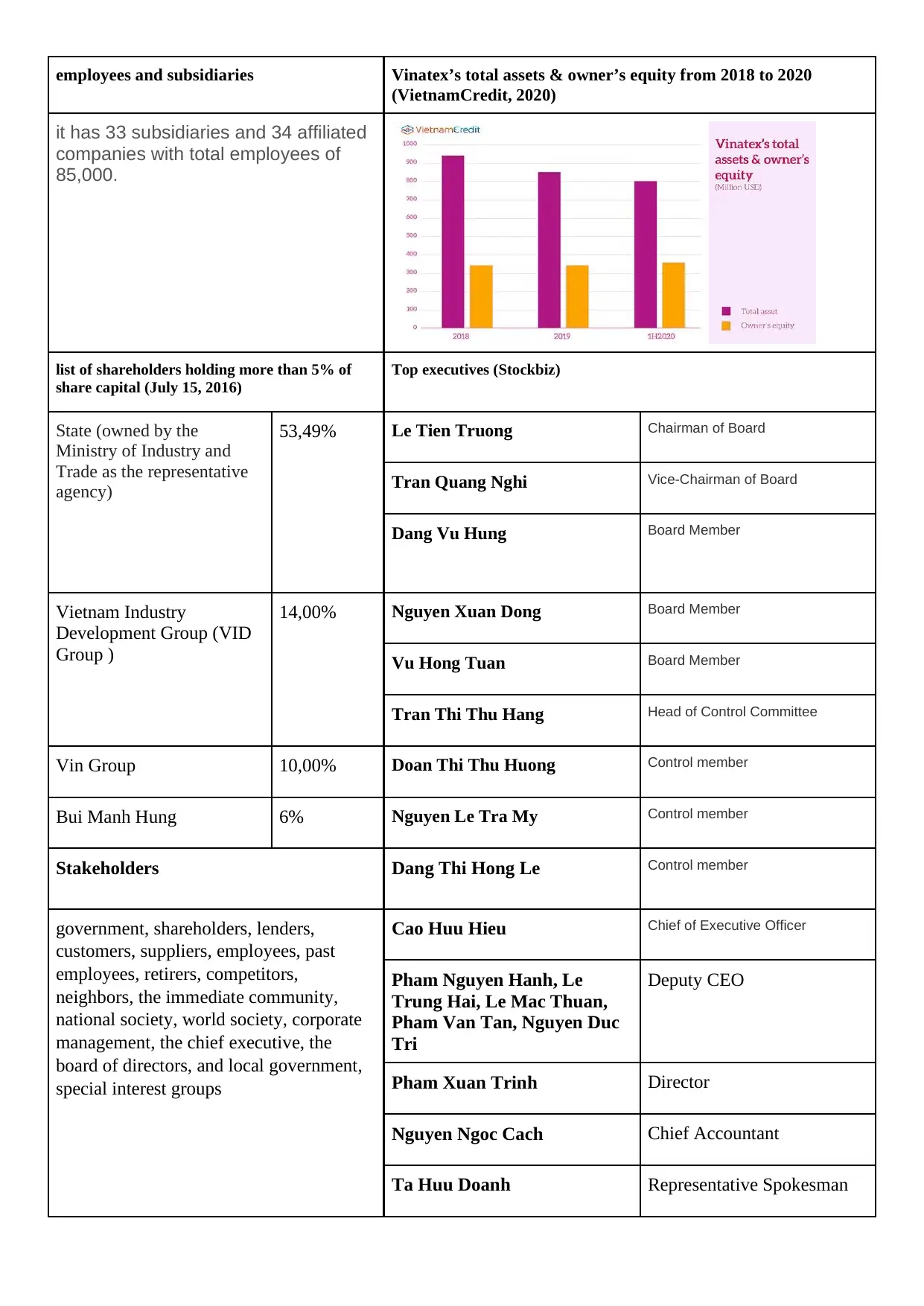
employees and subsidiaries Vinatex’s total assets & owner’s equity from 2018 to 2020
(VietnamCredit, 2020)
it has 33 subsidiaries and 34 affiliated
companies with total employees of
85,000.
list of shareholders holding more than 5% of
share capital (July 15, 2016)
Top executives (Stockbiz)
State (owned by the
Ministry of Industry and
Trade as the representative
agency)
53,49% Le Tien Truong Chairman of Board
Tran Quang Nghi Vice-Chairman of Board
Dang Vu Hung Board Member
Vietnam Industry
Development Group (VID
Group )
14,00% Nguyen Xuan Dong Board Member
Vu Hong Tuan Board Member
Tran Thi Thu Hang Head of Control Committee
Vin Group 10,00% Doan Thi Thu Huong Control member
Bui Manh Hung 6% Nguyen Le Tra My Control member
Stakeholders Dang Thi Hong Le Control member
government, shareholders, lenders,
customers, suppliers, employees, past
employees, retirers, competitors,
neighbors, the immediate community,
national society, world society, corporate
management, the chief executive, the
board of directors, and local government,
special interest groups
Cao Huu Hieu Chief of Executive Officer
Pham Nguyen Hanh, Le
Trung Hai, Le Mac Thuan,
Pham Van Tan, Nguyen Duc
Tri
Deputy CEO
Pham Xuan Trinh Director
Nguyen Ngoc Cach Chief Accountant
Ta Huu Doanh Representative Spokesman
(VietnamCredit, 2020)
it has 33 subsidiaries and 34 affiliated
companies with total employees of
85,000.
list of shareholders holding more than 5% of
share capital (July 15, 2016)
Top executives (Stockbiz)
State (owned by the
Ministry of Industry and
Trade as the representative
agency)
53,49% Le Tien Truong Chairman of Board
Tran Quang Nghi Vice-Chairman of Board
Dang Vu Hung Board Member
Vietnam Industry
Development Group (VID
Group )
14,00% Nguyen Xuan Dong Board Member
Vu Hong Tuan Board Member
Tran Thi Thu Hang Head of Control Committee
Vin Group 10,00% Doan Thi Thu Huong Control member
Bui Manh Hung 6% Nguyen Le Tra My Control member
Stakeholders Dang Thi Hong Le Control member
government, shareholders, lenders,
customers, suppliers, employees, past
employees, retirers, competitors,
neighbors, the immediate community,
national society, world society, corporate
management, the chief executive, the
board of directors, and local government,
special interest groups
Cao Huu Hieu Chief of Executive Officer
Pham Nguyen Hanh, Le
Trung Hai, Le Mac Thuan,
Pham Van Tan, Nguyen Duc
Tri
Deputy CEO
Pham Xuan Trinh Director
Nguyen Ngoc Cach Chief Accountant
Ta Huu Doanh Representative Spokesman
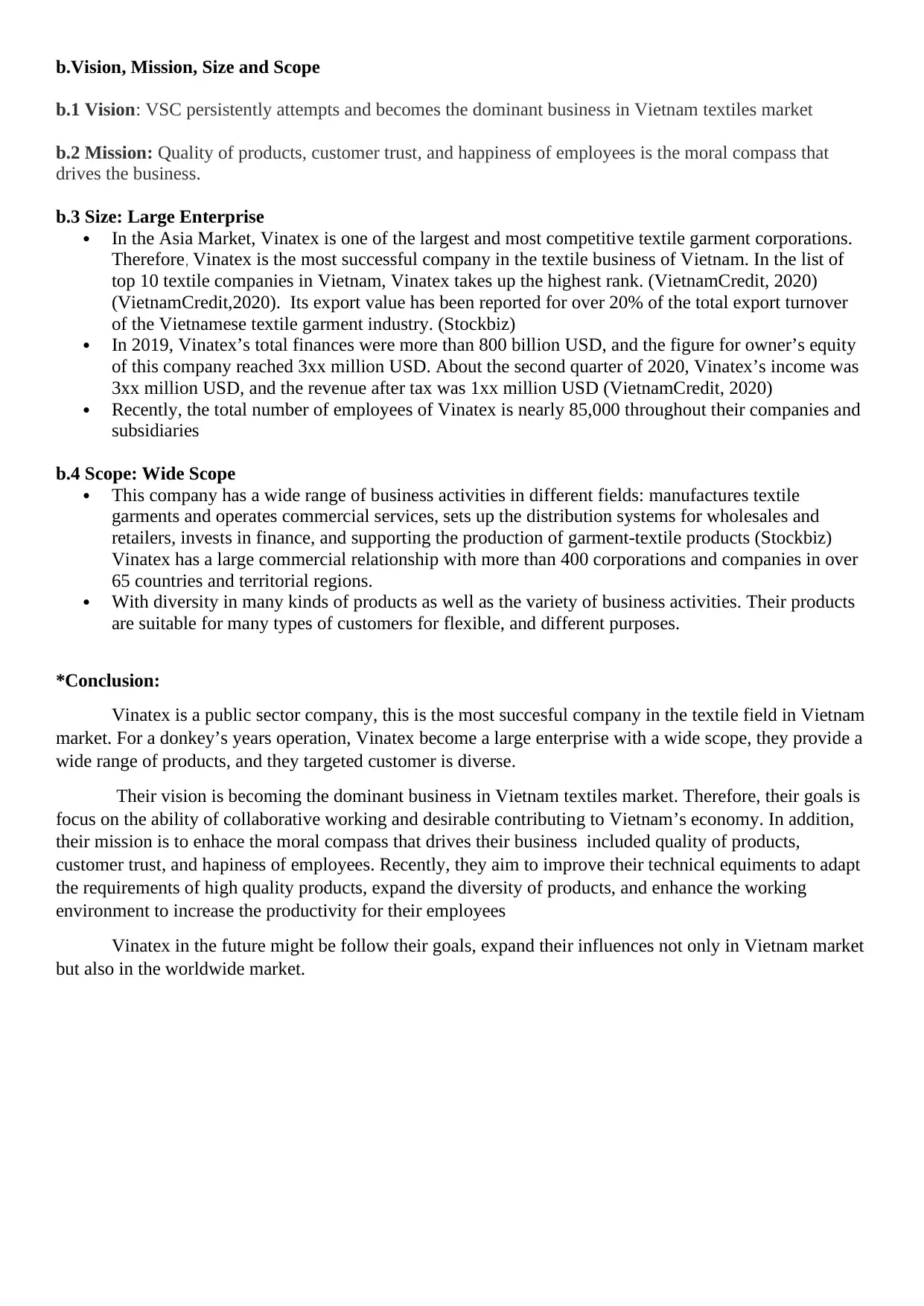
b.Vision, Mission, Size and Scope
b.1 Vision: VSC persistently attempts and becomes the dominant business in Vietnam textiles market
b.2 Mission: Quality of products, customer trust, and happiness of employees is the moral compass that
drives the business.
b.3 Size: Large Enterprise
In the Asia Market, Vinatex is one of the largest and most competitive textile garment corporations.
Therefore, Vinatex is the most successful company in the textile business of Vietnam. In the list of
top 10 textile companies in Vietnam, Vinatex takes up the highest rank. (VietnamCredit, 2020)
(VietnamCredit,2020). Its export value has been reported for over 20% of the total export turnover
of the Vietnamese textile garment industry. (Stockbiz)
In 2019, Vinatex’s total finances were more than 800 billion USD, and the figure for owner’s equity
of this company reached 3xx million USD. About the second quarter of 2020, Vinatex’s income was
3xx million USD, and the revenue after tax was 1xx million USD (VietnamCredit, 2020)
Recently, the total number of employees of Vinatex is nearly 85,000 throughout their companies and
subsidiaries
b.4 Scope: Wide Scope
This company has a wide range of business activities in different fields: manufactures textile
garments and operates commercial services, sets up the distribution systems for wholesales and
retailers, invests in finance, and supporting the production of garment-textile products (Stockbiz)
Vinatex has a large commercial relationship with more than 400 corporations and companies in over
65 countries and territorial regions.
With diversity in many kinds of products as well as the variety of business activities. Their products
are suitable for many types of customers for flexible, and different purposes.
*Conclusion:
Vinatex is a public sector company, this is the most succesful company in the textile field in Vietnam
market. For a donkey’s years operation, Vinatex become a large enterprise with a wide scope, they provide a
wide range of products, and they targeted customer is diverse.
Their vision is becoming the dominant business in Vietnam textiles market. Therefore, their goals is
focus on the ability of collaborative working and desirable contributing to Vietnam’s economy. In addition,
their mission is to enhace the moral compass that drives their business included quality of products,
customer trust, and hapiness of employees. Recently, they aim to improve their technical equiments to adapt
the requirements of high quality products, expand the diversity of products, and enhance the working
environment to increase the productivity for their employees
Vinatex in the future might be follow their goals, expand their influences not only in Vietnam market
but also in the worldwide market.
b.1 Vision: VSC persistently attempts and becomes the dominant business in Vietnam textiles market
b.2 Mission: Quality of products, customer trust, and happiness of employees is the moral compass that
drives the business.
b.3 Size: Large Enterprise
In the Asia Market, Vinatex is one of the largest and most competitive textile garment corporations.
Therefore, Vinatex is the most successful company in the textile business of Vietnam. In the list of
top 10 textile companies in Vietnam, Vinatex takes up the highest rank. (VietnamCredit, 2020)
(VietnamCredit,2020). Its export value has been reported for over 20% of the total export turnover
of the Vietnamese textile garment industry. (Stockbiz)
In 2019, Vinatex’s total finances were more than 800 billion USD, and the figure for owner’s equity
of this company reached 3xx million USD. About the second quarter of 2020, Vinatex’s income was
3xx million USD, and the revenue after tax was 1xx million USD (VietnamCredit, 2020)
Recently, the total number of employees of Vinatex is nearly 85,000 throughout their companies and
subsidiaries
b.4 Scope: Wide Scope
This company has a wide range of business activities in different fields: manufactures textile
garments and operates commercial services, sets up the distribution systems for wholesales and
retailers, invests in finance, and supporting the production of garment-textile products (Stockbiz)
Vinatex has a large commercial relationship with more than 400 corporations and companies in over
65 countries and territorial regions.
With diversity in many kinds of products as well as the variety of business activities. Their products
are suitable for many types of customers for flexible, and different purposes.
*Conclusion:
Vinatex is a public sector company, this is the most succesful company in the textile field in Vietnam
market. For a donkey’s years operation, Vinatex become a large enterprise with a wide scope, they provide a
wide range of products, and they targeted customer is diverse.
Their vision is becoming the dominant business in Vietnam textiles market. Therefore, their goals is
focus on the ability of collaborative working and desirable contributing to Vietnam’s economy. In addition,
their mission is to enhace the moral compass that drives their business included quality of products,
customer trust, and hapiness of employees. Recently, they aim to improve their technical equiments to adapt
the requirements of high quality products, expand the diversity of products, and enhance the working
environment to increase the productivity for their employees
Vinatex in the future might be follow their goals, expand their influences not only in Vietnam market
but also in the worldwide market.
⊘ This is a preview!⊘
Do you want full access?
Subscribe today to unlock all pages.
Trusted by 1+ million students worldwide

1 out of 22


Related Documents


Your All-in-One AI-Powered Toolkit for Academic Success.
+13062052269
info@desklib.com
Available 24*7 on WhatsApp / Email
![[object Object]](/_next/static/media/star-bottom.7253800d.svg)
Unlock your academic potential
Copyright © 2020–2025 A2Z Services. All Rights Reserved. Developed and managed by ZUCOL.