Applying Mean Value Theorem and Continuity in Calculus Assignment

Verified

Added on  2019/10/12

|4
|496
|142
Homework Assignment
AI Summary
This assignment delves into the applications of the Mean Value Theorem and continuity within the realm of calculus. The first problem demonstrates how the Mean Value Theorem can be applied to determine if a driver exceeded the speed limit. The second problem explores the continuity of temperature on Earth's surface, using the theorem to prove the existence of antipodal points with equal temperatures. The solution outlines the application of the theorem and the continuity of the function. The work reflection highlights the brainstorming process and the real-world application of the theorem. The assignment's structure and solutions provide a clear understanding of the Mean Value Theorem and its applications. This resource is helpful for students looking to understand and apply calculus principles.
Document Page
Continuity & Differentiability
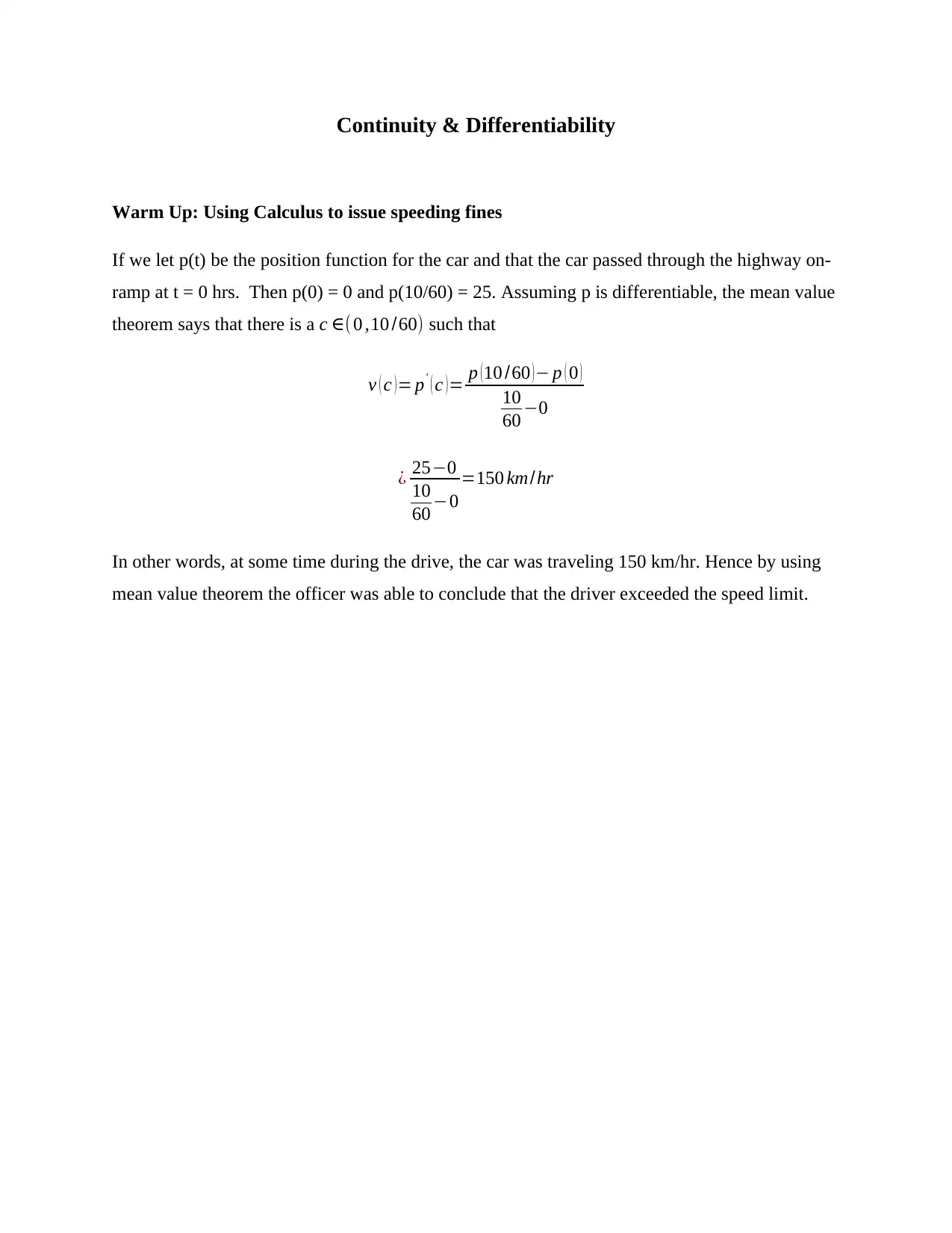
Warm Up: Using Calculus to issue speeding fines
If we let p(t) be the position function for the car and that the car passed through the highway on-
ramp at t = 0 hrs. Then p(0) = 0 and p(10/60) = 25. Assuming p is differentiable, the mean value
theorem says that there is a c ( 0 ,10 /60) such that
v ( c )= p' ( c )= p (10 /60 ) p ( 0 )
10
60 0
¿ 250
10
60 0
=150 km/hr
In other words, at some time during the drive, the car was traveling 150 km/hr. Hence by using
mean value theorem the officer was able to conclude that the driver exceeded the speed limit.
tabler-icon-diamond-filled.svg

Paraphrase This Document

Need a fresh take? Get an instant paraphrase of this document with our AI Paraphraser
Document Page
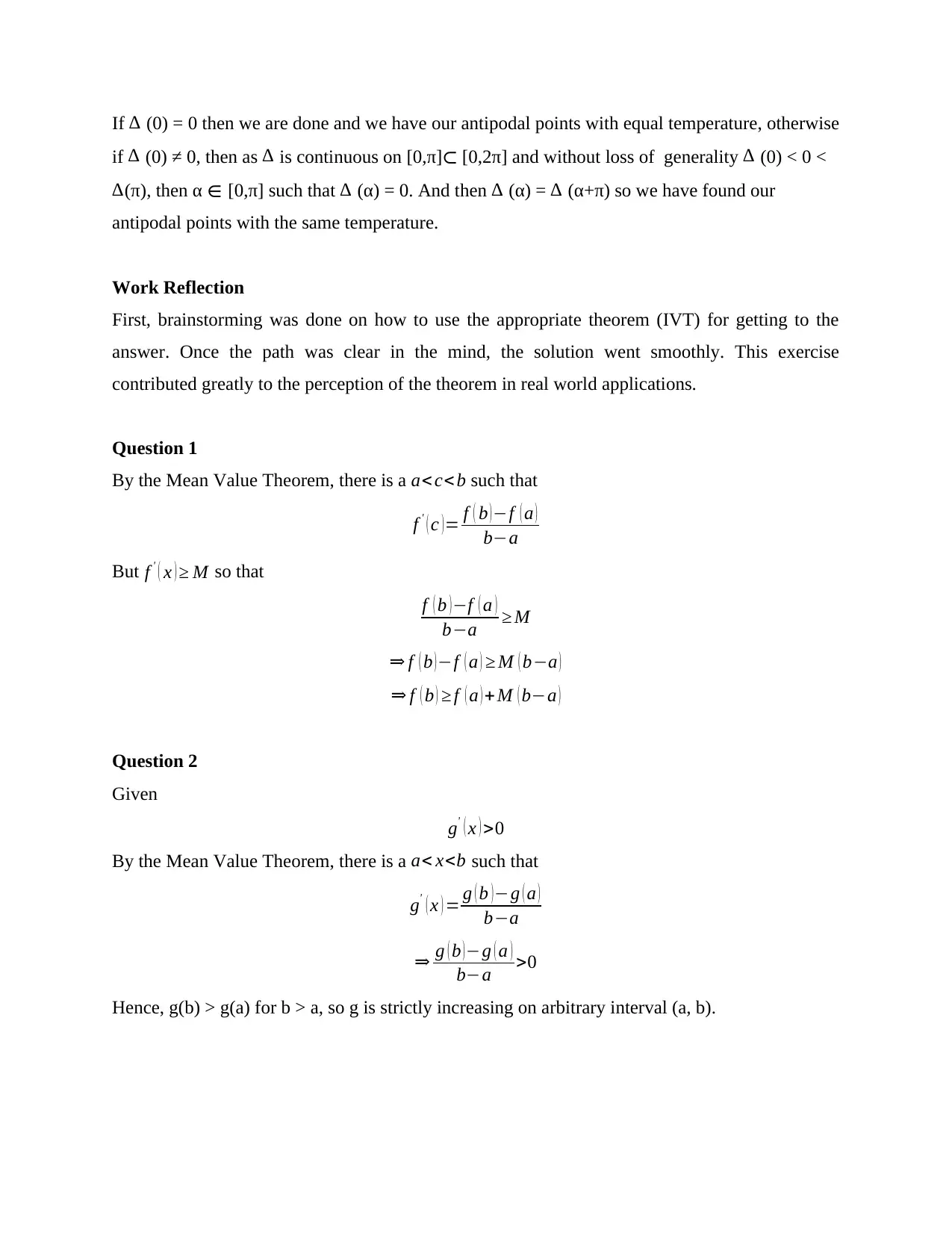
The Continuity of Climatology
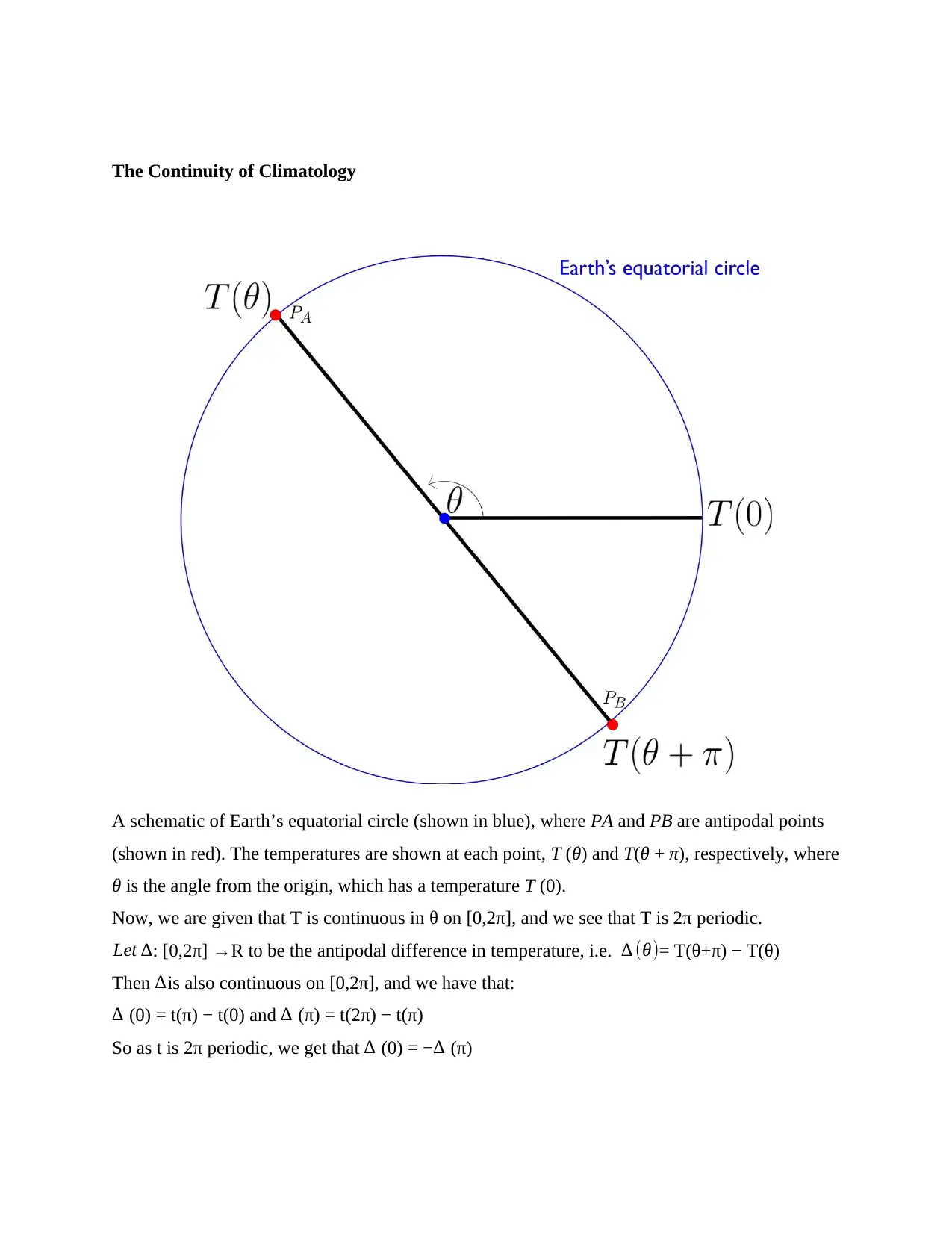
A schematic of Earth’s equatorial circle (shown in blue), where PA and PB are antipodal points
(shown in red). The temperatures are shown at each point, T (θ) and T(θ + π), respectively, where
θ is the angle from the origin, which has a temperature T (0).
Now, we are given that T is continuous in θ on [0,2π], and we see that T is 2π periodic.
Let : [0,2π] →R to be the antipodal difference in temperature, i.e. (θ)= T(θ+π) − T(θ)
Then is also continuous on [0,2π], and we have that:
(0) = t(π) − t(0) and (π) = t(2π) − t(π)
So as t is 2π periodic, we get that (0) = − (π)
Document Page
If (0) = 0 then we are done and we have our antipodal points with equal temperature, otherwise
if (0) ≠ 0, then as is continuous on [0,π] [0,2π] and without loss of generality (0) < 0 <
(π), then α [0,π] such that (α) = 0. And then (α) = (α+π) so we have found our
antipodal points with the same temperature.
Work Reflection
First, brainstorming was done on how to use the appropriate theorem (IVT) for getting to the
answer. Once the path was clear in the mind, the solution went smoothly. This exercise
contributed greatly to the perception of the theorem in real world applications.
Question 1
By the Mean Value Theorem, there is a a< c< b such that
f ' ( c ) = f ( b ) f ( a )
ba
But f ' ( x ) M so that
f ( b ) f ( a )
ba M
f ( b )f ( a ) M ( ba )
f ( b ) f ( a ) +M ( ba )
Question 2
Given
g' ( x ) >0
By the Mean Value Theorem, there is a a< x<b such that
g' ( x ) = g ( b ) g ( a )
ba
g ( b )g ( a )
ba >0
Hence, g(b) > g(a) for b > a, so g is strictly increasing on arbitrary interval (a, b).
Document Page
chevron_up_icon
1 out of 4
circle_padding
hide_on_mobile
zoom_out_icon
[object Object]