Challenges of IFRS Implementation: A Comprehensive Report
VerifiedAdded on 2023/03/20
|7
|1221
|89
Report
AI Summary
This report investigates the convergence of International Financial Reporting Standards (IFRS) and the challenges associated with their global implementation, particularly within the context of institutional theory. The report begins with definitions of key terms like IFRS and institutional theory, setting the stage for an exploration of factors influencing IFRS adoption and enforcement. It delves into economic environments, legal considerations, geographical distinctiveness, manpower availability, historical factors, and political influences, examining how these elements shape the practical application of IFRS across different regions and institutions. The report highlights the complexities of achieving standardized financial reporting due to these varied factors, ultimately questioning the efficacy of institutional theory in predicting and explaining IFRS implementation success. The conclusion emphasizes the difficulties in harmonizing accounting standards, reinforcing the significance of the factors explored throughout the analysis and referencing the provided literature.

RUNNING HEAD: CONVERGENCE OF IFRS AND CHALLENGES IN IMPLEMENTATIONS 1
UNIVERSITY NAME
STUDENT ID
STUDENT NAME
COURSE NAME
COURSE CODE
DATE
UNIVERSITY NAME
STUDENT ID
STUDENT NAME
COURSE NAME
COURSE CODE
DATE
Paraphrase This Document
Need a fresh take? Get an instant paraphrase of this document with our AI Paraphraser

CONVERGENCE OF IFRS AND CHALLENGES IN IMPLEMENTATIONS 2
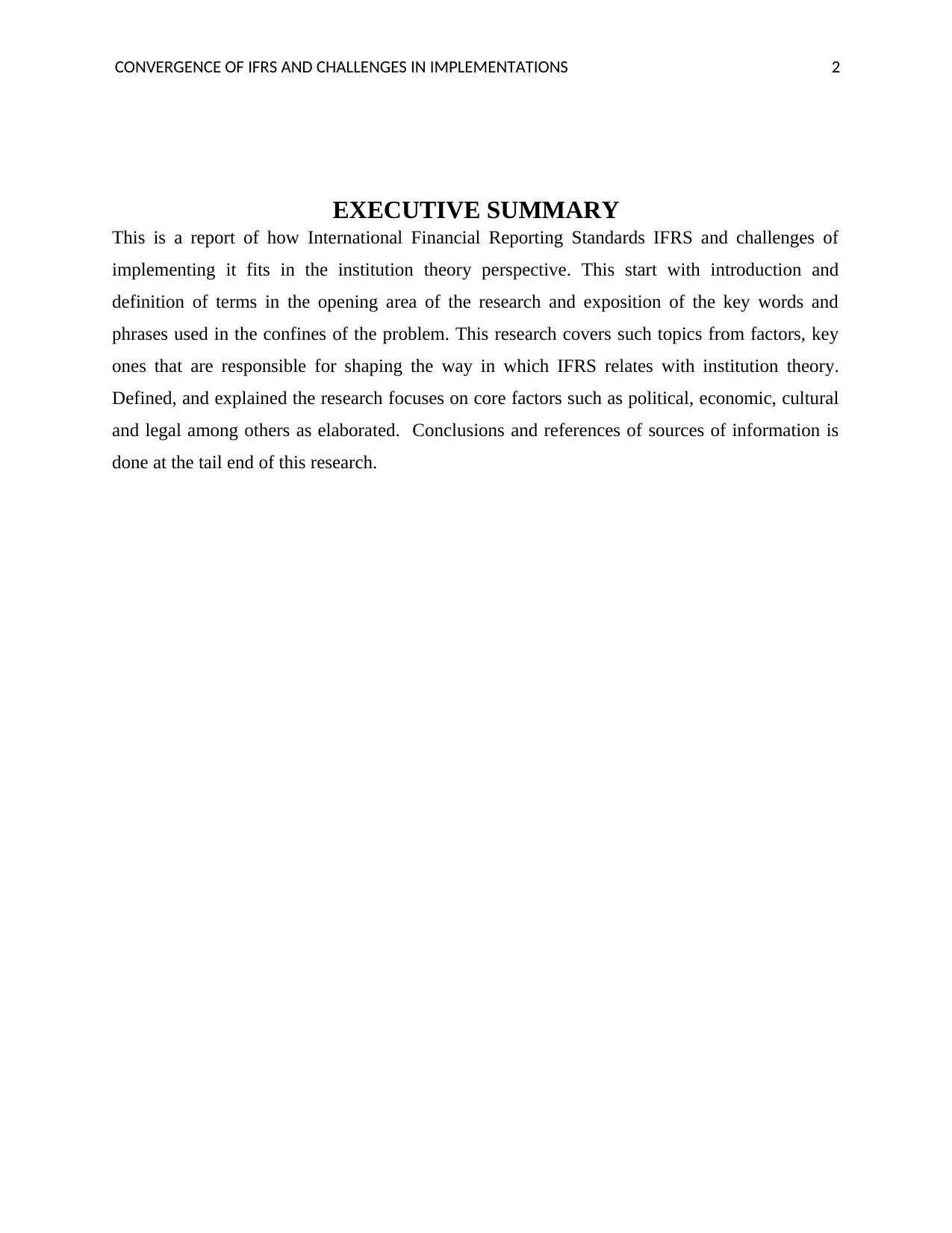
EXECUTIVE SUMMARY
This is a report of how International Financial Reporting Standards IFRS and challenges of
implementing it fits in the institution theory perspective. This start with introduction and
definition of terms in the opening area of the research and exposition of the key words and
phrases used in the confines of the problem. This research covers such topics from factors, key
ones that are responsible for shaping the way in which IFRS relates with institution theory.
Defined, and explained the research focuses on core factors such as political, economic, cultural
and legal among others as elaborated. Conclusions and references of sources of information is
done at the tail end of this research.
EXECUTIVE SUMMARY
This is a report of how International Financial Reporting Standards IFRS and challenges of
implementing it fits in the institution theory perspective. This start with introduction and
definition of terms in the opening area of the research and exposition of the key words and
phrases used in the confines of the problem. This research covers such topics from factors, key
ones that are responsible for shaping the way in which IFRS relates with institution theory.
Defined, and explained the research focuses on core factors such as political, economic, cultural
and legal among others as elaborated. Conclusions and references of sources of information is
done at the tail end of this research.

CONVERGENCE OF IFRS AND CHALLENGES IN IMPLEMENTATIONS 3
Table of Contents
EXECUTIVE SUMMARY.......................................................................................................................2
INTRODUCTION.....................................................................................................................................4
Definition of terms.................................................................................................................................4
ECONOMIC ENVIRONMENTS............................................................................................................4
LEGAL CONSIDERATIONS.................................................................................................................4
GEOGRAPHICAL LOCATION DISTINCTIVENESS..........................................................................5
MANPOWER..........................................................................................................................................5
HISTORICAL FACTORS.......................................................................................................................5
POLITICAL FACTORS..........................................................................................................................5
CONCLUSION..........................................................................................................................................6
REFERENCES..........................................................................................................................................6
Table of Contents
EXECUTIVE SUMMARY.......................................................................................................................2
INTRODUCTION.....................................................................................................................................4
Definition of terms.................................................................................................................................4
ECONOMIC ENVIRONMENTS............................................................................................................4
LEGAL CONSIDERATIONS.................................................................................................................4
GEOGRAPHICAL LOCATION DISTINCTIVENESS..........................................................................5
MANPOWER..........................................................................................................................................5
HISTORICAL FACTORS.......................................................................................................................5
POLITICAL FACTORS..........................................................................................................................5
CONCLUSION..........................................................................................................................................6
REFERENCES..........................................................................................................................................6
⊘ This is a preview!⊘
Do you want full access?
Subscribe today to unlock all pages.

Trusted by 1+ million students worldwide

CONVERGENCE OF IFRS AND CHALLENGES IN IMPLEMENTATIONS 4
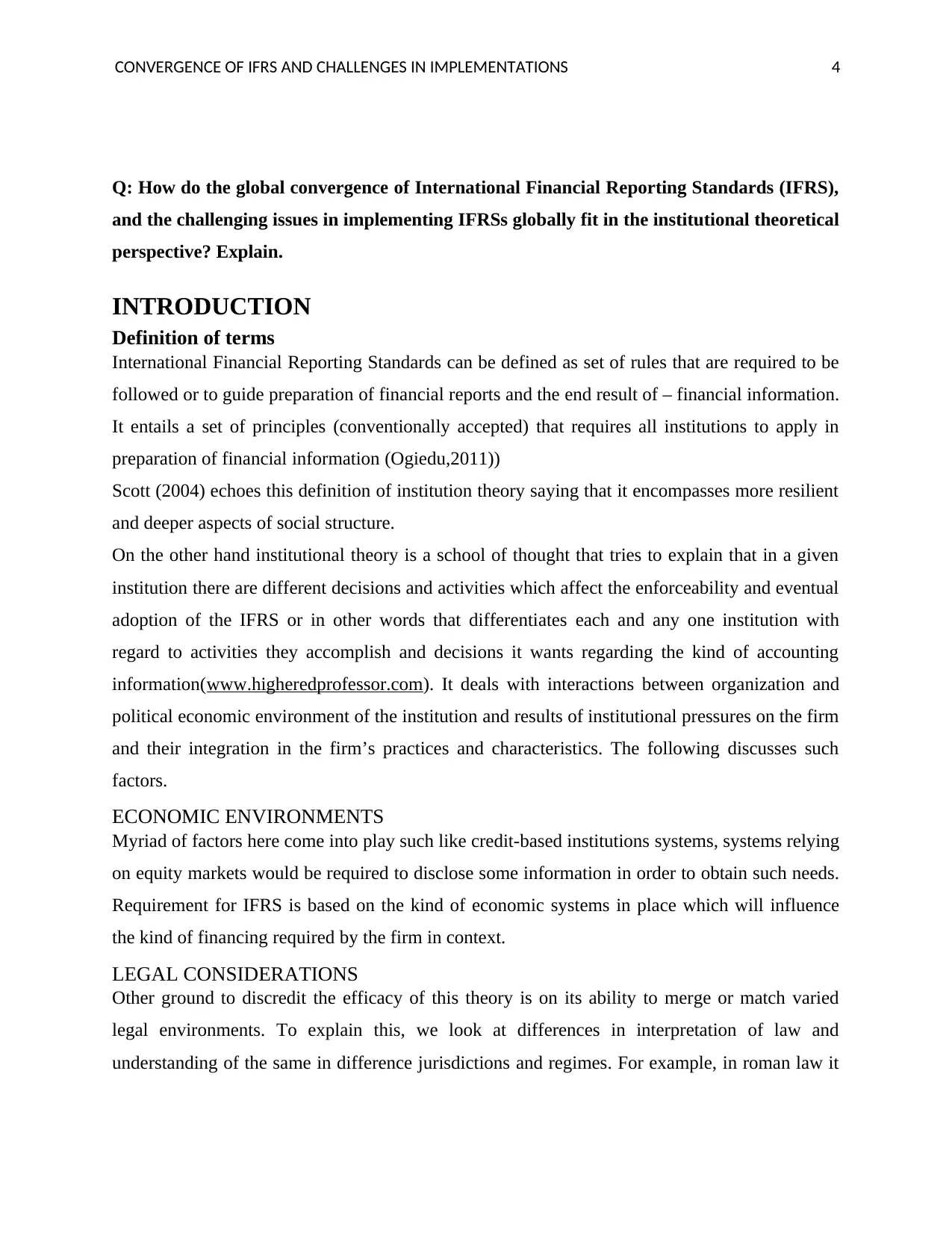
Q: How do the global convergence of International Financial Reporting Standards (IFRS),
and the challenging issues in implementing IFRSs globally fit in the institutional theoretical
perspective? Explain.
INTRODUCTION
Definition of terms
International Financial Reporting Standards can be defined as set of rules that are required to be
followed or to guide preparation of financial reports and the end result of – financial information.
It entails a set of principles (conventionally accepted) that requires all institutions to apply in
preparation of financial information (Ogiedu,2011))
Scott (2004) echoes this definition of institution theory saying that it encompasses more resilient
and deeper aspects of social structure.
On the other hand institutional theory is a school of thought that tries to explain that in a given
institution there are different decisions and activities which affect the enforceability and eventual
adoption of the IFRS or in other words that differentiates each and any one institution with
regard to activities they accomplish and decisions it wants regarding the kind of accounting
information(www.higheredprofessor.com). It deals with interactions between organization and
political economic environment of the institution and results of institutional pressures on the firm
and their integration in the firm’s practices and characteristics. The following discusses such
factors.
ECONOMIC ENVIRONMENTS
Myriad of factors here come into play such like credit-based institutions systems, systems relying
on equity markets would be required to disclose some information in order to obtain such needs.
Requirement for IFRS is based on the kind of economic systems in place which will influence
the kind of financing required by the firm in context.
LEGAL CONSIDERATIONS
Other ground to discredit the efficacy of this theory is on its ability to merge or match varied
legal environments. To explain this, we look at differences in interpretation of law and
understanding of the same in difference jurisdictions and regimes. For example, in roman law it
Q: How do the global convergence of International Financial Reporting Standards (IFRS),
and the challenging issues in implementing IFRSs globally fit in the institutional theoretical
perspective? Explain.
INTRODUCTION
Definition of terms
International Financial Reporting Standards can be defined as set of rules that are required to be
followed or to guide preparation of financial reports and the end result of – financial information.
It entails a set of principles (conventionally accepted) that requires all institutions to apply in
preparation of financial information (Ogiedu,2011))
Scott (2004) echoes this definition of institution theory saying that it encompasses more resilient
and deeper aspects of social structure.
On the other hand institutional theory is a school of thought that tries to explain that in a given
institution there are different decisions and activities which affect the enforceability and eventual
adoption of the IFRS or in other words that differentiates each and any one institution with
regard to activities they accomplish and decisions it wants regarding the kind of accounting
information(www.higheredprofessor.com). It deals with interactions between organization and
political economic environment of the institution and results of institutional pressures on the firm
and their integration in the firm’s practices and characteristics. The following discusses such
factors.
ECONOMIC ENVIRONMENTS
Myriad of factors here come into play such like credit-based institutions systems, systems relying
on equity markets would be required to disclose some information in order to obtain such needs.
Requirement for IFRS is based on the kind of economic systems in place which will influence
the kind of financing required by the firm in context.
LEGAL CONSIDERATIONS
Other ground to discredit the efficacy of this theory is on its ability to merge or match varied
legal environments. To explain this, we look at differences in interpretation of law and
understanding of the same in difference jurisdictions and regimes. For example, in roman law it
Paraphrase This Document
Need a fresh take? Get an instant paraphrase of this document with our AI Paraphraser

CONVERGENCE OF IFRS AND CHALLENGES IN IMPLEMENTATIONS 5
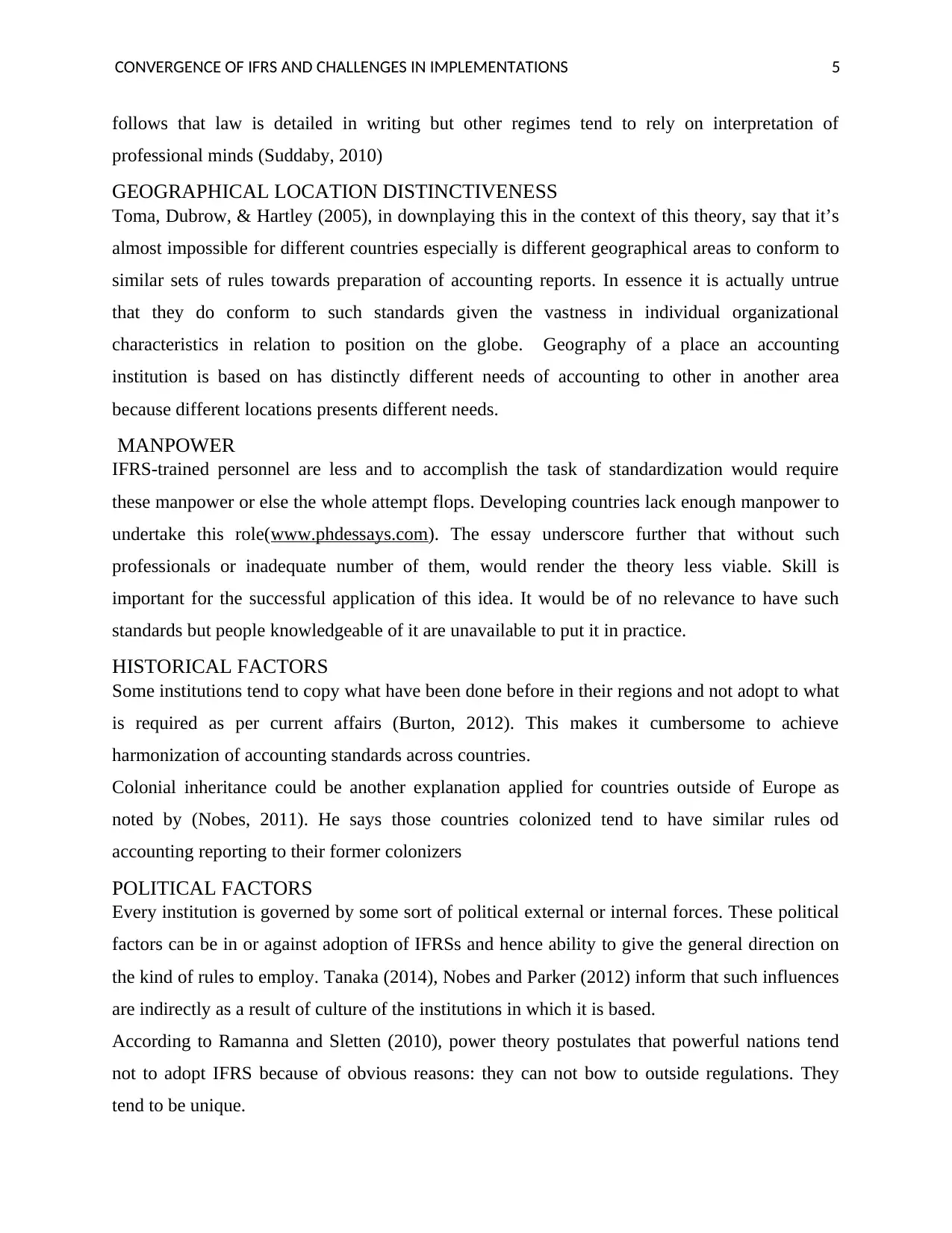
follows that law is detailed in writing but other regimes tend to rely on interpretation of
professional minds (Suddaby, 2010)
GEOGRAPHICAL LOCATION DISTINCTIVENESS
Toma, Dubrow, & Hartley (2005), in downplaying this in the context of this theory, say that it’s
almost impossible for different countries especially is different geographical areas to conform to
similar sets of rules towards preparation of accounting reports. In essence it is actually untrue
that they do conform to such standards given the vastness in individual organizational
characteristics in relation to position on the globe. Geography of a place an accounting
institution is based on has distinctly different needs of accounting to other in another area
because different locations presents different needs.
MANPOWER
IFRS-trained personnel are less and to accomplish the task of standardization would require
these manpower or else the whole attempt flops. Developing countries lack enough manpower to
undertake this role(www.phdessays.com). The essay underscore further that without such
professionals or inadequate number of them, would render the theory less viable. Skill is
important for the successful application of this idea. It would be of no relevance to have such
standards but people knowledgeable of it are unavailable to put it in practice.
HISTORICAL FACTORS
Some institutions tend to copy what have been done before in their regions and not adopt to what
is required as per current affairs (Burton, 2012). This makes it cumbersome to achieve
harmonization of accounting standards across countries.
Colonial inheritance could be another explanation applied for countries outside of Europe as
noted by (Nobes, 2011). He says those countries colonized tend to have similar rules od
accounting reporting to their former colonizers
POLITICAL FACTORS
Every institution is governed by some sort of political external or internal forces. These political
factors can be in or against adoption of IFRSs and hence ability to give the general direction on
the kind of rules to employ. Tanaka (2014), Nobes and Parker (2012) inform that such influences
are indirectly as a result of culture of the institutions in which it is based.
According to Ramanna and Sletten (2010), power theory postulates that powerful nations tend
not to adopt IFRS because of obvious reasons: they can not bow to outside regulations. They
tend to be unique.
follows that law is detailed in writing but other regimes tend to rely on interpretation of
professional minds (Suddaby, 2010)
GEOGRAPHICAL LOCATION DISTINCTIVENESS
Toma, Dubrow, & Hartley (2005), in downplaying this in the context of this theory, say that it’s
almost impossible for different countries especially is different geographical areas to conform to
similar sets of rules towards preparation of accounting reports. In essence it is actually untrue
that they do conform to such standards given the vastness in individual organizational
characteristics in relation to position on the globe. Geography of a place an accounting
institution is based on has distinctly different needs of accounting to other in another area
because different locations presents different needs.
MANPOWER
IFRS-trained personnel are less and to accomplish the task of standardization would require
these manpower or else the whole attempt flops. Developing countries lack enough manpower to
undertake this role(www.phdessays.com). The essay underscore further that without such
professionals or inadequate number of them, would render the theory less viable. Skill is
important for the successful application of this idea. It would be of no relevance to have such
standards but people knowledgeable of it are unavailable to put it in practice.
HISTORICAL FACTORS
Some institutions tend to copy what have been done before in their regions and not adopt to what
is required as per current affairs (Burton, 2012). This makes it cumbersome to achieve
harmonization of accounting standards across countries.
Colonial inheritance could be another explanation applied for countries outside of Europe as
noted by (Nobes, 2011). He says those countries colonized tend to have similar rules od
accounting reporting to their former colonizers
POLITICAL FACTORS
Every institution is governed by some sort of political external or internal forces. These political
factors can be in or against adoption of IFRSs and hence ability to give the general direction on
the kind of rules to employ. Tanaka (2014), Nobes and Parker (2012) inform that such influences
are indirectly as a result of culture of the institutions in which it is based.
According to Ramanna and Sletten (2010), power theory postulates that powerful nations tend
not to adopt IFRS because of obvious reasons: they can not bow to outside regulations. They
tend to be unique.

CONVERGENCE OF IFRS AND CHALLENGES IN IMPLEMENTATIONS 6
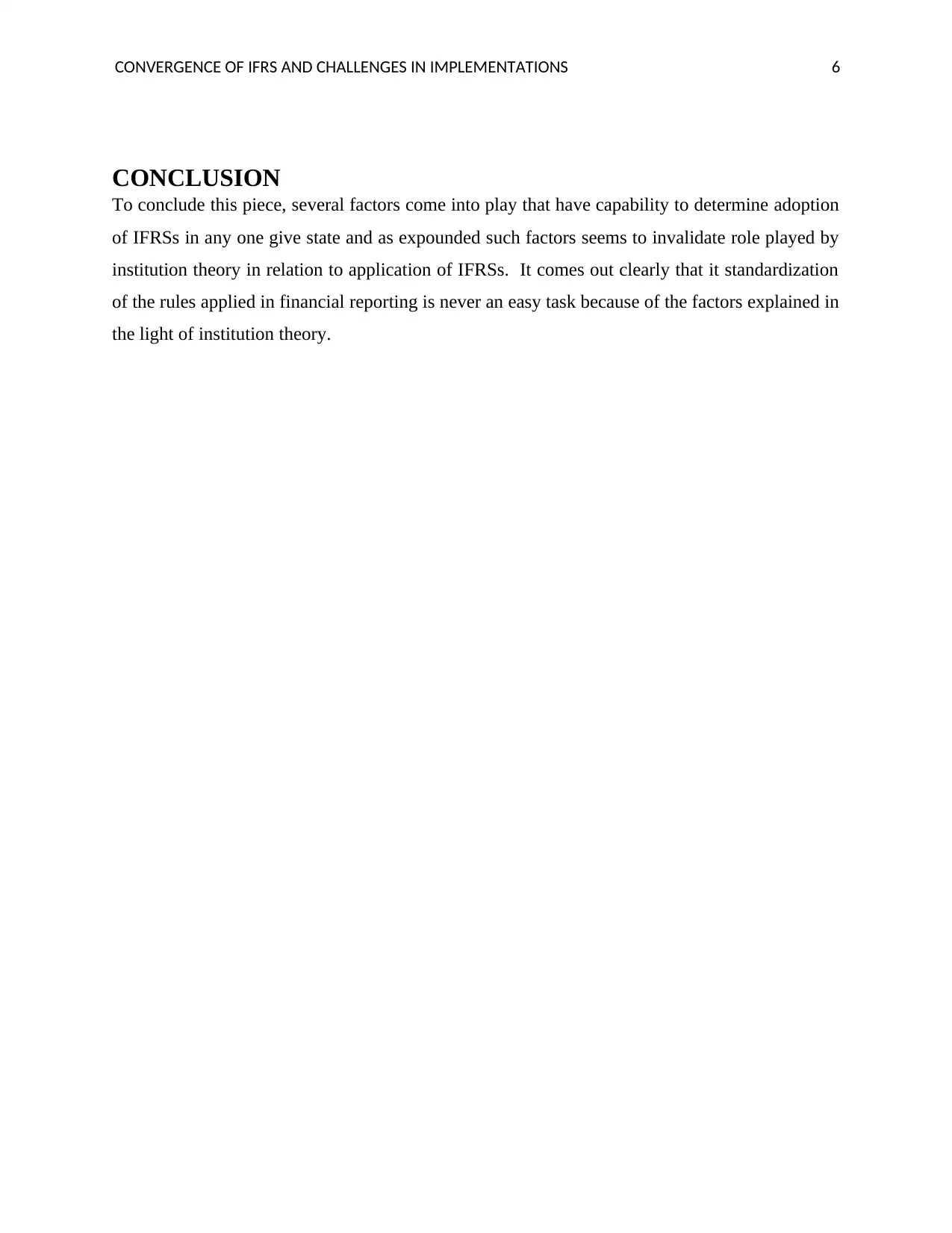
CONCLUSION
To conclude this piece, several factors come into play that have capability to determine adoption
of IFRSs in any one give state and as expounded such factors seems to invalidate role played by
institution theory in relation to application of IFRSs. It comes out clearly that it standardization
of the rules applied in financial reporting is never an easy task because of the factors explained in
the light of institution theory.
CONCLUSION
To conclude this piece, several factors come into play that have capability to determine adoption
of IFRSs in any one give state and as expounded such factors seems to invalidate role played by
institution theory in relation to application of IFRSs. It comes out clearly that it standardization
of the rules applied in financial reporting is never an easy task because of the factors explained in
the light of institution theory.
⊘ This is a preview!⊘
Do you want full access?
Subscribe today to unlock all pages.

Trusted by 1+ million students worldwide

CONVERGENCE OF IFRS AND CHALLENGES IN IMPLEMENTATIONS 7
REFERENCES
Burton, G. (2012) Discussion of a Cross‒Cultural Study of the Influence of Country of
Origin, Justice, Power Distance, and Gender on Ethical Decision Making. Journal of
International Accounting Research, Educational Trust, London, UK.
Nobes, C. (2011) International Variations in IFRS Adoption and Practice, Certified
Accountants.
Ramanna, K. and Sletten, E. (2012) Network Effects in Countriesʼ Adoption of IFRS,
Harvard Business School.
Suddaby, R. (2010). Challenges for Institutional Theory. Journal of Management Inquiry,
19(1), 14–20. https://doi.org/10.1177/1056492609347564
Ogiedu, K.O. (2011) International Financial Reporting Standards Adoption: A Challenge of
Definition and Implementation, A Seminar paper presented in PhD Accounting
Department of Accounting, University of Benin.
<https: \\www.higheredprofessor.com accessed on 9.5.2019>
REFERENCES
Burton, G. (2012) Discussion of a Cross‒Cultural Study of the Influence of Country of
Origin, Justice, Power Distance, and Gender on Ethical Decision Making. Journal of
International Accounting Research, Educational Trust, London, UK.
Nobes, C. (2011) International Variations in IFRS Adoption and Practice, Certified
Accountants.
Ramanna, K. and Sletten, E. (2012) Network Effects in Countriesʼ Adoption of IFRS,
Harvard Business School.
Suddaby, R. (2010). Challenges for Institutional Theory. Journal of Management Inquiry,
19(1), 14–20. https://doi.org/10.1177/1056492609347564
Ogiedu, K.O. (2011) International Financial Reporting Standards Adoption: A Challenge of
Definition and Implementation, A Seminar paper presented in PhD Accounting
Department of Accounting, University of Benin.
<https: \\www.higheredprofessor.com accessed on 9.5.2019>
1 out of 7
Related Documents
Your All-in-One AI-Powered Toolkit for Academic Success.
+13062052269
info@desklib.com
Available 24*7 on WhatsApp / Email
Unlock your academic potential
Copyright © 2020–2026 A2Z Services. All Rights Reserved. Developed and managed by ZUCOL.